Water is the lifeblood of our planet, constantly moving in a loop that has sustained life for billions of years. But the Hydrological Cycle is more than just rain falling and evaporating. It is a complex geological engine driven by solar energy and gravity, involving intricate sub-surface flows and atmospheric exchanges. Whether you are a geology student or a civil engineer, understanding the mechanics of infiltration, runoff, and groundwater is essential for mastering Earth Science. Dive into this comprehensive overview to understand how water shapes our world, from the clouds above to the aquifers beneath.
The Science of Hydrology: Defining Earth’s Water Systems
Hydrology is the science that deals with the occurrence, distribution, and disposal of water on Earth, encompassing various phases of the Hydrological Cycle/ Rain Cycle / Water Cycle.
The Hydrological Cycle: Definition & Global Significance
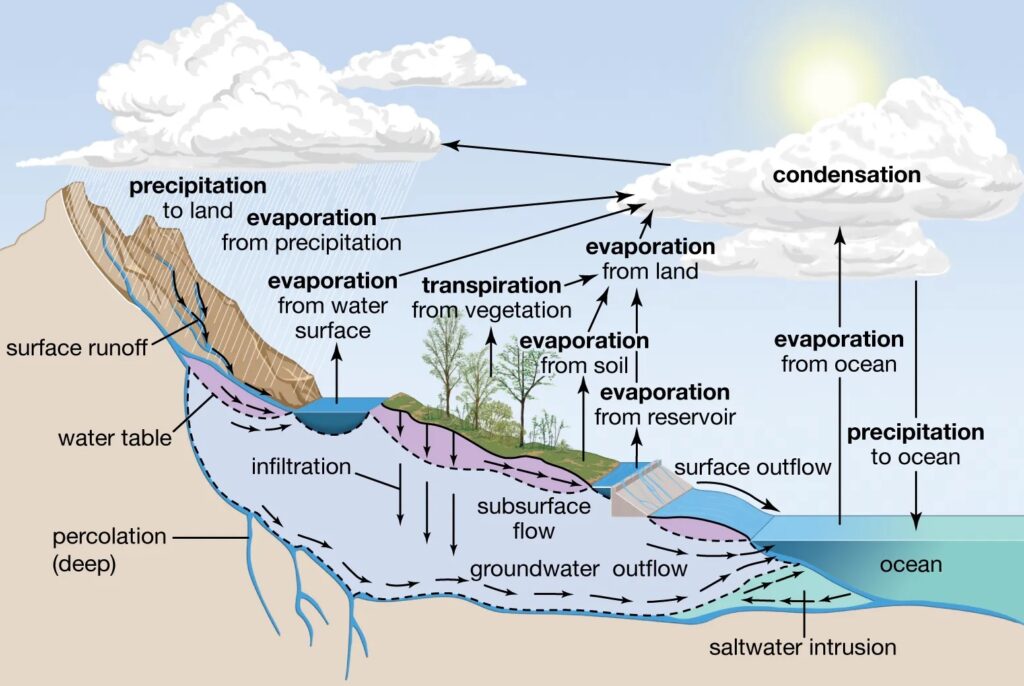
The Hydrological Cycle/ Rain Cycle / Water Cycle is a continuous water transfer cycle in nature with three main phases:
- Evaporation and evapotranspiration
- Precipitation
- Runoff
Core Mechanisms of the Water Cycle: A Step-by-Step Breakdown
- Evaporation and Evapotranspiration: In Hydrological Cycle/ Rain Cycle / Water Cycle Water evaporates from ponds, lakes, reservoirs, and oceans, and transpiration occurs from vegetation. These vapors rise to the sky, condense, and form clouds, leading to precipitation.
- Precipitation: In Hydrological Cycle/ Rain Cycle / Water Cycle When an air mass cools to the dew point temperature with seeding agents present, condensation occurs, forming raindrops that fall as rain, sleet, or snow. Precipitation is unevenly distributed across the Earth.
- Runoff: In Hydrological Cycle/ Rain Cycle / Water Cycle Part of the precipitation flows over the land as runoff, part infiltrates the soil, replenishes the groundwater table, and eventually returns to water bodies. Surface runoff is stored in reservoirs for various uses.
Why is Runoff Important?
Runoff is crucial for civil engineers as it involves storing surface runoff in tanks and reservoirs for irrigation, municipal water supply, hydroelectric power, and other uses.
Infiltration Dynamics & Soil Permeability
Infiltration is the process by which water reaching the ground surface enters the soil. The infiltration rate, measured in mm per hour, is governed by gravity and capillary action.
The Hidden Reservoir: Groundwater and Aquifer Dynamics
While surface water is visible, a massive volume of the global fresh water supply moves silently beneath our feet as groundwater. Once water infiltrates past the root zone, it enters the vadose zone (unsaturated soil) and eventually reaches the water table, marking the boundary of the phreatic zone (saturated zone).
Geologically, this water is stored in aquifers—permeable rock layers like sandstone or fractured limestone that act as natural sponges. This underground flow is not static; it moves slowly through hydraulic gradients, eventually discharging into streams as base flow, which keeps rivers running even during dry spells. Understanding aquifer recharge rates is critical for sustainable water management, especially as over-extraction can lead to land subsidence and the depletion of these ancient water reserves.
Key Geological Factors Influencing Infiltration Rates
- Soil Texture and Structure: Coarse soils encourage high infiltration.
- Vegetation Type and Cover: Vegetation creates more porous soil, promoting infiltration.
- Soil Moisture: Dry soil encourages high infiltration, but infiltration decreases with increasing soil moisture until it stabilizes.
- Topsoil Layer: Porous topsoil due to insects and burrowing animals enhances infiltration.
- Agricultural Practices: Soil compaction from farming reduces infiltration.
What is Evaporation?
Evaporation is the process where water turns into vapor due to solar heating. The rate of evaporation depends on water temperature, air temperature, humidity, and wind.
How is Evaporation Measured?
Evaporation is measured using a pan with an initial water depth of 20 cm. Daily measurements are taken to determine the volume of water needed to maintain the level, accounting for rainfall during the same period.
Surface Runoff Components: Overland, Interflow, and Base Flow
Runoff is the total amount of water flowing in a stream, consisting of several components:
- Overland Flow: Water flowing as a thin sheet across the surface.
- Interflow: Horizontal movement of infiltrating water.
- Base Flow: Groundwater flow into the stream.
Hydrology deals with the occurrence, distribution, and disposal of water on Earth through the Hydrological Cycle/ Rain Cycle / Water Cycle, which includes phases like evaporation, precipitation, and runoff. The water cycle is crucial for understanding how freshwater is distributed and stored, affecting climate change and water resources. Infiltration and evapotranspiration are essential processes within this cycle. The importance of water on Earth and the impact of climate change on water resources underscore the need for comprehensive study and management. Runoff water cycle examples illustrate the practical applications, such as in municipal water supply and hydroelectric power.
Anthropogenic Impact: How Humans Alter the Water Cycle
The natural hydrological rhythm is increasingly disrupted by human activity (anthropogenic factors). Urbanization replaces permeable soil with concrete (impervious surfaces), drastically reducing infiltration and increasing flash flood risks. Furthermore, deforestation removes the canopy that facilitates transpiration, disrupting local cloud formation and rainfall patterns.
On a global scale, climate change is intensifying the cycle. Warmer air holds more moisture—approximately 7% more for every 1°C rise in temperature—leading to more extreme precipitation events and prolonged droughts. These shifts force hydrologists and civil engineers to rethink traditional water management infrastructure to handle increasingly volatile weather patterns.