Isotope Geothermometry: How Rocks Record Ancient Heat

Isotope Thermometry

Table of Contents

How do we know the temperature of an ancient ocean from 100 million years ago, or the heat of a magma chamber long turned to stone? The answer lies in the atomic weight of oxygen. Isotope Thermometry acts as Earth’s “paleo-thermometer,” utilizing the temperature-dependent exchange of Oxygen-16 and Oxygen-18 between minerals. Whether you are studying sedimentary paleoclimates or high-grade metamorphic terrains, understanding isotopic fractionation is essential for modern geochemistry. This guide covers the fundamental principles, calibration techniques, and essential coefficients needed to calculate geological temperatures.

Principles of Oxygen Isotope Geothermometry

One of the first applications of the study of oxygen isotopes to geological problems was geothermometry. Urey (1947) suggested that the enrichment of 18O in calcium carbonate relative to seawater was temperature-dependent and could be used to determine the temperature of ancient ocean waters. The idea was quickly adopted, and paleotemperatures were calculated for the Upper Cretaceous seas of the northern hemisphere. Subsequently, a methodology was developed for application to higher-temperature systems based upon the distribution of 18O between mineral pairs. An excellent review of the methods and applications of oxygen isotope thermometry is given by Clayton (1981).

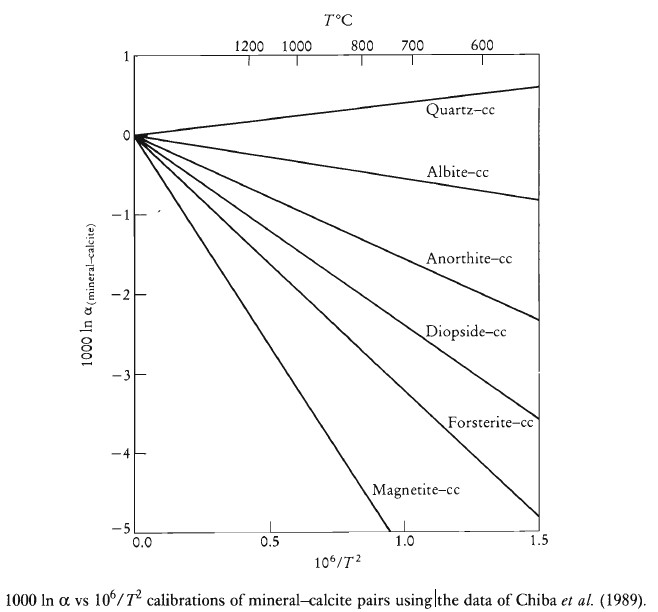
The expression summarizing the temperature dependence of oxygen isotopic exchange between a mineral-pair is often simplified where the fractionation factor is simply a function of 1/T. Empirical observations indicate that a graph of ln α vs 1/T2 is linear over a temperature range of several hundred degrees, and a plot of this type for a pair of anhydrous phases should also pass through the origin. Isotopic fractionations decrease with increasing temperature, so oxygen isotope thermometers might be expected to be less sensitive at high temperatures. However, experimental studies are most precise at high temperatures, and reliable thermometers have been calibrated for use with igneous and metamorphic rocks.

Oxygen isotope thermometry has a number of advantages over conventional cation-exchange thermometry; for example, oxygen isotopic exchange can be measured between many mineral pairs in a single rock. In addition, minerals with low oxygen diffusivities such as garnet and pyroxene are capable of recording peak temperature conditions.

Calibration Methods: Theoretical vs. Experimental Approaches

There are a large number of different calibrations of oxygen isotope exchange reactions, some of which give conflicting results. This has given rise to much confusion over which calibrations can be used as a basis for reliable thermometry. In brief, there are three different approaches to the calibration of oxygen isotope exchange thermometers—the theoretical approach, experimental methods, and empirical methods.

Theoretical calculations of oxygen isotope fractionations are based upon studies of lattice dynamics. Recent results of this type have been found to agree with new experimental studies by Clayton et al. (1989) and have been used to extrapolate experimental results outside their temperature range (Clayton and Kieffer, 1991).

READ ALSO  Sulphur Isotopes Geochemistry

Experimental studies based upon mineral-water isotopic exchange have been used to calibrate oxygen isotope thermometers, although the more reliable exchange reaction with calcite is now preferred. Calcite-mineral oxygen isotope exchange is stable to relatively high temperatures, and the results can be extrapolated outside the experimental range. Mineral-calcite pairs are combined to give mineral-mineral oxygen isotope fractionation equations. The best thermometers are between mineral-calcite pairs which show the greatest divergence on a ln α vs 1/T diagram. Thus, the mineral-pair quartz-diopside is a sensitive thermometer, for there is significant fractionation of oxygen isotopes between the two minerals, whereas a pair such as quartz-albite is not sufficiently sensitive. Quartz-magnetite fractionation is not widely used because the high diffusivity of oxygen in magnetite means that it cannot record peak temperatures.

Empirical calibrations of oxygen-isotope thermometers are based upon experimental data, which is then applied to a natural assemblage. Given that all the minerals in a rock are in isotopic equilibrium, thermometers can then be calibrated for mineral pairs which have not been experimentally studied. However, the underlying assumption of isotopic equilibrium is rarely fulfilled, making the application of this method questionable.

Currently, the most reliable calibration of oxygen isotope thermometers is based upon a combination of experimental and theoretical studies. Clayton (1991) combined calcite-mineral experimental data with theoretical studies and calculated polynomial expressions for a number of common rock-forming minerals. These expressions may be combined to give mineral-pair thermometers.

Oxygen Isotope Fractionation Factors (Mineral Pairs)

(a) Experimentally determined — Equilibration with Calcite (Chiba et al., 1989)

Mineral PairCoefficients
Cc – Q0.38
Ab – Q0.94
An – Q1.99
Di – Q2.75
Fo – Q4.35
Mt – Q6.29
Ab – Cc0.56
An – Cc1.61
Di – Cc2.37
Fo – Cc3.29
Mt – Cc5.91
An – Ab1.05
Di – Ab0.76
Fo – Ab1.68
Mt – Ab4.30
Di – An0.92
Fo – An2.54
Mt – An4.85
Fo – Di3.54
Mt – Di5.27
Mt – Fo2.62

(b) Experimentally determined — Equilibration with Water (Matthews et al., 1983)

Mineral PairCoefficients
Q – Ab0.50
Jd – Ab1.09
An – Ab1.59
Di – Ab2.08
Wo – Ab2.20
Mt – Ab6.11
Q – Jd0.57
An – Jd0.50
Di – Jd0.92
Wo – Jd1.08
Mt – Jd4.52
An – Di0.61
Wo – An1.14
Mt – An4.52
Wo – Di0.43
Mt – Di3.91
Mt – Wo4.30

(c) Empirically determined (Bottinga and Javoy, 1975; Javoy, 1977)

Mineral PairCoefficients
Q – Ab0.97
Pl – Ab1.59
Px – Ab2.75
Q – Pl1.08
Px – Pl1.24
Px – Mt2.91
Gt – Mt2.88
Il – Mt5.57
Il – Px3.59
Gt – Px3.29
Il – Gt3.70

(d) Polynomial Functions for Individual Minerals Used for Calculating Oxygen Isotopic Fractionation Between Mineral-Pairs (Clayton, 1991)

Mineral PairFunction
CalcitefCc=11.78x−0.420×2+0.018x3f_{Cc} = 11.78x – 0.420x^2 + 0.018x^3fCc​=11.78x−0.420×2+0.018×3
QuartzfQ=12.116x−0.370x+0.012x2f_{Q} = 12.116x – 0.370x + 0.012x^2fQ​=12.116x−0.370x+0.012×2
AlbitefAb=11.34x−0.372×2+0.016x3f_{Ab} = 11.34x – 0.372x^2 + 0.016x^3fAb​=11.34x−0.372×2+0.016×3
AnorthitefAn=9.92x−0.320×2+0.015x3f_{An} = 9.92x – 0.320x^2 + 0.015x^3fAn​=9.92x−0.320×2+0.015×3
DiopsidefDi=9.82x−0.299×2+0.022x3f_{Di} = 9.82x – 0.299x^2 + 0.022x^3fDi​=9.82x−0.299×2+0.022×3
ForsteritefFo=8.53x−0.212×2+0.006x3f_{Fo} = 8.53x – 0.212x^2 + 0.006x^3fFo​=8.53x−0.212×2+0.006×3
MagnetitefMt=5.674x−0.383×2+0.003x3f_{Mt} = 5.674x – 0.383x^2 + 0.003x^3fMt​=5.674x−0.383×2+0.003×3

Geological Applications of Isotope Thermometry

Low-Temperature Thermometry

The earliest application of oxygen isotopes to geological thermometry was in the determination of ocean paleotemperatures. The method assumes isotopic equilibrium between the carbonate shells of marine organisms and ocean water and uses the equation of Epstein et al. (1953), which is still applicable despite some proposed revisions (Friedman and O’Neil, 1977):

READ ALSO  Stratigraphy of Cuddapah Basin

TOC = 16.5 – 4.3(OC – Ow) + 0.14(OC – Ow)2

where OC and Ow are respectively the δ18O of CO2 obtained from CaCO3 by reaction with H3PO4 at 25°C and the δ18O of CO2 in equilibrium with the seawater at 25°C.

The method assumes that the oxygen isotopic composition of seawater was the same in the past as today, an assumption which has frequently been challenged and which does not hold for at least parts of the Pleistocene when glaciation removed 18O-depleted water from the oceans. This has the effect of amplifying the temperature variations. The method also assumes that the isotopic composition of oxygen in the carbonate is primary and that the carbonate precipitation was an equilibrium process. Both these assumptions should also be carefully examined. Because the temperatures of ocean bottom water vary as a function of depth, it is also possible to use oxygen isotope thermometry to estimate the depth at which certain benthic marine fauna lived—paleobathymetry.

Low-temperature isotopic thermometry is also applicable to ascertaining the temperatures of diagenesis and low-grade metamorphism, and estimating the temperatures of active geothermal systems, both in the continental crust and on the ocean floor.

High-Temperature Thermometry

Stable isotope systems are frequently out of equilibrium in rocks that formed at high temperatures as a result of equilibration with a fluid phase following crystallization. This fact can be used to make inferences about the nature of rock-water interaction but does not help establish solidus or peak-metamorphic temperatures in igneous and metamorphic rocks. In systems where there is minimal water present, such as on the Moon, oxygen isotope thermometers yield meaningful temperatures. High-temperature results have been obtained on terrestrial lavas and mantle nodules. In metamorphic rocks, where there has been minimal fluid interaction, the newly calibrated thermometers hold promise for mineral-pairs with slow diffusion rates such as garnet-quartz and pyroxene-quartz.
READ ALSO  Microscopic constituents of Hard coals | Classification of Coals
Isotope Geothermometry: How Rocks Record Ancient Heat

High-Temperature Geothermometry: Igneous and Metamorphic Rocks

While paleothermometry focuses on sedimentary environments, oxygen isotope thermometry is equally critical for reconstructing the thermal history of igneous and metamorphic terrains. In these high-temperature systems ($>400^\circ\text{C}$), isotopic fractionation decreases, requiring highly sensitive mineral pairs.

Metamorphic Thermometry In metamorphic rocks, the Quartz-Magnetite and Quartz-Garnet pairs are standard geothermometers. Because oxygen diffusion is slower in garnet than in quartz or feldspar, garnets often retain the isotopic signature of peak metamorphism, resisting retrograde exchange during cooling. This “closure temperature” concept allows geologists to pinpoint the maximum temperature a rock body endured during orogenesis.

Igneous Petrogenesis For igneous systems, oxygen isotopes help distinguish between mantle-derived magmas and those contaminated by crustal material. A Plagioclase-Pyroxene pair is frequently used to estimate crystallization temperatures. However, researchers must be wary of sub-solidus hydrothermal alteration, which can disturb the primary isotopic equilibrium, particularly in feldspars. By analyzing refractory minerals like Zircon, which is extremely resistant to isotopic resetting, geologists can determine crystallization temperatures even in altered rocks.


What is a carbon isotope Thermometry

Inspection of the fractionation of 13C between species of carbon shows that in many cases it is strongly temperature-dependent. Two of these fractionations have been used as thermometers in metamorphic rocks.

The Calcite-Graphite δ13C Thermometer

Graphite coexists with calcite in a wide variety of metamorphic rocks and is potentially a useful thermometer at temperatures above 600°C. There are three calibrations currently in use. The calibration of Bottinga (1969) is based upon theoretical calculations and has the widest temperature range. Valley and O’Neil (1981) produced an empirical calibration based upon temperatures calculated from two-feldspar and ilmenite-magnetite thermometry, which is valid in the range 600-800°C. This curve is about 2‰ lower than the calculated curve of Bottinga (1969). Wada and Suzuki (1983) also calibrated the calcite-graphite and the dolomite-graphite thermometers empirically using temperatures obtained from dolomite-calcite solvus thermometry. Their calibration is valid in the range 400-680°C and is close to the Valley and O’Neil (1981) curve at high temperatures. Valley and O’Neil (1981) suggest that equilibrium is not reached between calcite and graphite at temperatures below 600°C. However, at temperatures above 600°C, organic carbon loses its distinctively negative δ13C signature in the presence of calcite.

The CO2-Graphite Thermometer

The carbon isotope composition of CO2 in fluid inclusions and that of coexisting graphite can also be used as a thermometer. The exchange was calibrated by Bottinga (1969). The method was used by Jackson et al. (1988), who obtained equilibration temperatures close to the peak of metamorphism from CO2-rich inclusions in quartz and graphite in granulite facies gneisses from south India.


Sulfur Isotope Thermometry

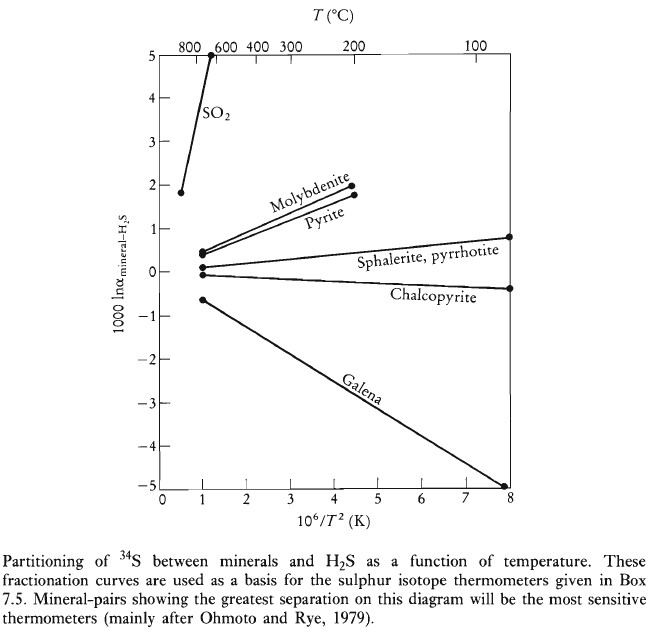
There are a number of theoretical and experimental determinations of the fractionation of δ34S between coexisting sulfide phases as a function of temperature. Sulfide-pair thermometers derived from these results are available. However, the partitioning of sulfur isotopes between sulfides is not a particularly sensitive thermometer and requires precise isotopic determinations. More extensive δ34S fractionation occurs between sulfide and sulfate phases.

In common with oxygen and carbon isotopes, sulfide mineral pairs, and sulfide-sulfate mineral pairs are not necessarily in isotopic equilibrium. This is particularly the case at low temperatures or where the isotopic composition of the mineralizing fluid has varied during mineralization. The attainment of isotopic equilibrium can best be demonstrated by determining temperature estimates between three coexisting minerals, and if the two temperature estimates agree, isotopic equilibrium may be assumed. If this approach is not possible, then clear textural evidence for the attainment of equilibrium should be present before the results are accepted.

Sulphur Isotope Fractionation Between H₂S and Sulphur Compounds
sulphur isotope thermometers
Isotope Geothermometry: How Rocks Record Ancient Heat
MineralABTemperature Range (°C)Reference
Anhydrite/gypsum6.4630.56 ± 0.5200–400Ohmoto and Lasaga (1982)
Baryte6.5 ± 0.30.5 ± 0.3200–400Miyoshi et al. (1984)
Molybdenite0.45 ± 0.10UncertainOhmoto and Rye (1979)
Pyrite0.40 ± 0.08200–700Ohmoto and Rye (1979)
Sphalerite0.10 ± 0.0550–705Ohmoto and Rye (1979)
Pyrrhotite0.10 ± 0.0550–705Ohmoto and Rye (1979)
Chalcopyrite-0.05 ± 0.08200–600Ohmoto and Rye (1979)
Bismuthinite-0.67 ± 0.07250–600Bente and Nielsen (1982)
Galena-0.63 ± 0.0550–700Ohmoto and Rye (1979)
SO₂4.70-0.5 ± 0.5350–1050Ohmoto and Rye (1979)

Leave a Reply

CSIR NET Exam: EARTH, ATMOSPHERIC, OCEAN AND PLANETARY SCIENCES

Exam Pattern: EARTH, ATMOSPHERIC, OCEAN AND PLANETARY SCIENCES 

 PART APART BPART CTOTAL
Total questions205080150
Max No. of Questions to attempt15352575
Marks for each correct answer224200
Marks for each incorrect answer (Negative marking for part A & B is @ 25%, and part C is @ 33%)0.50.51.32

The candidate is required to answer a maximum of 15, 35, and 25 questions from Part-A, Part-B, and Part-C, respectively. If more than the required number of questions are answered, only the first 15, 35, and 25 questions in Part A, Part B, and Part C, respectively, will be taken up for evaluation.

Below each question in Part A, Part B, and Part C, four alternatives or responses are given. Only one of these alternatives is the “correct” option to the question. The candidate has to find, for each question, the correct or the best answer.

Syllabus

EARTH, ATMOSPHERIC, OCEAN AND PLANETARY SCIENCES

PAPER I (PART B)

  1. The Earth and the Solar System

    • Milky Way and the solar system.
    • Modern theories on the origin of the Earth and planetary bodies.
    • Earth’s orbital parameters, Kepler’s laws of planetary motion.
    • Geological Time Scale; space and time scales of processes in the solid Earth, atmosphere, and oceans.
    • Radioactive isotopes and their applications.
    • Meteorites: chemical composition and primary differentiation of the Earth.
    • Basic principles of stratigraphy.
    • Theories about the origin of life and fossil records.
    • Earth’s gravity, magnetic fields, and thermal structure: Geoid and spheroid concepts; Isostasy.
  2. Earth Materials, Surface Features, and Processes

    • Gross composition and physical properties of important minerals and rocks.
    • Properties and processes responsible for mineral concentrations.
    • Distribution of rocks and minerals in Earth’s units and India.
    • Physiography of the Earth; weathering, erosion, and soil formation.
    • Energy balance of Earth’s surface processes.
    • Physiographic features and river basins in India.
  3. Interior of the Earth, Deformation, and Tectonics

    • Basic concepts of seismology and Earth’s internal structure.
    • Physico-chemical and seismic properties of Earth’s interior.
    • Stress and strain concepts; rock deformation.
    • Folds, joints, and faults; causes and measurement of earthquakes.
    • Interplate and intraplate seismicity; paleomagnetism.
    • Sea-floor spreading and plate tectonics.
  4. Oceans and Atmosphere

    • Hypsography of continents and ocean floors: continental shelves, slopes, abyssal plains.
    • Physical and chemical properties of seawater; residence times of elements.
    • Ocean currents, waves, tides, thermohaline circulation, and conveyor belts.
    • Major water masses, biological productivity, and fluid motion.
    • Atmospheric structure and heat budget; greenhouse gases and global warming.
    • General circulation, monsoon systems, ENSO, cyclones, and local systems in India.
    • Marine and atmospheric pollution, ozone depletion.
  5. Environmental Earth Sciences

    • Properties of water and the hydrological cycle.
    • Energy resources: uses, degradation, alternatives, and management.
    • Ecology, biodiversity, and natural resource conservation.
    • Natural hazards and remote sensing applications.

PAPER I (PART C)

I. Geology

  1. Mineralogy and Petrology

    • Point group, space group, and lattice concepts.
    • Crystal field theory, mineralogical spectroscopy, and bonding in mineral structures.
    • Genesis, properties, and crystallization of magmas.
    • Metamorphic structures, textures, and thermobarometry.
    • Petrogenesis of Indian rock suites: Deccan Traps, charnockites, ophiolites, and more.
  2. Structural Geology and Geotectonics

    • Stress and strain analysis; Mohr circles.
    • Geometry and mechanics of folds, faults, and ductile shear zones.
    • Plate boundaries, mantle plumes, and Himalayan orogeny.
  3. Paleontology and Applications

    • Life origin theories, evolution models, and mass extinctions.
    • Applications of fossils in age determination, paleoecology, and paleogeography.
    • Micropaleontology in hydrocarbon exploration.
  4. Sedimentology and Stratigraphy

    • Classification of sediments and sedimentary rocks.
    • Sedimentary environments and basin evolution.
    • Stratigraphic principles, correlation methods, and sequence stratigraphy.
    • Phanerozoic stratigraphy of India.
  5. Marine Geology and Paleoceanography

    • Ocean floor morphology, ocean circulation, and thermohaline processes.
    • Factors influencing oceanic sediments and paleoceanographic reconstruction.
  6. Geochemistry

    • Atomic properties, periodic table, thermodynamics of reactions, and isotopes in geochronology.
    • Applications of stable isotopes in Earth processes.
  7. Economic Geology

    • Ore formation processes, mineral deposit studies, and petroleum geology.
    • Coal and unconventional energy resources.
  8. Precambrian Geology and Crustal Evolution

    • Evolution of Earth systems and Precambrian characteristics of India.
    • Precambrian–Cambrian boundary.
  9. Quaternary Geology

    • Quaternary stratigraphy, climate variability, and human evolution.
    • Dating methods and tectonic geomorphology.
  10. Applied Geology

  • Remote sensing and GIS.
  • Engineering properties of rocks; construction investigations.
  • Methods of mineral exploration and groundwater studies.

II. Physical Geography

  1. Geomorphology: Landform processes, DEM analysis, extraterrestrial geomorphology.
  2. Climatology: Radiation balance, wind systems, ENSO, and climate classification.
  3. Biogeography: Plant and animal associations, Indian biogeography, and conservation.
  4. Environmental Geography: Man-land relationships, hazards, and ecological balance.
  5. Geography of India: Physical geography, climatology, agriculture, and population characteristics.

III. Geophysics

  1. Signal Processing: Fourier transforms, filters, and signal analysis.
  2. Field Theory: Newtonian potential, Green’s theorem, and seismic wave propagation.
  3. Numerical Analysis and Inversion: Least squares, optimization, and pattern recognition.
  4. Gravity and Magnetic Methods: Data interpretation and anomaly analysis.
  5. Seismic Methods: Ray theory, reflection/refraction techniques, seismic stratigraphy.
  6. Well Logging: Techniques for lithology, porosity, and fluid saturation interpretation.

(IV) METEOROLOGY

1) Climatology

  • Same as under Geography.

2) Physical Meteorology

  • Thermal Structure of the Atmosphere and Its Composition.
  • Radiation:
    • Basic laws – Rayleigh and Mie scattering, multiple scattering.
    • Radiation from the sun, solar constant, effect of clouds, surface and planetary albedo.
    • Emission and absorption of terrestrial radiation, radiation windows, radiative transfer, Greenhouse effect, net radiation budget.
  • Thermodynamics of Dry and Moist Air:
    • Specific gas constant, adiabatic and isentropic processes, entropy and enthalpy.
    • Moisture variables, virtual temperature, Clausius–Clapeyron equation.
    • Adiabatic processes of moist air, thermodynamic diagrams.
  • Hydrostatic Equilibrium:
    • Hydrostatic equation, variation of pressure with height, geopotential, standard atmosphere, altimetry.
  • Vertical Stability of the Atmosphere:
    • Dry and moist air parcel and slice methods, tropical convection.
  • Atmospheric Optics:
    • Visibility and optical phenomena – rainbows, haloes, corona, mirage, etc.

3) Atmospheric Electricity

  • Fair weather electric field in the atmosphere and potential gradients.
  • Ionization in the atmosphere, electrical fields in thunderstorms.
  • Theories of thunderstorm electrification, structure of lightning flash, mechanisms of earth-atmospheric charge balance, and the role of thunderstorms.

4) Cloud Physics

  • Cloud classification, condensation nuclei, growth of cloud drops and ice-crystals.
  • Precipitation mechanisms: Bergeron–Findeisen process, coalescence process.
  • Precipitation of warm and mixed clouds, artificial precipitation, hail suppression, fog and cloud dissipation.
  • Radar observation of clouds and precipitation:
    • Radar equation, rain drop spectra, radar echoes of hailstorms, tornadoes, hurricanes, and rainfall measurements.

5) Dynamic Meteorology

  • Basic Equations and Fundamental Forces:
    • Pressure, gravity, centripetal and Coriolis forces.
    • Continuity and momentum equations (Cartesian and spherical coordinates).
    • Scale analysis, inertial flow, geostrophic and gradient winds, thermal wind.
    • Divergence and vertical motion, Rossby, Richardson, Reynolds, and Froude numbers.
  • Atmospheric Turbulence:
    • Mixing length theory, planetary boundary layer equations, Ekman layer, eddy transport of heat, moisture, and momentum.
  • Linear Perturbation Theory:
    • Internal and external gravity waves, inertia waves, gravity waves, Rossby waves, wave motion in the tropics, barotropic and baroclinic instabilities.
  • Atmospheric Energetics:
    • Kinetic, potential, and internal energies; conversion into kinetic energy; available potential energy.

6) Numerical Weather Prediction (NWP)

  • Computational instability, filtering of sound and gravity waves.
  • Filtered forecast equations, barotropic and baroclinic models.
  • Objective analysis, data assimilation techniques, satellite applications in NWP.

7) General Circulation and Climate Modelling

  • Observed zonally symmetric circulations, meridional circulation models.
  • General circulation modelling principles: grid-point and spectral GCMs.
  • Climate variability phenomena: ENSO, QBO, MJO, etc.
  • Ocean-atmosphere coupled models.

8) Synoptic Meteorology

  • Weather observations and transmission, synoptic charts.
  • Synoptic weather forecasting, prediction of weather elements, and hazardous weather phenomena.
  • Tropical Meteorology:
    • ITCZ, monsoons, tropical cyclones, jet streams.
  • Extra-Tropical Features:
    • Jet streams, extratropical cyclones, anticyclones.
  • Air masses and fronts: sources, classification, frontogenesis, and associated weather.

9) Aviation Meteorology

  • Meteorological role in aviation, weather hazards during takeoff, cruising, and landing.
  • In-flight hazards: icing, turbulence, visibility issues, gusts, wind shear, thunderstorms.

10) Satellite Meteorology

  • Polar orbiting and geostationary satellites.
  • Applications in identifying synoptic systems, cyclones, temperature estimation, rainfall prediction, and temperature/humidity soundings.

(V) OCEAN SCIENCES

1) Physical Oceanography

  • T-S diagrams, mixing processes, characteristics of water masses.
  • Wind-generated waves, shallow and deep-water wave dynamics.
  • Coastal processes: wave reflection, refraction, diffraction, littoral currents, rip currents, tsunami, and more.
  • Ocean Circulation:
    • Global conveyor belt circulation, Ekman’s theory, upwelling processes.

2) Chemical Oceanography

  • Composition of seawater, chemical exchanges, and classification of elements.
  • Element chemistry under special conditions (estuaries, vents, etc.).
  • Carbonate chemistry, biological pumps, and sedimentary deposit factors.

3) Geological Oceanography

  • Topics as listed under “Marine Geology & Paleoceanography.”

4) Biological Oceanography

  • Classification of marine environments and organisms.
  • Primary and secondary production, factors affecting biodiversity.
  • Human impacts on marine communities and climate change effects.


How Study Hub Can Help You Prepare for the Earth, Atmospheric, Ocean, and Planetary Sciences Syllabus

Preparing for the extensive and demanding syllabus of Earth, Atmospheric, Ocean, and Planetary Sciences (702) requires a strategic approach and access to comprehensive study resources. Study Hub (accessible at studyhub.net.in) offers unparalleled support to help candidates excel in this challenging domain. Here’s how Study Hub can guide your preparation:


Comprehensive Coverage of Topics

At Study Hub, we provide in-depth study materials, mock tests, and curated articles to help candidates grasp even the most complex topics. Our resources are designed to address every aspect of the syllabus, including:

  1. Meteorology: Understand critical concepts like the thermal structure of the atmosphere, radiative transfer, vertical stability, numerical weather prediction, general circulation and climate modelling, and the role of satellite meteorology in observing weather systems such as cyclones, monsoons, and thunderstorms.

  2. Ocean Sciences: Dive into topics such as physical oceanography, chemical oceanography, geological oceanography, and biological oceanography. Study Hub’s resources emphasize key aspects like upwelling processes, estuarine circulation, ocean eddies, Ekman theory, and global conveyor belt circulation—helping you understand the intricate processes of ocean systems.

  3. Atmospheric Dynamics and Energetics: Through articles, conceptual guides, and practice questions, candidates gain a strong grasp of fundamental equations, vorticity, geostrophic winds, Rossby waves, atmospheric turbulence, and barotropic and baroclinic instabilities.

  4. Planetary Sciences: Our expertly crafted content helps students explore planetary structures, processes, and phenomena with precision, complementing other topics under Earth Sciences for an interdisciplinary understanding.


Mock Tests and Evaluation Framework

We align our mock tests and sample papers with the pattern of the Earth Sciences examination:

  • Objective Analysis for Numerical Weather Prediction (NWP): Test your knowledge of filtered forecasting models and data assimilation techniques.
  • Synoptic Meteorology Practices: Work on real-world weather data and forecast exercises involving tropical cyclones, ITCZ systems, monsoon depressions, and jet streams.
  • Topic-specific tests ensure mastery in areas like atmospheric optics, biochemical nutrient cycling, and the impact of human activities on ecosystems.

Why Study Hub is the Perfect Partner for Your Earth Sciences Preparation

  1. Academic Rigor: Study Hub maintains an academic tone throughout its resources, ensuring in-depth coverage of essential keywords such as radiative budget, MJO (Madden-Julian Oscillation), Quasi-Biennial Oscillation (QBO), and ENSO phenomena.
  2. Focused on Practical Applications: Be it radar observations, wave refraction techniques, or the impact of anthropogenic inputs on marine biodiversity, we emphasize the practical relevance of each topic for better comprehension.
  3. Adaptive Materials: From simple T-S diagrams to advanced topics like geopotential variation and numerical baroclinic models, we tailor our resources to match both beginner and advanced levels of understanding.
Scroll to Top