We cannot drill to Earth’s centre — the deepest hole ever made (the Kola Superdeep Borehole, Russia, 1970–1994) reached only 12.26 km after 24 years, barely penetrating the upper crust. Yet geologists can tell you, with extraordinary precision, that the boundary between Earth’s mantle and outer core lies exactly at 2,900 km depth, that the outer core is liquid iron, that the inner core beyond 5,100 km is solid despite being hotter than the surface of the Sun, and that the density of rock at Earth’s centre is approximately 13 g/cm³. How? The answer is seismic waves — vibrations generated by earthquakes that travel through and around Earth’s entire interior, bending and reflecting at internal boundaries like light through a lens. By meticulously recording seismic waves at thousands of stations worldwide and mathematically “inverting” their arrival times, geologists have produced a precise X-ray of Earth’s interior without ever directly observing it. This article explains exactly how — a topic examined directly in UPSC Prelims, SSC CGL, NDA, and state PCS Geography papers every year.
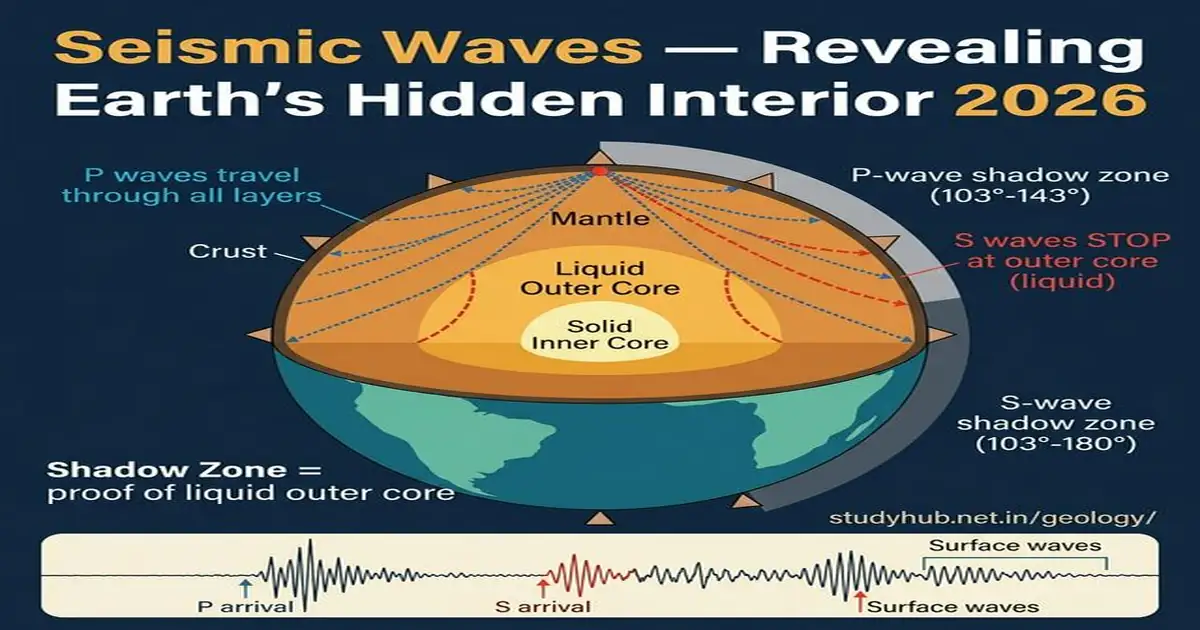
Seismic Waves — Types, Behaviour & What They Reveal 2026
The Three Types of Seismic Waves
| Wave Type | Travel Mode | Speed | Can Travel Through | What It Reveals |
|---|---|---|---|---|
| P Waves (Primary / Compressional) | Push-pull (compression + rarefaction) parallel to direction of travel — like sound waves | 5–8 km/s in crust; 8–13 km/s in mantle; 8–10 km/s in outer core; 11–12 km/s in inner core | Solids + Liquids + Gases — travel through everything | First arrival at seismograph (hence “Primary”). Slow down + refract at Gutenberg Discontinuity (2,900 km) → creates P wave shadow zone (103°–143°). Speed increase in inner core confirms it is solid (denser packing = faster P waves) |
| S Waves (Secondary / Shear) | Side-to-side shear perpendicular to direction of travel — like shaking a rope | 3–5 km/s in crust; 4–7 km/s in mantle; absent in outer core | Solids ONLY — cannot travel through liquids (liquids have no shear strength/rigidity) | Second arrival (hence “Secondary”). Completely disappear at 2,900 km (Gutenberg Discontinuity) → DEFINITIVE PROOF that outer core is liquid. S wave shadow zone: 103°–180° from epicentre. Reappear on far side only as converted waves through inner core |
| Surface Waves (L Waves) | Travel along Earth’s surface only — Love waves (horizontal shear) and Rayleigh waves (rolling elliptical motion) | 2–4 km/s (slowest) | Earth’s surface and shallow crust only — do not penetrate deep interior | Most destructive seismic waves (largest amplitude, longest duration). Used to study crustal thickness and shallow geology. Arrive last at seismograph. Cause most earthquake damage to buildings |
The Shadow Zones — Key Exam Concept
The most powerful evidence for Earth’s internal structure comes from seismic shadow zones — regions on Earth’s surface that receive no direct seismic waves from a given earthquake, even though they are within “line of sight” if Earth were uniform. Shadow zones exist because seismic waves refract (bend) as they pass through materials of different density and composition — exactly like light refracting through a prism.
| Shadow Zone | Location | Cause | What It Proves |
|---|---|---|---|
| P Wave Shadow Zone | 103° to 143° angular distance from earthquake epicentre (a doughnut-shaped ring around the far side) | P waves entering the mantle are refracted by the dense liquid outer core — they bend dramatically downward and emerge beyond 143° on the far side. Between 103° and 143°, no direct P waves arrive (though weak diffracted and reflected P waves do) | Earth has a liquid outer core that strongly refracts P waves. The angular width of the shadow zone (103°–143°) allows calculation of the outer core’s radius (3,471 km). Beno Gutenberg identified this shadow zone in 1914 and correctly deduced the liquid outer core and its depth (2,900 km = Gutenberg Discontinuity) |
| S Wave Shadow Zone | 103° to 180° angular distance from epicentre (the entire far hemisphere beyond 103°) | S waves travel through solid mantle normally until they hit the liquid outer core at 2,900 km — S waves cannot travel through liquid, so they are completely absorbed/stopped at the Gutenberg Discontinuity. No direct S waves emerge on the far side at all | The outer core is definitely liquid — the most direct seismological proof. S waves, by definition, only travel through solids. Their total absence beyond 103° proves the outer core has no shear strength = it is liquid iron-nickel alloy |
| P Wave “Bright Spot” in Shadow Zone | Anomalous P wave arrivals within the shadow zone (105°–143°) at sensitive seismographs | Inge Lehmann (1936) noticed P waves where none should exist — she proposed a solid inner core that reflects/refracts P waves back into the shadow zone region | Existence of inner core — solid iron-nickel at 5,100–6,371 km depth (Lehmann Discontinuity at 5,100 km). The solid inner core has higher P wave velocity (11–12 km/s) than liquid outer core (8–10 km/s), creating PKiKP reflections and PKIKP transmitted re-arrivals in the shadow zone |
How a Seismograph Works
A seismograph (or seismometer) records ground motion caused by seismic waves. The basic principle is elegant: a heavy mass (inertia) resists movement while the frame around it shakes with the ground — the relative motion between mass and frame is recorded. Modern seismographs use electronic feedback systems to keep the mass stationary while measuring the force required to do so — achieving sensitivities that can detect ground displacement of less than 1 nanometre (0.000000001 m). There are three components needed for full 3D motion recording: vertical, north-south horizontal, and east-west horizontal motion — requiring three separate seismometers at each station. The seismogram (the recording produced) shows: P wave arrival (small-amplitude, high-frequency oscillations — first arrival); S wave arrival (larger amplitude, lower frequency — arrives after P waves); Surface wave arrival (largest amplitude, lowest frequency, longest duration — last to arrive). The time delay between P and S wave arrivals at a single station determines the distance from that station to the earthquake epicentre (because P and S waves travel at known, different speeds). With readings from at least three seismograph stations, the epicentre can be triangulated precisely. India operates the National Seismological Network (NSN) — 115+ broadband seismograph stations managed jointly by the India Meteorological Department (IMD) and the National Centre for Seismology (NCS), headquartered in New Delhi. This network continuously monitors all seismic activity across India, including the high-seismicity Himalayan zone (Zone IV–V), the Andaman-Nicobar Islands (near the Sunda Arc subduction zone), and the Deccan Plateau (Zone II–III).
Decoding Earth’s Layers from Seismic Wave Velocities
The velocity of seismic waves depends on two rock properties: density (higher density = slower waves) and elastic moduli — bulk modulus (resistance to compression, affects P and S waves) and shear modulus (resistance to shearing, affects S waves only). As seismic waves descend deeper into Earth, they generally encounter denser material — but also material under higher pressure, which increases incompressibility (bulk modulus) faster than density increases — resulting in waves actually speeding up with depth through most of the mantle. This produces the wave bending (refraction) governed by Snell’s Law: waves bend toward lower-velocity material and away from higher-velocity material. The PREM model (Preliminary Reference Earth Model, Dziewonski & Anderson, 1981) — the standard reference used globally — gives precise seismic wave velocities at every depth through Earth, derived from thousands of global earthquake recordings. Key velocity transitions that reveal internal boundaries: P waves slow from ~13.7 km/s at the base of the mantle to ~8.1 km/s at the top of the outer core (Gutenberg Discontinuity, 2,900 km) — dramatic deceleration = transition from solid mantle to liquid core; P waves speed up from ~10.4 km/s at the base of the outer core to ~11.0 km/s at the top of the inner core (Lehmann Discontinuity, 5,100 km) — acceleration = transition from liquid to solid; S waves travel through the mantle at 3.5–7.3 km/s, then drop to zero at 2,900 km (outer core = liquid — no shear modulus), then reappear at 3.5 km/s in the solid inner core. The velocity-depth profile obtained from PREM is the primary evidence for Earth’s layered structure and is directly reproduced in NCERT Class 11 Physical Geography Chapter 3.
Other Evidence for Earth’s Interior
| Evidence Type | What It Tells Us | Details |
|---|---|---|
| Earth’s Mean Density | Core must be made of very dense material (iron) | Earth’s mean density = 5.5 g/cm³. But surface rocks average only 2.7–3.0 g/cm³. Therefore, deep interior must be much denser (13 g/cm³ at centre) to pull mean up to 5.5. Only iron (density ~7.9 g/cm³ at surface, compressed to ~13 g/cm³ at centre) fits. Iron is also cosmically abundant (formed in stellar nucleosynthesis) and present in meteorites (iron meteorites = samples of differentiated asteroid cores) |
| Meteorite Composition | Earth’s core composition analogous to iron meteorites | Chondrites = primitive undifferentiated meteorites ≈ bulk solar system composition; Iron meteorites = cores of differentiated asteroids that broke apart. Earth formed from similar material → underwent same differentiation → iron sank to form core. Stony meteorites (chondrites, achondrites) ≈ mantle/crust composition. Iron meteorites ≈ core composition |
| Magnetic Field Existence | Molten, conducting material in core | Earth’s magnetic field requires a dynamo: conducting fluid in motion in the presence of a seed magnetic field. Only liquid metallic iron in the outer core fits — solid rock is non-conducting. Solidified planets (Moon, Mars) have no active magnetic field (weak remnant fields only) |
| Moment of Inertia | Mass concentrated at centre | Earth’s moment of inertia factor = 0.3307 (vs 0.4 for a uniform sphere). This means Earth’s mass is concentrated toward its centre — consistent with a dense iron core. If Earth were uniform density, the factor would be 0.4 |
| Direct Sampling (limited) | Mantle composition via xenoliths + ophiolites | Xenoliths = mantle rock fragments carried up by volcanic eruptions (kimberlite pipes carrying diamonds from 150+ km); ophiolites = sections of oceanic crust + upper mantle obducted onto continents (e.g., Ladakh ophiolite, India = piece of ancient Tethys Ocean floor); both confirm upper mantle = peridotite (olivine + pyroxene) |
Frequently Asked Questions
What is the difference between P waves and S waves — and why does it matter for understanding Earth?
P waves (Primary / Compressional waves) and S waves (Secondary / Shear waves) are the two types of body waves — seismic waves that travel through Earth’s interior (as opposed to surface waves). The critical difference is in how they move material: P waves compress and expand material in the same direction as travel (push-pull, like sound). They can travel through any material — solid, liquid, or gas — because all materials resist compression (have a bulk modulus). S waves move material sideways, perpendicular to travel direction (shear). They can only travel through solids — liquids and gases have no shear strength (no rigidity, no shear modulus) and therefore S waves cannot propagate through them. This difference is the single most important fact for understanding Earth’s interior: when geologists observed that S waves completely disappeared beyond 103° from earthquake epicentres — creating the S wave shadow zone that covers the entire far hemisphere — they knew definitively that Earth must contain a large liquid region. The only explanation for S wave disappearance is a liquid layer — which turned out to be the iron-nickel outer core (2,900–5,100 km depth). P waves, which can travel through liquid, do reach the far side — but they arrive late and from unusual angles because they refract through the liquid outer core, creating the P wave shadow zone (103°–143°). The P wave shadow zone tells us the geometry (size and depth) of the liquid outer core. The S wave shadow zone tells us the outer core is liquid. Together, these two shadow zones provided the complete picture: a liquid iron-nickel outer core starting at 2,900 km depth (Gutenberg Discontinuity), surrounding a solid inner core deeper than 5,100 km (Lehmann Discontinuity). For UPSC/SSC exams: memorise — P waves travel through everything; S waves travel through solids only; S waves stop at 2,900 km = outer core is liquid.
How did Inge Lehmann discover the Earth’s inner core in 1936?
Inge Lehmann (1888–1993) was a Danish seismologist who made one of the most significant discoveries in geophysics — entirely through careful analysis of seismogram data, at a time when female scientists faced significant barriers. By the 1920s, Beno Gutenberg’s discovery of the liquid outer core (1914) was well accepted. The model assumed a liquid core from 2,900 km all the way to Earth’s centre — a fully liquid core would create a clean, total P-wave shadow zone from 103°–150°. But Lehmann, studying seismograms from a 1929 New Zealand earthquake and other events, noticed something that did not fit: faint but definite P wave arrivals at stations within the shadow zone — particularly at angular distances between 105° and 145°. These “rogue” P waves should not have existed if the core were entirely liquid. Lehmann proposed an elegant explanation: the liquid outer core must contain a solid inner sphere (the inner core) — and P waves could be refracted by this solid inner boundary and re-emerge into the shadow zone at unexpected angles. She published her landmark paper “P'” (also called “P prime prime”) in 1936 — a single-page paper that changed geoscience. The seismological community was initially sceptical (one prominent seismologist said “it would be extraordinary if that were true”) but within 15 years, improved seismographs and more earthquake data confirmed her inner core hypothesis conclusively. The boundary she identified — the inner core–outer core boundary at 5,100 km depth — was named the Lehmann Discontinuity in her honour. She continued working until age 99 (she lived to 104 — one of the longest-lived major scientists in history). For UPSC: Lehmann = female seismologist = inner core discovery = 1936 = Lehmann Discontinuity at 5,100 km.
Important for Exams — Seismic Wave Facts for UPSC, SSC & State PCS
Direct exam facts from this topic: Wave types: P waves (compressional, travel through solid + liquid, fastest, arrive first), S waves (shear, travel through solid ONLY, second arrival), Surface/L waves (slowest, most destructive, arrive last, two types: Love waves = horizontal shear; Rayleigh waves = rolling motion). Shadow zones: P wave shadow zone: 103°–143° from epicentre; cause: liquid outer core bends P waves. S wave shadow zone: 103°–180° (entire far hemisphere); cause: S waves cannot pass through liquid outer core. Key discovery dates for exam: Moho discovered 1909 (Mohorovičić); Gutenberg Discontinuity 1914 (Gutenberg); Lehmann Discontinuity 1936 (Inge Lehmann — first female to discover major Earth feature). Seismic wave velocity: P wave: 5–8 km/s crust, 8–13 km/s mantle, 8–10 km/s outer core, 11–12 km/s inner core; S wave: 3–5 km/s crust, 4–7 km/s mantle, 0 in outer core (liquid). India seismology: National Centre for Seismology (NCS) = India’s nodal agency; India Meteorological Department (IMD) = issues earthquake bulletins; National Seismological Network (NSN) = 115+ stations across India; Bhuj earthquake 2001 = 7.7 Mw = worst in independent India, killed ~20,000; Uttarkashi 1991, Chamoli 1999, Sikkim 2011 important events; 59% of India’s landmass in seismic Zones III, IV, V. Richter vs Moment Magnitude: Richter scale (ML) = used for local, smaller earthquakes; Moment Magnitude Scale (Mw) = standard for large earthquakes worldwide (includes seismic moment = rigidity × fault area × average slip); logarithmic — each integer = 10× ground motion amplitude, ~31.6× energy release. Kola Superdeep Borehole: Russia, 12.26 km (1970–1994), deepest artificial point = only upper crust (never reached Moho), abandoned due to extreme temperatures (~180°C at 12 km — far hotter than predicted), rocks became plastic at depth.
What to Read Next
- What is Geology? — Definition, 13 Branches, GSI & Importance for UPSC SSC 2026
- Earth’s Structure — Crust, Mantle, Outer Core & Inner Core with Discontinuities 2026
- Mohorovičić Discontinuity (Moho) — Crust-Mantle Boundary Explained 2026
- Earth’s Magnetic Field — Geodynamo, Van Allen Belts & Geomagnetic Reversal 2026
- What is an Earthquake? — Causes, Seismic Zones & India’s Earthquake History 2026
🎔 Exam Quick Reference — Seismic Waves: P waves = compressional, travel through solid + liquid, arrive FIRST. S waves = shear, solid ONLY, arrive SECOND — STOP at 2900km (Gutenberg) = outer core LIQUID. Surface waves = slowest, most destructive. P shadow zone: 103°–143°. S shadow zone: 103°–180°. Inge Lehmann (1936) = inner core discovery from anomalous P waves in shadow zone = Lehmann Discontinuity (5100km). Richter scale = logarithmic, each step = 10× ground motion = 31.6× energy. India NSN = 115+ seismograph stations (NCS + IMD).
🌍 India Seismology Connection: 59% of India’s landmass in seismic Zones III–V (high to very high risk). Zone V (Very High): J&K, Himachal Pradesh, Uttarakhand, North-East states, Andaman-Nicobar, parts of Gujarat (Bhuj). Zone IV (High): remainder of Himalayan states, Delhi, parts of Maharashtra. Zone III: Deccan most of peninsular India. Bhuj 2001 (7.7 Mw) remains India’s deadliest post-independence quake (~20,000 killed). National Building Code incorporates IS 1893 seismic zonation — all new buildings must be zone-appropriate seismically designed.
About This Guide: Written by the StudyHub Geology Editorial Team (studyhub.net.in/geology/) based on NCERT Class 11 Physical Geography Chapter 3 (Interior of the Earth), USGS Earthquake Hazards Program, Shearer “Introduction to Seismology” (2nd Ed., 2009), Dziewonski & Anderson PREM (1981), Lehmann “P'” (1936), and National Centre for Seismology (NCS) India bulletins. Last updated: March 2026.