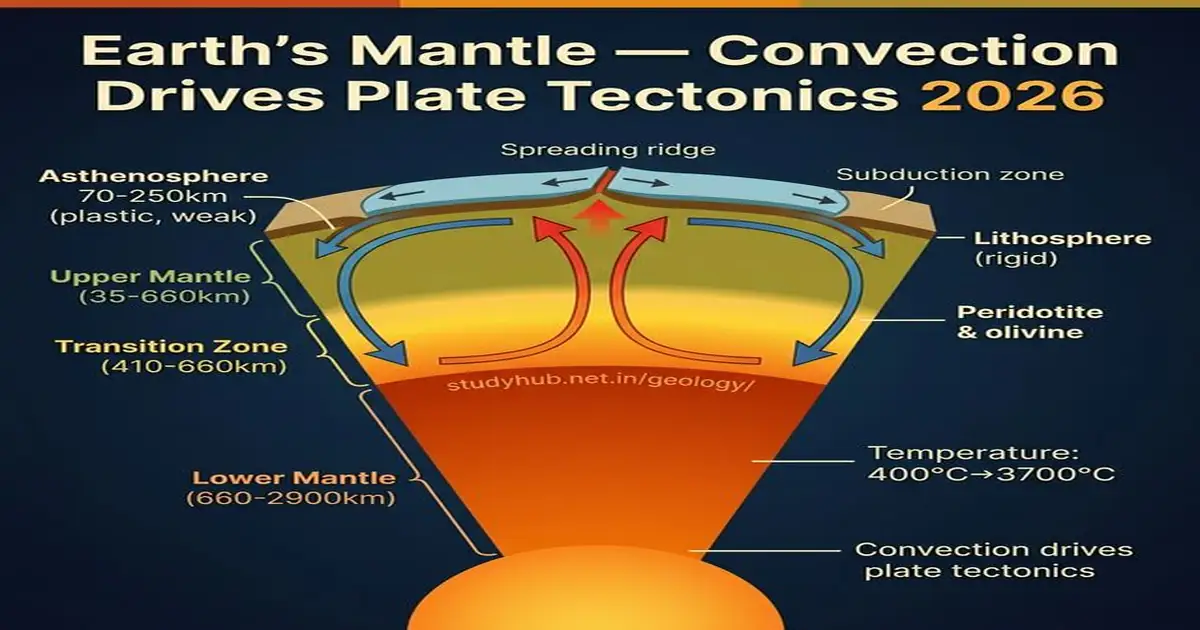
The Earth’s mantle is the planet’s largest structural layer — a vast shell of solid but slowly flowing rock that extends from the base of the crust (Mohorovičić Discontinuity, ~35 km depth) down to the top of the liquid outer core (Gutenberg Discontinuity, 2,900 km depth). Comprising 84% of Earth’s total volume and 67% of its mass, the mantle dwarfs every other layer. Despite being solid — s wave travel through it, confirming it has rigidity — the mantle behaves as an extraordinarily viscous fluid over geological timescales of millions of years. This ductile flow, driven by heat from Earth’s interior, generates the convection currents that power all of plate tectonics: building mountain ranges, opening ocean basins, triggering earthquakes, and fuelling volcanoes. For UPSC, SSC, and state PCS exams, the mantle’s composition (peridotite, olivine, bridgmanite), its subdivisions (upper mantle, asthenosphere, transition zone, lower mantle), and its role in plate movement are directly examined year after year.
Earth’s Mantle — Layers, Composition & Convection 2026
Mantle Subdivisions — The Four Zones
| Zone | Depth | Composition | Physical State | Temperature | Key Significance |
|---|---|---|---|---|---|
| Lithospheric Mantle (Upper Rigid Mantle) | Moho (~35 km) to ~70–100 km | Peridotite — harzburgite, lherzolite (olivine + orthopyroxene + clinopyroxene ± garnet). Cool and rigid. Together with the crust above, forms the lithosphere | Rigid solid — part of the tectonic plates. Moves as a coherent unit with the overlying crust | 400–800°C | The “keel” of tectonic plates. Continental lithosphere “keels” (cratonic roots) can extend 150–200 km deep beneath ancient Archean cratons. Oceanic lithosphere thickens with age (5 km thick at ridge → 80–100 km thick at 100 Ma subduction) |
| Asthenosphere | ~70–250 km (shallower under oceans and hotspots; deeper under Archean cratons) | Same composition as lithospheric mantle (peridotite) but near melting point — 1–3% partial melt in some zones (especially below mid-ocean ridges) | Weak, ductile, plastic — flows over geological timescales (viscosity ~10¹⁸–10²¹ Pa·s). Low-velocity zone (LVZ) for seismic waves. S wave velocity drops here (~4.3 km/s → 4.1 km/s) | 1,280–1,400°C (near the solidus = melting point curve) | The lubrication layer on which tectonic plates slide. Partial melt rises at mid-ocean ridges to create new oceanic crust. Source of basaltic magma for oceanic island volcanism (Iceland, Hawaii). Asthenospheric flow drives mantle convection and plate motion |
| Transition Zone | 410–660 km | Mineral phase transitions: olivine → wadsleyite (at 410 km); wadsleyite → ringwoodite (at 520 km); ringwoodite → bridgmanite + ferropericlase (at 660 km) | Solid (increasing rigidity with depth and pressure). Phase transitions cause seismic velocity jumps detectable as discontinuities at 410 km and 660 km | 1,400–1,900°C | The 660 km discontinuity is a major barrier: some mantle convection cells may be confined to above 660 km (upper mantle convection); others penetrate through (whole-mantle convection — current evidence favours some penetration). Subducting slabs can stagnate here (e.g., Pacific slab under eastern Asia at 660 km) |
| Lower Mantle | 660–2,900 km | Bridgmanite (MgSiO₃ perovskite — most abundant mineral in Earth, ~38% of Earth’s total volume) + ferropericlase (MgO) + Ca-perovskite. At base: post-perovskite phase (discovered 2004) | Solid but very slowly convecting. Higher viscosity than upper mantle (~10²¹–10²³ Pa·s). D″ layer (D double-prime) at base (2,700–2,900 km): anomalous zone — ultra-low seismic velocity zones (ULVZs), possible partial melt, chemical heterogeneity, origin of deep mantle plumes | 1,900–3,700°C | Contains most of Earth’s silicate mass. Bridgmanite is formally named after Percy Bridgman (Nobel laureate, high-pressure physics). Post-perovskite transition mimics the seismic properties of the D″ layer. Deep slab subduction to lower mantle = evidence for whole-mantle convection. CMB (Core-Mantle Boundary) at 2,900 km = Gutenberg Discontinuity |
Mantle Composition — What the Mantle is Made Of
The mantle is composed predominantly of silicate minerals — compounds built around SiO₄ tetrahedra — but much richer in magnesium and iron than the crust, making it ultramafic in composition. The dominant rock of the upper mantle is peridotite — a coarse-grained, dark green-black rock consisting mainly of: Olivine ((Mg,Fe)₂SiO₄) — typically 60–80% of upper mantle peridotite; apple-green colour; the mineral name “olivine” reflects this colour; transforms to denser phases (wadsleyite, ringwoodite) under the extreme pressures of the transition zone and lower mantle; Orthopyroxene (MgSiO₃ variety) — 15–25%; Clinopyroxene (Ca-Mg-Fe silicate) — 5–15%; Garnet (below ~80 km in the continental lithosphere, peridotite contains garnet rather than plagioclase — “garnet peridotite” or “lherzolite”). We know mantle composition from three direct sources: Xenoliths — fragments of mantle peridotite carried to the surface by rapidly ascending kimberlite magmas (the “express elevator” that also brings diamonds from 150–200 km depth); South African kimberlites, Deccan Traps xenoliths, and Rajasthan kimberlites are India’s sampling windows into the mantle. Ophiolites — sections of ancient oceanic crust + upper mantle thrust onto continents during plate collisions; the Ladakh Ophiolite (Indus-Tsangpo Suture Zone) is a preserved slice of Tethys Ocean upper mantle now exposed at 4,000+ m elevation in Ladakh — a remarkable geological treasure. Seismic tomography — mapping 3D variations in seismic wave velocity through the mantle reveals temperature and compositional anomalies: hot, slow zones (mantle plumes, asthenosphere); cold, fast zones (subducting slabs).
Mantle Convection — The Engine of Plate Tectonics
Mantle convection is the slow, thermally driven circulation of solid mantle rock that ultimately powers all of plate tectonics. The principle is identical to a lava lamp or boiling water: hot material at the base (heated by Earth’s core and by radioactive decay within the mantle) becomes less dense, rises; cooler material at the top (which has lost heat to the surface) becomes denser, sinks. This sets up a circulation — a convection cell. In the mantle, this process operates over millions of years because mantle rock, though solid, flows plastically at geological timescales (viscosity approximately 10¹⁸–10²³ Pa·s — for comparison, water is 10⁻³ Pa·s). The heat sources driving mantle convection are:
- (1) Primordial heat — residual heat from Earth’s accretion and differentiation 4.54 billion years ago (the violent collisions that built Earth from planetesimals released enormous kinetic energy, most of which remains as internal heat);
- (2) Radioactive decay — decay of long-lived isotopes ²³⁸U, ²³⁵U, ²³²Th, and ⁴⁰K within the mantle releases heat continuously; the mantle contains approximately 20 ppb uranium, 80 ppb thorium, and 260 ppb potassium — together producing ~20 × 10¹² watts of radiogenic heat globally;
- (3) Core heat — heat conducted across the Core-Mantle Boundary (CMB) from the hot liquid iron outer core drives vigorous convection in the lowermost mantle (D″ layer) and generates deep mantle plumes.
How Convection Drives Plate Motion — Forces on Plates
| Force | Mechanism | Contribution to Plate Motion | India Example |
|---|---|---|---|
| Slab Pull | Cold, dense subducting oceanic slab sinks into mantle under gravity — pulls the rest of the plate behind it like a tablecloth falling off a table | Dominant force — accounts for 50–70% of plate driving force. Plates with large subducting slabs (Pacific, Nazca, Indian) move faster than plates with no subduction (African, Eurasian) | Indian Plate moves 5 cm/yr NE — partly driven by subduction of remnant Indian oceanic lithosphere beneath Eurasian plate in the Himalayan collision zone. The Andaman subduction (Indian oceanic plate under Burma Plate) = slab pull contribution |
| Ridge Push | Hot, buoyant new oceanic crust at mid-ocean ridges is elevated → gravitational potential energy drives spreading outward from ridge | Secondary force (~20–30% contribution). Acts continuously at all spreading ridges. Carlsberg Ridge and Southwest Indian Ridge push Indian Plate toward NE | Carlsberg Ridge (NW Indian Ocean, spreading rate 2.5 cm/yr) + Southwest Indian Ridge contribute ridge push to Indian Plate motion |
| Mantle Drag (Basal Traction) | Flowing asthenosphere exerts viscous drag on the base of the lithosphere — either driving (if asthenosphere flows in same direction as plate) or resisting plate motion | Debated — probably a secondary resistive force for most plates. May be actively driving in some hotspot/plume-influenced regions | The deep mantle plume beneath the Deccan (responsible for Deccan Trap volcanism at 65.5 Ma) may have influenced Indian Plate motion by providing extra basal thermal thinning of lithosphere |
| Trench Suction | Subducting slab creates mantle flow that “sucks” the overriding plate toward the trench (trench rollback/retreat) | Important for back-arc basin opening (e.g., back-arc spreading behind Andaman Islands — Andaman Sea spreading) | Andaman Sea = small back-arc spreading basin west of the Andaman-Nicobar subduction zone. The Burma Plate (overriding) is being “sucked” toward the trench, opening the Andaman Sea basin |
Mantle Plumes — Hotspots and the Deccan Traps
Mantle plumes are narrow columns of anomalously hot mantle material that rise from deep in the mantle — probably from the D″ layer at the Core-Mantle Boundary — and penetrate through the overlying mantle to produce surface volcanism independent of plate boundaries. Mantle plumes create hotspots — regions of anomalously high volcanic activity fixed (approximately) to the deep mantle while tectonic plates slide over them. Classic examples: Hawaii — the Hawaiian hotspot has produced a 5,800 km chain of volcanic islands and seamounts as the Pacific Plate moves NW over it at 9 cm/yr; youngest island (Big Island, Hawaii) = active volcano today; progressively older and more eroded islands and seamounts to the NW (the “hotspot trail” proving Pacific plate motion); Yellowstone — supervolcano hotspot in Wyoming, USA; Iceland — sits on both the Mid-Atlantic Ridge and a mantle plume — explaining its anomalously thick crust and high eruption rates. Deccan Traps — India’s Mantle Plume Event: The Deccan Traps (from Dutch “trap” = staircase, describing the step-like topography of flood basalt plateaus) were produced by one of the largest volcanic events in Earth’s history — the eruption of ~1–2 million km³ of basaltic lava over approximately 750,000 years, centred at 65.5 Ma (million years ago) — coinciding precisely with the mass extinction event that killed the non-avian dinosaurs (the K-Pg boundary). The Deccan Traps cover approximately 500,000 km² of western/central India (Maharashtra, Gujarat, Karnataka, Madhya Pradesh), reaching thicknesses of 2–3 km in places (maximum 6 km near Mumbai). The source: the Réunion hotspot (now under the island of Réunion in the Indian Ocean) — the Indian Plate passed over this plume ~65.5 Ma, triggering the cataclysmic flood basalt eruptions. The hotspot trail leads from Deccan Traps → through the Lakshadweep Islands → to Réunion Island today, recording India’s ~5 cm/yr northward journey over the last 65 million years.
Frequently Asked Questions
If the mantle is solid, how does it flow? What is the asthenosphere?
This is one of the most common points of confusion in Earth science curricula. The mantle is indeed solid in the mechanical sense that seismic S waves (shear waves) travel through it — S waves cannot pass through liquids, and they travel throughout the entire mantle at 3.5–7.5 km/s. However, “solid” does not mean “rigid” on geological timescales. Solid materials can flow given sufficient temperature and time — a phenomenon called solid-state creep or ductile flow. The key concept is viscosity — the resistance to flow. Water has a viscosity of ~10⁻³ Pa·s (essentially zero resistance). Glacial ice, though solid, flows at ~10¹² Pa·s. The upper asthenosphere flows at ~10¹⁸–10²¹ Pa·s — between 10²¹ and 10²⁴ times more viscous than water, but still capable of flowing over millions of years. Think of it like silicone putty (Silly Putty): hit it with a hammer and it shatters like a solid (high-frequency response = rigid); leave it on a table for an hour and it slowly flattens and flows (low-frequency/long-time response = viscous fluid). The mantle behaves rigidly on the timescale of seismic waves (seconds) but flows plastically on the timescale of plate motions (millions of years). The asthenosphere (70–250 km depth) is particularly weak because it is close to its melting point (solidus) — rock weakens dramatically as it approaches melting, even if it remains technically solid. At asthenospheric conditions (~1,300°C, ~3 GPa pressure), peridotite is ~1–3% partially molten in low-melt-fraction zones, creating a weak, partially liquid network that reduces overall viscosity dramatically. This weak asthenospheric zone is the primary lubrication layer on which lithospheric tectonic plates slide — without the asthenosphere, plate tectonics as we know it would not be possible. For exam: mantle is solid (S waves travel through it) BUT flows plastically over geological timescales (solid-state creep). Asthenosphere = weak zone = 70–250 km = partially molten = low seismic velocity zone (LVZ).
What are mantle plumes and how did they create the Deccan Traps?
A mantle plume is a column of anomalously hot mantle material (hundreds of degrees hotter than surrounding mantle) that rises buoyantly from deep in Earth’s interior — probably initiated at the Core-Mantle Boundary (2,900 km depth) in the D″ layer through a combination of core heat flux and chemical heterogeneity. Plumes rise slowly (cm per year) through the viscous mantle, mushrooming at the top into a large “plume head” (potentially 1,000–2,000 km across) when they reach the base of the lithosphere. The plume head causes enormous volumes of rock to partially melt — producing flood basalt eruptions at the surface that are orders of magnitude larger than any eruption in recorded history. The Réunion hotspot — now located under the island of Réunion in the SW Indian Ocean — was responsible for the Deccan Traps (65.5 Ma). When the Indian Plate first passed over the nascent Réunion plume ~67–65 Ma, the plume head (1,000+ km wide) impinged on the base of the lithosphere, causing massive decompression melting: ~1–2 million km³ of basaltic magma erupted in geologically rapid pulses over ~750,000 years. The eruptions, now recognised as one of Earth’s Large Igneous Provinces (LIPs), released enormous quantities of SO₂, CO₂, and HF — contributing (along with the Chicxulub asteroid impact at 66 Ma) to the end-Cretaceous mass extinction. As the Indian Plate continued moving NE at 5 cm/yr, the hotspot track became progressively younger: Deccan Traps (65 Ma, Peninsular India) → Lakshadweep Island chain (45–60 Ma, formed as Indian Plate moved to NE) → Maldives Ridge → Réunion Island (active today, 0 Ma). This perfectly age-progressive hotspot trail is one of the most elegant pieces of evidence for the absolute motion of the Indian Plate — and for the existence of fixed deep mantle plumes beneath moving plates.
Important for Exams — Earth’s Mantle Facts for UPSC, SSC & State PCS
Key numbers: Mantle depth: 35–2,900 km. Volume: 84% of Earth. Mass: 67% of Earth. Mantle composition: peridotite (olivine + pyroxene + garnet). Temperature: 400°C (top) → 3,700°C (base, CMB).
Subdivisions (memorise): Lithospheric mantle (rigid, part of tectonic plate, 35–100 km); Asthenosphere (weak, plastic, 70–250 km, partially molten, LVZ, drives plate motion); Transition zone (410–660 km, mineral phase changes — olivine→wadsleyite→ringwoodite→bridgmanite); Lower mantle (660–2,900 km, bridgmanite = most abundant Earth mineral, post-perovskite at base).
Key minerals: Olivine (upper mantle, green, (Mg,Fe)₂SiO₄); Wadsleyite (410–520 km); Ringwoodite (520–660 km); Bridgmanite/MgSiO₃ perovskite (660–2,900 km) — most abundant mineral on Earth.
Convection forces: Slab pull (dominant), ridge push (secondary), mantle drag (variable).
Mantle plumes: Rise from D″ layer (CMB); create hotspots (fixed in mantle, plate moves over); examples: Hawaii, Réunion, Iceland, Yellowstone.
India specifics: Deccan Traps = Réunion hotspot eruption (65.5 Ma) = 500,000 km² Maharashtra, Gujarat, MP, Karnataka; 1–2 million km³ basalt; hotspot trail → Lakshadweep → Réunion active today. Ladakh Ophiolite = upper mantle peridotite from Tethys Ocean (suture zone). Xenoliths in Rajasthan/Deccan kimberlites = direct mantle samples. Andaman subduction = mantle wedge partial melt = arc volcanism (Barren Island).
What to Read Next
- Earth’s Structure — Crust, Mantle, Outer Core & Inner Core with Discontinuities 2026
- Continental vs Oceanic Crust — SIAL vs SIMA, Thickness, Density & Age 2026
- Earth’s Core — Iron-Nickel Composition, Geodynamo & How It Was Discovered 2026
- What is Plate Tectonics? — Convection, Continental Drift & Himalayan Formation 2026
- Deccan Traps — India’s Flood Basalt Eruption, Réunion Hotspot & K-Pg Extinction Link 2026
🎔 Exam Quick Reference — Earth’s Mantle: Depth: 35–2,900 km. Volume: 84%. Composition: peridotite (olivine+pyroxene). Temp: 400°C→3,700°C. Asthenosphere (70-250km) = weak, plastic, partially molten = drives plate tectonics. Bridgmanite (lower mantle 660-2900km) = most abundant mineral on Earth. Slab pull = dominant plate-driving force. Mantle plumes = rise from CMB → hotspots. Deccan Traps = Réunion plume (65.5 Ma) = 500,000 km² basalt, hotspot trail → Lakshadweep → Réunion Island today.
🌍 India Mantle Connection: Ladakh Ophiolite (Indus-Tsangpo Suture Zone) = sliver of ancient Tethys Ocean upper mantle (peridotite) now at 4,000m elevation. Rajasthan kimberlites (Wajrakarur, Andhra Pradesh) = rapid mantle “elevator” bringing xenoliths + diamonds from 150-200km depth. Deccan Traps (Maharashtra/Gujarat/MP/Karnataka) = Réunion plume, 65.5 Ma, 500,000 km², 1-2 million km³ basalt. Hotspot trail: Deccan → Lakshadweep islands → Chagos-Laccadive Ridge → Réunion (active). Andaman volcanic arc = mantle wedge above India-Burma subduction zone = basaltic andesitic volcanism (Barren Island).
About This Guide: Written by the StudyHub Geology Editorial Team (studyhub.net.in/geology/) based on NCERT Class 11 Physical Geography Chapters 3–4, Tarbuck & Lutgens “Essentials of Geology” (13th Ed.), Anderson (1989) “Theory of the Earth,” GSI Special Publication on Deccan Volcanism, and Tejada et al. (2015) large igneous provinces review. Last updated: March 2026.