At the very heart of our planet — 6,371 km below the surface — lies a world of extremes. Earth’s core is a region of crushing pressure (up to 360 GPa — 3.6 million times atmospheric pressure), searing temperatures (5,000–6,000°C, comparable to the surface of the Sun), and enormous density (13 g/cm³ at the centre — five times denser than surface granite). The core is divided into two fundamentally different regions: a liquid outer core (2,900–5,100 km depth) of convecting iron-nickel alloy whose electric currents generate Earth’s protective magnetic field, and a solid inner core (5,100–6,371 km) of iron-nickel crystalline iron kept solid not by cooling but by the sheer force of pressure. Understanding Earth’s core is essential not just for geology exams — it explains why Earth has a magnetic field that shields life from deadly solar radiation, why compass needles point north, and why Mars and the Moon lost their atmospheres while Earth did not. For UPSC, SSC, NDA, and state PCS exams, the core’s composition, its discovery through seismology, the geodynamo theory, and the comparison with Mars are directly examined topics.
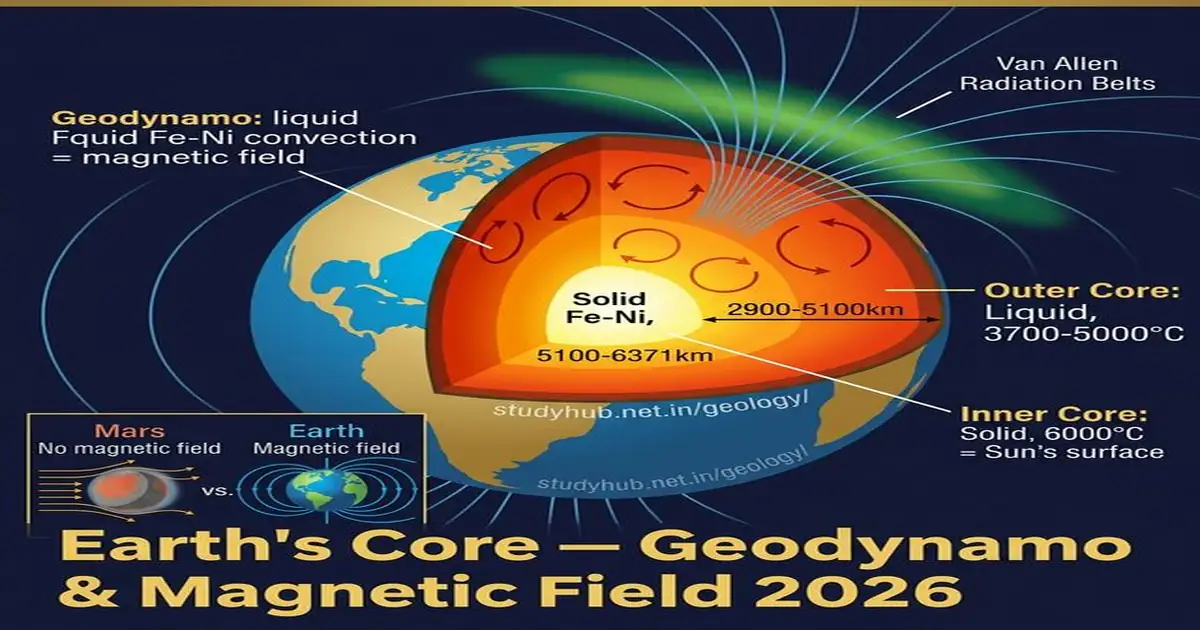
Earth’s Core — Composition, Discovery & Geodynamo 2026
Outer Core vs Inner Core — Full Comparison
| Property | Outer Core | Inner Core |
|---|---|---|
| Depth Range | 2,900 km – 5,100 km | 5,100 km – 6,371 km (Earth’s centre) |
| Thickness / Radius | Thickness: 2,200 km | Radius: 1,220 km (similar to Moon’s radius: 1,737 km; slightly larger than Mars’ core radius ~1,790 km) |
| Physical State | LIQUID — definitive proof: S waves (shear waves) cannot pass through → total S wave shadow zone from 103°–180°. P waves slow dramatically crossing from mantle into outer core (from ~13.7 km/s to ~8.1 km/s) = dramatic density/state change at Gutenberg Discontinuity (2,900 km) | SOLID — despite being hotter than outer core base temperature. Extreme pressure (360 GPa) forces iron into solid hexagonal close-packed (hcp) crystal structure. Evidence: anomalous PKiKP and PKIKP seismic phases detected by Inge Lehmann (1936) — Lehmann Discontinuity at 5,100 km |
| Composition | Iron-nickel alloy (Fe-Ni, ~80%) + ~10% lighter elements: sulfur (S), oxygen (O), silicon (Si), carbon (C), hydrogen (H) debated. Light element “impurities” lower density relative to pure Fe-Ni and lower the melting point (explains why outer core remains liquid) | Iron-nickel alloy (Fe-Ni, ~95%), very minor lighter elements. Nearly pure iron under compression. Crystal structure: hexagonal close-packed (hcp) iron = ε-iron (epsilon-iron). P wave velocity: 11–12 km/s — higher than outer core (8–10 km/s), confirming solid |
| Temperature | 3,700°C (top, near Gutenberg Discontinuity) → ~5,000°C (base, near inner core boundary) | ~5,000°C (top) → ~6,000°C (centre) — comparable to temperature of Sun’s photosphere (surface: ~5,500°C). Hotter than outer core yet solid due to extreme pressure |
| Pressure | ~136 GPa (top) → ~330 GPa (base) | 330–360 GPa (centre). 1 GPa = ~10,000 atmospheres. At 360 GPa, pressure is 3.6 million times Earth surface atmospheric pressure |
| Density | ~10 g/cm³ (top) → ~12 g/cm³ (base) — approximately 4× denser than surface granite (2.7 g/cm³) | ~12–13 g/cm³ — approximately 5× denser than surface granite. Earth’s mean density: 5.5 g/cm³; pulled up by the very dense core |
| Key Boundary | Top: Gutenberg Discontinuity (2,900 km) — discovered by Beno Gutenberg (1914) from P wave shadow zone (103°–143°) and S wave total disappearance (>103°) | Top: Lehmann Discontinuity (5,100 km) — discovered by Inge Lehmann (1936) from anomalous P wave arrivals in the P wave shadow zone |
How Was Earth’s Core Discovered?
We have never directly sampled Earth’s core — the deepest drill hole ever (Kola Superdeep Borehole, Russia, 12.26 km) barely scratched the upper crust. Knowledge of the core comes entirely from indirect evidence — primarily seismology but also supported by geophysics and meteoritics. The story of core discovery unfolded in three historical stages:
Stage 1 — Density argument (late 19th century): Scientists knew Earth’s mean density (5.5 g/cm³) was much higher than surface rocks (~2.7–3.0 g/cm³). The only way to reconcile this was a very dense interior — iron (density ~7.9 g/cm³ at surface, ~12–13 g/cm³ under core pressures) was the obvious candidate, being both cosmically abundant (formed in stellar nucleosynthesis) and found as the dominant component of iron meteorites (fragments of differentiated asteroid interiors). F.R. Helmert (1884) and later analyses established that Earth must have a dense metallic core, but its depth and state were unknown.
Stage 2 — Gutenberg discovers the liquid outer core (1914): Beno Gutenberg (1889–1960, German-American seismologist) systematically analysed global earthquake seismograms and identified the P wave shadow zone — a region from 103° to 143° angular distance from earthquakes where P waves arrived anomalously late and weak. Analysing P wave travel-time curves, he calculated that the discontinuity causing this refraction lay at exactly 2,900 km depth — now called the Gutenberg Discontinuity (or Core-Mantle Boundary, CMB). The total disappearance of S waves beyond 103° (the S wave shadow zone) proved the outer core was liquid. Gutenberg published his landmark result in 1914 — a year before he left Germany (eventually fleeing the Nazis to the USA in 1930, where he worked at Caltech).
Stage 3 — Lehmann discovers the solid inner core (1936): Inge Lehmann (1888–1993, Danish seismologist) noticed that seismographs within the P wave shadow zone (which should record no direct P waves) occasionally detected faint but definite P wave arrivals — particularly at 105°–143°. If the core were entirely liquid with no internal structure, these arrivals were impossible. Lehmann proposed in her 1936 paper “P'” that a solid inner core exists (radius ~1,220 km) whose higher seismic velocity reflects some P waves into the shadow zone, producing the observed anomalous arrivals. This brilliant deduction — from reading tiny wiggles on seismograms — was confirmed by more sensitive seismographs and global earthquake data over the following decades. The inner core boundary (5,100 km depth) was named the Lehmann Discontinuity in her honour. She remained scientifically active until her 99th year and lived to 104.
The Geodynamo — How Earth’s Core Creates the Magnetic Field
Earth’s magnetic field — the invisible force field that deflects compass needles, guides migratory birds, and shields the biosphere from lethal solar radiation — is generated in the liquid outer core by a process called the geodynamo. The geodynamo operates on the same basic principle as an electric generator: moving conductive material generates a magnetic field. In Earth’s outer core, the “moving conductive material” is liquid iron-nickel alloy — iron is an excellent electrical conductor even in liquid form. The driving mechanism is convection: hot, less-dense liquid iron rises from near the inner core boundary (ICB); as it rises and cools, it becomes denser and sinks back toward the ICB; the ICB itself is slowly crystallising (the inner core grows by ~1 mm/year as the Earth gradually cools) — this crystallisation releases latent heat (heat of solidification) + expels lighter elements (S, O, Si) which also drive convective flow upward. Combined with Earth’s rotation, which organises convection into helical flows (via the Coriolis effect), these moving electric currents generate and sustain Earth’s magnetic field. The field is roughly dipolar — resembling a bar magnet aligned approximately (but not exactly) with Earth’s rotation axis. Currently, the geographic north pole and the magnetic north pole differ by ~11° and the magnetic north pole is drifting — presently at ~86°N, 133°W (northern Canada/Arctic) and moving toward Siberia at ~50–60 km/year.
Earth’s Magnetic Field — Why It Matters for Life
| Function | How It Works | What Happens Without It — Mars Example |
|---|---|---|
| Solar Wind Deflection (Magnetosphere) | Earth’s magnetic field creates the magnetosphere — a teardrop-shaped region extending ~65,000 km toward the Sun and >600,000 km on the nightside (magnetotail). It deflects the solar wind (stream of charged particles: protons, electrons) around Earth, preventing direct particle bombardment of atmosphere | Mars lost its global magnetic field ~4 billion years ago (its small core solidified, geodynamo stopped). Since then, the solar wind has been stripping Mars’ atmosphere atom by atom for 4 billion years → Mars now has only 0.6% of Earth’s atmospheric pressure (essentially vacuum). Mars was once warm and wet (3.5–4 Ga); without the magnetic shield its atmosphere was stripped and oceans evaporated |
| Van Allen Radiation Belts | Charged particles from solar wind and cosmic rays are trapped by Earth’s magnetic field into two doughnut-shaped radiation belts (inner: 1,000–12,000 km altitude; outer: 15,000–25,000 km altitude). Named after James Van Allen (1958, discovered by Explorer 1 satellite). Belts protect Earth’s surface but pose radiation hazards to satellites and astronauts outside Earth’s magnetic protection | Without magnetic field: no Van Allen belts → direct cosmic ray bombardment of surface → DNA damage → mass extinction of surface life. Current Mars surface receives ~50× Earth’s surface radiation dose from cosmic rays — lethal for most life |
| Compass Navigation | Magnetic compass needles align with Earth’s field. Used for navigation since ~9th century CE in China, ~11th–12th century in Europe. Earth’s field has declination (difference between geographic north and magnetic north) that varies by location — surveyed globally and updated regularly | India Magnetic declination: varies from +0° to +5° East across India (magnetic north slightly east of geographic north in most of India). Indian Naval Hydrographic Office maintains India’s magnetic charts (isogonic lines) |
| Geomagnetic Reversals | Earth’s magnetic field reverses polarity periodically (geographic north ↔ magnetic south and vice versa) — recorded in oceanic basalts as symmetric magnetic anomaly stripes on either side of mid-ocean ridges. 183 reversals in last 83 Ma (average ~450,000 year intervals). Last reversal: Matuyama-Brunhes reversal, ~780,000 years ago | During reversals (which take ~1,000–10,000 years), the field weakens significantly — less solar wind protection → slightly elevated cosmic ray flux → weakly linked to some extinction events. Currently, Earth’s field has weakened ~10% over last 150 years (South Atlantic Anomaly = region of unusually weak field over South Atlantic) |
Frequently Asked Questions
Why is the inner core solid when it is hotter than the outer core?
This is one of the most counter-intuitive facts in Earth science and a frequent UPSC/SSC question. The inner core’s temperature is approximately 5,000–6,000°C — actually higher than the outer core’s temperature at comparable depths. Yet the iron in the inner core is solid, while the iron just a few kilometres away in the outer core is liquid. The explanation is pressure: metals, including iron, have a melting curve (solidus) that increases with pressure — the higher the pressure, the higher the temperature required to melt them (thermodynamic principle: solidification involves a volume decrease for most metals; high pressure favours the denser solid phase). In the outer core (2,900–5,100 km), the temperature is above iron’s melting point at those pressures → iron remains liquid. In the inner core (5,100–6,371 km), the pressure is so enormously high (330–360 GPa = 3.3–3.6 million atmospheres) that iron’s melting point exceeds even the very high temperature there (~6,000°C) → iron is forced into solid hcp crystal structure (ε-iron). The inner core is not “frozen” in the conventional sense — it is solidifying because the planet is very slowly cooling, causing the boundary between liquid outer core and solid inner core (the ICB, Lehmann Discontinuity) to migrate outward. The inner core “grows” by approximately 1 mm/year as liquid iron at the ICB solidifies. This crystallisation releases latent heat and expels light elements → driving the buoyancy that powers outer core convection → sustaining the geodynamo → sustaining Earth’s magnetic field. In other words: the inner core growing = Earth’s magnetic field powered. A fascinating circular chain for your exam notes.
Why does Earth have a magnetic field but Mars and Moon do not?
Earth, Mars, and Moon were all born from the same solar system material and all had liquid iron cores early in their history. The key difference is size and heat retention: Mars (diameter 6,779 km — about half Earth’s) and the Moon (diameter 3,475 km — about a quarter of Earth’s) are much smaller. Smaller bodies cool faster (higher surface-area-to-volume ratio). Mars’ small iron core cooled and solidified approximately 4 billion years ago — the liquid convecting outer core that once generated Mars’ geodynamo (confirmed by ancient magnetised crustal rocks in the Mars southern highlands — Noachis Terra — magnetised ~4.1 Ga) stopped convecting when the core solidified. Mars lost its geodynamo, then its magnetosphere, then the solar wind stripped its atmosphere. The Moon similarly lost any early geodynamo by ~3.5–1.5 Ga (evidence from lunar rock samples with remnant magnetism brought by Apollo missions). Earth, being much larger, retains more internal heat and its outer core remains liquid today — and will continue to do so for billions of years. The geodynamo will eventually stop when the outer core fully solidifies into the inner core (estimated in ~5–6 billion years — about when the Sun becomes a red giant). By that point, Earth will likely be uninhabitable for other reasons. For exam: Earth = large = hot core = liquid outer core = active geodynamo = magnetic field = atmosphere protected. Mars/Moon = small = cooled core = no geodynamo = no magnetic field = atmosphere stripped.
Important for Exams — Earth’s Core Facts for UPSC, SSC & State PCS
Core numbers (memorise): Outer core: 2,900–5,100 km (thickness 2,200 km); Inner core: 5,100–6,371 km (radius 1,220 km). Core total radius: 3,471 km. Centre temperature: ~6,000°C (= Sun’s surface). Centre pressure: 360 GPa = 3.6 million atm. Inner core density: 12–13 g/cm³.
Boundaries: Gutenberg Discontinuity (2,900 km) = mantle-outer core; S waves stop; discovered by Gutenberg (1914). Lehmann Discontinuity (5,100 km) = outer core-inner core; discovered by Inge Lehmann (1936) from anomalous P waves in shadow zone.
Geodynamo facts: Liquid outer core Fe-Ni convection + Earth’s rotation (Coriolis) → electric currents → Earth’s magnetic field; geodynamo powered by inner core crystallisation latent heat + light element buoyancy; Earth’s field weakened ~10% in 150 years (South Atlantic Anomaly); last polarity reversal: 780,000 years ago (Matuyama-Brunhes).
Magnetic field facts: Magnetosphere extends ~65,000 km sunward; Van Allen belts (inner 1,000–12,000 km, outer 15,000–25,000 km) discovered 1958 (James Van Allen). Declination = angle between geographic and magnetic north.
Mars comparison: Mars lost geodynamo ~4 Ga → solar wind stripped atmosphere → Mars now 0.6% atmospheric pressure → surface radiation 50× Earth → no liquid water today.
India specific: Compass declination in India: 0°–5°E; Geological Survey of India (GSI) maintains magnetic observatory network; Gulmarg Magnetic Observatory (J&K) + Hyderabad Magnetic Observatory (NGRI, CSIR) are key Indian geomagnetic research centres.
What to Read Next
- Earth’s Structure — Crust, Mantle, Outer Core & Inner Core with Discontinuities 2026
- Seismic Waves — How P Waves & S Waves Reveal Earth’s Hidden Interior 2026
- Earth’s Mantle — Asthenosphere, Convection Currents & Mantle Plumes 2026
- Earth’s Magnetic Field — Geomagnetic Reversals, Sea-floor Spreading Evidence 2026
- What is Plate Tectonics? — Theory, Continental Drift & Himalayan Formation 2026
🎔 Exam Quick Reference — Earth’s Core: Outer Core (2900-5100km): LIQUID Fe-Ni, 3700-5000°C, S waves STOP here (Gutenberg, 2900km). Inner Core (5100-6371km): SOLID Fe-Ni (hcp iron), 6000°C, radius 1220km (Lehmann, 5100km). Inner core solid because PRESSURE (360 GPa) forces solidification despite high temperature. Geodynamo: liquid Fe-Ni convection + Coriolis → magnetic field. Mars: lost geodynamo 4 Ga → no magnetosphere → atmosphere stripped → 0.6% Earth pressure. Van Allen Belts: 1000-12,000km (inner) & 15,000-25,000km (outer). Last reversal: 780,000 years ago.
🌍 India Geomagnetic Connection: National Geophysical Research Institute (NGRI, CSIR, Hyderabad) = India’s premier geophysics institute; runs magnetic observatories. Gulmarg Geophysical Observatory (J&K) = high-altitude magnetic station. India’s compass declination: 0°–5°E in most regions. GSI paleomagnetic studies on Deccan Traps basalts = confirmed 65.5 Ma age via paleomagnetism. Indian Antarctic Expedition stations (Maitri, Bharati) measure geomagnetic field in polar auroral zone. Chandrayan-2 Orbiter’s CLASS instrument detected solar X-rays and their interaction with lunar surface — key data for understanding remnant lunar magnetism.
About This Guide: Written by the StudyHub Geology Editorial Team (studyhub.net.in/geology/) based on NCERT Class 11 Physical Geography Chapter 3, Lay & Wallace “Modern Global Seismology” (1995), Buffett (2010) “Earth’s Core and Geodynamo” (Science), Lehmann “P'” (1936), USGS Core resources, and NGRI Hyderabad annual reports. Last updated: March 2026.