Last Updated: March 2026 | Reading Time: 9 minutes | ~2,000 words
Dengue fever kills over 40,000 Indians every year and infects an estimated 5–10 million more — making India the dengue capital of the world. India accounts for approximately one-third of all dengue cases globally. Yet despite its prevalence, most Indians cannot confidently identify dengue warning signs, don’t know when hospitalisation is urgently needed, and don’t know the dietary steps that directly impact platelet recovery. This complete guide covers everything you need to know — symptoms, danger signs, platelet count management, diet, and recovery.
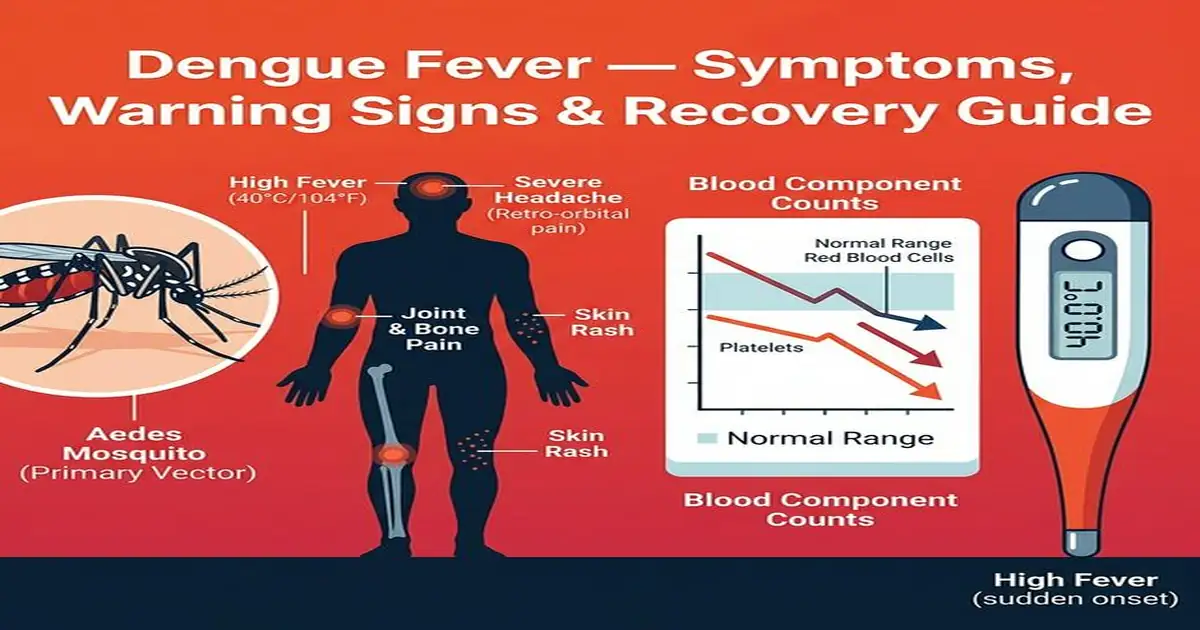
What is Dengue Fever?
Dengue is a viral infection caused by the dengue virus (DENV) — transmitted to humans through the bite of the Aedes aegypti mosquito (and to a lesser extent Aedes albopictus). There are four distinct dengue virus serotypes (DENV-1, 2, 3, 4) — which means you can potentially get dengue four times in your life. A critical feature: the second infection with a different serotype is usually more severe than the first, due to an immune mechanism called Antibody-Dependent Enhancement (ADE). The Aedes mosquito bites primarily during the day, especially in the early morning and late afternoon — unlike the malaria mosquito which bites at night.
| Feature | Dengue | Malaria | Chikungunya |
|---|---|---|---|
| Mosquito species | Aedes aegypti (day biting) | Anopheles (night biting) | Aedes aegypti (day biting) |
| Fever pattern | Sudden high fever (40°C); “breakbone” pain | Cyclical fever with chills; rigors | High fever + severe joint pain |
| Rash | Maculopapular rash (3–5 days in) | Rare | Maculopapular rash (early) |
| Platelet drop | Characteristic; severe in dengue haemorrhagic | Mild drop possible | Mild drop possible |
| Joint pain | Moderate; “breakbone” = bone/muscle ache | Mild | Severe joint pain (defining feature) |
| Danger period | Day 4–6 (defervescence phase) | Peak fever episodes | Less life-threatening |
Phases of Dengue — Day by Day
| Phase | Days | What Happens | Key Actions |
|---|---|---|---|
| Febrile Phase | Day 1–3 | Sudden high fever (39–40°C), severe headache, behind-eye pain, muscle and joint aches, possible rash. Platelet starts dropping. | Rest; hydration (ORS + coconut water); paracetamol only (NO ibuprofen or aspirin). Test NS1 antigen. |
| Critical Phase | Day 4–6 | Fever breaks — but this is the DANGER ZONE. Plasma leakage begins causing low blood pressure, vomiting, abdominal pain. Platelet drops sharply. Bleeding may occur. Shock possible in severe cases. | Monitor vitals closely. Hospitalise if any warning signs (see below). Daily CBC mandatory. |
| Recovery Phase | Day 7–10 | Plasma reabsorption begins. Patient feels better. Appetite returns. Platelet begins rising. Rash may persist. | Continue hydration. Avoid strenuous activity. Continue platelet-boosting diet. Retest CBC. |
⚠️ Critical Warning: The most dangerous misconception about dengue — “the fever broke, so they’re getting better.” Day 4–6, when the fever breaks, is paradoxically the most dangerous period of dengue. This is when plasma leakage occurs and shock can develop. Maximum alertness and monitoring is needed precisely when the patient feels they are recovering.
All Dengue Symptoms — Complete List
| Symptom | Details | When It Appears |
|---|---|---|
| Sudden high fever (39–40°C) | Abrupt onset; may have mild chills but not the rigors of malaria | Day 1 |
| Severe headache (frontal) | Behind the eyes (retro-orbital pain) — characteristic of dengue | Day 1–2 |
| “Breakbone” pain (bone + muscle ache) | Severe myalgia and arthralgia; nicknamed breakbone fever for a reason | Day 1–3 |
| Skin rash | Maculopapular (red flat/raised spots); may blanch on pressure; appears after initial fever | Day 3–5 |
| Nausea and vomiting | Frequent; loss of appetite | Day 2–5 |
| Mild bleeding (gums, nose) | Early sign of platelet drop and vascular effects | Day 3–5 |
| Abdominal pain (right upper quadrant) | Liver involvement; tender abdomen — particularly worrying sign | Day 3–5 |
| Facial flushing | Characteristic early sign in dengue | Day 1–2 |
| Positive tourniquet test | 20+ petechiae after BP cuff inflation — used in clinics | Day 3–5 |
🚨 Dengue Warning Signs — Go to Hospital Immediately
WHO defines specific dengue warning signs that indicate progression to severe dengue. If any of these appear — especially on Days 4–6 — go to a hospital emergency without delay:
- 🚨 Severe abdominal pain or tenderness
- 🚨 Persistent vomiting (3+ times in 24 hours; unable to keep fluids down)
- 🚨 Bleeding from gums, nose, in vomit, or in urine/stool
- 🚨 Rapid breathing or difficulty breathing
- 🚨 Fatigue, restlessness, or altered consciousness
- 🚨 Cold, clammy skin and lips becoming pale/blue (dengue shock)
- 🚨 Sudden drop in fever with worsening condition (Day 4–6 danger zone)
- 🚨 Platelet count below 50,000 (normal: 1.5–4 lakh; requires hospital monitoring)
- 🚨 Platelet count below 20,000 (risk of spontaneous bleeding; transfusion may be needed)
Dengue Tests — Which Test When?
| Test | Best Used | What It Detects | Cost |
|---|---|---|---|
| NS1 Antigen Test | Day 1–4 of fever | Dengue virus antigen (early detection) | ₹400–800 |
| Dengue IgM Antibody | Day 5 onwards | Immune response (IgM = current/recent infection) | ₹500–900 |
| Dengue IgG Antibody | After 1 week / past exposure | Past dengue infection; rises in secondary infection | ₹500–900 |
| CBC (Complete Blood Count) | Daily from Day 3 | Platelet count, WBC (drops in dengue), haematocrit (rises with plasma leak) | ₹150–250 |
| Dengue PCR | Day 1–7 (definitive) | Viral RNA — most accurate; expensive | ₹2,000–4,000 |
Platelet Count in Dengue — What the Numbers Mean
| Platelet Count | Status | Action |
|---|---|---|
| 1.5–4.5 lakh/µL (150,000–450,000) | Normal | Continue home management; hydration |
| 1–1.5 lakh (100,000–150,000) | Mildly low — monitor | Daily CBC; platelet-boosting diet; doctor review |
| 50,000–1 lakh | Moderate drop — hospitalise | Hospitalise; daily CBC; IV fluids if needed; close monitoring |
| 20,000–50,000 | Severely low — high risk | Hospital; avoid any injury; consider platelet transfusion |
| Below 20,000 | Critical — spontaneous bleeding possible | ICU monitoring; platelet transfusion very likely needed |
Dengue Diet — Foods That Help Platelet Recovery
- 🥝 Papaya leaf juice — most widely studied natural platelet-boosting remedy; two clinical trials in India and Sri Lanka show significant platelet rise with fresh papaya leaf extract (30–50ml twice daily). Bitter taste — blend fresh leaves, strain, drink immediately. Available as capsule supplements too. Evidence: ⭐⭐⭐ Moderate.
- 🥥 Coconut water — excellent electrolyte replacement; prevents dehydration which worsens dengue; easy to digest when nauseous.
- 🍊 Vitamin C rich foods — guava, amla, oranges, kiwi — aid platelet function and immune response.
- 🍖 High protein foods — eggs, dal, paneer, fish — support immune cell and platelet production by the bone marrow.
- 🌿 Tulsi (holy basil) + giloy (Tinospora cordifolia) — commonly used in India; some evidence for immunomodulatory and platelet-supporting properties. Safe to use as herbal tea.
- 💧 ORS + 3–5 litres of fluids daily — most critical intervention. Plasma leakage causes fluid loss; aggressive oral rehydration prevents dengue shock.
Foods to Avoid During Dengue
- ❌ Ibuprofen, aspirin, diclofenac (NSAIDs) — critically dangerous in dengue; increase bleeding risk by inhibiting platelet function. Use paracetamol only for fever and pain.
- ❌ Spicy, oily, or fried food — aggravates nausea and vomiting; hard to digest when ill
- ❌ Dark coloured drinks (cola, coffee) — make it difficult to detect blood in vomit
- ❌ Alcohol — dehydrates further; impairs immune response
Prevention — The Only Real Cure for Dengue
There is no specific antiviral treatment for dengue — management is entirely supportive. Prevention through mosquito control is therefore paramount:
- 🦟 Remove standing water from coolers, pots, flower vases, tyres, and rooftops weekly — this is where Aedes mosquitoes breed. They breed in clear, stagnant water — even in small bottle caps.
- 👕 Wear full sleeves during peak biting hours: early morning (6–9 AM) and late afternoon (4–7 PM)
- 🛏️ Use mosquito nets even during daytime naps — Aedes bites during the day
- 🧴 Use repellents containing DEET or Picaridin — apply on exposed skin when outdoors
- 🪟 Mosquito screens on windows and doors — especially important in dengue season (monsoon + post-monsoon)
- 💉 Dengue vaccine (Dengvaxia) — approved in India for those 9–45 years with confirmed prior dengue infection. Not suitable for first-time dengue exposure. Limited availability.
Frequently Asked Questions
How long does dengue fever last?
Dengue fever typically lasts 7–10 days in total, divided into three phases. The febrile phase (Days 1–3) brings high fever, headache, and body ache. The critical phase (Days 4–6) is when fever often breaks but the body is most vulnerable to plasma leakage and platelet drop — this is the period requiring closest monitoring. The recovery phase (Days 7–10) sees gradual improvement, returning appetite, and rising platelet counts. However, complete recovery to normal energy levels often takes 2–3 weeks after the acute illness resolves — post-dengue fatigue syndrome is very common and can last 3–6 weeks, manifesting as extreme tiredness, poor concentration, and mild depression. This is normal and resolves with rest, good nutrition, and time. Returning to vigorous physical activity too early prolongs fatigue. The hair loss that many patients notice 6–8 weeks post-dengue (telogen effluvium from the high fever stress) also resolves completely by 4–6 months.
What is dengue platelet count — when to worry?
Normal platelet count is 1.5–4.5 lakh per microlitre (150,000–450,000/µL). In dengue, platelets typically begin falling by Day 3 and reach their lowest point around Day 5–7. The critical thresholds to know: at below 1 lakh (100,000), close monitoring is needed but most patients without warning signs can be managed at home with daily CBC. At below 50,000, hospital admission is almost always recommended. At below 20,000, risk of spontaneous internal bleeding (brain, gut) rises significantly, and platelet transfusion is frequently required. An important misconception to address: platelet transfusions are not given based on platelet count alone — they are given when there is active significant bleeding or when count is below 10,000–20,000. Many hospitalised dengue patients self-discharge when platelets drop to 50,000–70,000 and doctors don’t immediately transfuse — believing the hospital is being negligent. The platelet count will naturally begin rising from Day 7–8 in the recovery phase, often quite dramatically (rising 20,000–50,000 per day).
Can dengue recur? Can I get it twice?
Yes — dengue can recur and, critically, the second infection is typically more severe than the first. The dengue virus has four distinct serotypes (DENV-1, 2, 3, 4). Infection with one serotype provides long-term immunity against that specific serotype only. A second infection with a different serotype triggers Antibody-Dependent Enhancement (ADE) — where antibodies from the first infection actually help the second virus enter cells more efficiently, causing a more severe immune response and significantly higher risk of dengue haemorrhagic fever and dengue shock syndrome. This is why people in dengue-endemic areas who have had dengue before must be even more vigilant about mosquito prevention and must seek medical evaluation immediately when they develop fever during dengue season — the stakes are higher with each subsequent infection. In India, areas like Delhi, Mumbai, Chennai, and Kolkata report all four serotypes, making reinfection biologically inevitable for long-term residents without strong prevention measures.
Does papaya leaf juice really increase platelets?
Papaya leaf juice (PLJ) for dengue platelet recovery has been studied more rigorously than most Indian home remedies, and the results are genuinely encouraging. Two randomised controlled trials — one from India (Sarala & Saraswathy, 2012) and one from Malaysia (Ahmad et al., 2011) — found significantly faster platelet recovery in patients given papaya leaf extract vs controls. A 2017 Cochrane-style review concluded that while sample sizes were small, the evidence was “promising but requires larger trials.” The mechanism is thought to involve compounds in papaya leaves that stimulate thrombopoiesis (platelet production) in the bone marrow. The practical recommendation from most Indian dengue specialists: papaya leaf juice is safe and has evidence of benefit — use it as a complementary measure, not as a substitute for medical monitoring and hospitalisation when warranted. Preparation: wash 2 medium papaya leaves, remove central stem, blend with ½ cup water, strain through cloth, and drink 30ml twice daily. The taste is very bitter; some patients mix with honey or take in capsule form (several Indian brands: Caripill, Platola).
What is dengue haemorrhagic fever?
Dengue haemorrhagic fever (DHF) is a severe form of dengue that occurs when the capillary beds begin leaking plasma — causing fluid accumulation in the chest cavity (pleural effusion) and abdomen (ascites), resultant low blood pressure, and significant bleeding tendencies. It is defined by four criteria: fever lasting 2–7 days, any sign of haemorrhage (positive tourniquet test, petechiae, nosebleeds, or internal bleeding), thrombocytopenia (platelets below 1 lakh), and evidence of plasma leakage (rising haematocrit, pleural effusion, or ascites). DHF can progress to dengue shock syndrome (DSS) — where blood pressure crashes, skin becomes cold and mottled, and the patient is in life-threatening circulatory collapse. DSS has a mortality rate of 1–10% without timely aggressive IV fluid resuscitation, and near-zero mortality with appropriate hospital management. The key to surviving severe dengue is early recognition of warning signs and not delaying hospitalisation.
What to Read Next
- Dengue Diet — What to Eat and Avoid During Dengue
- What is Anemia? — Platelet Drop vs Haemoglobin Drop
- Malaria vs Dengue — Symptoms Comparison Guide
- Typhoid Fever — Another Common Monsoon Fever in India
- Boost Immunity Naturally — Prepare for Dengue Season
Dengue doesn’t have a cure — but it has a script. Know the three phases, respect the Day 4–6 danger window, hydrate aggressively, monitor your platelets daily, and get to a hospital without hesitation if warning signs appear. Most dengue deaths in India are preventable. Awareness is the first treatment.
About This Guide: Written by the StudyHub Health Editorial Team (studyhub.net.in) based on WHO dengue guidelines, NVBDCP India data, and clinical management protocols from AIIMS and PGI Chandigarh. Last updated: March 2026.
Authoritative Sources: WHO — Dengue Fact Sheet | NVBDCP India — National Dengue Data | Mayo Clinic — Dengue Fever | ICMR India
⚕️ Medical Disclaimer: This article is for general informational and educational purposes only. Dengue fever requires medical diagnosis and monitoring. If you have fever during monsoon season with warning signs, seek emergency medical care immediately. Never take ibuprofen or aspirin for dengue fever.