Last Updated: March 2026 | Reading Time: 9 minutes | ~2,000 words
Skin disorders are among the most common conditions affecting Indians — seen in virtually every dermatology outpatient clinic across the country. Psoriasis and eczema (atopic dermatitis) together affect an estimated 2–3% and 5–8% of the Indian population respectively — translating to tens of millions of people living with chronic, visible, often stigmatised skin disease. Both are immune-mediated inflammatory conditions — not infections, not contagious, not caused by “unclean habits.” Yet the stigma, misdiagnosis, and chronic mismanagement of these conditions in India cause enormous suffering. This guide provides a comprehensive, evidence-based guide to both conditions with India-specific treatment costs, triggers, and options including cutting-edge biologics now available in India.
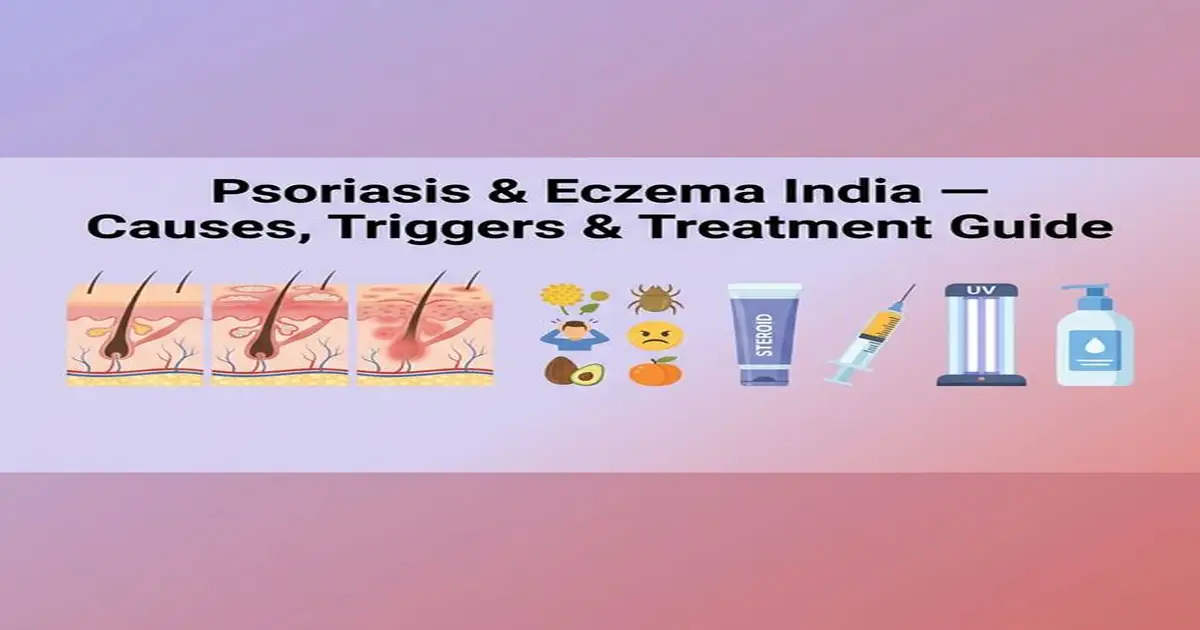
Psoriasis vs Eczema — Key Differences
| Feature | Psoriasis | Atopic Dermatitis (Eczema) |
|---|---|---|
| Mechanism | T-cell mediated autoimmune condition; rapid skin cell turnover (3–5 days vs 28 days normal); excess keratinocyte proliferation; TNF-α, IL-17, IL-23 pathway | IgE-mediated type 1 and late-phase hypersensitivity; skin barrier dysfunction (filaggrin gene mutations in many patients); Th2-mediated inflammation; IL-4, IL-13, IL-31 pathway |
| Age of onset | Two peaks: 15–30 years and 50–60 years; can occur at any age | Predominantly childhood onset; 60% present before age 1; often improves with age but 25% persist into adulthood |
| Appearance | Well-demarcated, thick, silvery-white scales on red plaques; symmetrically distributed; typically non-weeping (unless infected) | Ill-defined, erythematous, weeping, crusting patches; intensely itchy; lichenification with scratching; flexural distribution |
| Common sites | Elbows, knees, scalp, sacrum, umbilicus, nails (pitting, onycholysis); palms and soles (palmoplantar psoriasis) | Flexures (antecubital fossa, popliteal fossa, neck, wrist); face in infants; generalised in severe cases |
| Itch | Moderate; “Auspitz sign” (pinpoint bleeding on scale removal); Koebner phenomenon (new lesions at trauma site) | Severe, relentless itch — the defining and most distressing symptom; “itch-scratch cycle” worsens skin barrier further |
| Associated conditions | Psoriatic arthritis (20–30%); cardiovascular disease (psoriasis = independent CVD risk); metabolic syndrome; depression | Atopic triad: asthma (30%), allergic rhinitis (35%), food allergy; elevated IgE; more common in urban India (hygiene hypothesis) |
| India prevalence | 2–3% (estimated 28–40 million Indians); Punjab and North India variants may be higher | 5–8% of children; 2–3% of adults; rising rapidly in urban India |
Psoriasis — Treatment Guide India
| Severity | Treatment | India Availability & Cost |
|---|---|---|
| Mild (<10% BSA; PASI <10) | Topical corticosteroids (betamethasone, mometasone); Vitamin D analogues (calcipotriol/Daivonex); calcineurin inhibitors for face (tacrolimus); coal tar preparations; emollients (frequent heavy application essential) | Betamethasone cream ₹20–80; calcipotriol ₹200–500; coal tar shampoo ₹100–300; widely available at all pharmacies |
| Moderate–Severe (>10% BSA; PASI >10; joint/nail involvement) | Phototherapy: NB-UVB (narrowband UVB — gold standard for plaque psoriasis; 3×/week; 20–30 sessions); PUVA; Systemic: methotrexate (first-line India — cheap, effective), acitretin, cyclosporine | NB-UVB: ₹200–500/session at dermatology centres; Methotrexate: ₹5/tablet (very affordable); cyclosporine ₹50–200/tablet; available through dermatologist |
| Severe/refractory; Psoriatic Arthritis | Biologics: TNF-α inhibitors (adalimumab/Humira, etanercept); IL-17 inhibitors (secukinumab/Cosentyx — highly effective for moderate-severe psoriasis); IL-23 inhibitors (guselkumab, risankizumab); JAK inhibitors (tofacitinib for PsA) | Biosimilar adalimumab available India ₹8,000–15,000/month; secukinumab ₹25,000–40,000/month; IL-23 inhibitors ₹20,000–35,000/month; PM-JAY does NOT currently cover biologics for psoriasis; significant OOP cost |
Atopic Dermatitis (Eczema) — Treatment Guide India
- 🧴 Emollients (moisturisers) — the foundation of all eczema treatment: Applied immediately after bathing (soak and seal technique — bath then apply within 3 minutes); thick creams or ointments (petroleum jelly/Vaseline; paraffin; urea-based creams — far better than lotions); minimum 2–3× daily. Emollients restore the defective skin barrier, reduce transepidermal water loss, and reduce need for steroid use by 40–50%. India best options: petroleum jelly (₹30–60 for 100g — cheapest and most effective); Cetaphil cream; E45 (imported, pricey); Himalaya sensitive cream (accessible).
- 💊 Topical corticosteroids (TCS): Applied once or twice daily during flares and discontinued on clearance (not for continuous use); use lowest effective potency; face/flexures require mild TCS (1% hydrocortisone only); trunk/limbs may need moderate (mometasone, betamethasone valerate); never use potent steroids on face in India — very common dermatology problem with long-term tinea masquerading as eczema. Topical steroid overuse on face causing steroid-dependent skin is epidemic in India due to unlicensed use of potent combination creams (betamethasone+antifungal creams sold OTC).
- 💊 Calcineurin inhibitors (tacrolimus, pimecrolimus): Non-steroidal anti-inflammatory for face, eyelids, genitals — areas where TCS are unsafe long-term; steroid-sparing agents; tacrolimus 0.1% ointment most effective; cost ₹400–800 in India.
- 💊 Dupilumab (Dupixent) — the biologic for severe eczema: IL-4/IL-13 receptor antagonist; dramatic efficacy for moderate-severe atopic dermatitis (75%+ achieve 75% improvement in EASI score — the EASI-75 response); monthly SC injection; transforms quality of life; approved in India by CDSCO; cost ₹25,000–35,000/month private market; significantly reduces asthma and allergic rhinitis burden simultaneously as it targets the shared Th2 pathway. Market access improving but very expensive — most families in India cannot afford without insurance or CSR programmes.
- 💊 Antihistamines: Sedating antihistamines (promethazine, hydroxyzine) at bedtime to reduce nocturnal itch and allow sleep — not treating the underlying eczema but managing the most distressing symptom. Non-sedating (cetirizine, loratadine) have modest itch-relief in eczema. Cost: generic cetirizine 10mg ₹2/tablet.
Common Triggers — India-Specific
| Trigger | Psoriasis | Eczema | India Notes |
|---|---|---|---|
| Stress | Major trigger — stress-induced cortisol modulates keratinocyte proliferation; flares during exams, work stress, family conflict | Major trigger — stress impairs skin barrier; HPA axis dysregulation worsens itch | Extremely relevant in Indian students (board exams), IT workers; mind-skin connection well established |
| Infections | Streptococcal throat infection triggers guttate psoriasis — small drop-like lesions over trunk; fungal infections exacerbate plaques | Staphylococcus aureus skin colonisation (90% of eczema skin) perpetuates inflammation; herpes simplex → eczema herpeticum (emergency) | Recurrent strep throat in Indian children → repeated guttate psoriasis episodes; monsoon fungal infections exacerbate both |
| Climate | Cold, dry weather worsens; sunlight generally improves (phototherapy basis) — paradoxically, some Indian patients worsen in summer heat+sweating | Dry winter air worsens; sweating in Indian summer also worsens (sweat is an irritant in eczema); air conditioning (drying) | October–February worst for both in North India; ceiling fans running at night → excessive drying of skin in Delhi winters |
| Diet | Alcohol is among the strongest dietary triggers for psoriasis — direct immune effect; obesity worsens; gluten (in documented celiac-psoriasis overlap) | Food triggers in children: egg, milk, wheat, peanut, soy — properly documented food allergy; patch testing needed; NOT same as food intolerance | Mixed vegetable oil and spicy food — popular India belief as trigger — limited evidence; alcohol the most evidence-based dietary trigger for psoriasis |
| Medications | Beta-blockers (atenolol — widely used in India), lithium, NSAIDs (indomethacin), antimalarials — can precipitate or worsen psoriasis | Contact allergens (nickel in jewellery — very relevant in Indian women wearing metal jewellery; fragrance in soaps; preservatives in cosmetics) | Atenolol is the most used beta-blocker in India for hypertension — clinicians must consider psoriasis exacerbation; switch to amlodipine/nebivolol if psoriasis worsens |
Frequently Asked Questions
Is psoriasis contagious?
No — absolutely not. Psoriasis is entirely non-contagious. It cannot be spread by touching, sharing utensils or clothes, swimming in the same pool, or any form of contact. This is the most important misconception to address because the social stigma of psoriasis in India — people refused at barbers, swimming pools, and temples; marriages broken; employment denied — is entirely based on the false belief of contagion. What psoriasis actually is: An autoimmune condition caused by a malfunction of the immune system — specifically T-lymphocytes — that mistakenly attacks healthy skin cells, triggering rapid cell turnover. The skin cells of psoriasis patients complete their lifecycle in 3–5 days vs 28–30 days in normal skin, resulting in a build-up of immature cells on the skin surface → the characteristic silver-white scales. Genetic component: Psoriasis has a strong genetic basis (heritability approximately 65–70%); if one parent has psoriasis, the child has a 15% chance; if both parents, 50% chance. HLA-Cw6 is the most associated genetic marker. But genetics is not destiny — many Cw6-positive individuals never develop psoriasis without environmental triggers. The immune component: IL-17, IL-23, and TNF-α are the primary cytokines driving psoriatic inflammation — the same pathways targeted by modern biologics. Understanding that psoriasis is immune-driven (like arthritis or inflammatory bowel disease) rather than hygiene-related is the foundation of destigmatisation. People with psoriasis deserve to use public facilities, attend social events, and be treated with dignity without fear or discrimination.
Why is steroid cream overuse such a big problem in India?
Topical corticosteroid overuse is one of the most significant dermatological public health crises in India — and it is largely iatrogenic (caused by the medical/pharmacy system itself). The problem is multifactorial: OTC availability of potent combination creams: Fixed-dose combination creams containing potent corticosteroids (clobetasol, betamethasone) + antifungal + antibacterial (e.g., Quadriderm, Panderm, Lobate-GM) are available without prescription across India. These are brilliant “quick fix” products that improve almost any itchy skin condition in the short term through their steroid component — leading patients to overuse them for weeks, months, or years. Consequences of chronic facial steroid application: Steroid-induced rosacea and perioral dermatitis; skin atrophy (thinning — irreversible after prolonged use); telangiectasia (visible blood vessels); hypopigmentation; paradoxical skin dependency — the skin becomes “addicted” to steroid (topical steroid withdrawal syndrome) causing rebound redness, burning, and itch on stopping. This steroid-dependent facial skin (SDFS) is epidemic in Indian dermatology clinics — often affecting young women who began these creams for pigmentation or minor rashes. Misuse for skin lightening: Many Indian patients use these potent steroid combinations as skin lightening agents for prolonged periods — driven by India’s colourism culture. This causes all the above side effects plus mercury toxicity (from some unlicensed creams containing mercury). Guidance: Never use any branded cream containing clobetasol or betamethasone on the face without dermatologist supervision. Never use mild steroid cream (1% hydrocortisone) for more than 7–10 days on face without review. Potent steroids (betamethasone, mometasone) for body psoriasis/eczema should be used in intermittent “weekend therapy” (2 days/week maintenance after clearance) rather than daily. Always use the weakest steroid effective for the particular body site.
Can diet cure psoriasis or eczema?
Diet does not cure psoriasis or eczema — but specific dietary interventions have documented evidence for disease modification: Psoriasis — evidence-based dietary factors: Alcohol elimination — alcohol worsens psoriasis through multiple mechanisms (keratinocyte proliferation stimulation, immune dysregulation, increased gut permeability); complete abstinence in moderate-severe psoriasis is a legitimate medical recommendation. Weight loss — obesity significantly worsens psoriasis; adipose tissue is an inflammatory organ secreting TNF-alpha and IL-6; 5–10% weight loss reduces psoriasis severity and improves biologic response. Mediterranean diet — rich in omega-3 fatty acids, polyphenols, and antioxidants; significant evidence for anti-inflammatory benefit in psoriasis; Indian adaptation: extra virgin olive oil (available in urban India), fatty fish 2–3×/week (sardines/mackerel — affordable), walnuts, flaxseed, abundant vegetables, turmeric (curcumin has modest anti-inflammatory evidence). Gluten-free diet — beneficial ONLY in the subset of psoriasis patients with documented celiac disease (anti-tissue transglutaminase antibodies positive) — approximately 4–7% of psoriasis patients; routine gluten elimination without celiac testing is not recommended. Eczema (atopic dermatitis) — evidence-based dietary factors: Elimination diets for children — only for properly documented IgE-mediated food allergy (skin prick test/RAST positive); blind elimination without testing often nutritionally harmful (milk/egg elimination in toddlers causes rickets, growth failure); do NOT eliminate foods without allergist confirmation. Probiotic supplementation — Lactobacillus rhamnosus GG during pregnancy and in infants has modest evidence for reducing eczema incidence; benefit in established eczema is less clear. Omega-3 supplementation — fish oil 2–4g/day has modest anti-inflammatory evidence for eczema; safe and worth trying. What does NOT help: Generic “anti-inflammatory diets” without personalisation; expensive “organic only” restrictions; multiple food eliminations based on internet advice — these cause nutritional deficiencies without clear benefit. Consult a registered dermatologist + allergist rather than a wellness influencer for skin-diet interactions.
Are biologics available in India and are they affordable?
Biologics represent the most significant therapeutic advance in the management of moderate-severe psoriasis and atopic dermatitis in the last 20 years — and they are increasingly available in India with improving (though still limited) affordability. For psoriasis — key biologics in India: Adalimumab (Humira + Indian biosimilars Exemptia, Adfrar): SC injection every 2 weeks; effective in psoriasis and psoriatic arthritis; biosimilar cost ₹8,000–15,000/month (vs ₹60,000+ for originator Humira); significantly more affordable than originator. Secukinumab (Cosentyx — IL-17A inhibitor): monthly SC injection after loading; highly effective even for nail and scalp psoriasis (difficult sites); cost ₹25,000–40,000/month; no biosimilar yet in India. Guselkumab, risankizumab (IL-23 inhibitors): quarterly dosing after induction — the newest class; highest PASI 90/100 response rates; cost ₹20,000–35,000/month. For atopic dermatitis: Dupilumab (Dupixent): IL-4/IL-13 receptor blocker; transformative for severe atopic dermatitis; ₹25,000–35,000/month; Indian biosimilar in pipeline. Tralokinumab (Adtralza): IL-13 specific; newer option. Access pathways in India: Private insurance coverage: some companies now cover biologics for psoriasis under critical illness or advanced dermatology riders — review your policy. Patient assistance programmes (PAPs): pharmaceutical companies (AstraZeneca for dupilumab, Novartis for secukinumab) run compassionate/reduced-price programmes — ask your dermatologist. AIIMS and government teaching hospitals at reduced price under research protocols. PM-JAY currently does not cover biologics for dermatological indications — a significant policy gap. The trajectory is encouraging — adalimumab biosimilars have already made anti-TNF therapy more accessible; more biosimilars will follow.
Does stress actually cause skin disease?
Yes — the skin-brain axis is a real, mechanistically understood biological pathway. Both psoriasis and eczema have robust evidence linking psychological stress to disease flares through specific neuroimmunological mechanisms: The psycho-neuro-immunological pathway: Psychological stress (exam stress, relationship conflict, work pressure, the stress of the skin disease itself creating a vicious cycle) activates the hypothalamic-pituitary-adrenal (HPA) axis → cortisol elevation → initially anti-inflammatory but chronically disrupts immune regulation (reduces regulatory T-cells, shifts Th1/Th2 balance). Simultaneously, stress activates the sympathetic nervous system → neuropeptide release: substance P, nerve growth factor, calcitonin gene-related peptide (CGRP) → directly stimulate mast cells and keratinocytes → local skin inflammation. Skin itself has its own peripheral HPA axis — keratinocytes and mast cells produce CRH and respond to cortisol independently. Evidence from India: Studies at Indian dermatology centres consistently document stress as a reported trigger in 60–80% of psoriasis patients and 50–70% of eczema patients. JEE/NEET preparation periods, marriage stress, bereavement — all documented precipitants. Itch-scratch cycle: In eczema, anxiety and stress specifically amplify the perception of itch (through central sensitisation at the spinothalamic tract level) → scratching → skin barrier damage → allergen penetration → immune activation → more itch. Breaking this cycle requires BOTH treating the skin and the anxiety. Implications: Stress management is not “soft” adjunct therapy — it is evidence-based component of psoriasis and eczema management. Mindfulness-based stress reduction (MBSR) — 8-week programme — has RCT evidence for reducing psoriasis flare frequency and severity. CBT for eczema-related anxiety reduces scratch behaviour and disease severity. These psychodermatology approaches are available in India at major academic centres and increasingly through telemedicine.
What to Read Next
- Depression — Chronic Skin Disease Causes Significant Depression; Both Require Treatment
- Anxiety — Anxiety is the Key Mediator of Stress-Induced Skin Flares
- Arthritis — Psoriatic Arthritis Occurs in 20–30% of Psoriasis Patients
- Obesity — Obesity Worsens Psoriasis and Reduces Biologic Response
- Vitamin D — Low Vitamin D Worsens Both Psoriasis and Eczema
In India, a person with psoriasis may be refused a seat on a bus, denied employment, or struggled to find a marriage partner — based entirely on a misconception that a non-contagious immune-mediated skin condition is somehow shameful or infectious. Science has answered this question definitively. Psoriasis is no more contagious than arthritis or diabetes. The treatment exists. The cure is improving with every biologic approval. What needs to be treated is also the stigma.
About This Guide: Written by the StudyHub Health Editorial Team (studyhub.net.in) based on IAD (Indian Association of Dermatologists) and IADVL guidelines, AAD psoriasis guidelines, and NICE atopic dermatitis guidance. Last updated: March 2026.
Authoritative Sources: IADVL — Indian Association of Dermatologists | AAD — American Academy of Dermatology | NICE — Eczema Guidelines | WHO
⚕️ Medical Disclaimer: This article is for general informational and educational purposes only. Psoriasis and eczema require dermatologist evaluation for proper diagnosis and management. Never use potent steroid creams on the face without medical supervision. Biologic therapy requires specialist monitoring.