Last Updated: March 2026 | Reading Time: 10 minutes | ~2,100 words
Polycystic Ovary Syndrome (PCOS) is the most common hormonal disorder in women of reproductive age — and India bears a disproportionate burden. Studies across Indian cities show PCOS prevalence of 9.13–36% depending on diagnostic criteria and population studied, with a consensus estimate of approximately 1 in 5 Indian women of reproductive age affected. Despite being so common, PCOS remains dramatically underdiagnosed — many women spend years with irregular periods, acne, hair loss, and weight gain without a clear diagnosis; many are simply told to “lose weight” without investigating the underlying hormonal pathology driving the weight gain in the first place. PCOS is not just a reproductive disorder — it is a lifelong metabolic condition with profound implications for diabetes risk, cardiovascular health, mental health, and quality of life.
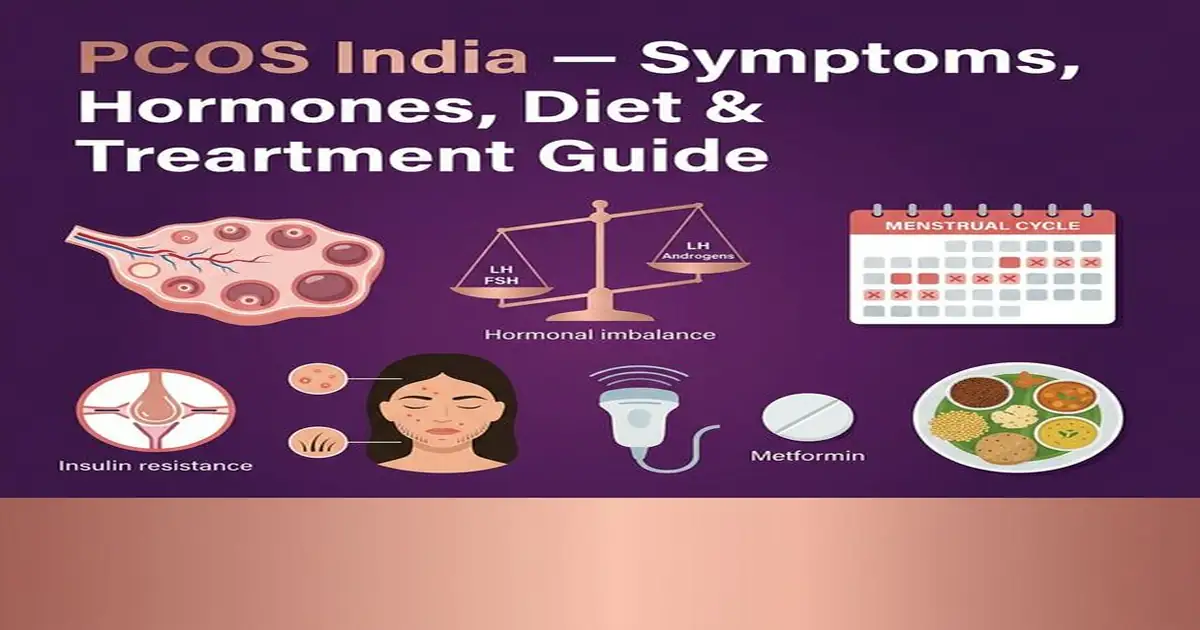
Diagnosis — Rotterdam Criteria (2 of 3 Required)
| Criterion | Definition | How Assessed | India Notes |
|---|---|---|---|
| Oligo/Anovulation | Irregular or absent periods — cycles <21 days or >35 days; fewer than 8 cycles/year; or absence of ovulation (confirmed by day 21 progesterone <5 nmol/L) | Menstrual history; basal body temperature chart; Day 21 progesterone; LH surge detection | Many Indian women normalise irregular periods as “stress” or family trait — a key diagnostic delay factor |
| Clinical or Biochemical Hyperandrogenism | Clinical: hirsutism (excessive hair — face, chest, abdomen — modified Ferriman-Gallwey score ≥6 India); acne; androgenic alopecia (female pattern hair loss). Biochemical: elevated total testosterone, free testosterone, DHEAS, androstenedione | Physical examination (mFG score); serum total testosterone, SHBG, free androgen index; 17-OHP to exclude CAH | Hirsutism assessment must account for ethnic hair patterns — South Asian women have higher baseline body hair; cultural stigma around facial hair causes significant psychological distress |
| Polycystic Ovarian Morphology (PCOM) | Ultrasound: ≥20 follicles per ovary (ESHRE 2023 updated criterion — previously 12); OR ovarian volume >10 mL; transvaginal ultrasound more sensitive than transabdominal | Pelvic ultrasound — transvaginal preferred; transabdominal in virginal women; follicle count and ovarian volume measured | “PCOD” (polycystic ovarian disease) is the colloquial Indian term — medically equivalent to PCOS; PCOM on ultrasound alone WITHOUT other criteria = NOT PCOS diagnosis |
Critical point: PCOM on ultrasound alone — polycystic-appearing ovaries — is present in 25% of normal women without any other PCOS features and does NOT constitute a PCOS diagnosis. Many Indian women are told they have “PCOD” based solely on ultrasound findings without proper hormonal evaluation — this leads to unnecessary treatment and anxiety. The diagnosis requires 2 of the 3 Rotterdam criteria + exclusion of other causes (thyroid disease, CAH, hyperprolactinaemia, Cushing’s syndrome).
Insulin Resistance — The Root of Most PCOS
Insulin resistance (IR) underlies 50–70% of PCOS and is the key driver in most Indian PCOS cases — particularly important given the Indian thin-fat phenotype and genetic insulin resistance predisposition. The mechanism: Insulin resistance → pancreatic beta cells compensate → hyperinsulinaemia (elevated circulating insulin). Elevated insulin directly stimulates ovarian theca cells to overproduce androgens (testosterone, androstenedione). Elevated insulin suppresses hepatic SHBG (Sex Hormone Binding Globulin) production → more free (biologically active) testosterone circulates. Elevated androgens → disrupt normal follicular maturation → follicles arrest at small antral stage (the “cysts” visible on ultrasound — not true cysts) → anovulation. Elevated insulin also directly disrupts LH pulsatility from the pituitary, further impairing ovulation. This means that treating insulin resistance — through weight loss, metformin, diet modification — addresses PCOS at its root cause, rather than just managing symptoms. The IR-PCOS connection also explains why PCOS is strongly associated with Pre-diabetes and T2DM: 30–40% of Indian women with PCOS develop impaired glucose tolerance by age 40; risk of T2DM is 7× higher than women without PCOS.
PCOS Symptoms — The 5 Domains
| Domain | Symptoms | Mechanism | Treatment Focus |
|---|---|---|---|
| Menstrual irregularity | Oligomenorrhoea (cycles >35 days), amenorrhoea (absent periods), heavy or unpredictable bleeding when periods do occur; absence of ovulation | Anovulation from androgen excess + insulin disruption of LH pulsatility → no progesterone production → endometrium not shed regularly | OCP (regulates cycle, reduces androgen); progestogen-only withdrawal bleed; address underlying IR; ovulation induction if fertility desired |
| Hyperandrogenism | Hirsutism (excess facial/body hair — the most distressing symptom for Indian women given cultural significance); acne (adult acne poorly responsive to topical treatment); androgenic alopecia (top of scalp thinning while temples remain) | Elevated free testosterone → pilosebaceous unit stimulation; DHT (dihydrotestosterone — testosterone metabolite) drives scalp hair follicle miniaturisation | OCP (anti-androgenic pills — ethinyl estradiol + cyproterone acetate / drospirenone); anti-androgens (spironolactone, finasteride — only in non-pregnant women); cosmetic (laser hair removal, minoxidil for alopecia) |
| Metabolic | Weight gain (particularly central adiposity); insulin resistance; impaired glucose tolerance; dyslipidaemia (high triglycerides, low HDL); hypertension; fatty liver | Insulin resistance → hyperinsulinaemia → fat storage, particularly visceral; androgen excess → visceral adiposity predisposition | Lifestyle modification (5–10% weight loss dramatically improves all features); metformin; GLP-1 agonists (semaglutide in severe IR-PCOS — off-label but evidence growing) |
| Reproductive | Anovulatory infertility (most common cause of female infertility India); miscarriage risk elevated; gestational diabetes in PCOS pregnancies | Absent ovulation → no egg release → infertility; hormonal milieu hostile to implantation | Letrozole (first-line ovulation induction — superior to clomiphene in PCOS); clomiphene; gonadotropin injections; IVF if required; preconception metformin reduces miscarriage risk |
| Psychological | Depression (3× more common in PCOS); anxiety; body image distress; binge eating disorder; social withdrawal; relationship difficulties | Multiple causative pathways: directly related to androgen effects on brain, chronically elevated cortisol from IR, body image impact of visible symptoms (hirsutism, acne, alopecia, weight), infertility stress | Screen all PCOS patients for depression and anxiety (PHQ-9, GAD-7); CBT for body image; treat underlying PCOS to reduce hormonal drivers; antidepressants where indicated (avoid weight-gaining agents) |
Evidence-Based Treatment — India Guide
| Treatment | Indication | Evidence & India Cost |
|---|---|---|
| Lifestyle modification (5–10% weight loss) | First-line for ALL overweight/obese PCOS women; most impactful single intervention — restores ovulation in 30–50% of women who achieve 5% weight loss | Meta-analyses show 5% weight loss reduces fasting insulin by 20–30%, restores menstrual regularity in 50%+, reduces androgen levels significantly; millet-based diet + 150 min/week exercise; zero cost; highest ROI of any PCOS intervention |
| Metformin | IR-PCOS; pre-diabetes prevention; adjunct to OCP for metabolic benefits; preconception; adolescent PCOS with IR evidence | Reduces insulin levels → reduces androgen drive → improves cycle regularity in 50–70%; reduces gestational diabetes risk significantly; generic metformin ₹2–5/tablet (extremely affordable); widely available; GI tolerance: start 500mg with food, titrate |
| Combined Oral Contraceptive Pill (OCP) | Not seeking pregnancy + menstrual irregularity + hyperandrogenism (hirsutism/acne/alopecia) | Ethinyl estradiol + anti-androgenic progestin (cyproterone acetate — Diane-35; or drospirenone — Yasmin, Yaz); suppresses LH → reduces ovarian androgen production; increases SHBG → reduces free testosterone; regulates cycle; cost ₹100–500/month; NOT recommended indefinitely without breaks and reassessment |
| Letrozole (ovulation induction) | Women with PCOS seeking pregnancy — first-line (replaced clomiphene per NICE and ESHRE 2023 guidelines) | Aromatase inhibitor; higher live birth rate than clomiphene in PCOS (PPCOS II trial); 2.5–7.5 mg Day 3–7 of cycle; monitor with follicular tracking ultrasound; cost ₹20–100 per cycle; requires gynaecologist supervision |
| Spironolactone | Hirsutism/acne not responding to OCP; non-pregnant women only (teratogenic — must use contraception simultaneously) | Anti-androgen; reduces hirsutism by 70–80% at 3–6 months; 50–200mg daily; ₹10–50/tablet; monitor potassium (hyperkalaemia risk, especially with ACE inhibitors) |
| Inositol (myo-inositol + D-chiro-inositol) | Adjunct for IR-PCOS; improving insulin sensitivity; preparing for conception | Growing evidence — reduces insulin resistance, improves oocyte quality in IVF; considered safe; ₹500–1,500/month; categorised as supplement; reasonable add-on under specialist guidance |
Frequently Asked Questions
Can PCOS be cured permanently?
PCOS cannot be permanently cured — it is a lifelong condition with a genetic and epigenetic basis that does not disappear. However, this framing is often unnecessarily discouraging — because PCOS can be managed so effectively that symptoms disappear entirely and quality of life is indistinguishable from women without PCOS. The key reframe: PCOS can be put into long-term remission through sustained lifestyle modification. The evidence: A woman with PCOS who achieves and maintains a 5–10% reduction in body weight (for overweight women) consistently demonstrates restoration of menstrual regularity (50%+ achieve natural ovulation), significant reduction in androgen levels and related symptoms (hirsutism, acne), normalisation of metabolic markers (fasting insulin, blood glucose, lipids), and reduced PCOS symptom burden across all domains. This is not pharmacological intervention — it is the deepest available treatment targeting the root pathophysiology. Some women with lean PCOS (20–30% of PCOS patients are not overweight) have fewer lifestyle-driven components and may have more pronounced neuroendocrine (LH excess) phenotypes — in these cases, cycle regulation through OCP and targeted symptom management are the most appropriate approach. Post-menopause: PCOS reproductive manifestations (anovulation, irregular cycles) resolve at menopause — but the metabolic risk (T2DM, cardiovascular disease, hypertension) persists and requires long-term monitoring. Some evidence suggests the metabolic risk of PCOS persists as elevated cardiovascular event risk even decades post-menopause. The realistic goal for Indian women with PCOS: Not “cure” — but a PCOS-informed life: informed dietary choices, regular exercise, targeted medical treatment for specific symptoms, periodic screening for T2DM and cardiovascular risk, and understanding that this is a manageable condition, not a life sentence.
Should I take the pill (OCP) or metformin for PCOS?
This is the most common treatment decision question in PCOS — and the answer depends entirely on the woman’s primary goals and PCOS phenotype: If the primary goal is menstrual regularity + managing hirsutism/acne (not planning pregnancy soon): The combined oral contraceptive pill (OCP) is most appropriate. It directly regulates cycle, suppresses androgen production, increases SHBG (reducing free testosterone → reduces hirsutism and acne), and prevents endometrial hyperplasia (from anovulation-driven unopposed oestrogen). Anti-androgenic progestins (cyproterone acetate, drospirenone) provide superior anti-androgen effects. Metformin alone is less effective than OCP for these androgenic symptoms. If the primary goal is metabolic improvement (IR, pre-diabetes prevention, weight management): Metformin is most appropriate. It addresses insulin resistance directly — the metabolic root of PCOS. OCP does not improve insulin resistance and some formulations mildly worsen metabolic markers (glucose tolerance). Metformin + lifestyle modification is the most evidence-based metabolic intervention for IR-PCOS. If planning pregnancy: Neither OCP nor metformin is appropriate as primary fertility treatment — stop OCP (fertility returns within 1–3 months), continue metformin (it reduces miscarriage and gestational diabetes risk in PCOS pregnancies), and begin letrozole (first-line ovulation induction) under gynaecologist supervision. Combination approach: Many Indian women with PCOS benefit from both — OCP for symptom control (cycle, androgen symptoms) with metformin for metabolic protection — particularly in women with significant IR markers. Duration question: OCP should not be taken indefinitely without periodic assessment. Every 1–2 years, the OCP can be stopped to assess whether the underlying PCOS has improved (with weight loss or age) — if cycles remain irregular off OCP, continue; if periods normalise, OCP can be used intermittently or discontinued. Metformin can be continued long-term (as it is in diabetes prevention, it is genuinely protective).
Can women with PCOS get pregnant naturally?
Yes — the majority of women with PCOS can achieve pregnancy with appropriate treatment, and many conceive naturally without any medical intervention: Natural conception without treatment: PCOS causes anovulatory infertility — absent ovulation — but not every cycle is anovulatory in PCOS, and cycle regularity varies. Some women with mild PCOS ovulate intermittently and conceive naturally. Women who achieve menstrual cycle regularisation through weight loss (5–10%) frequently restore natural ovulation and conceive without additional fertility treatment. First-line fertility treatment — Letrozole: For women who do not ovulate spontaneously or with lifestyle modification alone, letrozole (aromatase inhibitor) 2.5–7.5mg for 5 days starting Day 3–5 of the cycle is current first-line ovulation induction (ESHRE 2023). Letrozole achieves ovulation in 75–80% of PCOS women per cycle; cumulative pregnancy rates of 55–65% over 6 cycles. Requires ultrasound follicular monitoring to confirm ovulation and time intercourse/IUI. Gynaecologist supervision essential. Cost: letrozole ₹20–100/cycle. Second-line — Gonadotropins/IUI: For letrozole-resistant PCOS (no response to 5+ cycles of letrozole), FSH injections (gonadotropins) inducing follicular development under strict ultrasound monitoring, followed by IUI. Risk of ovarian hyperstimulation syndrome (OHSS) — higher in PCOS — requires careful dose titration. Cost: ₹8,000–25,000/cycle depending on hospital. If all else fails — IVF: IVF (In Vitro Fertilisation) with careful OHSS prevention protocols is highly effective in PCOS — egg retrieval yields are typically excellent (many follicles). Freeze-all strategy (freeze all embryos, transfer in a subsequent hormone-replacement cycle) reduces OHSS risk significantly. Success rates 40–55% per transfer at top Indian IVF centres; cost ₹1–2 lakhs/cycle at government-empanelled centres, ₹1.5–3.5 lakhs private. Important: Metformin 500–1500mg continued through the first trimester of PCOS pregnancies significantly reduces miscarriage risk (from 30–40% without metformin to 10–15% with metformin — a major benefit) and reduces gestational diabetes risk. Discuss with your gynaecologist before stopping metformin upon conception.
What is the best diet for PCOS in India?
Diet is the single most powerful tool in PCOS management — because diet directly modulates insulin resistance, the root pathophysiology in most Indian PCOS cases. The most evidence-based PCOS dietary approach for Indian women: Low Glycaemic Index (Low GI) eating — not caloric restriction: For Indian women, this means practical food swaps more than calorie counting: Replace white polished rice (GI 70–80) with brown rice or millets (jowar, bajra, ragi — GI 50–60); replace maida roti with whole wheat atta or multi-grain roti; eliminate biscuits, white bread, cakes, and packaged snacks; include amla, palak, methi, karela (bitter gourd — natural insulin sensitiser), cinnamon. Protein priority at every meal: Protein at breakfast specifically blunts the morning cortisol + insulin spike common in PCOS — moong dal chilla, besan chilla, paneer-vegetable breakfast, eggs (if non-vegetarian). A protein-prioritised breakfast reduces mid-morning hunger, reduces afternoon carbohydrate craving, and improves insulin sensitivity over the day. Millets for PCOS India — the evidence: Ragi (finger millet): GI 54; high calcium, high fibre; proven in Indian studies to reduce postprandial glucose by 25–30% vs white rice. Bajra (pearl millet): high iron, high magnesium (magnesium is an insulin co-factor — deficiency worsens IR); low GI 54. Jowar (sorghum): GI 62; high protein relative to rice; demonstrated benefit in PCOS in Indian research. Foxtail millet (kangni): lowest GI of common millets — ~50. These are not expensive “health foods” — they are cheaper than polished rice in most Indian markets and far superior metabolically. Avoid dairy overload specifically in PCOS: Milk consumption has insulin-stimulating effects disproportionate to its GI (high insulinotropic index); some evidence suggests high milk intake worsens IGF-1 driven androgen production in PCOS. Replacing 2–3 cups of milk/day with moderate paneer, curd (probiotic benefit), and other protein sources may be beneficial — evidence is evolving. Anti-inflammatory overlay: Turmeric (curcumin — 1 tsp/day in cooking); omega-3-rich foods (flaxseed/alsi, walnuts, sardines/mackerel); green tea (reduces DHT-driven hair loss in some evidence). These address the chronic low-grade inflammation that perpetuates the PCOS cycle alongside insulin resistance.
How does PCOS affect mental health?
PCOS has profound and underappreciated mental health consequences — and in India, the intersection of PCOS with cultural expectations around appearance, fertility, and marriage creates a particularly difficult psychological burden: The epidemiology: Women with PCOS have 3× higher prevalence of depression and 6× higher prevalence of anxiety compared to age-matched controls without PCOS. Rates of eating disorders (especially binge eating disorder and emotional eating) are significantly elevated. Quality of life scores in PCOS are consistently lower than in women with other chronic conditions including epilepsy and asthma — primarily driven by visible symptoms (hirsutism, acne, weight) and infertility concerns. The mechanisms driving mental health impact in PCOS: Hormonal — elevated androgens directly affect serotonin and dopamine systems; elevated LH pulse frequency is associated with anxiety states; chronic HPA axis dysregulation in IR-driven PCOS increases cortisol baseline. Visible symptoms — in Indian culture, facial hair (hirsutism) on women carries severe social stigma; it is linked to femininity, marriage prospects, and social acceptability in many communities. Many Indian women with PCOS spend hours in daily hair removal routines that are emotionally exhausting and financially draining; the shame and suppression of discussing this symptom leads to significant isolation. Weight — in a culture where body size is commented upon openly by family members, PCOS-driven weight gain that is largely insulin resistance-driven (not lifestyle-driven) creates shame and self-blame that is entirely misplaced and harmful. Infertility stress — in a society where motherhood is a central social identity and infertility is frequently stigmatised, a diagnosis of PCOS with fertility implications triggers significant anxiety and marital stress. What helps: Psychological support (CBT for body image; mindfulness; peer support groups — PCOS India support groups available on Facebook, Instagram); treating the physical symptoms reduces psychological burden significantly (OCP dramatically reduces hirsutism within 3–6 months; metformin and weight loss restore cycles → fertility confidence increases); open gynaecologist communication that validates the psychological impact; and screening for depression at every follow-up (PHQ-9 is a validated, 2-minute tool that should be standard in PCOS management India).
What to Read Next
- Diabetes — PCOS Women Have 7× Higher Risk of Type 2 Diabetes
- Obesity — 5–10% Weight Loss Restores Ovulation in 50%+ of PCOS Women
- Thyroid Disease — Thyroid Disorders Are Common in PCOS and Can Mimic/Worsen PCOS Symptoms
- Depression — PCOS Triples Depression Risk; Mental Health Is Part of PCOS Management
- Iron Deficiency — Heavy Irregular Periods in PCOS Can Cause Iron Deficiency Anaemia
PCOS is not a character flaw, a result of eating too much, or a consequence of lifestyle failure. It is a complex neuro-endocrine-metabolic condition with deep genetic roots, exacerbated by a modern food environment designed to worsen insulin resistance. The woman who blames herself for her PCOS weight or her facial hair is blaming herself for her genetics in an unforgiving food environment. The correct response to PCOS is not shame — it is accurate information, skilled medical care, and sustained self-compassion.
About This Guide: Written by the StudyHub Health Editorial Team (studyhub.net.in) based on ESHRE/ASRM 2023 PCOS International Guidelines, FOGSI (Federation of Obstetric and Gynaecological Societies of India) PCOS guidelines, and Indian PCOS epidemiological research. Last updated: March 2026.
Authoritative Sources: ESHRE PCOS Guidelines 2023 | FOGSI India | ICMR India | PCOS Awareness Association
⚕️ Medical Disclaimer: This article is for general informational and educational purposes. PCOS diagnosis requires gynaecologist evaluation — polycystic ovaries on ultrasound alone is NOT a PCOS diagnosis. Fertility treatment must be supervised by a reproductive endocrinologist or gynaecologist. Letrozole and gonadotropins require medical monitoring.