Last Updated: March 2026 | Reading Time: 9 minutes | ~2,000 words
Pneumonia is the single largest infectious killer of children globally — and India bears approximately 20% of the world’s childhood pneumonia deaths, making it a national child health emergency. Despite advances in prevention (PCV, Hib vaccines) and treatment (affordable amoxicillin), pneumonia still kills an estimated 100,000–140,000 Indian children each year — the majority under 2 years old, the majority in rural settings, and the majority preventably. The paradox is stark: pneumonia can be diagnosed using a watch (respiratory rate counting) and treated with amoxicillin tablets costing ₹2. Yet children die because parents don’t recognise fast breathing as danger, don’t know chest indrawing is an emergency, or receive antibiotic injections for viral pneumonia that needs only supportive care. This guide equips every Indian parent, ASHA worker, and healthcare provider with the diagnostic signs and treatment evidence needed to prevent these deaths.
WHO/IMNCI Classification — Diagnosis by Breathing Rate
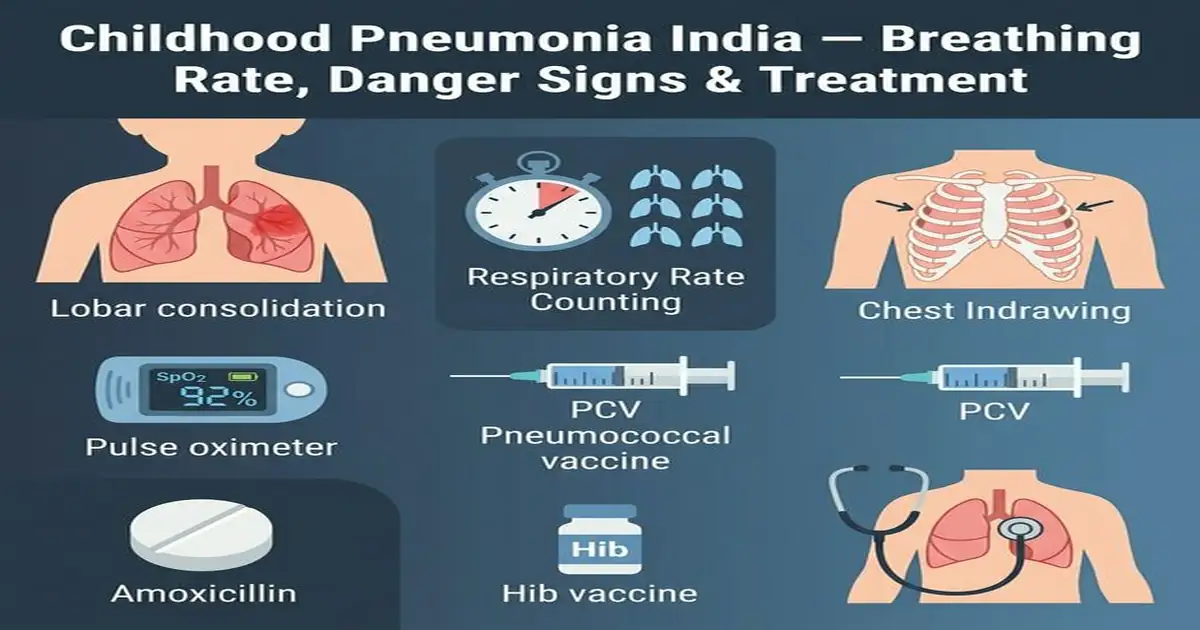
The WHO/IMNCI (Integrated Management of Neonatal and Childhood Illness) classification of childhood pneumonia is designed for use at every level of the health system — even without a stethoscope or X-ray. The respiratory rate thresholds by age:
| Age Group | Normal RR | Fast Breathing (Pneumonia) | Severe Signs | Action |
|---|---|---|---|---|
| Under 2 months | 30–60/min | ≥60 breaths/min | Any of: severe chest indrawing; grunting; nasal flaring; cyanosis; poor feeding; convulsion | EMERGENCY — refer to hospital immediately; oral amoxicillin for fast breathing; IV antibiotics + oxygen for severe signs |
| 2–11 months | 25–40/min | ≥50 breaths/min | Chest indrawing; inability to drink; stridor when calm; SpO2 <90% | Fast breathing without severe signs: amoxicillin oral 5 days + manage at home; severe signs → hospital referral + IV antibiotics |
| 1–5 years | 20–30/min | ≥40 breaths/min | Severe chest indrawing; stridor when calm; inability to drink | Fast breathing without severe signs: amoxicillin 5 days; severe signs → hospital; danger signs (cyanosis, convulsion, lethargic) → emergency |
| 5–12 years | 15–25/min | ≥30 breaths/min | Hypoxia (SpO2 <90%); severe respiratory distress; altered consciousness | Fast breathing alone may indicate walking pneumonia (Mycoplasma) — treat with amoxicillin ± azithromycin; severe → hospitalise |
How to count respiratory rate accurately: Count for a full 60 seconds (not 15 seconds × 4 — too inaccurate for this decision); observe when child is calm and quiet (crying elevates rate — recount after comforting); count chest/abdominal movements; use a watch. This single skill — counting breathing rate for 60 seconds — can identify pneumonia at primary health centre level without any investigations. India’s ASHA and ANM training includes this skill; parents can learn it in 5 minutes.
Causes of Childhood Pneumonia — India Profile
| Pathogen | Age | Features | Treatment |
|---|---|---|---|
| Streptococcus pneumoniae (most common deadly bacterial) | 6 months–5 years | High fever (39–40°C); rapid onset; lobar consolidation on X-ray; toxic appearance; productive cough; excellent response to penicillin/amoxicillin | Amoxicillin 45mg/kg/day in 2 divided doses × 5 days (oral — equivalent to injectable in non-severe cases); ceftriaxone for severe/hospitalised |
| Haemophilus influenzae type b (Hib) | Under 2 years | Can cause bacterial pneumonia, meningitis, and epiglottitis; clinical picture similar to pneumococcal; often more systemic | Amoxicillin; ampicillin-resistant strains: co-amoxiclav or ceftriaxone; Hib vaccine has dramatically reduced incidence (in UIP since 2011) |
| Respiratory Syncytial Virus (RSV) | Under 2 years; peak 2–6 months | Bronchiolitis (RSV in small airways): wheeze + fast breathing + subcostal recession; hypoxia; typically no response to amoxicillin; supportive management; high risk: prematurity, congenital heart disease, immunodeficiency | Supportive: oxygen (SpO2 target ≥92%); nasogastric feeds if unable to feed; hypertonic saline nebulisation; NO antibiotics unless secondary bacterial infection; RSV vaccine (Nirsevimab) available 2024 but not yet in UIP |
| Mycoplasma pneumoniae | 5 years and older (“walking pneumonia”) | Subacute onset; dry hacking cough; mild fever; child appears “not that sick” but has persistent cough; diffuse bilateral infiltrates on X-ray; atypical; amoxicillin alone may not be sufficient | Azithromycin 10mg/kg day 1, then 5mg/kg days 2–5; or clarithromycin; amoxicillin + azithromycin combination if uncertain bacterial vs atypical |
| Staphylococcus aureus | Under 1 year; post-influenza | Rapid deterioration; pneumatoceles (air cavities) on X-ray; empyema; septic appearance; high mortality without early appropriate antibiotics | Cloxacillin IV; MRSA: vancomycin IV; require ICU; must suspect after influenza season in rapidly deteriorating infant |
Prevention — Vaccines & Risk Reduction
| Prevention Tool | Effectiveness | India Status |
|---|---|---|
| PCV (Pneumococcal Conjugate Vaccine) | Reduces pneumococcal pneumonia by 35–45%; reduces all-cause pneumonia hospitalisations by 10–15% population-wide; reduces antibiotic-resistant pneumococcal strains | PCV13 (Prevenar 13) introduced into UIP 2017; schedule: 6 weeks, 14 weeks, 9 months; 3-dose schedule nationally; PCV15/PCV20 available privately covering additional serotypes; programme coverage improving; target >90% coverage |
| Hib vaccine | Reduces Hib pneumonia and meningitis by 85%; dramatic post-introduction reduction in under-5 Hib disease in India | Part of Pentavalent vaccine (DPT+HepB+Hib) in UIP since 2011–2014; 3 doses at 6, 10, 14 weeks; excellent coverage nationally |
| Influenza vaccine | Reduces secondary bacterial pneumonia post-influenza; recommended annually for high-risk children (premature, congenital heart disease, immunosuppressed, Down syndrome) | Not in UIP for all children; recommended for high-risk groups; privately available ₹300–600/dose annually; Fluquadri, Influvac available India |
| Exclusive breastfeeding 0–6 months | Breastfed infants have 3× lower pneumonia incidence vs non-breastfed; SIgA, lactoferrin, macrophages in breast milk provide direct mucosal immunity | 63.7% EBF rate India (NFHS-5); still 36% gap in universal breastfeeding; most cost-effective pneumonia prevention |
| Handwashing with soap | Handwashing with soap reduces acute respiratory infection incidence by 16–20% in children; reduces household transmission of respiratory pathogens | WASH India coverage improving through Swachh Bharat; soap availability in schools and Anganwadis improving; handwashing knowledge high, practice lower |
| Reducing household air pollution | Indoor biomass burning (wood/cow dung/coal cooking) causes particulate matter inhalation → airway inflammation → higher pneumonia susceptibility; PM2.5 exposure in infancy increases pneumonia risk 30–50% | PM Ujjwala Yojana (LPG to BPL households) — one of most impactful pneumonia prevention measures India; 9+ crore households connected; direct correlation between LPG adoption and reduction in childhood respiratory illness burden |
Frequently Asked Questions
Is oral amoxicillin as effective as injection for childhood pneumonia?
This is one of the most important questions in childhood pneumonia management in India — because the cultural and provider preference for “injection treatment” leads to massive overuse of IV antibiotics and unnecessary hospitalisation: The evidence — unambiguous: Multiple large, high-quality RCTs including the ISCAP trial (Indian Severe Community-Acquired Pneumonia trial — conducted in India) definitively showed: For non-severe pneumonia (fast breathing without severe signs), oral amoxicillin 45mg/kg/day × 5 days provides equivalent cure rates (80–90%) to injectable ampicillin. WHO 2013 guideline: For pneumonia without severe signs (no chest indrawing, no hypoxia, no inability to drink), oral amoxicillin is first-line — not IV ampicillin. The “Give an antibiotic injection” reflex in Indian private practice for childhood cough-fever is medically unjustified, more expensive, more painful, and carries unnecessary IV access infection risk. When IV antibiotics ARE indicated: Severe pneumonia: chest indrawing; hypoxia (SpO2 <90%); inability to drink or breastfeed; lethargy or reduced consciousness; stridor when calm. Very young infants (<2 months): all pneumonia in young infants is managed with injectable antibiotics (IV ampicillin + gentamicin) given severity and rapid progression risk. Suspected severe bacterial infection (Staph aureus, Klebsiella): IV therapy essential. Failure of oral therapy after 48–72 hours: switch to IV and reassess. The amoxicillin dosing issue: Standard adult dosing (250mg 3×/day) is significantly underdosing for Indian children with pneumonia. The correct dosing for non-severe pneumonia in India (where pneumococcal strains have higher MIC): amoxicillin 45mg/kg/day in 2 divided doses. For a 10kg child: 45×10 = 450mg/day = 225mg twice daily (approximately). Many Indian physicians prescribe adult 250mg capsules once daily — incorrect dosing that leads to treatment failure. Duration: SHORTER-COURSE amoxicillin (3 days) was found as effective as 5 days in some trials for non-severe pneumonia, but 5 days remains standard recommendation to ensure complete treatment and prevent relapse. Always complete the full course.
How do I tell the difference between a cold and pneumonia in my child?
This is the most practical, most important question for Indian parents managing a child with respiratory illness — distinguishing common viral URTI (cold, that needs only supportive care) from pneumonia (that needs antibiotics and possible hospitalisation): Signs that suggest simple URTI (cold) — observe at home: Runny nose prominent; mild fever (<38.5°C); mild cough; child active and drinking normally; no increase in breathing rate; no chest indrawing. Signs that suggest pneumonia — see a doctor same day: Breathing rate elevated for age (count for 60 seconds when child is calm): ≥60/min (<2 months), ≥50/min (2–11 months), ≥40/min (1–5 years); Lower chest wall indrawing visible on inspiration (the chest wall pulls in between the ribs — subcostal recession — visible with shirt removed); Fever ≥38.5°C lasting more than 2 days; Child not drinking or refusing feeds; Cough lasting more than 7 days without improvement. Signs that require emergency hospital attendance immediately: 🔴 Fast breathing + chest indrawing together → severe pneumonia; 🔴 Cyanosis (blue lips, blue fingernails); 🔴 Stridor (harsh crowing sound on breathing in — when calm, not just when crying); 🔴 Lethargic, floppy, or convulsing; 🔴 SpO2 <90% on pulse oximeter; 🔴 Any danger sign in infant under 2 months — emergency. The “shirt test” for chest indrawing: Remove child’s shirt; watch the lower chest during breathing in; if the lower chest clearly sucks inward with each breath (lower ribs and subcostal area visibly recessing) → chest indrawing = pneumonia until proved otherwise. This sign is visible to parents and is the most reliable physical sign of severe pneumonia identifiable without medical training. ASHA workers in India are trained on this exact sign for community detection.
Why does pneumonia kill so many Indian children despite having a cure?
The question at the heart of India’s childhood pneumonia burden — why do children die of a condition that costs ₹20 to treat? The answer is a convergence of systems failures: Delayed recognition: Parents don’t know fast breathing is the key danger sign — they look for high fever, severe cough, or child being “really sick.” Fast breathing in an otherwise alert infant (early pneumonia) is missed until the child deteriorates to severe pneumonia. IMNCI training for frontline workers addresses this, but parent education remains inadequate at community level. Diagnostic fixation on fever temperature: Families and providers measure fever temperature but not respiratory rate — yet respiratory rate is the more sensitive and specific sign for pneumonia. A thermometer is in every Indian home; a stopwatch is not. Health seeking behaviour barriers: Distance to health facility (especially tribal, remote, and hill regions — Northeast India, Chhattisgarh, Jharkhand have highest pneumonia mortality); Cost perception (even free government treatment has indirect costs — transport, lost wages of accompanying parent); Traditional medicine preference — delay reaching allopathic care; Vaccine refusal — PCV uptake in some communities remains low despite UIP inclusion. Antibiotic resistance: Inappropriate antibiotic prescribing (including for viral pneumonia, under-dosing, and treatment selling by pharmacists without prescription) → selection of resistant S. pneumoniae and H. influenzae → treatment failure with standard amoxicillin in some settings → need for second-line drugs unavailable at primary level. Malnutrition amplification: Severely malnourished children have reduced immune function, impaired respiratory muscle strength, and higher pneumonia mortality; India’s malnutrition-pneumonia nexus is a major driver of mortality. SAM children with pneumonia have 5–10× higher mortality than well-nourished children with the same infection. Solutions with highest impact: Community-based pneumonia management (CBPM) — training ASHAs to identify fast breathing and chest indrawing and give pre-referral amoxicillin — has shown 20–30% reduction in pneumonia mortality in pilot India programmes; universal PCV coverage; Ujjwala LPG expansion; addressing SAM; improving access to pulse oximeters at PHC level (SpO2 below 90% = refer immediately).
What is the role of oxygen in childhood pneumonia?
Oxygen is the most critical and most commonly unavailable treatment in severe childhood pneumonia in India’s peripheral health facilities: Why oxygen is essential in severe pneumonia: Pneumonic consolidation → reduced lung surface area for gas exchange → hypoxaemia (low blood oxygen). Hypoxaemia (SpO2 <90%) → impaired oxygen delivery to brain, heart, and kidneys → multi-organ failure → death. Antibiotics treat the bacterial cause; oxygen supports the child while antibiotics act — the gap between antibiotic administration and bacterial clearance (48–72 hours) is when hypoxaemia kills. SpO2 thresholds for oxygen therapy: SpO2 <90% = start oxygen immediately (100% oxygen via nasal prongs or mask); SpO2 90–94% = oxygen for children with severe clinical features; SpO2 >94% = oxygen not routinely required. Target during treatment: SpO2 ≥94%. Oxygen delivery methods in India: Nasal prongs: 0.5–2 L/min for under 2 years; 2–4 L/min for older children; most comfortable, allows feeding; standard at first referral level hospitals. Face mask: Higher flow; used for more severe hypoxia. Paediatric non-rebreather mask: For SpO2 <80% or respiratory failure — requires 10–15 L/min. Oxygen concentrators: Now widely deployed at CHC/district hospital level under NHM; eliminates cylinder supply problems; should be standard at all inpatient facilities managing pneumonia. India’s oxygen access crisis exposed by COVID-19: The 2021 COVID-19 second wave’s oxygen shortage exposed the chronic under-investment in medical oxygen infrastructure in India. In the post-COVID period, NHM has significantly expanded oxygen concentrator deployment to PHC and CHC level — a silver lining of the pandemic that directly benefits childhood pneumonia management. Hospitals without oxygen concentrators are not equipped to manage severe childhood pneumonia safely. Recognising hypoxia without SpO2 monitor: Clinical signs (when pulse oximeter unavailable): central cyanosis (blue tongue, blue mucous membranes) = severe hypoxia → immediate oxygen; respiratory distress (severe chest indrawing, head bobbing, grunting, nasal flaring) + severe tachycardia → presume hypoxia and start oxygen; altered consciousness in respiratory illness → presume hypoxia ± hypercapnia.
Can the PCV vaccine cause pneumonia or fever — is it safe?
PCV vaccine safety questions are the most common reason for vaccine hesitancy specifically around PCV in communities newly receiving it through the UIP — addressing them accurately is critical: Common after-effects that are normal and expected: Low-grade fever (37.5–38.5°C) for 24–48 hours — occurs in 15–30% of children; this is a normal immune response (toll-like receptor stimulation by the vaccine adjuvant); treat with paracetamol if uncomfortable; self-limiting within 48 hours. Local redness, swelling, and tenderness at injection site — present in 20–40%; resolves within 3 days; apply cool compress but do not massage. Irritability and poor feeding for 1–2 days — common; self-limiting. What PCV does NOT cause: Pneumonia — the vaccine cannot cause pneumonia; it contains only protein conjugates, not live or killed bacteria; fever after PCV is immune activation, not disease. Brain damage or autism — no evidence of any association; extensively studied globally. Long-term harm — PCV has been administered to over 500 million children globally; safety profile is well-established. The evidence for benefit outweighing risk: For every 1,000 children vaccinated with PCV: Approximately 5 prevent hospitalisation from pneumococcal pneumonia; 2–3 prevent pneumococcal meningitis; Small fraction prevented from death. The mild fever and discomfort from vaccination is trivially minor compared to the severity of pneumococcal disease prevented. India-specific concern: Some communities associate PCV with subsequent viral URTI occurring naturally after vaccination (coincidental timing — children receive vaccines at 6 and 14 weeks, a period of naturally high respiratory virus circulation and maternal antibody waning) → causal attribution to vaccine → refusal of next dose. ASHA counselling on anticipated post-vaccination fever and the coincidence of natural respiratory illness is critical for maintaining coverage. Never skip or delay PCV doses — protection is only complete after the full 3-dose schedule.
What to Read Next
- Childhood Asthma — Wheeze + Fast Breathing: Distinguishing Asthma from Pneumonia
- Child Malnutrition — SAM Increases Pneumonia Mortality 5–10 times
- Tuberculosis — TB Pneumonia is a Distinct Entity: Persistent Cough + Night Sweats + Weight Loss
- Diarrhoea — Pneumonia + Diarrhoea Often Co-occur; Both Preventable with Vaccines + Breastfeeding
- Adult Asthma — Childhood Pneumonia Can Cause Bronchiectasis Mimicking Asthma in Adults
A mother who knows to count her child’s breaths for 60 seconds has knowledge that saves a life. A child with 52 breaths per minute who is seen at 7am and given oral amoxicillin survives. The same child at 7pm with untreated pneumonia now has severe chest indrawing and hypoxia — and there is no oxygen cylinder at the closest district hospital. The difference between 7am and 7pm is information. This article is that information.
About This Guide: Written by the StudyHub Health Editorial Team (studyhub.net.in) based on WHO/UNICEF IMCI guidelines, IAP Standard Treatment Guidelines for Pneumonia, and India IMNCI programme protocols. Last updated: March 2026.
Authoritative Sources: WHO IMCI Pneumonia Guidelines | IAP India | NHM India — Respiratory Illness
🚨 Pneumonia Emergency Signs: Count breaths for 60 seconds when child is calm. ≥50/min (under 1 yr) or ≥40/min (1–5 yrs) = see a doctor TODAY. Chest indrawing visible (shirt off, watch lower chest) + blue lips or SpO2 <90% = Call 108 immediately.
⚕️ Medical Disclaimer: This article is for general educational purposes. Childhood pneumonia diagnosis and antibiotic treatment must be supervised by a healthcare provider. Never give antibiotics without medical guidance. Ensure all PCV and Hib vaccination doses are complete per UIP schedule.