Last Updated: March 2026 | Reading Time: 9 minutes | ~2,000 words
Dementia is not a normal part of ageing — it is a group of progressive neurodegenerative diseases that destroy memory, thinking, language, and the ability to perform daily activities. India currently has an estimated 5–5.5 million people living with dementia (Dementia India Report 2010 projection updated to 2024), with Alzheimer’s disease accounting for 60–70% of all cases. As India’s population ages — with the number of Indians above 60 set to reach 300 million by 2050 — dementia will become one of the country’s largest chronic disease burdens. The societal cost is already enormous: dementia care falls entirely on families in India’s limited social support infrastructure, creating massive caregiver burden, financial strain, and psychological suffering for millions of families. Despite this, awareness remains critically low: memory loss is normalised as “old age forgetting,” early treatable causes of dementia (hypothyroidism, B12 deficiency, normal pressure hydrocephalus, subdural haematoma) are missed, and patients who could benefit from medication and structured care reach diagnosis only in advanced stages. This guide provides the framework for early recognition, assessment, and management.
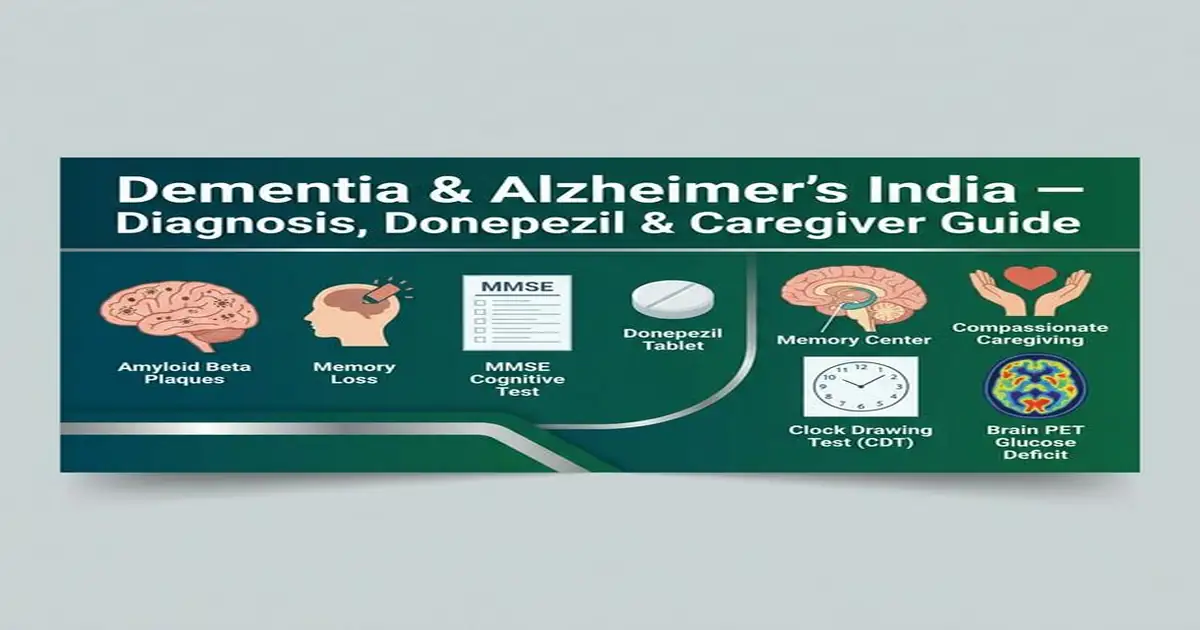
Types of Dementia — Differential Diagnosis
| Type | % of Dementia | Key Features | Onset Pattern | Treatment |
|---|---|---|---|---|
| Alzheimer’s Disease (AD) | 60–70% | Episodic memory impairment first (can’t recall recent events, repeats questions); progressive; loss of orientation (time, then place, then person); language difficulty; visuospatial problems (getting lost in familiar places); personality change late; hallucinations rare until late | Insidious; very gradual; subtle for years before diagnosis; memory complaints noticed by family before patient; “I keep forgetting where I put things” → “I can’t remember my grandchildren’s names” | Cholinesterase inhibitors (donepezil, rivastigmine, galantamine) for mild-moderate; memantine for moderate-severe or add-on; no disease-modifying treatment yet available; lecanemab/donanemab (amyloid-targeting) showing modest efficacy in trials, not yet India-approved |
| Vascular Dementia (VaD) | 15–20%; second most common; very common in India (high stroke, hypertension, diabetes burden) | Stepwise deterioration (each stroke worsens cognition in steps rather than gradual decline); focal neurological signs; executive dysfunction prominent (planning, organising impaired early); memory less affected than AD early; history of stroke/TIA; small vessel disease on MRI (white matter changes) | Often acute or subacute onset correlating with a stroke or TIA event; can be gradual with small vessel disease | No cholinesterase inhibitor evidence; PRIMARY PREVENTION is the treatment — aggressive BP control, diabetes management, antiplatelet therapy (aspirin/clopidogrel for stroke prevention), statin; treat vascular risk factors to prevent further strokes and cognitive decline |
| Lewy Body Dementia (DLB) | 5–15% | Fluctuating cognition (lucid periods alternating with confusion); visual hallucinations (well-formed — “little men,” children, animals — vivid and recurrent); Parkinsonism (tremor, rigidity, slow gait — developing within 1 year of cognitive symptoms — distinguishes from PD dementia where motor precedes cognitive by >1 year); severe neuroleptic sensitivity (antipsychotics → catastrophic worsening); REM sleep behaviour disorder (acting out dreams) | Often difficult to distinguish from PD dementia; the “1-year rule” — DLB: cognitive + Parkinsonism within 1 year; PDD: Parkinsonism many years before dementia | Rivastigmine best evidence for DLB; cholinesterase inhibitors help hallucinations and cognition; AVOID antipsychotics (haloperidol, risperidone, olanzapine) — can cause catastrophic deterioration and death from neuroleptic sensitivity; if antipsychotic must be used: quetiapine very low dose only |
| Frontotemporal Dementia (FTD) | 5–10%; most common dementia under age 65 | Personality and behaviour change prominent early (disinhibition, socially inappropriate, loss of empathy, impulsivity — often mistaken for psychiatric illness or “character change”); memory relatively preserved early (distinguishes from AD); language variants: progressive non-fluent aphasia; semantic dementia (loss of word meaning) | Typically younger onset (50–65 years); behaviour change often precedes formal diagnosis by 2–5 years; family members (not patient — who lacks insight) notice dramatic personality change | No approved disease-modifying treatment; treat behavioural symptoms (SSRIs for disinhibition/aggression — sertraline, citalopram evidence); avoid antipsychotics; caregiver support critical; safety assessment important (disinhibition creates social and legal risk) |
| Reversible causes (must exclude in every case) | 5–10% of dementia presentations are partially or fully reversible | Hypothyroidism; Vitamin B12 deficiency; Normal pressure hydrocephalus (triad: cognitive decline + gait disorder + urinary incontinence — “wet, wobbly, wacky”); Subdural haematoma; Neurosyphilis; Cryptococcal meningitis (HIV+); Drug-induced cognitive impairment (anticholinergics, benzodiazepines, opioids); Depression (“pseudodementia” — profound depression mimics dementia) | Reversible causes often have subacute or acute onset; non-progressive or fluctuating; important: B12 deficiency is endemic in India (vegetarian diet) and a major reversible cause of cognitive impairment — must be checked in every dementia assessment | Treat the underlying cause: levothyroxine for thyroid; B12 injections; VP shunt for NPH; evacuation for subdural; treat depression; stop causative drugs; full or partial cognitive recovery possible if caught early |
Assessment Tools — The India Context
| Tool | What It Measures | Score Interpretation | India Considerations |
|---|---|---|---|
| MMSE (Mini-Mental State Examination) | 30-point scale testing orientation, registration, attention, recall, language, visuospatial; takes 10–15 minutes; widely used globally for 50 years | 26–30: Normal; 18–25: Mild cognitive impairment/mild dementia; 10–17: Moderate dementia; <10: Severe dementia | Education-biased — literate patients score better; needs language adaptation (Hindi/regional language versions); cut-off adjusted downward for low-education individuals; validated Hindi MMSE available; illiterate elderly patients need alternative tools |
| MoCA (Montreal Cognitive Assessment) | 30-point scale; covers more executive function than MMSE; more sensitive for mild cognitive impairment (MCI); includes trail making, clock drawing, cube copy, visuospatial tasks; takes 10–15 minutes | ≥26: Normal; 18–25: Mild cognitive impairment; 10–17: Moderate dementia; <10: Severe | MoCA Hindi and several regional language validated versions available; superior to MMSE for detecting early MCI before frank dementia; MoCA <26 with memory complaints = refer to neurologist for full assessment; add 1 point if <12 years education |
| Clock Drawing Test (CDT) | Ask patient to draw a clock face from scratch, mark “10 past 11” — assesses visuospatial function, executive planning, numerical cognition; takes 2 minutes; no literacy required | Qualitative: Normal = complete face, correct numbers, hands in correct position; Mild impairment = minor spacing errors; Severe impairment = disorganised, numbers missing, hands absent/wrong | Can be administered by any trained health worker including ASHA; no literacy requirement; helpful for screening cognitively impaired patients who cannot complete MMSE/MoCA; culturally acceptable — all elderly Indians familiar with clock face |
| Investigation panel for new dementia | Mandatory blood tests to exclude reversible causes: FBC (anaemia); TSH (hypothyroidism); Vitamin B12 (B12 deficiency — very common India, vegetarian diet); folic acid; renal function; LFTs; calcium; fasting glucose; HIV (in relevant context); syphilis serology (RPR) | Any reversible cause identified = treat before diagnosing irreversible dementia; Vitamin B12 below 150 pg/mL with neurological symptoms = treat regardless of exact level; TSH elevated = treat before attributing cognitive impairment to neurodegeneration | B12 deficiency is arguably the single most important blood test in Indian dementia assessment — endemic in vegetarians, worsened by metformin use, and causes cognitive impairment that partially reverses with B12 supplementation; missed B12 deficiency masquerading as AD is a significant India-specific problem |
Frequently Asked Questions
What is the difference between normal age-related forgetfulness and dementia?
This is the most important distinction for Indian families who often either normalise early dementia as “old age” or catastrophise normal age-related memory changes as dementia: Normal age-related memory changes (NOT dementia): Taking longer to recall names (but eventually remembering — “tip of the tongue” phenomenon); slower processing speed (taking more time to complete tasks); more difficulty multitasking; occasionally misplacing objects but retracing steps and finding them; forgetting an appointment but remembering it later; NOT progressing to significant functional impairment. Mild Cognitive Impairment (MCI) — the grey zone: MCI is the intermediate stage: subjective cognitive complaint (patient/family notices memory or other cognitive change); objective cognitive impairment on testing (MoCA below 26, or memory test 1.5 SD below age norm); but preserved daily function (ADL intact); 10–15% of MCI patients progress to dementia per year (vs 1–2% of cognitively normal elderly). MCI that is predominantly memory-based (amnestic MCI) has highest conversion rate to AD. Early dementia — the difference from normal ageing: Forgetting recent events (what they ate for breakfast, who visited yesterday) but retaining distant memories (preserved remote memory until later stages); repeating the same question in the same conversation multiple times, having forgotten asking; getting lost in familiar environments (neighbourhood, local market); inability to manage previously routine tasks (bill payment, cooking steps, medication management); losing track of dates, months, seasons; word-finding difficulty progressing from occasional to frequent; personality change (increased irritability, suspicion, withdrawal, depression); this is NOT normal ageing and warrants a formal assessment. The India normalisation problem: Indian families commonly normalise early dementia symptoms for 2–4 years before seeking help: “Aai is just getting old,” “Papa was always forgetful,” “Dadi’s memory was never good.” This delay means patients reach diagnosis when moderate-advanced, missing the window when medications make the most difference and safety planning is most needed. Community education through ASHA and Anganwadi workers on dementia red flags is one of the highest-impact interventions for early detection.
Do dementia medicines (donepezil) actually work?
Donepezil and other cholinesterase inhibitors represent an important but often misunderstood class of drugs — understanding what they do and don’t do is critical for realistic patient and caregiver expectations: What cholinesterase inhibitors do: In Alzheimer’s disease, cholinergic neurons (which use acetylcholine as their neurotransmitter) are disproportionately lost. Cholinesterase inhibitors (donepezil, rivastigmine, galantamine) work by blocking the enzyme that breaks down acetylcholine → acetylcholine levels temporarily restored → modest improvement in cognitive function, behaviour, and daily activities. The evidence — realistic assessment: Multiple large RCTs (NICE technology appraisal, Cochrane reviews): Cholinesterase inhibitors produce a modest but statistically significant improvement in cognitive function (MMSE score improvement of 1–3 points vs placebo); modest improvement in functional abilities and neuropsychiatric symptoms (agitation, hallucinations). Clinical significance: About 40–50% of patients show some measurable benefit; drug does not stop disease progression — it delays functional decline by approximately 6–12 months; after stopping drug suddenly, patients often deteriorate to the level they would have been without drug (suggesting ongoing benefit). Practical prescribing in India: Donepezil 5mg at night × 4 weeks → increase to 10mg if tolerated; main side effects: nausea, vomiting, diarrhoea, muscle cramps (all cholinergic) — worst in first 2 weeks, usually subside; vivid dreams/nightmares (switch to morning dosing if problematic); bradycardia (if history of cardiac conduction disease, ECG first); India cost: Donepezil 10mg: ₹30–80/tablet depending on brand (Adonep, Donecept, Donep, Aldomer); generic available Jan Aushadhi: ₹15–25/tablet — affordable; Rivastigmine patch (Exelon patch): better tolerated for GI side effects; ₹400–800/patch (monthly cost ₹12,000–24,000 — prohibitive); Galantamine: less commonly used India. Memantine (for moderate-severe AD or add-on): NMDA receptor antagonist; different mechanism; modest benefit in moderate-severe AD; dose: 5mg/day → 20mg/day over 4 weeks; India cost: ₹50–120/tablet; Admenta brand commonly available. When to start and how long to continue: Start at mild-moderate stage (MMSE 10–26); continue even as disease progresses (ongoing benefit in moderate-severe); stop only if significant adverse effects or patient/family decide to discontinue given the modest benefit; do not stop suddenly (risk of precipitous decline); do not use in severe dementia (MMSE <10) — benefit absent; cholinesterase inhibitors are NOT appropriate for vascular dementia (no evidence) or FTD (may worsen behaviour).
How should families manage behavioural symptoms of dementia?
Behavioural and psychological symptoms of dementia (BPSD) — agitation, aggression, wandering, sleep disturbance, hallucinations, depression, disinhibition — are the most distressing aspect of dementia for caregivers and the most common reason for institutionalisation or hospitalisation: The guiding principle: Non-pharmacological approaches FIRST, always: Maintain routine: predictable daily schedules reduce agitation in dementia; use of familiar music (Bollywood songs from the patient’s youth are remarkably effective in Indian dementia patients — music activates emotional memory circuits preserved longer than verbal memory); Photo albums and familiar objects; Aromatherapy (lavender for agitation — modest evidence). Specific behavioural strategies: Agitation and aggression: Identify and address the trigger (pain, constipation, urinary retention, fear, environmental overstimulation); Do not argue with or correct the patient about false beliefs — use distraction and validation instead (“Yes, we’ll call your mother soon” rather than “Your mother has been dead for 20 years”); Simplify environment (reduce visual complexity, remove mirrors if patient is distressed by own reflection — common in moderate-severe AD). Wandering: Door alarms and GPS trackers (critical for safety — road accidents and getting lost are leading causes of injury and death in wandering dementia patients); Safe walking routes within home (minimise exit opportunities); Identity bracelets with name + contact number (essential recommendation for all motorically mobile dementia patients); Enlist neighbourhood awareness. Sleep disturbance: Maintain day-night distinction (bright light exposure during day; dark quiet at night); avoid daytime napping; melatonin 3–6mg at nighttime (evidence for sundowner syndrome); if hallucinations disturbing sleep: rivastigmine. When pharmacological behavioural management is needed: Severe agitation with risk to self or others: Risperidone 0.5mg if behaviours severe (lowest effective dose, shortest possible duration, with explicit recognition that all antipsychotics increase stroke and death risk in dementia patients by 1.5–1.7×; must be explicit consent discussion; avoid in DLB — catastrophic); AVOID benzodiazepines long-term (paradoxical agitation, confusion, falls risk worsen in dementia); SSRIs (sertraline) for mood symptoms and some agitation; Melatonin for sleep. India-specific challenge: Behavioural symptoms are the primary driver of family distress and caregiver burnout in India; community dementia support groups, caregiver training, and respite care are almost entirely absent outside metro cities; the Alzheimer’s and Related Disorders Society of India (ARDSI) provides some caregiver resources but is vastly under-resourced relative to population need.
Can dementia be prevented?
The 2024 Lancet Commission on Dementia Prevention, Intervention and Care identified 14 modifiable risk factors that together account for approximately 45% of dementia cases worldwide — meaning nearly half of all dementia is potentially preventable: The 14 modifiable risk factors (and India-specific relevance): 1. Less education (population attributable risk 5%) — India’s improving educational attainment is the primary driver of “cognitive reserve” at population level; 2. Hypertension in midlife (2%) — India’s hypertension epidemic is directly relevant; 3. Hearing loss (7% — highest single risk) — untreated hearing loss is the #1 modifiable dementia risk; hearing aids significantly reduce this risk; yet hearing aid use in India is extremely low despite high hearing impairment prevalence among elderly; 4. Smoking (5%) — India’s tobacco burden directly contributes; 5. Obesity in midlife (1%); 6. Physical inactivity (2%) — sedentary lifestyle increasing India; 7. Depression (3%) — treating depression in midlife reduces dementia risk; 8. Social isolation (5%) — India’s urbanisation → nuclear families → isolation of elderly is an increasing concern; 9. Excessive alcohol (1%); 10. Traumatic brain injury (3%) — road traffic accidents (India has the world’s highest RTA deaths) → head trauma → increased AD risk; 11. Air pollution (3%) — India’s PM2.5 exposure is among the world’s highest; 12. Diabetes (2%); 13. LDL cholesterol (7% — new in 2024 commission: statin use may reduce dementia risk in some populations); 14. Vision loss (2% — new in 2024: uncorrected vision impairment increases dementia risk; glasses may protect). The most immediately actionable India-relevant measures: Get hearing tested (free at PHC level in many states) and use a hearing aid if hearing impaired — this one intervention has the largest single modifiable impact; Treat hypertension and diabetes aggressively (blood pressure control in midlife is one of the strongest dementia prevention interventions); Stop smoking; Stay socially and mentally active (regular social engagement, learning new skills, reading, active participation in family and community life — all reduce dementia risk); Exercise regularly (aerobic exercise 150+ minutes/week); Protect brain from head injury (motorcycle helmets — India’s most preventable head injury cause). Cognitive reserve: Education, intellectually stimulating work, bilingualism, and lifelong learning build “cognitive reserve” — a buffer against the clinical expression of neurodegeneration; brains with higher reserve can tolerate more amyloid burden before dementia symptoms emerge; this partly explains why highly educated individuals tolerate more pathology before presenting with dementia.
How can caregivers in India cope with dementia?
In India, dementia care is almost exclusively provided by family — typically a spouse (elderly) or adult daughter/daughter-in-law — without professional support, respite services, or adequate training: The caregiver burden data: 60–80% of Indian dementia caregivers report high or very high burden (Caregiver Burden Scale); 40–50% develop clinical depression; 30–40% develop anxiety disorders; physical health consequences including sleep deprivation-related conditions; financial devastation from reduced work capacity + increasing care costs; caregiver health is inextricably linked to patient outcomes — a burned-out, depressed caregiver cannot provide safe or quality care. Practical strategies for Indian caregivers: A) Safety first: kitchen gas locks; stove guards; medication lock-boxes (patient may take wrong dose or hoard medications); bathroom grab rails; door alarms; remove car keys (driving dementia is illegal and dangerous — discuss family-supported driving cessation early). B) Communication with the dementia patient: Use short, simple sentences; one instruction at a time; speak slowly and clearly; allow extra time for response; never correct, argue, or shame; validate emotions rather than factual inaccuracies; say the patient’s name at start of every sentence to get attention. C) Personal care: Create routine bath/meal/sleep rituals; involve patient in simple tasks to maintain dignity and agency (folding laundry, peeling vegetables — simplified tasks engagement proven to reduce agitation); adapt diet to swallowing ability (soft foods when dysphagia develops). D) Managing the emotional impact: Allow yourself to grieve (the patient’s personality change is a bereavement-like loss — it is normal and healthy to mourn the person your loved one was); accept that some days will be much harder than others; seek caregiver support groups (ARDSI has regional chapters; online support emerging post-COVID); do not isolate — reach out to other family members, friends, and community. E) Plan ahead: legal and financial planning (Power of Attorney, advance care directives) should be completed while the patient still has capacity; this is emotionally difficult but practically essential and prevents legal complications later. Resources in India: ARDSI (Alzheimer’s and Related Disorders Society of India) — has regional chapters; helpline; caregiver training; The Banyan (Chennai-based mental health NGO) — has dementia care units; iCall and Vandrevala Foundation helplines — for caregiver mental health support.
What to Read Next
- Parkinson’s Disease — Parkinson’s Disease Dementia: When PD and Dementia Coexist
- Depression — Treating Depression in Elderly May Reduce Future Dementia Risk
- Vitamin B12 — B12 Deficiency is a Major Reversible Dementia Cause in India’s Vegetarian Population
- High Blood Pressure — Midlife Hypertension is the Most Modifiable Vascular Dementia Risk Factor
- Sleep — Sleep Disturbance Increases Amyloid Accumulation; Poor Sleep in Midlife Increases AD Risk
5 million Indians with dementia. 15 million caregivers bearing that burden — silently, exhaustedly, without training, without break, without recognition. Every rupee spent on caregiver training, respite care, and community dementia awareness is worth ten rupees in prevented hospitalisation, caregiver illness, and patient suffering. India’s dementia response is not primarily a pharmacological problem. It is a systems problem, a social problem, and a compassion problem. The drugs exist. The knowledge exists. The missing piece is the connection between that knowledge and the 15 million Indian families who need it today.
About This Guide: Written by the StudyHub Health Editorial Team (studyhub.net.in) based on the 2024 Lancet Commission on Dementia, DSM-5 diagnostic criteria, ARDSI India resources, and IAN dementia practice parameters. Last updated: March 2026.
Authoritative Sources: ARDSI — Alzheimer’s Society India | 2024 Lancet Dementia Commission | Alzheimer’s Disease International
🔍 ALWAYS check B12 and TSH in new dementia: Vitamin B12 deficiency (extremely common in Indian vegetarians) and hypothyroidism are partially reversible causes of dementia. A ₹500 blood test can rescue a patient from a diagnosis of progressive, irreversible Alzheimer’s disease. Do not skip this step.
⚠️ Antipsychotic Warning in Dementia: Antipsychotics (haloperidol, risperidone, olanzapine) increase stroke and death risk by 1.5–1.7× in elderly dementia patients. Never give to Lewy Body Dementia patients. Use only as last resort for severe agitation with safety risk, after non-pharmacological measures have failed.
⚕️ Medical Disclaimer: This article is for general educational purposes. Dementia diagnosis requires formal neuropsychological assessment by a qualified clinician. All treatment decisions including cholinesterase inhibitors and memantine must be made by a qualified doctor. Donepezil may not be suitable for all patients.