Last Updated: March 2026 | Reading Time: 9 minutes | ~2,000 words
Colorectal cancer (CRC) — cancer of the colon or rectum — is the third most common cancer globally and one of the fastest-rising cancers in urban India. An estimated 35,000–40,000 Indians are diagnosed with colorectal cancer annually, with incidence rising 2–3% per year in urban populations — driven by rapid dietary Westernisation (increased red meat, processed food, low fibre), sedentary lifestyle, obesity, and declining physical activity. The median age at diagnosis in India (50–55 years) is approximately 10 years younger than in Western populations. This “early-onset CRC” trend (under 50) is a global phenomenon particularly relevant to India’s young, urbanising demographic. The critical insight: CRC is one of the most preventable and detectable cancers — colonoscopy screening can detect and remove pre-cancerous polyps before they become cancer, and early-stage CRC (Stage I–II) has 80–90% 5-year survival vs Stage IV metastatic disease (<15% 5-year survival). India’s challenge is that over 60% of CRC patients present at Stage III–IV — when cure is significantly harder — due to lack of organised screening and late presentation.
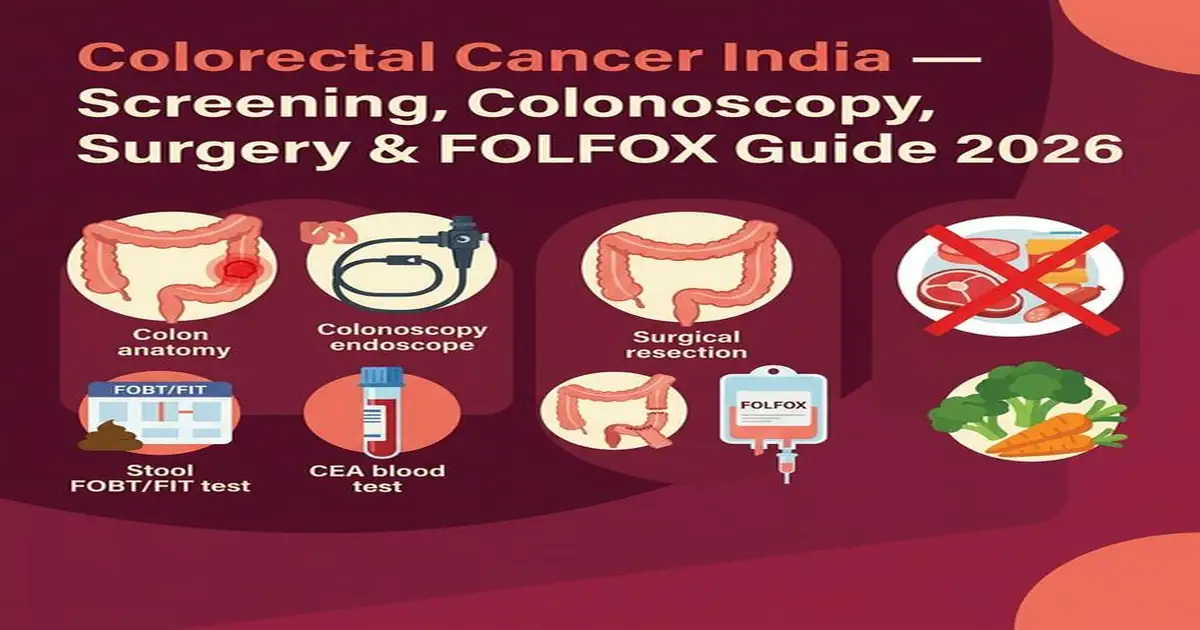
CRC Risk Factors — India Context
| Risk Factor | Evidence | India Relevance |
|---|---|---|
| Red and processed meat consumption | Grade A — IARC (International Agency for Research on Cancer): processed meat (bacon, sausages, salami) = Group 1 carcinogen (definite cause of CRC); red meat (beef, pork, lamb) = Group 2A (probable). Risk: 1 serving processed meat/day → 18% increased CRC risk; each 50g processed meat/day → increases CRC risk by 18% | Rising consumption in urban India — chicken tikka, seekh kebab, processed sausages/nuggets; traditional plant-heavy Indian diet (dal, sabzi, roti) is protective; dietary transition to Western patterns is driving urban CRC rise; vegetarian Indians have 20–30% lower CRC rates than non-vegetarians |
| Low dietary fibre | Grade A — Each 10g/day increase in dietary fibre → 10% reduced CRC risk; protective via: short-chain fatty acids (butyrate from fermentation of fibre — maintains colonic epithelial health, anti-apoptotic), reduced transit time (less carcinogen contact), microbiome modulation | Traditional Indian diet (chapati, dal, vegetables) is naturally high fibre — protective; urban shift to refined foods (white bread, biscuits, white rice replacing whole grain), reduced vegetable intake; recommended: 25–35g fibre/day; few Indians meet this target; psyllium/isabgol supplement can supplement if diet inadequate |
| Physical inactivity and obesity | Grade A — Physical activity reduces CRC risk by 20–25%; obesity (BMI >30 — waist circumference in Indians: men >90cm, women >80cm) increases CRC risk 40%; mechanism: hyperinsulinaemia, IGF-1, chronic inflammation | India’s rapid sedentarisation — desk jobs, no active commute, screen time; visceral/central obesity particularly high in urban Indians even at normal BMI; 30 minutes moderate physical activity 5 days/week is protective |
| Alcohol | Grade A — Each 10g/day alcohol → 7% increased CRC risk; no safe lower limit; affects all CRC subsites | Rising urban India alcohol consumption (beer, spirits); IARC: alcohol = Group 1 carcinogen for multiple cancers including CRC; India’s drinkers tend to binge-pattern drinking (higher acute exposure) |
| Adenomatous polyps (colonoscopic findings) | CRC arises almost always from adenomatous polyps (adenoma-carcinoma sequence); timeline: normal mucosa → adenoma → high-grade dysplasia → carcinoma = 10–15 year process; polypectomy during colonoscopy interrupts this sequence and PREVENTS cancer | India’s lack of organised colonoscopy screening means most polyps are never detected; high-risk adenoma (≥3 polyps, any adenoma ≥1cm, villous/tubulovillous pathology, high-grade dysplasia) requires 3-yearly surveillance; low-risk adenoma: 5-yearly |
| Hereditary CRC syndromes | Lynch syndrome (HNPCC): mismatch repair (MMR) gene mutations (MLH1, MSH2, MSH6, PMS2) → 40–80% lifetime CRC risk; Amsterdam criteria: ≥3 family members with CRC including one first-degree relative, ≥2 successive generations, one <50 years. FAP (Familial Adenomatous Polyposis): APC gene → hundreds of colonic polyps by adolescence; virtually 100% lifetime CRC risk without prophylactic colectomy | Both Lynch syndrome and FAP are under-recognised in India; any patient with CRC under 50 or multiple family members affected should have germline genetic testing; cascade testing of family members enables prophylactic treatment; Lynch syndrome patients also have elevated endometrial, ovarian, gastric, and urinary tract cancer risk |
CRC Staging and Survival — TNM and AJCC
| Stage | TNM Description | 5-Year Survival (Western data — India likely lower due to later presentation) | Treatment Approach |
|---|---|---|---|
| Stage I | T1–T2, N0, M0 — tumour confined to colon wall layers; no nodal involvement; no metastases | 90–95% | Surgery alone (colectomy with adequate margins and lymph node harvest ≥12 nodes); no adjuvant chemotherapy required |
| Stage II | T3–T4, N0, M0 — tumour penetrates through colon wall or into adjacent structures; no nodal involvement | 70–85% | Surgery primary; adjuvant FOLFOX chemotherapy considered for high-risk Stage II (perforation, T4 disease, <12 lymph nodes harvested, poor differentiation, LVI/PNI); MSI-H/dMMR Stage II has excellent prognosis without chemotherapy — molecular testing essential |
| Stage III | Any T, N1–N2, M0 — lymph node metastases present; no distant metastases | 40–70% (depending on N1 vs N2 — 1–3 vs ≥4 nodes involved) | Surgery + adjuvant FOLFOX chemotherapy ×12 cycles (6 months); FOLFOX significantly improves survival (oxaliplatin + 5-FU + leucovorin); in rectal cancer: preoperative chemoradiation (neoadjuvant CRT) → surgery → adjuvant chemotherapy (total mesorectal excision — TME is gold standard for rectal cancer) |
| Stage IV | Any T, Any N, M1 — distant metastases (most commonly liver 50%, then lung, peritoneum) | 10–15% (significantly better if liver-only resectable metastases: 30–40% 5-year survival after curative resection) | Palliative chemotherapy (FOLFOX, FOLFIRI, CAPOX); targeted agents (bevacizumab — anti-VEGF; cetuximab/panitumumab — anti-EGFR for RAS wild-type); immunotherapy (pembrolizumab/nivolumab for MSI-H metastatic CRC — durable responses); liver resection if oligometastatic and resectable — potential cure; best supportive care |
Frequently Asked Questions
Who needs colonoscopy screening in India and when?
Colonoscopy is the gold-standard CRC screening test — it both detects and removes pre-cancerous polyps in the same procedure — but India has no organised population-wide CRC screening programme unlike the UK, USA, Australia, or Japan: Current international guidelines — applicable to India: Average-risk individuals: colonoscopy from age 45 (ACS 2018 guideline updated from 50) — particularly relevant in India given younger median age at diagnosis; if normal: repeat every 10 years; High-risk individuals: earlier and more frequent screening (see below). High-risk groups requiring earlier/more intensive colonoscopy: 1. Family history of CRC: first-degree relative (parent, sibling, child) with CRC or advanced adenoma: colonoscopy at age 40 or 10 years younger than affected relative’s age at diagnosis (whichever is earlier); 2 or more first-degree relatives: colonoscopy at age 40. 2. Personal history of adenoma: low-risk adenoma (<3 polyps, all <1cm, tubular): repeat at 5 years; high-risk adenoma (≥3 polyps, any ≥1cm, sessile serrated, villous/tubulovillous, HGD): repeat at 3 years. 3. Lynch syndrome: annual colonoscopy from age 20–25; 4. IBD (Ulcerative Colitis): pancolitis ≥8 years → annual/biennial colonoscopy; left-sided colitis ≥15 years → 2-yearly. Non-invasive screening alternatives (where colonoscopy access is limited): FIT (Faecal Immunochemical Test): detects haemoglobin in stool using antibodies specific to human haemoglobin; FIT annually (if positive → colonoscopy); sensitivity 70–80% for CRC; widely available in India (₹300–800); simple — done at home. CT colonography (virtual colonoscopy): high sensitivity for polyps ≥6mm; no sedation required; radiation exposure; cannot biopsy — colonoscopy needed if abnormality found; available at tertiary radiology centres India; expensive (₹8,000–15,000). India access reality: Diagnostic colonoscopy is available at most district hospitals and private gastroenterology practices; cost: government hospitals ₹1,000–2,000; private ₹5,000–12,000; PMJAY Ayushman Bharat covers colonoscopy as a diagnostic procedure at empanelled centres; the bottleneck is patient awareness and referral — most Indian patients seek colonoscopy only when symptomatic (rectal bleeding, change in bowel habit) — at which point cancer may already be advanced. Symptoms requiring urgent colonoscopy (NOT screening — diagnostic): Rectal bleeding (haematochezia — blood with stool or on toilet paper; DO NOT attribute all rectal bleeding to haemorrhoids — always rule out CRC in anyone over 40 with new or changed rectal bleeding); new/changed bowel habit (persistent change in stool form or frequency for >4 weeks); iron deficiency anaemia without obvious cause (occult CRC is a common cause in over-50s); tenesmus (feeling of incomplete evacuation); unexplained weight loss; palpable abdominal mass.
What is the surgery for colorectal cancer?
Surgery remains the cornerstone of curative treatment for CRC — and surgical technique, particularly for rectal cancer, is highly specialised and volume-dependent: Colon cancer surgery — principles: Colectomy: surgical removal of the segment of colon containing the tumour with adequate surgical margins (5cm proximal and distal); lymph node harvest: minimum 12 lymph nodes must be retrieved and examined for staging accuracy and adequate oncological resection; higher lymph node harvest associated with better survival outcomes; standard procedures: right hemicolectomy (right colon cancer), left hemicolectomy (left colon cancer), sigmoid colectomy (sigmoid cancer); anastomosis restores bowel continuity (primary anastomosis) — defunctioning stoma (colostomy/ileostomy) used if resection in contaminated field or high anastomotic leak risk. Rectal cancer surgery — Total Mesorectal Excision (TME): Rectal cancer requires specialised technique: TME (total mesorectal excision) — sharp dissection along embryological tissue planes surrounding the rectum and mesorectum → removes tumour with intact mesorectal envelope → dramatically reduces local recurrence (from 30–40% with conventional surgery to <10% with proper TME); this was the single most important advance in rectal cancer surgery (Heald et al., 1982); TME performed correctly requires specialist colorectal surgeon — volume matters enormously (high-volume centres >50 cases/year have significantly lower local recurrence rates). Stoma (colostomy or ileostomy): low rectal cancers often require permanent colostomy (abdominoperineal resection — APR); temporary defunctioning ileostomy for complex low anterior resection; stoma care training (enterostomal therapy) — critical support for Indian patients with stoma (cultural, social, dietary adjustment); AIIMS, Tata Memorial Hospital, tertiary centres have stoma care nurses. Laparoscopic vs open colorectal surgery: Laparoscopic (keyhole) colectomy has equivalent oncological outcomes to open surgery (CLASICC, COLOR, COST trials); significantly faster recovery; less blood loss; shorter hospital stay; increasingly available at Indian tertiary centres; surgeon training required — learning curve significant.
What chemotherapy is used for colorectal cancer?
Chemotherapy for CRC has evolved significantly — from 5-FU monotherapy to sophisticated doublet and triplet regimens with targeted biologics, with molecular biomarker testing now guiding treatment selection: Adjuvant chemotherapy (post-surgery, curative intent — Stage III and high-risk Stage II): FOLFOX: Folinic acid (leucovorin) + Oxaliplatin + 5-Fluorouracil; administered IV every 2 weeks × 12 cycles (6 months); oxaliplatin addition to 5-FU (MOSAIC trial) reduced 3-year DFS recurrence by 23%; the standard of care since 2004; CAPOX (capecitabine + oxaliplatin): oral capecitabine replaces IV 5-FU; equivalent efficacy; more convenient (fewer IV lines); capecitabine 1250mg/m² twice daily × 14 days + oxaliplatin IV day 1, every 3 weeks × 8 cycles (6 months); popular in India’s private centres. Key toxicities: Oxaliplatin neurotoxicity (peripheral neuropathy — cumulative, dose-limiting; cold sensitivity — drinking cold water causes painful throat sensation); 5-FU: hand-foot syndrome (capecitabine), mucositis, diarrhoea, myelosuppression; India modification: Indian patients tend to have higher 5-FU toxicity (DPD deficiency more common in South Asian populations — impairs 5-FU metabolism) — consider DPD testing or reduced initial dosing. Palliative chemotherapy (Stage IV — metastatic CRC): First-line: FOLFOX or CAPOX + bevacizumab (anti-VEGF); for RAS wild-type left-sided CRC: FOLFOX/FOLFIRI + cetuximab or panitumumab (anti-EGFR). RAS testing: all metastatic CRC must have KRAS/NRAS mutation testing before anti-EGFR therapy — RAS mutations (present in 40–50% of CRCs) confer resistance to cetuximab/panitumumab; only RAS wild-type patients benefit; importance of molecular testing in India: increasingly available at AIIMS, Tata Memorial, private labs (Foundation Medicine, Strand Life Sciences); cost ₹15,000–50,000 for comprehensive panel. MSI/MMR testing: MSI-High or dMMR tumours (15% of metastatic CRC): pembrolizumab (Keytruda) or nivolumab (Opdivo) — checkpoint inhibitor immunotherapy; KEYNOTE-158 and CheckMate 142 trials: durable responses in 30–40% of MSI-H CRC; FDA-approved first-line pembrolizumab for MSI-H metastatic CRC; availability India: pembrolizumab available but very expensive (₹1–2 lakh/cycle); some access under clinical trials (AIIMS, Tata Memorial). India cost context: Generic capecitabine: ₹1,500–5,000/cycle (Xeloda vs generic equivalent); Oxaliplatin generic: ₹3,000–8,000/dose (vs ₹25,000+ for branded); Bevacizumab biosimilar (Krabeva, Abevmy): ₹15,000–25,000/dose (vs ₹80,000+ for Avastin); Generic access makes CAPOX + bevacizumab achievable for more Indian patients via biosimilar pathway.
How can colorectal cancer be prevented?
CRC is one of the most preventable cancers — both through lifestyle modification (primary prevention) and colonoscopic polypectomy (secondary prevention): Diet — the most impactful primary prevention: Increase fibre: 25–35g/day dietary fibre from vegetables, fruits, whole grains, legumes (dal, rajma, chana are excellent); Indian traditional diet if maintained is highly protective; replace refined white rice/maida with whole grain equivalents; Reduce red meat: maximum 500g cooked red meat/week (processed meat should be minimal or eliminated entirely); Increase calcium: dairy/fortified foods — calcium 1,000mg/day associated with 20% reduced CRC risk; Folate: green leafy vegetables, dal — protective; Vitamin D: adequate vitamin D levels (25-OHD >30 ng/mL) associated with lower CRC risk. Aspirin for CRC prevention: Multiple RCTs and meta-analyses show aspirin (75–150mg daily × ≥5 years) reduces CRC incidence by 30–40% and CRC mortality; mechanism: inhibits COX-2 (overexpressed in colorectal adenomas and cancers) → reduces prostaglandin E2 → inhibits adenoma growth; evidence is most robust for Lynch syndrome patients (aspirin 600mg daily under CAPP2 trial significantly reduced Lynch CRC risk); general population aspirin for CRC prevention: not universally recommended (GI bleeding risk must be weighed) — discuss with physician; aspirin is appropriate for high-risk individuals (Lynch syndrome, family history, prior adenoma). Exercise: Physical activity reduces CRC risk 20–25% independent of diet; mechanism: reduces transit time, reduces insulin/IGF-1, reduces inflammation; minimum 150 minutes moderate activity/week protective; occupational activity (agricultural work, daily walking) protective — India’s rural and semi-urban populations with higher physical activity have lower CRC rates than sedentary urban populations. Avoidance of tobacco and alcohol: Tobacco smoking increases CRC risk 20%; alcohol → avoid or significantly limit (each drink/day = 7% increased risk). Colonoscopy screening + polypectomy: The most powerful CRC prevention intervention — removing adenomatous polyps before they malignant transform; landmark NordICC trial (2022): colonoscopy invitation reduced CRC incidence by 18% and CRC mortality by 50% in per-protocol analysis over 10 years; organised screening programmes (Japan has population-wide annual FIT → colonoscopy) have dramatically reduced CRC mortality; India needs a structured screening programme — individuals must self-advocate for screening colonoscopy currently.
What to Read Next
- IBS — Rectal Bleeding is NEVER IBS: Always Exclude CRC with Colonoscopy Before Diagnosing IBS Over 40
- Acid Reflux — IBD (Crohn’s/UC) Increases CRC Risk; Regular Colonoscopy Surveillance Mandatory in Long-Standing UC
- Obesity — Abdominal Obesity is a Major CRC Risk Factor; Weight Loss Reduces CRC Risk 40%
- Cancer Awareness — CRC is Preventable with Colonoscopy Screening; India Needs Organised Screening Programme
- Fatty Liver — Metabolic Syndrome (Obesity + Diabetes + Dyslipidaemia) Increases Both NAFLD and CRC Risk
Every day in India, 100 people die of colorectal cancer that could have been prevented by colonoscopy — a procedure that removes polyps before they become cancer. The 10–15-year window from normal mucosa to cancer exists precisely to enable prevention. The dal-sabzi-roti diet that Indian grandmothers cooked — high fibre, low red meat, abundant vegetables — was protective. The seekh kebab, processed nugget, sedentary desk job diet replacing it is carcinogenic. The solution is both dietary and endoscopic: return to fibre-rich food, limit processed meat, move more, and get a colonoscopy at 45. It is not complicated. It just requires doing it.
About This Guide: Written by the StudyHub Health Editorial Team (studyhub.net.in) based on NCCN Colorectal Cancer Guidelines 2024, ACS CRC Screening Guidelines 2018, Indian Council of Medical Research Cancer Registry data, and Tata Memorial Hospital treatment protocols. Last updated: March 2026.
🩸 Never Ignore Rectal Bleeding: Blood in the stool or on toilet paper is NOT always haemorrhoids. Any person over 40 with rectal bleeding, or any age with persistent change in bowel habit or unexplained weight loss, needs colonoscopy to exclude colorectal cancer. Do not self-diagnose as “piles” and delay investigation.
🥦 Prevention is Real: Colonoscopy at age 45 removes pre-cancerous polyps before they become cancer. Dal, sabzi, high-fibre food protects. Processed meat causes cancer. Physical activity protects. These are not recommendations — they are Grade A evidence. CRC is one of the most preventable deaths in oncology.
⚕️ Medical Disclaimer: This article provides general educational information about colorectal cancer. All screening, diagnostic, and treatment decisions must be made by qualified gastroenterologists, colorectal surgeons, and oncologists after individual assessment. Lynch syndrome and genetic testing require specialist genetic counselling.