Last Updated: March 2026 | Reading Time: 10 minutes | ~2,100 words
Breast cancer is the most common cancer in Indian women — surpassing cervical cancer — and one of the leading causes of cancer mortality in women worldwide. An estimated 1,78,000 new breast cancer cases and 90,000 deaths occur annually in India (ICMR NCDIR data 2022). India’s breast cancer burden has unique features: women present a full 10 years younger than Western counterparts (median age 45–52 years in India vs 62 years in the USA), a higher proportion of premenopausal disease, more aggressive tumour biology (higher HER2 and triple-negative subtypes), and critically, over 50–60% present at Stage III–IV — when treatment is far more difficult and survival dramatically lower — solely due to late presentation and lack of organised screening. India has no population-wide mammographic screening programme. This guide covers the evidence-based pathway from detection through treatment for breast cancer in the Indian context.
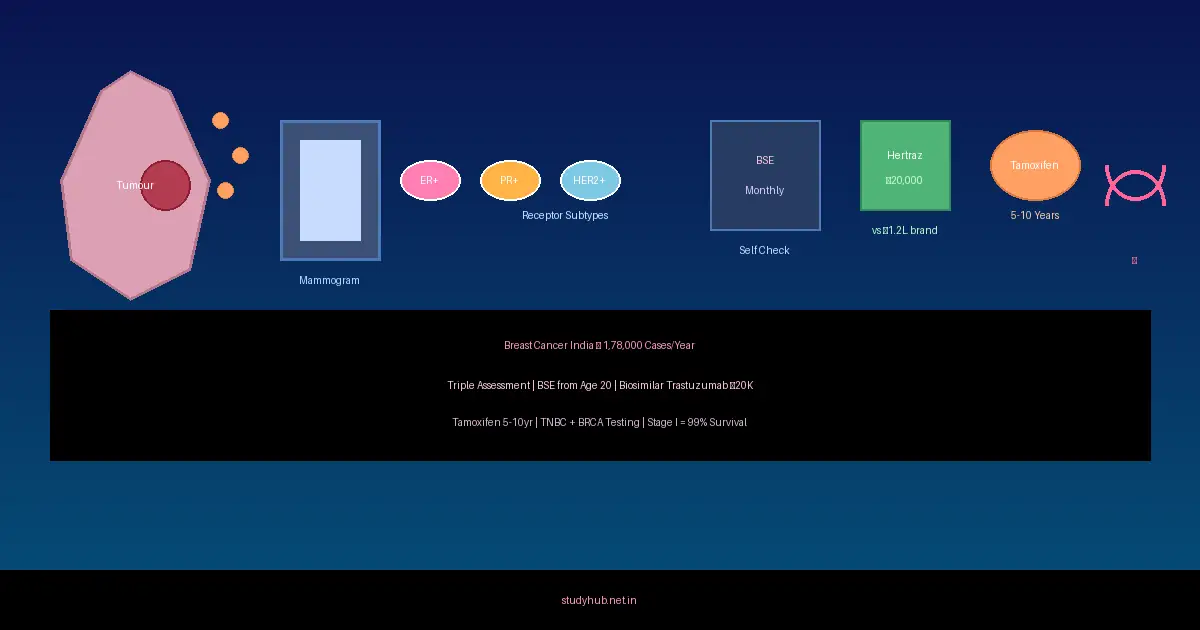
Breast Cancer Subtypes — Receptor Status and Biology
| Subtype | Receptor Profile | % of Cases (India) | Key Features | Treatment Approach |
|---|---|---|---|---|
| Luminal A (HR+/HER2−, low Ki-67) | ER+/PR+ (oestrogen/progesterone receptor positive), HER2−, low proliferation index Ki-67 <15% | ~35–40% | Most favourable biology; slow-growing; hormone-driven; excellent prognosis; low risk of visceral metastases; bone most common metastatic site; most responsive to endocrine therapy; often does NOT need adjuvant chemotherapy (Oncotype DX score guides) | Surgery + adjuvant endocrine therapy (tamoxifen 5–10 years for premenopausal; aromatase inhibitor — letrozole/anastrozole/exemestane — for postmenopausal); adjuvant chemotherapy: low risk = none; intermediate/high Oncotype DX or high Ki-67 = AC→T; CDK4/6 inhibitors (palbociclib, ribociclib) for metastatic Luminal A/B |
| Luminal B (HR+/HER2− or HER2+, high Ki-67) | ER+/PR+ (may be PR−), HER2− with high Ki-67 ≥15% OR HER2+ with ER+ | ~20–25% | Higher proliferation than Luminal A; intermediate prognosis; higher risk of recurrence vs Luminal A; HR+/HER2+ has added HER2 pathway activation — needs both anti-hormone and anti-HER2 treatment | Surgery + endocrine therapy + adjuvant chemotherapy (AC→T); if HER2+: add trastuzumab; if node-positive HR+/HER2−: CDK4/6 inhibitor adjuvant (abemaciclib — monarchE trial) for high-risk lymph node positive disease |
| HER2-enriched (HER2+/HR−) | HER2 amplified/overexpressed (IHC 3+ or FISH amplified), ER−/PR− | ~15–20% (higher in India vs West) | Aggressive biology; rapid growth; early visceral metastases; historically poor prognosis — dramatically improved by HER2-targeted therapy (trastuzumab reduced mortality 30%); HER2 testing critical — all breast cancers should have HER2 IHC ± FISH/CISH; Her2 testing in India: available at all major labs | Surgery; neoadjuvant or adjuvant pertuzumab + trastuzumab + chemotherapy (TCHP — docetaxel, carboplatin, trastuzumab, pertuzumab — for HER2+ disease ≥Stage II); adjuvant T-DM1 (ado-trastuzumab emtansine) if residual disease post-neoadjuvant; trastuzumab deruxtecan (T-DXd) for metastatic HER2+ — HER2CLIMB/DESTINY-Breast trials |
| Triple-Negative (TNBC) | ER−, PR−, HER2− — no targetable receptors | ~20–25% (significantly higher in India vs 12–15% in West) | Most aggressive subtype; highest recurrence risk within 5 years; disproportionately affects young premenopausal Indian women; BRCA1/2 mutation associated (25% of TNBC); poorest prognosis if metastatic; however pCR (pathological complete response) after neoadjuvant chemo = excellent prognosis; immune-rich tumours respond to immunotherapy | Neoadjuvant chemotherapy (AC→paclitaxel ± pembrolizumab/carboplatin — KEYNOTE-522 trial: pembrolizumab + chemo significantly improved pCR and EFS in Stage II–III TNBC); BRCA-mutated TNBC: olaparib/talazoparib (PARP inhibitors — OlympiAD trial); adjuvant capecitabine if residual disease post-neoadjuvant; atezolizumab/pembrolizumab for metastatic PD-L1+ TNBC |
Frequently Asked Questions
How is breast cancer detected early in India?
Early detection is the most powerful determinant of breast cancer survival — Stage I disease is 98–99% survivable at 5 years; Stage IV is approximately 28%. India lacks organised mammographic screening, making individual and opportunistic detection critical: Triple Assessment — the diagnostic gold standard: Every breast lump or symptom requires triple assessment (TA) — three independent assessments that together give 99.6% sensitivity: Clinical examination (CE): by trained clinician — assess lump characteristics (hard/soft, mobile/fixed, irregular/smooth, nipple changes, skin changes, axillary nodes); Breast imaging: Mammography (women ≥35–40 years: gold standard — detects microcalcification, mass lesions, architectural distortion; standard 2-view bilateral; report as BI-RADS 1–6); Breast ultrasound (women <35 or dense breast: preferred — no radiation; characterises cysts vs solid masses; assesses axillary nodes; guides biopsy); MRI: high sensitivity (95%); reserved for high-risk women (BRCA1/2 carriers), extent-of-disease assessment, occult primary; Histological/cytological assessment: core needle biopsy (CNB — tissue core by 14G needle under ultrasound guidance — provides histology, receptor status assessment — strongly preferred); fine needle aspiration cytology (FNAC — cells only; inadequate for receptor testing alone but fast). Breast self-examination (BSE): Monthly BSE from age 20: examine in mirror and lying down; feel for lumps, skin changes, nipple discharge; arm raised above head; BSE reduces tumour size at presentation (earlier self-detection); remains valuable in India’s low-resource context despite controversy in organised screening (CBE/BSE alone insufficient for population-wide screening). Clinical breast examination (CBE) by ASHA/ANM: Government of India NCD screening programme includes CBE by trained ASHA/ANM workers at PHC level for all women 30–65 years; if positive → referral to secondary/tertiary centre; expansion of this programme is India’s most scalable early detection strategy. Mammography screening in India — access reality: No population-wide mammographic screening programme currently exists in India; opportunistic mammography available in cities; recommended for average-risk women from age 40–45 annually or biennially; government hospitals: ₹500–1,500; private: ₹1,500–4,000; digital mammography (DBT — tomosynthesis) increasingly available (better sensitivity in dense breasts — common in Indian women who have predominantly dense breast tissue). High-risk surveillance — BRCA testing India: BRCA1/2 genetic testing: recommended for women with family history (first-degree relative with breast/ovarian/pancreatic cancer; bilateral breast cancer; triple-negative breast cancer <60 years; Ashkenazi Jewish ancestry — less relevant India but equivalent high-risk criteria); BRCA1/2 testing available in India ₹8,000–25,000 (Strand Life Sciences, MedGenome, Thyrocare); BRCA1/2 carriers: annual MRI + mammography from age 30; prophylactic mastectomy/oophorectomy discussed.
What surgery is recommended for breast cancer?
Breast cancer surgery involves two considerations: management of the breast (lumpectomy vs mastectomy) and management of the axilla (lymph nodes). India-specific patterns — large tumours at presentation — make neoadjuvant chemotherapy to enable surgery a critical tool: Breast conservation surgery (BCS / lumpectomy / wide local excision): Removal of tumour with adequate clear surgical margins (at least 1mm — ASCO guideline 2014; 2mm for DCIS); equivalent overall survival to mastectomy for appropriately selected patients (landmark NSABP B-06 trial, 1985 — Veronesi Milan trial); requires adjuvant whole-breast radiotherapy after BCS (essential — omitting radiation after BCS increases local recurrence 3–4 fold); contraindications: multicentric disease; inflammatory breast cancer; patient unable to receive radiation; large tumour relative to breast size (poor cosmesis); patient preference. Oncoplastic surgery: combining surgical oncology with plastic surgery techniques to achieve tumour clearance while preserving/improving breast shape; increasingly performed at Indian tertiary centres (Tata Memorial, AIIMS, Apollo, Fortis). Mastectomy: Total (simple) mastectomy: removes entire breast; no radiation if node-negative and adequate margins; nipple-sparing mastectomy: preserves nipple-areolar complex (oncologically safe for most indications); skin-sparing mastectomy: preserves skin envelope for reconstruction; immediate breast reconstruction: increasingly offered at Indian tertiary centres — implant (silicone prosthesis) or autologous tissue (TRAM/DIEP flap — uses abdominal tissue); excellent cosmetic outcome; requires plastic surgeon at same institution; significantly improves quality of life and body image. Modified radical mastectomy (MRM): mastectomy + level I–II axillary lymph node clearance; most commonly performed breast cancer surgery in India (large tumours at presentation, limited BCS eligibility). Neoadjuvant chemotherapy (NAC) — India context: Given that 50–60% of Indian breast cancers present at Stage III (locally advanced), NAC before surgery is critical: downstages tumour, enables BCS instead of MRM, assesses tumour response (pathological complete response = pCR — excellent prognostic sign); standard regimen: 4× AC (doxorubicin + cyclophosphamide) → 4× paclitaxel (AC→T); HER2+: add trastuzumab (± pertuzumab) to taxane phase; TNBC: add carboplatin and/or pembrolizumab. Axillary management: Sentinel lymph node biopsy (SLNB): if clinically node-negative → radioactive tracer/blue dye identifies sentinel node (first draining lymph node); if negative → no further axillary surgery (avoids lymphoedema); if positive → axillary lymph node dissection (ALND) or radiation; lymphoedema management (arm elevation, compression sleeve) critical after ALND.
What targeted therapies are available for HER2-positive breast cancer in India?
HER2-positive breast cancer represents one of the most remarkable therapeutic success stories in oncology — transforming a historically aggressive subtype to one with excellent prognosis through targeted anti-HER2 therapy: Trastuzumab (Herceptin) — the HER2 revolution: Monoclonal antibody against HER2 extracellular domain; first anti-HER2 agent (1998 FDA approval); added to chemotherapy dramatically improved survival: HERA trial: 1 year adjuvant trastuzumab reduced mortality 33% in HER2+ early breast cancer; CLEOPATRA trial: pertuzumab + trastuzumab + docetaxel (dual HER2 blockade) — gold standard for HER2+ metastatic breast cancer (mOS 56+ months vs 40 months); India cost: innovator trastuzumab (Herceptin) ₹80,000–1,20,000/dose; biosimilar trastuzumab (Hertraz, CANMAb, Biceltis, Ontruzant): ₹18,000–35,000/dose (India manufactures multiple trastuzumab biosimilars at significantly reduced cost — making HER2-targeted therapy far more accessible than in the USA); 17 cycles (1 year total adjuvant duration) × biosimilar cost = ₹3–6 lakh (vs ₹15–20 lakh innovator). Pertuzumab (Perjeta): Anti-HER2 monoclonal antibody targeting different HER2 epitope (dimerisation domain); used in combination with trastuzumab (dual blockade): more potent HER2 suppression; APHINITY trial: pertuzumab + trastuzumab + chemo: improved DFS in node-positive HER2+ early breast cancer; neoadjuvant TCHP + pCR → T-DM1 if residual disease. India cost: pertuzumab ₹80,000–1,20,000/dose; biosimilar pertuzumab emerging (Qarziba — Cipla/Roche biosimilar). T-DM1 / TDM1 (Kadcyla — ado-trastuzumab emtansine): Antibody-drug conjugate (ADC): trastuzumab linked to emtansine (cytotoxic agent); delivers chemotherapy directly to HER2+ cells; given if residual invasive disease after neoadjuvant HER2-targeted chemo (KATHERINE trial — reduces distant recurrence 50% vs trastuzumab alone); India: ₹60,000–90,000/dose — limited accessibility; Roche patient assistance programmes. Trastuzumab deruxtecan (T-DXd / Enhertu): Next-generation ADC; DESTINY-Breast03 trial: T-DXd vs T-DM1 — dramatically superior PFS and OS; also active in HER2-low breast cancer (ER+/HER2 IHC1+ or 2+/FISH−) — DESTINY-Breast04 trial: expanding targetable population significantly; emerging in India at tertiary oncology centres; very expensive; increasing access through Roche Genentech access programmes. Lapatinib (Tykerb): Oral small-molecule HER1/HER2 kinase inhibitor; used in HER2+ metastatic breast cancer with CNS metastases (crosses blood-brain barrier); combined with capecitabine; generic lapatinib available India ₹3,000–8,000/month (vs ₹50,000+ for Tykerb brand).
How long does breast cancer endocrine therapy last and what are the side effects?
Endocrine (hormone) therapy for ER+ breast cancer is one of the most effective and underutilised treatments in India — typically 5–10 years of daily oral tablets that dramatically reduce recurrence, but with adherence challenges driven by side effects and cost: Tamoxifen (premenopausal women): Selective oestrogen receptor modulator (SERM) — blocks oestrogen receptors in breast tissue; standard: 5 years (if <35% risk reduction, extend to 10 years — ATLAS and aTTom trials showed additional benefit of 10 years); significantly reduces local recurrence and contralateral breast cancer risk; common India scenario: many Indian women are premenopausal at diagnosis (younger age) → tamoxifen primary choice; generic tamoxifen: ₹50–100/month (extremely affordable at generics). Side effects of tamoxifen: Hot flushes (most common — ice packs, venlafaxine 37.5mg helps); Vaginal dryness/discharge (vaginal lubricants — hyaluronic acid gel); Irregular menses/amenorrhoea; DVT/PE risk (1% — avoid if prior clot history; contraindicated in Factor V Leiden); Endometrial cancer risk (0.1–0.2%/year — report any post-menopausal bleeding; annual TVS in symptomatic post-menopausal women on tamoxifen); Weight gain (modest). Adherence in India: tamoxifen 5-year adherence rates are poor (30–40% discontinue by year 2 due to side effects, cost, or lack of prescriber follow-up) — significantly reduces survival benefit; oncologist review at every follow-up visit must include endocrine therapy adherence check. Aromatase inhibitors (AIs) — postmenopausal women: Letrozole (Femara), anastrozole (Arimidex), exemestane (Aromasin); block peripheral oestrogen synthesis (aromatase enzyme in fat and muscle); more effective than tamoxifen in postmenopausal women (BIG 1-98, ATAC trials); 5 years primary or as switch after 2–3 years tamoxifen; generic AI: ₹200–500/month (letrozole/anastrozole generic very affordable India). Side effects of AIs: Arthralgia (joint pain — most limiting; affects 30–40%; paracetamol/omega-3 supplementation; rarely requires switch to alternate AI or tamoxifen); Bone density loss (DEXA scan before starting; calcium + vitamin D mandatory; bisphosphonates if T-score ≤−2.0); Vaginal atrophy (dryness, dyspareunia — topical vaginal oestrogen safe with systemic AI); Sexual dysfunction; Cardiovascular risk (modest). Ovarian suppression (OFS) — SOFT/TEXT trials: Premenopausal high-risk ER+ breast cancer patients benefit from ovarian function suppression (OFS — either surgical oophorectomy or monthly goserelin/leuprorelin injection) combined with AI; SOFT/TEXT trials: OFS + exemestane superior to tamoxifen alone in high-risk premenopausal patients; significantly improves recurrence-free survival; India context: goserelin (Zoladex) ₹3,000–5,000/injection × monthly × 5 years = significant cost; PMJAY coverage variable; affordable generic goserelin available (Decapeptyl).
What to Read Next
- Cancer Awareness India — Breast Cancer is India’s #1 Cancer in Women; Mammography from 40; Monthly BSE from 20
- PCOS — PCOS Does Not Significantly Increase Breast Cancer Risk; Combined OCP Use: Breast Cancer Risk Very Small
- Osteoporosis — Aromatase Inhibitor Therapy for 5–10 Years Causes Significant Bone Density Loss; DEXA + Bisphosphonates Essential
- Depression — Breast Cancer Diagnosis and Chemotherapy Causes High Rates of Depression and Anxiety; Integration of Psycho-oncology into Treatment
- Obesity — Postmenopausal Obesity Increases Breast Cancer Risk 30–40%; Adipose Tissue Aromatase Converts Androgens to Oestrogen
India’s young women — in their 40s, still raising children, still in the middle of their careers — are presenting with Stage III breast cancer because no one told them to check. No one organised a mammogram. No one explained that a lump is not necessarily painful. No one said that a hard, irregular, non-mobile breast lump requires urgent assessment — not watching and waiting for three months. India’s breast cancer mortality is not primarily a treatment failure. It is a detection failure. Triple assessment, available at every district hospital. Monthly breast self-examination, taking five minutes. These are not resource-intensive interventions. They require awareness.
About This Guide: Written by the StudyHub Health Editorial Team (studyhub.net.in) based on NCCN Breast Cancer Guidelines 2024, ESMO Breast Cancer Guidelines 2023, ICMR National Cancer Registry Data, and Tata Memorial Hospital Clinical Practice Guidelines. Last updated: March 2026.
🎀 Breast Self-Examination: Every woman over 20 should perform monthly breast self-examination — 5 minutes, same time each month. A hard, irregular, non-tender, fixed lump; skin dimpling (“orange peel”); nipple discharge or inversion — any of these requires urgent assessment (within 2 weeks). Do not wait for pain — early breast cancer is almost always painless.
💊 Biosimilar Trastuzumab: Indian-manufactured biosimilar trastuzumab (Hertraz, CANMAb) costs ₹18,000–35,000/dose vs ₹80,000–1,20,000 for innovator Herceptin — with equivalent clinical efficacy. HER2+ breast cancer is no longer untreatable due to cost in India. Insist on biosimilar prescribing through your oncologist.
⚕️ Medical Disclaimer: This article provides general educational information about breast cancer. Diagnosis, subtype determination, and treatment planning require qualified breast oncologist, breast radiologist, and pathologist assessment. All receptor testing and treatment decisions must be individualised.