Last Updated: March 2026 | Reading Time: 8 minutes | ~1,900 words
Oral health is an integral part of overall health — yet India has one of the most neglected oral health burdens in the world. Dental caries (tooth decay) affects approximately 60–65% of Indian children aged 5–12 years and over 80% of adults above age 35 (NSSO Oral Health Survey). Periodontal (gum) disease — the primary cause of tooth loss in adults — affects an estimated 95% of Indians above age 35 in some form (MoHFW NFHS data). India’s oral cancer burden is among the world’s highest: approximately 130,000 new cases of oral cancer annually, responsible for approximately 30% of all cancer deaths in India — directly attributable to the catastrophically widespread use of tobacco (smoked + smokeless), pan masala, and betel quid (paan). Yet dental care-seeking behaviours in India are extraordinarily poor — most Indians visit a dentist only when in excruciating pain (abscess, facial swelling), missing decades of preventable disease. India has approximately 240,000 dentists (dentist-to-population ratio approximately 1:5,000 — WHO minimum recommended 1:7,500 — numerically adequate but severely maldistributed — 70% in urban areas serving 30% of population). The Pradhan Mantri Jan Arogya Yojana (PMJAY) has limited dental coverage (emergency extractions covered; preventive dentistry largely excluded). The National Oral Health Programme (NOHP) focuses on school screening, fluoride programmes, and tobacco cessation linkage to oral health.
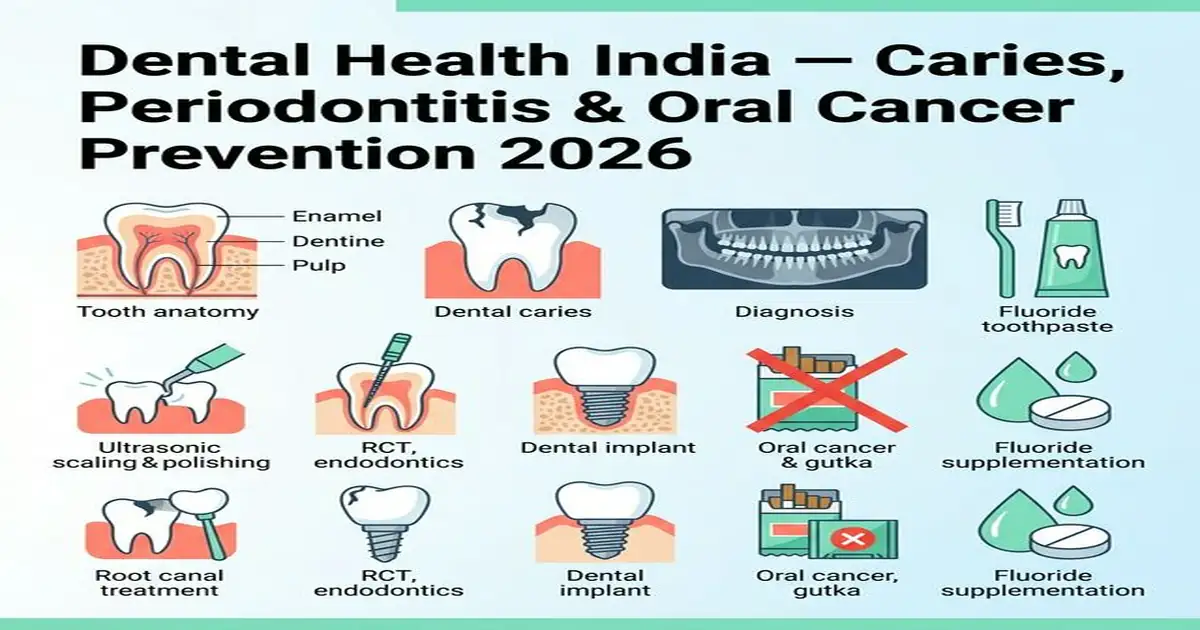
Dental Health India — Caries, Gum Disease, RCT, Implants and Oral Cancer
| Domain | Details | India Context |
|---|---|---|
| Dental Caries — Causes, Stages & Prevention | Dental caries (tooth decay): infectious, multifactorial disease caused by acidogenic bacteria (Streptococcus mutans primary, Lactobacillus) metabolising fermentable carbohydrates → acid production → demineralisation of enamel and dentine → progressive tooth destruction; Caries process: pellicle (salivary glycoprotein film) → plaque biofilm colonisation by S. mutans → sugar → acid (pH drop below 5.5 “critical pH”) → enamel dissolution → if remineralisation insufficient → progressive lesion; Stages: Incipient (white spot lesion): subsurface enamel demineralisation — reversible with fluoride; Enamel caries: cavity limited to enamel — restorative needed; Dentinal caries: extends to dentine — sensitivity begins; Pulpal involvement: deep caries → pulpitis (reversible → irreversible) → periapical abscess → requires RCT or extraction; Risk factors: high sugar frequency (between-meal snacking; sugary drinks — India: biscuits, mithai, chai with sugar between meals); poor oral hygiene (infrequent brushing; no flossing); low fluoride exposure; dry mouth (xerostomia — medications: antihistamines, antidepressants, antihypertensives); previous caries experience; genetic susceptibility; ECC (Early Childhood Caries): baby bottle caries — child put to bed with milk/juice bottle → sugary fluid pools → severe decay of maxillary incisors; Caries prevention (3 pillars): (1) Fluoride: mechanism — inhibits demineralisation, enhances remineralisation, inhibits S. mutans enzymes; fluoride toothpaste (1000–1500 ppm F): brush TWICE daily (morning + night); spit, don’t rinse (leave thin film of toothpaste — “spit don’t rinse” rule); reduce toothpaste-rinsing with water after brushing (washes out fluoride); (2) Diet: reduce frequency of sugary snacks + drinks (frequency more important than quantity); (3) Professional: fissure sealants (pits and fissures of molars — sealant application — caries-free 10+ years); topical fluoride varnish (22,600 ppm — applied at dental visit × every 6 months for high-risk) | India caries burden: NSSO data: 60–65% school children with untreated caries; majority never seen by dentist; ECC India: rampant — milk bottle at night common in upper-middle-class urban India; traditional foods: kheer, halwa, barfi, lollipops, flavoured milk → high sugar frequency from childhood; fluoride India: NaF toothpaste widely available (Colgate Total, Pepsodent, Dabur Red — note: Dabur Red contains no fluoride — herbal — NOT evidence-based for caries prevention; advise fluoride-containing toothpaste); optimal water fluoridation (0.7–1.0 ppm F): naturally occurring in some wells (Gujarat, Rajasthan) — endemic fluorosis (dental + skeletal) where >1.5 ppm; deficient areas: supplemental fluoride needed; school dental health India: NOHP mandates biannual dental screening in all government schools + fluoride varnish application → implementation highly variable; private dentistry: fluoride varnish (₹200–500 per application); fissure sealants: ₹500–1,500 per tooth; government: free at govt dental colleges |
| Periodontal Disease — Gingivitis, Periodontitis & Systemic Links | Periodontal disease: spectrum of inflammatory conditions affecting supporting structures of teeth (gingiva, periodontal ligament, alveolar bone, cementum); Gingivitis: inflammation of gingiva only (reversible); signs: red, swollen, bleeding gums on gentle probing; no bone/attachment loss; cause: plaque biofilm (calculus — tartar); treatment: supragingival scaling + improved oral hygiene → resolves; Periodontitis: infection + inflammation beyond gingiva → destruction of periodontal ligament + alveolar bone → pocket formation → tooth mobility → tooth loss; Stages (AAP/EFP 2018): Stage I (initial), II (moderate), III (severe bone loss, tooth loss), IV (very severe including masticatory dysfunction); Grades A (slow), B (moderate), C (rapid, risk factors driving progression); Aggressive early-onset periodontitis: young patients (<35 years) with rapid severe bone loss — typically specific organisms (A. actinomycetemcomitans); Systemic links (bidirectional): Diabetes: periodontitis worsens glycaemic control (HbA1c) and vice versa; treating periodontitis reduces HbA1c by 0.3–0.5% (meta-analysis — Sanz 2018); HIV/AIDS: severe necrotising periodontal disease; Cardiovascular disease: periodontal inflammation → bacteraemia → systemic inflammation → atherogenesis; association established — causation debated; Preterm birth/LBW: periodontal disease associated with increased risk; Respiratory disease (COPD, aspiration pneumonia in elderly): oral bacteria aspirated → respiratory infection; Treatment: Non-surgical (Stages I–II): supra + subgingival scaling and root planing (SRP — “deep cleaning” — removes biofilm, calculus, infected cementum from roots); strict oral hygiene instruction (OHI); Surgical (Stage III–IV): open flap debridement (OFD); guided tissue regeneration (GTR — membrane + bone graft); bone grafting; Maintenance: 3-monthly periodontal recall visits | India periodontal burden: NFHS data: 95% adults have some gum disease; 30% have moderate/severe periodontitis (clinical attachment loss ≥4mm); tobacco use dramatically accelerates periodontitis (smoking: masks gum bleeding → patient thinks improving; chewing tobacco: gingival recession, fibrous changes); India-specific: paan chewing + tobacco → fibrous bands in cheek (oral submucous fibrosis — OSF — premalignant) + severe buccal mucosa recession; gutka addiction → periodontal destruction + OSF; Scaling India: widely available; government dental colleges: free scaling; private dentists: ₹500–2,000 per arch; patient education problem: patients fear scaling “loosens teeth” (myth — exactly opposite: scaling + gum care tightens teeth by reducing inflammation); SRP (deep cleaning): ₹3,000–8,000 per quadrant (private); government: free; Diabetes + periodontitis India: enormous overlap — 80M diabetics × 95% with gum disease = enormous bidirectional treatment opportunity; diabetologist-dentist joint protocol: every T2DM patient → mandatory dental referral for periodontal assessment annually; scaling reduces HbA1c 0.3–0.5% — equivalent to adding a low-potency diabetes drug; this link completely missed in India routine T2DM management |
| Root Canal Treatment (RCT) — Myths vs Facts | Root Canal Treatment (RCT/endodontic treatment): treatment to save a tooth with irreversible pulpitis or periapical pathology (abscess, necrotic pulp) by removing infected pulp tissue, disinfecting the root canal system, and sealing it with inert material (gutta percha); Indications: irreversible pulpitis (severe, spontaneous, lingering toothache — worse with hot, relieved briefly by cold — then persists); necrotic pulp + periapical abscess (pus, swelling, sinus tract); deep caries approaching pulp; tooth with crown requiring RCT; Procedure: access cavity (drilling through crown to pulp chamber); pulp extirpation (removal); cleaning + shaping (Ni-Ti rotary instruments → most efficient India now); irrigation (sodium hypochlorite 3% main canal disinfectant); obturation (gutta-percha + sealer — fills canal 3D); post-RCT: MANDATORY crown (cap) within 1–3 months — uncrowned RCT tooth fractures within 2–5 years; rotary endodontics: Ni-Ti rotary files (motor-driven) → more efficient, less ledging than manual stainless steel; CBCT (Cone Beam CT): 3D imaging for complex root canal anatomy (multi-canals, calcified canals, resorption); Microscope-assisted RCT: enhanced visualisation → better diagnosis of canals, crack detection; Single visit vs multi-visit RCT: single-visit RCT for non-infected cases is as effective as multi-visit (Cochrane 2016) + reduced patient time; multi-visit preferred: necrotic teeth with acute apical abscess (inter-appointment Calcium hydroxide); RCT success rate: 85–95% over 10 years when properly done + crowned; Alternatives: tooth extraction + replacement (implant, bridge, denture) — permanent loss of natural tooth | India RCT myths and barriers: “RCT is extremely painful”: COMPLETELY FALSE — RCT under adequate local anaesthesia is painless; the tooth ache BEFORE RCT (pulpitis/abscess) → pain; RCT removes the source of pain WHILE under anaesthesia; patient should feel nothing during procedure; the myth “RCT = pain” is one of India’s most harmful dental misconceptions → drives patients to refuse tooth-saving treatment → extract teeth unnecessarily; “RCT will make the tooth black/weak”: RCT-treated tooth needs a crown; without crown → fracture → loss; WITH crown: tooth functions normally for life; “just extract — it’s cheaper/easier”: extraction + implant costs ₹30,000–80,000; RCT + crown costs ₹5,000–15,000; natural tooth is always best; Indian RCT cost: basic RCT (anterior tooth): ₹2,000–5,000 govt dental college; ₹4,000–12,000 private; molar RCT (complex): ₹8,000–25,000 private; crown: ₹3,000–25,000 (metal, PFM, ceramic, zirconia); rotary RCT (Ni-Ti): most private dental clinics India now; microscope RCT: specialty centres (₹15,000–40,000 per tooth) — for complex canals; PMJAY: extractions covered (heavily); RCT not covered → extraction often chosen by poor patients for cost reasons → preventable tooth loss |
| Dental Implants, Dentures & Missing Teeth India | Consequences of missing teeth: adjacent teeth drift + tip into gap; opposing tooth over-erupts; bone resorption (alveolar bone — “use it or lose it”); impaired chewing → dietary restriction → malnutrition especially elderly; altered speech; psychosocial impact (self-image, social confidence); Replacement options: Dental implant: titanium post osseointegrated into jawbone → abutment → crown; gold standard for single/multiple tooth replacement; advantages: preserves bone; no damage to adjacent teeth; feels/functions like natural tooth; longevity: 95% survival at 10 years, 90% at 20 years; contraindications: uncontrolled diabetes (poor osseointegration); active smokers (higher failure rate); insufficient bone (requires bone grafting — GBR); bisphosphonate use (>3 years — BRONJ risk — bisphosphonate-related osteonecrosis of jaw); Fixed Dental Prosthesis (FDP — Bridge): crowns on adjacent teeth (abutments) + pontic (false tooth) in gap; requires cutting healthy adjacent teeth — major disadvantage; lifetime expectancy 10–15 years; cost-effective if adjacent teeth already need crowning; Removable Partial Denture (RPD): acrylic/metal framework; lower cost; less comfort; compliance issue; Removable Complete Denture: for fully edentulous; requires regular relining as bone resorbs; implant-retained overdenture: implant + snap-on attachment → dramatically superior retention + function vs conventional denture; All-on-4/All-on-6: full arch rehabilitation on 4–6 implants; permanent fixed teeth; emerging India; Implant cost India: single implant (imported — Nobel Biocare, Straumann, Osstem): ₹30,000–80,000 per tooth (implant + abutment + crown); Indian implants (BioHorizon, Adin, Generic): ₹15,000–35,000 per tooth; significant cost barrier → bridges + dentures more common India | India missing teeth epidemiology: 60% of Indians above age 60 have multiple missing teeth; 40% of above-70 are edentulous (fully toothless) — IAPHD data; functional edentulism: <20 teeth (natural) = inability to eat hard foods properly → nutritional compromise → accelerated frailty; India implant market: growing 15% annually; Mumbai, Bangalore, Delhi, Chennai — high concentration of implant centres; dental tourism: India attracts significant dental tourists (Sri Lanka, Bangladesh, East Africa, Gulf NRIs) — particularly for implants (1/5th cost of UK/USA); bone grafting for implants: GBR (guided bone regeneration) + xenograft (bovine) or synthetic + membrane → ₹15,000–40,000 extra; sinus lift: for upper posterior implants with insufficient height (post-extraction sinus pneumatisation); All-on-4 India: ₹1.5–3.5 lakh per jaw (vs ₹15–25 lakh UK) → significant dental tourism driver; elderly denture India: free/subsidised complete dentures at govt dental colleges; private: ₹5,000–20,000 per denture; compliance: elderly often refuse dentures → malnutrition cycle |
| Oral Cancer Prevention — Tobacco, Gutka & Screening India | Oral cancer India: 130,000+ new cases annually (ICMR 2023); India has highest global oral cancer burden; subtypes: squamous cell carcinoma (SCC) of tongue (most common), buccal mucosa, lip, floor of mouth, hard palate, oropharynx; 5-year survival: early-stage (T1N0M0): 80–90%; late-stage (T4/N+): 30–40%; most India cases present LATE (Stage III/IV) → poor survival; Risk factors: Tobacco (smoking: cigarettes, beedis — carcinogen exposure − India: beedi most common); smokeless tobacco (khaini, gutkha, pan masala, zarda — direct mucosal carcinogen contact — highest risk for buccal mucosa SCC); alcohol (additive risk with tobacco — 15× multiplicative risk with combined use); HPV (human papillomavirus — HPV16 — oropharyngeal SCC especially — increasing India; HPV vaccine protective); betel quid/paan (carcinogenic nitrosamines + arecoline → DNA damage + fibrous bands → OSF — premalignant); Premalignant lesions: Leukoplakia (white patch — cannot be scraped off; not explained by other cause): 5–17% malignant transformation risk — biopsy mandatory (non-homogeneous/red areas → highest risk); Erythroplakia (red velvety patch): 40–90% already dysplastic/malignant at biopsy → URGENT biopsy + resection; Oral Submucous Fibrosis (OSF): South Asian chewing tobacco/paan → fibrous bands → restricted mouth opening (trismus) → burning sensation → premalignant (7–13% transform to SCC); Screening: Visual oral examination (VOE): performed by any healthcare worker — 5 min; India trials (Trivandrum RCT — Sankaranarayanan 2005): VOE by trained health workers in tobacco users → 30% oral cancer mortality reduction in screening arm; Toluidine blue (toludine blue staining) → highlights dysplastic/malignant mucosa; VELscope (violet light autofluorescence): adjunct — not diagnostic alone; Biopsy: mandatory for any suspicious lesion — incisional biopsy ≥2 weeks persistent; HPV vaccination: Cervavax/Gardasil (HPV16/18) → recommended for all adolescents including boys (oropharyngeal HPV cancer prevention); Treatment: surgery (primary for operable oral SCC) ± adjuvant radiation/chemotherapy (cisplatin concurrent); neck dissection (SND/MND for N+ or elective); reconstruction: pedicled (PMMC) or free flap (ALT, fibula) — complex but achievable at TATA, AIIMS, Tata Memorial Mumbai | India oral cancer prevention crisis: 28% Indians use some form of tobacco (GATS India 2016–17); 22% use smokeless tobacco (khaini, gutka, paan masala); ban on gutka: Supreme Court/FSSAI 2012 banned gutka nationally — limited enforcement; pan masala (substitute without tobacco declared) → still sold with tobacco at point of purchase; tobacco cessation: iQuit Telemedicine App (NTCP); National Tobacco Cessation Helpline: 1800-11-2356 (free); NRT (nicotine replacement therapy — patch, lozenge, gum): available pharmacy ₹200–500/week; varenicline (Champix — Pfizer — Schedule H): ₹2,000–3,000/month → most effective cessation agent (doubles quit rate); India COTPA 2003: prohibits tobacco near educational establishments, requires 85% pictorial health warnings; implementation: inadequate; OSF screening India: dentists + ENT specialists should screen every tobacco chewer for OSF → refer for biopsy if leukoplakia/OSF + dysplastic features; NCCP (National Cancer Control Programme): provides free oral cancer screening camps; Tata Memorial Hospital Mumbai: highest-volume oral cancer centre India → free treatment for public; PBCR (Population Based Cancer Registry): most accurate India cancer incidence data; oral cancer: declining in states with strong COTPA enforcement + tobacco cessation programmes |
Frequently Asked Questions
Is root canal treatment really as painful as people say — and when do I need it?
Root canal treatment is arguably the most feared dental procedure in India — and simultaneously one of the most misunderstood. The fear is based almost entirely on myth and outdated experience from an era before modern rotary endodontics and adequate local anaesthesia: The truth about RCT pain — what current evidence says: Modern RCT under adequate local anaesthesia should be completely painless during the procedure; the endodontist administers inferior alveolar nerve block + infiltration (for molars), achieving profound anaesthesia of the tooth; the tooth (even with a painful abscess) is anaesthetised before any instrument enters the canal; perceived pressure sensation is normal — but sharp pain during the procedure indicates inadequate anaesthesia → patient must communicate → additional anaesthesia administered; post-procedural soreness: 24–72 hours of mild aching is normal (periapical tissue disruption during cleaning) → managed with ibuprofen 400mg or paracetamol 1g; typically resolves by day 3; this is significantly LESS pain than the toothache BEFORE RCT. Why people believe RCT is painful — the historical reason: Before the 1990s: manual stainless steel files + inadequate anaesthesia techniques + multiple long painful visits = valid fear; today: Ni-Ti rotary files → faster, smoother, painless; digital apex locator → precise canal length without perforation; CBCT → visualise anatomy before starting; single-visit RCT for most cases → one anaesthetic visit; microscope-assisted → better visualisation → less guesswork + less discomfort. When you need RCT — the clear indicators: Spontaneous severe toothache (wakes you at night; throbbing; lingers after hot liquid removed): irreversible pulpitis → RCT; Swelling of face/gum with pus: periapical abscess → RCT (or extraction); Deep cavity visible on X-ray approaching pulp: even if not yet symptomatic, RCT before crown → prevents emergency later; Tooth requiring a crown: if tooth structure insufficient → post + core → crown → RCT must be done first; Tooth darkening (trauma-related): pulp necrosis → RCT before whitening or crown; When extraction might be better than RCT: Grossly broken down tooth with insufficient structure remaining for restoration (even with post-core → cannot crown); severe bone loss (advanced periodontitis — tooth mobile grade 3) — RCT buys limited time; patient circumstance (limited opening, gag reflex — CBCT-guided approach needed); financially — if tooth is non-functional position (third molar/wisdom tooth, single premolar with no opposing tooth) → extraction may be pragmatic; cost comparison India: extraction ₹500–2,000; RCT + crown ₹8,000–30,000; implant ₹20,000–80,000; bridge ₹8,000–25,000; the long-term wisdom: preserving a natural tooth with RCT is almost always the economically AND functionally optimal decision.
How should I care for my teeth daily — and how often should I see a dentist?
The foundation of a lifetime of dental health is extraordinarily simple and inexpensive — and yet most Indians get it dramatically wrong in one or more of its basic components: The evidence-based daily oral hygiene routine: Brushing — HOW: use a soft-bristled toothbrush (soft = effective + gentler on gingiva; medium/hard = gingival recession + abrasion); technique: modified Bass technique (45° angle to gums, small back-and-forth strokes + sweep downward) — most evidence-based; minimum 2 minutes (front, back, chewing surfaces of all four quadrants); electric toothbrush (Oral-B/Philips Sonicare): superior plaque removal — particularly valuable for elderly (arthritis, poor coordination), children, orthodontic patients; Brushing — WHEN: at night before sleep MANDATORY (most critical brush — removes day’s plaque before overnight acid production; salivary flow drops at night → less natural buffering); morning (after breakfast preferred — before food = plaque remains; some prefer before breakfast for fresh mouth — both acceptable); Toothpaste: choose fluoride toothpaste minimum 1000 ppm F (Colgate Cavity Protection, Pepsodent Germi Check, Sensodyne — all contain fluoride; check label); spit out gently after brushing — do NOT rinse vigorously with water (washes out fluoride); avoid rinsing for 30 minutes post-brushing; Dabur Red, Vicco Vajradanti, Patanjali: herbal — NO proven caries protection — no fluoride → do not use as primary toothpaste; Interdental cleaning: floss: removes plaque from between teeth (areas brush cannot reach); daily — at night before brushing; technique: guide floss between teeth, curve in C-shape, up-and-down × 5 strokes each side, don’t snap into gums; Interdental brushes (TePe, Curaprox): for spaces between teeth, post-RCT/bridge span cleaning, periodontal patients; Water flossers (Waterpik, Oclean): good adjunct — not fully equivalent to floss; Mouthwash: fluoride mouthwash (Colgate Plax, Listerine Total Care): valuable adjunct especially post-brushing rinse at different time than brushing; Chlorhexidine 0.2% mouthwash (Chlorhex, Hexidine): antimicrobial — NOT for daily long-term use (>2 weeks causes tooth staining, altered taste); use only as directed by dentist; Diet for dental health: Sugar frequency (NOT total sugar per day but number of sugar exposures): each acidic attack lasts 20–40 minutes; 6 sugar exposures/day = 3–4 hours acid attack; limit to <3 sugar exposures; cheese, nuts, fibrous vegetables as between-meal snacks (stimulate saliva, calcium-containing); India mithai consumption: limit to meal times, not throughout day; fluoride water: check local water supply; bottle water: most bottled water has low fluoride; Dental visit frequency India: Every 6 months: best practice — professional scaling + examination → early detection of caries + periodontal disease; minimum: annually; children: from first tooth eruption or 1st birthday (whichever first) → establish dental home; Every visit: OPG (panoramic X-ray) not needed every visit — risk-stratified; bitewing X-rays for caries detection every 12–24 months; screening: oral cancer screen at every dental visit (soft tissue examination) — mandatory; emergency visit: swelling of face → same-day dental emergency; toothache with fever → dental emergency → antibiotics (amoxicillin 500mg TDS + metronidazole 400mg TDS × 5 days) as bridge while awaiting drainage/RCT; India dental college: dental colleges have undergraduate students treating under faculty supervision — significantly cheaper (scaling ₹100–300; RCT ₹1,000–3,000; crown ₹1,500–5,000) — excellent for BPL/low-income patients.
What to Read Next
- Oral Cancer India — Tobacco + Gutka + OSF = Premalignant Progression; Toluidine Blue Screening; Tata Memorial Protocol; HPV16 Oropharyngeal SCC Increasing India
- Diabetes & Teeth — Periodontitis Worsens HbA1c; Scaling Reduces HbA1c 0.3-0.5%; DM → Dry Mouth → Caries; Diabetic Patients Need 3-Monthly Dental Recall
- Bisphosphonate & Jaw — BRONJ (Bisphosphonate-Related Osteonecrosis of Jaw): Risk After ≥3 Years IV/Oral BP; Dental Extractions Dangerous; Always Disclose BP Use to Dentist
- Mental Health & Dental — Dental Anxiety Disorder (specific phobia — dentist); CBT for Dental Phobia; Nitrous Oxide Sedation in Dental Settings; Dry Mouth from Antidepressants
- Child Nutrition & Teeth — Vitamin D + Calcium = Dental Development; Fluorosis from Excess Fluoride; ECC from Nighttime Bottle Feeding; First Dental Visit by Age 1
A 55-year-old man from Hyderabad — chews gutka 3–4 pouches daily for 22 years. At a health camp: noticed a white patch in his right cheek (buccal mucosa) — leukoplakia + restricted mouth opening (trismus — 22mm interincisal distance — normal 40mm). Referred immediately. Biopsy: moderate epithelial dysplasia. Diagnosis: Oral Submucous Fibrosis + Leukoplakia with dysplasia. He is given a brutally honest conversation: “This is pre-cancer. If you continue gutka, there is a 10–13% chance this becomes oral cancer within 5–10 years. Oral cancer at this stage requires surgery that will remove part of your jaw and tongue.” He stops gutka — first time in 22 years. Weekly physiotherapy for trismus (Therabite jaw opening device). Antioxidant supplementation. Monthly follow-up. Six months later: patch size reduced, dysplasia grade improved on repeat biopsy. “I didn’t know that little white patch meant anything. I thought it was just paan stain.” The white patch costs ₹600 to biopsy. Ignoring it can cost a jaw.
About This Guide: Written by the StudyHub Health Editorial Team (studyhub.net.in) based on NOHP India Oral Health Guidelines, WHO Oral Health Action Plan 2023–2030, AAE (American Association of Endodontists) Guidelines, ICMR Cancer Registry Data 2023, and Tata Memorial Hospital Oral Cancer Protocol. Last updated: March 2026.
🦷 Daily Dental Routine That Actually Works: (1) Brush TWICE daily — night brushing is MANDATORY. (2) Use fluoride toothpaste (1000+ ppm F) — spit but don’t rinse. (3) Floss once daily before sleep. (4) See a dentist every 6 months — scaling prevents gum disease. (5) Limit sugary snacks to mealtimes only. Your natural teeth are irreplaceable — dental colleges treat at 1/10th private cost.
🚫 Gutka, Khaini, Pan Masala = Oral Cancer Risk: Smokeless tobacco causes oral submucous fibrosis (OSF — restricted mouth opening) and leukoplakia — both premalignant. Any white patch, red patch, or restricted mouth opening after chewing tobacco → immediate dental visit + biopsy. 10–13% of OSF progresses to oral cancer. Gutka cessation + monthly monitoring can prevent cancer. National Tobacco Cessation Helpline: 1800-11-2356 (free).
⚕️ Medical Disclaimer: This article provides general educational information about dental health. All dental diagnosis, treatment planning (RCT, implants, periodontal surgery), oral cancer biopsy, and surgical management require a qualified dentist, endodontist, periodontist, or oral and maxillofacial surgeon assessment. Do not self-medicate dental pain with antibiotics without dental assessment.