Last Updated: March 2026 | Reading Time: 9 minutes | ~2,000 words
Sexual and reproductive health (SRH) remains one of the most stigmatised — and consequently most neglected — dimensions of healthcare in India. Yet the statistics are stark: India has an estimated 4.0 million people living with HIV (NACO 2022 — though declining with ART scale-up); approximately 1.5 million new sexually transmitted infections (STIs) annually through STI clinics (under-reporting massive — actual burden 10× higher); India’s contraceptive prevalence rate (CPR) stands at 67% but with heavy over-reliance on female sterilisation (37% of all contraception — making India an international outlier in contraceptive equity); and approximately 15 million unsafe abortions annually outside certified facilities, primarily due to access barriers and stigma, despite the MTP Act 2021 legalising termination up to 24 weeks for specific circumstances. Adolescent sexual health is catastrophically under-addressed: India has 250 million adolescents (the world’s largest adolescent population) but comprehensive sexuality education is absent from most curricula. STI rates in adolescents and young adults are rising — with gonorrhoea antimicrobial resistance accelerating (GASP India network: 60%+ isolates resistant to ciprofloxacin). HPV vaccination — proven to prevent 70–90% of cervical cancer — was introduced into India’s NIP only in 2024 (Cervavac — SII’s quadrivalent, ₹200–400/dose) after over a decade of advocacy. India’s sexual health crisis is primarily a crisis of education, stigma, access and gender equity — not a shortage of medical knowledge.
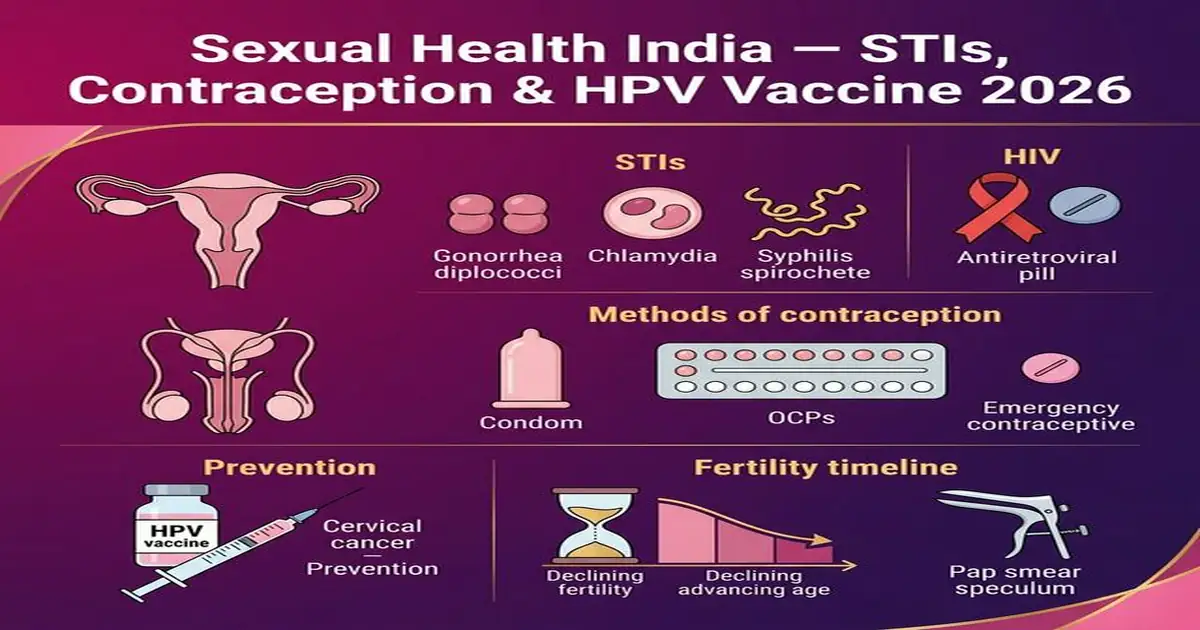
Sexual Health India — STIs, Contraception, HPV Vaccination and Sexual Dysfunction
| Domain | Details | India Context |
|---|---|---|
| Sexually Transmitted Infections — Gonorrhoea, Chlamydia, Syphilis & HSV | Gonorrhoea (N. gonorrhoeae): urethral discharge (purulent — green/yellow) in males; cervicitis/PID in females; diagnosis: NAAT (GeneXpert CT/NG) — gold standard; AMR crisis: ciprofloxacin resistance 60%+ India; treatment: ceftriaxone 500mg IM stat + azithromycin 1g stat (dual therapy — reduces resistance); Chlamydia (C. trachomatis): often ASYMPTOMATIC in females → silent PID → tubal infertility; diagnosis: NAAT; treatment: doxycycline 100mg BD × 7 days (preferred over azithromycin 1g stat — BASHH 2021 update — superior efficacy for genital CT); LGV (L1/L2/L3 serovars): anorectal syndrome in MSM → doxycycline 100mg BD × 21 days; Syphilis (T. pallidum): stages — primary (painless chancre); secondary (rash, mucous patches, condylomata lata — highly infectious); latent; tertiary (gumma, aortitis, neurosyphilis); diagnosis: RPR (non-treponemal — screening + titres) + TPPA (confirmatory); treatment: primary/secondary: benzathine penicillin G 2.4 MU IM stat; latent: 2.4 MU IM weekly × 3; neurosyphilis: IV penicillin 18–24 MU/day × 14 days; pregnant women: penicillin desensitisation if allergic — doxycycline NOT safe in pregnancy; Herpes Simplex (HSV-1/HSV-2): painful genital vesicles → ulcers; primary severe; recurrences milder; diagnosis: PCR swab; treatment: acyclovir 400mg TDS × 5–10 days (primary); suppressive: acyclovir 400mg BD (≥6 recurrences/year); no cure — HSV latent lifetime; key message: HSV is common, manageable, not a moral failing; Trichomonas vaginalis: frothy yellow-green vaginal discharge + itch; metronidazole 2g stat (or 400mg BD × 7 days); treat partner simultaneously; PID (Pelvic Inflammatory Disease): polymicrobial (C. trachomatis, N. gonorrhoeae, anaerobes, BV organisms); treatment: ceftriaxone 500mg IM + doxycycline 100mg BD × 14 days + metronidazole 400mg BD × 14 days (outpatient cases; inpatient for severe/tubo-ovarian abscess) | India STI services: NACO Targeted Intervention (TI): STI/RTI services at ICTC + designated STI clinics; syndromic management still primary at PHC level (treat empirically based on syndrome — urethral discharge/vaginal discharge/genital ulcer/lower abdominal pain); NAAT scale-up at ART centres and STI clinics ongoing; AMR gonorrhoea India: GASP surveillance network confirmed 60%+ ciprofloxacin resistance → ceftriaxone now universal first-line; emerging cephalosporin resistance monitoring; syphilis resurgence India: congenital syphilis from untreated maternal syphilis — VDRL test mandatory at first ANC → treat if positive → prevents congenital syphilis; partner notification: weak at primary level; ICTC counsellors trained for partner referral — reach improving with digital tools; STI stigma India: patients with genital ulcers delay 3–6 weeks before presenting (shame, fear) — allowing onward transmission; integrated SRH + STI services at all PHCs gradually being implemented under NHM |
| Contraception — Methods, Effectiveness & Emergency Pill | Effectiveness hierarchy (typical use failure rates): Most effective: Implant (etonogestrel subdermal — Implanon NXT): 0.05%; 3 years; Levonorgestrel-IUS (Mirena): 0.2%; 5 years; Male vasectomy: 0.15%; permanent; Female sterilisation: 0.5%; permanent; Cu-IUD (Copper-T): 0.8%; 10 years; Short-acting: DMPA injectable (Depo-Provera): 0.2% perfect/6% typical; monthly injection (Cyclofem/SA): combined injectable; COCP (Combined Oral Contraceptive Pill): 0.3% perfect/9% typical — oestrogen + progestogen; contraindications: migraine with aura, VTE, breast cancer, hypertension, >35 years smoker; benefits: regular cycles, dysmenorrhoea relief, reduced risk ovarian/endometrial cancer; POP (Progestogen-Only Pill): safe in breastfeeding + cardiovascular risk; Condom: 2% perfect/18% typical use — ONLY method protecting against STIs; Barrier (female condom, diaphragm, cap): less effective; Emergency Contraception (EC): LNG-EC (i-pill — levonorgestrel 1.5mg): within 72h → 84–92% effective; mechanism: delays/inhibits ovulation (NOT abortifacient); over-the-counter India (no prescription); ulipristal acetate (UPA/EllaOne): within 120h; superior to LNG at 72–120h; Cu-IUD as EC: >99% effective within 5 days; provides ongoing contraception; Fertility awareness (FAM, rhythm method): typical use 24% failure → not recommended as primary method; Natural family planning must be learned through certified educator + cycle tracking; MTP Act 2021: up to 20 weeks: any registered doctor; up to 24 weeks: two doctors + specific circumstances (rape, fetal abnormality, contraceptive failure — all women — unmarried included); above 24 weeks: state Medical Board only for severe fetal anomaly; MTP services: free at government hospitals (PHC+); manual vacuum aspiration (MVA) — safest early method; medical MTP: mifepristone 200mg + misoprostol 800mcg (WHO regimen — up to 12 weeks) | India contraception equity gap: CPR 67% but: female sterilisation 37% (most lopsided globally); vasectomy 0.3% (massive gender inequity); implant 0.1% (shockingly underutilised — most effective LARC); condom 5.6% (low — with high STI burden — condom promotion critical); India national contraception schemes — FREE at health facilities: condoms (Nirodh brand), OCPs (Mala-N), Cu-T 380A, DMPA injectable (Antara Programme via ASHA), centchroman/Chhaya (weekly oral non-estrogen — India-developed), male condom male sterilisation; i-pill misuse India: i-pill marketed aggressively → widely used as regular method → incorrect (EC is for emergencies; regular use → cycle disruption + reduced efficacy perception + no STI protection); ASHA programme: now educated to counsel against i-pill as routine method + promote LARC; MTP access: legal but stigma at government facilities (providers refusing or shaming women) → women pay private clinics ₹3,000–15,000; rural: access distance major barrier → medical abortion kit (mifepristone + misoprostol) home use now permitted under telemedicine NHP guidelines for ≤9 weeks gestation |
| HPV Vaccine — Cervical Cancer Prevention India | HPV (Human Papillomavirus): most common STI globally; persistent high-risk HPV (hrHPV) → cervical cancer (HPV16+18 = 70% of all cervical cancers), oropharyngeal cancer, anal/vulvar/penile cancer; low-risk HPV6+11 → genital warts (condylomata); Vaccines available India: Cervavac (Serum Institute of India): quadrivalent (HPV6+11+16+18); 2-dose schedule age 9–14 (0 + 6 months); 3-dose age 15+; ₹200–400/dose; included in NIP 2024 for girls; Gardasil 9 (MSD — 9-valent: 6+11+16+18+31+33+45+52+58): most comprehensive; 2-dose (age 9–14); 3-dose (15+); ₹3,000–4,000/dose in India (private); Cervarix (bivalent 16+18): 2-dose (≤14 years); efficacy: 90–98% protection against HPV16+18 cervical intraepithelial neoplasia if given before first sexual contact; Dosing: 9–14 years: 2 doses (0 + 6 months); 15+ years: 3 doses (0 + 1 + 6 months); catch-up: up to age 26 recommended (26–45: shared decision); gender-neutral vaccination: boys also benefit (prevents oropharyngeal cancer + anogenital warts + prevents transmitting HPV to female partners); Cervical screening (EVEN POST-VACCINATION — vaccine does not cover all HPV types): Pap smear/LBC: every 3 years from age 25–65; hrHPV DNA testing: primary screen every 5 years (superior sensitivity — WHO recommends); VIA (Visual Inspection Acetic Acid): simple, cheap for LMICs — nurse/ASHA-trained → whitening after acetic acid application → suspicious → refer; Colposcopy + biopsy: for abnormal cytology / positive hrHPV; CIN management: CIN1 — observe (70% regress); CIN2/3 — LLETZ (large loop excision) / LEEP / cold-knife cone; cervical cancer: surgery (hysterectomy/trachelectomy early stage) + chemoradiation (later stage: cisplatin weekly + EBRT + brachytherapy) | India HPV vaccine programme: NIP 2024: Class 6 government school girls (≈age 11–12) → Cervavac free through school immunisation; private sector catch-up: Gardasil (₹8,000–12,000 full course), Cervavac (₹800–1,500); HPV vaccine myths India: “promiscuity encouragement” — comprehensively debunked across dozens of countries (no change in sexual debut, partner numbers — LARC UK, USA, Australia data); “only for girls who will have sex outside marriage” — HPV transmissible first sexual intercourse within marriage; “Pap smear cancels out need for vaccine” — screening detects CIN; vaccine prevents HPV acquisition → prevents CIN forming; both needed; Cervical cancer screening India 2024: NFHS-5: 1.9% women aged 30–49 had Pap smear in last 5 years; vast gap; NPCBBCS: National Programme Cancer Breast Cervical Cancer Screening: VIA + mammography at CHC/PHC level; NHM: CHO/nurse-led VIA training nationwide; Tata Memorial Mumbai: highest-volume cervical cancer treatment centre |
| Male Sexual Health — Erectile Dysfunction, Premature Ejaculation, Low Testosterone | Erectile Dysfunction (ED): inability to achieve/maintain erection sufficient for satisfactory sexual performance; prevalence: 40–70% of men aged 40–70 have some degree of ED (Massachusetts Male Aging Study); India prevalence: under-reported (stigma) but estimated 30–40M men affected; Causes: vascular (most common — atherosclerosis, hypertension, DM, dyslipidaemia — ED is marker of CAD — arteries of penis smaller than coronary arteries → ED symptoms precede MI by 3–5 years — ED = “canary in the cardiovascular coal mine”); neurogenic (diabetes neuropathy, post-prostatectomy, multiple sclerosis, spinal cord injury); hormonal (low testosterone, hyperprolactinaemia, thyroid); psychogenic (performance anxiety — very common young men; pornography-induced — ED to real-life partner but not to pornography — increasingly recognised); drug-induced (antihypertensives: beta-blockers, thiazides; antidepressants: SSRIs; antipsychotics; finasteride 1mg — hair loss → post-finasteride syndrome); Diagnosis: history + IIEF-5 (International Index of Erectile Function) score; fasting glucose, HbA1c, lipids, testosterone, prolactin, TFT; penile Doppler USS (vascular assessment); nocturnal penile tumescence (NPT — to distinguish psychogenic vs organic ED — erections during sleep normal → psychogenic); Treatment: Lifestyle: exercise (aerobic, resistance), weight loss, smoking cessation — MOST IMPORTANT (lifestyle alone improves ED in 30–40%); PDE5 inhibitors (Phosphodiesterase-5 inhibitors): sildenafil (Viagra, Penegra — India: ₹100–300 per tablet); tadalafil (Cialis, Tadacip); vardenafil (Levitra); daily tadalafil 5mg (low dose ED treatment, BPH): mechanism: NO → cGMP → smooth muscle relaxation → vasodilation → erection; timing: sildenafil 30–60min before (on demand); tadalafil 1–3h (lasts 36h — “weekend pill”); contraindication: nitrates absolute contraindication (potentially fatal hypotension); Premature Ejaculation (PE): most common male sexual dysfunction (20–30% males); defined: <2 minutes intravaginal ejaculatory latency (IELT); primary (lifelong) vs secondary (acquired); treatment: dapoxetine (Priligy — short-acting SSRI) 30–60mg 1–3h before sex (on-demand — only licensed PE drug); numbing creams (lidocaine/prilocaine — SS cream, EMLA): reduce glans sensitivity; behavioural (squeeze technique, stop-start). Low Testosterone (Male Hypogonadism): symptoms: low libido, ED, fatigue, depression, reduced muscle mass, increased body fat, bone loss; check: morning total testosterone (normal 10–35 nmol/L); free testosterone if low-normal; LH, FSH; TFT, prolactin; Treatment: primary (LH elevated → gonadal failure — Klinefelter, orchiectomy): testosterone replacement therapy (TRT) — gel, injection, pellet; secondary (LH low → pituitary/hypothalamic — clomiphene, hCG for fertility preservation before TRT) | India male sexual health stigma: ED in India: profound shame → men delay seeking help 5–10 years on average; tendency toward: (1) self-medication with herbal libido supplements (ashwagandha, shilajit, musli — limited evidence for ED; some have mild testosterone effect; AVOID unregulated combination products — heavy metal contaminants reported); (2) predatory online pharmacy purchase of sildenafil without cardiovascular evaluation (dangerous in undiagnosed CAD — nitrate use concurrent = death risk); PDE5i India: sildenafil generic: ₹100–300 per tablet (Penegra, Suhagra, Manforce) — widely available; SAFETY: ALL patients starting PDE5i need CV assessment (BP, ECG, check for nitrate use); tadalafil 5mg daily: ₹80–150/day — for daily ED + BPH (dual benefit); PE India: deeply underreported — estimated 30% of men — dapoxetine on demand highly effective (₹150–400 per tablet — Duralast, Dapox); PE + ED: combination sildenafil + dapoxetine (Dura-S, Superhit) — combination tablets available India; testosterone testing India: morning serum testosterone: ₹500–800 at pathology labs; testosterone subcutaneous pellet: niche; testosterone gel (Cernos Gel — SunPharma): ₹2,500–3,500/month; testosterone injection (250mg every 3–4 weeks — sustanon): ₹150–250/injection |
| Female Sexual Health — Vaginismus, GSM, HSDD & FSD India | Female Sexual Dysfunction (FSD): broad category — hypoactive sexual desire disorder (HSDD), sexual arousal disorder, orgasm disorder, genito-pelvic pain/penetration disorder (vaginismus/dyspareunia); Vaginismus (Genito-Pelvic Pain/Penetration Disorder — GPPPD): involuntary spasm of pelvic floor muscles on attempted vaginal penetration → prevents or makes intercourse extremely painful/impossible; primary (lifelong — never achieved penetration) vs secondary (occurs after previously painless intercourse); causes: anxiety/fear conditioning; trauma; cultural/religious beliefs around sex (very prevalent India — “sex is forbidden/sinful” internalisation → physical vaginismus); lack of sexual education; diagnosis: clinical + GRISS or FSFI + gynaecological examination (dilator assessment); treatment: multidisciplinary — sex therapy (CBT-based → address anxiety, cognitions about sex); pelvic floor physiotherapy (vaginal dilator therapy — graduated sets — Amielle dilators — ₹2,000–5,000/set; self-directed with physiotherapist guidance); Botulinum toxin injection into pubococcygeus/levator ani (specialist): relaxes spasm → allows dilator therapy to proceed; EMDR for trauma-related vaginismus; key: never force penetration (causes further conditioning); GSM (Genitourinary Syndrome of Menopause): vulvovaginal atrophy — oestrogen deficiency post-menopause → vaginal dryness, dyspareunia, urinary urgency/frequency/recurrent UTIs; treatment: local vaginal oestrogen (Ovestin cream, Estriol pessary — safe even if systemic HRT contraindicated — low systemic absorption): highly effective + safe; vaginal moisturisers (non-hormonal — Replens — polycarbophil glycol); vaginal lubricants (silicone-based for penetration); HSDD (Hypoactive Sexual Desire Disorder): low desire causing distress; treatment: flibanserin (Addyi — pink pill, USA only), bremelanotide (Vyleesi, USA); in India: off-label bupropion (Wellbutrin) — norepinephrine-dopamine reuptake inhibitor — augments desire; sex therapy (CBT); address contributory factors (relationship issues, depression, low testosterone, oral contraceptive-induced HSDD — some women report reduced desire on OCP → switch to non-hormonal contraception); sexual pain: dyspareunia (painful intercourse) — causes: vaginismus, GSM, endometriosis, pelvic floor dysfunction, vulvodynia, vaginitis; careful evaluation required; vulvodynia (chronic vulvar pain without identifiable cause): topical lidocaine, amitriptyline cream, pelvic PT, CBT | India female sexual health gap: vaginismus India: extremely common (estimates 10–15% women — many cases unrecognised; labelled as “too tight” or “cultural”; husbands/families told to “be patient” without professional help); sex therapy India: paucity of AASECT/COSRT-trained sex therapists; a handful in Mumbai, Delhi, Bangalore (Dr. Anjali Chhabria, Dr. Shyam Mithiya); online sex therapy: exponentially growing post-pandemic (iCall, Amaha, Your Dost — include sexual health counselling); GSM India: massively undertreated — post-menopausal women in India normalise dyspareunia as “natural at this age” rather than a treatable medical condition; local vaginal oestrogen cream: ₹200–500/tube; highly effective; available at all pharmacies on prescription; should be used for ALL symptomatic menopausal women; lubricants India: KY Jelly, Durex Lube widely available; Replens (polycarbophil): ₹600–800/pack; sexual health education India: AARSH (Association for Adolescent and Reproductive Sexual Health): NGO working in school SRH education; YES (Youth and Education for Sexual health): Tarshi NGO; iCall: mental health platform includes sexual health; NIMHANS: sex therapy clinic (Bangalore); AIIMS: sexual medicine OPD |
Frequently Asked Questions
Is the i-pill (emergency contraceptive) safe to use regularly — and how does it actually work?
The i-pill (levonorgestrel 1.5mg emergency contraceptive pill) is arguably India’s most widely used — and most widely misused — contraceptive product. Understanding what it is, how it works, and crucially what it is NOT, is essential public health education: How i-pill works — the clear science: Levonorgestrel (LNG) 1.5mg is a high-dose progestogen that works primarily by delaying or inhibiting ovulation; it also may alter cervical mucus and potentially affect the endometrium — but it does NOT terminate an already-established pregnancy (implantation has occurred — LNG will not cause abortion). If ovulation has already occurred before the i-pill is taken → the pill has minimal efficacy (egg already released, fertilisation may already have occurred). This is why it works best when taken IMMEDIATELY after unprotected sex — within 24 hours (95% effective) → within 24–48 hours (85%) → within 48–72 hours (58%) → after 72 hours: efficacy drops significantly. What i-pill is NOT — common India misconceptions: NOT an abortion pill: LNG EC does not terminate pregnancy — it prevents conception from occurring; if taken after a missed period (i.e., already pregnant) → no effect on the pregnancy; NOT a regular contraceptive: the consistent and repeated use of i-pill as a regular monthly method is pharmacologically irrational (designed as emergency backup, not primary prevention); “i-pill every month” → progressively disrupted menstrual cycles (irregular periods), reduced efficacy with repeated use within the same cycle, zero protection against STIs, higher total dose of synthetic progestogen than regular OCP; marketing of i-pill as “carefree” in India led to explosive misuse — surveys show 30%+ of i-pill users in India take it multiple times per month; NOT a protection against STIs: condom is the ONLY method preventing STIs; i-pill does not protect against gonorrhoea, chlamydia, syphilis, HIV; Who should use i-pill — correct use: Emergency: condom broke; missed OCP for 2+ days; unprotected intercourse; sexual assault (EC + STI prophylaxis + emergency services); Take as soon as possible after the event — do not wait to see if period comes; one-time or very infrequent use only; after i-pill use: initiate regular contraception (COCP, DMPA, Cu-T) immediately — speak to a doctor or ASHA worker; Better alternatives to i-pill India (free at government health facilities): Cu-IUD (Copper-T): inserted within 5 days → >99% effective EC AND provides 10 years ongoing contraception → ask at PHC/CHC; COCP (Mala-N): free → daily regulation from next cycle; Antara (DMPA injectable): free from ASHA → 3-month protection; Implanon implant: 3-year protection; copper IUD always preferred over i-pill for regular contraceptive needs — more effective, free, hormone-free, long-acting.
Is vaginismus treatable — and why does it happen?
Vaginismus (now classified under Genito-Pelvic Pain/Penetration Disorder — GPPPD in DSM-5) is one of India’s most profoundly underdiagnosed conditions — affecting an estimated 10–15% of women in India, causing couples to remain unconsummated for months or years after marriage — and yet it is highly treatable when correctly identified and managed: What vaginismus is and isn’t: Vaginismus is an involuntary, reflexive tightening (spasm) of the pubococcygeus and other pelvic floor muscles that surround the vaginal opening — occurring as a conditioned fear response when penetration is anticipated; it is entirely involuntary — the woman is NOT consciously refusing penetration; it is a physiological reflex, like blinking when something approaches your eye; it is NOT: “too small vagina” (vaginal anatomy is normal in virtually all vaginismus cases); cultural “tightness” (no such thing medically — vaginismus is a learned reflex); lack of attraction to partner; conscious resistance; a permanent structural problem; the vagina is physiologically capable of distension to accommodate childbirth — vaginismus is a muscular reflex that prevents this distension under specific psychological trigger conditions; Causes — the India-specific context: (1) Lack of sexual education: particularly affects women who grew up without any positive framing of sexuality — sex taught exclusively as dangerous, sinful, or painful → anticipatory anxiety → vaginismus reflex; (2) Cultural/religious conditioning: messages like “conjugal duty — suffer through it,” absence of consent education, modesty socialization → conditioned fear; (3) Prior painful experiences: previous painful gynaecological examinations; painful attempts at penetration by non-aware partner; (4) Trauma: sexual assault or prior abuse → PTSD-mediated vaginismus; (5) Secondary vaginismus: develops after menopause (GSM — dryness → painful → fear → spasm) or after pelvic surgery/infection; Treatment — full recovery IS possible: Vaginismus is one of the most treatable sexual dysfunctions — cure rates of 80–95% with proper, patient-led treatment are documented; Multidisciplinary approach: (1) Sex therapy / CBT: cognitive reframing (identify and challenge distorted beliefs about sex, pain, and bodies); systematic desensitisation (gradual exposure hierarchy starting from self-touch → finger → dilator; no pressure or timeline); (2) Pelvic floor physiotherapy: pelvic PT teaches voluntary relaxation of levator ani + pubococcygeus muscles; graduated vaginal dilator therapy (Amielle Comfort set — 4–6 sizes from finger-width to tampon/average; self-directed at own pace — no timeline); kegel exercise + reverse kegel (conscious releasing of pelvic floor — the opposite motion to contraction — crucial for vaginismus; completely underutilised); (3) Partner education: partner MUST understand the condition is involuntary, never forced, at woman’s pace entirely; (4) Botulinum toxin: specialist intervention for refractory primary vaginismus with inability to tolerate dilator — botox injection into puborectalis relaxes spasm → allows dilator therapy to restart; available at specialist gynaecology/urogynecology centres; India resources: sex therapist (Mumbai: Aastha Ahuja, Delhi/Bangalore: Dr Rajan Bhonsle — FPAI); pelvic floor physiotherapy: available at women’s health physiotherapy clinics in metro cities; online sex therapy: iCall (TISS), YourDost; women’s support: Tarshi NGO; partner resources (for husbands): Marital Harmony Foundation; India couples: many seek help from “sexologists” (unregulated, often prescribing injections of dubious provenance) → emphasise: vaginismus is managed by certified sex therapists + physiotherapists, NOT injections or surgical stretching.
What to Read Next
- HIV/AIDS India — ART Free, CD4 Monitoring, U=U (Undetectable=Untransmittable), PrEP Access & PLHIV Rights RPWD 2016
- Cervical Cancer India — HPV16+18 Cause 70%; Pap Smear Every 3 Years; VIA at PHC Free; LLETZ CIN2/3; Cisplatin Chemoradiation Advanced Stage; Brachytherapy
- PCOS & Sexual Health — Androgen Excess → HSDD Sometimes; Metformin + OCP; Fertility Treatment; PCOS Dyspareunia from Endometriosis Overlap
- Depression & Sexual Health — SSRI-Induced Sexual Dysfunction (Low Libido + PGAD); Switching to Mirtazapine/Bupropion; Performance Anxiety, PIED
- Diabetes & ED — DM Microvascular Neuropathy → ED Most Common Complication 25-30%; Sildenafil Safe in DM; Testosterone Check; PDE5i + Daily Tadalafil 5mg
A couple from Chennai — married 3 years. Unable to consummate. Husband frustrated. Wife in tears at gynaecology clinic. Pelvic examination: unable to tolerate speculum — classic vaginismus. She had been told by a traditional healer: “Your body is too small — surgery to make it bigger.” She was offered a painful “stretching procedure” at a private clinic. She refused, intuitively. The correct diagnosis: primary vaginismus from lifelong messages that “sex is bad, sex is pain” — zero sexual education. Management: sex therapy (12 sessions CBT + systematic desensitisation); dilator therapy (8 weeks); pelvic floor physiotherapy (reverse kegel). Week 14: first successful penetration — entirely painless. She had waited 3 years in shame and pain for what should have been first-year diagnosis and first-year treatment. “No one told me what it was. They told me I was broken. I just needed someone to explain that I wasn’t.”
About This Guide: Written by the StudyHub Health Editorial Team (studyhub.net.in) based on NACO India HIV/STI Guidelines 2023, BASHH STI Treatment Guidelines 2021, WHO Sexual Health Framework 2010, NFHS-5 India Contraception Data, IUSTI Gonorrhoea Guidelines 2021, and ACOG/FDA guidance on emergency contraception. Last updated: March 2026.
💊 i-pill Is Emergency Contraception — Not Regular Contraception: i-pill (LNG 1.5mg) is for emergencies — condom failure, missed pill, assault. Take within 72h max (sooner = more effective). It does NOT protect against STIs. It does NOT terminate pregnancy. Using it repeatedly → irregular periods + reduced efficacy. For regular contraception: Cu-T IUD (free at PHC, lasts 10 years), OCP (free — Mala-N), DMPA injectable (Antara — free via ASHA). Speak to an ASHA or PHC doctor for free regular contraception.
⚠️ Genital Ulcer or Discharge? Get Tested — Don’t Self-Treat: STIs in India are typically undertreated or self-medicated with random antibiotics. Any genital ulcer (even painless), penile discharge, or vaginal discharge with odour/itch needs STI evaluation at ICTC or STI clinic (free, confidential). Gonorrhoea is now resistant to ciprofloxacin — correct treatment is ceftriaxone IM. Partner must also be tested and treated. NACO Helpline: 1097 (free, confidential).
⚕️ Medical Disclaimer: This article provides general educational information about sexual and reproductive health. All STI diagnosis and treatment, contraceptive prescribing, MTP decisions, sexual dysfunction assessment, and fertility evaluation require qualified healthcare provider assessment. Sexual health services are available free and confidentially at ICTC centres, PHCs, and NACO-linked hospitals. NACO helpline: 1097.