India has one of the most diverse soil profiles in the world — shaped by its varied geology, climate, vegetation, and topography accumulated over millions of years. The Indian Council of Agricultural Research (ICAR) classifies Indian soils into 8 major types, but for competitive exams (UPSC, SSC, State PSC), the six most important are: Alluvial, Black (Regur), Red & Yellow, Laterite, Arid & Desert, and Mountain & Forest soils. Understanding each soil’s origin, properties, distribution, and agricultural use is essential for Geography, Environment, and Agriculture questions.
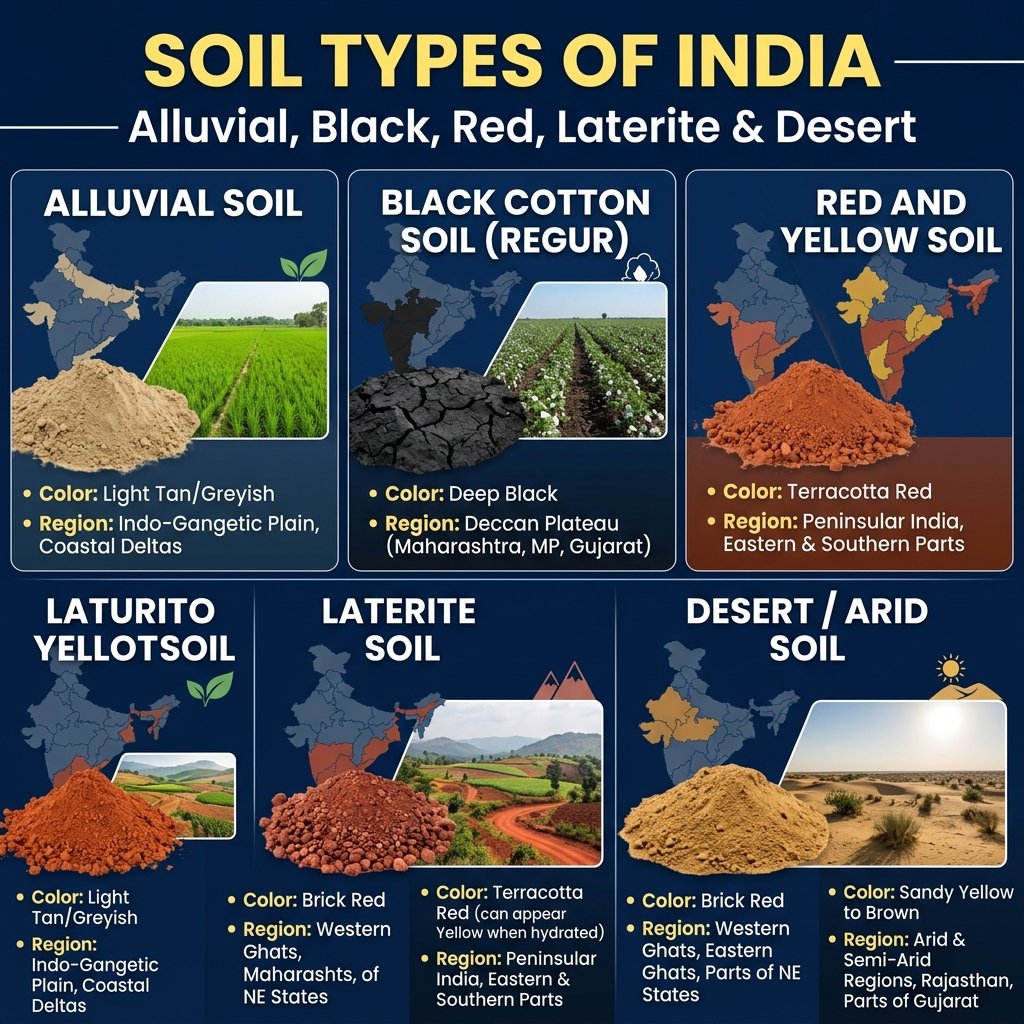
Overview — Major Soil Types of India
| Soil Type | Area Covered | Main States | Key Crops |
|---|---|---|---|
| Alluvial Soil | ~43% of India | UP, Punjab, Haryana, Bihar, West Bengal, Assam | Wheat, Rice, Sugarcane, Pulses |
| Black / Regur Soil | ~15% of India | Maharashtra, MP, Gujarat, AP, Karnataka | Cotton, Soybean, Jowar, Sunflower |
| Red & Yellow Soil | ~18% of India | Tamil Nadu, AP, Odisha, Jharkhand, Karnataka | Groundnut, Pulses, Coarse cereals |
| Laterite Soil | ~8% of India | Kerala, Karnataka, Tamil Nadu, Assam, NE India | Tea, Coffee, Cashew, Rubber |
| Arid & Desert Soil | ~5% of India | Rajasthan, Gujarat (Rann of Kutch), Ladakh | Bajra, Drought-resistant crops (with irrigation) |
| Mountain & Forest Soil | ~8% of India | Himalayas, NE India, Western Ghats | Tea (Darjeeling), Apple, Temperate fruits |
1. Alluvial Soil — कछारी मिट्टी
Alluvial soil is India’s most extensive and agriculturally productive soil, covering about 43% of India’s total land area and supporting over 60% of India’s food production.
Formation
Formed by the deposition of silt, sand, and clay carried by rivers — primarily the Himalayan rivers (Indus, Ganga, Brahmaputra and their tributaries). Also found in river deltas and coastal plains from peninsular rivers.
Types of Alluvial Soil
- 🟡 Khadar (New Alluvium): Found in floodplains — newer deposits closer to river channels. Light-coloured, porous, sandy, renewed every year during floods. Very fertile. Found in low-lying floodplains (khadar land).
- 🟤 Bhangar (Old Alluvium): Found on older terraces above floodplain — older deposits, coarser, darker, contains nodules of calcium carbonate called kankar. Less fertile than Khadar but stable for settlement.
Key Properties
- ✅ Rich in Potash (K) — excellent for wheat and rice
- ⚠️ Deficient in Nitrogen (N), Phosphorus (P), Humus
- ✅ Texture varies: Sandy in upper plains → clayey in deltas
- ✅ Well-watered — best with irrigation (Indo-Gangetic Plain gets Ganga canal system)
- 📍 Distribution: Northern Plains (Indo-Gangetic-Brahmaputra), river deltas (Ganga Delta, Krishna-Godavari Delta, Mahanadi Delta)
2. Black Soil (Regur / Cotton Soil) — काली मिट्टी
Black soil — also called Regur (from Telugu word regar) or cotton soil — is one of the most distinctive soils in India. It is uniquely suited for cotton cultivation and covers the Deccan Plateau.
Formation — The Volcanic Connection
Black soil formed from the weathering of Deccan Trap basaltic lava rocks (~66 million years ago). As the black basalt weathered under tropical monsoon climate, it produced montmorillonite clay — a highly expansive clay mineral that gives black soil its unique properties. This is why black soil is found specifically on the Deccan Plateau where Deccan Traps are exposed.
Key Properties
- ⬛ Colour: Deep black — from titaniferous magnetite and iron content
- 💧 High moisture retention: Swells when wet (cracks close), shrinks and cracks deeply when dry (self-ploughing — no need to plough!)
- 🌱 Rich in: Calcium Carbonate (CaCO₃), Magnesium, Potash, Iron — ideal for cotton
- ⚠️ Poor in: Nitrogen, Phosphorus, Organic matter, Humus
- 🏗️ Engineering problem: Expansive clay = major foundation problem for buildings, roads, dams in Deccan region
- 📍 Distribution: Maharashtra, Madhya Pradesh, Gujarat, parts of Karnataka, Andhra Pradesh, Telangana — coinciding with Deccan Trap lava coverage
🇮🇳 Geology Link: Black soil is direct product of the Deccan Traps volcanic eruption (66 Ma). The basalt lava cooled, was weathered over millions of years under monsoon climate, and produced the montmorillonite clay we call black/regur soil. This is why Maharashtra and MP have such productive cotton-growing black soil covering the same region as the ancient lava flows!
3. Red and Yellow Soil — लाल और पीली मिट्टी
Red soil develops on crystalline igneous rocks under conditions of low rainfall and high temperature. The red colour comes from diffusion of iron oxides (Fe₂O₃ — haematite) through the soil mass.
Key Properties
- 🔴 Red colour: From iron oxyhydroxide (haematite) in the soil — fully oxidized iron
- 🟡 Yellow colour (in lower horizons): From hydrated iron oxides — partially weathered iron
- ⚠️ Deficient in: Nitrogen, Phosphorus, Humus, Lime, Magnesia
- ✅ Suitable for groundnut, pulses, coarse cereals with fertilization
- 💧 Porous, friable, less water retention than black soil
- 📍 Distribution: Eastern Peninsula — Tamil Nadu, parts of Andhra Pradesh, Karnataka, Odisha, Jharkhand, Chhattisgarh, Bundelkhand (UP/MP)
4. Laterite Soil — लैटेराइट मिट्टी
Laterite soil (later = Latin for “brick”) forms in regions of high temperature and high rainfall with alternating wet and dry seasons. Intense leaching by heavy rain removes silica and soluble minerals, leaving behind iron and aluminium oxides — creating a hard, brick-like surface layer.
Formation Process
- 🌧️ Heavy monsoon rain leaches (washes out) silica, lime, and plant nutrients downward
- 🌞 Dry season — water table drops, iron and aluminium oxides concentrate in the upper layer
- 🧱 Over time, the upper layer hardens into a porous, brick-like material that can literally be cut and used as building material (traditional Kerala homes used laterite blocks)
Key Properties
- 🧱 Hard crust on surface — name comes from Latin “later” (brick)
- ⚠️ Very poor in: Nitrogen, Phosphorus, Potash, Calcium, Organic matter — heavily leached
- ✅ Rich in: Iron (hence brick-red colour), Aluminium
- 🌿 Supports plantation crops with management: Tea, Coffee, Rubber, Cashew, Coconut
- 📍 Distribution: Western Ghats (Kerala, Karnataka), parts of Tamil Nadu, NE India (Assam, Meghalaya), Odisha hills, Jharkhand plateaus
5. Arid and Desert Soil — शुष्क एवं मरुस्थलीय मिट्टी
Arid soils form in regions of very low rainfall (<50 cm/year) and high evaporation. The lack of water means very little chemical weathering and almost no leaching — so soluble salts accumulate at the surface.
Key Properties
- 🏜️ Sandy, light-coloured (pale yellow to red) — low humus, low moisture
- 🧂 High soluble salt content — kankar (calcium carbonate) nodules common in lower horizons
- ⚠️ Poor in: Nitrogen, Humus, Organic matter; low water retention
- ✅ Rich in: Phosphate (surprisingly!) — phosphorus is not leached in dry conditions
- 💧 With irrigation: Can support Bajra, Jowar, Pulses, Cotton in some areas (Indira Gandhi Canal has transformed parts of western Rajasthan)
- 📍 Distribution: Rajasthan (Thar Desert), Gujarat (Rann of Kutch), parts of Punjab-Haryana (semi-arid)
6. Mountain and Forest Soil — पर्वतीय एवं वन मिट्टी
Mountain soils develop on the slopes of the Himalayas, Western Ghats, NE hills, and other hill regions under forest cover. They are immature (poorly developed), thin, and vary greatly with altitude.
Types by Altitude (Himalayas)
- 🌲 Lower slopes (below 1,000m): Rich red/brown loam — suitable for tea, cardamom, tropical fruits
- 🌿 Mid slopes (1,000–2,000m): Dark brown, high organic content under coniferous forests — Darjeeling tea region
- ❄️ High slopes (above 3,000m): Shallow, rocky, acidic, humus-rich — Alpine meadow (bugyal) soils; pastoral use only
- 🏔️ Above tree line: Tundra soils — thin, cold, permafrost in places
Key Properties
- 🌱 High organic matter and humus under forest cover
- ⚠️ Thin, immature, prone to erosion on steep slopes
- 🍵 Tea zones: Darjeeling (WB), Assam, Nilgiris use mountain/forest soils
- 📍 Distribution: Himalayas, NE India hill ranges (Shillong, Garo, Naga hills), Western Ghats (Nilgiris, Brahmagiri)
7. Saline and Alkaline Soils (Usar / Reh / Thur)
These are problem soils caused by waterlogging, poor drainage, or over-irrigation leading to salt accumulation at the surface. Found in arid/semi-arid regions and poorly-drained Indo-Gangetic plains.
- 🧂 Saline (Reh/Thur): High soluble chlorides and sulphates; white efflorescence on surface; found in UP, Bihar, Rajasthan
- ⚠️ Alkaline (Usar/Kalar): High sodium carbonate; damages crops; requires gypsum application to reclaim
- 🔄 Reclamation: Gypsum application + proper drainage + salt-tolerant crops (like dhaincha) + leaching with canal water
8. Peaty and Marshy Soils
Found in regions of heavy rainfall and high humidity where organic matter accumulates faster than it decomposes — leading to peat formation. Waterlogged, dark-coloured, heavy, acidic.
- 📍 Found in: Kerala backwaters (kuttanad — the “rice bowl” of Kerala below sea level), Sunderbans delta, coastal Odisha, NE India wetlands
- 🌾 Kuttanad in Kerala — paddy cultivation below sea level in peaty soil
Soil Erosion in India — Key Issue
| Type of Erosion | Region | Cause |
|---|---|---|
| Sheet erosion | Peninsular plateau slopes | Rainwater flowing in sheets strips topsoil |
| Rill erosion | Northern plains | Small channels form and carry away soil |
| Gully erosion (Ravines) | Chambal Valley (MP/Rajasthan), Yamuna, Damodar | Long-term gully formation creates ravine land (badland topography) |
| Wind erosion | Thar Desert (Rajasthan) | Deflation and saltation of desert soils |
| Landslides | Himalayas, NE India, Western Ghats | Steep slopes + heavy rain + deforestation |
Key Takeaways
| Soil Type | Origin | Best For | Deficient In |
|---|---|---|---|
| Alluvial | River deposits (Himalayan rivers) | Wheat, Rice, Sugarcane | N, P, Humus |
| Black (Regur) | Deccan Trap basalt weathering | Cotton, Soybean | N, P, Humus |
| Red & Yellow | Weathering of crystalline rock | Groundnut, Pulses | N, P, Humus, Lime |
| Laterite | Leaching in high rainfall zone | Tea, Coffee, Rubber | N, P, K, Lime, Organic matter |
| Arid/Desert | Low rainfall, evaporation | Bajra (with irrigation) | N, Humus (rich in P!) |
| Mountain/Forest | Mountain slopes under forest | Tea, Temperate fruits | Varies by altitude |
Frequently Asked Questions (FAQs)
1. Which soil covers the largest area in India?
Alluvial soil covers the largest area — approximately 43% of India’s total land surface. It is found across the entire Indo-Gangetic Plain (stretching from Punjab to Assam) and in the river deltas along the eastern coast. Because it is the most fertile and well-watered, it supports the majority of India’s food production, including nearly all of the wheat and rice grown in the country.
2. Why is black soil ideal for cotton but not for all crops?
Black soil’s unique property is its high moisture retention — it swells when wet and holds water for a long period. Cotton requires prolonged moisture from a single rainy season to complete its growth, which black soil naturally provides. However, black soil is deficient in Nitrogen, Phosphorus, and Organic matter, making it unsuitable for crops that need these nutrients without intensive fertilization. Its sticky, expansive nature also makes cultivation difficult with traditional implements when wet.
3. Why does laterite soil support plantation crops but not food crops?
Laterite soil is intensely leached — heavy tropical rains wash away almost all plant nutrients (N, P, K, Calcium, Organic matter). What remains is mainly iron and aluminium oxides. Most food crops (rice, wheat, pulses) cannot thrive in such nutrient-poor, acidic conditions. However, plantation crops like Tea, Coffee, Rubber, and Cashew have adapted to acidic, well-drained laterite soils — especially with organic mulching and targeted fertilization. Tea particularly prefers the slight acidity and good drainage of laterite soils.
4. What is the “self-ploughing” property of black soil?
Black soil contains montmorillonite clay which shrinks significantly when dry and swells when wet. This causes the soil to develop wide deep cracks (sometimes 1 metre deep) during the dry season. When it rains, the surface soil, water, and organic matter fall into these cracks. When the soil swells back as it wets, the fallen material gets mixed into the soil profile — essentially turning and mixing the soil without human intervention. This is called self-ploughing or vertic behaviour, and it reduces the need for deep ploughing in black soil regions.
⭐ Important for Exams — Quick Revision
- 🔑 Alluvial soil = 43% India; Indo-Gangetic Plain; Khadar (new) + Bhangar (old); Rich in K; poor in N, P
- 🔑 Khadar = new alluvium, floodplains, more fertile; Bhangar = old alluvium, terraces, kankar nodules
- 🔑 Black/Regur soil = from Deccan Trap basalt weathering; montmorillonite clay; self-ploughing; cotton soil; Maharashtra + MP + Gujarat
- 🔑 Red soil = red from Fe₂O₃ (haematite); yellow in lower horizons; Tamil Nadu, AP, Odisha
- 🔑 Laterite = Latin “later” = brick; leached by heavy rain; iron + aluminium left; Tea, Coffee, Rubber; Kerala, Karnataka, NE India
- 🔑 Desert/Arid soil = sandy, saline; low N, low humus; HIGH IN PHOSPHATE (not leached); Rajasthan
- 🔑 Mountain soil = thin, immature, high humus; Tea (Darjeeling), temperate fruits; Himalayas, NE hills
- 🔑 Saline soil (Reh/Usar) = waterlogging, over-irrigation; UP, Rajasthan; reclaimed by gypsum
- 🔑 Peaty soil = high organic matter, waterlogged; Kerala Kuttanad, Sunderbans
- 🔑 ICAR classification = 8 soil types in India
- 🔑 Chambal Valley = worst gully erosion (ravine land / badland) in India
- 🔑 Gondwana coalfields in black soil region (MP/Jharkhand) — both from Gondwana geological legacy
Related Geology Articles on StudyHub
- ➡️ Volcanoes & Deccan Traps — The Origin of Black Cotton Soil
- ➡️ Pangaea & Gondwana — India’s Geological History
- ➡️ Coastal Geomorphology India — Beaches, Deltas & Lagoons
- ➡️ Physiography of India — Himalayas, Deccan & Coastal Plains
- ➡️ Glaciers & Glacial Geomorphology — How Ice Shapes the Landscape