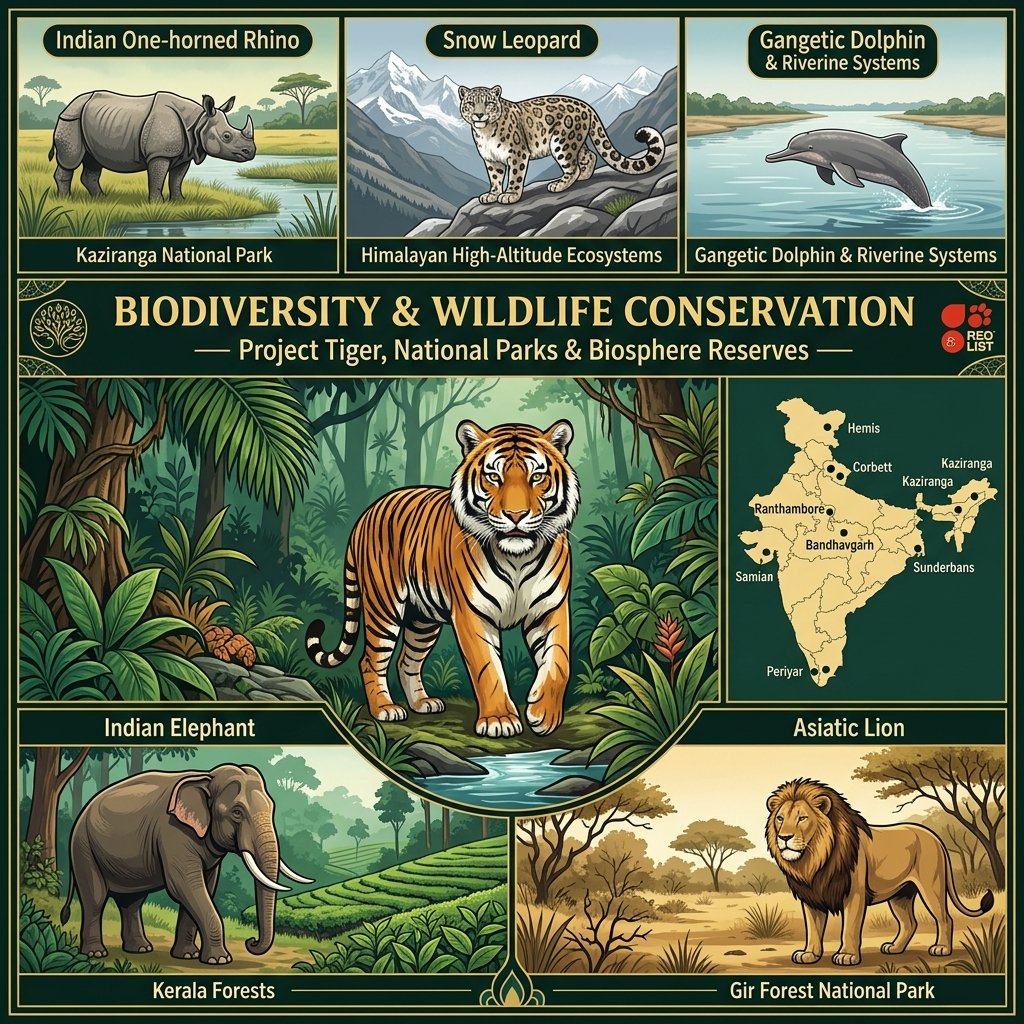
Biodiversity & Wildlife Conservation in India — Project Tiger, National Parks, Biosphere Reserves & IUCN Red List 2026
By
Pramod
Table of Contents
India is a mega-biodiversity country — one of only 17 nations worldwide that together harbour over 70% of the Earth’s species. With 47,000+ plant species, 91,000+ animal species, and four of the world’s 36 biodiversity hotspots, India’s biological wealth is extraordinary. Yet rapid habitat loss, poaching, invasive species, pollution, and climate change threaten this heritage. Understanding India’s wildlife conservation framework — Project Tiger, national parks, biosphere reserves, wildlife sanctuaries, the IUCN Red List, and key legislation — is essential for UPSC, SSC, and all environmental exams.
Biodiversity & Wildlife Conservation in India — Project Tiger, National Parks, Biosphere Reserves & IUCN | StudyHub Geology
India’s Biodiversity — Key Statistics
Category
India’s Count
% of World Total
Plant species (Flora)
47,000+
~7%
Animal species (Fauna)
91,000+
~6.5%
Bird species
1,300+
~13%
Reptile species
520+
~8%
Freshwater fish
2,500+
~7%
Mammal species
430+
~8%
Endemic plant species
~33% of all Indian plants
—
Global Biodiversity Hotspots in India
4 out of 36
~11%
India’s 4 Biodiversity Hotspots
Hotspot
Region
Key Features
Western Ghats + Sri Lanka
Western Ghats (Kerala, Karnataka, Tamil Nadu, Maharashtra, Goa)
~5,000 endemic plant species; 139 endemic mammals; Lion-tailed Macaque, Nilgiri Tahr, Malabar Giant Squirrel; 40% of Indian reptiles endemic here
Eastern Himalayas
Arunachal Pradesh, Sikkim, NE India, Nepal, Bhutan
The IUCN Red List (International Union for Conservation of Nature) is the world’s comprehensive inventory of species’ conservation status. It classifies species into 9 categories:
Category
Abbreviation
Meaning
India Examples
Extinct
EX
No living individuals remain
Cheetah (from India, 1952); Pink-headed Duck
Extinct in the Wild
EW
Survives only in captivity
Sangai (Manipur brow-antlered deer — recovered from EW)
Critically Endangered
CR
Extremely high extinction risk
Great Indian Bustard, Gharial, Bengal Florican, Malabar Large-spotted Civet
Endangered
EN
Very high extinction risk
Bengal Tiger, Asiatic Lion, Indian Elephant, One-horned Rhino, Snow Leopard
Project Tiger was launched on 1 April 1973 by Prime Minister Indira Gandhi — one of the world’s first and most successful species-specific wildlife conservation programmes. India’s Bengal Tiger population had crashed from ~40,000 (1900) to just ~1,800 (1972) due to hunting, habitat loss, and poaching.
🐯 2022:3,682 tigers — India has 75% of all wild tigers on Earth; achieved target 4 years early
🌍 Global wild tiger population (2024): ~5,000 — India accounts for ~74% of world’s wild tigers
Major Tiger Reserves in India
Tiger Reserve
State
Notes
Jim Corbett
Uttarakhand
India’s OLDEST National Park (1936); FIRST tiger reserve under Project Tiger (1973); named after Jim Corbett (hunter-turned-conservationist)
Kaziranga
Assam
UNESCO WHC; highest tiger density in world + world’s largest concentration of one-horned rhinos; 2⁄3 of world’s rhinos here
Sundarbans
West Bengal
UNESCO WHC; world’s largest mangrove; swimming tigers; only tigers adapted to saltwater habitat
Ranthambore
Rajasthan
Famous for “photogenic tigers”; ruins of Ranthambore Fort inside reserve; most-visited tiger reserve
Bandhavgarh
Madhya Pradesh
Highest tiger density in India (per unit area); famous for white tigers historically (now extinct in wild)
Kanha
Madhya Pradesh
Inspiration for Rudyard Kipling’s “Jungle Book”; habitat of Barasingha (Hard Ground Swamp Deer)
Tadoba-Andhari
Maharashtra
Maharashtra’s largest and oldest national park; growing tiger population
Nagarhole + Bandipur
Karnataka
Together with Mudumalai (TN) + Wayanad (Kerala) = Nilgiri Biosphere Reserve; largest tiger habitat in South Asia
Periyar
Kerala
Tiger reserve + elephant reserve; Periyar lake ecosystem; community conservation model
Simlipal
Odisha
Biosphere Reserve + Tiger Reserve; one of India’s largest parks; melanistic (black) tigers reported
Protected Area Network in India
Category
Count
Definition
Key Examples
National Parks
106
Highest protection; no human activity; private rights abolished
Jim Corbett, Kaziranga, Gir, Sundarbans, Valley of Flowers, Hemis
Wildlife Sanctuaries
567
Some human activities permitted; focus on species protection
Vedanthangal (birds, TN), Chilika Lake (Odisha), Bharatpur
Tiger Reserves
54
Core + buffer zone; NTCA oversight; no human activity in core
As listed above
Biosphere Reserves
18 (12 UNESCO MAB)
Large areas with core/buffer/transition zones; research + conservation
Nilgiris (#1 India 1986), Sundarbans, Nanda Devi, Gulf of Mannar
Elephant Reserves
32
Project Elephant (1992); corridor protection
Nilgiri, Garo Hills, Eastern Dooars
Ramsar Wetlands
85 (largest count globally)
International Ramsar Convention wetlands of global importance
Chilika Lake, Sundarbans, Loktak, Sambhar, Wular Lake
Key Conservation Projects & Success Stories
Project Elephant (1992)
🐘 India has ~27,000–29,000 wild elephants — world’s largest Asian elephant population
📍 Concentrated in: South India (Nilgiris, Kerala, Karnataka), NE India (Assam, Arunachal), central (Odisha, Jharkhand), North (Uttarakhand, West Bengal Duars)
🔑 Major challenge: Human-elephant conflict — elephants entering farmlands, crop raiding, deaths on railway tracks; Assam most affected
📜 Wildlife Protection Act 1972 (WPA) — India's primary wildlife law; 6 schedules (Schedule I = highest protection: Tiger, Lion, Rhino, Elephant, Snow Leopard, Great Indian Bustard; killing Schedule I = 7 years minimum); established national parks and sanctuaries
📜 Forest Conservation Act 1980 (FCA) — no diversion of forest land for non-forest use without central govt approval; amended 2023 (Van Sanrakshan Evam Janpadiya Vikas Adhiniyam) to include plantations + simplify clearances for certain projects
📜 Biological Diversity Act 2002 (BDA) — regulates access to biological resources; National Biodiversity Authority (NBA); Nagoya Protocol implementation
📜 Environment Protection Act 1986 (EPA) — umbrella legislation for environment; enacted after Bhopal Gas Tragedy 1984; empowers govt to take all measures for environmental protection
⭐ Important for Exams — Quick Revision
🔑 India: 47,000+ plants, 91,000+ animals; 7% world plants; 4 of 36 biodiversity hotspots
🔑 IUCN CR (Critically Endangered): Great Indian Bustard, Gharial, Bengal Florican
🔑 IUCN EN (Endangered): Bengal Tiger, Asiatic Lion, Indian Elephant, One-horned Rhino, Snow Leopard
🔑 Project Tiger: Launched 1 April 1973 by PM Indira Gandhi; 54 reserves; 2022 count = 3,682 tigers = 74% of world's wild tigers
🔑 Jim Corbett = India's oldest NP (1936); first Project Tiger reserve (1973)
🔑 Kaziranga (Assam) = UNESCO WHC; world's largest one-horned rhino population (70%); highest tiger density
🔑 Sundarbans = UNESCO WHC + Ramsar + Tiger Reserve; world's largest mangrove; swimming tigers
🔑 Kanha = inspiration for Rudyard Kipling's "Jungle Book"
🔑 Nilgiri Biosphere Reserve = India's first (1986) + UNESCO MAB; Bandipur+Nagarhole+Mudumalai+Wayanad; largest tiger habitat in South Asia
🔑 India = 85 Ramsar Wetlands = highest number globally; Chilika Lake = largest (Odisha)
🔑 Project Cheetah (2022): Kuno National Park (MP); 8 Namibian cheetahs first; NOT Asiatic Cheetah (only in Iran)
🔑 National Aquatic Animal: Gangetic/South Asian River Dolphin; Project Dolphin 2020
🔑 WPA 1972: Schedule I = Highest protection; Tiger, Lion, Rhino, Elephant, Great Indian Bustard
🔑 Cheetah extinct in India: 1952 (last 3 shot in Koriya, Madhya Pradesh)
Frequently Asked Questions (FAQs)
1. Why is the Great Indian Bustard (GIB) Critically Endangered despite being in protected areas?
The Great Indian Bustard (GIB) (Ardeotis nigriceps) — India's National Bird candidate (Indian Peafowl is the official National Bird) — is one of the world's most endangered birds with only ~100–150 individuals remaining. Despite being an officially protected species (WPA Schedule I), GIBs face existential threats: (1) Power transmission lines — GIBs fly low and have poor frontal vision; they collide with overhead power lines (the Supreme Court ordered underground cabling in GIB habitat in 2021 — partly reversed in 2024 due to renewable energy concerns); (2) Habitat loss — grasslands of Rajasthan (Desert National Park, Jaisalmer) converted to agriculture/solar parks; (3) Extremely slow reproduction — GIBs lay only one egg per year; any mortality is hard to recover from. India runs a captive breeding programme at Jaisalmer.
2. What is the difference between a National Park, Wildlife Sanctuary, Tiger Reserve, and Biosphere Reserve?
These are overlapping but distinct categories. A National Park (106 in India) has the highest legal protection — all human activities including grazing and private rights are prohibited; boundaries fixed by law and cannot be changed without Parliament. A Wildlife Sanctuary (567 in India) has slightly lower protection — some human activities (grazing, collection of minor forest produce) may be permitted with approval; managed for specific species. A Tiger Reserve (54 in India) is designated under Project Tiger and has two zones: the Core (= equivalent to National Park — no human activity) and the Buffer (= controlled eco-tourism, limited activity). A Biosphere Reserve (18 in India) is the largest category — has three concentric zones: Core (strictly protected), Buffer (research allowed), and Transition/Cooperation Zone (sustainable human use). Biosphere Reserves can contain national parks and sanctuaries within them (e.g., Nilgiri BR contains Bandipur NP, Nagarhole NP, Mudumalai WS, Wayanad WS).
3. Why does India have 74% of the world's wild tigers?
India's tiger conservation success has multiple causes: (1) Dedicated legislation + enforcement — Project Tiger (1973) created dedicated tiger reserves with a full protection regime; NTCA (National Tiger Conservation Authority, 2006) provides centralised oversight. (2) Large protected area network — India's 54 tiger reserves cover ~70,000+ km² with buffer zones. (3) Community participation — voluntary village relocation from tiger core areas (with compensation) reduced human-tiger conflict. (4) Anti-poaching — M-STrIPES (Monitoring System for Tigers — Intensive Protection and Ecological Status) app-based monitoring; NTCA-Wildlife Crime Control Bureau coordination. (5) Prey recovery — protection of deer, pigs, and other tiger prey in reserves naturally supports tiger recovery. In contrast, countries like China, Vietnam, and Indonesia lost their tigers mainly due to lack of enforcement and smaller protected areas.
The official editorial and research desk at StudyHub. Consisting of experienced educators, content validators, and recruitment experts, the StudyHub Editorial Team is dedicated to publishing highly researched, syllabus-aligned study material, exam analyses, and verified government job notifications. Every article published under this profile is checked by multiple subject matter experts across History, Polity, Geography, and General Sciences to ensure accuracy, factual correctness, and compliance with the latest exam patterns.
StudyHub Content Team
At StudyHub, our team includes subject experts and exam-qualified educators with hands-on experience across SSC, Railways, State PSCs, and other major competitive exams. With their deep understanding of varied exam patterns and syllabi, they create content that is clear, to the point, reliable, and genuinely helpful for aspirants.
Their aim is to make even the toughest topics easy to understand and directly useful for your exam preparation—whether it's Current Affairs, General Studies, Reasoning, Quantitative Aptitude, or any subject-specific area. Every note, article, and test is designed to save your time and boost your performance, no matter which competitive exam you're preparing for.
📢 Join StudyHub For Fast Updates!
Get instant alerts for Latest Test Series, Courses, Govt Jobs, Admit Cards, and Results.