World Geography is the foundation of all geographic study — from understanding why India has a monsoon to why the Middle East has deserts, from why certain countries are rich to why earthquakes cluster along specific lines. Mastering the 7 continents, 5 oceans, latitude and longitude framework, important geographical lines (Equator, Tropics, Date Line, Prime Meridian), and key world geographic facts is essential for UPSC, SSC, CDS, NDA, Railways, and virtually every competitive examination in India. This comprehensive guide covers all the fundamentals you need.
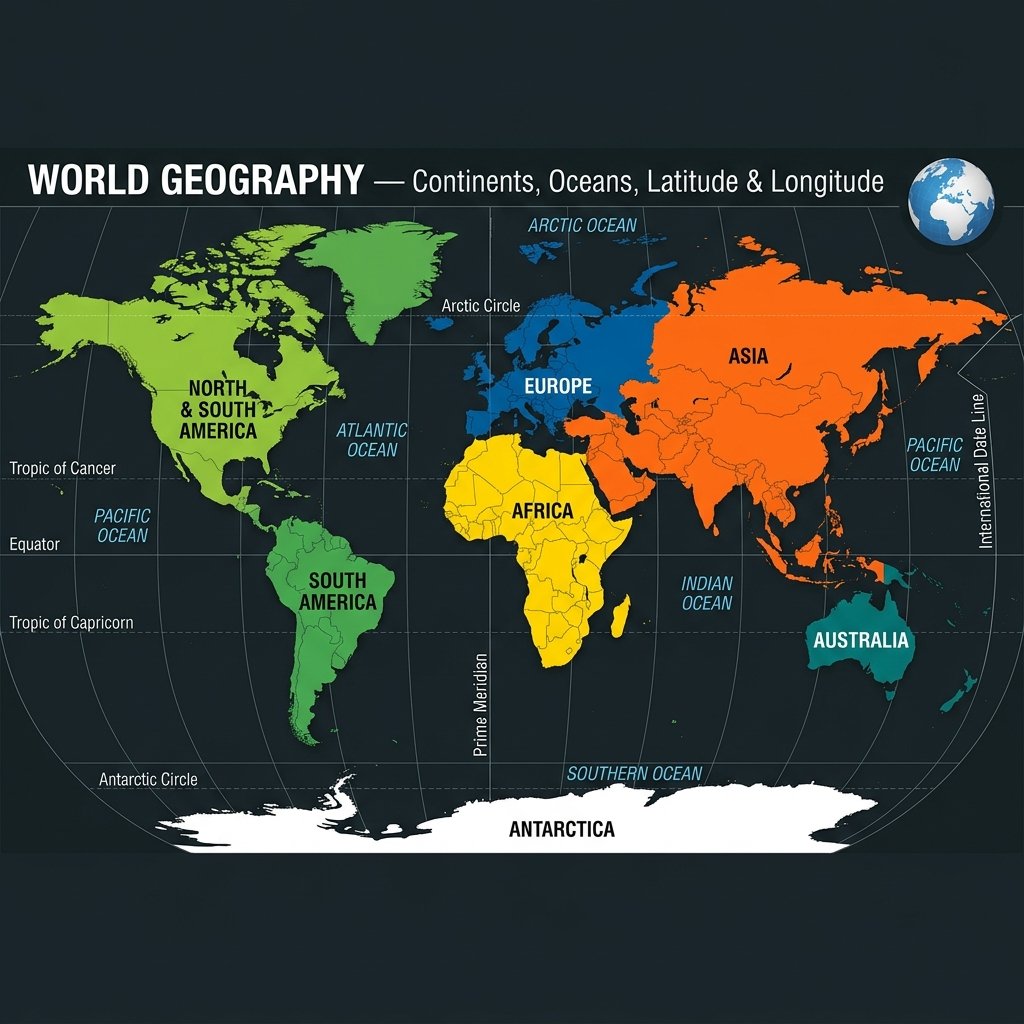
The 7 Continents of the World
| Continent | Area (km²) | Population | Countries | Key Facts |
|---|---|---|---|---|
| Asia | 44.6 million | 4.7 billion (60% world) | 49 | Largest continent; highest point (Everest 8,849m); lowest point (Dead Sea −431m); India, China, Russia (Asia part) |
| Africa | 30.4 million | 1.4 billion | 54 (most countries) | Equator passes through; Sahara = world’s largest hot desert; Nile = world’s longest river; Kilimanjaro = highest peak |
| North America | 24.7 million | 590 million | 23 | Mississippi-Missouri system; Grand Canyon; Rocky Mountains; includes Caribbean |
| South America | 17.8 million | 440 million | 12 | Amazon River (largest by volume); Amazon Rainforest (largest tropical forest); Andes (longest mountain chain); Angel Falls (highest waterfall) |
| Antarctica | 14.2 million | 0 (permanent) | 0 | Coldest, windiest, highest average elevation continent; 90% of world’s freshwater ice; South Pole; no countries — governed by Antarctic Treaty (1959) |
| Europe | 10.5 million | 750 million | 44 | Densely developed; Alps; Rhine, Danube rivers; smallest area after Australia (mainland) |
| Australia/Oceania | 8.5 million | 44 million | 14 | Smallest continent; only continent = one country (Australia); Great Barrier Reef; Uluru; marsupial wildlife |
🗺️ Memory Trick — Continental Area (Largest to Smallest): Asia, Africa, North America, South America, Antarctica, Europe, Australia → “AANSAEA” or remember: Asia (44M) → Africa (30M) → N.America (25M) → S.America (18M) → Antarctica (14M) → Europe (10M) → Australia (8.5M)
The 5 Oceans of the World
| Ocean | Area (km²) | Deepest Point | Key Facts |
|---|---|---|---|
| Pacific Ocean | 165.2 million (largest) | Mariana Trench 11,034 m (deepest point on Earth) | Largest ocean (47% of all ocean area); “Ring of Fire” tectonic activity surrounds it; El Niño originates here |
| Atlantic Ocean | 106.5 million | Puerto Rico Trench (8,376 m) | 2nd largest; Mid-Atlantic Ridge (seafloor spreading); Gulf Stream (warm current); Bermuda Triangle |
| Indian Ocean | 70.6 million | Java/Sunda Trench (7,187 m) | 3rd largest; monsoon-driven currents; only ocean named after a country; 2004 tsunami; Strait of Hormuz + Malacca strategic |
| Southern Ocean | 21.9 million | South Sandwich Trench (7,235 m) | 4th largest; surrounds Antarctica; officially recognised as 5th ocean by National Geographic (2021); IHO recognition pending; Antarctic Circumpolar Current (world’s largest ocean current) |
| Arctic Ocean | 14.1 million (smallest) | Fram Basin (5,608 m) | Smallest ocean; largely frozen; strategic importance growing as Arctic ice melts (new shipping routes: Northwest Passage, Northern Sea Route); geopolitical tensions (Russia, USA, Canada, Norway, Denmark) |
Latitude — The Horizontal Lines
Latitude lines (parallels) run east-west, parallel to the Equator. They measure distance north or south of the Equator (0°) in degrees. All latitude lines are equal in length (unlike longitude lines which converge at poles).
Important Latitude Lines
| Line | Degrees | Significance | Countries it Passes Through |
|---|---|---|---|
| Equator | 0° | Divides N & S hemispheres; maximum solar heating; ITCZ; tropical rainforests; longest day = 12 hrs year-round | Brazil, Congo, Indonesia, Kenya, Ecuador, Colombia, Uganda, Gabon, Maldives (close), São Tomé |
| Tropic of Cancer | 23.5° N | Northernmost point where Sun is directly overhead (June 21 — Summer Solstice in NH); STH belt; deserts; passes through India | India (Gujarat→Rajasthan→MP→Chhattisgarh→Jharkhand→WB→Tripura→Mizoram), China, Bangladesh, Myanmar, Saudi Arabia, Egypt, Libya, Algeria, Mauritania, Mali, Niger, Mexico, Bahamas |
| Tropic of Capricorn | 23.5° S | Southernmost point of direct overhead Sun (December 21 — Summer Solstice in SH); STH belt; Atacama, Kalahari, Australian deserts | Brazil, Argentina, Chile, South Africa, Mozambique, Madagascar, Namibia, Botswana, Australia |
| Arctic Circle | 66.5° N | Midnight Sun (June 21); Polar Night (December 21); permafrost; tundra; limit of tree growth | Russia, Norway, Sweden, Finland, Iceland, Canada, Alaska (USA), Greenland (Denmark) |
| Antarctic Circle | 66.5° S | Reciprocal of Arctic Circle; midnight sun in southern summer; Antarctica mostly within | Only Antarctica (no inhabited countries) |
Tropic of Cancer Through India — Critical for Exams
The Tropic of Cancer (23.5°N) passes through 8 Indian states from west to east: Gujarat → Rajasthan → Madhya Pradesh → Chhattisgarh → Jharkhand → West Bengal → Tripura → Mizoram. It divides India into tropical (south of the tropic) and sub-tropical (north of the tropic) climatic zones. This is why India has both tropical monsoon forests in the south AND semi-arid/temperate conditions in Rajasthan and northern plains.
Longitude — The Vertical Lines
Longitude lines (meridians) run north-south, from pole to pole. They measure distance east or west of the Prime Meridian (0°, Greenwich, London). Unlike latitudes (all equal length), meridians converge at the poles — forming wedge shapes.
Important Longitude Lines
| Line | Degrees | Significance |
|---|---|---|
| Prime Meridian (Greenwich Meridian) | 0° | Reference line for all longitudes; passes through Greenwich, London, UK; basis of Universal Time (UTC/GMT); divides Eastern and Western Hemispheres |
| International Date Line (IDL) | Approximately 180° | Crossing westward = jump one day forward; crossing eastward = go back one day; meanders to avoid splitting countries; passes through Pacific Ocean (largely uninhabited); Tonga, Samoa, Kiribati on east side = world’s first to greet new day |
| India’s Standard Meridian | 82.5° E | India’s standard time = UTC+5:30; passes through Mirzapur/Prayagraj (UP) — “zero hour” of India; India has single time zone despite 30° longitude width (could have 2 time zones) |
| 180° Meridian | 180° E/W | Opposite side of Prime Meridian; IDL follows roughly along here (with deviations) |
Time Zones & India’s Standard Time
- ⏰ Earth rotates 360° in 24 hours = 15° per hour = 1° per 4 minutes
- 🌏 India Standard Time (IST) = UTC+5:30 — based on 82.5°E meridian (82.5 × 4 = 330 minutes = 5 hours 30 minutes ahead of Greenwich)
- 🗺️ India’s east-to-west longitude span = 68°E to 97°E = nearly 30° longitude = theoretically 2 hours difference between Arunachal Pradesh and Gujarat, but India uses a single time zone
- ⚠️ Consequence: Arunachal Pradesh sunrise is ~2 hours earlier than Gujarat’s; NE states use “chai bagan” (tea garden) time, informally 1 hour ahead
- 🔑 Countries with multiple time zones: Russia (11 zones), USA (6 zones), Canada (6 zones), Australia (3 zones), China (officially 1 zone despite vast width)
Key World Geographic Facts for Exams
World’s Superlatives
| Category | Record Holder | Detail |
|---|---|---|
| Highest mountain | Mt Everest (Nepal/China) | 8,849 m (revised 2020); in Himalayas; Sagarmatha in Nepali |
| Lowest point on land | Dead Sea (Jordan/Israel/Palestine) | −431 m below sea level; saltiest large water body; hypersaline |
| Longest river | Nile (Africa) | 6,650 km; N. Africa; Egypt, Sudan, Uganda, Ethiopia |
| Largest river (by volume) | Amazon (S. America) | ~7,062 km; 20% of world’s freshwater discharge; Amazon Rainforest |
| Largest lake | Caspian Sea | 374,000 km²; technically a lake (landlocked saltwater); borders Russia, Azerbaijan, Kazakhstan, Turkmenistan, Iran |
| Largest freshwater lake | Lake Superior (N. America) | 82,103 km²; Canada-USA border; part of Great Lakes |
| Deepest lake | Lake Baikal (Russia) | 1,642 m; Siberia; holds 20% of world’s liquid freshwater; UNESCO WHC |
| Largest desert | Antarctica (cold desert) | 14.2 million km²; Sahara = largest HOT desert (9.2M km²) |
| Highest waterfall | Angel Falls (Venezuela) | 979 m; Canaima NP; drops from Auyán-Tepuí mesa |
| Largest rainforest | Amazon (Brazil) | ~5.5 million km²; lungs of the Earth; rapidly deforesting |
| Longest mountain chain | Andes (S. America) | 7,000 km along Pacific coast; 7 countries; highest = Aconcagua (6,961m) |
| Deepest ocean point | Mariana Trench (Pacific) | 11,034 m (Challenger Deep); deeper than Everest is tall; Pacific Ocean |
| Largest coral reef | Great Barrier Reef (Australia) | 2,300 km; Queensland coast; UNESCO WHC; threatened by bleaching |
| Largest country (area) | Russia | 17.1 million km²; 11 time zones; spans Europe + Asia |
| Smallest country (area) | Vatican City | 0.44 km²; within Rome, Italy; seat of Catholic Church |
| Most populous country | India | 1.44B+ (surpassed China April 2023) |
Important Straits of the World
| Strait | Connects | Importance |
|---|---|---|
| Strait of Gibraltar | Mediterranean Sea ↔ Atlantic Ocean | Europe-Africa divide; Spain-Morocco; key trade route; gateway to Mediterranean |
| Strait of Hormuz | Persian Gulf ↔ Gulf of Oman/Arabian Sea | 21M barrels oil/day; most critical energy chokepoint in the world |
| Strait of Malacca | Indian Ocean ↔ South China Sea/Pacific | World’s busiest shipping lane; 80,000 ships/year; China’s Malacca dilemma |
| Bab-el-Mandeb | Red Sea ↔ Gulf of Aden/Indian Ocean | Entry to Suez Canal-Europe shipping route; Houthi attacks 2023–24 |
| Palk Strait | India ↔ Sri Lanka | Separates Tamil Nadu from Sri Lanka; Pamban Island; Sethusamudram proposed channel |
| Ten Degree Channel | Andaman Islands ↔ Nicobar Islands | At 10°N latitude; divides India’s two island groups; strategic naval route |
| Drake Passage | South America ↔ Antarctica | Roughest ocean water; only open ocean route around the world outside Arctic; Cape Horn |
⭐ Important for Exams — Quick Revision
- 🔑 Largest continent: Asia (44.6M km²); 60% of world’s population; Smallest: Australia (8.5M km²)
- 🔑 Most countries in one continent: Africa (54 countries)
- 🔑 Largest ocean: Pacific (165.2M km²; 47% of all oceans); Smallest: Arctic (14.1M km²)
- 🔑 Deepest ocean point: Mariana Trench (Pacific) — 11,034 m
- 🔑 Southern Ocean = officially recognised as 5th ocean by National Geographic 2021; surrounds Antarctica
- 🔑 Equator = 0° latitude; passes through Brazil, Congo DRC, Indonesia, Kenya; hottest, most humid zone
- 🔑 Tropic of Cancer = 23.5°N; passes through 8 Indian states: Guj→Raj→MP→CG→Jhk→WB→Tripura→Mizoram
- 🔑 Tropic of Capricorn = 23.5°S; Brazil, South Africa, Australia; southern STH belt; Atacama desert
- 🔑 Prime Meridian = 0° longitude; Greenwich, London; basis of UTC/GMT
- 🔑 India Standard Time = UTC+5:30; based on 82.5°E meridian; Mirzapur (Prayagraj, UP)
- 🔑 International Date Line = ~180°; cross westward = one day forward; meanders through Pacific
- 🔑 Longest river: Nile (6,650 km, Africa); Largest by volume: Amazon (S. America)
- 🔑 Deepest lake: Lake Baikal (Russia, 1,642m); holds 20% world liquid freshwater
- 🔑 Largest hot desert: Sahara (9.2M km²); largest desert (cold): Antarctica (14.2M km²)
- 🔑 Highest waterfall: Angel Falls (Venezuela, 979m); Highest mountain: Everest (8,849m)
Frequently Asked Questions (FAQs)
1. Why is Antarctica considered a desert despite being mostly ice?
A desert is scientifically defined not by heat or sand but by low precipitation — less than 250 mm (25 cm) of precipitation per year. Antarctica receives an average of only 166 mm/year (mostly snow) — far less than even the Sahara’s edges. The Sahara averages about 250 mm/year; parts of the Atacama Desert in Chile receive barely 1 mm/year. Antarctica’s interior (the East Antarctic plateau) is one of the driest places on Earth — some areas haven’t seen precipitation in 2 million years. The vast ice sheets exist because Antarctica is so cold that even the tiny amount of snow that falls has accumulated over millions of years without melting. So Antarctica is both the world’s largest desert (by area) AND the world’s largest ice sheet — a cold, dry desert.
2. Why does India have only one time zone despite covering nearly 30° of longitude?
India spans from 68°7’E (Gujarat/Sir Creek) to 97°25’E (Arunachal Pradesh) — nearly 30° of longitude, which theoretically should cover nearly 2 time zones (15° = 1 hour). The time difference between India’s easternmost and westernmost points is actually about 1 hour 58 minutes. Using a single time zone (IST = UTC+5:30) means: (1) Administrative simplicity — a unified nation functions better with one time; railway timetables, stock market, government would be chaotic with 2 zones; (2) Historical reasons — British India used a single time zone; (3) Political unity — having 2 time zones might emphasise North-East India’s separateness. However, the cost is real: in Arunachal Pradesh and other NE states, the sun rises around 4:30–5:00 AM in summer (IST), wasting early daylight, while offices open at 10 AM. The Tea Garden time (1 hour ahead of IST) used informally in NE tea estates reflects the practical need. Several committees have recommended a Northeast Time Zone (UTC+6 or +6:30) but political sensitivities have prevented implementation.
3. What is the International Date Line and why does it zigzag?
The International Date Line (IDL) is an imaginary line at approximately 180° longitude (opposite the Prime Meridian) where each new calendar day begins. Crossing it westward = one day forward; eastward = one day backward (this is why Jules Verne’s Phileas Fogg gained a day in “Around the World in 80 Days” — he traveled east). If the IDL were a perfectly straight line at 180°, it would bisect several landmasses and island groups — creating the absurd situation of different parts of the same country having different calendar dates. So the IDL zigzags to accommodate countries: it bends east around the Aleutian Islands (Alaska/USA), bends west around Kiribati and Samoa (so that these island nations all share the same calendar day as their main islands — Kiribati was one of the first to celebrate Y2K in 2000). The IDL is an international convention, not a legal treaty — individual nations can choose which side of it to be on.
Related Geology Articles on StudyHub
- ➡️ Indian Ocean — Strategic Importance, Trade Routes & IORA
- ➡️ Atmosphere — Layers, Pressure Belts & Wind Systems
- ➡️ What is Geology — Earth’s Structure & Planet Formation
- ➡️ Plate Tectonics — Why Continents Look Like Puzzle Pieces
- ➡️ Natural Disasters — World-Scale Disaster Geography