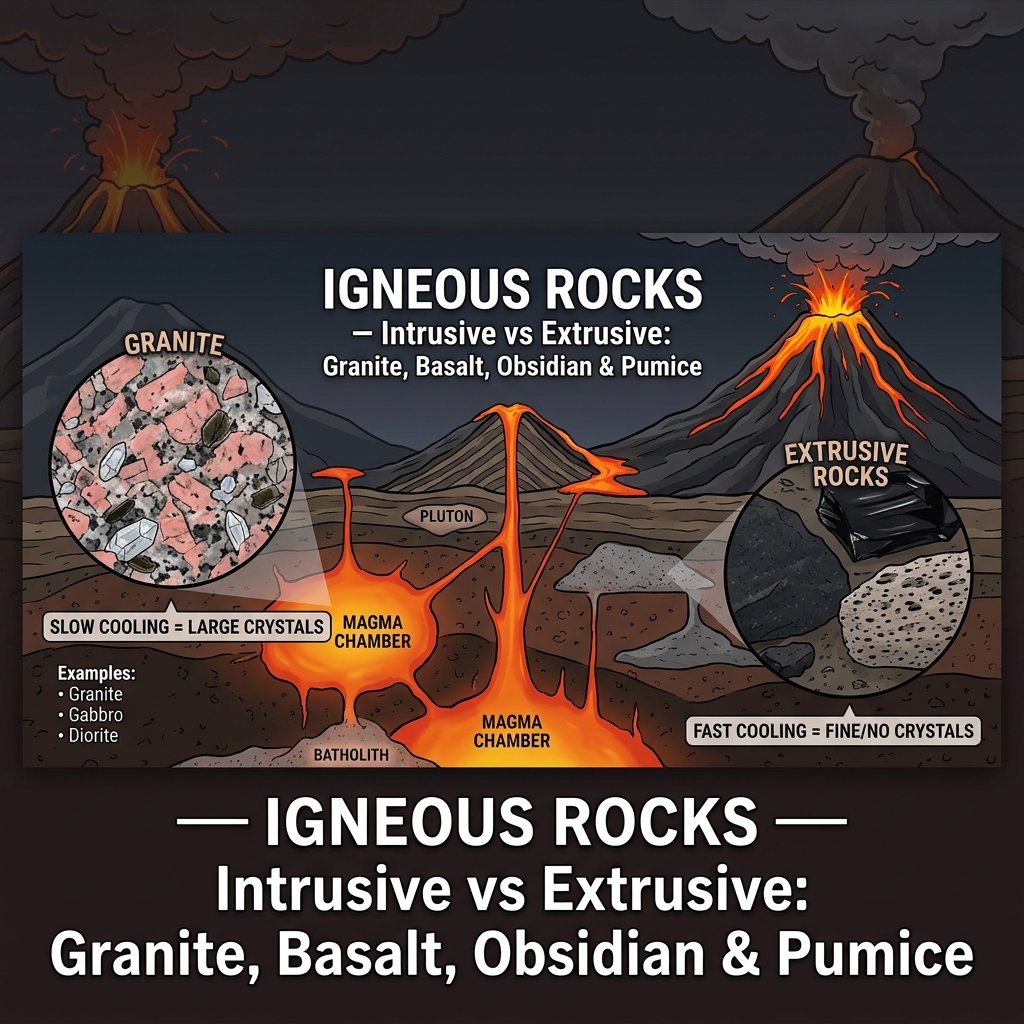
Igneous rocks are the original rocks of Earth — they form when molten material (magma underground, or lava at the surface) cools and solidifies. The word “igneous” comes from the Latin ignis, meaning fire. Comprising approximately 65% of Earth’s crust by volume, igneous rocks are the foundation upon which all other rocks ultimately build. They are divided into two great families: intrusive (plutonic) rocks that solidify slowly underground and develop large crystals, and extrusive (volcanic) rocks that cool rapidly at the surface and have tiny or no crystals. From the pink granite of South India’s temples to the dark basalt of the Deccan Plateau and the black glass of obsidian, igneous rocks define much of Earth’s geology. This is the complete guide — spanning formation, classification, textures, and key rock types — essential for UPSC, SSC, Class 9–11 NCERT, and all geology examinations.
How Igneous Rocks Form — The Process
- 🌋 Magma = molten rock + dissolved gases + crystals, formed inside Earth at depths of 50–200 km in the mantle or lower crust; temperatures of 700–1300°C
- 🔺 Magma is less dense than surrounding solid rock, so it rises through cracks and faults (like a bubble rising in water)
- ❄️ As magma rises and loses heat, it begins to crystallise — minerals form in a specific sequence controlled by Bowen’s Reaction Series (high-temperature minerals crystallise first: olivine, pyroxene; lower-temperature minerals last: quartz, feldspar)
- 🏔️ If magma cools underground (never reaches surface) = solidifies slowly over millions of years = intrusive/plutonic igneous rock
- 🌋 If magma reaches the surface as lava or erupts explosively = cools in hours to years = extrusive/volcanic igneous rock
- 💧 Water content in magma matters greatly — water lowers the melting point and increases magma fluidity; more water = more explosive eruptions
Intrusive vs Extrusive Igneous Rocks — Master Comparison
| Feature | Intrusive (Plutonic) | Extrusive (Volcanic) |
|---|---|---|
| Where solidified | Underground — deep within Earth’s crust | At Earth’s surface — as lava flows, ash, or pyroclastic material |
| Cooling rate | Very slow — thousands to millions of years | Very fast — hours to a few years |
| Crystal size | Large, coarse-grained (phaneritic) — visible to naked eye; often several mm to cm | Small or no crystals (aphanitic = fine-grained; or glassy = no crystals) |
| Texture name | Phaneritic (Greek: phaneros = visible) | Aphanitic (Greek: aphaneis = invisible) or glassy (hyaline) |
| Gas bubbles? | No — pressure underground keeps gases dissolved | Yes (vesicular texture) — in pumice, scoria; gas escapes as lava surfaces |
| Geological body names | Batholith (largest), Stock, Laccolith, Dyke (vertical sheet), Sill (horizontal sheet) | Lava flows, volcanic ash/tuff, pyroclastic deposits, pillow basalt (underwater) |
| Exposed how | Only by erosion of overlying rocks over millions of years | Directly at surface — can be observed forming today |
| Key examples | Granite, Gabbro, Diorite, Peridotite, Syenite | Basalt, Rhyolite, Andesite, Obsidian, Pumice, Scoria, Tuff |
| Indian examples | Bundelkhand granitic complex (Jharkhand/UP/MP); Rajasthan granites; South Indian granites (Tamil Nadu Karnataka) | Deccan Traps basalt (Maharashtra, Goa, Gujarat, MP) = world’s 2nd largest flood basalt; Barren Island (Andaman) active volcano |
Bowen’s Reaction Series — Crystallisation Order
N.L. Bowen (1922) discovered that minerals crystallise from magma in a predictable order as temperature drops — this is the Bowen’s Reaction Series, one of petrology’s most important concepts:
| Temperature | Mineral Crystallising | Rock Type |
|---|---|---|
| ~1200°C (highest) | Olivine [(Mg,Fe)₂SiO₄] | Peridotite, Dunite (mantle rocks) |
| ~1100°C | Pyroxene (e.g., Augite) | Basalt, Gabbro |
| ~1050°C | Amphibole (Hornblende) + Ca-rich Plagioclase feldspar | Andesite, Diorite |
| ~900°C | Biotite mica + Na-rich Plagioclase feldspar | Granodiorite |
| ~800°C | Potassium/Orthoclase feldspar + Muscovite mica | Granite |
| ~600°C (lowest) | Quartz (SiO₂) | Granite, Pegmatite (last to crystallise = largest crystals!) |
💡 Key insight: Granite is a late-stage igneous rock — it forms from the last remaining magma after high-temperature minerals have already crystallised. Basalt forms from the early-stage, high-temperature melt. This is why granite and basalt have such different compositions despite both being igneous rocks.
Igneous Rock Textures — Guide to Classification
| Texture | Description | Cooling Rate | Example |
|---|---|---|---|
| Phaneritic (coarse-grained) | All crystals visible to naked eye (>1mm); interlocking mosaic | Very slow (millions years) | Granite, Gabbro, Diorite |
| Aphanitic (fine-grained) | Crystals too small to see without microscope (<1mm) | Fast (lava flow = days to years) | Basalt, Rhyolite, Andesite |
| Glassy (Hyaline) | No crystal structure — supercooled glass with random atom arrangement | Extremely fast (quenched in water or air) | Obsidian, Tachylite (basaltic glass) |
| Vesicular | Full of gas bubble holes (vesicles); porous | Fast — gas escapes as lava surfaces | Pumice (light, floats), Scoria (dark, heavy) |
| Porphyritic | Two distinct crystal sizes: large phenocrysts in fine-grained groundmass; records TWO-STAGE cooling history | Slow then fast (erupted after partial crystallisation) | Porphyritic basalt, Porphyritic granite |
| Pegmatitic | Exceptionally coarse — crystals >1 cm (sometimes metres!); forms from water-rich late-stage magma | Extremely slow; water lowers viscosity | Pegmatite — contains giant crystals of feldspar, mica, quartz + rare minerals (tourmaline, beryl/emerald, lithium ores) |
| Pyroclastic | Fragments blown into air during explosive eruption; welded together | Instant (explosion); slow welding | Tuff (fine ash), Breccia (coarse fragments), Ignimbrite (welded tuff) |
Key Intrusive Igneous Rocks
Granite
- 🪨 Composition: Quartz (20–30%) + Potassium feldspar (35–50%) + Plagioclase feldspar + Biotite/Muscovite mica ± Amphibole
- 🎨 Colour: Light — pink, grey, or white (feldspar colour dominates); speckled appearance (quartz = glassy, feldspar = pink/white, mica = black flakes)
- 🔬 Texture: Coarse-grained phaneritic; crystals interlocked
- 💪 Hardness: Very hard and resistant to erosion; long-lasting rock
- 🏗️ Uses: Building stone (countertops, floor tiles, monuments), road aggregate, dimension stone, bridge foundations
- 🇮🇳 India: Rajasthan (Jaisalmer, Jalore), Tamil Nadu (Krishnagiri, Salem), Karnataka, Andhra Pradesh; Bundelkhand granitic complex (Jharkhand-UP-MP) = ancient granite ~2.5 billion years; southern India = major granite exporter (used globally in construction)
- 🌍 Geological role: Makes up most of continental crust; continental cratons = ancient granite and gneiss; oceanic crust has NO granite (too less silica)
Gabbro
- 🪨 Composition: Pyroxene (augite) + Plagioclase feldspar (Ca-rich) ± Olivine; NO quartz
- 🎨 Colour: Dark — black to dark grey/green
- 🔬 Texture: Coarse-grained (intrusive); same composition as basalt but coarse-grained
- 🌊 Key fact: Forms the lower part of ocean crust (Layer 3 below basalt Layer 2); abundant on ocean floor but rarely seen at surface
- 🏗️ Uses: “Black granite” in construction/tiles (commercial misnomer — gabbro sold as black granite); road aggregate
Diorite & Peridotite
- 🔵 Diorite = intermediate composition (between granite and gabbro); Plagioclase + Hornblende; salt-and-pepper appearance; intrusive equivalent of andesite; found at convergent margins
- 🟢 Peridotite = olivine-dominated; makes up Earth’s upper mantle; brought to surface in kimberlite pipes (which also bring diamonds!); very dense, dark green to black; rarely found at surface — only in ophiolites (chunks of ocean floor thrust onto land)
Key Extrusive Igneous Rocks
Basalt — Earth’s Most Common Volcanic Rock
- 🪨 Composition: Pyroxene (augite) + Ca-rich plagioclase feldspar + olivine; NO quartz; same minerals as gabbro but fine-grained
- 🎨 Colour: Dark grey to black (dark minerals dominate)
- 🔬 Texture: Aphanitic (fine-grained); sometimes vesicular (with gas holes) or porphyritic (phenocrysts of olivine/pyroxene)
- 🌊 Occurrence: Makes up the entire ocean floor (Layer 2 of oceanic crust); forms at mid-ocean ridges (decompression melting); largest volcanic rock type on Earth by volume
- 🌋 Flood basalts: When extremely large amounts of basaltic lava erupt rapidly from fissures rather than single volcanoes — called Large Igneous Provinces (LIPs)
- 🇮🇳 Deccan Traps (India): Erupted 66–60 million years ago; covers ~500,000 km² of Maharashtra, Goa, Gujarat, MP, Karnataka; up to 2,000m thick; one of the largest flood basalt provinces on Earth; basalt weathering gave rise to India’s famous Black Cotton/Regur soil — best for cotton, soybean, sugarcane
- 🏗️ Uses: Road aggregate (crushed basalt), railway ballast, construction, basalt fibre (thermal insulation)
- 🌋 Pillow basalt: Forms when basaltic lava erupts underwater — rapidly quenched into pillow-shaped blobs; pillow basalts in Himalayas indicate ancient ocean floor (Tethys Sea) now thrust onto land
Obsidian — Volcanic Glass
- 🪨 Composition: Rhyolitic (same as granite/rhyolite: high silica, rich in SiO₂) but NO crystals — supercooled glass
- 🎨 Colour: Jet black typically; occasionally brown, red, or banded (with flow patterns)
- 🔬 Origin: Forms when high-silica lava is chilled extremely rapidly — high viscosity prevents atoms from organizing into crystals; essentially a frozen liquid
- 💎 Special property: Conchoidal fracture produces edges thinner than 3 nanometres — sharper than the finest surgical steel; used by prehistoric humans for arrowheads, blades, scrapers; still used in some microsurgery
- 🌡️ Stability: NOT stable over geological time — over millions of years, obsidian slowly devitrifies (crystals begin to nucleate) and becomes dull; geological obsidian is always relatively young
- 🇮🇳 India: Not abundant; some occurrences in Andaman volcanic region
Pumice — The Rock That Floats
- 🪨 Composition: Rhyolitic to andesitic; same chemistry as rhyolite but full of gas bubbles
- 🎨 Colour: Light grey to white (light colour reflects felsic/silica-rich composition)
- 🔬 Origin: Forms when gas-rich, viscous magma erupts explosively — steam and volcanic gases expand rapidly, creating countless tiny bubbles; the frothy magma solidifies instantly, trapping the bubbles
- 🌊 Unique property: So many gas bubbles that bulk density is often <1.0 g/cm³ — lightest of all rocks; floats on water; after major eruptions, pumice “rafts” can cover hundreds of km² of ocean surface
- 🏗️ Uses: Cosmetics (exfoliant in foot/body scrubs), abrasive for polishing, lightweight concrete aggregate (Roman concrete), water filtration, dental polishing pastes
- ⚫ Scoria vs Pumice: Scoria = basaltic (dark, heavy, vesicular volcanic rock); Pumice = rhyolitic (light, pale, lighter than water); both have gas holes but very different densities
Rhyolite & Andesite
- 🟡 Rhyolite = extrusive equivalent of granite; high silica; light-coloured (pink, beige, light grey); fine-grained; very viscous lava; found at continental volcanic arcs; same composition as obsidian and pumice but crystalline
- 🟤 Andesite = intermediate composition (between basalt and rhyolite); named after the Andes Mountains; found at subduction zones (convergent margins); grey/brown; forms composite/stratovolcanoes; Indian context: Barren Island (Andaman) produces andesitic lava
Classification by Silica Content
| Type | SiO₂ % | Colour | Intrusive | Extrusive | Viscosity |
|---|---|---|---|---|---|
| Felsic (Si+Al rich) | >65% | Light (pink, grey, white) | Granite | Rhyolite, Obsidian, Pumice | Very high — explosive eruptions |
| Intermediate | 52–65% | Grey, brown | Diorite | Andesite | Medium — Stratavolcanoes (Andes, Cascade Range) |
| Mafic (Mg+Fe rich) | 45–52% | Dark (grey, black) | Gabbro | Basalt | Low — effusive, gentle lava flows (Hawaii, Deccan) |
| Ultramafic | <45% | Dark green/black | Peridotite, Dunite | Komatiite (ancient only) | Lowest — ancient extremely hot mantle melts |
Igneous Intrusions — Underground Structures
- ⛰️ Batholith — largest intrusive body; >100 km² exposed at surface; composed of multiple magma intrusions; forms the core of mountain ranges; Bundelkhand batholith (India) = ~26,000 km²; Idaho Batholith (USA) = 40,000 km²
- 🔵 Stock — smaller batholith (<100 km² exposed); isolated igneous mass
- 🍄 Laccolith — mushroom-shaped; magma intrudes between sedimentary layers and domes up overlying rock; Henry Mountains (USA)
- 📏 Dyke (Dike) — vertical or near-vertical sheet of igneous rock cutting across existing rock layers; resistant to erosion, forms walls or ridges; Cleveland Dyke (UK); dyke swarms associated with rifting
- 📄 Sill — horizontal sheet of igneous rock intruded parallel to existing rock layers; Great Whin Sill (UK) — Hadrian’s Wall built on it; Palisades Sill (New York)
- 🌋 Volcanic Neck (Plug) — solidified magma filling an old volcanic pipe; resistant core left after surrounding volcano erodes; Edinburgh Castle Rock, Scotland
⭐ Important for Exams — Quick Revision
- 🔑 Igneous = from magma/lava; 65% of Earth’s crust; original rocks
- 🔑 Intrusive = underground = slow cooling = large crystals (phaneritic); Granite, Gabbro, Diorite, Peridotite
- 🔑 Extrusive = at surface = fast cooling = small/no crystals (aphanitic/glassy); Basalt, Rhyolite, Andesite, Obsidian, Pumice
- 🔑 Porphyritic texture = TWO crystal sizes = magma cooled slowly underground THEN erupted = two-stage cooling history
- 🔑 Pegmatite = exceptionally coarse; forms from water-rich late-stage magma; contains giant crystals + rare minerals (lithium, beryl/emerald, tourmaline)
- 🔑 Bowen’s Reaction Series: Olivine first (1200°C) … Quartz last (600°C); basalt = early stage; granite = late stage
- 🔑 Felsic (SiO₂ >65%) = light colour, high viscosity; Granite/Rhyolite/Obsidian/Pumice — explosive eruptions
- 🔑 Mafic (SiO₂ 45–52%) = dark colour, low viscosity; Gabbro/Basalt — gentle lava flows
- 🔑 Basalt = most common volcanic rock; makes up entire ocean floor; Deccan Traps = India’s largest basalt province; Black Cotton Soil formed from basalt weathering
- 🔑 Granite = most common intrusive rock; makes up continental crust; contains quartz + feldspar + mica; South India = major granite exporter
- 🔑 Obsidian = volcanic glass; conchoidal fracture; sharper than surgical steel; forms when high-silica lava cools instantly
- 🔑 Pumice = only rock that floats on water; vesicular; rhyolitic; used in cosmetics
- 🔑 Batholith = largest intrusion (>100 km²); Dyke = vertical sheet; Sill = horizontal sheet; Laccolith = mushroom-shaped dome
- 🔑 Barren Island (Andaman) = India’s only active volcano; produces andesitic lava; last eruption 2017
- 🔑 Kimberlite pipes = bring peridotite (+ diamonds!) from mantle to surface; Panna (Madhya Pradesh) = India’s only diamond mine area
Frequently Asked Questions (FAQs)
1. Why is there no granite on the ocean floor?
This is one of the most revealing facts about Earth’s geology. The ocean floor is made entirely of basalt and gabbro (mafic/low-silica rocks) — there is essentially no granite there. The reason is fundamental to how the ocean floor forms. All ocean crust is produced at mid-ocean ridges by decompression melting of the mantle (which is peridotite/ultramafic). When mantle rock partially melts, the first melt produced is basaltic in composition — this is what erupts at mid-ocean ridges. The oceanic crust is therefore always young (no more than ~200 million years old), continuously produced at ridges and consumed at subduction zones. Granite forms from late-stage, silica-enriched magmas that only develop in the continental crust — through long, complex processes of repeated melting, crystallisation, and crustal thickening. Continental crust can contain ancient granites 4+ billion years old because it’s too light (low density = ~2.7 g/cm³) to be subducted and destroyed. Oceanic crust (density ~3.0 g/cm³) is always subducted back into the mantle at convergent boundaries. This density difference between continental granite (~2.7 g/cm³) and oceanic basalt (~3.0 g/cm³) is fundamental to plate tectonics — it controls which plate goes under which when they collide (oceanic always subducts under continental).
2. What caused India’s Deccan Traps and could they have contributed to dinosaur extinction?
The Deccan Traps (from Dutch: trappa = staircase, referring to stepped landscape) are one of Earth’s largest volcanic features — a flood basalt province covering ~500,000 km² of central and western India with lava up to 2,000m thick. They formed between 66 and 60 million years ago due to the Reunion hot spot — a mantle plume that was then beneath the Indian tectonic plate (which was rapidly moving northward). As India passed over this hot spot, enormous volumes of basaltic lava erupted from fissures (not single volcanoes) in pulses over millions of years. The hot spot is still active today — the Reunion Islands in the Indian Ocean are its current location. The timing of the Deccan Traps eruptions coincides almost exactly with the Cretaceous-Paleogene (K-Pg) mass extinction 66 million years ago that killed the dinosaurs. Scientists debate whether: (1) only the Chicxulub asteroid impact caused the extinction; (2) only Deccan volcanism (which would have released enormous amounts of CO₂ and SO₂, causing climate disruption); or (3) both acted together (the “one-two punch” hypothesis). Current evidence suggests the asteroid was the primary killer, but Deccan volcanism — both before and after the impact (possibly triggered or accelerated by seismic waves from the impact) — may have prolonged the environmental stress and prevented recovery of ecosystems.
3. How were India’s famous diamonds formed, and why are they found in Madhya Pradesh?
India’s diamonds — the source of famous gems like the Koh-i-Noor, Hope Diamond, and Regent Diamond — originate from kimberlite pipes near Panna in Madhya Pradesh. The journey of a diamond begins deep in Earth’s mantle, at depths of 150–200 km, where temperatures exceed 1200°C and pressures exceed 4.5 GPa. Under these extreme conditions, carbon atoms in the mantle arrange into the strongest possible structure — diamond (cubic crystal system). These diamonds remain stable in the high-pressure environment of the lithospheric mantle. Occasionally, a special type of volatile-rich magma (kimberlite) forms very deep and rises explosively to the surface at speeds of 15–30 m/s — fast enough to bring the diamonds up without them converting to graphite (which is the stable form of carbon at surface pressure). This explosive eruption creates a carrot-shaped pipe (kimberlite pipe) cutting through the crust. The diamonds are found in the kimberlite rock within these pipes, or in placer deposits in rivers that have eroded kimberlite pipes. Panna (MP) is one of the few places in India with kimberlite pipes; ancient rivers carried some diamonds to alluvial placer deposits across parts of Karnataka, Andhra Pradesh (Golconda), and MP. Most of the famous historical Indian diamonds came from Golconda (Telangana/Andhra Pradesh) alluvial sources, ultimately traceable to Precambrian kimberlite intrusions into the Gondwana craton.
Related Geology Articles on StudyHub
- ➡️ What is a Rock? — Three Types Overview
- ➡️ Rock Cycle — How Igneous Rocks Lead to Sedimentary and Metamorphic
- ➡️ Deccan Traps — India’s Greatest Igneous Province
- ➡️ Plate Tectonics — Why Basalt Covers the Ocean Floor
- ➡️ Minerals — Building Blocks of Igneous Rocks