India is one of the world’s most disaster-prone countries — every year, floods, cyclones, droughts, earthquakes, landslides, and heat waves collectively claim thousands of lives and cause hundreds of billions of rupees in economic damage. The country’s unique geography — the Himalayas in the north, long coastlines on three sides, arid deserts in the west, and dense river systems across the plains — combined with a rapidly changing climate and a population of 1.4 billion creates an unprecedented disaster risk landscape. According to the National Disaster Management Authority (NDMA), approximately 59% of India’s land area is prone to earthquakes of various intensities, 12% to floods, and the entire eastern coastline is vulnerable to cyclones. This comprehensive guide covers India’s major natural disasters — their geological and meteorological causes, historical events, affected regions, and India’s disaster management framework — essential for UPSC, SSC, State PSC, and all competitive examinations.
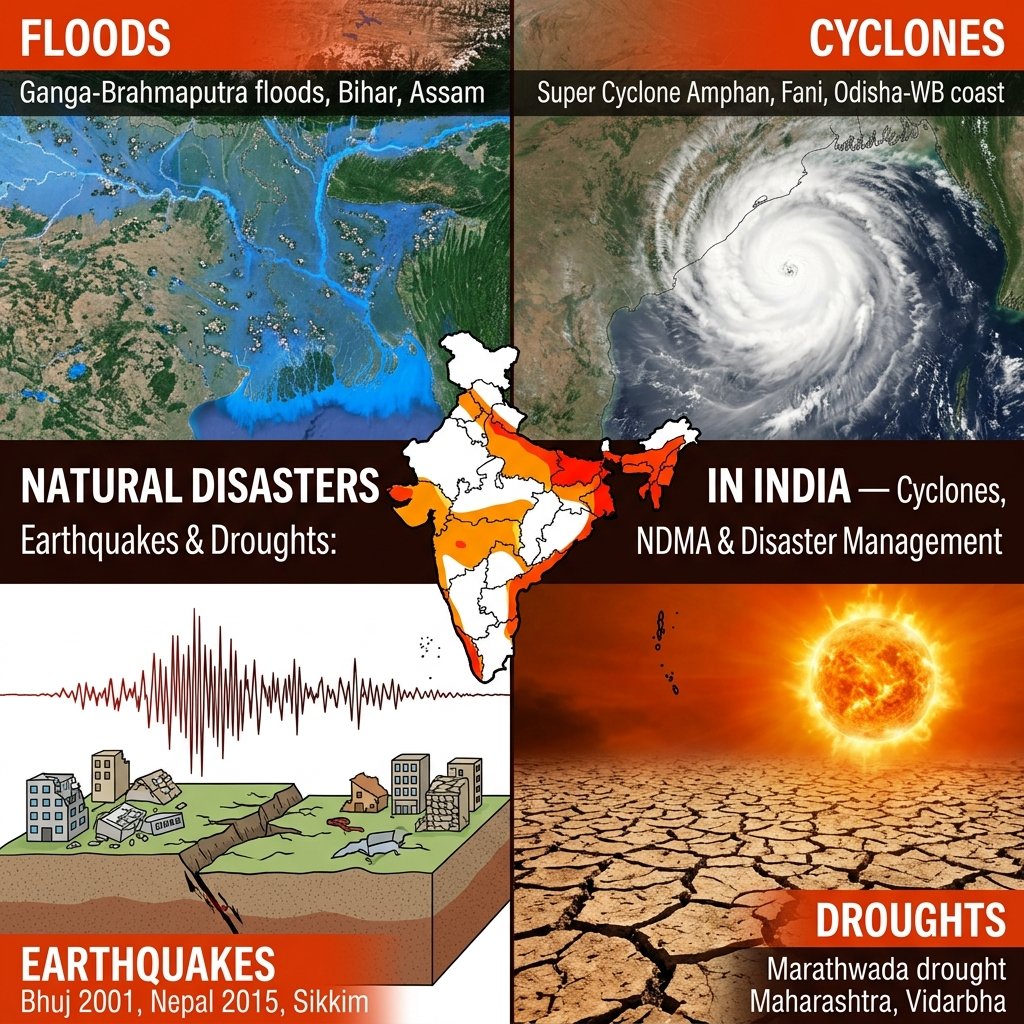
India’s Disaster Vulnerability — Why So Prone?
- 🏔️ Tectonically active Himalayas — young fold mountains sitting on an active collision zone (Indian plate colliding with Eurasian plate at ~5cm/year); immense earthquake and landslide risk across entire Himalayan arc
- 🌊 7,516 km coastline — exposed to cyclones forming in Bay of Bengal and Arabian Sea; India’s eastern coast (Bay of Bengal) is world’s most cyclone-prone coastline
- 🌧️ Monsoon dependence — 80% of India’s annual rainfall in just 4 months (June–September); flood risk when excess, drought when deficient; El Niño disrupts monsoon pattern
- 🏞️ Ganga-Brahmaputra flood plains — among world’s most flood-prone; Brahmaputra carries the highest sediment load of any river in the world
- 🌡️ Climate change amplification — increasing frequency and intensity of extreme events; sea surface temperatures rising in Indian Ocean = stronger cyclones; irregular monsoon = more intense floods + longer droughts
- 👥 High population density — Indo-Gangetic Plain has 400–1,000+ people/km²; any major disaster affects tens of millions simultaneously
1. Floods — India’s Most Recurring Disaster
- 📊 Scale: India accounts for ~20% of all global flood-related deaths; average annual damage ~₹5,000–25,000 crore; ~40 million hectares flood-prone
- 💧 Causes: Excess monsoon rainfall; cloudbursts (sudden intense rainfall, especially in mountains); cyclonic rainfall on coast; snowmelt (spring floods in Himalayan rivers); poor drainage; deforestation (reduces interception + increases runoff); encroachment on floodplains
| Region | Rivers | Key States | Cause |
|---|---|---|---|
| Brahmaputra basin | Brahmaputra, Barak, Subansiri, Tista | Assam, Arunachal Pradesh | World’s highest rainfall catchments + steep Himalayan slopes + narrow gorge exit to plains; annual floods now nearly permanent in parts of Assam |
| Ganga-Ghaghara-Gandak belt | Ganga, Ghaghara, Gandak, Kosi, Mahananda | Bihar, Eastern UP | Rivers originating in Nepal; “Kosi = Sorrow of Bihar” — very high sediment load + shifting channel; Nepal dam releases during excess rain |
| Mahanadi-Brahmani belt | Mahanadi, Brahmani, Baitarani | Odisha | Floods + cyclonic rainfall combination; Hirakud Dam controls upper Mahanadi but delta still floods |
| Krishna-Godavari | Krishna, Godavari | AP, Telangana | Heavy Deccan rainfall + simultaneous monsoon surge; massive deltas flood frequently |
| Western coast | Periyar, Chaliyar, Bharathapuzha | Kerala, Karnataka | Extremely heavy Western Ghats orographic rainfall; 2018 Kerala floods = worst in 100 years (1,400+ deaths; 5.4 million displaced) |
| Urban floods | Local drains overwhelmed | Mumbai, Chennai, Bengaluru, Hyderabad | Impervious surfaces + encroached water bodies + poor drainage; 2005 Mumbai (26 July) = 944mm rain in 24 hours; 2015 Chennai floods |
- 📌 Kosi River — Sorrow of Bihar: Most tragic flood story in India; extremely high sediment load from Himalayan erosion raises river bed; river has shifted 120km westward since 1736; 2008 Kosi breach = 3 million displaced, worst Bihar flood in 50 years
- 📌 2018 Kerala Floods: Triggered by extreme rainfall (largest since 1924); all 14 districts affected; 483 deaths; ₹40,000 crore damage; Idukki and Cheruthoni dam shutters opened simultaneously causing downstream surge; exposed vulnerability of Western Ghats deforestation and construction in fragile areas
2. Cyclones — The Bay of Bengal Threat
- 🌀 Formation: Tropical cyclones form over warm ocean water (>26.5°C, depth >50m); low pressure develops, draws in moist air, bands of thunderstorms spiral inward; named tropical cyclone in Indian Ocean; hurricane in Atlantic; typhoon in Pacific
- 📊 Bay of Bengal vs Arabian Sea: Bay of Bengal generates ~80% of India’s cyclones (vs ~20% Arabian Sea) because: (a) warmer SST year-round in Bay; (b) Bay is semi-enclosed = storms track toward coast efficiently; (c) funnel shape amplifies storm surge; (d) Bangladesh + Odisha coasts are low-lying = devastating inundation
- 📅 Season: Pre-monsoon (April–May) and post-monsoon (October–December) are peak periods; post-monsoon Bay of Bengal cyclones most destructive
| Cyclone | Year | Category | Affected States | Deaths / Impact |
|---|---|---|---|---|
| Bhola Cyclone | 1970 | Category 3 | Bangladesh (then East Pakistan), WB | 300,000–500,000 deaths = deadliest tropical cyclone in history |
| 1999 Odisha Super Cyclone | 1999 | Super Cyclonic Storm (wind 260 km/h) | Odisha (Paradip, Puri, Cuttack) | ~10,000 deaths; 15 million affected; worst cyclone to hit India in 20th century |
| Cyclone Phailin | 2013 | Very Severe (wind 220 km/h) | Odisha, AP | Only 45 deaths thanks to mass evacuation of 1 million people before landfall — model disaster management |
| Cyclone Hudhud | 2014 | Extremely Severe (wind 215 km/h) | AP (Visakhapatnam) | 124 deaths; ₹20,000 crore damage; Vizag city devastated; trees flattened |
| Cyclone Fani | 2019 | Extremely Severe (wind 250 km/h) | Odisha (Puri) | 89 deaths in India; 1.2 million evacuated in 48 hours; near-zero casualties despite being strongest Indian cyclone since 1999 — gold standard evacuation |
| Cyclone Amphan | 2020 | Super Cyclone (wind 185 km/h at landfall) | WB, Odisha | 128 deaths; ₹1 lakh crore damage; devastated Sundarbans and Kolkata suburbs; during COVID lockdown |
| Cyclone Tauktae | 2021 | Extremely Severe (wind 185 km/h) | Gujarat, Maharashtra, Kerala (Arabian Sea) | 155 deaths; Mumbai coast + Gujarat; rare strong Arabian Sea cyclone |
| Cyclone Biparjoy | 2023 | Extremely Severe | Gujarat (Kutch) | Very low casualties; mass evacuation; strongest cyclone to hit Gujarat coast in recent history |
- 🔑 Storm surge = deadliest component: Cyclone winds push ocean water inland as a wall of water (2–10m high); responsible for majority of cyclone deaths; the 1970 Bhola cyclone’s 10m storm surge over the Ganges delta = 500,000 deaths; coastal embankments (India) + early warning systems now reduce storm surge deaths dramatically
- 🔑 IMD Early Warning System: India Meteorological Department now provides 72-hour accurate cyclone track forecasts; state governments carry out massive evacuations; dramatic reduction in deaths (1999 Odisha = 10,000 deaths; 2019 Fani = 89 deaths despite same intensity)
3. Earthquakes — The Himalayan Seismic Risk
- 🌍 Cause: India plate moving NNE at ~5cm/year; collision with Eurasian plate builds the Himalayas and creates enormous stress; stress released episodically as earthquakes along the Main Boundary Thrust (MBT), Main Central Thrust (MCT), and Himalayan Frontal Thrust (HFT)
- 📊 Seismic zones (BIS IS 1893): India divided into 4 zones (Zone II = least risk to Zone V = highest risk)
| Zone | Risk Level | Key Regions | Expected MSK Intensity |
|---|---|---|---|
| Zone V | Very High (highest) | Entire NE India (Assam, Meghalaya, Manipur, Mizoram, Nagaland), J&K (Kashmir Valley), Uttarakhand (Kumaon Himalayas), North Bihar, Andaman-Nicobar Islands, western Rann of Kutch (Gujarat) | MSK IX and above; capable of M8.0+ earthquakes |
| Zone IV | High | HP, Sikkim, most of J&K, remaining Bihar, Delhi NCR, parts of Rajasthan (Jaipur), parts of Maharashtra (Mumbai region), Ladakh | MSK VIII; M7.0–8.0 possible |
| Zone III | Moderate | Kerala, Goa, Lakshadweep, remaining Rajasthan, UP (except north), Gujarat (except Kutch), remaining MH, AP, Karnataka, TN (most parts) | MSK VII; M6.0–7.0 possible |
| Zone II | Low | Remaining parts of peninsular India (stable craton core) | MSK VI and below |
- 📌 Major Indian earthquakes:
- 1897 Shillong (Meghalaya) — M8.0; triggered by Dauki Fault; one of world’s largest recorded quakes; changed topography, raised plateau by 11m
- 1934 Bihar-Nepal — M8.1; 30,000 deaths; major Ganga Plain liquefaction; Gandhi coined “divine retribution” controversy
- 1950 Assam — M8.6 (one of strongest recorded in India); caused massive Brahmaputra channel changes; Subansiri tributary dammed then burst
- 1993 Killari (Latur), Maharashtra — M6.2; 9,748 deaths; midnight earthquake in Zone III = people asleep in stone houses; proved even “moderate” zones deadly; changed India’s building codes
- 2001 Bhuj (Gujarat) — M7.7; 20,000+ deaths; 166,000 injured; 400,000 houses destroyed; worst earthquake in independent India’s history; Kutch Zone V as expected; woke up India’s disaster management policy → NDMA created
- 2005 Kashmir (Uri) — M7.6; 86,000 deaths (mostly Pakistan-administered Kashmir); 3 million homeless
- 2015 Nepal — M7.8 + M7.3 aftershock; 9,000 deaths in Nepal; affected Bihar, Uttarakhand, Sikkim (India side); reminder of Himalayan seismic gap risk
- ⚠️ Himalayan Seismic Gap: Large sections of the Main Himalayan Thrust have NOT ruptured since the great 1905 Kangra (M7.8, Himachal Pradesh) and 1934 Bihar earthquakes — stress is accumulating; seismologists warn of potential M8.5+ “Great Himalayan Earthquake” especially in the central Himalayan gap (Uttarakhand to Bihar) and NW Himalayan gap
4. Droughts — The Silent Killer
- 📊 Scale: ~33% of India’s area is drought-prone; 68% of India receives <1,000mm rainfall (considered water-stressed); droughts often affect 300–500 million people across multiple states
- 🌦️ Types: Meteorological drought (rainfall deficiency >25% of normal); Agricultural drought (soil moisture insufficient for crops despite some rain); Hydrological drought (rivers and reservoirs below normal); Socio-economic drought (water scarcity causing economic impact)
- 🌡️ Cause: Failure or weak monsoon; El Niño events (Pacific warming deflects Indian Ocean moisture); La Niña can bring excess rain; negative Indian Ocean Dipole reduces Kerala/peninsular rainfall
| Region | States | Frequency | Key Cause |
|---|---|---|---|
| Marathwada | Maharashtra (Aurangabad, Latur, Osmanabad) | Every 3–5 years | Rainshadow of Western Ghats; rainfall 600–750mm; Black soil + cotton monoculture; farmer suicides crisis; 2015–16 worst in 100 years |
| Vidarbha | Maharashtra (Amravati, Nagpur, Wardha) | Frequent | Inland, interior; 700–800mm but highly variable; cotton+soybean rainfed; farmer distress capital of India |
| Rayalaseema | Andhra Pradesh (Kurnool, Kadapa, Anantapur) | Very frequent | Double rainshadow (Bay of Bengal cyclone track misses + Western Ghats partially blocks SW monsoon); Anantapur gets only 550mm — most drought-prone district in India |
| Rajasthan | Western + Central Rajasthan | Chronic | Thar Desert; <300mm rainfall; Aravalli rainshadow; depends on groundwater (rapidly depleting) |
| Bundelkhand | MP + UP border | Every 2–3 years | Poor catchment water retention; hard Vindhyan rock = limited groundwater; 2007–2010 multi-year drought caused mass migration |
| Odisha tribal belt | Odisha western districts | Moderate | Interior rainshadow; poverty + dependence on rain-fed agriculture |
- 📌 Farmer suicides and drought linkage: India’s “farmer suicide belt” (Maharashtra, Karnataka, AP, MP, Telangana) correlates strongly with drought-prone regions + cotton/cash crop dependence + lack of crop insurance + debt trap from failed crops; NCRB data shows ~10,000–12,000 farmer deaths/year classified as suicides
- 📌 El Niño years with major Indian droughts: 1972, 1982, 1987, 1994, 2002, 2009, 2015 — all strong El Niño years corresponded to weak/failed monsoons; 2002 drought = worst since 1918; India’s GDP growth fell by 2%
5. Landslides — The Himalayan Slope Crisis
- 📊 Scale: India accounts for ~30% of global landslide deaths; Himalayas + Western Ghats + NE India = most vulnerable; ~0.42 million km² of Indian territory prone to landslides
- 🔴 Causes: Steep young mountain slopes + intense monsoon rainfall + Himalayan geology (weak shale, unconsolidated glacial debris, fault zones) + deforestation + road/tunnel construction in mountains + earthquakes triggering slope failure
- 📌 Key events: 2013 Kedarnath disaster (Uttarakhand) = cloudburst triggered massive landslide + glacial lake outburst = 6,000+ deaths; 2021 Chamoli rock-ice avalanche (Uttarakhand) = Dhauliganga dam swept away, 200+ deaths; 2023 Joshimath land subsidence (Uttarakhand) = town sinking due to fragile geology + construction + possible hydroelectric tunnelling effects
6. Heat Waves — The Growing Climate Crisis
- 📊 Definition (IMD): Heat wave when maximum temperature is ≥40°C in plains and departure from normal is ≥4.5°C; Severe heat wave = ≥6.5°C departure
- 🌡️ Most affected: Rajasthan (Churu = 50°C recorded), Odisha, Telangana, AP (Ongole, Nandyal), Maharashtra (Vidarbha), Delhi NCR; pre-monsoon May = deadliest month
- 📌 Key events: 2015 = worst in India’s recorded history; Andhra Pradesh + Telangana = 2,500+ deaths in single heat wave; 2022 March-April = unprecedented early heat wave affecting wheat crop (yield loss ~5%)
- 🌡️ Climate change amplification: Frequency and duration of heat waves increasing; IPCC projects Indian heat waves will exceed “wet bulb temperature” of 35°C (the limit of human survivability with sweating) in parts of India by 2050s under high-emission scenarios
India’s Disaster Management Framework
- ⚖️ Disaster Management Act, 2005 — passed in aftermath of 2004 Indian Ocean Tsunami (which killed 16,389 in India, mostly Tamil Nadu, Andaman-Nicobar); established the legal framework for disaster management in India
- 🏛️ NDMA (National Disaster Management Authority) — apex body; chaired by Prime Minister; issues guidelines; established 2005
- 🏛️ SDMA (State Disaster Management Authority) — state-level; chaired by Chief Minister
- 🏛️ DDMA (District Disaster Management Authority) — district level; chaired by District Magistrate
- 🚁 NDRF (National Disaster Response Force) — dedicated paramilitary force for disaster response; 16 battalions (12 from BSF/CRPF/CISF/ITBP/SSB); deployed in all major disasters; trained in flood rescue, earthquake debris removal, CBRN (chemical, biological, radiological, nuclear) response
- 📡 Early Warning Systems: IMD = cyclone + heat wave + heavy rain warnings; INCOIS (Hyderabad) = Indian National Centre for Ocean Information Services = tsunami early warning (set up after 2004); Flood Forecasting Monitoring Directorate (Central Water Commission) = river flood warnings
- 🌊 Indian Ocean Tsunami Warning System: Set up by India after 2004; INCOIS operates 24/7 monitoring of seismic activity; deep-ocean buoy network (DART buoys); can issue warning within 10 minutes of major undersea earthquake
- 💰 NDRF (National Disaster Response Fund) / SDRF (State DRF): Dedicated funds for immediate disaster relief; Centre + States contribute; releases within 24–48 hours of disaster declaration
⭐ Important for Exams — Quick Revision
- 🔑 59% of India’s land area = earthquake-prone; 12% = flood-prone; entire eastern coast = cyclone-prone (per NDMA)
- 🔑 Zone V = highest earthquake risk: NE India, J&K Kashmir, Uttarakhand Himalayas, North Bihar, Andaman, Rann of Kutch
- 🔑 Bhuj 2001 (M7.7) = worst earthquake independent India; 20,000+ deaths; led to formation of NDMA and updated building codes
- 🔑 Latur 1993 = M6.2 but 9,748 deaths; midnight + unreinforced stone houses; proved even Zone III areas deadly
- 🔑 Kosi = “Sorrow of Bihar” — extremely high sediment, shifting channel (120km shift since 1736), annual floods; 2008 breach = worst in 50 years
- 🔑 Bay of Bengal cyclones = 80% of India’s cyclones; most dangerous post-monsoon (Oct–Dec); eastern coast (Odisha, AP, WB) = most cyclone-hit
- 🔑 1999 Odisha Super Cyclone = 10,000 deaths; 2019 Fani = same intensity = 89 deaths (same area) = proof of evacuation effectiveness
- 🔑 Cyclone Fani 2019 = 1.2 million evacuated in 48 hours = gold standard; Cyclone Amphan 2020 = super cyclone + COVID = ₹1 lakh crore damage
- 🔑 Droughts: Marathwada + Vidarbha (Maharashtra), Rayalaseema (AP, Anantapur most drought-prone district), Rajasthan, Bundelkhand
- 🔑 El Niño = weak monsoon = drought; La Niña = strong monsoon = floods; Indian Ocean Dipole also affects monsoon
- 🔑 2013 Kedarnath = cloudburst + landslide + GLOF (Glacial Lake Outburst Flood) = 6,000+ deaths; Uttarakhand
- 🔑 2004 Tsunami = triggered Disaster Management Act 2005 + NDMA + NDRF formation; 16,389 deaths India
- 🔑 NDMA = chaired by PM; SDMA = CM; DDMA = DM (District Magistrate); NDRF = 16 battalions paramilitary
- 🔑 INCOIS (Hyderabad) = tsunami early warning for Indian Ocean; 10-minute warning capability
- 🔑 2015 heat wave = worst in India; AP + Telangana 2,500+ deaths; Churu Rajasthan = 50°C hottest city
Frequently Asked Questions (FAQs)
1. Why does India have so many more cyclone deaths on the eastern coast than the western coast?
The dramatic disparity in cyclone impact between India’s eastern and western coasts is one of the clearest examples of how geography controls disaster risk. The Bay of Bengal generates far more frequent and intense cyclones for several reasons: the Bay’s sea surface temperatures remain above 28°C year-round at depths sufficient to sustain cyclone intensity, while the Arabian Sea is cooler and more frequently disrupted by dry continental air from the Middle East. The Bay’s semi-enclosed geometry acts like a funnel — cyclones forming in the central Bay track northwest, directly toward the Odisha-Andhra coast. Crucially, the coastal geography of the eastern coast amplifies storm surges catastrophically. The Bay of Bengal’s northwest corner (Odisha, WB, Bangladesh) is extremely shallow — the continental shelf extends far offshore at depths of <50m. When a cyclone’s winds push ocean water toward this shallow shelf, the water piles up dramatically; the funnel shape of the Bay concentrates this surge further. Storm surges of 5–10m are common in intense Bay of Bengal cyclones hitting the Odisha-WB coast. Compare this to the Arabian Sea — which is deeper offshore the Gujarat/Maharashtra coast, allowing storm surge energy to dissipate, and whose coastline is more irregular, providing less funnel amplification. Additionally, the population of the eastern coastal zone is denser and poorer; traditional fishing communities live directly on low-lying beach stretches; concrete cyclone shelters are more recently constructed here. The 1999 Odisha Super Cyclone’s 10m storm surge in Paradip was the primary killer of ~10,000 people — not the winds. India’s dramatic improvement in cyclone mortality (from 10,000 deaths in 1999 to 89 in the same-intensity Fani 2019) was achieved through an engineering solution: thousands of elevated cyclone shelters built along the Odisha coast that communities could reach within hours of warning, combined with IMD’s highly improved 72-hour accurate track forecasting.
2. What is the “Himalayan Seismic Gap” and why do scientists consider it one of the world’s greatest earthquake risks?
The Himalayan arc is one of the world’s most seismically dangerous regions — the result of the ongoing collision between the Indian plate moving north at ~5cm/year and the Eurasian plate. This collision releases energy episodically as great earthquakes (M8.0+) along the Main Himalayan Thrust, the major fault system running the entire 2,500km length of the Himalayas. Historical records show that great earthquakes have not ruptured evenly along this thrust — some sections have experienced recent quakes (1934 Bihar M8.1, 1950 Assam M8.6, 2005 Kashmir M7.6) while other sections have been seismically “quiet” for hundreds of years. These quiet sections are called seismic gaps — they are not quiet because they’re safe; they’re quiet because stress is silently accumulating. Two major gaps concern seismologists: (1) The Central Himalayan Gap (running roughly from western Nepal through Uttarakhand to Himachal Pradesh) — this section last experienced a great earthquake in 1505 (a M8.2 event known from historical records) — over 500 years ago. Stress equivalent to M8.0+ is estimated to have built up. An earthquake here would directly affect densely populated cities: Dehradun, Haridwar, Rishikesh (all on mountain fronts), plus Nepal’s Kathmandu Valley (partially ruptured in 2015 but not fully). (2) The Northeast Himalayan corridor — Assam’s last great M8.6 was in 1950, but the entire arc from Bhutan to Arunachal Pradesh has complex remaining stress. The frightening reality: a M8.5+ earthquake in the Central Himalayan Gap would generate ground shaking felt over 1,000+ km; the Ganga Plain’s thick alluvial soil would undergo devastating amplification (like what happened in the 1934 Bihar earthquake where liquefaction swallowed houses) across Bihar, eastern UP, and West Bengal — a total population exposure of 200–400 million people. Current Indian building codes (mandatory seismic zoning) exist but enforcement in smaller towns and villages along the Himalayan front remains weak.
3. How did the 2004 Indian Ocean Tsunami transform India’s disaster management permanently?
The 2004 Indian Ocean Tsunami (26 December; M9.1–9.3 undersea earthquake, epicentre off Sumatra, Indonesia) was a watershed moment for India’s disaster preparedness. The tsunami killed 16,389 people in India — with Tamil Nadu (8,010), Andaman-Nicobar Islands (3,647), Kerala (1,096), and Andhra Pradesh (105) most affected. In Nagapattinam district of Tamil Nadu alone, 6,051 died — entire fishing villages were erased. At the time of the tsunami, India had no tsunami warning system, no tsunami hazard maps, no coastal evacuation plans, and no trained coastal rescue forces. Many coastal residents had never heard the word “tsunami.” The first warning came from media reports hours after the waves struck. The magnitude of the failure — technologically avoidable deaths that occurred hours after the earthquake because no one warned coastal populations — galvanised action: (1) India passed the Disaster Management Act, 2005 — creating the comprehensive legal framework for disaster management; (2) The NDMA was established with the PM as chair; (3) The NDRF (National Disaster Response Force) was created as a dedicated paramilitary rescue force; (4) INCOIS in Hyderabad was established as India’s tsunami early warning centre — part of the Indian Ocean Tsunami Warning System; deep-ocean DART buoys deployed; (5) Coastal community awareness programmes “Tsunami Ready” certification launched; (6) State disaster management reforms — every coastal state now has evacuation plans, shelter networks, and mock drill programmes. The transition from reactive to proactive disaster management in India is directly traceable to 26 December 2004 — often called “Black Sunday” in India’s coastal communities.
Related Geology Articles on StudyHub
- ➡️ Earthquakes & Seismic Zones of India — Complete Guide
- ➡️ Tsunamis — Formation, Causes & 2004 Indian Ocean
- ➡️ Himalayan Formation — Why the Himalayas Cause Earthquakes
- ➡️ Climate Change — Intensifying India’s Disaster Risk
- ➡️ Indian Monsoon — The Driver of Floods & Droughts