Despite being a single country, India encompasses an astonishing variety of climates — from the perpetually snow-covered Trans-Himalayan cold deserts of Ladakh to the scorching hot Thar Desert of Rajasthan, from the tropical rainforests of Kerala and the Andaman Islands to the subtropical humid belt of the Ganga Plains, and from the highland alpine meadows of Himachal Pradesh to the cyclone-battered Coromandel Coast of Tamil Nadu. This extraordinary climatic diversity is the result of India’s vast latitudinal extent (8°N to 37°N), its dramatic altitude range (sea level to 8,848m), and the profound influence of the Indian Monsoon system. Geographers classify India’s climates using the Köppen Climate Classification — the world’s most widely used system — and identify 6 major climate types within India. Understanding India’s climate types, their characteristics, governing factors, and regional distribution is essential for UPSC, SSC, State PSC, Class 11 NCERT Geography, and all competitive examinations.
Factors Controlling India’s Climate
- 🌍 Latitude: India spreads from 8°N (Cape Comorin / Kanyakumari) to 37°N (Siachen). Tropic of Cancer (23.5°N) divides India into tropical south and subtropical north. Lower latitudes = higher solar radiation = hotter and more humid
- 🏔️ Altitude: Temperature decreases ~6.5°C per 1,000m of altitude (normal lapse rate). Himalayas (8,000m+) vs. Deccan Plateau (600m) vs. sea level coasts — a range of ~50°C potential temperature differences due to altitude alone
- 🌊 Distance from sea (continentality): Coastal areas (Mumbai, Chennai) have moderate temperatures year-round (maritime influence buffers extremes). Interior continental areas (Delhi, Nagpur, Jaipur) have extreme temperatures — very hot summers and cool winters (large diurnal and annual temperature range)
- 🏔️ Himalayas as barrier: Block cold Central Asian air masses in winter (protecting India from extreme continental cold) and block monsoon moisture from escaping northward (intensifying monsoon rainfall in India)
- 🌬️ Prevailing winds: SW monsoon winds (June–September) bring moisture; NE monsoon winds (October–December); Western Disturbances (winter); Loo (pre-monsoon hot dry winds). Wind direction controls moisture availability and temperature
- 🌊 Ocean currents: Warm Indian Ocean surrounding India on three sides keeps coastal temperatures moderate; warm Arabian Sea and Bay of Bengal SST (>28°C) fuel monsoon intensity
Köppen Climate Classification of India
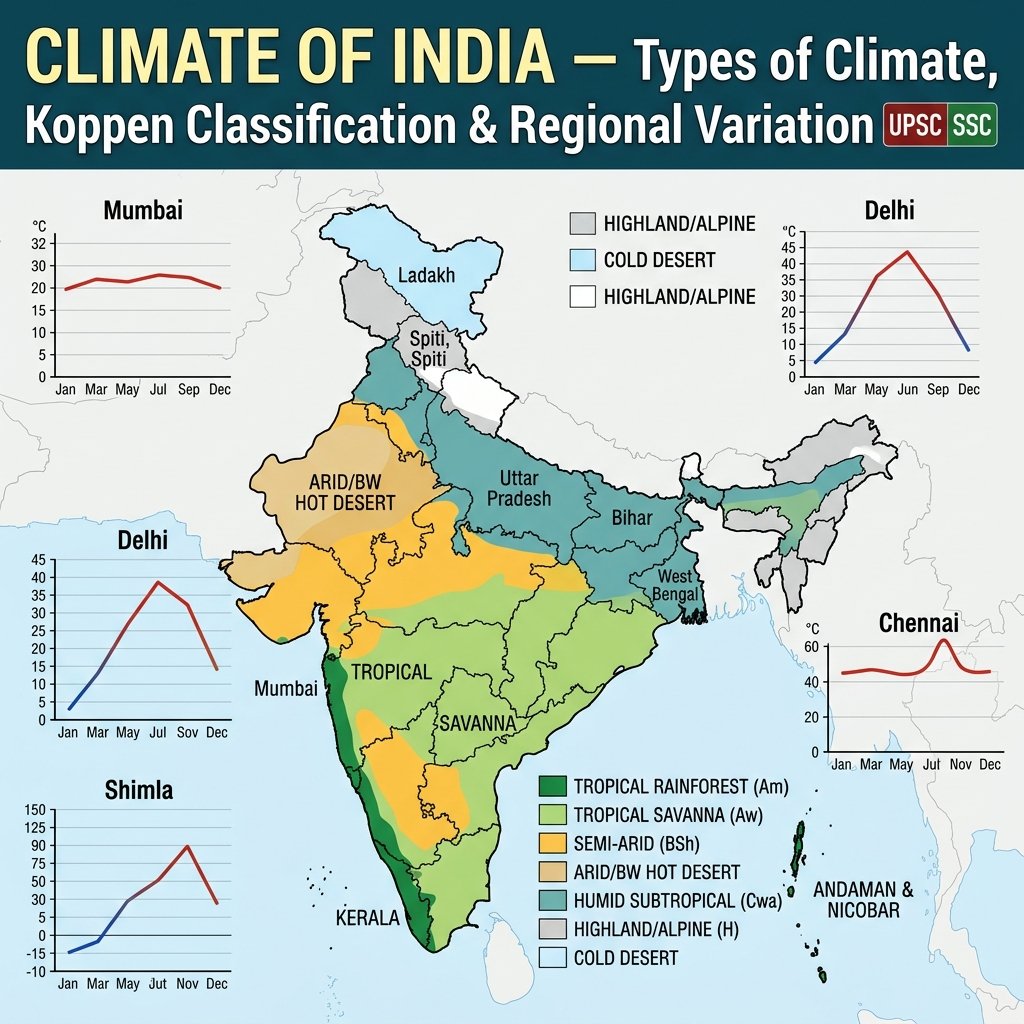
The Köppen Climate Classification (developed by German-Russian climatologist Wladimir Köppen, 1884–1918) divides Earth’s climates into 5 main groups (A–E) based on temperature and precipitation patterns. India has representatives from Groups A (Tropical), B (Arid), C (Temperate), and H (Highland/Alpine):
| Köppen Code | Climate Type | Definition | India Regions |
|---|---|---|---|
| Am | Tropical Monsoon | All months >18°C; short dry season compensated by heavy monsoon; annual rain >1,500mm | Kerala coast, coastal Karnataka, Goa, Konkan coast, Andaman & Nicobar |
| Aw | Tropical Savanna | All months >18°C; distinct dry season (winter); most common Indian type | Most of peninsular India — Maharashtra, Karnataka interior, AP, Telangana, TN interior, Odisha, parts of UP-Bihar |
| BSh | Hot Semi-Arid (Steppe) | Rainfall 250–750mm; hot summers; limited vegetation | Rajasthan fringe, Deccan leeward rain-shadow areas (Pune-Nashik area), interior Karnataka, parts of Gujarat |
| BWh | Hot Desert (Arid) | Rainfall <250mm; very hot; sparse vegetation | Western Rajasthan (Thar Desert) — Jaisalmer, Barmer, Bikaner area |
| BWk | Cold Desert (Arid) | Rainfall <250mm; cold winters; high altitude | Ladakh, Lahaul-Spiti (HP) — cold high-altitude deserts |
| Cwa | Humid Subtropical (Monsoon) | Hottest month >22°C; winter dry; monsoon summer rain; cold winter months | Indo-Gangetic Plain — most of UP, Bihar, WB (Kolkata), NE India, large parts of MP-CG; Delhi |
| Cwb | Subtropical Highland (Monsoon) | Like Cwa but coolest months <22°C; higher altitude variation | Nilgiris, higher parts of Deccan, parts of Chhattisgarh-Jharkhand plateau |
| ET | Tundra (Polar) | Warmest month 0–10°C; permafrost possible; alpine tundra | High Himalayan areas above treeline (~4,000m+); Siachen area |
| EF | Ice Cap | All months below 0°C; permanent ice/snow | Himalayan glaciers, high permanent snowfields; Siachen glacier summit areas |
India’s Major Climate Regions in Detail
1. Tropical Rainforest / Tropical Monsoon Climate (Am)
- 📍 Location: Kerala coast, Dakshina Kannada (coastal Karnataka), Goa, Andaman & Nicobar Islands, some parts of Maharashtra’s Konkan coast
- 🌡️ Temperature: Hot throughout year; 24–32°C; very small annual range (~2–4°C); no cold season
- 🌧️ Rainfall: Very heavy; 2,000–4,000+ mm; concentrated in monsoon months (June–September); short dry season (December–February) but compensated by very heavy monsoon; Kerala annually by Bay of Bengal branch + Arabian Sea branch
- 🌴 Vegetation: Tropical evergreen and semi-evergreen forests; rubber, coconut, spices; very high biodiversity
- 📌 Key cities: Thiruvananthapuram, Mangalore, Panaji (Goa); these cities have warm, humid, heavy-rainfall climates with no “cold” winter
2. Tropical Savanna / Dry Winter Climate (Aw) — Most Common in India
- 📍 Location: Most of peninsular India — entire Deccan Plateau, most of Maharashtra, Karnataka interior, Telangana, AP, Tamil Nadu interior, Madhya Pradesh south, most of Odisha, eastern UP, Bihar, Jharkhand plains
- 🌡️ Temperature: Hot summers (35–45°C in inland areas); mild winters (15–22°C in peninsular areas; colder in North); all months above 18°C (tropical criterion)
- 🌧️ Rainfall: 600–1,500mm annually; distinct dry season November–May; monsoon (June–September) provides nearly all rainfall
- 🌾 Agriculture: Rainfed agriculture; jowar, bajra, cotton, pulses, groundnut; vulnerable to monsoon variability (droughts in Marathwada, Vidarbha when monsoon weak)
- 📌 Key cities: Hyderabad, Nagpur, Bengaluru, Bhubaneswar, Patna — all experience hot, dry summers and brief but dramatic monsoon; mild pleasant winters
3. Arid and Semi-Arid Climate (BWh / BSh)
- 📍 Location: Rajasthan (western and central), Gujarat (northwest), parts of Haryana-Punjab semi-arid belt, rain-shadow areas of Deccan (interior Maharashtra — Nasik, Pune eastern areas; interior Karnataka)
- 🌡️ Temperature: Extreme! Summer day temperatures 45–50°C (Rajasthan); winter nights can drop to 2–5°C; largest temperature range in India; large diurnal (day-night) range (15–20°C)
- 🌧️ Rainfall: Very low — <250mm (hot desert, BWh: Jaisalmer ~100mm) to 250–500mm (semi-arid, BSh: Jodhpur ~350mm, Ahmedabad ~700mm); erratic and unreliable; when rain comes, often in heavy bursts causing flash floods then long dry spells
- 🌵 Vegetation: Xerophytic (thorny scrub, khejri tree, cactus-like plants); fauna: Indian Gazelle (Chinkara), Great Indian Bustard (critically endangered; most remaining in Rajasthan)
- 📌 Distinguished feature of Rajasthan desert: Nights are cold even in summer (desert radiation cooling); in January Jaisalmer can reach 0°C at night despite 45°C summer days
4. Humid Subtropical Climate (Cwa) — The Ganga Plains
- 📍 Location: Indo-Gangetic Plains — most of UP, Bihar, West Bengal, NE India (Assam plains), Delhi NCR, large parts of MP and Chhattisgarh
- 🌡️ Temperature: Extreme seasonal variation; Delhi: summer max 45°C (May–June), winter min 3–5°C (January); largest seasonal range of any Indian metro; continental nature = far from moderating ocean effect
- 🌧️ Rainfall: Moderate to heavy; 600–1,800mm (increasing eastward — Kolkata ~1,600mm, Delhi ~750mm); monsoon July–September; dry winters; Western Disturbances bring light winter rain to northwest parts
- 🌾 Agriculture: Most productive agricultural zone in India; Kharif (rice, cotton, groundnut) in monsoon; Rabi (wheat, mustard, peas) in winter; two-crop cycle possible
- 📌 Key cities: Delhi (hottest Indian capital globally, extreme summers), Lucknow, Kanpur, Varanasi, Patna, Kolkata; Delhi experiences: dense winter fog (reduces visibility to near zero; major aviation + road disruption January, caused by cool stable air + pollution mixing under temperature inversion), summer dust storms, monsoon flooding, and severe heat waves pre-monsoon — most extreme seasonal climate of any major Indian city
5. Highland / Alpine Climate (H / ET)
- 📍 Location: Himalayas (J&K, HP, Uttarakhand, Sikkim, NE hill states), Nilgiris and higher Western Ghats in south
- 🌡️ Temperature: Varies dramatically with altitude; Shimla (2,200m): summer 18–25°C, winter -5 to 5°C; Leh/Ladakh (3,500m): summer 25°C day/0°C night, winter -20 to -30°C; Siachen glacier summit: -50°C extreme
- 🌧️ Rainfall: Highly variable by aspect; windward slopes of Himalayas get heavy monsoon rainfall; leeward sides (Ladakh, Lahaul-Spiti, Kinnaur) are rain-shadow cold deserts (<100mm/year); higher Himalayas get snowfall instead of rain
- ❄️ Distinct sub-types: Temperate (Shimla, Srinagar, Darjeeling); Sub-alpine (above 2,500m — pine forests, meadows); Alpine (above 3,500m — only shrubs and grasses); Nival/Glacial (above 5,000m — permanent snow)
- 🌿 Nilgiris special case: Ooty (2,240m) in TN — despite being at 11°N latitude (tropical), the elevation gives it a cool temperate climate (max 20°C, min 5°C); tea plantations thrive here; frost possible in January
6. Cold Desert Climate (BWk) — Ladakh & Spiti
- 📍 Location: Ladakh (Leh, Nubra Valley), Lahaul-Spiti (HP), Zanskar; situated north of main Himalayan ranges in rain-shadow zone
- 🌡️ Temperature: Extreme cold; Leh winter averages -8 to -14°C; extreme record -40°C; summer pleasant (15–25°C day); massive diurnal range (20–25°C daily); intense solar radiation at altitude despite cold
- 🌧️ Rainfall: Very low; Leh ~114mm/year; only snow in winter (from Western Disturbances); SW monsoon completely blocked by Himalayas; most precipitation as snow
- 🔑 Contrast with Thar: Both BWk (cold desert) and BWh (hot desert) get <250mm rain — but Thar is HOT (up to 50°C) while Ladakh is COLD (down to -40°C); same aridity, completely different temperature mechanism
- 🌱 Agriculture: Only possible where glacial meltwater can be channelled; barley, peas, apricots; “Zabo” and traditional water harvesting systems; short growing season (June–September only)
Seasonal Characteristics — India’s Four Seasons
| Season | Months | Characteristics | Key Weather Events |
|---|---|---|---|
| Cold (Winter) | December–February | Cold wave in north; mild in south; cold fog in Ganga plains; dry everywhere except TN (NE monsoon) | Western Disturbances bring rain to Punjab, HP, J&K; cold waves (Delhi below 5°C); dense fog disrupts transport; TN paddy harvest |
| Hot Dry (Pre-Monsoon / Summer) | March–May | Hottest season; severe heat waves; Rajasthan 45–50°C; dust storms; Loo winds; low humidity most areas | Heat waves (NDMA alerts); Kalbaisakhi thunderstorms in WB; mango showers Kerala; Loo in Rajasthan/UP; Baisakh storms |
| Southwest Monsoon | June–September | Heavy rainfall; humidity extreme; floods in low-lying areas; temperatures moderate (not as hot as May); overcast skies | Floods (Brahmaputra, Ganga, Krishna, Godavari); landslides (Himalayas, NE); cyclones begin in Bay (Sept); break monsoon spells |
| Retreating Monsoon (Post-Monsoon) | October–November | Monsoon withdraws NW to SE; TN gets NE monsoon rains; rest of India transitioning to winter; temperature pleasant | Cyclone season peaks (Bay of Bengal); NE monsoon rain on TN coast; Diwali season; Kharif harvest; pleasant weather most of India |
Regional Climate Comparison — Key Indian Cities
| City | Climate Type | Annual Rainfall | Summer Max | Winter Min | Key Feature |
|---|---|---|---|---|---|
| Mumbai | Am (Tropical Monsoon) | ~2,170 mm | 32°C | 17°C | Very small annual temp range; extreme monsoon (July average: 856mm!); July 2005 flood (944mm/24hrs) |
| Chennai | Aw (Tropical Savanna) | ~1,400 mm | 40°C | 20°C | 60% rain from NE monsoon (Oct–Dec); hottest metro India (up to 45°C in May); July relatively dry! |
| Delhi NCR | Cwa (Humid Subtropical) | ~750 mm | 45°C+ | 3°C | Most extreme seasonal range of any Indian metro (42°C annual range); heat waves + cold waves + fog + dust storms all in one cycle |
| Kolkata | Cwa (Humid Subtropical) | ~1,625 mm | 40°C | 12°C | Very high humidity; Kalbaisakhi pre-monsoon; heavy July rain; milder than Delhi due to proximity to Bay |
| Bengaluru | Aw / BSh transition | ~970 mm | 32°C | 15°C | Highland plateau effect (920m altitude) moderates temperatures; two rainy seasons (SW + NE monsoon); “Garden City” climate; warming trend erasing historic coolness |
| Hyderabad | BSh (Semi-Arid) | ~810 mm | 42°C | 14°C | Semi-arid; variable monsoon (bimodal pattern); increasingly water-stressed; hot dry March–May |
| Leh (Ladakh) | BWk (Cold Desert) | ~114 mm | 28°C (day) | -14°C (avg) | Cold desert; extreme diurnal range; intense UV; oxygen deficient altitude; tourist season only June–September |
| Shimla (HP) | H (Highland) | ~1,575 mm | 25°C | -5°C | British summer capital of India; snowfall annually (December–February); apple orchards; Western Disturbance winter rain/snow |
⭐ Important for Exams — Quick Revision
- 🔑 6 factors controlling India’s climate: Latitude, Altitude, Distance from Sea, Himalayas as barrier, Prevailing winds, Ocean currents
- 🔑 Tropic of Cancer (23.5°N) divides India into tropical south (all months >18°C) and subtropical north (cold winters)
- 🔑 Köppen Am = Tropical Monsoon (Kerala coast, Andaman); Aw = Tropical Savanna (most peninsular India = most common type); BWh = Hot Desert (Rajasthan Thar); BWk = Cold Desert (Ladakh); Cwa = Humid Subtropical (Ganga plains, Delhi, Kolkata)
- 🔑 Tropical Savanna (Aw) = most widespread climate type in India; covers most of the peninsular plateau
- 🔑 Delhi’s climate = most extreme of any Indian metro: 45°C summer + 3°C winter = 42°C annual range; Cwa type
- 🔑 Chennai gets 60% rain in Oct–Dec from NE monsoon (Coromandel coast); July is relatively dry — opposite of rest of India (unusual exam fact!)
- 🔑 Mumbai gets 856mm in July alone (record: 944mm in 24 hours on 26 July 2005 floods); total ~2,170mm/year
- 🔑 Leh (Ladakh) = 114mm/year = cold desert; Jaisalmer = ~100mm = hot desert; both below 250mm threshold for desert classification
- 🔑 Ooty at 11°N latitude (tropical!) has cool temperate climate due to 2,240m altitude — classic example of altitude overriding latitude in climate
- 🔑 4 Indian seasons: Winter (Dec–Feb), Pre-monsoon/Summer (Mar–May), SW Monsoon (Jun–Sep), Retreating Monsoon (Oct–Nov)
- 🔑 Indian winter cold waves = cold air from Central Asia + Western Disturbances; Himalayan barrier keeps worst cold out; still Punjab/UP/Bihar experience dangerous cold waves (<5°C = NDMA alert)
- 🔑 Bengaluru’s pleasant climate (~920m altitude on Deccan Plateau) is increasingly threatened by urban heat island effect + groundwater depletion (lakes disappearing)
- 🔑 Shimla = British summer capital because cool Himalayan highland climate provided relief from Indo-Gangetic Plain heat; same logic as Ooty (British summer residence), Darjeeling (tea + cool climate), Mussoorie, Nainital
- 🔑 Western Disturbances = only source of winter precipitation for Punjab, Haryana, J&K, HP, Uttarakhand; critical for Rabi crops (wheat); bring snowfall to Shimla, Gulmarg, Manali
Frequently Asked Questions (FAQs)
1. Why is Bengaluru’s famously pleasant climate rapidly getting hotter?
Bengaluru (Bangalore) earned the nickname “Garden City” and “Air Conditioned City” for its historically gentle climate — a product of its location at ~920m elevation on the Deccan Plateau’s eastern face (12.97°N latitude, but altitude moderates what should be a tropical climate). Historically, March temperatures rarely exceeded 28°C and May (pre-monsoon peak) was around 32–33°C maximum. Today, May temperatures in Bengaluru routinely touch 38–40°C — a 6–7°C increase over the last 50 years. The causes are multiple and mutually reinforcing: (1) Urban Heat Island Effect: Bengaluru’s population grew from ~1.6 million (1971) to ~14 million (2023). Dense construction, concrete and asphalt surfaces, reduced tree cover, waste heat from millions of air conditioners and vehicles — all increase local temperatures. Concrete absorbs 4x more heat than vegetation. (2) Lake disappearance: Bengaluru had ~262 tanks/lakes in 1960; today fewer than 80 active water bodies remain. Lakes act as natural heat sinks, moderate local humidity, and trigger breezes. The loss of lakes has removed a major natural cooling mechanism. Many lakes were drained and built over during the IT boom (1990s–2010s); others choked by sewage and real estate encroachment. (3) Tree cover loss: Urban sprawl pushed into erstwhile green corridors and natural forests (e.g., Hesaraghatta grasslands, Bannerghatta forest fringe); tree canopy reduces by 1–2% per year in outer zones. (4) Climate change background warming: South India has warmed ~0.7°C since 1901 from global warming; this adds to the local urban heat. The combined effect: what was once India’s most climatically comfortable major city is now experiencing summer temperatures that make outdoor work dangerous in April–May. The 2022 and 2024 March heat waves in Bengaluru (35°C+ in March — historically unprecedented) shocked residents accustomed to 26–28°C March afternoons.
2. How does the altitude-latitude interplay create India’s extraordinary climate diversity in such a compact geography?
India’s climate diversity is fundamentally a story of altitude overriding latitude. Under “normal” circumstances, latitude determines climate — as you move from the equator towards the poles, temperatures decrease predictably. India should, based on its latitude range (8°N to 37°N), have a relatively predictable gradient from tropical to subtropical climate. But altitude introduces a completely independent control, allowing tropical latitudes to have temperate climates. The key relationship: temperature decreases ~6.5°C per 1,000m altitude gain (Environmental Lapse Rate). This creates vertical climate zones as dramatic as moving thousands of kilometres of latitude: Ooty (11°N, 2,240m) — the same latitude as tropical Kerala, but at elevation produces apple orchards and frost in January. If Ooty were at sea level at 11°N, it would have a hot tropical climate identical to coastal Kerala. The Himalayas amplify this to an extreme: Manali (32°N, 2,050m) in HP has cool summers and heavy snowfall — similar to highland Scotland at 57°N latitude. Siachen glacier summit (~5,800m) experiences -50°C — a temperature encountered in the Arctic at 70°N+. This altitude-latitude interplay creates India’s remarkable diversity: from the Kerala coast (equatorial feel at 8–10°N) to just 500km away inland (Deccan plateau at 600m = savanna feel), then north through the subtropical Ganga plains (Cwa) to the Greater Himalayas (alpine tundra) all within the same country. This is also why India has globally significant biodiversity — the rapid climate gradient from tropical to polar within short distances creates an extraordinary range of ecological niches. The Western Ghats UNESCO World Heritage designation specifically recognises that these mountains create a rapid rainfall transition (3,000mm+ on windward side to 400mm on leeward side in just 50km) that supports one of Earth’s highest biodiversity hotspot densities.
3. What is a “cold wave” in India and how many people does it kill?
India’s cold waves are a winter climate hazard that kills approximately 800–2,000 people annually — yet receives far less media attention than heat waves or floods. IMD defines a cold wave as: when minimum temperature is ≤10°C in plains and departs from normal by 4.5–6.4°C (cold wave) or >6.5°C (severe cold wave). Cold waves affect primarily the Indo-Gangetic Plain (Punjab, Haryana, Delhi, UP, Bihar) from December to February, with January being the most dangerous month. The mechanism: during prolonged high-pressure systems (anticyclones) over Central Asia, cold continental air masses drain southward through Afghanistan, Pakistan, and into northwest India. The Himalayas largely block the coldest Arctic air, but cold waves still push minimum temperatures to 2–5°C in Delhi, near 0°C in parts of Punjab and UP. Who dies: The primary victims are homeless persons (India’s homeless population estimated at 1.77 million by census; possibly much higher in reality); daily wage workers (construction workers, agricultural labourers sleeping in fields); elderly persons in unheated homes (poor thermal insulation of traditional rural housing — mud walls, thatch roofs, no glazed windows); infants; and those with cardiovascular or respiratory conditions (cold triggers heart attacks). Dense fog compound effect: Cold waves in the Ganga plains are usually accompanied by dense fog (relative humidity near 100% + cold stable air + particulate pollution = visibility drops to 0–50m). This fog disrupts aviation (Delhi airport delays/diversions); rail transport (100+ trains delayed simultaneously in January fog season); road accidents increase dramatically. State governments operate night shelters (rein baseras) in cities, but capacity is always insufficient for the actual homeless population. Cold wave deaths are systematically under-counted in India because many occur outside hospital settings and are not always attributed to cold exposure in death certificates.
Related Geology Articles on StudyHub
- ➡️ Indian Monsoon — The Primary Climate Driver
- ➡️ Physiographic Divisions — How Topography Controls Climate
- ➡️ Natural Disasters — Climate-Driven Disasters
- ➡️ Climate Change — How Global Warming is Shifting India’s Climates
- ➡️ Soil Types — Climate Controls Indian Soil Development