
Appendix B Answers to Review Questions
Chapter 1. Introduction to Geology
See the end of Chapter 1 for solutions.
Chapter 2. The Origin of Earth and the Solar System
See the end of Chapter 2 for solutions.
Chapter 3. Earth’s Interior
See the end of Chapter 3 for solutions.
Chapter 4. Plate Tectonics
See the end of Chapter 4 for solutions.
Chapter 5. Minerals
See the end of Chapter 5 for solutions.
Chapter 6. The Rock Cycle
See the end of Chapter 6 for solutions.
Chapter 7. Igneous Rocks
See the end of Chapter 7 for solutions.
Chapter 8. Weathering, Sediment, and Soil
See the end of Chapter 8 for solutions.
Chapter 9. Sedimentary Rocks
See the end of Chapter 9 for solutions.
Chapter 10. Metamorphism and Metamorphic Rocks
See the end of Chapter 10 for solutions.
Chapter 11. Volcanism
See the end of Chapter 11 for solutions.
Chapter 12. Earthquakes
See the end of Chapter 12 for solutions.
Chapter 13. Geological Structures
See the end of Chapter 13 for solutions.
Chapter 14. Streams and Floods
1. Approximately 1% of the Earth’s water is liquid fresh water.
2. Approxmately 30% of the Earth’s fresh water is groundwater.
3. A trellis drainage pattern typically forms on sedimentary rock that has been tilted and eroded
4. Many of the streams in the southwestern part of Vancouver Island flow to the ocean as waterfalls because the land has been uplifted relative to sea level over the past several thousand years.
5. The fastest water flow on a straight stretch of a stream will be in the middle of the stream near the surface.
6. 1 mm sand grains will be eroded if the velocity if over 20 cm/s and will be kept in suspension as long as the velocity is over 10 cm/s.
7. If the flow velocity is 1 cm/s particles less than 0.1 mm (fine sand or finer) can be transported, while those larger than 0.1 mm cannot. At this velocity no particles can be eroded.
8. A braided stream can develop where there is more sediment available than can be carried in the amount of water present at the rate at which that water is flowing. This may happen where the gradient drops suddenly, or where there is a dramatic increase in the amount of sediment available (e.g., following an explosive volcanic eruption).
9. If a meander is cut off it reduces the length of a stream so it increases the gradient.
10. The average gradient of the Fraser River between Hope and the Pacific Ocean is 0.28 m/km (or 28 cm/km).
11. In coastal regions of B.C. the highest levels of precipitation are in the winter, and large parts of most drainage basins are not frozen solid. As a result stream discharges tend to be greatest in the winter.
12. In most parts of Canada winter precipitation is locked up in snow until the melt season begins, and depending on the year and the location that happens in late spring or early summer. If the thaw is delayed because of a cold spring, and then happens very quickly, flooding is likely. Some regions also receive heavy rainfall during this period of the year.
13. Ri = (n+1)/r (where n is the length of the record) and r is the rank of the flood in question. In the Ashnola River case Ri = (65+1)/2 = 33. The probability of such a flood next year is 1/Ri, or 1/33 which is 0.03 or 3%.
Chapter 15. Mass Wasting
1. The shear force and normal force vectors are shown on the left-hand diagram:
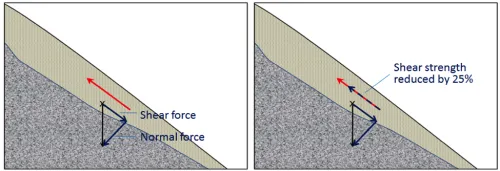
2. Based on the relative lengths of the arrows it appears that this material is stable, and unlikely to fail.
3. If the shear strength was reduced by 25% (right-hand diagram) the material would be much closer to failure, but the strength (based on the length of the arrows) still appears to be greater than the shear force.
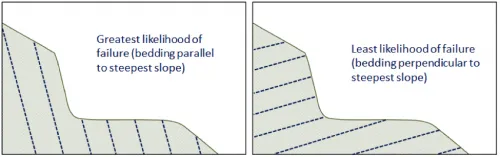
4. 
5. In moist sand the grains are each surrounded by an envelope of water, and the water envelopes overlap. The attractive surface tension of the water holds the grains together.
6. In a the material moves like a fluid (individual particles move independently). In a the mass moves as an intact unit, with little or no relative motion between grains or clasts.
7. If a large rock slide starts moving at a rate of several metres per second, the rock is very likely to break into smaller pieces. If the pieces are small and numerous enough that the material can flow, then it becomes a rock avalanche.
8. A debris flow is composed mostly of sand-sized and larger clasts, while a mudflow is composed mostly of sand-sized and smaller clasts.
9. Residents at risk from Mt. Rainier lahars need to know what the warnings mean and roughly how much time they have between receiving a warning and being in actual danger. They need to create a plan to exit their residence quickly, and they need to know which way to go to get to safety as efficiently as possible.
10. Some of the important factors include:
- The steepness of the slope
- Any existing erosion processes happening at the base of the slope (e.g., wave or stream erosion)
- The nature of surface or shallow sub-surface drainage in the upper part of the slope, and any effects that the construction might have on the drainage
- The weight of the building (unless it is to be constructed in an excavation that represents more mass than the building itself)
Chapter 16. Earth-System Change
See the end of Chapter 16 for solutions.
17. Glaciation
See the end of Chapter 17 for solutions.
Chapter 18. Geological Resources
1. Some of the components of a compact fluorescent lightbulb (and the resources used to make one) are as follows:
- Steel (iron, carbon from coal plus some manganese, nickel, chromium, molybdenum)
- Plastic housing (petroleum)
- Glass coil (silica from sand, plus minor amounts of sodium, calcium, and magnesium)
- Copper conductors, lead solder, and basal contact
- Silica (sand), plastics (petroleum), ceramics (clay), aluminum, gold, copper, etc. in the electronics
- Mercury inside the tube (less than 5 mg)
2. Nickel deposits form within mafic and ultramafic igneous bodies because the original magma have relatively high nickel levels to begin with, while intermediate or felsic magma have low levels.
3. The “smoke” in a black smoker is composed of tiny crystals of sulphide minerals. If those include significant quantities of ore minerals like chalcopyrite (CuFeS2), sphalerite (ZnS), and galena (PbS), a VMS deposit could form during this process.
4. A porphyry deposit is situated in the rock around an igneous pluton that has intruded to a relatively high level in the crust (and hence is porphyritic), and they form at least in part from fluids released by the magma. Epigenetic gold deposits may be formed from the same or similar fluids, but are situated at a greater distance from the pluton/
5. Ferrous iron (Fe2+) is soluble in water with a low oxidation potential, and gets converted to insoluble ferric iron (Fe3+) when the water becomes oxidized. The opposite situation happens with uranium. Uranyl uranium (U6+) is soluble under oxidizing conditions, but when the water in which it is dissolved encounters reducing conditions the uranium is converted to the insoluble uranous ion (U4+).
6. It is common for the upper part of a kimberlite to be mined using an open pit (in this case around 500 m wide and up to 500 m deep), and for the lower part to be mined underground.
7. Pyrite (FeS2) is typically responsible for acid rock drainage around mine sites, and it is very common for pyrite to form within the rock at the same time that other metal sulphides (e.g., chalcopyrite) are forming.
8. Glaciofluvial gravels are typically relatively well sorted, and may include clasts ranging in size from coarse sand to pebbles. Till, on the other hand, tends to be poorly sorted and may have clasts ranging from clay to boulders. More processing would be needed to separate the required size ranges, and because till tends to be relatively hard and strong, this would require a lot of effort.
9. During the manufacture of CaO limestone is heated and CO2 is released to the atmosphere, adding to the greenhouse effect. The energy required for this process typically comes from fossil fuels (e.g., natural gas) and the combustion also releases CO2.
10. Some important evaporite minerals include halite (NaCl), sylvite (KCl), and gypsum (CaSO4.2H2O).
11. The 15 m of organic matter required to make 1.5 m of coal, is equivalent to 15,000 mm, and if the organic matter accumulates at 1 mm/y that would require 15,000 years. That organic matter would have to remain submerged in oxygen-poor water for at least that length of time.
12. Petroleum source rocks must have a significant component of organic matter, and then need to be buried to at least 2,500 m depth so that the organic matter can be converted to oil or gas. Reservoir rocks must be both porous and permeable, so that the petroleum liquids can be extracted, and should also take the form of a trap (e.g., an anticline) and capped with impermeable rock.
13. The optimum depth for the generation of oil from buried organic matter is 2,500 to 3,500 m.
14. Shale gas is an unconventional reserve because shale is not permeable enough to allow the gas to be extracted. The rock has to be fractured (fracked) to allow recovery. Fracking involves the use of vast amounts of water, and there is the potential that the fracking fluids can contaminate freshwater aquifers.
15. Kimberlite indicator minerals are much more abundant than diamonds within kimberlites, and so they can typically be detected further away from the kimberlite source, and over a much wider area.
Chapter 19. Understanding Geological Time
See the end of Chapter 19 for solutions.