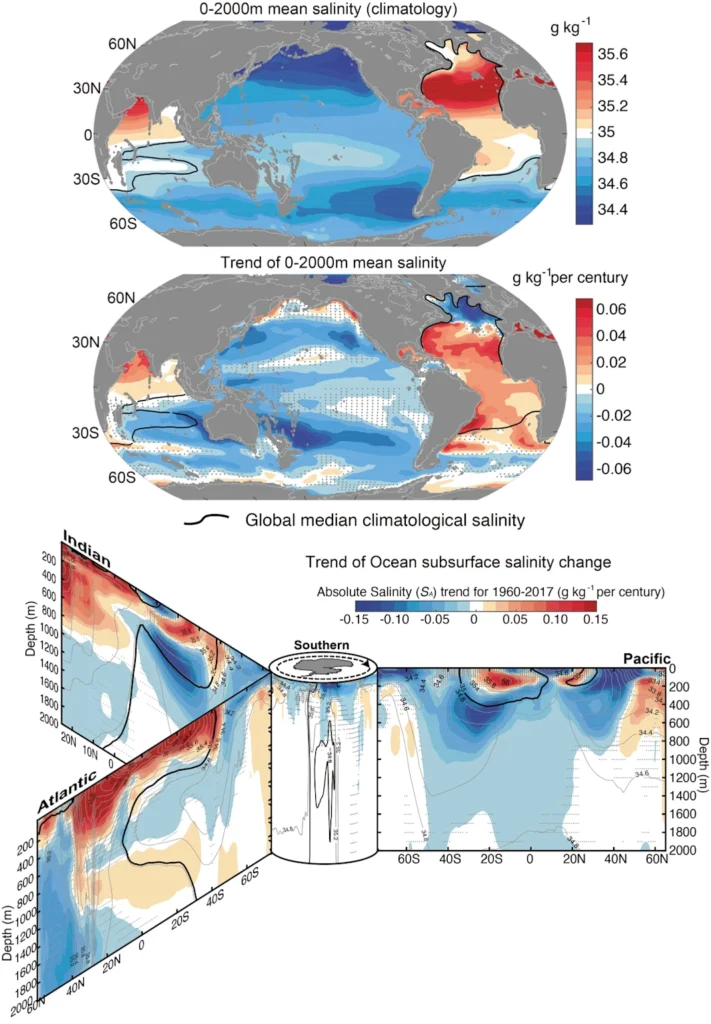
Global ocean salinity distribution and trends from surface to 2000m depth demonstrating variations influenced by evaporation, precipitation, and ocean circulation
Uncategorized

Ocean Salinity Variations: 5 Key Factors & Global Patterns

Ocean salinity variations result from five primary physical processes that work simultaneously across global marine systems. Evaporation increases salinity by removing pure water while leaving dissolved salts, with subtropical regions around 30°N and 30°S showing maximum levels due to clear skies and descending air currents. Precipitation and freshwater input from rivers like the Amazon, Congo, and St. Lawrence reduce salinity through dilution, creating distinct regional patterns. Prevailing winds redistribute saline waters through trade wind systems and upwelling phenomena, while ocean currents continuously mix surface and subsurface waters. These interconnected factors create salinity ranges from 2‰ in the Baltic Sea to 41‰ in the Red Sea, directly influencing marine ecosystems, thermohaline circulation, and global climate patterns.
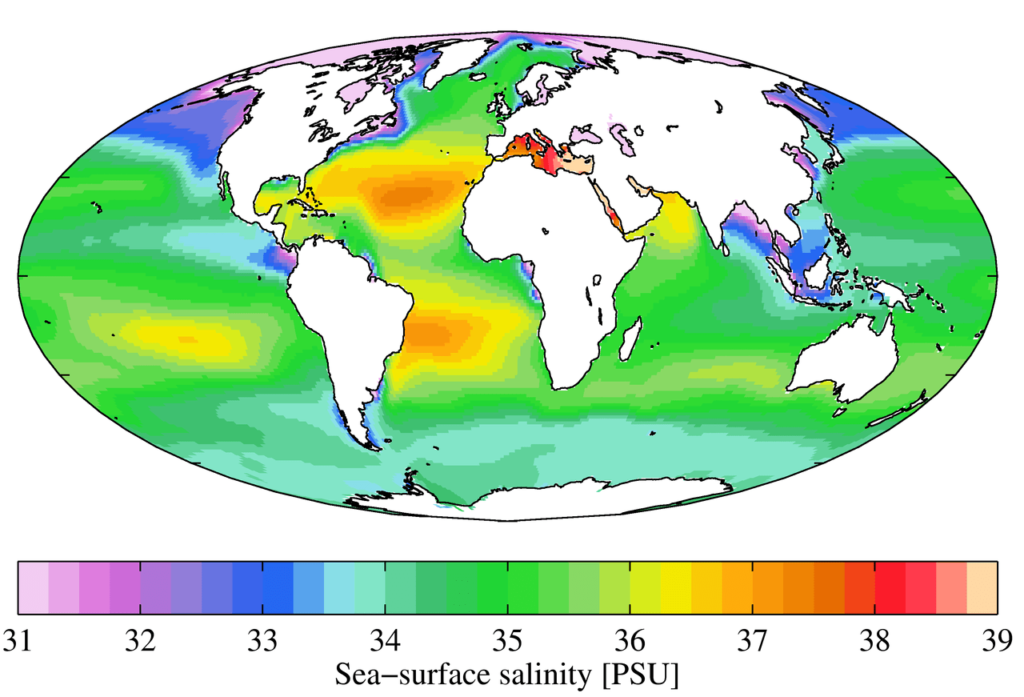
Global sea-surface salinity distribution showing variations from about 31 to 39 PSU with higher salinity in subtropical seas and lower salinity near polar and river-influenced regions
Uncategorized

Salinity of Ocean Water

As an oceanographer who has spent decades sampling the vast waters of our planet, from the frigid poles to the

Combined Geo-Scientist Examination

Syllabus for Chemist

Syllabus: Chemist/Scientist ‘B’ Syllabus for Chemist/Scientist ‘B’(Chemical) /Assistant Chemist Stage-II (Descriptive Type) Paper I Paper II Paper III Chemistry :

Combined Geo-Scientist Examination

Syllabus Main Examination Geology and Hydrogeology

Syllabus: Combined Geo-Scientist (Main) Examination Syllabus of Combined Geo-Scientist (Main) Examination For the post of Geologist/Scientist ‘B’(Hydrogeology) /Assistant Hydrogeologist Stage-II

Combined Geo-Scientist Examination

Preliminary Syllabus

Combined Geo-Scientist Examination Syllabus Standard and Syllabus Combined Geo-Scientist (Preliminary) Examination Paper-I in General Studies of Stage-I is common for

Combined Geo-Scientist Examination

Combined Geo-Scientist Examination Plan

The UPSC Combined Geo-Scientist Examination (CGSE) is a three-stage competitive exam conducted by UPSC for recruitment to Geologist, Geophysicist, Chemist, and Scientist ‘B’ positions in GSI and CGWB. The examination consists of Stage I (Preliminary – 400 marks), Stage II (Main – 600 marks), and Stage III (Personality Test – 200 marks), with a total of 1,200 marks determining the final merit ranking.

Combined Geo-Scientist Examination

Combined Geo-Scientist

Combined Geo-Scientist Examination Complete Examination Plan & Eligibility Conditions Plan of Examination The Combined Geo-Scientist Examination will consist of three

Indian constitution studyhub
Uncategorized

PART III FUNDAMENTAL RIGHTS

Part III of the Indian Constitution (Articles 12-35) guarantees fundamental rights including right to equality, freedom, protection against exploitation, freedom of religion, cultural rights, and constitutional remedies, making these rights justiciable and enforceable through Supreme Court and High Courts.

Mineralogy by Dexter Perkins
Uncategorized

8 Metamorphic Minerals and Metamorphic Rocks

Metamorphic rocks form when existing rocks undergo changes in temperature, pressure, or chemical environment. Heat and pressure are the primary drivers, creating new minerals and textures through solid-state transformations without melting the original rock.

Scroll to Top