
The vast majority of earthquakes and volcanic eruptions occur near plate boundaries, but there are some exceptions. For example, the Hawaiian Islands, which are entirely of volcanic origin, have formed in the middle of the Pacific Ocean more than 3,200 km from the nearest plate boundary. How do the Hawaiian Islands and other volcanoes that form in the interior of plates fit into the plate-tectonics picture?
Introduction
In 1963, J. Tuzo Wilson, the Canadian geophysicist who discovered transform faults, came up with an ingenious idea that became known as the “hotspot” theory. Wilson noted that in certain locations around the world, such as Hawaii, volcanism has been active for very long periods of time. This could only happen, he reasoned, if relatively small, long-lasting, and exceptionally hot regions — called hotspots — existed below the plates that would provide localized sources of high heat energy (thermal plumes) to sustain volcanism. Specifically, Wilson hypothesized that the distinctive linear shape of the Hawaiian Island-Emperor Seamounts chain resulted from the Pacific Plate moving over a deep, stationary hotspot in the mantle, located beneath the present-day position of the Island of Hawaii. Heat from this hotspot produced a persistent source of magma by partly melting the overriding Pacific Plate. The magma, which is lighter than the surrounding solid rock, then rises through the mantle and crust to erupt onto the seafloor, forming an active seamount. Over time, countless eruptions cause the seamount to grow until it finally emerges above sea level to form an island volcano. Wilson suggested that continuing plate movement eventually carries the island beyond the hotspot, cutting it off from the magma source, and volcanism ceases. As one island volcano becomes extinct, another develops over the hotspot, and the cycle is repeated. This process of volcano growth and death, over many millions of years, has left a long trail of volcanic islands and seamounts across the Pacific Ocean floor.
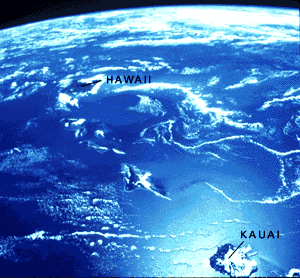
Space Shuttle photograph of the Hawaiian Islands, the southernmost part of the long volcanic trail of the “Hawaiian hotspot” (see text). Kauai is in the lower right corner (edge) and the Big Island of Hawaii in the upper left corner. Note the curvature of the Earth (top edge). (Photograph courtesy of NASA.)
According to Wilson’s hotspot theory, the volcanoes of the Hawaiian chain should get progressively older and become more eroded the farther they travel beyond the hotspot. The oldest volcanic rocks on Kauai, the northwesternmost inhabited Hawaiian island, are about 5.5 million years old and are deeply eroded. By comparison, on the “Big Island” of Hawaii — southeasternmost in the chain and presumably still positioned over the hotspot — the oldest exposed rocks are less than 0.7 million years old and new volcanic rock is continually being formed.
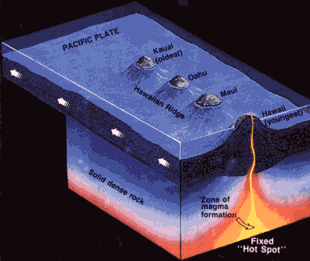
Above: Artist’s conception of the movement of the Pacific Plate over the fixed Hawaiian “Hot Spot,” illustrating the formation of the Hawaiian Ridge-Emperor Seamount Chain. (Modified from a drawing provided by Maurice Krafft, Centre de Volcanologie, France). Below: J. Tuzo Wilson’s original diagram (slightly modified), published in 1963, to show his proposed origin of the Hawaiian Islands. (Reproduced with permission of the Canadian Journal of Physics.)
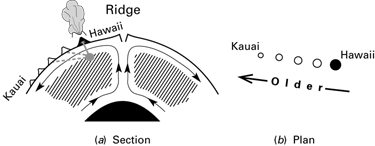
The possibility that the Hawaiian Islands become younger to the southeast was suspected by the ancient Hawaiians, long before any scientific studies were done. During their voyages, sea-faring Hawaiians noticed the differences in erosion, soil formation, and vegetation and recognized that the islands to the northwest (Niihau and Kauai) were older than those to the southeast (Maui and Hawaii). This idea was handed down from generation to generation in the legends of Pele, the fiery Goddess of Volcanoes. Pele originally lived on Kauai. When her older sister Namakaokahai, the Goddess of the Sea, attacked her, Pele fled to the Island of Oahu. When she was forced by Namakaokahai to flee again, Pele moved southeast to Maui and finally to Hawaii, where she now lives in the Halemaumau Crater at the summit of Kilauea Volcano. The mythical flight of Pele from Kauai to Hawaii, which alludes to the eternal struggle between the growth of volcanic islands from eruptions and their later erosion by ocean waves, is consistent with geologic evidence obtained centuries later that clearly shows the islands becoming younger from northwest to southeast.
Prominent world hotspots
Although Hawaii is perhaps the best known hotspot, others are thought to exist beneath the oceans and continents. More than a hundred hotspots beneath the Earth’s crust have been active during the past 10 million years. Most of these are located under plate interiors (for example, the African Plate), but some occur near diverging plate boundaries. Some are concentrated near the mid-oceanic ridge system, such as beneath Iceland, the Azores, and the Galapagos Islands.
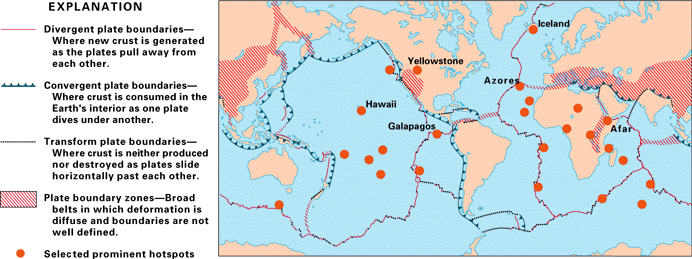
World map showing the locations of selected prominent hotspots; those labelled are mentioned in the text. (Modified from the map This Dynamic Planet.)
A few hotspots are thought to exist below the North American Plate. Perhaps the best known is the hotspot presumed to exist under the continental crust in the region of Yellowstone National Park in northwestern Wyoming. Here are several calderas (large craters formed by the ground collapse accompanying explosive volcanism) that were produced by three gigantic eruptions during the past two million years, the most recent of which occurred about 600,000 years ago. Ash deposits from these powerful eruptions have been mapped as far away as Iowa, Missouri, Texas, and even northern Mexico. The thermal energy of the presumed Yellowstone hotspot fuels more than 10,000 hot pools and springs, geysers (like Old Faithful), and bubbling mudpots (pools of boiling mud). A large body of magma, capped by a hydrothermal system (a zone of pressurized steam and hot water), still exists beneath the caldera. Recent surveys demonstrate that parts of the Yellowstone region rise and fall by as much as 1 cm each year, indicating the area is still geologically restless. However, these measurable ground movements, which most likely reflect hydrothermal pressure changes, do not necessarily signal renewed volcanic activity in the area.
Authors’ Note: Since this booklet’s publication in 1996, vigorous scientific debate has ensued regarding volcanism at “hotspots.” New studies suggest that hotspots are neither deep phenomena nor “fixed” in position over geologic time, as assumed in the popular plume model. See http://www.mantleplumes.org/.”
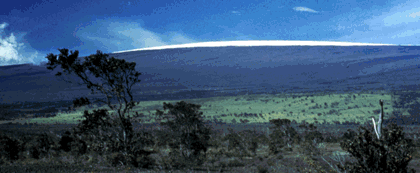
Snow-capped 4,169-m-high Mauna Loa Volcano, Island of Hawaii, seen from the USGS Hawaiian Volcano Observatory. Built by Hawaiian hotspot volcanism, Mauna Loa — the largest mountain in the world — is a classic example of a shield volcano. (Photograph by Robert I. Tilling, USGS.)
4.1: Tuzo Wilson
Discovering transforms and hotspots
Canadian geophysicist J. Tuzo Wilson was also pivotal in advancing the plate-tectonics theory. Intrigued by Wegener’s notion of a mobile Earth and influenced by Harry Hess’ exciting ideas, Wilson was eager to convert others to the revolution brewing in the earth sciences in the early 1960s. Wilson had known Hess in the late 1930s, when he was studying for his doctorate at Princeton University, where Hess was a dynamic young lecturer.
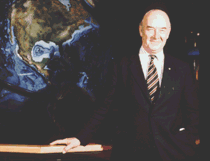
J. Tuzo Wilson (1908-1993) made major contributions to the development of the plate-tectonics theory in the 1960s and 1970s. He remained a dominant force in the Canadian scientific scene until his death. (Photograph courtesy of the Ontario Science Centre.)
In 1963, Wilson developed a concept crucial to the plate-tectonics theory. He suggested that the Hawaiian and other volcanic island chains may have formed due to the movement of a plate over a stationary “hotspot” in the mantle. This hypothesis eliminated an apparent contradiction to the plate-tectonics theory — the occurrence of active volcanoes located many thousands of kilometers from the nearest plate boundary. Hundreds of subsequent studies have proven Wilson right. However, in the early 1960s, his idea was considered so radical that his “hotspot” manuscript was rejected by all the major international scientific journals. This manuscript ultimately was published in 1963 in a relatively obscure publication, the Canadian Journal of Physics, and became a milestone in plate tectonics.
Another of Wilson’s important contributions to the development of the plate-tectonics theory was published two years later. He proposed that there must be a third type of plate boundary to connect the oceanic ridges and trenches, which he noted can end abruptly and “transform” into major faults that slip horizontally. A well-known example of such a transform-fault boundary is the San Andreas Fault zone. Unlike ridges and trenches, transform faults offset the crust horizontally, without creating or destroying crust.
Wilson was a professor of geophysics at the University of Toronto from 1946 until 1974, when he retired from teaching and became the Director of the Ontario Science Centre. He was a tireless lecturer and traveller until his death in 1993. Like Hess, Wilson was able to see his concepts of hotspots and transform faults confirmed, as knowledge of the dynamics and seismicity of the ocean floor increased dramatically. Wilson and other scientists, including Robert Dietz, Harry Hess, Drummond Matthews, and Frederick Vine, were the principal architects in the early development of plate tectonics during the mid-1960s — a theory that is as vibrant and exciting today as it was when it first began to evolve less than 30 years ago. Interestingly, Wilson was in his mid-fifties, at the peak of his scientific career, when he made his insightful contributions to the plate-tectonics theory. If Alfred Wegener had not died at age 50 in his scientific prime, the plate tectonics revolution may have begun sooner.
4.2: The long trail of the Hawaiian hotspot
Over the past 70 million years, the combined processes of magma formation, volcano eruption and growth, and continued movement of the Pacific Plate over the stationary Hawaiian “hot-spot” have left a long trail of volcanoes across the Pacific Ocean floor. The Hawaiian Ridge-Emperor Seamounts chain extends some 6,000 km from the “Big Island” of Hawaii to the Aleutian Trench off Alaska. The Hawaiian Islands themselves are a very small part of the chain and are the youngest islands in the immense, mostly submarine mountain chain composed of more than 80 volcanoes. The length of the Hawaiian Ridge segment alone, from the Big Island northwest to Midway Island, is about equal to the distance from Washington, D.C. to Denver, Colorado (2,600 km). The amount of lava erupted to form the Hawaiian-Emperor chain is calculated to be at least 750,000 cubic kilometers-more than enough to blanket the entire State of California with a layer of lava roughly 1.5 km thick.
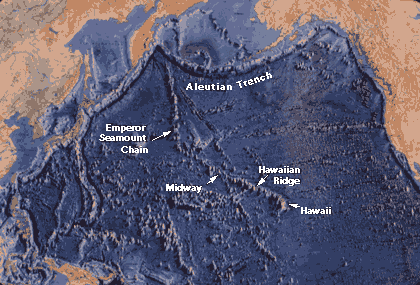
Map of part of the Pacific basin showing the volcanic trail of the Hawaiian hotspot– 6,000-km-long Hawaiian Ridge-Emperor Seamounts chain. (Base map reprinted by permission from World Ocean Floor by Bruce C. Heezen and Marie Tharp, Copyright 1977.)
A sharp bend in the chain indicates that the motion of the Pacific Plate abruptly changed about 43 million years ago, as it took a more westerly turn from its earlier northerly direction. Why the Pacific Plate changed direction is not known, but the change may be related in some way to the collision of India into the Asian continent, which began about the same time.
As the Pacific Plate continues to move west-northwest, the Island of Hawaii will be carried beyond the hotspot by plate motion, setting the stage for the formation of a new volcanic island in its place. In fact, this process may be under way. Loihi Seamount, an active submarine volcano, is forming about 35 km off the southern coast of Hawaii. Loihi already has risen about 3 km above the ocean floor to within 1 km of the ocean surface. According to the hotspot theory, assuming Loihi continues to grow, it will become the next island in the Hawaiian chain. In the geologic future, Loihi may eventually become fused with the Island of Hawaii, which itself is composed of five volcanoes knitted together-Kohala, Mauna Kea, Hualalai, Mauna Loa, and Kilauea.