
Continental drift was hotly debated off and on for decades following Wegener’s death before it was largely dismissed as being eccentric, preposterous, and improbable. However, beginning in the 1950s, a wealth of new evidence emerged to revive the debate about Wegener’s provocative ideas and their implications. In particular, four major scientific developments spurred the formulation of the plate-tectonics theory: (1) demonstration of the ruggedness and youth of the ocean floor; (2) confirmation of repeated reversals of the Earth magnetic field in the geologic past; (3) emergence of the seafloor-spreading hypothesis and associated recycling of oceanic crust; and (4) precise documentation that the world’s earthquake and volcanic activity is concentrated along oceanic trenches and submarine mountain ranges.
Ocean floor mapping
About two thirds of the Earth’s surface lies beneath the oceans. Before the 19th century, the depths of the open ocean were largely a matter of speculation, and most people thought that the ocean floor was relatively flat and featureless. However, as early as the 16th century, a few intrepid navigators, by taking soundings with hand lines, found that the open ocean can differ considerably in depth, showing that the ocean floor was not as flat as generally believed. Oceanic exploration during the next centuries dramatically improved our knowledge of the ocean floor. We now know that most of the geologic processes occurring on land are linked, directly or indirectly, to the dynamics of the ocean floor.
“Modern” measurements of ocean depths greatly increased in the 19th century, when deep-sea line soundings (bathymetric surveys) were routinely made in the Atlantic and Caribbean. In 1855, a bathymetric chart published by U.S. Navy Lieutenant Matthew Maury revealed the first evidence of underwater mountains in the central Atlantic (which he called “Middle Ground”). This was later confirmed by survey ships laying the trans-Atlantic telegraph cable. Our picture of the ocean floor greatly sharpened after World War I (1914-18), when echo-sounding devices — primitive sonar systems — began to measure ocean depth by recording the time it took for a sound signal (commonly an electrically generated “ping”) from the ship to bounce off the ocean floor and return. Time graphs of the returned signals revealed that the ocean floor was much more rugged than previously thought. Such echo-sounding measurements clearly demonstrated the continuity and roughness of the submarine mountain chain in the central Atlantic (later called the Mid-Atlantic Ridge) suggested by the earlier bathymetric measurements.
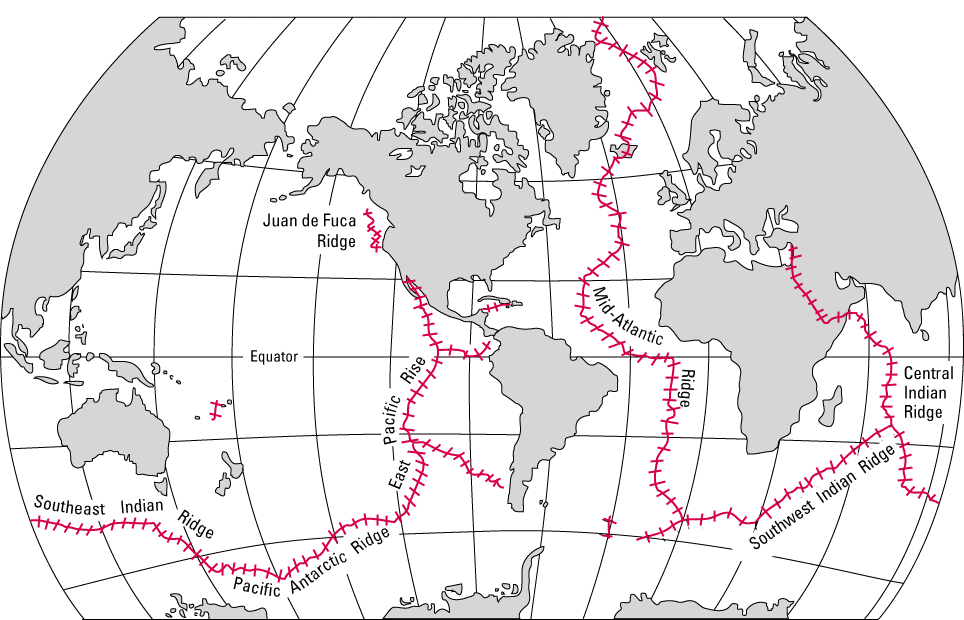
The mid-ocean ridge (shown in red) winds its way between the continents much like the seam on a baseball.
In 1947, seismologists on the U.S. research ship Atlantis found that the sediment layer on the floor of the Atlantic was much thinner than originally thought. Scientists had previously believed that the oceans have existed for at least 4 billion years, so therefore the sediment layer should have been very thick. Why then was there so little accumulation of sedimentary rock and debris on the ocean floor? The answer to this question, which came after further exploration, would prove to be vital to advancing the concept of plate tectonics.
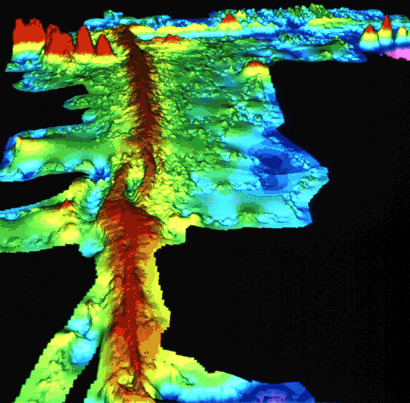
Computer-generated detailed topographic map of a segment of the Mid-Oceanic Ridge. “Warm” colors (yellow to red) indicate the ridge rising above the seafloor, and the “cool” colors (green to blue) represent lower elevations. This image (at latitude 9° north) is of a small part of the East Pacific Rise. (Imagery courtesy of Stacey Tighe, University of Rhode Island.)
In the 1950s, oceanic exploration greatly expanded. Data gathered by oceanographic surveys conducted by many nations led to the discovery that a great mountain range on the ocean floor virtually encircled the Earth. Called the global mid-ocean ridge, this immense submarine mountain chain — more than 50,000 kilometers (km) long and, in places, more than 800 km across — zig-zags between the continents, winding its way around the globe like the seam on a baseball. Rising an average of about 4,500 meters(m) above the sea floor, the mid-ocean ridge overshadows all the mountains in the United States except for Mount McKinley (Denali) in Alaska (6,194 m). Though hidden beneath the ocean surface, the global mid-ocean ridge system is the most prominent topographic feature on the surface of our planet.
Magnetic striping and polar reversals
Beginning in the 1950s, scientists, using magnetic instruments (magnetometers) adapted from airborne devices developed during World War II to detect submarines, began recognizing odd magnetic variations across the ocean floor. This finding, though unexpected, was not entirely surprising because it was known that basalt –– the iron-rich, volcanic rock making up the ocean floor– contains a strongly magnetic mineral (magnetite) and can locally distort compass readings. This distortion was recognized by Icelandic mariners as early as the late 18th century. More important, because the presence of magnetite gives the basalt measurable magnetic properties, these newly discovered magnetic variations provided another means to study the deep ocean floor.
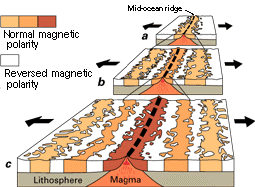
A theoretical model of the formation of magnetic striping. New oceanic crust forming continuously at the crest of the mid-ocean ridge cools and becomes increasingly older as it moves away from the ridge crest with seafloor spreading (see text): a. the spreading ridge about 5 million years ago; b. about 2 to 3 million years ago; and c. present-day.
Early in the 20th century, paleomagnetists (those who study the Earth’s ancient magnetic field) — such as Bernard Brunhes in France (in 1906) and Motonari Matuyama in Japan (in the 1920s) — recognized that rocks generally belong to two groups according to their magnetic properties. One group has so-called normal polarity, characterized by the magnetic minerals in the rock having the same polarity as that of the Earth’s present magnetic field. This would result in the north end of the rock’s “compass needle” pointing toward magnetic north. The other group, however, has reversed polarity, indicated by a polarity alignment opposite to that of the Earth’s present magnetic field. In this case, the north end of the rock’s compass needle would point south. How could this be? This answer lies in the magnetite in volcanic rock. Grains of magnetite — behaving like little magnets — can align themselves with the orientation of the Earth’s magnetic field. When magma (molten rock containing minerals and gases) cools to form solid volcanic rock, the alignment of the magnetite grains is “locked in,” recording the Earth’s magnetic orientation or polarity (normal or reversed) at the time of cooling.
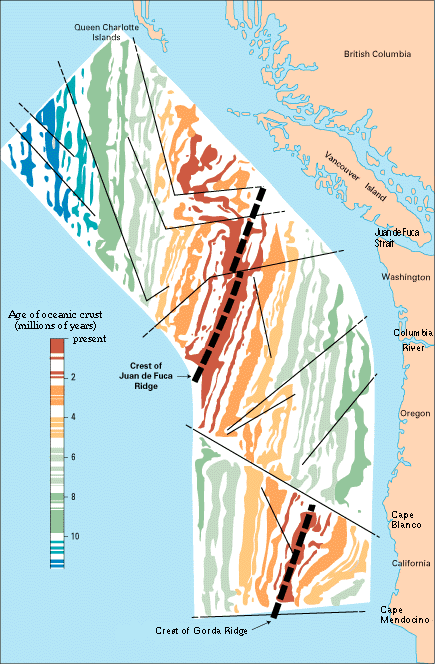
The center part of the figure — representing the deep ocean floor with the sea magically removed — shows the magnetic striping (see text) mapped by oceanographic surveys offshore of the Pacific Northwest. Thin black lines show transform faults (discussed later) that offset the striping.
As more and more of the seafloor was mapped during the 1950s, the magnetic variations turned out not to be random or isolated occurrences, but instead revealed recognizable patterns. When these magnetic patterns were mapped over a wide region, the ocean floor showed a zebra-like pattern. Alternating stripes of magnetically different rock were laid out in rows on either side of the mid-ocean ridge: one stripe with normal polarity and the adjoining stripe with reversed polarity. The overall pattern, defined by these alternating bands of normally and reversely polarized rock, became known as magnetic striping.
Seafloor spreading and recycling of oceanic crust
The discovery of magnetic striping naturally prompted more questions: How does the magnetic striping pattern form? And why are the stripes symmetrical around the crests of the mid-ocean ridges? These questions could not be answered without also knowing the significance of these ridges. In 1961, scientists began to theorize that mid-ocean ridges mark structurally weak zones where the ocean floor was being ripped in two lengthwise along the ridge crest. New magma from deep within the Earth rises easily through these weak zones and eventually erupts along the crest of the ridges to create new oceanic crust. This process, later called seafloor spreading, operating over many millions of years has built the 50,000 km-long system of mid-ocean ridges. This hypothesis was supported by several lines of evidence: (1) at or near the crest of the ridge, the rocks are very young, and they become progressively older away from the ridge crest; (2) the youngest rocks at the ridge crest always have present-day (normal) polarity; and (3) stripes of rock parallel to the ridge crest alternated in magnetic polarity (normal-reversed-normal, etc.), suggesting that the Earth’s magnetic field has flip-flopped many times. By explaining both the zebralike magnetic striping and the construction of the mid-ocean ridge system, the seafloor spreading hypothesis quickly gained converts and represented another major advance in the development of the plate-tectonics theory. Furthermore, the oceanic crust now came to be appreciated as a natural “tape recording” of the history of the reversals in the Earth’s magnetic field.
Additional evidence of seafloor spreading came from an unexpected source: petroleum exploration. In the years following World War II, continental oil reserves were being depleted rapidly and the search for offshore oil was on. To conduct offshore exploration, oil companies built ships equipped with a special drilling rig and the capacity to carry many kilometers of drill pipe. This basic idea later was adapted in constructing a research vessel, named the Glomar Challenger, designed specifically for marine geology studies, including the collection of drill-core samples from the deep ocean floor. In 1968, the vessel embarked on a year-long scientific expedition, criss-crossing the Mid-Atlantic Ridge between South America and Africa and drilling core samples at specific locations. When the ages of the samples were determined by paleontologic and isotopic dating studies, they provided the clinching evidence that proved the seafloor spreading hypothesis.
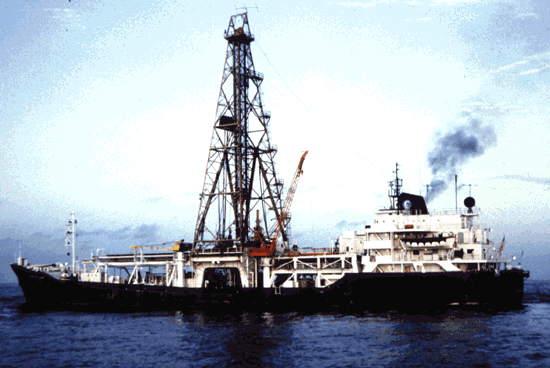
Above: The Glomar Challenger was the first research vessel specifically designed in the late 1960s for the purpose of drilling into and taking core samples from the deep ocean floor. Below: The JOIDES Resolution is the deep-sea drilling ship of the 1990s (JOIDES= Joint Oceanographic Institutions for Deep Earth Sampling). This ship, which carries more than 9,000 m of drill pipe, is capable of more precise positioning and deeper drilling than the Glomar Challenger. (Photographs courtesy of Ocean Drilling Program, Texas A & M University.)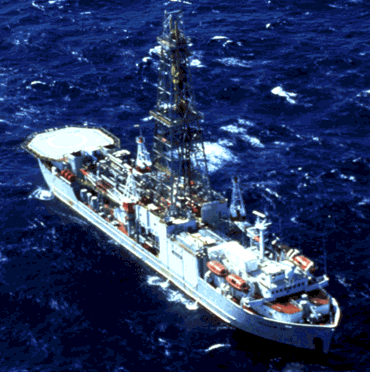
A profound consequence of seafloor spreading is that new crust was, and is now, being continually created along the oceanic ridges. This idea found great favor with some scientists who claimed that the shifting of the continents can be simply explained by a large increase in size of the Earth since its formation. However, this so-called “expanding Earth” hypothesis was unsatisfactory because its supporters could offer no convincing geologic mechanism to produce such a huge, sudden expansion. Most geologists believe that the Earth has changed little, if at all, in size since its formation 4.6 billion years ago, raising a key question: how can new crust be continuously added along the oceanic ridges without increasing the size of the Earth?
This question particularly intrigued Harry H. Hess, a Princeton University geologist and a Naval Reserve Rear Admiral, and Robert S. Dietz, a scientist with the U.S. Coast and Geodetic Survey who first coined the term seafloor spreading. Dietz and Hess were among the small handful who really understood the broad implications of sea floor spreading. If the Earth’s crust was expanding along the oceanic ridges, Hess reasoned, it must be shrinking elsewhere. He suggested that new oceanic crust continuously spread away from the ridges in a conveyor belt-like motion. Many millions of years later, the oceanic crust eventually descends into the oceanic trenches — very deep, narrow canyons along the rim of the Pacific Ocean basin. According to Hess, the Atlantic Ocean was expanding while the Pacific Ocean was shrinking. As old oceanic crust was consumed in the trenches, new magma rose and erupted along the spreading ridges to form new crust. In effect, the ocean basins were perpetually being “recycled,” with the creation of new crust and the destruction of old oceanic lithosphere occurring simultaneously. Thus, Hess’ ideas neatly explained why the Earth does not get bigger with sea floor spreading, why there is so little sediment accumulation on the ocean floor, and why oceanic rocks are much younger than continental rocks.
Concentration of earthquakes
During the 20th century, improvements in seismic instrumentation and greater use of earthquake-recording instruments (seismographs) worldwide enabled scientists to learn that earthquakes tend to be concentrated in certain areas, most notably along the oceanic trenches and spreading ridges. By the late 1920s, seismologists were beginning to identify several prominent earthquake zones parallel to the trenches that typically were inclined 40-60° from the horizontal and extended several hundred kilometers into the Earth. These zones later became known as Wadati-Benioff zones, or simply Benioff zones, in honor of the seismologists who first recognized them, Kiyoo Wadati of Japan and Hugo Benioff of the United States. The study of global seismicity greatly advanced in the 1960s with the establishment of the Worldwide Standardized Seismograph Network (WWSSN) to monitor the compliance of the 1963 treaty banning above-ground testing of nuclear weapons. The much-improved data from the WWSSN instruments allowed seismologists to map precisely the zones of earthquake concentration worldwide.
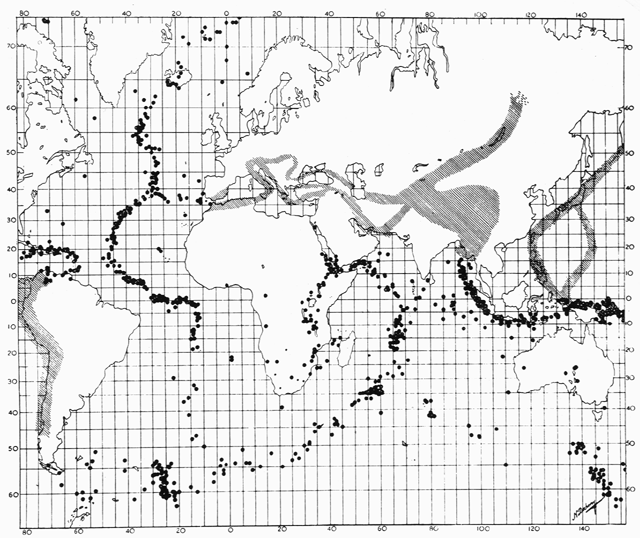
As early as the 1920s, scientists noted that earthquakes are concentrated in very specific narrow zones (see text). In 1954, French seismologist J.P. Rothé published this map showing the concentration of earthquakes along the zones indicated by dots and cross-hatched areas. (Original illustration reproduced with permission of the Royal Society of London.)
But what was the significance of the connection between earthquakes and oceanic trenches and ridges? The recognition of such a connection helped confirm the seafloor-spreading hypothesis by pin-pointing the zones where Hess had predicted oceanic crust is being generated (along the ridges) and the zones where oceanic lithosphere sinks back into the mantle (beneath the trenches).
2.1: Harry Hammond Hess
Spreading the seafloor
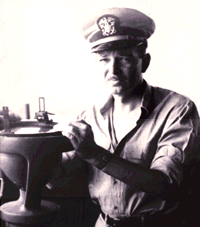
Harry Hess (1906-1969) in his Navy uniform as Captain of the assault transport Cape Johnson during World War II. After the war, he remained active in the Naval Reserve, reaching the rank of Rear Admiral. (Photograph courtesy of Department of Geological and Geophysical Sciences, Princeton University.)
Harry Hammond Hess, a professor of geology at Princeton University, was very influential in setting the stage for the emerging plate-tectonics theory in the early 1960s. He believed in many of the observations Wegener used in defending his theory of continental drift, but he had very different views about large-scale movements of the Earth.
Even while serving in the U.S. Navy during World War II, Hess was keenly interested in the geology of the ocean basins. In between taking part in the fighting in the Marianas, Leyte, Linguayan, and Iwo Jima, Hess — with the cooperation of his crew — was able to conduct echo-sounding surveys in the Pacific while cruising from one battle to the next. Building on the work of English geologist Arthur Holmes in the 1930s, Hess’ research ultimately resulted in a ground-breaking hypothesis that later would be called seafloor spreading. In 1959, he informally presented this hypothesis in a manuscript that was widely circulated. Hess, like Wegener, ran into resistance because little ocean-floor data existed for testing his ideas. In 1962, these ideas were published in a paper titled “History of Ocean Basins,” which was one of the most important contributions in the development of plate tectonics. In this classic paper, Hess outlined the basics of how seafloor spreading works: molten rock (magma) oozes up from the Earth’s interior along the mid-oceanic ridges, creating new seafloor that spreads away from the active ridge crest and, eventually, sinks into the deep oceanic trenches.
Hess’ concept of a mobile seafloor explained several very puzzling geologic questions. If the oceans have existed for at least 4 billion years, as most geologists believed, why is there so little sediment deposited on the ocean floor? Hess reasoned that the sediment has been accumulating for about 300 million years at most. This interval is approximately the time needed for the ocean floor to move from the ridge crest to the trenches, where oceanic crust descends into the trench and is destroyed. Meanwhile, magma is continually rising along the mid-oceanic ridges, where the “recycling” process is completed by the creation of new oceanic crust. This recycling of the seafloor also explained why the oldest fossils found on the seafloor are no more than about 180 million years old. In contrast, marine fossils in rock strata on land — some of which are found high in the Himalayas, over 8,500 m above sea level — can be considerably older. Most important, however, Hess’ ideas also resolved a question that plagued Wegener’s theory of continental drift: how do the continents move? Wegener had a vague notion that the continents must simply “plow” through the ocean floor, which his critics rightly argued was physically impossible. With seafloor spreading, the continents did not have to push through the ocean floor but were carried along as the ocean floor spread from the ridges.
In 1962, Hess was well aware that solid evidence was still lacking to test his hypothesis and to convince a more receptive but still skeptical scientific community. But the Vine-Matthews explanation of magnetic striping of the seafloor a year later and additional oceanic exploration during subsequent years ultimately provided the arguments to confirm Hess’ model of seafloor spreading. The theory was strengthened further when dating studies showed that the seafloor becomes older with distance away from the ridge crests. Finally, improved seismic data confirmed that oceanic crust was indeed sinking into the trenches, fully proving Hess’ hypothesis, which was based largely on intuitive geologic reasoning. His basic idea of seafloor spreading along mid-oceanic ridges has well withstood the test of time.
Hess, who served for years as the head of Princeton’s Geology Department, died in 1969. Unlike Wegener, he was able to see his seafloor-spreading hypothesis largely accepted and confirmed as knowledge of the ocean floor increased dramatically during his lifetime. Like Wegener, he was keenly interested in other sciences in addition to geology. In recognition of his enormous stature worldwide, in 1962 Hess — best known for his geologic research — was appointed by President John F. Kennedy to the prestigious position of Chairman of the Space Science Board of the National Academy of Sciences. Thus, in addition to being a major force in the development of plate tectonics, Hess also played a prominent role in designing the nation’s space program.
2.2: Exploring the deep ocean floor
Hot springs and strange creatures
The ocean floor is home to many unique communities of plants and animals. Most of these marine ecosystems are near the water surface, such as the Great Barrier Reef, a 2,000-km-long coral formation off the northeastern coast of Australia. Coral reefs, like nearly all complex living communities, depend on solar energy for growth (photosynthesis). The sun’s energy, however, penetrates at most only about 300 m below the surface of the water. The relatively shallow penetration of solar energy and the sinking of cold, subpolar water combine to make most of the deep ocean floor a frigid environment with few life forms.
In 1977, scientists discovered hot springs at a depth of 2.5 km, on the Galapagos Rift (spreading ridge) off the coast of Ecuador. This exciting discovery was not really a surprise. Since the early 1970s, scientists had predicted that hot springs (geothermal vents) should be found at the active spreading centers along the mid-oceanic ridges, where magma, at temperatures over 1,000 °C, presumably was being erupted to form new oceanic crust. More exciting, because it was totally unexpected, was the discovery of abundant and unusual sea life — giant tube worms, huge clams, and mussels — that thrived around the hot springs.
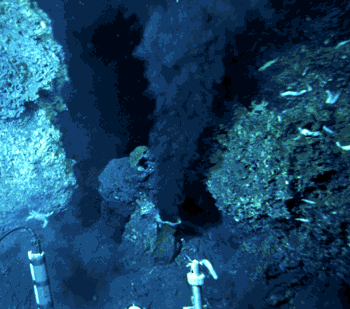
View of the first high-temperature vent (380 °C) ever seen by scientists during a dive of the deep-sea submersible Alvin on the East Pacific Rise (latitude 21° north) in 1979. Such geothermal vents–called smokers because they resemble chimneys–spew dark, mineral-rich, fluids heated by contact with the newly formed, still-hot oceanic crust. This photograph shows a black smoker, but smokers can also be white, grey, or clear depending on the material being ejected. (Photograph by Dudley Foster from RISE expedition, courtesy of William R. Normark, USGS.)
Since 1977, other hot springs and associated sea life have been found at a number of sites along the mid-oceanic ridges, many on the East Pacific Rise. The waters around these deep-ocean hot springs, which can be as hot as 380 °C, are home to a unique ecosystem. Detailed studies have shown that hydrogen sulfide-oxidizing bacteria, which live symbiotically with the larger organisms, form the base of this ecosystem’s food chain. The hydrogen sulfide (H2S–the gas that smells like rotten eggs) needed by these bacteria to live is contained in the volcanic gases that spew out of the hot springs. Most of the sulfur comes from the Earth’s interior; a small portion (less than 15 percent) is produced by chemical reaction of the sulfate (SO4) present in the sea water. Thus, the energy source that sustains this deep-ocean ecosystem is not sunlight but rather the energy from chemical reaction (chemosynthesis).
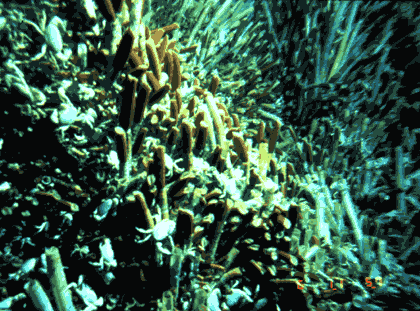
The deep-sea hot-spring environment supports abundant and bizarre sea life, including tube worms, crabs, giant clams. This hot-spring “neighborhood” is at 13° N along the East Pacific Rise. (Photograph by Richard A. Lutz, Rutgers University, New Brunswick, New Jersey.)
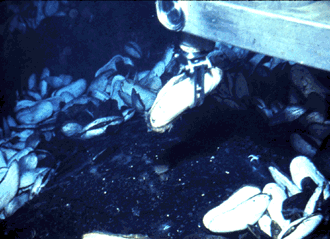
The manipulator arm of the research submersible Alvin collecting a giant clam from the deep ocean floor. (Photograph by John M. Edmond, Massachusetts Institute of Technology.)

The size of deep-sea giant clams is evident from the hands of a scientist holding them. (Photograph by William R. Normark, USGS.)
But the story about the source of life-sustaining energy in the deep sea is still unfolding. In the late 1980s, scientists documented the existence of a dim glow at some of the hot geothermal vents, which are the targets of current intensive research. The occurrence of “natural” light on the dark seafloor has great significance, because it implies that photosynthesis may be possible at deep-sea geothermal vents. Thus, the base of the deep-sea ecosystem’s food chain may comprise both chemosynthetic and, probably in small proportion, photosynthetic bacteria.

USGS scientist Jan Morton entering the submersible Alvin before its launch to begin a research dive. (Photograph by Randolph A. Koski, USGS.)
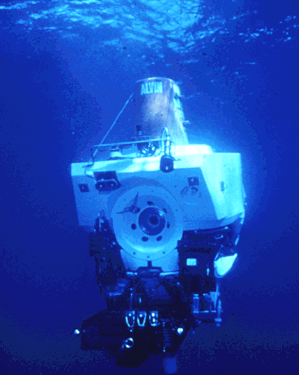
The Alvin below water after the launch and en route to the deep seafloor. (Photograph courtesy of the Woods Hole Oceanographic Institution).

A colony of tube worms, some as long as 1.5 m, clustered around an ocean floor hot spring. (Photograph by Daniel Fornari, Woods Hole Oceanographic Institution.)

Close-up of spider crab that was observed to be eating tube worms. (Photograph by William R. Normark, USGS.)
Scientists discovered the hot-springs ecosystems with the help of Alvin, the world’s first deep-sea submersible. Constructed in the early 1960s for the U.S. Navy, Alvin is a three-person, self-propelling capsule-like submarine nearly eight meters long. In 1975, scientists of Project FAMOUS (French-American Mid-Ocean Undersea Study) used Alvin to dive on a segment of the Mid-Atlantic Ridge in an attempt to make the first direct observation of seafloor spreading. No hot springs were observed on this expedition; it was during the next Alvin expedition, the one in 1977 to the Galapagos Rift, that the hot springs and strange creatures were discovered. Since the advent of Alvin, other manned submersibles have been built and used successfully to explore the deep ocean floor. Alvin has an operational maximum depth of about 4,000 m, more than four times greater than that of the deepest diving military submarine. Shinkai 6500, a Japanese research submarine built in 1989, can work at depths down to 6,400 m. The United States and Japan are developing research submersible systems that will be able to explore the ocean floor’s deepest spot: the 10,920-m Challenger Deep at the southern end of the Marianas Trench off the Mariana Islands.
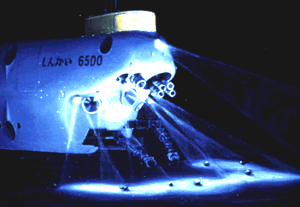
Sketch of the Shinkai 6500, a Japanese vessel that is currently the world’s deepest-diving manned research submarine. (Courtesy of Japan Marine Science & Technology Center.)
2.3: Magnetic Stripes and Isotopic Clocks
Oceanographic exploration in the 1950s led to a much better understanding of the ocean floor. Among the new findings was the discovery of zebra stripe-like magnetic patterns for the rocks of the ocean floor. These patterns were unlike any seen for continental rocks. Obviously, the ocean floor had a story to tell, but what?
In 1962, scientists of the U.S. Naval Oceanographic Office prepared a report summarizing available information on the magnetic stripes mapped for the volcanic rocks making up the ocean floor. After digesting the data in this report, along with other information, two young British geologists, Frederick Vine and Drummond Matthews, and also Lawrence Morley of the Canadian Geological Survey, suspected that the magnetic pattern was no accident. In 1963, they hypothesized that the magnetic striping was produced by repeated reversals of the Earth’s magnetic field, not as earlier thought, by changes in intensity of the magnetic field or by other causes. Field reversals had already been demonstrated for magnetic rocks on the continents, and a logical next step was to see if these continental magnetic reversals might be correlated in geologic time with the oceanic magnetic striping. About the same time as these exciting discoveries were being made on the ocean floor, new techniques for determining the geologic ages of rocks (“dating”) were also developing rapidly.
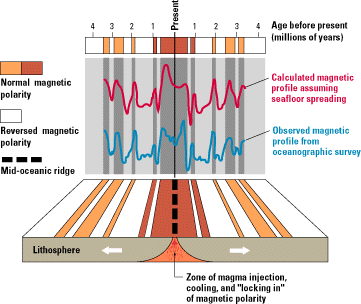
An observed magnetic profile (blue) for the ocean floor across the East Pacific Rise is matched quite well by a calculated profile (red) based on the Earth’s magnetic reversals for the past 4 million years and an assumed constant rate of movement of ocean floor away from a hypothetical spreading center (bottom). The remarkable similarity of these two profiles provided one of the clinching arguments in support of the seafloor spreading hypothesis.
A team of U.S. Geological Survey scientists — geophysicists Allan Cox and Richard Doell, and isotope geochemist Brent Dalrymple — reconstructed the history of magnetic reversals for the past 4 million years using a dating technique based on the isotopes of the chemical elements potassium and argon. The potassium-argon technique — like other “isotopic clocks” — works because certain elements, such as potassium, contain unstable, parent radioactive isotopes that decay at a steady rate over geologic time to produce daughter isotopes. The rate of decay is expressed in terms of an element’s “half-life,” the time it takes for half of the radioactive isotope of the element to decay. The decay of the radioactive potassium isotope (potassium-40) yields a stable daughter isotope (argon-40), which does not decay further. The age of a rock can be determined (“dated”) by measuring the total amount of potassium in the rock, the amount of the remaining radioactive potassium-40 that has not decayed, and the amount of argon-40. Potassium is found in common rock-forming minerals, and because the potassium-40 isotope has a half-life of 1,310 million years, it can be used in dating rocks millions of years old.
Other commonly used isotopic clocks are based on radioactive decay of certain isotopes of the elements uranium, thorium, strontium, and rubidium. However, it was the potassium-argon dating method that unlocked the riddle of the magnetic striping on the ocean floor and provided convincing evidence for the seafloor spreading hypothesis. Cox and his colleagues used this method to date continental volcanic rocks from around the world. They also measured the magnetic orientation of these same rocks, allowing them to assign ages to the Earth’s recent magnetic reversals. In 1966, Vine and Matthews — and also Morley working independently — compared these known ages of magnetic reversals with the magnetic striping pattern found on the ocean floor. Assuming that the ocean floor moved away from the spreading center at a rate of several centimeters per year, they found there was a remarkable correlation between the ages of the Earth’s magnetic reversals and the striping pattern. Following their break-through discovery, similar studies were repeated for other spreading centers. Eventually, scientists were able to date and correlate the magnetic striping patterns for nearly all of the ocean floor, parts of which are as old as 180 million years.
Contributors and Attributions
W. Jacquelyne Kious and Robert Tilling (“The Dynamic Earth” via the U.S. Geological Survey)