
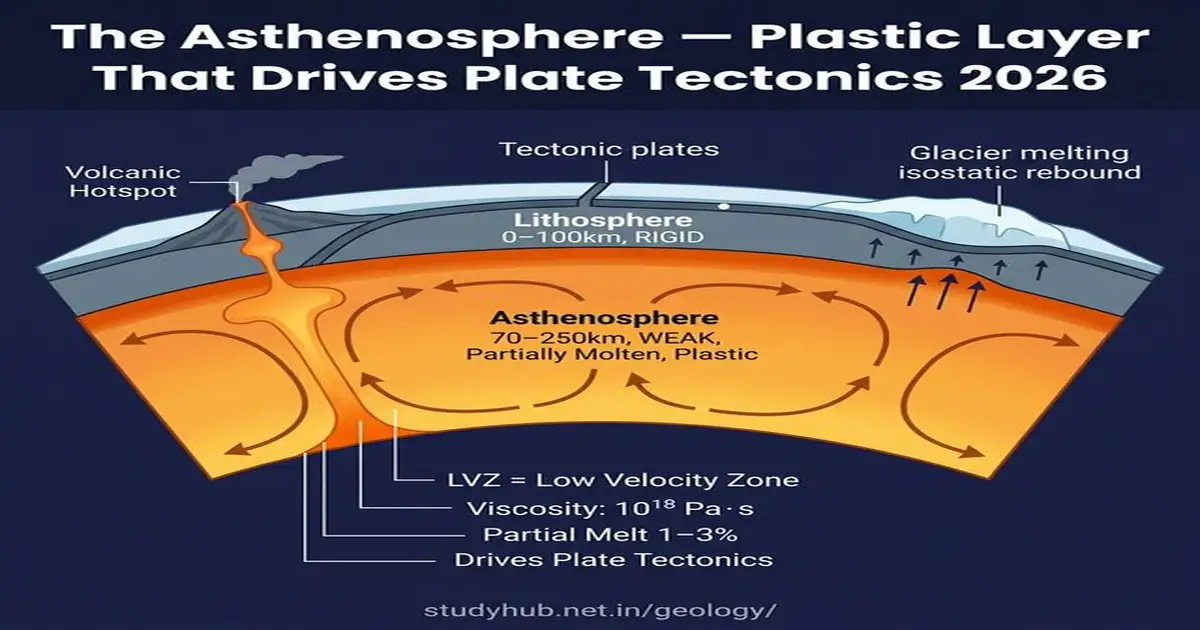
Beneath the rigid tectonic plates — between approximately 70 km and 250 km depth — lies one of the most geologically critical and frequently misunderstood zones in Earth science: the asthenosphere (from Greek asthenos = weak + sphaira = sphere). This is the layer that makes plate tectonics possible. Despite being composed of the same rock as the mantle above and below it (ultramafic peridotite), the asthenosphere is mechanically completely different from the rigid lithosphere above: it is weak, ductile, and plastic — capable of flowing extremely slowly over geological timescales, providing the lubrication surface on which tectonic plates glide. Understanding the asthenosphere means understanding why plates move, why volcanoes erupt at mid-ocean ridges and hotspots, why land surfaces rise centuries after glaciers melt (isostatic rebound), and why seismic waves slow down at this depth. For UPSC, SSC, NDA, and state PCS exams, the asthenosphere’s definition, its contrast with the lithosphere, its role in plate tectonics, and the concept of isostasy are directly tested.
Asthenosphere — Definition, Properties & Role in Plate Tectonics 2026
Asthenosphere — Key Properties at a Glance
| Property | Details | Why It Matters |
|---|---|---|
| Depth Range | ~70 km to ~250 km (highly variable). Shallower (~20–50 km) beneath mid-ocean ridges and mantle hotspots (Iceland, Hawaii). Deeper (~150–250 km) beneath old, thick Archean cratons. Absent or extremely thin beneath some continental shields | Variable depth means plates vary in thickness — oceanic plates ride on a shallow asthenosphere (thin plates glide more easily); thick cratons have deep asthenosphere (strongly anchored, geologically stable) |
| Composition | Identical to lithospheric mantle: peridotite (olivine + orthopyroxene + clinopyroxene ± garnet). EXACTLY the same rock — the distinction is purely physical/mechanical, not chemical | Clarifies the most common exam confusion: asthenosphere ≠ different rock from mantle. Same peridotite, different temperature relative to its melting point = different strength |
| Temperature | ~1,280–1,400°C — very close to the rock’s solidus (melting point curve at those pressures). At ~3 GPa pressure (70 km depth), peridotite melting point ≈ 1,280–1,320°C; asthenospheric temperature is right at or just above this | Near-solidus temperature = dramatically weakened rock (orders of magnitude weaker than cold lithospheric mantle at same composition). Just 50–100°C above normal geotherm = plastic vs rigid behaviour |
| Partial Melt Fraction | ~1–3% partial melt in zones beneath mid-ocean ridges and some hotspots. The melt forms a thin film on grain boundaries and in pore spaces — this thin liquid film lubricates grain boundaries and dramatically reduces overall viscosity | Even 1% partial melt reduces rock viscosity by 1–2 orders of magnitude. This melt fraction is also the source of basaltic magma extracted at mid-ocean ridges: as rock rises and pressure drops, more melt is produced (decompression melting) → erupts as MORB (mid-ocean ridge basalt) |
| Viscosity | ~10¹⁸–10²¹ Pa·s (pascal-seconds). Compare: water = 10⁻³ Pa·s; glacier ice = 10¹³ Pa·s; lithospheric mantle = 10²³⁺ Pa·s. Asthenosphere is 10²–10³ times less viscous than overlying rigid lithosphere, allowing slow flow | Low viscosity (relative to lithosphere) = can flow on timescales of thousands to millions of years. Responsible for: plate motion (basal drag/lubrication), isostatic rebound (1–10 mm/yr land rise), mantle plume ascent |
| Seismic Signature — Low Velocity Zone (LVZ) | P wave velocity drops slightly from ~8.3 km/s at base of lithosphere to ~7.9–8.1 km/s in asthenosphere. S wave velocity more dramatically drops from ~4.5 km/s to ~4.1–4.3 km/s. This velocity decrease = Low Velocity Zone (LVZ). Discovered by Beno Gutenberg (~1926) from teleseismic P travel time anomalies | The LVZ was the first observational evidence for the ductile asthenosphere before the plate tectonics revolution. The velocity drop is caused by partial melt (melt attenuates seismic waves) + high temperature (reduces rigidity). Note: LVZ ≠ everywhere — it is clearest under oceans and hotspots; under old cratons the LVZ may be weak or absent |
| Physical Behaviour | Solid on seismic timescales (S waves do travel through it — confirming it is solid, not liquid). Behaves as extremely viscous fluid on geological timescales (millions of years). Solid-state creep mechanisms: dislocation creep (dominant in asthenosphere — crystal lattice defect migration) and diffusion creep | The key paradox: seismically solid (elastic response to S waves) but geologically liquid (flows like honey over millions of years). Like Silly Putty — breaks when hit fast, flows when deformed slowly. Critical for UPSC exam: asthenosphere is solid in composition but behaves plastically |
How the Asthenosphere Drives Plate Tectonics
The asthenosphere is the essential mechanical foundation of plate tectonics. Without it, the lithosphere could not move as coherent plates. Three mechanisms connect the asthenosphere directly to plate motion: (1) Lubrication / Decoupling: The weak asthenosphere mechanically decouples the rigid lithosphere from the deeper, stiffer lower mantle. This allows lithospheric plates to slide horizontally over the asthenosphere with relatively low resistance. If the mantle were uniformly rigid from surface to core, plates could not slide. The asthenosphere is the “ball-bearing” layer in the planetary engine. (2) Convective Flow / Basal Drag: The asthenosphere itself convects slowly — hot material rises (at mid-ocean ridges), flows outward, cools, and descends (at subduction zones). This flow exerts a viscous drag force on the base of the lithosphere above it — either driving plates in the direction of flow (where convection and plate motion align) or resisting plate motion. The exact contribution of basal drag vs slab pull is debated, but most models favour slab pull as dominant with basal drag as secondary. (3) Decompression Melting at Ridges: Where plates diverge and separate, the asthenosphere wells up to fill the gap. As asthenospheric peridotite moves upward (decompresses from ~3 GPa to <1 GPa), it crosses its solidus at shallower depths → melting without any temperature increase (decompression melting) → basaltic melt separates upward → erupts at mid-ocean ridge as MORB (mid-ocean ridge basalt) → solidifies to form new oceanic crust. The asthenosphere is therefore the source of all new oceanic crust on Earth. The Carlsberg Ridge (Indian Ocean) and Southwest Indian Ridge are currently doing this — the Indian Ocean floor is entirely asthenosphere-derived basalt.
Isostatic Rebound — The Asthenosphere’s Memory
One of the most elegant demonstrations of the asthenosphere’s plastic nature is glacial isostatic adjustment (GIA) — the slow rising of continental landmasses after ice sheets melt, observed and measured in real time around the world today. During the last ice age (~20,000–10,000 years ago), ice sheets several kilometres thick covered Scandinavia, Canada, Greenland, and parts of Antarctica. The enormous weight of this ice pushed down the lithosphere — compressing the asthenosphere beneath it. As the lithosphere sank, asthenospheric material slowly flowed laterally outward (like squeezing toothpaste from a tube). When the ice sheets melted (~10,000–8,000 years ago), the weight was removed and the process reversed: the asthenosphere slowly flowed back inward and upward → the lithosphere rose (isostatic rebound). This rebound is still happening today: Scandinavia (Fennoscandia) is currently rising at 5–10 mm/year (net ~1 cm/year in some places, total uplift since deglaciation: ~300–800 m). Hudson Bay, Canada is rising at ~1 cm/year. Why the time lag of 10,000+ years? Because the asthenosphere is not a simple fluid — it has an enormous viscosity (10¹⁸–10²¹ Pa·s). The relaxation time (how long it takes to respond) is thousands of years. This “geological memory” of ice loading is providing one of the best ways to measure the asthenosphere’s viscosity — by modelling the observed rate of rebound against ice sheet models, geophysicists can calculate viscosity profiles of the mantle with increasing accuracy.
Asthenosphere Under India — Regional Variations
| Region | LAB Depth (Lithosphere-Asthenosphere Boundary) | Asthenosphere Character | Geological Significance |
|---|---|---|---|
| Peninsular India (Deccan Craton / Dharwar) | ~150–200 km (deep — thick cratonic keel) | Cool, relatively weak asthenosphere. LVZ less pronounced under craton (thicker lithosphere insulates asthenosphere from surface heat loss) | Stable, geologically quiet terrain (Zone II–III seismicity). The deep lithospheric keel “anchors” Peninsular India. Diamonds from Wajrakarur kimberlites (Andhra Pradesh) = sourced from 150–200 km depth = within basal lithosphere/top asthenosphere |
| Himalayan Collision Zone | ~100–150 km (Indian plate) under-thrust beneath Eurasian plate | Indian lithosphere being pushed below Tibetan Plateau. Indian asthenosphere delaminating beneath Himalayan collision. Anomalously hot asthenosphere beneath southern Tibet (detected by seismic tomography as low-velocity zone) | Active seismicity (Zone IV–V). Geothermal activity (hot springs in Himachal Pradesh, Uttarakhand — Manikaran, Badrinath, Tapoban). Tectonic compression = lithosphere shortening = asthenosphere squeezed upward in suture zone |
| Deccan Trap Region (Maharashtra/Gujarat) | ~100–120 km (slightly thinner — previous plume thinning) | Réunion plume (65.5 Ma) thermally eroded lithosphere base and thinned the lithospheric keel → asthenosphere temporarily very shallow during eruption; now recovering thermally | Historical flood basalt eruption = asthenospheric melt + plume head melt. Now: relatively shallow asthenosphere, hot springs in Konkan coast (minor), seismicity: Latur 1993 (6.2 Mw — intraplate earthquake triggered by fault reactivation in stable craton, not plate boundary) |
| Andaman-Nicobar / Andaman Sea | ~30–50 km (very shallow — active backarc spreading) | Very hot, very shallow asthenosphere. Andaman Sea = active backarc rifting = asthenosphere welling up. Mantle wedge above Indian subducting slab = highly molten (partial melt 10–20%) → magma feeding Barren Island and Narcondam volcanoes | Most tectonically active region of India (Zone V). 2004 tsunami (9.1 Mw megathrust). Barren Island eruptions fed by asthenospheric melt in mantle wedge. Hydrothermal vents on Andaman Sea floor. High geothermal gradient |
Frequently Asked Questions
Is the asthenosphere liquid? How can it be solid and still flow?
The asthenosphere is not liquid — this is one of the most persistent misconceptions in geology education. Seismic S waves (shear waves) travel through the asthenosphere at ~4.1–4.3 km/s. S waves cannot pass through liquids (liquids have zero shear modulus — no resistance to shearing). The fact that S waves slow down (but do not disappear) in the asthenosphere proves it is solid, not liquid — just significantly weaker and more attenuating than the lithosphere above. What the asthenosphere has is a small fraction (1–3%) of partial melt — tiny pockets of liquid basaltic melt distributed along grain boundaries in a predominantly solid peridotite matrix. This 1–3% melt is enough to dramatically reduce viscosity and help explain the S wave slowdown and attenuation (higher wave energy absorption), but the bulk material remains solid. The reason the asthenosphere can flow despite being solid is solid-state creep — the migration of crystal defects (dislocations) through the crystal lattice of olivine and pyroxene at high temperatures and over long timescales. Think of how glacial ice flows (solid-state creep) — ice is solid (S waves pass through it), yet it flows down mountainsides over years. The asthenosphere does the same, just over millions of years instead of years. The key factors enabling solid-state creep: (1) Temperature close to melting point — rocks become vastly weaker as they approach their solidus; (2) Sufficiently low strain rate — geological deformation is so slow (cm/yr plate motion) that even very viscous material can accommodate it; (3) High pressure facilitating diffusion mechanisms at grain boundaries. For exams: asthenosphere = solid (S waves pass) but plastic/ductile (flows over geological time). NOT liquid. “Semi-fluid” is an approximate description of behaviour, not composition.
Important for Exams — Asthenosphere Facts for UPSC, SSC & State PCS
Definition: Asthenosphere = weak, plastic zone in upper mantle, 70–250 km depth, where rock is near melting point and flows slowly (solid-state creep). NOT liquid — S waves travel through it (confirms solid).
Key properties: Temperature: 1,280–1,400°C (near solidus); Partial melt: 1–3% (mid-ocean ridges/hotspots); Viscosity: 10¹⁸–10²¹ Pa·s; Seismic signature: Low Velocity Zone (LVZ) — S waves slow to ~4.1 km/s (vs 4.5 km/s in lithosphere). Discovered by Gutenberg (~1926).
Contrast with lithosphere: Lithosphere = rigid (0–100 km); Asthenosphere = plastic (70–250 km); Boundary = LAB (Lithosphere-Asthenosphere Boundary). Same composition (peridotite) — different temperature/mechanical behaviour.
Roles: (1) Lubrication = plates slide over it; (2) Mantle convection source; (3) Decompression melting at ridges = new oceanic crust (MORB); (4) Isostatic adjustment mechanism.
Isostatic rebound: Scandinavia rising 5–10 mm/yr (10,000 years after ice sheet removal) — proves asthenosphere viscous flow. I
ndia specifics: Dharwar Craton: LAB at 150–200 km (stable, deep keel). Himalayas: LAB at 100–150 km (collision zone). Deccan: ~100–120 km. Andaman: ~30–50 km (backarc spreading area, hottest). Barren Island: mantle wedge melt above subducting Indian slab (hotspot of asthenospheric melt). Latur 1993 earthquake (6.2 Mw) = intraplate earthquake in stable Deccan craton (NOT asthenospheric activity — triggered fault reactivation by local stress). Geothermal springs in Himalayas (Manikaran, Badrinath) = asthenosphere proximity + active tectonics.
What to Read Next
- Lithosphere — Definition, Tectonic Plates & Plate Boundaries Explained 2026
- Earth’s Mantle — Composition, Convection Currents & Mantle Plumes 2026
- Mohorovičić Discontinuity (Moho) — Crust-Mantle Boundary Explained 2026
- What is Plate Tectonics? — Theory, Evidence & Himalayan Formation 2026
- Isostasy — How Earth’s Crust Floats on the Mantle & Isostatic Rebound 2026
🎔 Exam Quick Reference — Asthenosphere: Depth: 70-250km. Composition: peridotite (same as lithosphere). Temperature: 1,280-1,400°C (near solidus). Partial melt: 1-3%. Viscosity: 10¹⁸-10²¹ Pa·s. NOT liquid (S waves pass through = solid). LVZ: S waves slow to 4.1 km/s here. Glutenberg discovered LVZ ~1926. LAB = Lithosphere-Asthenosphere Boundary (~100km depth). Role: lubrication for plate motion + decompression melting at ridges (MORB) + isostatic adjustment. Isostatic rebound: Scandinavia rising 5-10mm/yr (10,000 years post-glacial). India: Andaman LAB shallowest (~30-50km); Dharwar deepest (~200km).
🌍 India Asthenosphere Connection: Andaman Sea (backarc spreading) = shallowest LAB in India (~30-50km) → most active volcanic/seismic zone. Barren Island active volcano = mantle wedge asthenospheric partial melt (10-20% melt fraction) above subducting Indian oceanic slab. Himalayan hot springs (Manikaran, Badrinath, Gangotri, Puga Valley J&K – India’s highest geothermal zone) = shallow asthenosphere + active faulting = geothermal heat. Wajrakarur kimberlites (Andhra Pradesh) = diamonds brought from 150km depth = right at base of Dharwar lithospheric keel = asthenosphere boundary. Deccan Traps = 65.5 Ma asthenospheric melt event triggered by Réunion plume → India’s 500,000 km² basalt plateau.
About This Guide: Written by the StudyHub Geology Editorial Team (studyhub.net.in/geology/) based on NCERT Class 11 Physical Geography Chapters 3-4, Karato & Wu (1993) “Rheology of the Upper Mantle” (Science), Gutenberg (1926) LVZ discovery papers, Peltier (2004) glacial isostatic adjustment review, and GSI/NGRI reports on Indian upper mantle structure. Last updated: March 2026.