
Last Updated: March 2026 | Reading Time: 11 minutes | ~2,500 words | Category: Geomorphology & Coastal Systems
Coastal geomorphology is the study of landforms shaped by the interaction of land and sea — the dynamic boundary zone where wave energy, tidal action, wind, sediment supply, sea level change, and rock type all interact to create a constantly evolving landscape. India has one of the world’s longest and most diverse coastlines: approximately 7,516 km of mainland coast (plus 1,197 km of Andaman & Nicobar Islands and 132 km of Lakshadweep), with fundamentally different character between the west coast (Arabian Sea — predominantly rocky, steep, submerged, with backwaters, estuaries, and fjord-like features) and the east coast (Bay of Bengal — predominantly low-lying, emergent, depositional, with large deltas, lagoons, barrier islands, and mangrove forests). This contrast reflects fundamentally different geological origins and histories: the west coast (Konkan, Malabar) is a submerged (drowned) coastline — the Western Ghats are a horst block, and the coastal plain was downtilted toward the sea in the Cenozoic, causing river valleys and coastal inlets to be “drowned” by the sea. The east coast is an emergent coastline — the land has gradually emerged from the sea (or sea level fell relative to land), producing a wide coastal plain built from sediment deposited by the major Peninsular rivers (Godavari, Krishna, Cauvery, Mahanadi). Understanding coastal processes, landform types, and India’s specific coastal geography — including Kerala kayals, Chilika Lake, Lakshadweep atolls, Sundarbans mangroves, and the threats from sea-level rise and coastal erosion — is essential for UPSC Geography, SSC, NDA, and State PCS examinations.
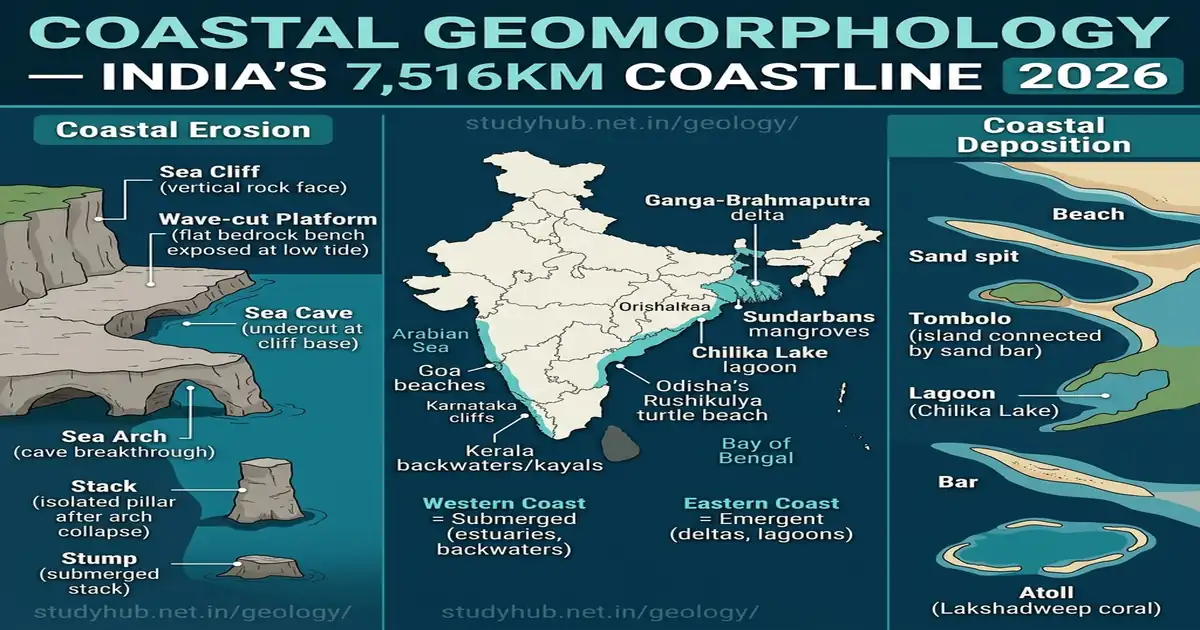
Coastal Geomorphology — India’s 7,516km Coastline, Wave Erosion & Deposition Landforms 2026
1. Wave Action — Coastal Erosion Processes & Landforms
| Process / Landform | Formation Mechanism | Features & Geometry | India / World Example |
|---|---|---|---|
| Wave Erosion Processes | (1) Hydraulic Action: Waves crash against cliff faces, compressing air in cracks → explosive decompression on wave retreat hydraulically widens cracks and dislodges rock fragments. (2) Abrasion (Corrasion): Wave-carried pebbles, sand, and boulders grind against bedrock, wearing it down (like sandpaper). Most effective erosional process. (3) Attrition: Rocks and pebbles in transport collide and grind each other → produce smaller, rounder particles over time. (4) Solution (Corrosion): Seawater chemically dissolves carbonate rocks (limestone, chalk) — enhanced by CO₂ in seawater. Rate depends on rock type, wave energy, exposure | Wave energy concentrated at headlands (wave refraction focuses energy at protruding points). Bays receive less energy → deposition. This produces characteristic headland-and-bay (zeta-bay / pocket bay) coastline geometry progressively straightened by erosion of headlands and infill of bays | Konkan Coast (Maharashtra-Goa): active wave erosion on Basalt/laterite cliffs. Goa sea cliffs. Tamil Nadu coast: sandstone and laterite coastal cliffs (Kanyakumari area). Digha (West Bengal): wave erosion causing shoreline recession. Puri (Odisha) beach erosion. Classic: Twelve Apostles (Australia — sea stacks in limestone). White Cliffs of Dover (chalk, UK) |
| Sea Cliff & Wave-Cut Platform | Cliff: Waves undercut the base of a coastal rock face (hydraulic action + abrasion), creating a notch. The overhang eventually collapses → vertical sea cliff face. The cliff retreats landward over time. Wave-cut platform (shore platform): As cliff retreats, the eroded bedrock surface remains as a wide, gently inclined or nearly flat rocky bench exposed at low tide. Covered by seawater at high tide, exposed at low tide. Width = measure of how far cliff has retreated. Surface often has rock pools | Sea cliff: near-vertical rock face, often 10–100+ m high. Active cliff: bare rock face (wave attack at base). Inactive/degraded cliff: vegetation-covered, wave not currently reaching base. Wave-cut platform: nearly horizontal or very gently seaward-sloping bedrock surface below cliff. Width typically 0.5–3 km | Konkan Coast (Maharashtra-Goa): sea cliffs in Deccan Basalt (vertical, columnar jointing). Goa: laterite-capped basalt cliffs at Vagator, Chapora, Anjuna beaches. Karnataka (Gangavali, Om beach, Gokarna): spectacular rock headlands. Kanyakumari (Tamil Nadu): rocky southernmost tip, wave-cut platforms visible at low tide. Andaman & Nicobar: limestone sea cliffs (Neil Island, Ross Island) |
| Sea Cave | Waves concentrate erosion at points of weakness in a sea cliff (joints, fracture planes, softer rock bands). Hydraulic action + abrasion open these weaknesses into hollows and tunnels. The roof of the cavity is left intact because erosion is concentrated at the base (water level). As the cave deepens, wave sounds are amplified inside = “booming caves.” If a cave is eroded through a headland from both sides, the two caves eventually meet | Hollow arch or tunnel in the base of a cliff or headland. May extend 5–50 m into the cliff. Roof spans the wave-erosion zone. May be partially submerged at high tide. Booming/whistling in storms (air compressed inside) | Andaman Islands: caves in limestone cliffs (Baratang Island = limestone caves formed partly by both marine and karstic action). Goa: small sea caves at Cabo de Rama. Maharashtra coast: Ganpatipule area limestone/laterite small caves. Classic (non-India): Fingal’s Cave, Scotland (basalt columns). Blue Grotto, Malta (marine cave in limestone) |
| Sea Arch & Stack | When a sea cave erodes completely through a headland from both sides, the two caves merge to form a natural arch (the top of the headland still spans over the sea). Sea Arch: dramatic rock span over the sea, still connected to mainland on both ends. When the arch roof eventually collapses from weathering and wave action, the seaward end is left as an isolated column of rock = Stack. Stack: isolated, steep-sided rock pillar standing in the sea near the coast. Further erosion at base → Stack falls → leaves a submerged stump | Sea Arch: roughly elliptical or triangular opening through a headland rock. Stack: isolated vertical column, 5–80 m high. Stump: submerged remnant | Goa: natural arches visible at some headlands during low tide. Andaman Islands: rock arches and stacks in limestone. Karnataka coast (Yana Rocks area, Uttara Kannada): spectacular rock stacks in black limestone/marble. Classic: Old Man of Hoy (Scotland, 137m sandstone stack). Twelve Apostles (Australia). Durdle Door (Dorset, UK — arch in limestone). Natural Arch (Andaman — famous underwater arch) |
2. Coastal Deposition Landforms
| Landform | Formation | Features | India Example |
|---|---|---|---|
| Beach | Accumulation of loose sediment (sand, gravel, pebbles, shells) along the shoreline, deposited by waves and longshore drift. Form between the low-tide mark and the landward limit of wave action. Beach material reflects source: granite/gneiss coasts → coarser sand + pebbles; limestone/shells → white calcareous sand; heavy mineral placers → dark sand. Seasonal variation: narrow, coarse storm beach in monsoon; wide, fine sand beach in calm season (constructive waves build beach; destructive waves erode it) | Gently sloping sand/gravel strip along shore. Backshore (above high tide, dry), Foreshore (between tide marks, seasonally flooded), Nearshore (below low tide). Berms (ridges of coarser material at high-tide limit). Cusps (regular rhythmic scalloping of beach face) | Marina Beach (Chennai, Tamil Nadu): world’s longest urban beach (~13 km — some claims exceed Praia do Cassino, Brazil, for title of world’s longest). Juhu Beach (Mumbai). Goa beaches (Calangute, Baga, Anjuna, Palolem). Puri (Odisha — major pilgrim beach). Digha (West Bengal — erosive, retreating). Radhanagar Beach (Havelock Island, Andaman — voted best beach in Asia). Kerala: Varkala, Kovalam, Alleppey. Heavy mineral beach placers: Kerala coast (ilmenite-garnet-monazite-zircon = titanium, rare earth minerals) |
| Spit & Hook | Longshore drift (movement of sand along the coast due to waves hitting at an angle + swash + backwash) transports sediment into open water at a coastline bend → sand is deposited as an elongated ridge projecting into the sea. The tip curves (hook) as the longshore current weakens and waves refract around the end. Spit may grow progressively until it reaches a headland on the other side — forming a bay bar (enclosing a lagoon) | Narrow ridge of sand/gravel extending into the sea from the shore. One end attached to land, other end free (or curved = hook). Length: hundreds of metres to tens of km. Lagoon or estuary may form behind the spit | Kerala backwater coast: sand spits and bars at river mouths (Vembanad Lake, Ashtamudi Lake). Chilika Lake (Odisha): the lake is enclosed by a sand bar/barrier beach (Rambha to Satapata). Pulicot Lake (AP) = similar barrier-enclosed lagoon. Lakshadweep: narrow sand spits on atoll islands. Classic: Spit of Hel (Poland), Spurn Head (UK) |
| Lagoon & Bar | Lagoon: body of shallow, calm water enclosed or partially enclosed by a sand bar, spit, barrier island, or coral reef, separated from the open sea. Form where longshore drift and wave deposition build a bar across a bay or river mouth. Water in lagoon = brackish (mix of fresh river water + salt sea water). Barrier beach: long offshore/nearshore sand/gravel ridge parallel to coast. Bay bar: barrier completely sealing a bay. Tombolo: sand bar connecting an offshore island to the mainland | Lagoon: calm, shallow, variable salinity (brackish). Barrier bar: parallels coastline, exposed above water. Multiple inlets (tidal channels) may connect lagoon to sea | Chilika Lake (Odisha): India’s largest coastal lagoon and Asia’s largest brackish lake (~1,100 km² in monsoon). UNESCO Ramsar site. Separated from Bay of Bengal by sand bar. Flamingoes, Irrawaddy dolphins, migratory birds. Rambha Bay. Vembanad Lake (Kerala): India’s longest lake (~96 km), enclosed by barrier bar, brackish, backwaters. Ashtamudi Lake (Kerala). Pulicat Lake (AP/TN border): India’s 2nd largest coastal lagoon. Lonar Lake (Maharashtra) = meteorite impact lake (NOT coastal). Tombolos: Pamban Island (Rameswaram, Tamil Nadu) = connected to mainland by Adam’s Bridge causeway (actually a natural chain of shoals/sandbanks) and a bridge at Pamban. St. Mary’s Islands (Karnataka) = tombolo-like |
| Delta | Coastal depositional landform at river mouth where river velocity drops → all sediment deposited → builds outward into sea. Forms when sediment supply > wave energy + tidal energy (otherwise estuary forms). Delta types: Arcuate (fan/arc shaped = Nile, Ganga-Brahmaputra), Bird’s foot (Mississippi), Cuspate (sharp pointed = Tiber, Italy), Estuarine (drowned delta). Delta is constantly built forward (prograding) by river deposition, but subsides gradually from compaction of sediment below | Low-lying, flat, fertile, criss-crossed by distributaries. Active prograding (seaward-building) front. Subject to flooding in monsoon. Extremely fertile soils (fresh sediment). High freshwater-saltwater mixing zones (mangroves) | Ganga-Brahmaputra Delta (~80,000 km² — world’s largest delta, shared India-Bangladesh). Godavari Delta (AP). Krishna Delta (AP). Mahanadi Delta (Odisha). Cauvery (Kaveri) Delta (Tamil Nadu — “rice bowl of Tamil Nadu”). All these are arcuate deltas. Note: Narmada and Tapti = ESTUARIES (not deltas). Sundarban mangroves in Ganga-Brahmaputra delta = world’s largest mangrove forest (~10,000 km² India+Bangladesh) |
| Kerala Backwaters (Kayals) | Kerala backwaters (kayals) = network of interconnected brackish lagoons, lakes, rivers, and canals running parallel to and behind the Kerala coast (Arabian Sea). Total network: ~900 km of waterways (some estimates ~1,500 km). Formed by: (1) Submerged coastline (Malabar Coast = drowned river mouths/estuaries); (2) Long-shore deposition of sand bars sealing off river mouths → lakes form behind; (3) Dense drainage from Western Ghats rivers all reaching sea within short distance → interconnected network. Brackish water → mangroves → rich biodiversity. Unique ecosystem | Narrow, parallel, placid lagoons/channels behind nearshore sand bars. Mangrove lined. Coconut palms on banks. Houseboat tourism centre. Connected by canals (Kottayam, Alappuzha district) | Vembanad Lake (Kerala, ~96 km = India’s longest lake, including Kuttanad area = lowest agricultural land in India, 2.2 m below sea level = “rice bowl of Kerala”). Ashtamudi Lake (Kollam — wetland of international importance, Ramsar). Sasthamkotta (Kerala’s largest freshwater lake). Alleppey/Alappuzha = famous houseboat destination. National Waterway 3 (Kottapuram to Kollam, 205 km — inland waterway through backwaters). Ramsar sites: Vembanad-Kol and Ashtamudi Lake |
| Coral Reefs & Atolls | Coral reefs: Massive calcareous structures built by colonial organisms (Scleractinia coral polyps) secreting calcium carbonate (CaCO₃) skeleton. Require: warm water (18–28°C), clear/clean water (no sediment), shallow water (photic zone for photosynthetic zooxanthellae algae in coral tissue), salt water. Types: Fringing reef (attached to shore, no lagoon), Barrier reef (parallel to shore, separated by lagoon), Atoll (ring/horseshoe reef enclosing a lagoon, no central island — forms as volcanic island subsides: fringing→barrier→atoll per Darwin’s subsidence theory). Bleaching: when water too warm, symbiotic zooxanthellae expelled → coral whitens → if prolonged, coral dies | Fringing reef: coral close to shore. Barrier reef: reef separated from mainland by lagoon (10s–100s km wide). Atoll: ring/horseshoe coral reef, central lagoon, no central island. Coral rock = calcarenite (lithified coral) | Lakshadweep Islands (Arabian Sea): classic coral atolls — 36 islands, all coral atolls/reef islands. Highest elevation ~4 m. Coconut palm covered. EEZ rich fishing grounds. Agatti, Kavaratti (capital), Bangaram (resort island). Andaman & Nicobar: fringing reefs along coasts (Mahatma Gandhi Marine National Park, Wandoor, South Andaman — coral reef ecosystem). Gulf of Mannar (Tamil Nadu-Sri Lanka): fringing reefs + seagrass beds (Dugong habitat, Gulf of Mannar Marine National Park). Gulf of Kutch (Gujarat): corals + mangroves. Great Barrier Reef (Australia) = world’s largest barrier reef (~2,300 km) |
Frequently Asked Questions
What is the difference between India’s east coast and west coast — and why are they so geologically different?
The difference between India’s east and west coasts is one of the most important and frequently examined topics in Indian physical geography. The two coasts are structurally and geomorphologically completely different, reflecting different geological histories that go back to when India separated from Gondwana. West Coast (Konkan-Malabar Coast, Arabian Sea): India’s west coast is a submerged (drowned) coastline. When India separated from Madagascar (~88 Ma) and the Deccan Traps erupted, the Western Ghats formed as a rift escarpment — essentially a fault scarp where the western block subsided into the Arabian Sea. The western coastal strip was down-faulted, and river valleys cutting from the Western Ghats to the Arabian Sea were partially “drowned” as the land subsided (or sea level rose). This produces: (1) Narrow coastal plain (10–80 km wide). (2) Submerged river mouths = estuaries (NOT deltas for west-coast rivers — Narmada, Tapti, Periyar, Bharathapuzha all form estuaries, not deltas). (3) Kerala backwaters (kayals) = drowned coastal plain with barrier bar. (4) Rocky, elevated shoreline with cliffs and headlands (Goa, Karnataka, Maharashtra = Konkan coast). (5) Average water depth offshore is greater (steeper continental shelf). (6) Shorter rivers (Western Ghats watershed is close to west coast — rivers have short, steep courses to Arabian Sea). (7) Arabian Sea coast receives the FIRST monsoon rains — Western Ghats orographically lift the SW monsoon, producing 3,000–5,000 mm/year on the windward slopes. This makes the west coast extremely humid, lush, and forest-covered. East Coast (Coromandel-Utkal-Kalinga Coast, Bay of Bengal): India’s east coast is an emergent coastline. As peninsular India tilted eastward over geological time (the Western Ghats/Deccan Plateau is higher in the west, draining predominantly east), the major Peninsular rivers (Godavari, Krishna, Cauvery, Mahanadi, Brahmani) all flow east to the Bay of Bengal, carrying enormous sediment loads from the Deccan Plateau. This has built up a wide coastal plain and produced delta-dominated coastline. (1) Wide coastal plain (100–300 km wide). (2) Large, actively growing deltas (Ganga-Brahmaputra, Godavari, Krishna, Cauvery, Mahanadi). (3) Barrier beaches, lagoons and backwaters (Chilika Lake, Pulicat Lake, Kolleru Lake). (4) Low, flat, sandy shoreline — extensive beaches (Marina Beach, Puri, Digha). (5) Mangrove forests in deltas (Sundarbans = world’s largest mangrove). (6) Moderate continental shelf width. (7) Bay of Bengal receives NE monsoon (October-December) in Tamil Nadu coast area — the east coast gets winter monsoon rain while west coast is dry in winter. (8) More vulnerable to Bay of Bengal cyclones (Bay of Bengal generates more intense, more frequent cyclones than Arabian Sea — funnel shape, shallow water, warm SST amplify cyclones hitting Odisha, Andhra Pradesh, Tamil Nadu). Key facts for exams: West coast = narrow, submerged, rocky, estuaries, backwaters. East coast = wide, emergent, sandy, deltas, lagoons. Longest river = Ganga (drains to east coast delta). Largest delta = Ganga-Brahmaputra (east coast). Marina Beach (east coast, Chennai) = world’s longest urban beach. Chilika Lake (east coast, Odisha) = India’s largest lagoon. Lakshadweep = (Arabian Sea, west) = coral atolls. Andaman-Nicobar = (Bay of Bengal, east) = fringing reefs.
Important for Exams — Coastal Geomorphology UPSC, SSC & State PCS
India’s coastline: 7,516 km mainland + 1,197 km Andaman-Nicobar + 132 km Lakshadweep. States with coastline: Gujarat (longest, ~1,600 km), Andhra Pradesh (~974 km), Tamil Nadu (~906 km), Maharashtra (~720 km), Odisha (~476 km), Karnataka (~320 km), Kerala (~580 km), West Bengal (~157 km), Goa (~101 km). West coast vs East coast: West (Arabian Sea) = submerged/drowned, narrow plain, rocky cliffs, estuaries, kayals/backwaters, Lakshadweep atolls, first monsoon. East (Bay of Bengal) = emergent, wide plain, sandy beaches, deltas, lagoons, Andaman-Nicobar fringing reefs, NE monsoon, more cyclones. Wave erosion landforms: Sea cliff (Konkan coast, basalt), Wave-cut platform, Sea cave (Andaman limestone), Sea arch, Stack (Karnataka — Yana rocks), Stump. Processes: Hydraulic action, Abrasion, Attrition, Solution. Wave deposition landforms: Beach (Marina Beach Chennai = world’s longest urban beach ~13km), Spit, Bar, Lagoon (Chilika Lake Odisha = largest coastal lagoon India, ~1,100km², Ramsar), Bay bar, Tombolo, Delta (Ganga-Brahmaputra = world’s largest, ~80,000 km²). Kerala Backwaters: Vembanad Lake (longest lake India, ~96km), Ashtamudi Lake, Kayals = drowned west coast + sand bars. Kuttanad = India’s lowest agricultural land (2.2m below sea level). Coral: Lakshadweep (coral atolls, Arabian Sea). Andaman-Nicobar (fringing reefs). Gulf of Mannar (dugong habitat). Coral bleaching threat from warming ocean. Coastal hazards: Bay of Bengal cyclones (Odisha, AP, TN most vulnerable — Phailin 2013, Fani 2019, Yaas 2021, Biparjoy 2023). Tsunami 2004 (Indian Ocean — 10,000+ deaths in India, Tamil Nadu/Andaman worst affected). Sea-level rise: India’s coastline extremely vulnerable — several islands in Lakshadweep and Andaman-Nicobar at risk of submergence. Coastal erosion acute at Digha, Chandipur, Puri, coastal AP. Mangroves = natural coastal shield (Sundarbans protect from storms; deforestation increases vulnerability).
What to Read Next
- Rivers & Fluvial Geomorphology — River Deltas on India’s Coast 2026
- Deserts & Aeolian Geomorphology — coastal vs desert contrasts 2026
- Earthquakes — 2004 Indian Ocean Tsunami & Coastal Geohazards 2026
- Plate Tectonics — How India’s Tectonic History Shaped Its Coastline 2026
- Weathering — Chemical Weathering of Coastal Rocks & Karst Coasts 2026
🎔 Exam Quick Reference — Coastal Geomorphology: India coastline = 7,516km mainland (Gujarat=longest state coast ~1,600km). Wave erosion processes: Hydraulic action, Abrasion (most important), Attrition, Solution. Erosion landforms: Sea cliff (vertical, Konkan basalt), Wave-cut platform (bedrock bench at low tide), Sea cave (weakness in cliff), Sea arch (cave through headland), Stack (arch collapse = isolated pillar, Karnataka Yana rocks), Stump (collapsed stack). Deposition landforms: Beach (Marina Beach Chennai = world’s longest urban ~13km), Spit (sand ridge into sea), Bay bar (seals bay), Lagoon (Chilika Lake Odisha = India’s largest lagoon ~1,100km² = Ramsar + Asia’s largest brackish), Tombolo (island linked to mainland), Delta (Ganga-Brahmaputra = world’s largest ~80,000km²). West coast (Arabian Sea): Submerged/drowned, narrow, rocky, estuaries NOT deltas, Kerala backwaters/kayals (Vembanad Lake = India’s longest lake ~96km, Kuttanad = 2.2m below sea level), Lakshadweep = coral atolls. East coast (Bay of Bengal): Emergent, wide, sandy, deltas, lagoons, Chilika (Odisha), Pulicat (AP-TN), Sundarbans mangroves, Andaman-Nicobar = fringing coral reefs, more cyclones (Bay of Bengal = more frequent/intense cyclones). Coral reefs: Fringing (attached to shore), Barrier (lagoon between reef and shore), Atoll (ring reef = Lakshadweep, Darwin’s subsidence theory). Kerala kayals = drowned coastline + barrier bars. Sundarbans = world’s largest mangrove (~10,000 km² India+Bangladesh). Coastal hazards: 2004 tsunami, Bay of Bengal cyclones, coastal erosion, sea-level rise.
🌍 India’s Key Coastal Lakes & Lagoons — Quick Facts: Chilika Lake (Odisha): India’s LARGEST coastal lagoon, Asia’s largest brackish lake, ~1,100 km² (monsoon peak). Ramsar wetland. Chilika Development Authority (CDA). Irrawaddy dolphins (endangered, Chilika = one of few habitats). Flamingoes, migratory birds (200,000+ in winter). Separated from Bay of Bengal by Peninsular Spit (sand bar). Chilika Battle: conservation vs prawn aquaculture dispute (SC ruling 2002 to remove prawn farms). Vembanad Lake (Kerala): India’s longest lake (~96 km including Kuttanad). Ramsar (Vembanad-Kol Wetland). Nehru Trophy Boat Race (Punnamada Lake = part of Vembanad system, Alappuzha). Kuttanad: below-sea-level paddy cultivation (2.2 m, unique system — “rice bowl of Kerala”). Pulicat Lake (AP-TN): India’s 2nd largest brackish coastal lagoon (~759 km²). Flamingo City. Flamingoes nest here. Sriharikota Island (ISRO launch station = separated from mainland by Pulicat Lake). Kolleru Lake (AP): large freshwater lake between Krishna-Godavari delta (Ramsar). Lonar Lake (Maharashtra): meteorite impact crater lake — NOT coastal. Sambhar Lake (Rajasthan): India’s largest inland saline lake (NOT coastal). All 4 major coastal lagoons (Chilika, Vembanad, Pulicat, Kolleru) are Ramsar sites — important for examinations.
About This Guide: Written by the StudyHub Geology Editorial Team (studyhub.net.in/geology/) based on NCERT Class 11 Physical Geography Chapter 7 (Geomorphic Processes — Coastal), NCERT Class 11 Geography India Chapter 2 (Coastline, Islands), National Institute of Ocean Technology (NIOT), ICZM (Integrated Coastal Zone Management) Project India reports, and Summerfield (1991) “Global Geomorphology.” Last updated: March 2026.