
Earth’s outermost solid shell — the crust — is not a single uniform layer. It exists in two fundamentally different forms: continental crust (the land beneath your feet if you live in India, Europe, or any landmass) and oceanic crust (the rock beneath the world’s ocean floors). These two types differ in composition, thickness, density, age, and geological behaviour — and their differences drive the entire engine of plate tectonics, determining where mountains rise, where ocean trenches plunge, and why volcanic island arcs form. The boundary between crust (of either type) and the underlying mantle is the Mohorovičić Discontinuity (Moho), where seismic P wave velocity jumps abruptly from ~6–7 km/s to ~8 km/s. For UPSC, SSC, NDA, and state PCS geography exams, the SIAL vs SIMA distinction, the precise thickness values, and the India-specific examples (Dharwar Craton, Deccan Plateau, Indian Ocean floor) are directly examined.
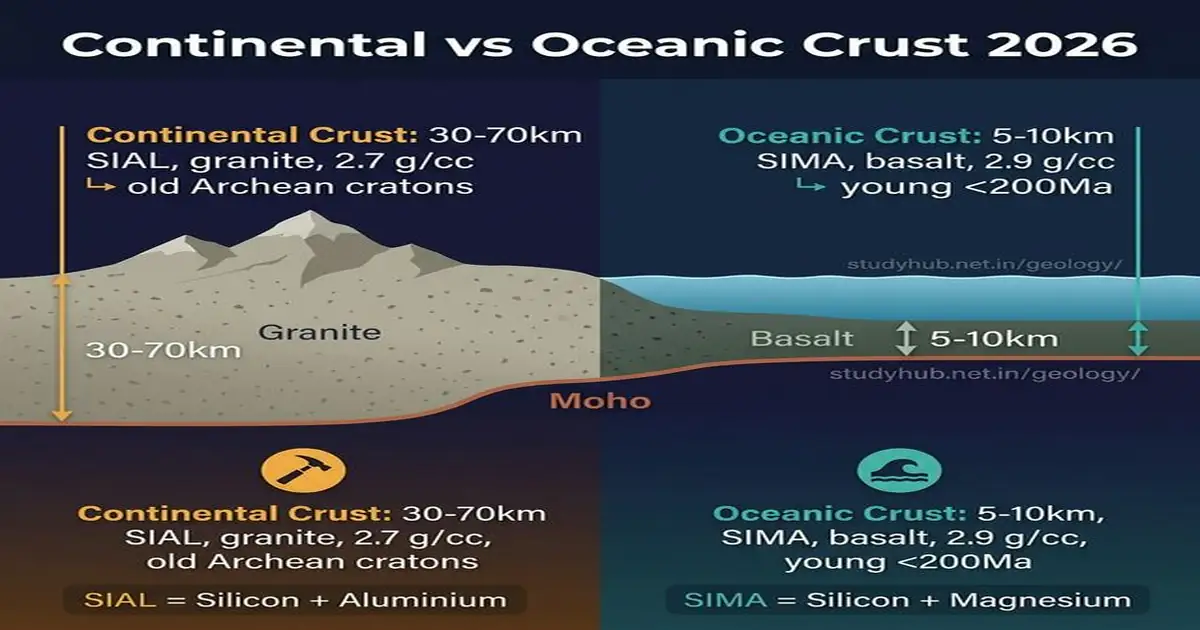
Continental vs Oceanic Crust — Complete Comparison 2026
| Property | Continental Crust | Oceanic Crust |
|---|---|---|
| Composition / Rock Type | Predominantly granite and granodiorite (felsic igneous rocks); high SiO₂ (65–75%) + Al₂O₃ = “SIAL” (Silicon + Aluminium). Also includes metamorphic rocks (gneiss, schist — dominant in ancient shields), sedimentary cover (on top), and intermediate volcanics. Upper crust: granite; lower crust: granulite (high-grade metamorphic equivalent of basalt) | Predominantly basalt (mafic igneous rock); lower SiO₂ (45–52%) + high MgO + FeO = “SIMA” (Silicon + Magnesium). Three-layer structure: (1) oceanic sediments (0–1 km, pelagic clay, calcareous ooze, siliceous ooze); (2) basaltic pillow lavas + sheeted dyke complex (1–2 km); (3) gabbro (coarse-grained equivalent of basalt, 3–5 km). Underlain by Moho then peridotite mantle |
| Thickness | Average: 30–35 km under stable platforms; 50–70 km under mountain belts (Himalayas: ~70 km; Alps: ~50 km; Tibetan Plateau: 65–70 km); as thin as 20–25 km under rifted margins and extended terrains (e.g., Basin and Range, USA) | Average: 5–10 km. Thinnest (~3–5 km) at mid-ocean ridge crests (newly formed, hot, pillowed basalt). Thickest (~10–15 km) at oceanic plateaus (e.g., Ontong Java Plateau — world’s largest, 32 km thick = formed by mantle plume eruption) |
| Density | 2.6–2.8 g/cm³ (average 2.7 g/cm³). Lower density than oceanic crust = relatively buoyant on mantle. Continental crust “floats” higher on the denser mantle (principle of isostasy). Density increases with depth (lower crust granulite: ~3.0 g/cm³) | 2.9–3.0 g/cm³. Denser than continental crust — therefore sits lower (ocean basins average 3,800 m below sea level vs 840 m above for continental crust). Denser oceanic crust subducts under lighter continental crust at convergent boundaries. Young, hot oceanic crust is less dense; old, cold oceanic crust is denser and subducts more readily |
| Age | Very old — ancient shield rocks (cratons) date to the Archean eon: oldest continental crust: 4.031 Ga (Acasta Gneiss, Canada); oldest mineral: Jack Hills zircon, Australia, 4.404 Ga. Continental crust is preserved and accumulates over geological time because it is too buoyant to subduct. India: Dharwar Craton (Karnataka) = 3.0–3.4 Ga; Aravalli orogen (Rajasthan) = 2.5–3.0 Ga; Deccan Plateau/Gondwana basement = 0.5–1.0 Ga metamorphic basement | Very young — maximum age: ~200 million years (Jurassic). Oldest oceanic crust: western Pacific (off Japan), ~180–200 Ma. No oceanic crust older than 200 Ma survives because it is continuously consumed by subduction at convergent boundaries. Average ocean floor age: ~65 Ma. The young age of all detected oceanic crust was crucial evidence for sea floor spreading (Harry Hess, 1960) |
| Topography | Average elevation: +840 m above sea level. Range: from below-sea-level basins (Death Valley, −86 m; Dead Sea, −430 m) to mountain peaks (Everest: +8,849 m). Low horizontal velocity = stable continents (cratons, shields) persist for billions of years | Average depth: −3,800 m below sea level. Range: mid-ocean ridge crests (~−2,000 m) to abyssal plains (~−5,000 m) to ocean trenches (Mariana Trench: −11,034 m — deepest point on Earth). Topography controlled by age (older = colder = denser = deeper — the depth-age relationship) |
| Seismic Velocity | P wave: 5.8–6.8 km/s (upper crust granite). Increases with depth to ~6.8–7.5 km/s in lower crust (granulite). S wave: ~3.4–4.0 km/s | P wave: 4.5–5.5 km/s (upper basaltic layer); 6.5–7.0 km/s (lower gabbroic layer). S wave: ~2.8–4.0 km/s. Distinct velocity profile allows seismologists to distinguish crustal type |
| Heat Flow | Average: ~65 mW/m² (milliwatts per square metre). High heat flow in active orogens (Himalayas, Andes). Low in stable cratons (Dharwar, Canadian Shield: ~35–45 mW/m²). Continental crust produces significant radiogenic heat from U, Th, K decay | Average: ~100 mW/m² (higher than continental). Very high at mid-ocean ridges (hydrothermal vents: up to 300+ mW/m²). Decreases with age as crust cools. Low at subduction zones where cold oceanic slab descends |
SIAL and SIMA — The Two Crustal Chemistries
The terms SIAL and SIMA are classic geology mnemonics still used in NCERT and UPSC syllabi. SIAL (Silicon + Aluminium) refers to the continental crust, which is dominated by silicate minerals rich in silica (SiO₂) and alumina (Al₂O₃). The typical SIAL rock is granite — a coarse-grained igneous rock with large crystals of quartz, feldspar, and mica, formed when magma cools slowly deep underground. Granite is the dominant rock of the Deccan Plateau’s crystalline basement, the Aravallis, the Eastern Ghats, and the Himalayan main central thrust zone. SIMA (Silicon + Magnesium) refers to the oceanic crust, dominated by silicate minerals rich in magnesium (Mg) and iron (Fe) — the mafic minerals. The typical SIMA rock is basalt — a fine-grained volcanic rock (cooled rapidly from lava), dark grey-black in colour, with small or invisible crystals. Basalt forms when mantle peridotite partially melts at mid-ocean ridges, erupting as pillow lavas onto the sea floor. Importantly, the mantle below both types of crust is also SIMA-rich — but even denser (peridotite, NIFE zone: Nickel + Iron-dominant). The density hierarchy — SIAL (2.7) < SIMA crust (2.9) < SIMA mantle (3.3) — underpins isostasy and plate tectonics.
Isostasy — Why Continents Float and Mountains Have Roots
Isostasy is the principle that Earth’s crust is in gravitational equilibrium — it “floats” on the denser mantle below, like icebergs floating on water. Because continental crust (density 2.7 g/cm³) is lighter than the mantle (density 3.3 g/cm³), it stands higher — just as a less dense iceberg protrudes above water while a denser one sinks lower. Two models explain isostasy: the Pratt model (different crustal blocks have different densities, achieving equilibrium at a common depth of compensation) and the Airy model (crust has uniform density but varies in thickness — mountains have deep roots extending into the mantle, like an iceberg’s deeper keel). The Airy model is more widely applied: the Himalayas, with their surface elevation of 3,000–8,849 m, have a corresponding deep crustal root (Moho at 70 km) extending far into the mantle to provide isostatic support. The Deccan Plateau (average elevation ~600 m, stable craton) has a shallower Moho (~35–40 km). Isostatic rebound occurs when mass is removed from the crust (e.g., melting of ice sheets after the last Ice Age): Scandinavia is still rising at ~1 cm/year as it rebounds from the removal of the Fennoscandian Ice Sheet (once 3 km thick) ~10,000 years ago. Conversely, when mass is added (e.g., large sediment deposited in a delta), crust slowly sinks — the Indo-Gangetic Plain has subsided due to Himalayan sediment loading from rivers.
India’s Crust — A Geological Masterclass
| Region | Crust Type | Age / Composition | Exam Relevance |
|---|---|---|---|
| Peninsular India (Deccan Plateau) | Ancient continental crust (shield/craton) | Precambrian basement: 600 Ma–3.4 Ga crystalline rocks (gneiss, schist, granite). Overlain by Deccan Trap basalts (65.5 Ma flood basalts — erupted over Precambrian continental crust) | India’s most stable geological region; very low seismicity (Zone II). Gondwana origin — once part of southern supercontinent Gondwana (India + Africa + Australia + Antarctica + S. America). Rich in minerals: iron ore (Jharkhand, Odisha), manganese, chromite, mica |
| Dharwar Craton (Karnataka) | Archean continental crust | 3.0–3.4 billion years old — oldest in India; greenstone belts + granite gneiss. India’s geological “basement” | Gold mines (Kolar Gold Field — deepest mine in India until closure). Iron ore, manganese. Type locality for Dharwarian geological sequence in NCERT |
| Indo-Gangetic Plain | Continental crust with thick sedimentary cover | Himalayan foreland basin: Precambrian basement buried under 10–15 km of Tertiary + Quaternary alluvial sediment (Siwalik molasse + Quaternary alluvium) | Thickest sedimentary sequence in India. Groundwater aquifer — Jal Jeevan Mission relies on this. Oil and gas (Assam, Cambay basin). Not crystalline shield — sedimentary foreland basin |
| Himalayas | Thickest continental crust on Earth (~70 km) | Collision of Indian + Eurasian plates (50 Ma–present). Main Central Thrust (MCT), Main Boundary Thrust (MBT), Siwalik thrust → stacked thrust sheets; Indian crust underthrusting Eurasian plate | Seismic Zone IV–V (very high risk). Landslides (Chamoli 2021, Joshimath subsidence). Glacial lakes (GLOF risk). Earthquakes: Nepal 2015 (7.8 Mw), Uttarkashi 1991. Moho: 70 km deep |
| Indian Ocean Floor | Oceanic crust (SIMA, basalt) | Young (0–130 Ma). Created at Carlsberg Ridge (NW Indian Ocean) and Southwest Indian Ridge. Indian Plate moving NE at 5 cm/yr. Arabian Sea floor: 0–80 Ma. Bay of Bengal: sediment-covered, 0–130 Ma | Carlsberg Ridge = spreads at 2.5 cm/yr. Magnetic anomaly stripes = evidence for sea floor spreading history. Subducting under Eurasia (Burma Plate subduction = Andaman volcanoes). 2004 Indian Ocean tsunami (subsea megathrust earthquake, 9.1 Mw, off Sumatra) |
| Andaman & Nicobar Islands | Accretionary prism + island arc (oceanic-continental boundary) | Sunda Arc subduction zone — Indian oceanic plate subducting under Burma Plate. Barren Island = India’s only active volcano (mantle-derived magma above subducting slab = stratovolcano) | Seismic Zone V (highest risk). 2004 tsunami source zone. Barren Island eruptions (last 2017). Narcondam Island = dormant volcano |
Frequently Asked Questions
Why can’t oceanic crust be as old as continental crust?
The oldest surviving oceanic crust is approximately 180–200 million years old — a tiny fraction of Earth’s 4.54 billion year age. In contrast, continental crust survives for billions of years (the oldest confirmed continental crust fragment is the Acasta Gneiss in Canada at 4.031 Ga; the oldest mineral grain is a zircon from Jack Hills, Australia at 4.404 Ga). The reason for this dramatic age difference is density and buoyancy: oceanic crust (density 2.9–3.0 g/cm³) is denser than continental crust (2.7 g/cm³) but less dense than the mantle (3.3 g/cm³) when young and warm. As oceanic crust ages, it cools, contracts, and becomes denser — eventually approaching mantle density. At convergent plate boundaries, where oceanic and continental plates meet, the denser oceanic crust is pulled down (subducted) beneath the lighter continental crust into the mantle, where it is melted and recycled. Continental crust, being lighter (density 2.7 g/cm³), is too buoyant to subduct — when two continental plates collide, neither sinks; instead they crumple upward to form mountain ranges (e.g., Himalayas = India + Eurasia collision, both continental). This means oceanic crust is continuously created (at mid-ocean ridges via sea floor spreading) and destroyed (at subduction zones) on a global conveyor belt cycle averaging ~65–100 million years per cycle. Continental crust, being insubductible, accumulates and is preserved. The oldest surviving ocean floor is in the western Pacific — but even this will eventually be subducted. In 200–300 million years, the Pacific Ocean will close entirely as North America and Asia converge (the next Pangaea-style supercontinent). India context: the ancient Tethys Ocean that once separated India from Eurasia had oceanic crust that is now entirely subducted — only tiny slivers (ophiolites, e.g., the Ladakh Ophiolite, Indus-Tsangpo Suture Zone) survive on land as remnants of that former ocean floor.
What is SIAL and SIMA — and are they still used in modern geology?
SIAL (Silicon + Aluminium) and SIMA (Silicon + Magnesium) were terms introduced by Eduard Suess (Austrian geologist, 1831–1914) and popularised by Alfred Wegener to distinguish the two crustal layers he proposed. In Wegener’s original model: the outer layer = SIAL (continental); it “floated” on a denser SIMA layer below (now understood as oceanic crust + upper mantle). In modern geology, the terms SIAL and SIMA are replaced by more precise geochemical terminology — felsic (SiO₂-rich, similar to SIAL; from “feldspar + silica”) and mafic (Mg+Fe-rich, similar to SIMA; from “magnesium + ferric”).
The NCERT Class 11 syllabus and most Indian competitive exam materials still use SIAL and SIMA because they appear in older standard references and are embedded in India’s geological vocabulary. For UPSC/SSC purposes: SIAL = continental crust = granite = felsic; SIMA = oceanic crust + mantle = basalt/peridotite = mafic/ultramafic. The mantle proper is sometimes separately designated NIFE (Nickel + Iron) in older texts, though modern geochemistry prefers “peridotitic” or “ultramafic.” For exam: SIAL (Si+Al) → Continental crust → Lighter (2.7) → Higher elevation → Older (up to 4 Ga) → Granite → Not subducted. SIMA (Si+Mg) → Oceanic crust → Denser (2.9–3.0) → Lower elevation (ocean) → Younger (<200 Ma) → Basalt → Subducted at convergent margins.
Important for Exams — Continental vs Oceanic Crust Facts
Key numbers (memorise): Continental crust thickness: 30–35 km average; 70 km under Himalayas; Oceanic crust: 5–10 km average; 3–5 km at mid-ocean ridges. Continental density: 2.7 g/cm³; oceanic: 2.9–3.0 g/cm³; mantle: 3.3 g/cm³. Continental avg elevation: +840 m; oceanic avg depth: −3,800 m. Oldest continental crust: Acasta Gneiss 4.031 Ga (Canada). Oldest oceanic crust: ~180–200 Ma (W Pacific). Oldest mineral: Jack Hills zircon 4.404 Ga.
SIAL vs SIMA: SIAL = continental = granite = Si+Al = 2.7 g/cc = lighter = preserved; SIMA = oceanic = basalt = Si+Mg = 2.9 g/cc = denser = subducted.
Isostasy: Airy model = mountains have deep crustal roots (Moho 70 km under Himalayas); Pratt model = density variation achieves equilibrium. Isostatic rebound = Scandinavia rising 1 cm/yr (post-Ice Age).
India specifics: Dharwar Craton = 3.0–3.4 Ga = India’s oldest rocks (Karnataka). Deccan Plateau = ancient shield + Deccan Trap basalts (65.5 Ma). Indo-Gangetic Plain = sedimentary foreland basin, 10–15 km deep. Himalayan Moho = 70 km. Ladakh Ophiolite = Tethys Ocean remnant. Barren Island = Sunda Arc subduction = India’s active volcano = Zone V. Gondwana: Peninsular India was part of Gondwana (southern supercontinent, broke up 130–70 Ma). Gondwana coalfields (Damodar, Mahanadi, Son-Mahanadi valleys) = continental origin. Contrast with Tethys Sea (marine) sediments in Himalayas containing marine fossils.
What to Read Next
- What is Geology? — Definition, 13 Branches, GSI & UPSC Importance 2026
- Earth’s Structure — Crust, Mantle, Cores & Three Discontinuities 2026
- Seismic Wave Evidence — How P & S Waves Reveal Earth’s Hidden Interior
- What is Plate Tectonics? — Theory, Evidence & Himalayan Formation 2026
- Mohorovičić Discontinuity (Moho) — Crust-Mantle Boundary Explained 2026
🎔 Exam Quick Reference — Crust Types: SIAL (continental) = granite, 2.7 g/cc, 30-70km thick, old (up to 4 Ga), elevated, preserved — never subducted. SIMA (oceanic) = basalt, 2.9-3.0 g/cc, 5-10km thick, young (<200 Ma), deep below sea, subducted at convergent margins. Dharwar Craton = India’s oldest (3.4 Ga, Karnataka). Himalayan Moho = 70km (Airy isostasy crustal root). Ladakh Ophiolite = fossil Tethys Ocean floor. Barren Island = SIMA oceanic subduction → mantle melt → active volcano.
🌍 Gondwana Connection: Peninsular India = ancient Gondwana fragment. When Gondwana broke apart (~130 Ma), Indian Plate separated from Antarctica/Africa and drifted north. Gondwana coalfields (Damodar Valley, Singrauli, Talcher) = plant fossils (Glossopteris) prove Gondwana connection — same fossils in India, Africa, Australia, Antarctica = key evidence for continental drift. Marine fossils in Himalayan limestone (Tethys Sea sediments now at 5,000+ m elevation) = proof Himalayas were once ocean floor before India-Eurasia collision.
About This Guide: Written by the StudyHub Geology Editorial Team (studyhub.net.in/geology/) based on NCERT Class 11 Physical Geography Chapter 3 & Chapter 4 (Distribution of Oceans and Continents), Tarbuck & Lutgens “Essentials of Geology” (13th Ed.), GSI Special Publication reports on Precambrian of India, and Mooney, Laske & Masters (1998) CRUST 5.1 global crustal thickness model. Last updated: March 2026.