
Last Updated: March 2026 | Reading Time: 11 minutes | ~2,500 words | Category: Geomorphology & Aeolian Systems
Aeolian geomorphology (from Aeolus, Greek god of wind) is the study of landforms shaped by wind action — the dominant geomorphic agent in arid and semi-arid environments where sparse vegetation allows wind to move sediment freely. A desert is any region receiving less than 250 mm of mean annual precipitation — though the concept of “desert” encompasses hot (tropical/subtropical) deserts like the Thar and Sahara, cold deserts like Ladakh and Gobi, and coastal deserts like the Atacama. Contrary to popular imagery, only about 20–25% of the world’s desert surface is actually covered by sand dunes (erg desert) — the majority is rocky desert (hammada/reg = desert pavement of pebbles and gravel) and gravel plains (reg). Wind shapes desert landscapes through two processes: erosion (deflation = removal of loose particles; abrasion = sandblasting of bedrock by windborne grains) and deposition (sand dunes of various forms depending on wind regime and sand supply). India’s major desert, the Thar Desert of Rajasthan, covers approximately 200,000–320,000 km² (estimates vary by boundary definition) and is one of the most densely populated desert regions on Earth — paradoxically, because it receives just enough rainfall (100–300 mm) and supports agriculture through the Indira Gandhi Nahar Project (IGNP) and traditional step-well (baoli/bawdi) water harvesting. Understanding desert formation, aeolian landforms, India’s Thar Desert geography, and the processes driving desertification (the spread of desert-like conditions into semi-arid areas) is essential for UPSC Geography, SSC CGL, NDA, and State PCS examinations.
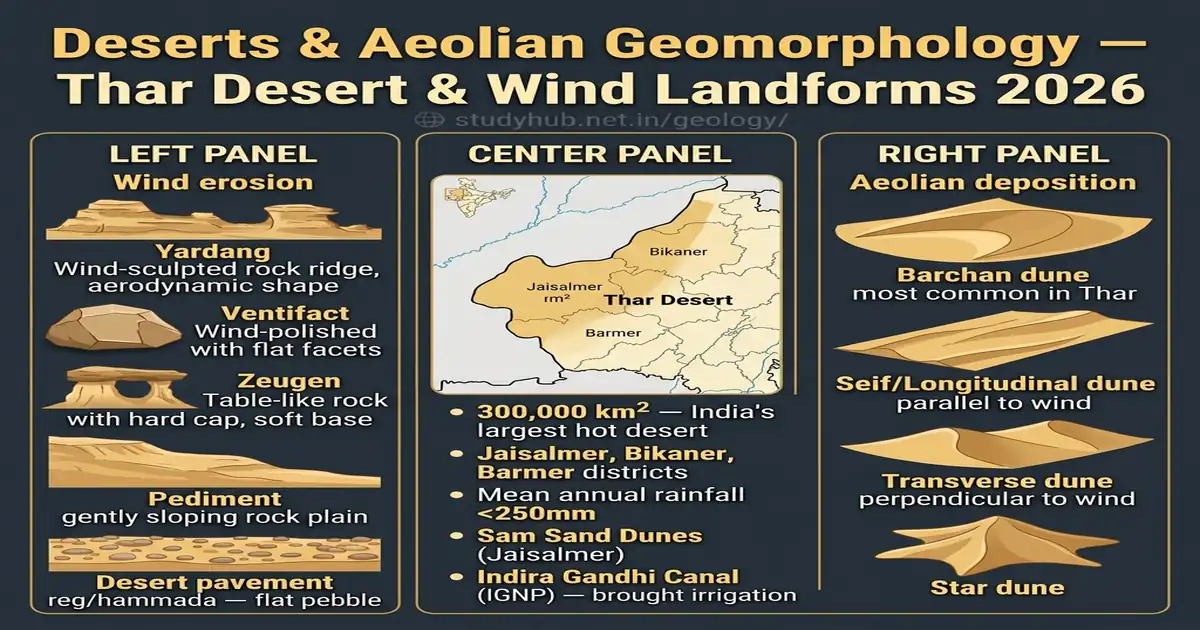
Deserts & Aeolian Geomorphology — Thar Desert, Wind Erosion & Dune Types 2026
1. Wind Erosion Processes & Landforms
| Process / Landform | Mechanism & Formation | Shape & Features | India / World Example |
|---|---|---|---|
| Deflation | Wind picks up and removes loose, fine particles (clay, silt, fine sand) from the surface — effectively “vacuuming” the surface. The remaining coarser particles (pebbles, gravels) cannot be lifted by wind and are left behind. Over time, this selective removal of fine material lowers the surface (deflation hollow/basin) and concentrates coarse lag gravel at the surface = desert pavement (reg/hammada = flat, paved surface of closely-packed pebbles that self-armours the surface against further deflation). Deflation can lower a surface by tens of metres over geological time | Deflation hollows/basins (shallow depressions where fine material removed). Desert pavement / Reg / Hammada (flat, densely packed gravel/pebble surface = “self-armoured”). Desert varnish (dark Mn-Fe oxide coating on pebble surfaces = diagnostic of old desert pavement) | Thar Desert (Rajasthan): extensive reg/desert pavement in western Rajasthan (Barmer, Jaisalmer districts). Painted Desert (Arizona USA). Qattara Depression (Egypt, 133 m below sea level — world’s largest deflation hollow, ~19,500 km²). Kharga Depression (Egypt). Sambhar Lake (Rajasthan — partly occupies a deflation basin filled with salt) |
| Abrasion (Corrasion) | Wind-carried sand grains act as a natural sandblaster — grinding, polishing, and cutting exposed rock surfaces. Most effective at and slightly above ground level (sand grains rarely rise above 2 m even in strong winds — saltation height limit). Creates smooth, polished, or pitted rock surfaces. Exploits existing cracks, joint planes, and zones of weakness in bedrock, producing distinctive shapes. Rate depends on: wind speed (increases as cube of velocity), grain hardness, grain size, rock hardness, time | Polished/pitted rock surfaces (ventifacts). Undercut bases of rock outcrops (sandblasting concentrated near ground → weaker base → top overhang). Faceted pebbles (wind-polished pebbles with flat grinding faces = dreikanter = “three edges” in German) | Thar Desert: ventifacts (polished pebbles) common in exposed rocky areas. Lonar (Maharashtra) — not desert but wind abrasion polishes basalt boulders. Gobi Desert (China): dreikanter pebbles extensively documented |
| Yardang | Streamlined, whaleback-shaped rock ridges sculpted by wind abrasion. Forms when alternating hard and soft rock bands, or joint-controlled weakness, allow wind to erode soft material as parallel corridors (wind streets), leaving hard rock as elongated ridges. Tapered at the downwind end (aerodynamic shape — Yardangs orient PARALLEL to prevailing wind direction). From Uyghur word “yar” = steep bank. Can range from 1 m to several km in length | Aerodynamic whaleback or boat-shaped ridge, steep face upwind, tapered tail downwind. Oriented parallel to wind. Smooth wind-polished surface. Multiple yardangs in parallel arrays = Yardang field | Ladakh (India): yardangs in the Indus Valley near Leh in places where loess and soft sediments are exposed. Classic: Egypt (near Abu Simbel), Iran (Lut Desert — world’s largest yardang field), Peru (Pampa de la Joya). Not common in Thar (Thar mainly sandy/alluvial) |
| Zeugen (Tabletop rocks) | Horizontal alternation of hard (resistant) rock layer on top and soft (easily eroded) rock layer below. Wind abrasion is concentrated near ground level, eroding the soft layer faster than the hard cap → tabletop or mushroom-shaped rock outcrops. As soft layer is eroded, the hard cap eventually collapses. Related to Pedestal rocks (isolated rock columns with narrowed base) | Flat-topped table rock with wider hard cap overlying narrower soft base (mushroom/pedestal shape). Usually small (metres to tens of metres scale). Seen in horizontal sedimentary rock sequences in desert | Thar Desert: seen in exposed Terziary sandstone/mudstone sequences in western Rajasthan. Middle East: pronounced in Wadi Rum (Jordan) |
| Pediment & Bajada | Pediment: gently sloping, almost flat bedrock erosion surface at the base of a mountain in arid regions. Formed by parallel retreat of mountain scarp (desert hillock retreats while base flattens). Usually veneered with thin layer of coarse gravel and sand. Distinct from alluvial fan (pediment = bedrock; alluvial fan = alluvial sediment). Bajada (Spanish = “descent”): when multiple alluvial fans from adjacent mountain fronts merge laterally into a continuous gently-sloping alluvial apron, it forms a bajada (= coalescent alluvial fans). Playa: flat, dry lake bed in centre of desert basin — temporary lake after rain, quickly evaporates leaving salt-encrusted flat | Pediment: gently inclined (1-7°) smooth bedrock surface, slight “concave up” profile. Bajada: apron of merged alluvial fans at mountain base, sloping gently toward valley center. Playa: flat, white, salt-encrusted basin floor | Thar Desert: bajada and pediment surfaces at foot of Aravallis (Rajasthan). Sambhar Lake (Rajasthan) = large playa (seasonal saline lake — source of India’s salt from lake deposits). Lonar Lake (Maharashtra) = meteorite crater playa (saline lake). Classic: Basin-and-Range (USA), Atacama Desert (Chile), Sahara |
| Inselberg & Mesa / Butte | Inselberg (German: “island mountain”): isolated rocky hill rising abruptly from a flat, semi-arid pediment plain. Formed by differential weathering — surrounding softer rocks weathered and eroded away, leaving isolated resistant rock masses (usually granite or quartzite). Two forms: (a) Bornhardt = smooth, dome-shaped granite inselberg (exfoliation/sheeting). (b) Kopje / Kopie = smaller, angular rocky outcrops. Mesa: flat-topped eroded plateau capped by hard rock (horizontal beds). Butte: isolated narrow mesa (when further eroded, width < height) | Inselberg: Isolated steep-sided rocky mountain on flat plain. Dome-shaped (bornhardt) or angular (kopje). Mesa: flat-topped, steep-sided plateau. Butte: narrow spire-like remnant | Deccan Plateau (India) — Inselbergs common on ancient crystalline craton that borders the Thar: Savandurga (Karnataka = bornhardt). Rajasthan: scattered rocky inselbergs at Thar margin (Jodhpur area, Mehrangarh Fort on rocky knoll). Rajasthan Mesa type landforms: flat-topped Vindhyan sandstone plateaus in eastern Rajasthan transition zone. Classic mesas/buttes: Monument Valley (USA) |
2. Aeolian Deposition — Types of Sand Dunes
| Dune Type | Shape & Wind Regime | Formation Mechanism | India / Thar Example |
|---|---|---|---|
| Barchan Dune | Crescent-shaped in plan view (like the letter C or a crescent moon). Horns point DOWNWIND (in direction of sand movement). Height: 1–30 m typically. Steep slip face on the lee (downwind) side (~32°, angle of repose of sand). Gentle windward slope. Move as a unit in direction of dominant wind | One dominant wind direction + limited sand supply + flat hard surface. Wind pushes sand up the gentler windward face, sand cascades over the crest down the steep slip face. Horns advance faster than centre (less sand at horns = move faster). Net dune migration: 10s of metres per year | Thar Desert (Rajasthan): Barchans found in areas of moderate sand supply and consistent NW wind (June-September). Jaisalmer/Barmer region. Most mobile dune type — frequently advance over farmland/roads. Also: Sahara, Namib Desert, Peru coast (world’s largest barchans, up to 30m high, moving 30m/yr) |
| Seif Dune (Longitudinal) | Long, sinuous, knife-edged ridge oriented PARALLEL to prevailing wind direction. Two symmetrical slip faces (one on each side, activated alternately by slightly varying wind direction). Can reach enormous lengths: hundreds of km in Sahara/Arabian/Australian deserts. Height: tens of metres | Two alternating wind directions (bimodal wind regime) — wind blows from slightly different directions seasonally. Sand accumulates in elongated ridges parallel to resultant wind. Or: extension of barchan horns as one horn grows longer than the other | Thar Desert: Seif dunes present in Jaisalmer-Barmer region. Arabian Desert (world’s largest seif dunes — up to 250 km long, 200 m high in Empty Quarter/Rub’ al Khali). Great Sandy Desert (Australia) |
| Transverse Dune | Long, asymmetric, wave-like ridges oriented PERPENDICULAR to prevailing wind. Steep lee face (slip face), gentle windward face. Like waves frozen in sand — undulating parallel ridges. Occur in sheets of dunes (erg = sand sea) | Abundant sand supply + one dominant wind direction. Sand supply so abundant that barchans merge into continuous transverse ridges. Most common dune type in large sand seas (ergs) | Thar Desert: Transverse dunes common in Sam Sand Dunes area near Jaisalmer (famous tourist destination). Eastern Rajasthan also shows transverse dune belts. Sahara (Algeria, Libya): extensive transverse erg |
| Star Dune | Pyramidal, star-shaped with multiple (3+) arms radiating outward from a central high point. Arms, ridges, and slip faces oriented in multiple directions. Tallest dune type — can reach 100–400 m. Relatively stationary (don’t migrate significantly from one spot) | Multidirectional wind regime (winds from 3+ directions seasonally). Sand supply variable. Net transport in all directions cancels out → dune grows vertically rather than migrating horizontally | Not strongly developed in Thar (wind regime too uniform). Classic: Erg Chebbi (Morocco), Badain Jaran Desert (China — world’s highest star dunes up to 460 m). Algerian Sahara |
| Parabolic Dune | U-shaped in plan, with HORNS pointing UPWIND (opposite of barchan). Blowout in centre, sand migrates downwind, but the arms are anchored by vegetation | Partial vegetation cover anchors the flanks/horns of the dune, while the central bare area is blown out downwind. Common in semi-arid margins of deserts where sparse vegetation exists | Thar Desert margins: parabolic dunes found at the eastern/vegetated margin of the Thar — in Rajasthan-Haryana border areas, Gujarat (Rann of Kutch margins). Important indicator of desertification (expanding desert pushing into semi-arid zone) |
| Sand Ripples (Megaform: Sand Sheets) | Small, regular wave-like pattern on sand surface (mm to cm scale). Oriented perpendicular to wind. Sand sheets = flat, thin veneer of sand (no distinct dunes) on flat hard surfaces | Wind moving sand by saltation (bouncing grains) creates regular spacing of impact ripples. Sand sheets form where coarse sand cannot form steep slip faces | All Thar Desert sandy surfaces show ripple marks. Sam Dunes (Jaisalmer): beautiful ripple patterns visible at dawn/dusk (popular camel safari destination). Ripple wavelength = proxy for wind velocity at time of formation |
3. Thar Desert — India’s Hot Desert: Geography, Formation & Key Facts
| Topic | Details | Exam Relevance / Key Facts |
|---|---|---|
| Thar Desert — Location & Extent | Located in north-western India and eastern Pakistan. Indian Thar: Rajasthan (~90% of Indian Thar), Gujarat (Rann of Kutch, little Rann), Haryana (southern fringes), Punjab (Bhatinda-Firozpur districts). Pakistan side: Cholistan Desert (Punjab, Pakistan), Sindh Desert. Total area: Indian side ~200,000–209,000 km² (some estimates up to 320,000 km² including semi-arid margins). Bounded: N/NE by Aravallis (partial rain shadow), W by Indus Plain (Pakistan), S by Rann of Kutch, E by Aravallis and fertile alluvial Rajputana plains. Major districts: Jaisalmer, Barmer, Bikaner, Sri Ganganagar, Jodhpur, Churu, Jalore (Rajasthan) | Thar = India’s LARGEST hot desert (NOT world’s largest — Sahara is worlds largest hot desert; Antarctica = world’s largest desert overall by precipitation criteria). Rajasthan covers most of Thar. Key towns: Jaisalmer (gateway, Sam Sand Dunes, Khuri Dunes, Gadisar Lake fort-city built of Jaisalmer Yellow Limestone). Bikaner (camel research station, Karni Mata temple). Jodhpur (Blue City, edge of Thar). Barmer (oil fields — Rajasthan’s Barmer-Sanchore Basin = India’s largest onshore oil producer). Desert National Park (Jaisalmer-Barmer, 3,162 km², protects Great Indian Bustard & desert ecosystem) |
| Thar Desert — Formation & Climate | Formation controversial — partly natural (Pleistocene aridity), partly linked to Aravalli Mountains blocking monsoon moisture from the west (but Aravallis actually run parallel to monsoon track, not perpendicular — rain shadow debate). Key factor: position in subtropical high-pressure belt (23–30°N) = descending air = dry conditions. Also: distance from Arabian Sea moisture (monsoon rains out over Western Ghats/Eastern Rajasthan mountains before reaching western Thar). Climate: BWh (hot desert) by Köppen classification. Mean temperature: June 40–48°C (hottest), January 0–5°C (can freeze at night — extreme diurnal range 20–30°C). Mean annual rainfall: 100–500 mm (decreasing westward — Jaisalmer gets ~180 mm). Rainfall variability extremely high — coefficient of variation 60–100% (unreliable). Groundwater: scarce and often saline. Traditional water sources: Baoli/Bavdi (step wells), Kund (underground cisterns collecting rainwater halving runoff) | Key climate facts: Hottest location in India: Sri Ganganagar (Rajasthan) regularly records highest summer temperatures (50°C+ noted). Coldest night in Thar: Churu (Rajasthan) has recorded -½°C to -1°C in winter mornings! Extreme diurnal range = desert climate diagnostic. Rainfall: Jaisalmer ~180 mm/yr vs Jodhpur ~360 mm/yr (significant gradient from W to E). The Thar IS the world’s most populated desert (per km²) largely because: (1) seasonal monsoon rainfall allows dryland farming, (2) IGNP irrigation canal transformed horticulture/agriculture, (3) deep cultural rootedness of Rajput, Bishnoi, and other communities. Desert National Park: Great Indian Bustard (GIB, Ardeotis nigriceps) = India’s most endangered bird, found almost exclusively in Thar Desert. Fossil evidence: Thar was wetter ~6,000-8,000 BP (Holocene Humid Period) — Saraswati River may have flowed (now dried = Ghaggar-Hakra paleochannel) |
| Indira Gandhi Nahar Project (IGNP) / Rajasthan Canal | India’s largest irrigation project. Canal: takes water from Harike Barrage (confluence of Sutlej + Beas rivers, Punjab-Rajasthan border near Ferozepur). Total length: ~9,060 km (main canal 649 km + distributaries). Flows through Ganganagar, Bikaner, Jaisalmer, Barmer. Transformed ~19,000 km² of desert into agricultural land (wheat, cotton, mustard, vegetables). Approved 1958 (Jawaharlal Nehru era). Phase I (1958–1975): Ganganagar-Bikaner districts. Phase II (1975-ongoing): beyond Bikaner into deeper Thar | IGNP = “Lifeline of Rajasthan” — transformed western Rajasthan from barren desert to wheat/cotton producing zone. Also: Indira Gandhi Canal (common name). Environmental concerns: waterlogging and soil salinisation in some irrigated areas (canal water without adequate drainage → waterlogged soils → salt accumulation → land degradation). Also: accidental return of vegetation to canal margins has altered local microclimate. UPSC examinations frequently ask about IGNP, its length, source (Harike Barrage = Sutlej+Beas), and transformation of Thar agriculture. The project also provides drinking water to otherwise water-starved Thar districts |
| Desertification in India | Desertification = degradation of land in arid, semi-arid, and dry sub-humid areas due to human activities (overgrazing, deforestation, poor irrigation management, soil erosion) and climatic variation. Distinct from natural desert expansion. India’s desertification status (ISRO 2021 Report): India has 97.85 million hectares (Mha) of degraded land as of 2018-19. Of this, ~30% is affected by wind erosion (mainly Rajasthan, Gujarat, Haryana, Punjab). States most vulnerable: Rajasthan (highest desertified area), Gujarat, Karnataka, Jharkhand. Desertification drivers: Overgrazing (livestock > land carrying capacity), Deforestation (fuelwood collection), Water table depletion (over-extraction of groundwater), Sand dune migration (encroachment on farmland), Soil salinisation from irrigation | National Action Programme to Combat Desertification (NAPCD): India’s strategy aligning with UN Convention to Combat Desertification (UNCCD, to which India is signatory). Land Degradation Neutrality (LDN) target: India committed to restore 26 Mha of degraded land by 2030 (Bonn Challenge). EXAMS: Desertification ≠ desert expansion per se. Thar Desert dune encroachment into farmland is real concern — some villages in Jaisalmer-Barmer have been repeatedly relocated. Bishnoi community (Rajasthan) = traditional eco-guardians who protect trees and wildlife of Thar (Khejri tree = state tree of Rajasthan, sacred to Bishnoi). Chipko Movement analogy in desert context. Great Green Wall of India: proposed tree belt along Aravalli range to check sand encroachment |
Frequently Asked Questions
Why does the Thar Desert exist? Why doesn’t the Indian monsoon bring rain to Rajasthan like it does to Mumbai?
This is an excellent question that requires understanding both global atmospheric circulation and India’s specific topographic and geographic setting. The Thar Desert’s existence results from a combination of global atmospheric dynamics and regional geography — NOT simply because the Arabian Sea monsoon “doesn’t reach” Rajasthan (in fact, the Bay of Bengal branch of the monsoon does reach eastern Rajasthan). The primary cause of Thar aridity is the subtropical high-pressure belt. Western Rajasthan lies between approximately 24°N and 30°N latitude — exactly in the zone of the global subtropical high-pressure cells (also called Horse Latitudes or subtropical anticyclones). These cells are caused by the Hadley Cell circulation: warm, moist air rises at the equator (ITCZ — Inter-Tropical Convergence Zone), moves poleward and cools, and descends at ~25–30°N creating zones of high atmospheric pressure. Descending dry air is adiabatically compressed and warmed → extremely low relative humidity → clear skies → intense solar heating → no rain. This is the same reason that a belt of great hot deserts lies between approximately 20–35°N: Sahara (North Africa), Arabian Desert, Thar (South Asia), Chihuahuan/Sonoran (Mexico/US). The Aravalli Mountains are often cited as blocking monsoon moisture, but this is partly a misconception. The Aravallis run NE-SW, roughly parallel to the direction from which the Arabian Sea monsoon branch approaches (from SW) — not perpendicular to it. A true rain shadow requires a range perpendicular to wind. The Western Ghats create a powerful rain shadow on their eastern side (leeward = Deccan Plateau receives much less rain than the windward western slopes) because they are perpendicular to the SW monsoon. The Aravallis create only a partial rain shadow effect and are not the primary cause of Thar aridity. The second important factor is land surface heating and monsoon dynamics. During summer (April-July before monsoon onset), western Rajasthan heats to 45-50°C, creating an intense low-pressure system (Thar Low). This actually DRAWS IN the monsoon — both branches (Arabian Sea and Bay of Bengal) flow toward this Thar Low. The Bay of Bengal monsoon branch reaches Rajasthan. But by then it has already delivered most of its moisture to the Western Ghats (Arabian Sea branch) and the Bengal-Odisha-MP-UP plains (Bay of Bengal branch). The moisture gradient decreases westward within India: Mumbai 2,400 mm → Jaipur 650 mm → Jodhpur 360 mm → Jaisalmer 180 mm → true desert. So the Thar exists primarily because: (1) Subtropical high-pressure descending air anticyclone (primary cause, global atmospheric driver); (2) Distance from moisture source — the moisture is progressively rained out as the monsoon tracks from coast inland; (3) Hot dry surface creates convective instability that dissipates moist air before rain can form; (4) Lack of orographic barrier to force uplift and condensation. The Aravallis do play a secondary role — the eastern Rajasthan “green zone” (Jaipur, Kota area) is more humid partly because the Aravallis do cause some uplift of Bay of Bengal moist air on their eastern slopes.
Important for Exams — Deserts & Aeolian Geomorphology UPSC, SSC & State PCS
Desert definition: Less than 250 mm annual precipitation. Types: Hot desert (Thar, Sahara = subtropical high), Cold desert (Ladakh, Gobi = rain shadow + continental), Coastal desert (Atacama = cold ocean current). World’s largest deserts: Antarctic Desert (largest by area, ~14 million km²), Arctic Desert (2nd), Sahara (3rd = world’s largest HOT desert, ~9 million km²), Arabian, Gobi. Thar = world’s 7th largest hot desert, India’s largest desert. Wind erosion processes: Deflation (removal of fine particles → desert pavement/reg/hammada + deflation hollows). Abrasion (sandblasting → ventifacts, dreikanter). Wind erosion landforms: Yardang (whaleback ridge, parallel to wind — Ladakh, Lut Desert Iran), Zeugen (tabletop rock = hard cap + soft base), Ventifact (polished faceted pebble/rock surface), Pediment (bedrock erosion plain at mountain base), Bajada (coalescent alluvial fans), Playa (dry saline lake bed — Sambhar Lake Rajasthan, Lonar Lake Maharashtra). Inselbergs (isolated resistant rock hills — Savandurga Karnataka). Dune types: Barchan (crescent, horns downwind, one dominant wind, limited sand — MOST COMMON in Thar), Seif/Longitudinal (long ridge, parallel to wind, bimodal wind), Transverse (perpendicular to wind, abundant sand — Sam Dunes Jaisalmer), Star (pyramidal, multidirectional wind, stationary), Parabolic (U-shape, horns upwind, vegetated flanks — Thar margins). Thar Desert facts: India’s largest hot desert (~200,000 km²). Mainly Rajasthan. Hottest: Sri Ganganagar. Lowest rainfall: Jaisalmer (~180 mm). IGNP: Harike Barrage (Sutlej+Beas) → 9,060 km canal → transforms Thar agriculture. Desert National Park (3,162 km²) = Great Indian Bustard habitat. Bishnoi community = eco-guardians. Khejri tree = Rajasthan state tree. Sambhar Lake = largest inland saline lake India, source of salt. Sand dune encroachment + overgrazing = desertification. India: 97.85 Mha degraded land (ISRO 2021). Common confusion: Thar is NOT India’s only desert — Ladakh (Leh) is India’s cold desert (rain shadow of Greater Himalayas, ~100 mm rain, altitude 3,500 m+). Coldest desert in India = Ladakh. Hottest desert in India = Thar (Rajasthan). World’s largest desert = Antarctica (by precipitation criterion).
What to Read Next
- Weathering — Physical Weathering Processes in Desert Environments 2026
- Rivers & Fluvial Geomorphology — India’s River Systems vs Desert Drainage 2026
- Glaciers — Cold Desert Ladakh vs Himalayan Glaciated Landscapes 2026
- Plate Tectonics — How Tectonic Setting Controls Desert Distribution 2026
- Deccan Traps — Black Cotton Soil vs Desert Soils of India 2026
🎔 Exam Quick Reference — Deserts & Aeolian Geomorphology: Desert = <250mm annual rain. Hot deserts (subtropical high-pressure belt 20-30°N): Sahara, Arabian, Thar. Cold deserts (rain shadow + continental): Ladakh, Gobi. World’s largest desert = Antarctica (by precipitation). World’s largest HOT desert = Sahara. India’s largest desert = Thar (~200,000 km² in Rajasthan). India’s cold desert = Ladakh (Leh). Wind erosion: Deflation → Desert pavement (reg/hammada) + deflation hollow. Abrasion → Ventifact (polished rock). Erosion landforms: Yardang (whaleback, parallel to wind — Ladakh, Iran), Zeugen (tabletop/mushroom rock = hard cap + soft base), Pediment (bedrock plain at mountain base), Bajada (merged alluvial fans), Playa (dry saline lake — Sambhar Lake, Rajasthan). Dune types: Barchan (crescent, horns DOWNWIND, one dominant wind = MOST COMMON in Thar, Jaisalmer), Seif/Longitudinal (long ridge, parallel to wind, bimodal wind), Transverse (ridge perpendicular to wind, abundant sand, Sam Dunes Jaisalmer), Star (pyramidal, multidirectional wind, stationary, Sahara/China), Parabolic (U-shape, horns UPWIND, vegetated margins). Thar key facts: Hottest area India = Sri Ganganagar. Lowest rainfall Thar = Jaisalmer ~180mm. IGNP = Harike Barrage (Sutlej+Beas) → world’s longest irrigation canal system (~9,060 km) → Rajasthan agriculture. Desert NP = Great Indian Bustard. Sambhar Lake = largest inland saline lake India. Bishnoi = eco-guardians. Khejri = Rajasthan state tree. Desertification India: 97.85 Mha degraded land (ISRO 2021), Rajasthan worst.
🌍 India’s Cold Desert — Ladakh (Leh): Key Facts & Contrast with Thar: Ladakh = India’s cold desert (Trans-Himalayan rain shadow desert). Annual precipitation: ~50–100 mm (mostly as winter snow — summer is dry). Altitude: 3,000–5,000 m (Leh = 3,514 m). Temperature: Summer max 30°C, Winter min -30°C to -40°C (extreme continental climate). Rain shadow: Greater Himalayas block all moisture from both SW and NE monsoon. Desert type: BWk (Köppen = cold semi-arid) / BW (cold desert). Landforms: Wind erosion (yardangs in soft sediments, ventifacts), Periglacial (frost polygons, sorted stone circles, solifluction), River erosion (Indus + Zanskar deeply incised). Flora: Sparse cold desert scrub (Artemisia, Juniperus), Poplar + willow along streams (oases). Economy: Tourism (Leh), Pashmina wool (Changra goats on Changthang Plateau), Solar energy (excellent insolation). Strategic: Siachen Glacier (Karakoram) + Line of Actual Control with China. Contrast Thar vs Ladakh: Thar = HOT desert (subtropical high), 200,000 km², 100-300mm rain, sea level to 300m elevation. Ladakh = COLD desert (rain shadow), ~59,000 km², 50-100mm, 3,000-5,000m elevation.
About This Guide: Written by the StudyHub Geology Editorial Team (studyhub.net.in/geology/) based on NCERT Class 11 Physical Geography Chapter 7 (Geomorphic Processes — Aeolian), NCERT Class 11 Geography India Chapter 2 (Structure and Physiography — Thar Desert), Central Arid Zone Research Institute (CAZRI, Jodhpur) Thar Desert reports, ISRO National Land Degradation Assessment 2021, and Bloom (2010) “Geomorphology.” Last updated: March 2026.