
What lies beneath your feet right now? If you drilled a hole straight through the Earth and came out the other side, you would pass through four distinct regions — each with dramatically different composition, temperature, pressure, and physical state. The Earth’s internal structure consists of the crust, the mantle, the outer core, and the inner core — a configuration that took 4.54 billion years to develop through a process called planetary differentiation: when Earth was molten early in its history, denser iron and nickel sank toward the centre while lighter silicate minerals rose to form the crust. We cannot drill directly to observe these layers — the deepest hole ever drilled (the Kola Superdeep Borehole, Russia — 12.26 km) barely scratched the outermost crust. Instead, geologists “X-ray” the Earth using seismic waves generated by earthquakes: P waves (compressional) and S waves (shear) bend, reflect, and stop at internal boundaries, revealing layer properties with extraordinary precision. For UPSC, SSC, and state geography exams, Earth’s internal structure is a direct-scoring, frequently-asked topic — this guide covers every layer, every discontinuity, and every exam-critical fact.
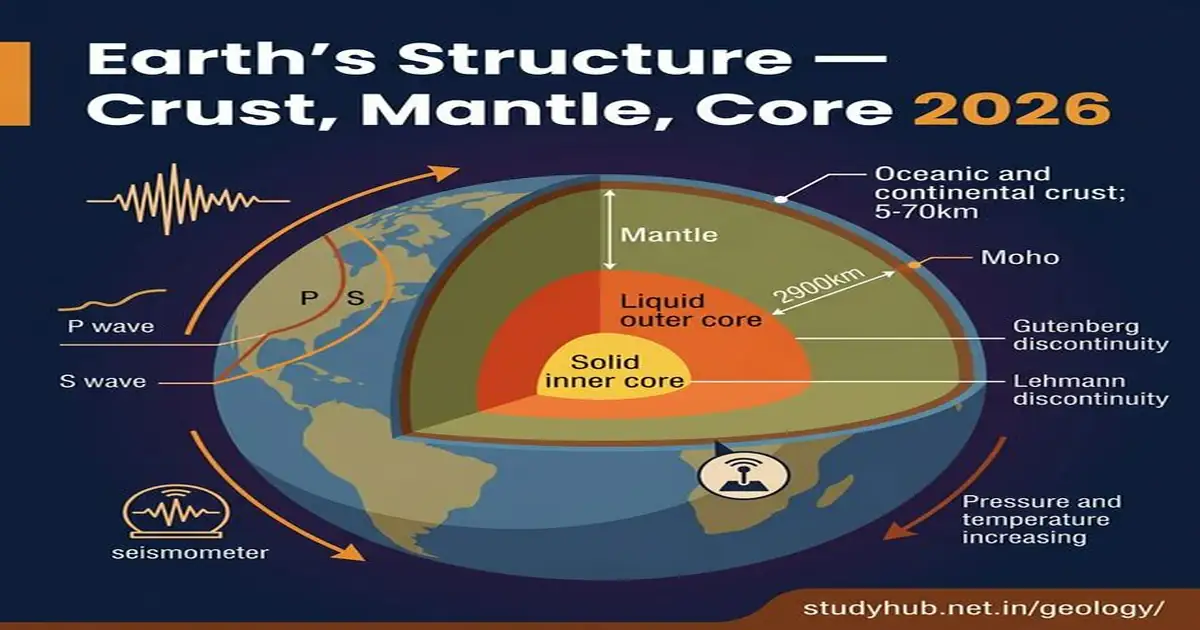
Earth’s Structure — Crust, Mantle, Outer Core & Inner Core Explained 2026
The Four Layers at a Glance
| Layer | Depth Range | Composition | State | Temperature | Key Facts (Exam) |
|---|---|---|---|---|---|
| Crust | 0–5 km (oceanic) to 0–70 km (continental under Himalayas) | Oceanic: basalt (SIMA — silicon + magnesium); Continental: granite (SIAL — silicon + aluminium) | Solid | 0°C surface → ~400°C base of lower crust | Thinnest under mid-ocean ridges (5 km); thickest under Himalayas (70 km); density: continental 2.7 g/cc, oceanic 2.9 g/cc; separated from mantle by Mohorovičić Discontinuity (Moho) |
| Mantle | 5–70 km to 2,900 km | Ultramafic: peridotite (olivine + pyroxene); upper mantle: dunite, harzburgite; lower mantle: denser mineral phases (bridgmanite = MgSiO₃ perovskite — most abundant mineral in Earth) | Solid (but behaves plastically over geological time — convects); asthenosphere (70–250 km): partially molten, weak, flowing | 400°C (top) → 3,700°C (base) | Largest layer by volume (84%); convection currents drive plate tectonics; lithosphere = crust + rigid upper mantle; asthenosphere = weak zone over which plates slide; ULVZ at base = ultra-low velocity zones (partial melt?) |
| Outer Core | 2,900 km – 5,100 km | Liquid iron-nickel alloy (Fe-Ni); ~10% lighter elements (sulphur, oxygen, silicon, and/or hydrogen) | Liquid — S waves cannot pass through (key evidence) | 3,700°C (top) → 5,000°C (base) | Generates Earth’s magnetic field (geodynamo — convecting liquid Fe-Ni); S waves stop at 2,900 km = Gutenberg Discontinuity (proof it is liquid); rotation of liquid iron = electrical currents = magnetic field; protects Earth from solar wind |
| Inner Core | 5,100 km – 6,371 km (centre) | Solid iron-nickel alloy (Fe-Ni); hexagonal close-packed iron (hcp) under extreme pressure | Solid (paradoxically — same composition as outer core, but pressure so extreme that iron solidifies despite higher temperature) | 5,000°C – 6,000°C (similar to surface of Sun) | Radius: 1,220 km; discovered by Inge Lehmann (Danish seismologist) in 1936 from anomalous P wave reflections → Lehmann Discontinuity; rotates slightly faster than rest of Earth (super-rotation ~0.1°/year — debated); P waves travel faster along Earth’s rotation axis than perpendicular (seismic anisotropy) |
The Three Major Discontinuities — Exam Hot Topic
| Discontinuity | Depth | Separates | Discoverer | Evidence |
|---|---|---|---|---|
| Mohorovičić (Moho) | 5 km (oceanic) to 70 km (under Himalayas); average: ~35 km under continents | Crust from Mantle | Andrija Mohorovičić (Croatian, 1909) — noticed seismic P waves arrived faster than expected at distance → must be refracted off a faster, denser layer below | P wave velocity jumps from ~6–7 km/s (crust) to ~8 km/s (mantle) at the Moho boundary. The Moho is shallower under oceans and deeper under mountain ranges — reflecting isostatic compensation (thicker crustal root under mountains) |
| Gutenberg Discontinuity | 2,900 km | Mantle from Outer Core | Beno Gutenberg (German-American, 1914) | S waves (shear waves, cannot travel through liquids) completely disappear at 2,900 km → outer core must be liquid. P waves slow down dramatically and refract, creating the “P wave shadow zone” (103°–143° from epicentre — no direct P waves received). This shadow zone was the key observational evidence for a liquid outer core. |
| Lehmann Discontinuity | 5,100 km | Outer Core (liquid) from Inner Core (solid) | Inge Lehmann (Danish, 1936) — first female to make a major seismological discovery | P waves that should be absent in the shadow zone were detected by sensitive seismographs. Lehmann proposed a solid inner boundary that reflects P waves into the shadow zone. The inner core’s higher P wave velocity (11–12 km/s) vs outer core (8–10 km/s) confirms it is solid iron under extreme pressure. |
How Seismic Waves Reveal Earth’s Interior
The single most important tool for studying Earth’s deep interior is seismic wave analysis. When an earthquake occurs, it generates two main body waves that travel through Earth’s interior:
P Waves (Primary / Compressional waves): Travel by alternately compressing and expanding the material in the direction of travel — like sound waves. They travel through all materials: solids, liquids, and gases. Speed: ~6 km/s in crust → ~8 km/s in upper mantle → slows at Gutenberg Discontinuity → ~8–10 km/s in outer core → ~11–12 km/s in inner core. P waves are the fastest seismic waves and are therefore the first to arrive at a seismograph — hence “Primary.”
S Waves (Secondary / Shear waves): Travel by shearing material sideways, perpendicular to the direction of travel — like a rope being shaken. Critically, S waves cannot travel through liquids (liquids have no shear strength). This is why S waves stop completely at the Gutenberg Discontinuity (2,900 km) — direct proof that the outer core is liquid. S waves are slower than P waves (~3.5–4.5 km/s in crust) and arrive second — hence “Secondary.” At a seismograph station, the time gap between P and S wave arrivals allows geologists to calculate the distance to the earthquake epicentre.
Shadow Zones — the key exam concept: Because seismic waves bend (refract) and reflect at internal boundaries, certain regions on Earth’s surface receive no direct seismic energy from a given earthquake. The P wave shadow zone extends from 103° to 143° angular distance from an earthquake epicentre — no direct P waves are received here because they are bent away by the liquid outer core. The S wave shadow zone extends from 103° to 180° (the entire far hemisphere) — no S waves at all because the liquid outer core absorbs them. These shadow zones were the crucial observational evidence that led Gutenberg to identify the outer core, and Lehmann to identify the inner core from anomalous P waves detected within the P wave shadow zone.
Earth’s Crust in Detail — Continental vs Oceanic
| Property | Continental Crust | Oceanic Crust |
|---|---|---|
| Composition | Granite (felsic — high SiO₂ + Al₂O₃); “SIAL” — Silicon + Aluminium | Basalt (mafic — high Mg + Fe); “SIMA” — Silicon + Magnesium |
| Thickness | 30–50 km average; up to 70 km under Himalayas; 25–30 km under plains | 5–10 km average (thinnest 5 km at mid-ocean ridges) |
| Density | 2.7 g/cm³ (lighter — “floats” higher on mantle) | 2.9–3.0 g/cm³ (denser — sits lower, subducts under continental crust) |
| Age | Very old — Archean cratons (Dharwar, India: 3.4 Ga; Canadian Shield: 4.0 Ga) | Very young — maximum ~200 million years old (older oceanic crust is subducted and recycled) |
| Elevation | Averages ~840 m above sea level | Averages ~3,800 m below sea level |
| India examples | Entire Peninsular India (Deccan Plateau, Eastern Ghats, Western Ghats, Aravallis — ancient continental crust, 1–3.4 billion years old) | Indian Ocean floor; Arabian Sea floor; Bay of Bengal floor — young basaltic oceanic crust |
Earth’s Mantle — The Largest Layer
The mantle comprises 84% of Earth’s total volume and 67% of Earth’s total mass — making it by far the largest layer. It extends from the Moho (average ~35 km depth) down to the Gutenberg Discontinuity at 2,900 km. The mantle is divided into the upper mantle (35–660 km) and the lower mantle (660–2,900 km), separated by a transition zone where minerals undergo pressure-induced phase changes.
The Asthenosphere — Why Plates Move: Within the upper mantle (approximately 70–250 km depth) lies the asthenosphere — a mechanically weak zone where rock is close to its melting point (partially molten in some regions, particularly under mid-ocean ridges). The asthenosphere behaves plastically over geological time — it flows very slowly (cm/year timescales), driven by heat from Earth’s interior. This plastic flow drives the convection currents that move tectonic plates and power all of plate tectonics — mountain building, earthquake generation, and volcanism. The lithosphere (rigid crust + uppermost rigid mantle, above the asthenosphere) rides on top of the flowing asthenosphere like a raft on water.
Mantle Convection — India Connection: The Indian Plate has been moving northeastward at approximately 5 cm/year for the past ~130 million years, driven by mantle convection pull (slab pull from the subducting Indian oceanic lithosphere under the Eurasian plate, plus ridge push from the diverging Indian Ocean mid-ridge). The collision of the Indian Plate with the Eurasian Plate that began ~50 million years ago — and continues today — is the direct geological cause of the Himalayan mountain system. The Himalayas are still rising at ~5mm/year because the Indian Plate continues to push northward, driven by the same mantle convection that has been operating for millions of years.
Earth’s Core — The Iron-Nickel Heart
Earth’s core occupies approximately 16% of Earth’s volume but contains 32% of Earth’s mass — because it is made of dense iron-nickel alloy. The core is divided into the liquid outer core (2,900–5,100 km) and the solid inner core (5,100–6,371 km). Together they have a radius of approximately 3,471 km — slightly larger than Mars (radius 3,390 km).
Earth’s Magnetic Field — The Geodynamo: The flowing liquid iron of the outer core is the engine that generates Earth’s magnetic field — a process called the geodynamo. The convecting liquid iron (driven by Earth’s internal heat + crystallisation heat as the inner core slowly grows by solidifying iron from the outer core) generates electrical currents, which in turn generate a magnetic field. Earth’s magnetic field extends approximately 65,000 km into space at the equator (the magnetosphere) and deflects the solar wind (a stream of charged particles from the Sun) — protecting Earth’s atmosphere from being stripped away (as happened to Mars, which lost its magnetic field 4 billion years ago and subsequently lost most of its atmosphere). The Van Allen radiation belts — doughnut-shaped regions of trapped charged particles — are a direct consequence of Earth’s magnetic field, and they protect satellites and astronauts from deadly solar particle radiation.
Frequently Asked Questions
What is the Mohorovičić discontinuity (Moho) and why is it important?
The Mohorovičić discontinuity, universally abbreviated as the Moho, is the boundary between Earth’s crust and the upper mantle. It was identified in 1909 by Croatian seismologist Andrija Mohorovičić when he noticed that seismic P waves from a 1909 earthquake in the Kupa Valley arrived at distant seismograph stations faster than expected — he correctly deduced that some waves had refracted downward into a denser, faster layer (the mantle) and travelled farther but faster, arriving before the direct crustal path waves. At the Moho, P wave velocity jumps sharply from ~6–7 km/s (granite/basalt crust) to ~8 km/s (peridotite mantle) — this velocity jump is the defining characteristic. The depth of the Moho varies enormously: under mid-ocean ridges: just 5 km (thin, young, basaltic crust); under normal oceanic crust: 7–10 km; under normal continental crust: 30–35 km; under mountain ranges: 50–70 km (the “crustal root” — a downward bulge of lighter crust into the denser mantle, providing isostatic support for the mountain mass above). Under the Himalayas, the Moho is approximately 70 km deep — one of the deepest on Earth, reflecting the enormous mass of rock pushed upward by the India-Eurasia collision. The MOHOLE PROJECT (1961–1966, USA) was a ambitious plan to drill through the oceanic crust (thinnest ~5 km) to sample the Moho directly — it was cancelled before reaching the Moho due to cost overruns. India’s NCERT Class 11 Physical Geography Chapter 3 covers the Moho and other discontinuities explicitly — memorise its depth range (5–70 km, averaging 35 km under continents) for UPSC and SSC exams.
Why is Earth’s outer core liquid but the inner core solid — if both are iron-nickel?
This is one of the most elegant paradoxes in Earth science — and a favourite UPSC/SSC question. Both the outer core and inner core have essentially the same iron-nickel composition, yet one is liquid and one is solid. The explanation is pressure versus temperature: metals have a melting point that increases with increasing pressure (the pressure-melting curve — also called the melting curve or solidus). In the outer core, the temperature is above the iron melting point at the prevailing pressure → iron is liquid. In the inner core, the extreme pressure (360 GPa — 3.6 million atmospheres) is so high that even at temperatures of 5,000–6,000°C (comparable to the surface of the Sun), iron is forced into a solid hexagonal close-packed (hcp) crystal structure. The inner core is not cooling down — it is solidifying because pressure is increasing (as the planet slowly loses heat to space, the boundary between liquid outer core and solid inner core moves outward, the inner core grows by ~1 mm/year). This solidification releases latent heat + compositional buoyancy (lighter elements expelled from the crystallising iron) → drives the convective flow in the outer core → sustains Earth’s geodynamo (magnetic field). So: inner core solid = extremely high pressure overrides high temperature; outer core liquid = temperature above iron melting curve at that pressure. The inner core boundary (Lehmann Discontinuity at 5,100 km) is therefore not fixed — it is a slowly advancing solidification front. Scientists have found evidence (through PKIKP seismic waves) that the inner core may itself have an “innermost inner core” (~550 km radius) with different crystal orientation — a discovery still under active investigation.
What is the asthenosphere and how does it drive plate tectonics?
The asthenosphere (from Greek asthenos = weak) is a mechanically weak, partially molten zone in the upper mantle, roughly between 70–250 km depth (though its exact boundaries vary laterally — it is deeper under cratons, shallower under mid-ocean ridges and hotspots). The asthenosphere is solid in composition but behaves as a very viscous fluid over geological time scales due to its proximity to the rock’s melting point — a condition called “incipient melting” (1–3% partial melt in some zones). Its viscosity is approximately 10¹⁸–10²¹ Pa·s — millions of times more viscous than water but capable of flowing over millions of years. The asthenosphere is the lubrication layer on which the rigid lithosphere (crust + uppermost rigid mantle, 0–70–100 km thick) slides. Plate tectonics is driven by several forces acting on the lithosphere, all ultimately powered by Earth’s internal heat: Mantle convection: hot material rises at mid-ocean ridges (divergent boundaries), spreads laterally, cools and sinks at subduction zones; the flowing asthenosphere drags the overlying lithospheric plates along with it (basal drag); Ridge push: newly formed, hot, buoyant oceanic crust at mid-ocean ridges is elevated above the surrounding sea floor → gravitational sliding pushes plates away from ridges; Slab pull: cold, dense subducting oceanic crust sinks into the mantle → pulls the rest of the plate behind it; this is now considered the dominant force driving plate motion (explains why plates attached to large subducting slabs move fastest — the Pacific Plate moves at 7–10 cm/year). For India specifically: the Indian Plate is being pulled northward by the remnant subducting oceanic slab of the ancient Tethys Ocean (slab pull) and pushed from behind by the Southwest Indian Ridge (ridge push). The resulting collision with Eurasia — beginning ~50 Ma and ongoing — has created the Himalayas, the Tibetan Plateau (average elevation 4,500 m — the world’s highest plateau), and the Zagros Mountains of Iran. The Indian Plate currently moves at approximately 5 cm/year — one of the fastest-moving plates on Earth.
Important for Exams — Must-Know Facts About Earth’s Structure
The following facts appear directly in UPSC Prelims, state PCS exams, SSC CGL/CHSL geography sections, and NDA/CDS geography papers: Layers (depth ranges — memorise these): Crust: 0–35 km average (5 km oceanic, 70 km Himalayan); Mantle: 35–2,900 km (largest by volume: 84%); Outer Core: 2,900–5,100 km (liquid Fe-Ni); Inner Core: 5,100–6,371 km (solid Fe-Ni); Total Earth radius: 6,371 km. Discontinuities: Moho = crust-mantle boundary (Mohorovičić, 1909); Gutenberg Discontinuity = mantle-outer core boundary (2,900 km — S waves stop here); Lehmann Discontinuity = outer core-inner core boundary (5,100 km — discovered by Inge Lehmann, 1936, first female seismologist to make major discovery). Seismic waves: P waves travel through solid + liquid; S waves travel through solid only — S waves stop at 2,900 km (Gutenberg) = outer core is liquid. SIAL vs SIMA: Continental crust = SIAL (Si+Al = granite); Oceanic crust = SIMA (Si+Mg = basalt); Mantle = NIFE (Ni+Fe). Earth’s magnetic field: Generated by convecting liquid iron in outer core (geodynamo); protects Earth from solar wind; without it, atmosphere would be stripped (Mars example). Kola Superdeep Borehole: Russia; 12.26 km deep (deepest artificial point on Earth); reached only upper crust after 24 years of drilling (1970–1994); never reached Moho. India connection: Himalayan Moho depth: 70 km (deepest continental Moho); Indian Plate velocity: 5 cm/year northward; Dharwar Craton (Karnataka): Archean continental crust 3.0–3.4 billion years old.
What to Read Next
- What is Geology? — Definition, 13 Branches, GSI & Importance for Exams 2026
- How Do We Know What’s Inside Earth? — Seismic Wave Evidence Explained
- What is Plate Tectonics? — Theory, Evidence & Himalayan Formation 2026
- Mohorovičić Discontinuity (Moho) — Crust-Mantle Boundary Explained Simply 2026
- Earth’s Magnetic Field — Geodynamo, Van Allen Belts & Geomagnetic Reversal 2026
🎔 Exam Quick Reference — Earth’s Layers: Crust (0–35km avg) → Moho → Mantle (35–2900km, 84% volume) → Gutenberg Discontinuity (2900km, S waves stop = liquid) → Outer Core (2900–5100km, liquid Fe-Ni, generates magnetic field) → Lehmann Discontinuity (5100km) → Inner Core (5100–6371km, solid Fe-Ni, temperature 6000°C). SIAL = continental crust (granite). SIMA = oceanic crust (basalt). Asthenosphere (70–250km) = plastic zone that drives plate tectonics. Kola Borehole = deepest drill = 12.26km = barely through crust.
🌍 India Connection: Himalayan Moho = 70km deep (world’s deepest crustal root). Indian Plate moves 5cm/year north. Dharwar Craton (Karnataka) = 3.4 billion year old continental crust. Deccan Plateau = ancient stable continental shield = thick, old, cool, low seismicity. Himalayan zone = thin young plate collision zone = high seismicity (Zone IV–V). Barren Island (Andaman) sits on Sunda Arc subduction zone = mantle-derived magma = volcanic activity.
About This Guide: Written by the StudyHub Geology Editorial Team (studyhub.net.in/geology/) based on NCERT Class 11 Physical Geography Chapter 3 (Interior of the Earth), USGS Earthquake Hazards Program, Stein & Wysession “An Introduction to Seismology, Earthquakes and Earth Structure” (2003), Tarbuck & Lutgens “Essentials of Geology” (13th Ed.), and GSI publications. Last updated: March 2026.