
Ecology — from the Greek oikos (house) and logos (study) — is the scientific study of the relationships between living organisms and their environment. It is the foundational science underlying all environmental management, conservation biology, climate change adaptation, and sustainable development. India, with its extraordinary geographic diversity spanning tropical rainforests, Himalayan alpine zones, hot deserts, mangrove coasts, and coral reefs, contains an exceptional diversity of ecosystems — including 4 of the world’s 36 biodiversity hotspots (Western Ghats, Eastern Himalayas, Indo-Burma, and Sundaland/Nicobar) and over 91,000 animal species and 45,500 plant species, representing approximately 7–8% of the world’s biodiversity on 2.4% of its land area. The ecology section of UPSC, SSC, and state competitive examinations covers ecosystems, energy flow, biogeochemical cycles, population ecology, species interactions, and India’s specific conservation frameworks — all of which are covered comprehensively in this article.
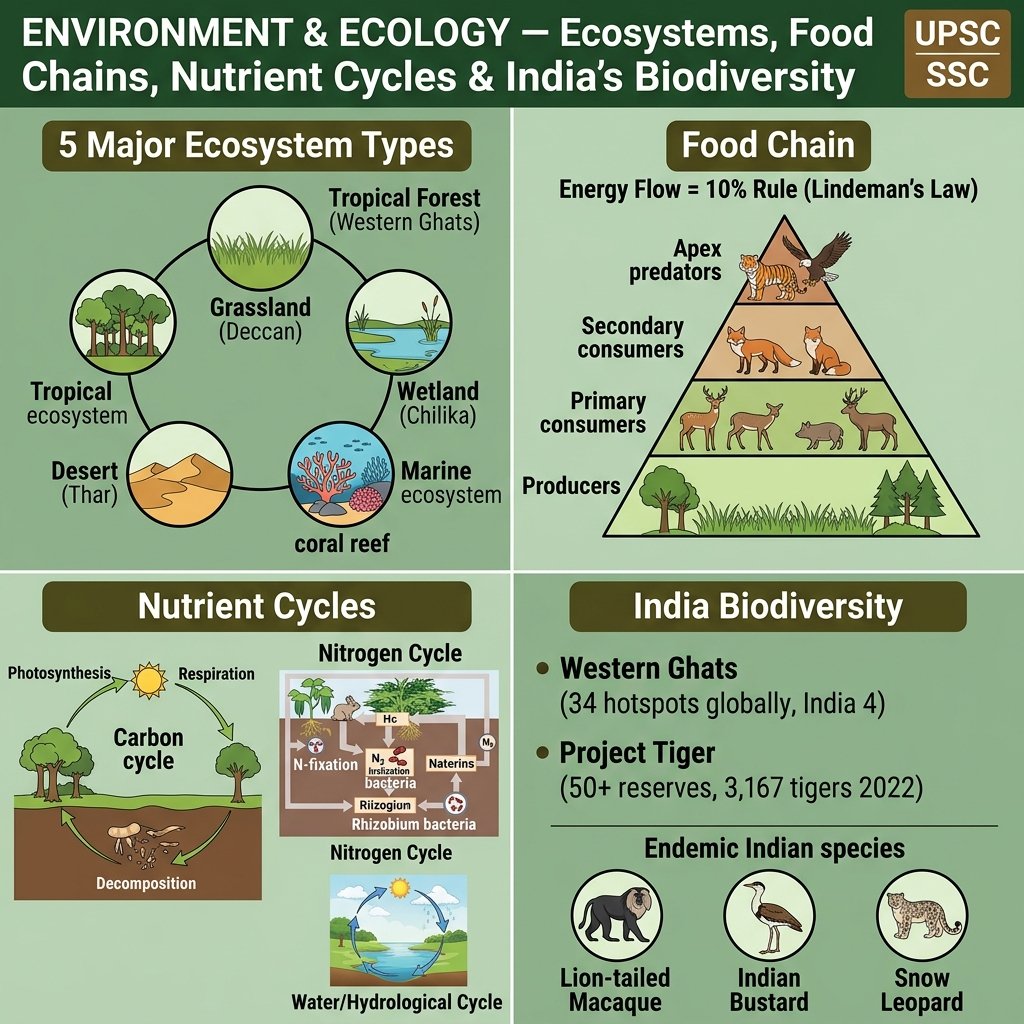
What is an Ecosystem?
- 🌿 Definition: An ecosystem is a functional unit comprising all living organisms (biotic components) and non-living physical environment (abiotic components = sunlight, water, soil, air, temperature, minerals) in a given area, interacting as a system through energy flow and material cycling
- 🌿 Coined by: A.G. Tansley (British ecologist), 1935 — he introduced the term “ecosystem” to replace “biome” and “community” with a more functional, systems-based concept
- 🌿 Biotic components: Producers (autotrophs = plants, algae, cyanobacteria that photosynthesize); Consumers (heterotrophs = animals, fungi that eat other organisms); Decomposers / Detritivores (bacteria, fungi, earthworms that break down dead organic matter into inorganic nutrients)
- 🌿 Abiotic components: Climatic factors (temperature, rainfall, light, humidity, wind); Edaphic factors (soil type, pH, texture, nutrient content); Topographic factors (altitude, slope aspect)
Major Types of Ecosystems in India
| Ecosystem Type | Location in India | Key Characteristics | Flagship Species / Features |
|---|---|---|---|
| Tropical Evergreen Forest | Western Ghats (Kerala, Karnataka, Goa), Northeast (Meghalaya, Assam, Arunachal), Andaman & Nicobar | Rainfall >200 cm; no dry season; multi-layered canopy; highest biodiversity per unit area globally | Lion-tailed Macaque, Great Hornbill, Malabar Giant Squirrel; Dipterocarp trees; epiphytes and orchids |
| Tropical Deciduous Forest (Dry / Moist) | Central India (MP, Maharashtra, Odisha, Jharkhand), Eastern Ghats, parts of UP, Rajasthan (moist) | Rainfall 75–200 cm; distinct dry season; trees shed leaves; most of India’s Tiger Reserves | Tiger, Leopard, Indian Gaur, Teak (Tectona grandis), Sal (Shorea robusta), Bamboo |
| Tropical Thorn / Scrub Forest | Rajasthan (eastern Thar), Gujarat, Punjab, Western MP, Andhra | Rainfall <75 cm; sparse vegetation; thorny shrubs; adapted for extreme water stress | Indian Grey Wolf, Chinkara, Blackbuck; Khejri (Prosopis cineraria = State Tree of Rajasthan) |
| Himalayan Alpine / Sub-Alpine | J&K, Ladakh, HP, Uttarakhand, Sikkim, Arunachal — above 3,000m | Extreme cold; low oxygen; summer pastures (bugyals); krummholz (stunted wind-bent trees near treeline) | Snow Leopard, Red Panda, Bharal (Blue Sheep), Tibetan Wolf; Rhododendrons; Yak (domesticated) |
| Mangrove Ecosystem | Sundarbans (WB + Bangladesh = world’s largest); Godavari-Krishna delta (AP); Gulf of Kutch; Andaman Nicobar; Kerala backwaters | Saline tidal zone; prop roots / pneumatophores (breathing roots); nursery for marine fish; coastal protection | Royal Bengal Tiger (Sundarbans); Saltwater Crocodile; Irrawaddy Dolphin; Mangrove Pitta; India = 3rd largest mangrove area globally |
| Coral Reef Ecosystem | Lakshadweep (best; atoll system); Gulf of Mannar (Tamil Nadu); Gulf of Kutch; Andaman & Nicobar | Warm (25–29°C), clear, shallow tropical waters; built by coral polyps (symbiotic algae = zooxanthellae); “rainforests of the sea” | Parrotfish, Sea Turtle, Clownfish, Sea Anemone; Lakshadweep coral cover declining due to bleaching events (2016, 2020) |
| Wetland Ecosystem | Chilika Lake (Odisha); Loktak Lake (Manipur); Wular Lake (J&K); Sambhar Lake (Rajasthan); Keoladeo Ghana (Rajasthan) | High biological productivity; migratory waterbird habitat; carbon storage; water purification; flood buffering | Siberian Crane (migratory, Keoladeo); Bar-headed Goose; Irrawaddy Dolphin (Chilika); India = 75 Ramsar sites (3rd globally) |
| Grassland / Savanna | Deccan Plateau grasslands; Banni grasslands (Gujarat); Terai grasslands (Nepal border UP/Uttarakhand) | Low-medium rainfall; fire-maintained; high ungulate (grazing animal) diversity; undervalued for conservation | Indian Bustard (critically endangered, Rajasthan/Gujarat grasslands); Blackbuck; Chital; Wolves; Tal Chhapar WLS (Rajasthan) |
Energy Flow in Ecosystems
Food Chains & Food Webs
- 🌱 Food Chain: A linear sequence of organisms where each is eaten by the next; starts with a Producer (plant) and ends with an Apex Predator (tiger, eagle) or Decomposer; e.g., Grass → Deer → Tiger → Decomposer
- 🌱 Food Web: Interconnected network of multiple food chains in an ecosystem; more realistic than single chain; provides stability (if one prey species falls, predator can switch to another)
- 🌱 Trophic Levels: Producer (T1) → Primary Consumer/Herbivore (T2) → Secondary Consumer/Omnivore (T3) → Tertiary Consumer/Apex Predator (T4); each level is a Trophic Level
- 🌱 10% Law (Lindeman’s Law, 1942): Only 10% of energy is transferred from one trophic level to the next; 90% is lost as heat (respiration, excretion, non-consumed biomass); this is why food chains are rarely longer than 4–5 levels — too little energy reaches the top; this is also why vegetarian diets are ecologically more efficient than meat-based diets (eating plants directly = 10x more efficient than eating meat from herbivores)
- 🌱 Ecological Pyramid: Graphical representation of trophic structure: (1) Pyramid of Numbers (number of organisms at each level — can be inverted in parasitism); (2) Pyramid of Biomass (total mass at each level — always upright in terrestrial ecosystems; inverted in aquatic/phytoplankton-zooplankton systems); (3) Pyramid of Energy (amount of energy — always upright, never inverted = fundamental law)
Productivity in Ecosystems
- 📊 Gross Primary Productivity (GPP): Total rate of photosynthesis = total energy fixed by producers from sunlight
- 📊 Net Primary Productivity (NPP): GPP minus Respiration (R) = energy available to consumers; NPP = GPP – R
- 📊 Secondary Productivity: Rate of energy storage at consumer levels; much lower than primary
- 📊 Most productive ecosystems globally: Estuaries/coral reefs/tropical rainforests (highest NPP); least productive = open ocean, tundra, deserts
Biogeochemical Cycles (Nutrient Cycles)
| Cycle | Key Processes | Human Disruption | India Context |
|---|---|---|---|
| Carbon Cycle | Photosynthesis (CO2 absorbed); Respiration (CO2 released); Decomposition (organic C to CO2); Combustion (fossil fuels); Ocean absorption; Carbonate sedimentation | Fossil fuel burning +36 billion tonnes CO2/year; deforestation = forest carbon released; atmospheric CO2 from 280ppm (pre-industrial) to 421ppm (2023) | India’s forests = 712 lakh hectares = net carbon sink (~7 billion tonnes CO2 equivalent); India committed to 2.5–3 billion tonne additional carbon sink by 2030 (NDC) |
| Nitrogen Cycle | N-Fixation (Rhizobium in legume root nodules; Azotobacter free-living; lightning); Nitrification (NH3 to NO2 to NO3 by Nitrosomonas, Nitrobacter); Denitrification (NO3 back to N2 by Pseudomonas); Assimilation; Ammonification (decomposition of proteins) | Synthetic fertiliser (Haber-Bosch process) = excess reactive nitrogen in soils and water; eutrophication; N2O (nitrous oxide) = potent GHG (296x CO2); acid rain (NOx from vehicles) | India = 2nd largest fertiliser consumer; urea subsidy ~Rs50,000 cr/year; excess nitrogen in Punjab/Haryana groundwater from Green Revolution agriculture; NBS (Nutrient-Based Subsidy) attempts rationalisation |
| Phosphorus Cycle | Weathering of phosphate rocks; uptake by plants; return via decomposition; no atmospheric component (unlike C and N cycles — only sedimentary cycle) | Mining phosphate rock for fertilisers (finite resource — “peak phosphorus” predicted); runoff causes algal blooms/eutrophication in water bodies | India is net phosphorus importer (no major phosphate deposits); Chilika Lake eutrophication partially from phosphorus runoff; river water quality impacted |
| Water (Hydrological) Cycle | Evaporation; Transpiration (from plants = “green water”); Condensation; Precipitation; Infiltration; Surface runoff; Groundwater recharge; River discharge to ocean | Deforestation reduces transpiration and infiltration (more runoff, less groundwater recharge); urbanisation increases impervious surfaces (floods, less recharge); climate change alters precipitation patterns | India receives ~4,000 BCM (billion cubic metres) precipitation/year but only 1,123 BCM is utilizable (rest runs off, evaporates); monsoon dependence = 75% rain in June-September = agricultural and flood vulnerability |
| Sulphur Cycle | Weathering of rocks; volcanic emissions (SO2); decomposition; oxidation (SO2 to H2SO4); deposition | Fossil fuel burning (coal, oil) releases SO2 = acid rain (H2SO4); kills aquatic life; corrodes stone monuments (Taj Mahal yellowing) | Acid rain from thermal power plants near heritage sites; India began implementing FGD (Flue Gas Desulphurisation) requirements for coal plants after NGT orders |
Species Interactions
| Interaction Type | Species A | Species B | Example |
|---|---|---|---|
| Mutualism | + (benefits) | + (benefits) | Rhizobium bacteria in legume roots (both fix nitrogen + get shelter); Clownfish + Sea Anemone; Bees pollinating flowers |
| Commensalism | + (benefits) | 0 (neutral) | Orchids on tree branches (epiphytes — use tree for height/light, don’t harm tree); Cattle Egret following cattle (eats insects disturbed by cattle) |
| Parasitism | + (benefits) | – (harmed) | Cuscuta (Amarbel) on host plant; Plasmodium in humans (malaria); Tapeworm in mammals |
| Predation | + (benefits) | – (killed) | Tiger eating Sambar deer; Barn Owl eating mice; Pitcher plant consuming insects |
| Competition | – (harmed) | – (harmed) | Two grass species competing for soil moisture; Lantana camara (invasive) competing with native plants; Competitive Exclusion Principle (Gause): two species with identical niches cannot coexist |
| Amensalism | 0 (neutral) | – (harmed) | Penicillium mould releasing antibiotic that kills bacteria; large tree shading out smaller plants |
India’s Biodiversity Hotspots
- 🌍 Global context: Biodiversity hotspots (Norman Myers, 1988; Conservation International) = regions with at least 1,500 endemic vascular plant species AND have lost at least 70% of original habitat; 36 hotspots globally cover 2.4% of Earth’s surface but contain 50%+ of plant species and 42%+ of vertebrate species
- 🇮🇳 India’s 4 hotspots:
- Western Ghats: 1,600+ endemic plant species; Lion-tailed Macaque, Nilgiri Tahr, Purple Frog (living fossil); only 7–8% original habitat remains; UNESCO World Heritage Site (2012)
- Eastern Himalayas: Includes Sikkim, Arunachal Pradesh, West Bengal hills, Bhutan; Red Panda, Snow Leopard, Takin, Black-necked Crane; centres of origin for rice, citrus, banana
- Indo-Burma (Northeast India): Assam, Manipur, Nagaland, Mizoram, Tripura, Meghalaya; one of planet’s most threatened hotspots; Hoolock Gibbon (India’s only ape), Sangai (Manipur’s floating island deer), Brow-antlered Deer
- Sundaland (Nicobar Islands): India’s Nicobar archipelago is the Indian component; Nicobar Megapode, Nicobar Long-tailed Macaque; highly endemic island biota; heavily impacted by 2004 tsunami
Ecological Concepts for Exams
- 🔬 Ecological Niche: The functional role of an organism in its ecosystem — what it eats, how it behaves, when it is active, where it lives; species with identical niches compete until one excludes the other (Competitive Exclusion Principle / Gause’s Law)
- 🔬 Keystone Species: A species with disproportionately large ecological impact relative to its abundance; removal causes ecosystem collapse; e.g., Tigers in Indian forests — regulate deer/sambar populations, preventing overgrazing of forest understory; Sea otters in Pacific kelp forests (eat sea urchins that would otherwise overgraze kelp)
- 🔬 Ecological Succession: Sequential replacement of species communities in an ecosystem over time; Primary succession = on bare rock/sand (pioneer species = lichens → mosses → grasses → shrubs → climax forest); Secondary succession = on disturbed land with soil (faster, e.g., abandoned agricultural land returning to forest)
- 🔬 Climax Community: The stable, self-sustaining end-state of ecological succession for a given climate; tropical rainforest = climax of humid tropical zone; oak-hickory forest = climax of eastern USA temperate zone
- 🔬 Ecotone: Transitional zone between two different ecosystems (e.g., forest-grassland boundary, mangrove between land and sea); ecotones often have higher biodiversity than either adjacent ecosystem (Edge Effect)
- 🔬 Biome: Large-scale regional ecosystem defined by climate and dominant vegetation: Tropical Rainforest, Tropical Savanna, Desert, Mediterranean Shrubland, Temperate Grassland, Temperate Deciduous Forest, Boreal Forest (Taiga), Tundra, Alpine
- 🔬 Biomagnification (Bioaccumulation): Increase in concentration of a persistent pollutant (DDT, mercury, PCBs) at each trophic level; organisms at apex of food chain (eagles, crocodiles, humans eating large fish) accumulate highest concentrations; DDT caused eggshell thinning in Peregrine Falcon (near extinction in USA) — classic example; biomagnification of mercury in Minamata Bay Japan fish (1950s) = neurological disease in humans who ate fish
⭐ Important for Exams — Quick Revision
- 🔑 Ecosystem = coined by A.G. Tansley (1935); biotic + abiotic components interacting through energy flow and material cycling
- 🔑 10% Law (Lindeman, 1942): Only 10% energy transferred per trophic level; 90% lost as heat; explains short food chains
- 🔑 Pyramid of Energy = ALWAYS upright (never inverted); Pyramid of Biomass can be inverted (aquatic); Pyramid of Numbers can be inverted (parasitism)
- 🔑 GPP – Respiration = NPP; NPP = energy available to consumers; most productive ecosystem = estuaries/coral reefs/tropical forests
- 🔑 Carbon cycle: 421 ppm CO2 (2023) vs 280 ppm pre-industrial; India forests = 712 lakh ha = carbon sink
- 🔑 Nitrogen cycle: N-fixation by Rhizobium (legumes) + Azotobacter; Nitrification = Nitrosomonas + Nitrobacter; Denitrification = Pseudomonas; N2O = 296x CO2 global warming potential
- 🔑 Phosphorus cycle = only sedimentary cycle (no atmospheric component unlike N and C)
- 🔑 Mutualism (+/+); Commensalism (+/0); Parasitism (+/-); Predation (+/-); Competition (-/-); Amensalism (-/0)
- 🔑 Competitive Exclusion Principle (Gause’s Law): Two species with same niche cannot coexist; one will exclude the other
- 🔑 Keystone species: Disproportionate ecological impact; Tiger = keystone of Indian forests
- 🔑 Ecological succession: Primary (bare rock; pioneer = lichens) vs Secondary (disturbed soil; faster); ends at Climax Community
- 🔑 Ecotone: Forest-grassland boundary; higher diversity = Edge Effect; Mangrove = classic ecotone
- 🔑 Biomagnification: DDT/mercury concentrated at apex predators; Peregrine Falcon eggshell thinning; Minamata mercury Japan
- 🔑 India’s biodiversity: 91,000 animal + 45,500 plant species = 7–8% world biodiversity on 2.4% land
- 🔑 India’s 4 biodiversity hotspots: Western Ghats; Eastern Himalayas; Indo-Burma (Northeast); Sundaland (Nicobar)
- 🔑 India = 75 Ramsar Wetland sites (3rd globally); Chilika (largest coastal lagoon India); Loktak (Manipur phumdis); Keoladeo (Siberian Crane)
- 🔑 India mangroves = 3rd largest globally; Sundarbans = world’s largest mangrove = Royal Bengal Tiger habitat
- 🔑 Biodiversity hotspot criteria (Norman Myers 1988): 1,500+ endemic plant species AND 70%+ original habitat lost
Frequently Asked Questions (FAQs)
1. Why is the 10% law so important — and what does it tell us about vegetarian diets and human diet choices?
The 10% Law, proposed by Raymond Lindeman in 1942, states that on average, only about 10% of the energy stored at one trophic level is transferred to the next trophic level in a food chain. The remaining ~90% is lost as heat (through cellular respiration as organisms metabolise food to power their activities), undigested matter (in faeces), parts not consumed by predators, and energy used by decomposers. This seemingly simple biological rule has profound implications for understanding ecosystems, food security, and sustainable diet choices. Why food chains are short: If a grassland has 1,000 units of energy in grass (T1), herbivores (deer, T2) can only store 100 units. Carnivores eating those deer (T3) can only store 10 units. Apex predators eating those carnivores (T4) can only store 1 unit. By T5, only 0.1 units remain — which would support almost nothing. This is why food chains in nature almost never exceed 4–5 trophic levels — there simply is not enough energy to support another level. Implications for human diets: Humans eating directly from T1 (plants) have access to 10x more energy from the same sun-powered productivity than humans eating from T2 (plant-eating animals). If a field produces 1,000 calories of grain, feeding the grain to cattle and then eating beef yields only ~100 calories (10% efficiency). Eating the grain directly yields ~900 calories (after the 10% loss to human metabolism). This means that vegetarian/vegan diets are approximately 10 times more energy-efficient than beef-heavy diets from an ecosystem perspective. Globally, ~33% of Earth’s arable land is used to grow crops to feed livestock (not humans directly), while ~26% of land surface is used for livestock grazing. Shifting a significant fraction of global population towards plant-based diets is considered one of the most impactful individual actions to reduce land use pressure, greenhouse gas emissions (livestock = ~14.5% of global GHGs, FAO), and biodiversity loss from habitat conversion for agriculture. The efficiency cascade in India’s context: India has the world’s largest vegetarian population (~28–40% by various surveys) — partly for religious/cultural reasons (Hindu, Jain, Buddhist traditions). India’s per capita beef consumption is among the world’s lowest. Paradoxically, India’s Green Revolution increased grain yields while keeping meat consumption low, allowing India’s caloric availability to keep pace with population growth at far lower environmental cost per person than countries with meat-heavy diets. The ecological efficiency of India’s food system — despite its well-documented nutritional challenges (protein, micronutrient deficiencies) — is actually far more sustainable than the Western high-meat model, by the very logic of the 10% law.
2. What is biomagnification — and why does it explain why apex predators like tigers and eagles are most vulnerable to pollution?
Biomagnification (also called biological magnification or bioaccumulation) refers to the process by which the concentration of a persistent toxic substance increases at each successive trophic level of a food chain. Unlike nutrients or energy (which diminish with each trophic transfer), certain pollutants — particularly fat-soluble, chemically stable compounds that are not metabolised or excreted efficiently — accumulate in fatty tissues and become progressively more concentrated as they move up the food chain. The mechanism: A small amount of DDT (dichlorodiphenyltrichloroethane, a pesticide) dispersed in a lake is at very low concentration in water — say 0.000003 ppm. Phytoplankton (T1) absorb and concentrate DDT: ~0.04 ppm. Small fish eating larges amounts of phytoplankton (T2): ~0.5 ppm (12,500x concentration increase from water). Large fish eating small fish (T3): ~2 ppm. Birds of prey eating large fish repeatedly (T4): ~25 ppm (8 million times more concentrated than in water). The bird accumulates every small fish’s DDT load in its own fat — a massive multiplication over a lifetime of eating. Classic ecosystem disaster — American Bald Eagle and Peregrine Falcon: DDT was used extensively across North America in the 1950s–60s as an agricultural and mosquito-control pesticide. By the 1970s, Bald Eagle and Peregrine Falcon populations had crashed — not because the birds were directly poisoned, but because high DDT levels in their fatty tissues interfered with calcium metabolism, causing females to lay eggs with shells too thin to survive incubation (the mother’s weight would crack them). Peregrine Falcon went from ~3,900 breeding pairs in 1940 to fewer than 400 by 1970 in North America. Rachel Carson’s 1962 book “Silent Spring” documented these effects and catalysed the modern environmental movement; DDT was banned in the USA in 1972. Populations recovered after the ban. Indian context: India used DDT extensively in the National Malaria Eradication Programme and agricultural pest control (DDT remains one of few licensed uses under the Stockholm Convention in India — for malaria vector control). Studies of eggs and tissues of Indian Vultures, Peregrine Falcons, Sea Eagles (Osprey), and Indian Crocodilians (Gharial) have found elevated organochlorine concentrations consistent with biomagnification. India’s Gharial (critically endangered, Chambal River) and Mugger Crocodile populations show elevated pesticide accumulation. Mercury biomagnification is also documented in India’s coastal fisheries — affecting fish-eating communities in coastal Maharashtra, Goa, and Kerala. The Minamata Convention on Mercury (2013, India ratified 2018) is the global treaty response. Understanding biomagnification explains why persistent pollutants should never be treated as safe merely because concentrations in the environment seem low — the food chain does the multiplication for you, and the apex species always receives the concentrated dose.
3. What makes the Western Ghats one of the world’s most important biodiversity hotspots — and why is it threatened?
The Western Ghats, declared a UNESCO World Heritage Site in 2012, is one of the world’s eight “hottest hotspots” — regions with the highest concentration of endemic biodiversity and the most severe habitat loss. Stretching ~1,600 km from the Tapti River (Gujarat-Maharashtra border) to the southern tip of India (Kanyakumari, Tamil Nadu), the Western Ghats is older than the Himalayas (formed ~60–70 million years ago from Deccan Vulcanism and subsequent erosion) and separated from the Deccan Plateau by an escarpment that creates a dramatic rainfall gradient (west-facing slopes receive 2,000–7,000 mm annually; eastern rain shadow receives 400–700 mm). What makes it exceptional: The Western Ghats contains an estimated 5,000–6,000 flowering plant species, of which ~1,700+ are endemic to the Ghats (found nowhere else on Earth). It harbours 84 endemic fish species (~26% of India’s freshwater fish), 179 endemic amphibian species (frogs and lizards — amphibians are the most sensitive biodiversity gauge because they require pristine water and are biological indicators of water quality; the extraordinary frog diversity of Kerala’s Agasthyamalai hills is globally unique), 16 endemic bird species, and 14 endemic mammal species. The Endemic biodiversity per square kilometre of the Western Ghats is comparable to the Amazon basin — remarkable for a non-tropical-moist region. Notable endemic species: Lion-tailed Macaque (largest primate endemic to India, ~3,000 remaining, highly endangered), Nilgiri Tahr (endemic mountain goat), Malabar Giant Squirrel (State Animal of Maharashtra), Purple Frog (Nasikabatrachus sahyadrensis — “living fossil” found in 2003; spends 11 months underground; only surfaces to reproduce during monsoon), Grauer’s Tree Frog, and hundreds of undescribed species being discovered annually. Why it is threatened: The Western Ghats is home to approximately 50 million people and faces intense anthropogenic pressure across multiple fronts: (1) Deforestation for plantations: Tea (Munnar, Ooty), coffee (Coorg, Wayanad), cardamom (Kerala), rubber (Kerala lowlands) plantations have replaced large areas of natural forest — these are non-native, monoculture plantations that support a fraction of the biodiversity of natural forest. Plantation expansion continues particularly in Kerala, Karnataka, and Tamil Nadu. (2) Hydroelectric projects: Western Ghats rivers (Periyar, Bhavani, Chaliyar, Godavari tributaries) are heavily dammed for power and irrigation; dam construction fragments river corridors essential for fish migration and adversely affects downstream wetlands. Athirappilly Falls (Kerala) — India’s most biodiverse river stretch, habitat of the Great Hornbill — has been under recurring hydroelectric project threat. (3) Linear infrastructure: Road widening, railway expansion, and powerline projects through Ghats forest fragments wildlife corridors; road kills of endangered species (elephants, leopards, giant squirrels) are documented. (4) Mining: Iron ore, laterite, and sand mining in Goa and Karnataka (especially in the North-Western Ghats) has been highly destructive. The Gadgil Committee (2011) recommended that 64% of the Western Ghats be declared an Ecologically Sensitive Area (ESA) with strong protections — its report was largely shelved due to political opposition from plantation and mining interests. The Kasturirangan Committee (2013) reduced the ESA to 37%. Implementation remains contested between conservation and development interests in all 6 Ghats states (Goa, Gujarat, Maharashtra, Karnataka, Kerala, Tamil Nadu).
Related Geology Articles on StudyHub
- ➡️ Wildlife Conservation — Project Tiger, National Parks & Conservation Tools
- ➡️ Natural Vegetation — Forest Types & Mangrove Ecology
- ➡️ Climate Change — Carbon Cycle & Ecosystem Disruption
- ➡️ Water Resources — Watershed & Aquatic Ecosystem Links
- ➡️ Soil Formation — Edaphic Factors in Ecosystems