
Last Updated: March 2026 | Reading Time: 11 minutes | ~2,500 words | Category: Petrology — Igneous Rocks
Igneous rocks (Latin: ignis = fire) are rocks formed by the cooling and solidification of molten rock material — either magma (molten rock below Earth’s surface) or lava (magma that has erupted onto the surface). They are the most fundamental rock type, forming ~90% of Earth’s crust by volume (though most are hidden under the sedimentary/metamorphic cover at the surface). Igneous rocks form the crystalline basement beneath all continents (cratons) and the entire oceanic crust. Understanding igneous rocks requires mastering three key classification axes: (1) Texture — the size, shape, and arrangement of mineral crystals, which reflects the rate of cooling (slow cooling deep underground = large crystals; fast cooling at surface = tiny or no crystals); (2) Chemical/Mineralogical composition — the silica (SiO₂) content and the type of minerals present (felsic = silica-rich, light-coloured; mafic = silica-poor, iron/magnesium-rich, dark); (3) Origin (intrusive vs extrusive) — whether the magma cooled underground (intrusive/plutonic) or erupted and cooled on the surface (extrusive/volcanic). Norman L. Bowen’s pioneering laboratory experiments (1913–1928) on silicate melt crystallisation produced the famous Bowen’s Reaction Series — the sequence in which minerals crystallise from a cooling basaltic magma, explaining the mineralogical diversity of igneous rocks from a single magma source by the process of fractional crystallisation. India has some of the world’s most scientifically significant igneous provinces: the Deccan Traps (world’s largest flood basalt province outside Siberia), the Dharwar Craton (some of Earth’s oldest granite-greenstone terranes at 3.0–3.8 Ga), the Rajmahal Traps (Jurassic-Cretaceous basalts, Jharkhand-West Bengal), and the spectacular Eastern Ghats charnockite (high-temperature metamorphic-igneous hybrid).
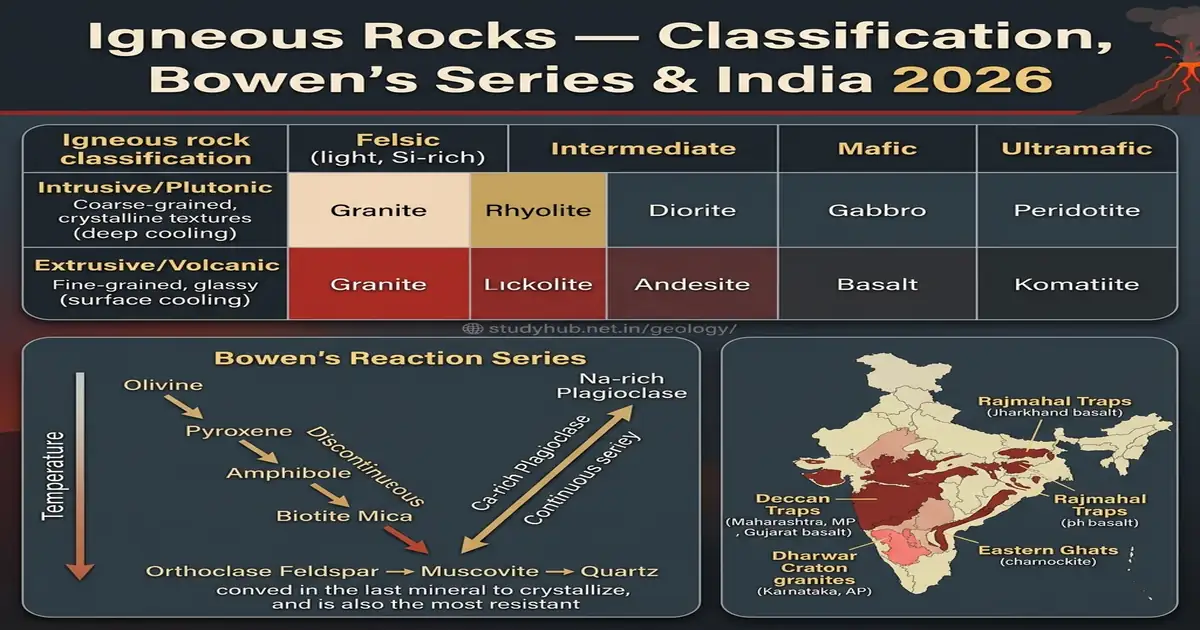
Igneous Rocks — Classification, Bowen’s Reaction Series & India’s Igneous Provinces 2026
1. Igneous Rock Classification — Texture & Composition
| Criterion | Categories | Key Details | Examples / India Context |
|---|---|---|---|
| Texture (Cooling Rate) | Coarse-grained (Phaneritic): crystals visible to naked eye (>1 mm). Slow cooling deep underground (thousands to millions of years). Fine-grained (Aphanitic): crystals too small to see (microscopic). Fast cooling at surface or shallow intrusion. Glassy (Vitreous): no crystals — so fast cooling that atoms cannot arrange into crystal lattice. Porphyritic: two crystal sizes mixed — large phenocrysts (early-formed crystals that grew slowly when magma was deeper) set in fine groundmass (late-stage fast-cooled matrix). Pegmatitic: extremely coarse (crystals >1 cm, sometimes metres) — very slow, water-rich, late-stage crystallisation. Vesicular: gas bubbles (vesicles) preserved in solidified lava — formed as dissolved volatiles exsolve on pressure decrease and lava solidified before bubbles escaped. Amygdaloidal: vesicles filled with secondary minerals (calcite, quartz, zeolites). Pyroclastic (fragmental): volcanic fragments (ash, lapilli, bombs) blown out of volcano and solidified → ignimbrite, tuff, agglomerate | Coarse = deep (granite, gabbro). Fine = surface (basalt, rhyolite). Glass = rapidly quenched (obsidian, pumice). Porphyritic = two-stage cooling (one period deep, then erupted). Vesicular basalt = Deccan Traps (gas-rich basalt), amygdales filled with zeolite minerals (zeolite facies). Pegmatites = economically important — contain rare minerals (tourmaline, beryl=emerald, lepidolite, spodumene=lithium). Pyroclastic: tuff deposits (Rajasthan, Vindhyan tuff layers) | Deccan Basalt (India): vesicular tops of lava flows → amygdales filled with zeolites (natrolite, stilbite) + calcite + agate/chalcedony. Commercially: Maharashtra zeolite deposits (Pune, Nashik areas). Granite of Dharwar Craton: coarse-grained, well-crystallised (slow cooling ~3 Ga). Deccan basalt columns: fine-grained (rapid surface cooling). Obsidian: glassy basalt (minor occurrences in volcanic areas). Pegmatites: Rajasthan mica-bearing pegmatites (Nellore AP = world-class phlogopite, muscovite). Vizianagaram-Srikakulam, AP: rare-earth phosphate pegmatites (monazite) |
| Silica (SiO₂) Content | Felsic (Feldspar + Silica): SiO₂ > 66%. Light coloured (abundant quartz, K-feldspar, Na-plagioclase — all light minerals). Lower density (~2.6–2.7 g/cm³). Higher viscosity magma. Intermediate: SiO₂ 52–66%. Mix of light and dark minerals. Mafic (Magnesium + Ferrous): SiO₂ 45–52%. Dark coloured (abundant pyroxene, amphibole, Ca-plagioclase). Higher density (~2.9–3.0 g/cm³). Lower viscosity. Ultramafic: SiO₂ < 45%. Almost no feldspar. Mostly olivine + pyroxene. Very dark. Very dense (~3.3 g/cm³). Rare at surface — makes up Earth’s mantle | Felsic rocks: Granite (intrusive), Rhyolite (extrusive), Pegmatite. Intermediate: Diorite (intrusive), Andesite (extrusive), Syenite. Mafic: Gabbro (intrusive), Basalt (extrusive), Diabase/Dolerite (medium-grained intrusive). Ultramafic: Peridotite (upper mantle rock), Dunite (pure olivine), Komatiite (ancient Archean ultramafic lava). Note: SILICA content controls viscosity → determines eruption style: High silica (rhyolite) = very viscous = explosive eruptions. Low silica (basalt) = low viscosity = quiet effusive eruptions | India felsic: Dharwar Craton granites and Vindhyan basement granites. Rajasthan granophyre (Malani Igneous Suite, ~750 Ma, largely felsic). India intermediate: Syenite intrusions (Mundwara, Rajasthan). India mafic: Deccan Basalt (~65.5 Ma). Rajmahal Traps (~117 Ma). India ultramafic: Sukinda Complex (Odisha) = peridotite/dunite/chromitite → chromite ore (world-class). Naga Hills (Nagaland) = ophiolite ultramafics (obducted oceanic crust). Sittampundi Complex (Tamil Nadu) = Neoarchean ultramafic complex (chromitite, anorthosite) |
| Igneous Bodies (Plutons) | Intrusive igneous bodies have characteristic shapes: Batholith: very large irregular pluton (>100 km²) — the “backbone” of mountain ranges (Sierra Nevada USA, Dharwar granites India). Stock: smaller batholith (<100 km²). Laccolith: sill-like body with domed upper surface (mushroom shape), flat base — uplifted overlying rock. Lopholith: saucer-shaped, downward-sagging centre. Sill: tabular intrusive body concordant with (parallel to) host rock layering. Dyke (Dike): tabular intrusive body cutting ACROSS host rock layers (discordant). Dike swarms: multiple parallel or radiating dykes (around volcanic centres). Phacoltih: lens-shaped body in fold crests/troughs. Ring dyke & Cone sheet: around collapsed calderas. Volcanic neck/plug: cylindrical solidified magma column in old volcano’s vent | Sill: Artaban Sill (Deccan Traps, horizontal basalt sheets intruded between sedimentary rocks). Palghat sill (Kerala). Dyke: Radial dykes around Deccan volcanic centre. Narmada dolerite dykes. Eastern Ghats: multiple mafic dyke systems cutting charnockite and khondalite. Batholith: Dharwar Craton granitoid batholiths (Karnataka-Andhra — Closepet Granite = a ~3.0 Ga batholith). Bundelkhand Granite (MP-UP, ~2.5 Ga = one of India’s largest exposed granitic batholiths). Malani Rhyolite (Rajasthan — 750 Ma, one of India’s largest acid igneous province). Laccolith: Rajmahal hills (Jharkhand) = domelike forms in Gondwana sediments |
2. Bowen’s Reaction Series & Fractional Crystallisation
| Series / Stage | Temperature | Minerals Crystallising | What This Explains |
|---|---|---|---|
| High-Temperature Stage (Early Crystallisation) | ~1,200–1,000°C | DISCONTINUOUS SERIES (left branch): Olivine (Mg₂SiO₄) — first mineral to solidify from basaltic magma, dense, settles to base. Then: Ca-rich Pyroxene (Mg,Fe silicate). Then: Amphibole (hornblende). Then: Biotite Mica. CONTINUOUS SERIES (right branch, simultaneous): Ca-rich Plagioclase feldspar (anorthite composition at top, calcium-rich). Continuously reacts with remaining melt to become more Na-rich: Anorthite → Bytownite → Labradorite → Andesine. These two series proceed simultaneously from a cooling basaltic magma | Why olivine is never found with quartz (they crystallise at very different temperatures — if quartz forms, olivine would have completely reacted away earlier). Why Deccan Trap basalt is dark coloured — full cooling to basalt means all these high-temperature dark minerals (olivine, pyroxene, Ca-plagioclase) crystallised and were preserved without the later felsic enrichment |
| Middle-Temperature Stage | ~1,000–800°C | DISCONTINUOUS: Amphibole (Hornblende) → Biotite Mica. These dark, Fe-Mg-rich silicates (collectively called ferromagnesian minerals) crystallise and are denser — may settle (crystal settling = fractional crystallisation). CONTINUOUS: Plagioclase becomes increasingly sodium-rich (Andesine → Oligoclase). Removal of early crystals (olivine, pyroxene settled) leaves the remaining melt enriched in Si, Al, Na, K (depleted in Mg, Fe, Ca) → magma becomes more felsic! | Explains magmatic differentiation: starting from one basaltic magma, by progressively removing (settling/crystallising) mafic minerals, the residual melt becomes progressively more felsic → eventually granite-like melt remains. This process is called Fractional Crystallisation (Bowen’s mechanism). Also explains: why andesitic volcanoes (intermediate composition) occur in subduction zones where basaltic oceanic crust partly melts and fractionates |
| Low-Temperature Stage (Late Crystallisation) | <800°C | CONVERGENCE of two series at: Orthoclase (K-feldspar), then Muscovite (white mica), then Quartz (SiO₂). These light-coloured, silica-rich minerals crystallise LAST from the most evolved, Si-enriched residual melt. Quartz is the LAST mineral to crystallise = most stable at Earth’s surface temperature = most resistant to chemical weathering. K-feldspar + Quartz + Muscovite = the minerals of granite and pegmatite | Explains why Granite (K-feldspar + Quartz + sometimes Biotite/Muscovite) = the most evolved igneous rock — it is the end-product of fractional crystallisation of basaltic magma (OR forms directly from partial melting of continental crust at convergent margins). Explains the Goldich Stability (Weathering) Series: minerals that crystallise FIRST (olivine, pyroxene = top of Bowen’s) are LEAST STABLE at Earth’s surface and weather fastest. Minerals that crystallise LAST (quartz, muscovite) are MOST STABLE and most resistant to weathering — that’s why quartz sand is everywhere and olivine sand is rare |
| Goldich Dissolution / Weathering Stability Series | Surface temperature | Mirror image of Bowen’s Series for weathering stability: LEAST STABLE (weather fastest): Olivine → Pyroxene → Amphibole → Biotite → Ca-Plagioclase → Na-Plagioclase → K-Feldspar → Muscovite → MOST STABLE (weather slowest): Quartz. Also: Garnet, Zircon, Magnetite, Tourmaline — resistant accessory minerals (form “heavy mineral placers” on beaches) | Explains India’s beach placer deposits: Kerala coast heavy mineral sand (ilmenite/garnet/zircon/monazite/rutile) — these are residual resistant minerals concentrated by wave washing away lighter material + feldspar and quartz leave beaches as sand. Explains: granite weathers to grus (granular disintegration) because feldspars hydrolyse (hydrolysis = feldspar → clay minerals + silica in solution), while quartz grains survive. Red soil = oxidation of ferromagnesian minerals in granite/gneiss. Black cotton soil = montmorillonite from basalt hydrolysis (ferromagnesian minerals in basalt are top of Bowen’s = weather fastest!) |
3. India’s Major Igneous Provinces & Economic Significance
| Province | Rock Type | Age / Origin | Location | Economic / Scientific Significance |
|---|---|---|---|---|
| Deccan Traps | Flood Basalt (Tholeiitic Basalt). Vesicular tops with amygdales (zeolites, calcite, agate). Columnar jointing (hexagonal columns from contraction on cooling) | ~66–60 Ma (Late Cretaceous–Paleocene). Erupted over ~1 million yr at K-Pg boundary. Related to Réunion Hotspot (now under Réunion Island, Indian Ocean). ~30+ lava flows stacked | Maharashtra (largest coverage), Madhya Pradesh, Gujarat, Karnataka, Andhra Pradesh. ~500,000 km² original area (eroded from larger original extent). Thickness: up to 3 km (Nasik area). Pune-Nashik-Aurangabad core | Zeolites (industrial minerals — ion exchange, molecular sieves, cat litter, water purification): Maharashtra is India’s largest zeolite producer. Agate-chalcedony nodules (gemstones, abrasives): Ratnapuri, Khambhat (Gujarat) — India exports agates worldwide. Black Cotton Soil (Regur): Deccan basalt chemical weathering → montmorillonite = agricultural wealth of Maharashtra, MP, Gujarat. Groundwater: Deccan basalt aquifer (millions depend on dug wells in basalt). Scientific: K-Pg mass extinction link — Deccan eruptions + Chicxulub asteroid = double catastrophe theory |
| Dharwar Craton Granites | Granitoid (Granite, Granodiorite, Gneiss, Greenstone belts of mafic-ultramafic rocks). Tonalite-Trondhjemite-Granodiorite (TTG) suite — the dominant Archaean granite type. Charnockite (hypersthene-bearing granulite-facies rock) — Eastern Ghats | 3.8–2.5 Ga (late Hadean to Neoarchean). One of Earth’s oldest large cratons. Dharwar Supergroup greenstone belts (Kolar, Chitaldrug belts) = ancient volcanic-sedimentary sequences on Archean seafloor | Karnataka, Andhra Pradesh, southern Tamil Nadu. Eastern Ghats (charnockite). Singhbhum Craton (Odisha/Jharkhand) = separate, ~3.5–2.5 Ga. Bundelkhand Granite (UP/MP, ~2.5 Ga) | Kolar Gold Field (KGF, Karnataka): mined Archaean greenstone belt quartz reefs — was India’s deepest mine (3.2 km). Now closed (uneconomic). Hutti Gold Mine (active, Raichur Karnataka) — same greenstone belt. Chromite: Nuggihalli (Karnataka, greenstone ultramafics). Iron ore: BIF (Banded Iron Formation) in Dharwar greenstone belts (Bababudan Hills = Kudremukh NMDC mines, Karnataka). Manganese: Sandur (Karnataka — Archaean). Singhbhum: Copper (Ghatsila, Mosaboni), Uranium (Jaduguda — India’s first uranium mine, ~1.8 Ga unconformity). Scientific: Oldest zircon in India = ~3.8 Ga (Jharkhand/Odisha) |
| Rajmahal Traps | Flood Basalt (Continental basalt, Lower Gondwana-Rajmahal groups). Often called Rajmahal Trap Basalts. Associated with Sylhet Traps (Bangladesh-Meghalaya border) | ~117 Ma (Early Cretaceous). Related to Kerguelen Hotspot passage (India was drifting north over Kerguelen plume). Preceded Deccan Traps by ~50 Ma | Rajmahal Hills, Jharkhand (Sahibganj-Pakur districts, east of Jharkhand). Some extend into West Bengal. Sylhet Traps: Shillong Plateau (Meghalaya) fringe area | Fossil plant beds: Rajmahal Hills contain excellent Glossopteris flora remnants in Gondwana sediments (coal = Barakar Formation below the traps). Industrial minerals: Some silica/basalt commercial quarrying. Scientific: Proof of India’s drift over Kerguelen hotspot (ocean island basalt geochemistry). Rajmahal-Sylhet Traps = equivalent of Iceland basalt geochemistry for this hotspot |
| Malani Igneous Suite | Rhyolite, Granite, Dacite (felsic igneous). One of India’s largest acid igneous provinces | ~750 Ma (Neoproterozoic). Formed during breakup of Rodinia supercontinent. Rift-related magmatism | Western Rajasthan (Barmer, Jalore, Sirohi, Pali, Jodhpur districts). Extends into SE Pakistan (Nagar Parkar) | Dimension stone: Jaisalmer Yellow Limestone quarried for construction (actually next to Malani in age). Jodhpur Sandstone (Vindhyan — separate but adjacent). Scientific: Rodinia supercontinent breakup evidence. Fluorite (fluorspar) deposits in Rajasthan partly associated with felsic magmatism (Dungarpur, Jalore = India’s primary fluorite deposits) |
| Sukinda Ultramafic Complex | Peridotite, Dunite, Pyroxenite, Chromitite (= chromite ore embedded in ultramafic rock). Layered intrusion | ~2.8–2.9 Ga (Archaean). Part of Singhbhum Craton | Sukinda Valley, Jajpur District, Odisha (40 km from Cuttack) | Chromite (Cr₂FeO₄): Sukinda = 2nd largest chromite deposit in the world (accounts for ~98% of India’s chromite, ~35% of world reserves). India = 2nd largest chromite producer globally. Chromium = essential for stainless steel, refractory bricks, pigments. Environmental concern: Sukinda = one of world’s most polluted places (hexavalent chromium Cr⁶⁺ contamination of groundwater — carcinogenic). MOEF & CPCB have ongoing remediation programmes |
Frequently Asked Questions
How does Bowen’s Reaction Series explain why basalt weathers faster than granite?
This question perfectly illustrates the power of Bowen’s Reaction Series as a predictive tool for understanding both rock formation and rock weathering — a connection that is directly useful for UPSC Geography and Geology examinations. The key insight is Norman Bowen’s experimental finding that minerals that crystallise at HIGH temperatures (early in the cooling sequence) are thermodynamically stable at high temperatures — but are far from equilibrium at Earth’s surface temperatures (approximately 15–25°C), and therefore weather much faster. Minerals that crystallise at LOW temperatures (late in the sequence) are already close to equilibrium at surface conditions and resist weathering much longer. This principle is called the Goldich Dissolution Series (1938, by Samuel Goldich), which is simply the reverse of Bowen’s Reaction Series: Olivine > Pyroxene > Amphibole > Biotite > Ca-Plagioclase > Na-Plagioclase > K-Feldspar > Muscovite >> Quartz (reading from least stable to most stable). Basalt is composed primarily of minerals from the top of Bowen’s Series — olivine, calcium-rich pyroxene (augite), and calcium-rich plagioclase feldspar (labradorite). These are all minerals that crystallised at very high temperatures (~1,200–1,000°C) and are therefor chemically unstable at Earth’s surface. Olivine is particularly reactive — it undergoes rapid hydrolysis and oxidation, converting to clay minerals (serpentine, talc) + iron oxides within decades under tropical humid conditions. Calcium-plagioclase also hydrolyses readily to clay (kaolinite). This is why Deccan Trap basalt in Maharashtra’s monsoon climate (warm, wet) has been so efficiently chemically weathered to produce the thick, rich black cotton soil (regur) — the montmorillonite clay forming the Vertisols is the product of rapid hydrolysis of basalt’s ferromagnesian and Ca-plagioclase minerals. Granite is composed primarily of minerals from the bottom of Bowen’s Series — quartz, K-feldspar (orthoclase/microcline), and Na-rich plagioclase (albite/oligoclase), plus minor muscovite and biotite mica. Quartz is essentially immune to chemical weathering (it’s already pure SiO₂, very stable). K-feldspar and Na-plagioclase are more resistant than their calcium counterparts. Even when feldspar hydrolyses, it leaves behind kaolinite and silica — not the swelling smectite clay of basalt weathering. So granite weathering produces a sandy, grussy residue (grus) with kaolinite clay and abundant quartz sand — stable, less agriculturally valuable soils. In India’s context: Dharwar Craton granites of Karnataka (old, tectonically stable, low-relief terrain) tend to produce thin, red, sandy soils with scattered deep laterite profiles where deep weathering has depleted iron and aluminium — quite different from the thick, swelling black cotton soils of the Deccan Traps to the northwest. Bottom line for exams: Basalt (mafic, top of Bowen’s) weathers FASTER than Granite (felsic, bottom of Bowen’s). Black cotton soil = Deccan basalt weathering product (montmorillonite). Red laterite/kaolin = granite/gneiss weathering product (kaolinite + iron oxides). Quartz = highly resistant (bottom of Bowen’s) = survives beach erosion = quartz sand beaches everywhere.
Important for Exams — Igneous Rocks UPSC, SSC & State PCS
Igneous rock basics: Formed from cooling magma (intrusive, underground) or lava (extrusive, extrusive/volcanic). Texture reflects cooling rate: slow=coarse (granite), fast=fine (basalt), very fast=glassy (obsidian). Porphyritic = two crystal sizes (two-stage cooling). Vesicular = gas bubbles (Deccan basalt zeolites). Classification grid: Felsic (SiO₂>66%): Granite (intrusive), Rhyolite (extrusive). Intermediate: Diorite/Andesite. Mafic (SiO₂ 45-52%): Gabbro (intrusive), Basalt (extrusive). Ultramafic (<45%): Peridotite (mantle rock). Intrusive bodies: Batholith (largest, >100km²), Stock, Laccolith (domed sill), Sill (parallel to layers), Dyke (cuts across layers), Phacoltih (fold structure), Volcanic plug (solidified vent). Bowen’s Reaction Series: HIGH T: Olivine → Pyroxene → Amphibole → Biotite (DISCONTINUOUS left branch) + Ca-Plagioclase → Na-Plagioclase (CONTINUOUS right branch). LOW T: Orthoclase → Muscovite → Quartz. Early = mafic minerals. Late = felsic minerals. Goldich Weathering Stability = REVERSE of Bowen’s: Olivine weathers FASTEST, Quartz weathers SLOWEST. India igneous provinces: Deccan Traps (65.5 Ma, Maharashtra/MP/Gujarat, flood basalt, Réunion hotspot, K-Pg link, vesicular, zeolites, black cotton soil, agates). Dharwar Craton granites (3.8–2.5 Ga, Karnataka-AP, KGF gold, greenstone belt, chromite, BIF iron ore). Rajmahal Traps (117 Ma, Jharkhand, Kerguelen hotspot). Malani Rhyolite (750 Ma, Rajasthan, Rodinia breakup). Sukinda Complex (Odisha, chromite = 98% India, world’s 2nd largest deposit). Economic minerals from igneous rocks: Gold (greenstone belt quartz vein — Hutti mine Karnataka). Chromite (ultramafic = Sukinda Odisha). Iron BIF (greenstone belt — Kudremukh Karnataka). Copper (Singhbhum Odisha-Jharkhand). Uranium (Jaduguda Jharkhand). Mica pegmatites (Rajasthan, AP). Rare earth minerals (pegmatites, AP coast monazite). Confusion to avoid: Basalt = extrusive (surface), Gabbro = intrusive (same composition but cooled deep). Rhyolite = extrusive, Granite = intrusive (same felsic composition). Columnar jointing = hexagonal columns formed by contraction of cooling basalt (NOT metamorphism). India’s Deccan Traps NOT related to Deccan Plateau entirely — Traps (basalt) cover the plateau but the plateau’s foundation is much older Archean rock.
What to Read Next
- Rock Cycle — How Igneous, Sedimentary & Metamorphic Rocks Interconvert 2026
- Deccan Traps — Flood Basalt, K-Pg Extinction & Réunion Hotspot 2026
- Volcanoes — How Magma Composition Determines Explosive vs Effusive Eruptions 2026
- Minerals — Which Minerals Crystallise First in Bowen’s Series? 2026
- Weathering — Goldich Stability & Why Basalt Weathers Faster Than Granite 2026
🎔 Exam Quick Reference — Igneous Rocks: Definition: cooled from magma (intrusive) or lava (extrusive). TEXTURE: Slow cooling=coarse/phaneritic (granite, gabbro). Fast cooling=fine/aphanitic (basalt, rhyolite). Very fast=glassy (obsidian). Two-stage=porphyritic. Gas bubbles=vesicular (Deccan basalt). Very slow water-rich=pegmatitic (mica, tourmaline, rare minerals). COMPOSITION: Felsic (SiO₂>66%, light colour): Granite (intrusive)/Rhyolite (extrusive). Intermediate: Diorite/Andesite. Mafic (SiO₂ 45-52%, dark): Gabbro (intrusive)/Basalt (extrusive). Ultramafic (<45%): Peridotite (mantle). INTRUSIVE BODIES: Batholith (largest), Stock, Laccolith (domed), Sill (parallel to layers), Dyke (cuts across layers), Volcanic plug/neck. BOWEN’S SERIES: High-T first: Olivine, Pyroxene (DISCONTINUOUS) + Ca-Plagioclase (CONTINUOUS). Middle: Amphibole, Biotite, Na-Plagioclase. Low-T last: Orthoclase Feldspar, Muscovite, Quartz. Goldich=reverse=weathering stability: Olivine weathers FASTEST, Quartz SLOWEST. INDIA: Deccan Traps (basalt, 65.5Ma, Réunion hotspot, K-Pg event, zeolites, black cotton soil). Dharwar Craton granites (3.8-2.5Ga, Karnataka=KGF gold, Kolar greenstone belt, BIF iron ore, chromite). Rajmahal Traps (117Ma, Jharkhand, Kerguelen hotspot). Malani Rhyolite (750Ma, Rajasthan, Rodinia). Sukinda Complex (Odisha, chromite=98% India reserves, world 2nd). Remember: Basalt=extrusive=fine, Gabbro=intrusive=coarse (SAME composition). Rhyolite=extrusive, Granite=intrusive (SAME felsic composition).
🌍 India’s Igneous Rock Economic Minerals — Quick Reference: DECCAN BASALT (Maharashtra): Zeolites (water purification, cat litter, molecular sieve — Pune, Nashik). Agate-chalcedony (Khambhat/Cambay Gujarat — India’s agate capital, exports worldwide). Basalt fibre (industrial material, Karnataka small-scale). DHARWAR GREENSTONE BELT: Gold (Kolar Gold Field = historic, closed; Hutti Mine = operational, Raichur Karnataka). Chromite (Nuggihalli Karnataka + Sukinda Odisha). Iron ore BIF (Kudremukh Karnataka, Sandur Karnataka). Manganese (Sandur). SINGHBHUM CRATON (Odisha-Jharkhand): Copper (Ghatsila, Mosaboni, Surda mines). Uranium (Jaduguda, Bagjata, Turamdih — India’s primary uranium mine area). Gold (Jharkhand minor occurrences). Chromite (Sukinda). RAJASTHAN: Mica (pegmatites — Ajmer-Bhilwara belt = India’s largest mica producer). Feldspar (pegmatites — ceramic industry raw material). Fluorite (Dungarpur, Jalore). Radioactive minerals: Rajasthan has some Th-U pegmatites. ANDHRA PRADESH (Eastern coastal region): Heavy mineral beach placers (Bheemunipatnam to Srikakulam) — Ilmenite (titanium), Garnet (abrasive), Monazite (thorium+rare earths), Zircon (nuclear material), Rutile (TiO₂). India is the world’s largest garnet exporter (most from AP+Rajasthan). ATOMIC MINERALS DIRECTORATE (AMD) controls survey and mining of all atomic minerals (uranium, thorium, monazite, beryl, lithium) in India.
About This Guide: Written by the StudyHub Geology Editorial Team (studyhub.net.in/geology/) based on NCERT Class 11 Physical Geography Chapter 5 (Minerals and Rocks), Hyndman “Petrology” (4th ed.), Winter “Igneous and Metamorphic Petrology” (2nd ed.), Geological Survey of India (GSI) Mineral Atlas 2023, and B.P. Radhakrishna & F.J. Vail “Crustal Evolution of Southern Peninsular India” (1987). Last updated: March 2026.