
Last Updated: March 2026 | Reading Time: 13 minutes | ~2,900 words | Category: Human Geography — Human Settlements of India
Human settlements — the places where people live, work, and organise their communities — are the spatial expression of a society’s economic, social, cultural, and environmental conditions. India’s settlement geography is extraordinarily diverse: from the ancient nucleated villages of the Gangetic plains (where entire extended families and caste groups live in tightly packed abaadis), to the dispersed farmstead hamlets of tribal Jharkhand and Chhattisgarh, to the gleaming smart-city districts being constructed in Pune, Ahmedabad, and Lucknow, to the sprawling mega-slums of Dharavi in Mumbai. Understanding this full spectrum is essential for UPSC Civil Services, State PCS, and all competitive examinations that cover Geography, Urban Planning, and Social Issues. India is undergoing one of the most dramatic urban transitions in human history: in 1951, only 17% of Indians lived in cities. By 2011, this had risen to 31.2%. By 2036, India will have a majority urban population for the first time (projected 40-50% urban by 2031, 60%+ by 2047). This means 800 million to 1 billion Indians will need to be housed, served with water-sanitation-electricity-transport, and employed in cities within the next two decades. The policy architecture managing this transition — the Smart Cities Mission (2015, 100 cities), the AMRUT scheme (Atal Mission for Rejuvenation and Urban Transformation, 500 cities), the Pradhan Mantri Awas Yojana — Urban (PMAY-U, “Housing for All” by 2022), the 74th Constitutional Amendment (1992, giving Urban Local Bodies constitutional recognition), and the National Urban Policy Framework 2018 — shapes how 400+ million urban Indians live. Simultaneously, India’s 800,000+ villages still house 70% of the population (Census 2011), exhibiting extraordinary diversity of settlement patterns shaped by terrain, climate, caste, religion, water availability, and agricultural systems.
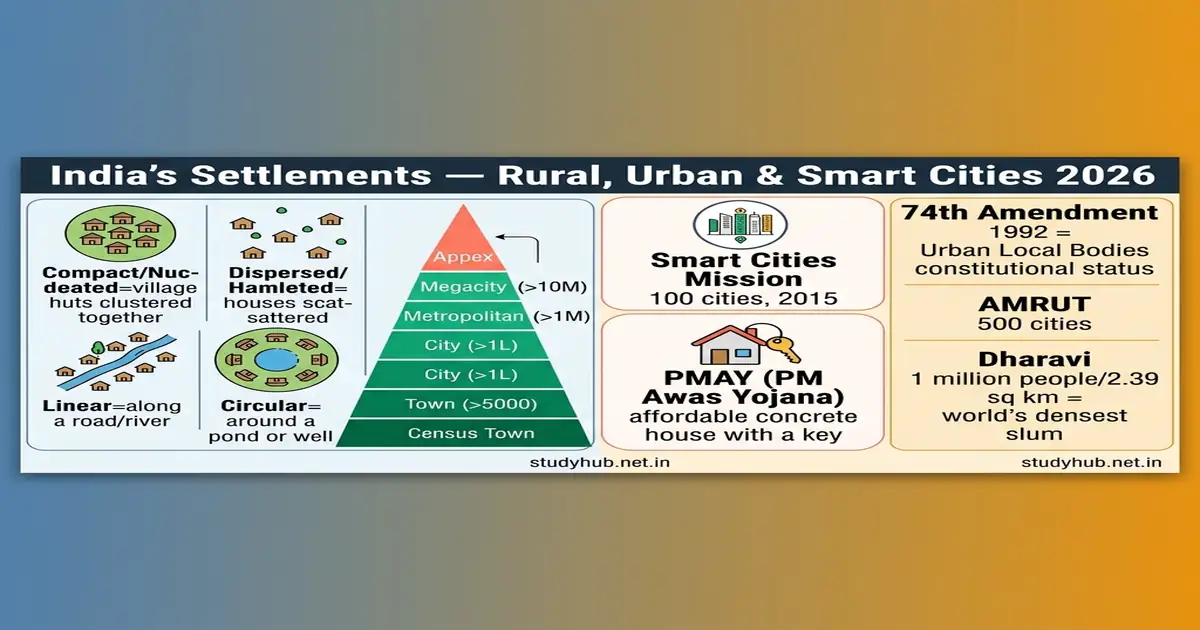
India’s Human Settlements — Rural Settlement Types, Urban Hierarchy, Smart Cities & Housing 2026
1. Rural Settlements — Types, Patterns & Factors
| Topic | Details | India Examples & Exam Facts |
|---|---|---|
| Types of Rural Settlements | Rural settlements classified by: (A) DEGREE OF NUCLEATION — how clustered or dispersed the houses are: (1) COMPACT / NUCLEATED / AGGLOMERATED: Houses clustered tightly in one central settlement with agricultural fields radiating outward. Characteristic of: fertile plains, areas with scarce water (all share one well/pond), regions with history of insecurity (defence, clustering = safety). Examples: Gangetic plain villages (UP, Bihar, WB), Punjab-Haryana villages. The chaupal or village centre is a recognisable feature. Within compact villages: caste-based spatial segregation (Brahmin, OBC, SC localities distinct areas = spatial expression of social hierarchy). (2) SCATTERED / DISPERSED / HAMLETED: Houses spread over a wide area, often in isolated farmsteads. Characteristic of: forested areas where clearing is done individually, hilly terrain (accessibility difficult), tribal areas (each family on its own land, no common dependency). Examples: Jharkhand, Chhattisgarh, Meghalaya, Arunachal Pradesh tribal settlements. Kerala’s tharavad (ancestral homestead) system = individual homesteads amid coconut groves. Uttarakhand mountain hamlets. (3) SEMI-NUCLEATED / LINEAR / INTERMEDIATE: Houses arranged along a line — road, river, canal, or ridge. Neither fully clustered nor fully dispersed. Examples: Canal-side villages in Rajasthan (IGNP canal) where farmhouses are linearly strung. River-side fishing villages (WB, AP, Kerala backwaters). Hill ridgeline villages in H.P., Uttarakhand. (4) HAMLETED / HAMLET CLUSTER: Larger village broken into smaller clusters called paras (CG/JH), padas (WB), pallis (AP), naglas (North India). Different caste/kinship groups live in separate hamlet clusters but share the same village name administratively | FACTORS GOVERNING SETTLEMENT TYPE: (1) Relief: plains = compact (easy movement, fertile soil, everyone shares resources). Hills = dispersed (each family on its slope, difficult collective access). Valleys = linear (along valley floor). (2) Water supply: areas with scarce water = compact (share one well/tank). Well-watered areas = dispersed (each farm has own well). Kerala’s high rainfall = individual homesteads with own well. Rajasthan (scarce water) = compact around step-wells (baoris, kunds). (3) Security and defence history: medieval raiding, bandits → compact settlements with high walls. Rajput villages in Rajasthan = compact with fortress-like interiors. Mewat region = compact due to historical insecurity. (4) Social/Caste: rigid caste → spatial segregation within villages (untouchable communities historically pushed to periphery = harijanvada, cheriyeri, cheri in South India, mohalla in North India for scheduled caste locality). SC localities at village edge/downwind = physical manifestation of caste hierarchy. (5) Land tenure: zamindari areas = compact (landlord-tenant proximity). Peasant proprietor areas = more dispersed. (6) Climate: hot dry areas = compact (mutual shading, less wind, defence). Humid tropical = dispersed (ventilation, disease prevention). PATTERN TYPES (shape of settlement from aerial view): Linear (along road/river). Rectangular (crossroads settlements). Radial (roads radiating from centre). Star-shaped (multiple roads joining). T-shaped (T-junction). Circular (around a pond/tank). Cross-shaped (crossroads with overshoot). EXAM FACT: Punjab-Haryana villages = compact “lal dora” (red line = traditional village abadi boundary). Delhi Urban sprawl has engulfed hundreds of compact villages → Delhi village clusters visible inside the city (Hauz Khas village, Mehrauli = urban village phenomenon) |
| Urban Settlement Hierarchy & Classification | URBAN HIERARCHY in India (Census classification + administrative): (1) MEGACITY (>10 million): Mumbai (18.4M UA), Delhi (16.3M UA), Kolkata (14.1M UA), Chennai (8.7M), Bengaluru (8.5M), Hyderabad (7.7M), Ahmedabad (6.4M). [Note: UA = Urban Agglomeration includes satellite towns]. Total megacities: 7 (Census 2011 definition). (2) METROPOLITAN CITY (>1 million = “million-plus city”): 53 cities in 2011. Expected ~70 by 2031. (3) CLASS I CITY (>1,00,000 population): 468 cities in 2011. (4) CLASS II (50,000-99,999): 410 towns. (5) CLASS III (20,000-49,999): 993 towns. (6) CLASS IV (10,000-19,999): 1,666 towns. (7) CLASS V (5,000-9,999): 3,925 towns. (8) CLASS VI (<5,000): 3,060 towns. CENSUS TOWN (informal urban): Settlements that are officially classified as rural in administrative terms but functionally urban per Census criteria: (i) Population ≥ 5,000. (ii) Density ≥ 400 persons/km². (iii) ≥75% of male workers in non-agricultural activities. Census Towns grew from 1,362 (2001) to 3,894 (2011) = significant informal urbanisation. URBAN AGGLOMERATION (UA): contiguous urban spread beyond city boundary. Delhi UA includes Delhi + Faridabad + Gurgaon + Ghaziabad + Noida = NCR. Mumbai UA includes Mumbai + Navi Mumbai + Thane + Kalyan-Dombivli. CONURBATION: a megalopolis formed by merger of several cities. India’s emerging conurbations: Delhi-NCR mega-conurbation, Mumbai-Pune corridor becoming quasi-conurbation, Bengaluru extending toward Mysuru and Hosur. RIBBON DEVELOPMENT: urban sprawl along highways (NH-8 Delhi-Gurgaon = classic ribbon development → Gurgaon millionaire suburb from empty fields in 1990s to megacity edge by 2010s) | TYPES OF TOWNS (functional classification): (1) Administrative towns: state capitals (Lucknow, Bhopal, Jaipur, Patna, Bhubaneswar, Dispur = Guwahati metro), UT capitals (Panaji, Silvassa, Port Blair). Central government planned capitals: Chandigarh (Punjab-Haryana capital, Le Corbusier planned, 1953, India’s first planned city), Bhubaneswar (Odisha capital, planned 1948 by Otto Königsberger), Gandhinagar (Gujarat, planned capital, 1970s). (2) Industrial towns: Jamshedpur (Tata Steel company town — Tata manages ALL civic infrastructure), Bhilai, Rourkela, Durgapur, Bokaro (steel towns), Ankleshwar (Gujarat petrochemical), Noida (UP IT+manufacturing), Manesar (Haryana automotive). (3) Transport/Trade towns: Kandla (port town), Kochi (port city), Varanasi (road-rail-river junction). (4) Administrative-military cantonments: Pune Cantonment, Secunderabad, Mhow (MP), Wellington (Nilgiris TN), Barrackpore (WB), Danapur (Bihar). (5) Educational towns: Pilani (BITS Pilani, Rajasthan), Srirampur (engineering colleges), Manipal (Karnataka private university town), Wardha (Sevagram-Wardha Gandhi centre). (6) Religious towns: Varanasi (Shiva, Ganga, oldest living city in world per some scholars, 5,000+ year continuous habitation), Tirupati (richest temple), Puri (Jagannath), Mathura-Vrindavan, Ayodhya, Haridwar, Rishikesh, Amritsar (Golden Temple). (7) Tourism towns: Shimla, Manali, Darjeeling, Ooty, Munnar. PLANNED vs ORGANIC: Most Indian cities = organically grown (unplanned, complex, chaotic). Planned cities: Chandigarh (Corbusier), Gandhinagar (Gujarat), Navi Mumbai (CIDCO planned 1972 as planned counter-magnet to Mumbai), GIFT City (Gujarat), smart city expansions |
2. Smart Cities, PMAY Housing, Slums & Urban Governance
| Topic | Details | Key Data & Policy |
|---|---|---|
| Smart Cities Mission & AMRUT | SMART CITIES MISSION (SCM, 2015): Ministry of Housing and Urban Affairs (MoHUA). 100 cities selected through competitive challenge method (“City Challenge” — cities submit plans, evaluated, selected in rounds). Total investment: Rs 2.05 lakh crore. Duration: 2015-2024 (extended twice). Focus: ICT (Information and Communications Technology) integration in urban services, retrofitting existing areas, greenfield development in new areas, and pan-city solutions. Components: (1) Area-Based Development (ABD): retrofitting (improving old areas), redevelopment (rebuilding slums), greenfield (new areas). (2) Pan-City Solutions: city-wide ICT, integrated command and control centres (ICCC = war room for city management — cameras, sensors, traffic monitoring, emergency response, all integrated). Smart City elements: smart transport (integrated transit, GPS on buses, e-tickets), smart water management (sensor-based leakage detection, 24×7 supply target), smart energy (LED streetlights, solar rooftops, smart meters), smart governance (citizen apps, online services), smart environment (air quality sensors, solid waste management). AMRUT (Atal Mission for Rejuvenation and Urban Transformation): 500 cities (cities >1 lakh population). Focus: basic urban infrastructure (water supply, sewerage, parks, urban transport). AMRUT 2.0 (2021-2026): Rs 2.99 lakh crore. Target 100% tap water supply in 4,800 urban local bodies. 100% sewerage management in 500 AMRUT cities. Rejuvenation of water bodies. | SMART CITIES RESULTS (2024): 100 Smart Cities selected across all states. 7,800+ projects completed out of 8,000+ total projects across 100 cities. Rs 1.59 lakh crore worth projects implemented. ICCC (Integrated Command & Control Centres): Surat (often cited as India’s best smart city implementation — sensor-based water management, central control room, 24×7 water supply achieved), Pune (digitised governance), Bhubaneswar (greenfield smart area), Amaravati (AP new capital — ambitious but stalled post-2019 change of state government). Smart Cities failure critiques: (1) Many projects are cosmetic cosmetic (LED lights, parks) rather than transformative. (2) Top-down selection bypassed local electoral bodies (Municipal Corporations). SPV (Special Purpose Vehicle) companies established outside regular municipal governance = accountability deficit. (3) Smaller towns with least capacity got most complex ICT mandates. (4) Land acquisition delays and state government coordination problems. AMRUT ACHIEVEMENTS (2022): 1.01 crore water tap connections. 71 lakh sewer connections. 9,900+ parks created. Urban Transport: over 650 km new bus routes. NMSH (National Mission for Sustainable Habitat) — energy efficiency in buildings. GRIHA (Green Rating for Integrated Habitat Assessment) — India’s green building rating system. BEE (Bureau of Energy Efficiency) star ratings for appliances. |
| PMAY — Housing for All & Slums | PRADHAN MANTRI AWAS YOJANA — URBAN (PMAY-U, 2015): “Housing for All” by 2022. Extended to 2024. Target: build/improve 1.12 crore (11.2 million) urban houses for EWS (Economically Weaker Sections, income <Rs 3 lakh/yr), LIG (Low Income Group, Rs 3-6 lakh), MIG-I (Rs 6-12 lakh), MIG-II (Rs 12-18 lakh). Components: (1) In-situ slum redevelopment (ISSR) — government gives free house to slum dwellers in exchange for land. (2) Credit Linked Subsidy Scheme (CLSS) — interest subsidy on home loans (4-6.5% subsidy for different income groups). (3) Affordable Housing in Partnership (AHP) — private developers build affordable housing (government buys for BPL families). (4) Beneficiary Led Construction (BLC) — government grants Rs 1.5-2.5 lakh per family to build/improve own house. By March 2024: 1.19 crore houses sanctioned. 95 lakh completed and delivered. PMAY-GRAMIN (Rural, formerly IAY = Indira Awas Yojana): target 2.95 crore rural houses (2016-24). By March 2024: 2.67 crore rural houses completed. Average Rs 1.2-1.3 lakh support per rural house. SLUMS: Census 2011 definition of slum: (i) Compact area >300 persons OR >60 households, (ii) Poorly built tenements, (iii) Inadequate sanitation, water supply, lighting, ventilation. India’s slum population: 6.55 crore (65.5 million = Census 2011). In 4,041 towns with slums. 13.7% of urban India lives in slums. 17% of urban households in slums. Largest urban slum population: Maharashtra (1.18 crore people in slums). | DHARAVI (Mumbai) — India’s Most Famous Slum: Located in central Mumbai (between Mahim and Sion). Area: 2.39 sq km (only 2.1% of Mumbai area). Population: estimated 600,000 to 1,000,000 (one of world’s densest human settlements). 15,000 single-room factories and workshops inside Dharavi: leather goods, pottery (Kumbharwada = Maharashtra’s largest pottery community, making clay pots for centuries), garment recycling (estimated $1 billion USD informal economy in Dharavi). 80+ religions, 18+ languages spoken. Dharavi Redevelopment Project (DRP): proposed since 1990s. Adani Group was awarded contract (2023) — Rs 20,000+ crore project, will rehouse slum dwellers in free 350 sq ft flats in exchange for prime land (2.39 sq km in central Mumbai = enormous real estate value). Controversies: displacement of livelihoods, tenant vs landlord distinctions, eligibility cutoffs (who qualifies for free flat?). Annawadi (Dharavi adjacent): subject of Katherine Boo’s Pulitzer Prize winning book “Behind the Beautiful Forevers” — documented life in Mumbai informal settlement. OPEN DEFECATION FREE (ODF): Swachh Bharat Mission Urban (2014-2019 Phase 1): 66,42,000 household toilets built. 6.33 lakh community/public toilets built. 4,041 urban local bodies declared ODF. SBM Urban 2.0 (2021-2026): garbage-free cities, ODF++. SBM Rural: 100% ODF by 2 Oct 2019 (Mahatma Gandhi’s 150th birth anniversary) = declared. But independent surveys (NSSO, RICE Institute) found actual ODF usage ≠ declaration. Izzat Ghar: community toilet scheme for poor urban women (dignity, safety). |
| Urban Local Bodies & 74th Amendment | 74th CONSTITUTIONAL AMENDMENT ACT (1992): a landmark reform giving Urban Local Bodies (ULBs) constitutional recognition (prior = state discretion to create/cancel municipalities). Key provisions: (1) 3-tier urban governance: Municipal Corporations (for large cities), Municipal Councils/Municipalities (medium towns), Nagar Panchayats (transitional rural-urban). (2) Mandatory elections every 5 years. (3) Ward Committees for cities >3 lakh (citizen participation unit). (4) Reservation of seats: 1/3 for women (many states now 50%). SC/ST proportional reservation. OBC reservation at states’ discretion. (5) 12th Schedule — 18 functions listed for municipalities (urban planning, land use, public health, sanitation, fire, public amenities, slums, public utilities, roads, bridges, water supply, street lighting, parks, poverty alleviation, vital statistics). (6) State Finance Commissions (SFCs) — like Finance Commission at state level, must recommend revenue sharing with ULBs every 5 years. District Planning Committees (DPCs) and Metropolitan Planning Committees (MPCs) for integrated city-region planning. Municipalities can levy property tax, profession tax, entertainment tax, advertisement tax, etc. TYPES OF ULBs: Municipal Corporations (Mahanagar Palikas): largest cities. Commissioners appointed. Mayors elected (executive power varies). Municipal Councils/Municipalities: medium towns. Nagar Panchayats: small towns, semi-urban. Notified Area Committees (NAC): areas of local importance not yet qualifying as full municipality. Town Area Committees. Cantonment Boards: military cantonment areas (under Defence Ministry). Port Trust: ports (Mumbai Port Trust etc.). Special Purpose Agencies: HUDA (Haryana Urban Development Authority), CIDCO (City Industrial Development Corporation), MIDC, DDA (Delhi Development Authority) — these are PARA-STATAL agencies, not directly elected = accountability gap in Indian urban governance. | 74th AMENDMENT LIMITATIONS: Despite constitutional recognition, ULBs in India remain weak compared to international municipal governments. key gaps: (1) FINANCE: Indian ULBs collect only 0.75% of GDP as own revenues (vs 6% in Brazil, 4.5% in South Africa). Property tax under-assessed (database outdated). Most ULBs depend on state grants, not own revenues = fiscal dependency = political dependency → no real autonomy. (2) FUNCTIONS: Most cities’ 12th Schedule functions are performed by PARA-STATAL agencies (DDA, HMDA, BDA etc.) rather than elected corporations → mayors have no real power. Bengaluru: BBMP (Bruhat Bengaluru Mahanagara Palike) = elected body, but BMRCL (metro), BWSSB (water), BESCOM (electricity), BDA (development authority), BMTC (buses) = all separate state agencies. Mayor of Bengaluru has no power over metro rail, water, bus services = bizarre governance fragmentation. (3) EMPOWERMENT: Mayors of American/European cities have enormous powers. Indian mayors = largely ceremonial (Municipal Commissioner = state IAS officer = actual power). SMART CITIES and AMRUT bypass elected municipalities (SPV model) = further weakening democratic accountability. 15TH FINANCE COMMISSION (2021-2026): Allocated Rs 4.36 lakh crore to urban local bodies (13% of central taxes) — largest-ever ULB allocation. But conditionalities: must conduct property tax assessment and publish annual audited accounts to get second tranche. Only 750 cities published audited accounts (as of 2024) = many unable to access funds due to governance gaps. NANDAN NILEKANI (Infosys co-founder) has advocated: strong, independent, digitally capable urban governments with proper revenue sources as India’s #1 governance reform priority. |
Frequently Asked Questions
Why is Chandigarh called India’s first planned city — and what makes it different from organically grown Indian cities?
Chandigarh’s story is one of the most fascinating in post-independence urban history, encapsulating India’s aspirations, contradictions, and the meeting of modernity with tradition. Understanding it gives a template for analyzing India’s approach to urban planning in UPSC Geography and Governance. The Context — Why Chandigarh Was Built: After Partition in 1947, the Punjab province was divided between India and Pakistan. India got most of Punjab’s agricultural hinterland but LOST Lahore — the historic, magnificent capital city of undivided Punjab (Lahore had the best buildings, institutions, cultural infrastructure of the Punjab). Indian Punjab suddenly had no capital. PM Nehru decided to build a completely NEW capital — seeing it as an opportunity to demonstrate that independent India could build a world-class modern city, free of colonial tradition. He famously wanted a city “unfettered by the traditions of the past… an expression of the nation’s faith in the future.” Le Corbusier’s Design (1951-1966): Swiss-French architect Le Corbusier (Charles-Édouard Jeanneret, 1887-1965) was commissioned (after American Matthew Nowicki died in a plane crash). Le Corbusier designed Chandigarh on the “CIAM” (Congrès Internationaux d’Architecture Moderne) principles of modernism: (1) City divided into sectors (each sector = 1.2×0.8 km = a “superblock” with all services within walking distance). (2) 4 functions of a city separated: WORK (sectors with offices/industry), LIVING (residential sectors), RECREATION (parks/green belts), CIRCULATION (road network). (3) Zoning: The Capitol Complex (Sector 1) = government buildings. City Centre (Sector 17) = commercial. University (Sector 14). Industrial Area (south). (4) The Capitol Complex features 3 iconic buildings: the High Court (1955), Secretariat (1958), and Legislative Assembly (1962) — all in raw concrete (béton brut = “Brutalism”). The “Open Hand” monument = Corbusier’s symbol of giving and receiving = Chandigarh’s official emblem. What Makes It Different from Organic Cities: (1) Grid-based sectors vs chaotic organic growth. (2) Separation of functions (no mix of residential + commercial + industrial = classic zoning). (3) Hierarchical road system: V1 (major arterial) → V2 (sector roads) → V3 (inter-sector) → V4 (shopping streets) → V5 (within-sector) → V6 (pedestrian) → V7 (cycle tracks). (4) Green belts between sectors (Chandigarh has the highest tree cover per capita of any Indian city). (5) Maximum building height restrictions (No high-rises originally — Corbusier wanted 8-storey maximum). (6) Sukhna Lake (artificial, by Matlak Anand): recreational + ecological anchoring. Chandigarh’s Paradoxes and Lessons: Despite being India’s “most planned city,” Chandigarh has its own contradictions: (1) Car-dependent design: Corbusier designed for private automobiles in the 1950s. Today = massive congestion, insufficient parking, no metro rail (plans delayed). (2) Human scale failures: wide roads, large open spaces = beautiful in design drawings, but hostile in 45°C Punjab summers. Streets lack shade. Walking is uncomfortable. (3) Peripheral slums: Chandigarh’s planned perfection pushed low-income workers to satellite towns (Mohali, Panchkula, Zirakpur) outside the UT boundary = unplanned sprawl around a planned core. (4) Division headache: Chandigarh belongs to neither Punjab nor Haryana (both have territorial claim) = Union Territory administered by Centre. Both states’ capitals are Chandigarh but both have offices there! (5) Preservation vs modernisation: Today, Chandigarh’s Capitol Complex is a UNESCO World Heritage Site (2016) — but this means no changes allowed. The city’s conservation needs conflict with development needs. Comparison with other planned cities: Navi Mumbai (CIDCO, 1972) = planned counter-magnet to Mumbai. Near-successful — but is now organically growing beyond its planned areas. GIFT City (Gandhinagar, Gujarat) = India’s newest quasi-planned urban project. Amaravati (AP) = planned capital of AP post-bifurcation (2015) = stalled (funding + political change). Dholera SIR (Gujarat) = India’s largest greenfield smart city planned (920 sq km). The lesson: planned cities only succeed when: (a) backed by political will + consistent funding; (b) designed with climate + local culture in mind; (c) provided with affordable housing for ALL income levels from day one; (d) based on public transport not private car infrastructure.
Important for Exams — India Settlements UPSC, SSC & State PCS
RURAL SETTLEMENT TYPES: Compact/Nucleated (IGP plains, scarce water, security concerns — Punjab, Bihar, WB). Dispersed/Scattered (tribal areas — JH, CG, NE India, Kerala). Linear (along roads/rivers/canals). Hamleted (clusters by caste/kin = paras/padas/pallis). FACTORS: terrain, water, climate, security, land tenure, caste. PATTERNS: linear, rectangular, radial, star-shaped, T-shaped, circular. URBAN HIERARCHY: Megacity(>10M): 7 cities (Mumbai, Delhi, Kolkata, Chennai, Bengaluru, Hyderabad, Ahmedabad). Million-plus: 53 (Census 2011). Class I-VI by population. Census Town criteria: pop≥5000 + density≥400/km² + ≥75% non-farm male workers. Urban Agglomeration = city + outgrowths. Conurbation = merged cities. TOWN TYPES: Administrative (Chandigarh=planned 1953, Le Corbusier, Punjab-Haryana capital/UT). Industrial (Jamshedpur=Tata company town). Transport (Kandla, Kochi port). Religious (Varanasi=oldest living city, Tirupati, Puri, Golden Temple Amritsar). Planned: Chandigarh (UNESCO World Heritage Capitol Complex 2016), Gandhinagar, Navi Mumbai, GIFT City. 74TH AMENDMENT (1992): Constitutional status to ULBs. 3-tier: Municipal Corporations + Municipalities + Nagar Panchayats. 12th Schedule (18 functions). 1/3 women reservation (many states 50%). State Finance Commissions. District Planning Committees. Ward Committees. WEAKNESS: mayors have little power, IAS Municipal Commissioner = real power. Para-statal agencies (DDA, BDA, HUDA) bypass elected bodies. Property tax under-assessed. ULBs collect only 0.75% GDP revenue. SMART CITIES MISSION (2015): 100 cities, Rs 2.05 lakh cr. ICCC (Integrated Command+Control). Best performers: Surat (water), Pune, Bhubaneswar. Criticism: SPV bypasses elected body. AMRUT (500 cities). AMRUT 2.0 (2021-26, Rs 2.99 lakh cr): 100% tap water + sewerage. PMAY-URBAN (2015): 1.12 crore target houses. CLSS, ISSR, AHP, BLC components. By 2024: 1.19 cr sanctioned, 95 lakh complete. PMAY-GRAMIN: 2.95 cr rural houses. SLUMS: Census 2011: 6.55 crore slum dwellers (13.7% urban). Definition: >300 persons/60 HH, poor construction, inadequate services. Dharavi (Mumbai): 600,000-1M people in 2.39 km² = Adani redevelopment project 2023. SBM Urban (Swachh Bharat), ODF 2019. CHANDIGARH: India’s first planned city. 1953. Le Corbusier (Swiss-French architect, béton brut/Brutalism). Capitol Complex = UNESCO World Heritage 2016. Sector-based grid. V1-V7 road hierarchy. Sukhna Lake. Shared capital Punjab+Haryana = Union Territory. OTHER PLANNED CITIES: Bhubaneswar (Otto Königsberger, 1948). Gandhinagar (Gujarat capital, 1970s). Navi Mumbai (CIDCO, 1972). GIFT City (Gujarat, IFSC). Amaravati (AP stalled). Dholera SIR (Gujarat, greenfield, 920 sq km).
What to Read Next
- India’s Population — Urbanisation Trends & Demographic Dividend 2026
- Transport System — How Metro Rail & DFC Are Reshaping India’s Urban Geography 2026
- Industries — Industrial Towns & Company Cities in India 2026
- Soils & Land Use — How Alluvial Soils Support India’s Densest Rural Settlements 2026
- Physiographic Divisions — Why the IGP Has India’s Densest Rural Settlement Patterns 2026
🎔 Exam Quick Reference — India Settlements: RURAL TYPES: Compact/Nucleated(IGP, Punjab, Bihar). Dispersed(tribal JH-CG-NE, Kerala). Linear(canal/river side). Hamleted(caste/kin clusters=paras CG, padas WB, pallis AP). PATTERNS: linear, rectangular, radial, star-shaped, T-shaped, circular. URBAN HIERARCHY: Megacity(>10M)=7 cities(Mumbai, Delhi, Kolkata, Chennai, Bengaluru, Hyderabad, Ahmedabad). Million-plus=53(2011). Census Town: pop≥5000+density≥400+75% non-farm males. 3,894 census towns(2011, up from 1,362 in 2001). 74TH AMENDMENT(1992): ULBs constitutional status. 12th Schedule(18 functions). Women’s reservation=1/3(many states 50%). State Finance Commissions. DPC+MPC. 3-tier: Municipal Corp+Municipality+Nagar Panchayat. WEAKNESS: Para-statals(DDA,BDA), weak mayor, 0.75% GDP revenue only. TOWN TYPES: Administrative(Chandigarh=planned 1953, Le Corbusier, UNESCO WH). Industrial(Jamshedpur=Tata company town). Religious(Varanasi=oldest living city, Tirupati richest temple). SMART CITIES MISSION(2015): 100 cities, Rs 2.05 lakh cr. SPV model. ICCC war rooms. Surat=best. AMRUT=500 cities. AMRUT 2.0(2021-26, Rs 2.99 Lcr). PMAY-U(2015): 1.12 crore target. 95 lakh complete(2024). CLSS+ISSR+AHP+BLC components. PMAY-G(rural): 2.95 crore target, 2.67 crore complete. SLUMS: 6.55 crore(Census 2011). 13.7% urban. Dharavi(Mumbai, 600k-1M people, 2.39 km², Adani redevelopment 2023). SBM Urban(ODF 2019). PLANNED CITIES: Chandigarh(1953, Corbusier), Bhubaneswar(Otto Konigsberg, 1948), Gandhinagar, Navi Mumbai(CIDCO 1972), GIFT City, Dholera SIR(920 km²). CHANDIGARH FACTS: Capitol Complex=UNESCO 2016. Le Corbusier. Open Hand monument. V1-V7 roads. Sukhna Lake. Shared Punjab+Haryana capital. Union Territory.
🌍 India’s Urban Governance Challenges — Quick Reference 2026: PROBLEM 1 — FRAGMENTATION: A typical Indian megacity has 15-20 agencies managing different services (DDA for land use, DMRC for metro, NDMC for elite area, DJB for water, DSIIDC for industrial estates, PWD for roads, Delhi Police for law enforcement, Municipal Corp for garbage). Elected mayor of Delhi controls only MCDs (garbage+sanitation) but NOT metro, water, land use, or police. Chicago mayor controls all these! PROBLEM 2 — FINANCES: Indian cities generate only 0.75% of GDP in own revenues. Municipal bonds rare. Property tax database outdated. Mumbai’s MCGM (richest municipal body in India) collects Rs 35,000 cr/yr but manages 2 crore people (Rs 17,500/person/yr vs Rs 2,50,000/person/yr in Singapore). PROBLEM 3 — INFORMALITY: 40-60% of urban India lives in informal settlements (slums + urban villages + unauthorised colonies). Delhi has 1,700+ “unauthorised colonies” (homes built without planning permission, now regularised by Delhi government). Mumbai = 55-60% live in informal housing. PROBLEM 4 — INFRASTRUCTURE DEFICIT: India needs to build the equivalent of a new Chicago every year to house its urban growth. PROBLEM 5 — CLIMATE VULNERABILITY: Urban heat islands (Ahmedabad = 3-5°C hotter than surrounding rural), urban flooding (Chennai 2015, Mumbai 2005, Bengaluru 2022 = IT hub flooded due to wetland encroachment), coastal cities vulnerable (Mumbai, Kochi, Chennai, Visakhapatnam = sea level rise + cyclone risk). AMRUT + PMAY + Smart Cities + National Urban Policy = attempting to address these. 15th Finance Commission Rs 4.36 lakh crore to ULBs = largest ever. PERFORMANCE-BASED transfers: first of its kind. Annual Urban Finance Reports (AAUFR): transparency mandate. NITI Aayog on urban governance: complete political executive authority to mayors. Police + water + transport + land use under elected city government = “mayoral city” reform needed.
About This Guide: Written by the StudyHub Geology Editorial Team (studyhub.net.in/geology/) based on NCERT Class 12 Geography Chapter 10 (Human Settlements), Census of India 2011 (Urban Agglomerations and Towns), Ministry of Housing and Urban Affairs Smart Cities Mission Annual Reports 2023-24, PMAY-U Progress Dashboard (March 2024), AMRUT Progress Report 2023, and 15th Finance Commission Report on Urban Local Bodies (2021). Last updated: March 2026.