
India’s island territories — the Andaman & Nicobar Islands in the Bay of Bengal and Lakshadweep in the Arabian Sea — are geographically, culturally, ecologically, and strategically among the most distinctive parts of the Indian Union. Together they comprise just 0.25% of India’s land area but sit astride two of the world’s most critical maritime trade routes: the Strait of Malacca shipping lane (which Andaman & Nicobar overlooks) and the Arabian Sea (which Lakshadweep commands). India’s Exclusive Economic Zone (EEZ) — the 200-nautical-mile maritime zone within which India has exclusive rights to ocean resources (fisheries, minerals, energy) — is massively expanded by these island territories, contributing approximately 30% of India’s total EEZ of 2.37 million km². Understanding these islands’ geography, formation history, ecology, strategic value, and governance is essential for UPSC, SSC, and all competitive examinations.
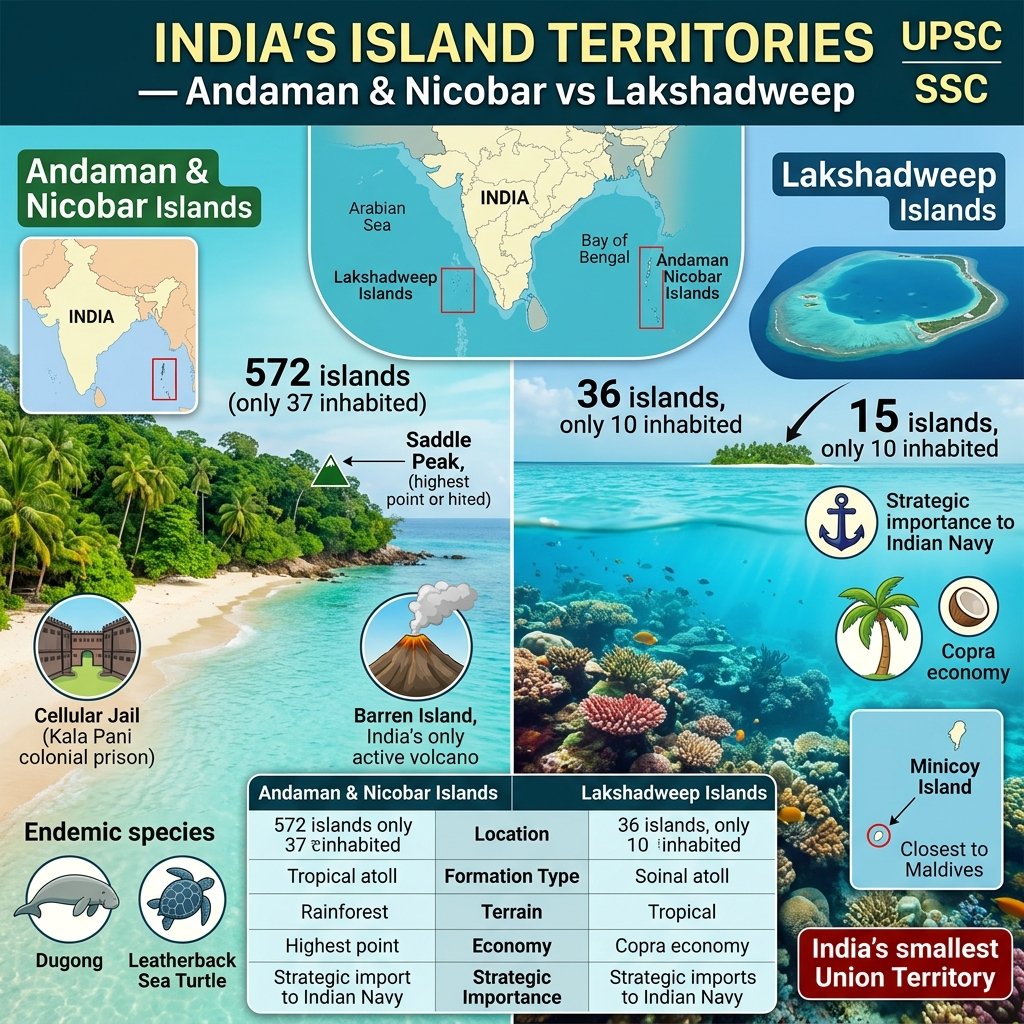
Comparison: Andaman & Nicobar vs Lakshadweep
| Feature | Andaman & Nicobar Islands | Lakshadweep |
|---|---|---|
| Location | Bay of Bengal; 1,255 km SE of mainland India (Chennai); near Myanmar, Indonesia, Thailand | Arabian Sea; 200–440 km west of Kerala coast; nearest to Kozhikode (~200 km) |
| Total Islands | 572 islands (only 37 inhabited) | 36 islands (only 10 inhabited) + 12 atolls + 5 submerged banks |
| Area | 8,249 km² (India’s largest UT by area) | 32 km² (India’s smallest UT by area) |
| Capital | Port Blair (South Andaman island) | Kavaratti (largest inhabited island) |
| Population (2011 Census) | 3.8 lakh (low density) | 64,473 (very low; no Hindu majority — Muslim majority UT) |
| Geological Origin | Submerged mountain range of the Arakan Yoma extension (fold mountains); volcanic in Barren Island and Narcondam Island; tectonic origin | Coral atolls — built up by coral reef organisms over millions of years; no volcanic or sedimentary rock; purely biogenic (coral + shell) formation on submarine volcanic ridge |
| Terrain | Hilly (highest = Saddle Peak, 732m, North Andaman); dense tropical rainforest (86% forest cover = highest among ITs); coastal beaches | Flat (max elevation ~4m above sea level); coralline sand; no hills; extremely vulnerable to sea-level rise; coconut palms dominant vegetation |
| Major Ecological Feature | Tropical rainforest; mangroves; coral reefs (especially around Ritchie’s Archipelago); species-rich as extension of Southeast Asian biodiversity | Coral atoll ecosystem; India’s best-preserved coral reefs (relatively low human pressure); Agatti Island reef; Dugong habitat |
| Strategic Importance | Commands eastern approach to Indian Ocean; overlooks Strait of Malacca (world’s busiest shipping lane — 25% of global trade); critical for Andaman Sea surveillance; INS Baaz (India’s southernmost naval air station, Car Nicobar); IOR (Indian Ocean Region) strategy | Guards Arabian Sea sea lanes; close to Maldives (Minicoy Island = 200 km from Maldives); strategic counter to Chinese and Pakistani naval presence in IOR |
| Economy | Tourism (growing), fisheries, timber (regulated); coconut; small manufacturing; major connectivity through Port Blair airport and shipping | Copra (dried coconut), fisheries (tuna), tourism (permit-restricted); 100% dependent on Kerala for food and goods supply by mainland ferry/flight |
| Governance | Union Territory with Lieutenant Governor; no state legislature (schedule 5 and tribal protection areas); local bodies; CAR Nicobar tribal area restrictions | Union Territory with Administrator; no elected legislature; fully administered by Centre; PESA (Panchayats Extension to Scheduled Areas) applicable; Lakshadweep Administration Act |
Andaman & Nicobar Islands — Deep Dive
Geography & Geology
- 🌋 Formation: The Andaman chain is the emergent portion of a submarine mountain range — the continuation of the Arakan Yoma fold mountains of Myanmar — stretching approximately 800 km north-south; the islands are geologically young (Cenozoic era) and tectonically active, sitting on the Burma Plate at its boundary with the Indian Plate; the 2004 Indian Ocean Tsunami (26 December 2004) originated in this subduction zone (9.1 magnitude earthquake off northern Sumatra); the tsunami killed approximately 2,000 people in the Andaman & Nicobar Islands and permanently submerged several low-lying islands
- 🌋 Barren Island: India’s only confirmed active volcano; located 135 km northeast of Port Blair; last major eruption = 2017 (smoke and lava flows); part of the same volcanically active arc as Indonesia’s Krakatoa; monitored by Geological Survey of India (GSI)
- 🌋 Narcondam Island: Dormant volcano; 145 km northeast of Port Blair; home to the Narcondam Hornbill (endemic subspecies of Wreathed Hornbill — found ONLY on this one island; classified as Vulnerable; protected as Bird Sanctuary); the island has never been permanently inhabited
- ⛰️ Highest point: Saddle Peak (732m), North Andaman Island; highest point in any of India’s Union Territories; covered in evergreen tropical forest
Cellular Jail (Kaala Paani)
- ⛓️ History: Constructed 1896–1906 by British colonial authorities specifically to exile Indian political prisoners far from mainland India across the “Kaala Paani” (Black Water = the dark, terrifying Bay of Bengal as conceived in Indian Hindu tradition where crossing the ocean was a ritual taboo); its remote location (1,255 km from Calcutta) made escape impossible and communication nearly impossible; housed thousands of freedom fighters including Bal Gangadhar Tilak’s associate Lokmanya Tilak’s associates, Veer Savarkar (confined 1911–1921 in solitary confinement; wrote Marathi poetry on cell walls), and revolutionaries from the 1857 uprising’s survivors
- ⛓️ Architecture: Octopus-like design with 7 wings radiating from a central tower; 698 cells; each cell could monitor adjoining wings from the central tower; a panopticon-style surveillance architecture
- ⛓️ National Memorial: Declared National Memorial; daily light-and-sound show narrating Indian freedom struggle; major historical tourism destination; UPSC frequently asks about Cellular Jail and Kaala Paani in Indian history context
Tribal Communities (Andaman)
- 👥 Great Andamanese: Once thousands; driven to near-extinction by British colonisation (disease, displacement, land alienation); fewer than 60 individuals remain today on Strait Island; government-supported but severely endangered as cultural group
- 👥 Onge: Inhabit Little Andaman Island; ~100 individuals remaining; Primitive Tribal Group (PTG) classification
- 👥 Jarawa: South and Middle Andaman Island; approximately 300–400 individuals; resisted all outside contact until the late 1990s; Andaman Trunk Road (ATR) passes through their reserve — tourists and traders using ATR created contact; SC ordered closure of ATR to tourism; their uncontrolled contact with outsiders = threat of disease (immune to diseases common to others), loss of hunter-gatherer way of life; anthropological debate: isolate or integrate?
- 👥 Sentinelese: North Sentinel Island; world’s most isolated tribe; approximately 50–400 individuals (unknown); respond to all outsider approach with arrows; Indian government maintains a buffer zone — no approach allowed within 3 nautical miles; American Christian missionary John Allen Chau was shot dead by Sentinelese with arrows in November 2018 when he attempted to contact them; Indian law protects their right to remain isolated; any contact is illegal
- 👥 Shompen: Great Nicobar Island; semi-nomadic forest tribe; ~200–400 individuals; affected by 2004 tsunami; critically threatened by proposed Great Nicobar Island development project
Great Nicobar Island Development Project (Controversy)
- 🏗️ The project: ₹72,000 crore “Holistic Development” project approved by Union Cabinet in 2022; components: transshipment megaport (to compete with Singapore’s transshipment hub), greenfield international airport, township for 3.5 lakh people, 450 MW gas/solar power plant; Great Nicobar is India’s southernmost island (just 90 km from Indonesia’s Sumatra); strategic importance for Indian Navy IOR presence
- ⚠️ Conservation controversy: Great Nicobar Island is a UNESCO Biosphere Reserve; home to Leatherback Sea Turtle (world’s largest sea turtle, nests prolifically on Great Nicobar beaches), Nicobar Megapode (endemic, endangered; nests in sand mounds that would be obliterated by construction), 330 bird species, saltwater crocodile, Shompen tribe; MoEF’s Forest Advisory Committee granted clearance for 130 sq km of pristine rainforest to be felled = one of the largest single forest clearances in recent Indian history; environmentalists say: “This is India’s biggest single ecological mistake”; government says: “India cannot remain inaccessible for environmental reasons while China builds Gwadar and Hambantota nearby”; Supreme Court is monitoring
Lakshadweep Islands — Deep Dive
- 🪸 Formation: Lakshadweep is a classic coral atoll archipelago — formed by coral polyps building reef structures on the tops of a submerged volcanic ridge over millions of years; as the volcanic foundation slowly subsided, coral grew upward, eventually forming the ring-shaped atolls (atoll = lagoon enclosed by coral reef) characteristic of Lakshadweep; exactly the same formation process as Maldives, Marshall Islands, Hawaiian atolls; maximum elevation = approximately 3–4 metres above current sea level; one of the most sea-level-rise-vulnerable territories in the world
- 🪸 Islands distribution: 36 islands; 12 atolls; 5 submerged banks; 2 submerged reefs; only 10 islands inhabited by permanent population; Minicoy is the southernmost island (closest to Maldives at 200 km); Agatti has the only airport; Kavaratti = capital; Bangaram = premier tourist resort (uninhabited prior)
- 🪸 Demography: Population = 64,473 (2011 Census); almost entirely Muslim (Sunni, matrilineal traditions among Lakshadweep’s indigenous people — the Aminidivi, Minicoyans etc., many historically with matrilineal property norms influenced by pre-Islamic culture blending with Islam); Malayali language; culturally closely linked to Kerala; livelihoods = fishing (tuna export), copra (dried coconut), limited tourism
- 🪸 Coral reef ecology: Lakshadweep’s reefs are among the healthiest in India — relatively low population density and restricted tourist access have maintained reef health; however, the 1998 El Niño event caused severe coral bleaching (loss of zooxanthellae algae from thermal stress at +2°C anomaly sea surface temperature) with 70%+ coral mortality at some atolls; recovery partial by 2005; 2016 El Niño bleaching again caused 25–40% damage; with projected +1.5–2°C baseline ocean warming from climate change = existential threat to Lakshadweep’s reef ecosystem and the island chain itself (no reef = no land building = atoll below sea level)
- 🌊 Lakshadweep Administration controversy (2021): Administrator Praful Patel issued a series of draft regulations in 2021 — restricting beef sale, preventing “non-local” panchayat candidates, changing liquor rules, demolishing “unauthorised” structures — that caused mass protest from Lakshadweep’s Muslim majority population and Kerala government; Congress and Left parties termed the regulations an attack on minority culture; the beef ban in a territory with near-100% Muslim population was particularly sensitive; most controversial draft regulations were either withdrawn or not implemented; highlighted the tension between centrally-administered UT governance and local community rights
Strategic Importance of Island Territories
| Strategic Asset | Andaman & Nicobar | Lakshadweep |
|---|---|---|
| Naval Base | INS Baaz (Car Nicobar) = India’s southernmost naval air station; INS Jarawa (Port Blair) = tri-services command; Andaman & Nicobar Command = India’s only tri-service theatre command (Army+Navy+Air Force jointly) | INS Dweeprakshak (Kavaratti); maritime patrol base; Coast Guard Station Minicoy; expanding in response to Chinese IOR activity |
| Choke Point Control | Ten Degree Channel separates Andaman and Nicobar island chains; Six Degree Channel = southern tip near Indonesia; these channels are key entry/exit routes for ships moving between Indian Ocean and Pacific via Malacca; India can monitor (and theoretically interdict) shipping through these channels | Guards the Nine Degree Channel (9-degree parallel) between Lakshadweep and Maldives; crucial for Arabian Sea security |
| China Factor | China’s String of Pearls strategy = Chinese naval access points surrounding India (Gwadar/Pakistan, Hambantota/Sri Lanka, Kyaukpyu/Myanmar, Chittagong/Bangladesh); Andaman & Nicobar positions India to monitor Chinese warships transiting to IOR through Malacca | Counter to Gwadar port (Pakistan) and CPEC naval implications; Minicoy’s proximity to Maldives = strategic relevance as China deepens Maldives security ties (post-2023 Muizzu govt) |
| EEZ Contribution | Adds ~600,000 km² of EEZ to India — rich fishing grounds; potential hydrocarbon resources in Andaman basin | Adds ~400,000 km² of EEZ to India — rich tuna fishing grounds; coral ecosystem resource |
⭐ Important for Exams — Quick Revision
- 🔑 A&N Islands: 572 islands; 37 inhabited; 8,249 km² area; Bay of Bengal; capital Port Blair; India’s largest UT by area
- 🔑 Lakshadweep: 36 islands; 10 inhabited; 32 km² area; Arabian Sea; capital Kavaratti; India’s smallest UT by area; Muslim majority
- 🔑 A&N geological origin: Extension of Arakan Yoma fold mountains (Myanmar); some volcanic (Barren Island = active, Narcondam = dormant)
- 🔑 Lakshadweep geological origin: Coral atolls on submerged volcanic ridge; max elevation 3–4m; most sea-level-rise vulnerable UT
- 🔑 Barren Island: India’s only active volcano; 135 km NE of Port Blair; last erupted 2017; monitored by GSI
- 🔑 Saddle Peak: Highest point in A&N Islands (732m) AND highest point in any UT of India; North Andaman
- 🔑 Cellular Jail (Kaala Paani): Built 1896–1906; 698 cells; 7 wings; Port Blair; housed Veer Savarkar + freedom fighters; National Memorial; National Memorial light-and-sound show
- 🔑 2004 Tsunami: 9.1 magnitude earthquake near Sumatra; ~2,000 deaths in A&N Islands; some islands permanently submerged
- 🔑 Sentinelese of North Sentinel Island: World’s most isolated tribe; 50–400 individuals; approach illegal (3 nautical mile buffer); John Allen Chau killed 2018
- 🔑 Jarawa tribe: 300–400 individuals; South and Middle Andaman; Andaman Trunk Road debate; contact only recent (late 1990s)
- 🔑 Great Nicobar Development: ₹72,000 crore project; transshipment port + airport + township; UNESCO Biosphere Reserve area; Leatherback Turtle nesting threatened; Shompen tribe endangered; SC monitoring
- 🔑 Narcondam Hornbill: Endemic to single island (Narcondam); found ONLY there; classified Vulnerable
- 🔑 Lakshadweep coral bleaching: 1998 El Niño = 70%+ coral mortality; 2016 El Niño = 25–40% damage; rising sea temperatures = existential threat
- 🔑 Andaman & Nicobar Command: India’s ONLY tri-service theatre command (joint Army+Navy+Air Force); HQ Port Blair
- 🔑 String of Pearls (China): Chinese strategic access points = Gwadar (Pakistan) + Hambantota (Sri Lanka) + Kyaukpyu (Myanmar); Andaman islands provide India counter-monitoring capability
- 🔑 India’s EEZ: 2.37 million km²; islands contribute ~30%; EEZ rights = exclusive fishing, minerals, energy resources up to 200 nautical miles
- 🔑 Ten Degree Channel: Separates Andaman Islands from Nicobar Islands; strategic maritime passage
- 🔑 Minicoy Island (Lakshadweep): Southernmost; 200 km from Maldives; strategically valuable for Arabian Sea monitoring
Frequently Asked Questions (FAQs)
1. Who are the Sentinelese — and why does India protect their isolation rather than “civilise” them?
The Sentinelese of North Sentinel Island are arguably the world’s most studied un-contacted people — and the most deliberately un-contacted by a democratic government. North Sentinel Island, roughly the size of Manhattan (approximately 60 km²) in the Bay of Bengal southwest of Andaman Islands, is home to approximately 50–400 people (population estimates vary enormously because no safe census has ever been conducted) who have resisted all outside contact for at least 60,000 years — making them likely the world’s longest continuously isolated human community. Archaeological and genetic evidence suggests that the Andamanese peoples, including the Sentinelese, are among the first descendant populations of anatomically modern humans who migrated Out of Africa approximately 60,000–70,000 years ago along the southern coastal route; they may retain a direct genetic and cultural lineage to the earliest human settlers of Asia, essentially unchanged by the subsequent agricultural revolutions, metallurgical transformations, and state-building that shaped the rest of humanity. The contact attempts: The British colonial administration attempted contact multiple times; most resulted in the Sentinelese pulling their children indoors and launching arrows at the approaching boats. In the 1960s–70s, anthropologist T.N. Pandit led the most successful early contact missions — managing to leave gifts (coconuts, pigs, plastic toys) on the beach and observe the islanders at distance; some cautious, limited, non-hostile interactions occurred in 1991. After a Indian Coast Guard helicopter approached in 2006 (after the 2004 tsunami, to assess their survival), they shot arrows at it. Two fishermen who accidentally drifted onto the island (2006) were killed. John Allen Chau, an American Christian missionary who genuinely believed he was called by God to convert the Sentinelese, made multiple attempts to land on North Sentinel Island in November 2018; on his third attempt he was shot by arrows and killed; his body was never recovered. Indian authorities arrested the fishermen who illegally transported Chau to the island but chose not to attempt recovery of his body, avoiding any confrontation with the Sentinelese. Why India protects isolation: India’s policy since the 1990s has been to protect the Sentinelese’s right to remain isolated. The rationale has multiple dimensions: (1) Immunological vulnerability: The Sentinelese have had no exposure to common diseases (influenza, measles, chickenpox, smallpox) for which mainland populations have developed centuries of immune memory and vaccination; contact with outsiders has historically caused catastrophic disease die-offs among isolated peoples — the Andaman Islands’ Great Andamanese (once thousands, now ~60) were nearly exterminated by diseases introduced by British colonists. For the Sentinelese, contact-borne disease could kill 80–100% of the community within months. (2) Right to self-determination: The Sentinelese’s consistent, clear communication — shooting arrows at any approaching vessel or helicopter — constitutes an unmistakable “no” to contact. Forcing contact would be colonialism by another name. (3) Anthropological value: As the last completely isolated community, the Sentinelese represent irreplaceable knowledge about pre-agricultural human society, skills, and social organisation. Contact that destroys their community would permanently erase this knowledge. Indian law (Protection of Andaman and Nicobar Aboriginals Act) makes any approach within 3 nautical miles of North Sentinel Island illegal. The Indian government enforces this by Coast Guard patrols and surveillance. The Sentinelese are, in effect, sovereign on their own island by India’s legal framework — the only such designation in the world for an un-contacted people.
2. What is the Great Nicobar Island Development Project — and why do scientists say it is India’s biggest ecological mistake?
The Great Nicobar Island Holistic Development Project, approved by India’s Union Cabinet in 2022 at an estimated cost of ₹72,000 crore, is simultaneously India’s most ambitious island infrastructure investment and the most contested environmental decision of the Modi government’s tenure. The island — India’s southernmost (at 6°45’N latitude, just 90 km from Indonesia’s Sumatra) — is a UNESCO Biosphere Reserve, home to one of the most biodiverse tropical ecosystems in the Indian subcontinent, and the primary nesting site of the endangered Leatherback Sea Turtle in India. What the project proposes: A four-component development: (1) A transshipment megaport — designed to capture a share of the massive cargo transshipment business currently handled by Singapore (which processes approximately 30% of global container traffic); Great Nicobar’s position near the Malacca Strait would reduce shipper costs compared to detouring to Singapore; (2) A greenfield international airport (Great Nicobar currently has no airport); (3) A township for 3.5 lakh people — the island currently has ~8,000 residents (mostly Shompen and Nicobarese tribes plus some military); bringing 3.5 lakh people would transform its demographics utterly; (4) A 450 MW gas and solar power plant for the new township. What ecologists say is at stake: The Forest Advisory Committee (FAC) under the MoEF granted clearance for 130 km² of tropical rainforest to be cleared in a UNESCO Biosphere Reserve — the largest single deforestation in the Andaman & Nicobar Islands’ recorded history. The ecological damage catalogued by scientists includes: (a) Leatherback Sea Turtle (Dermochelys coriacea) — the world’s largest sea turtle (up to 2 metres, 900 kg); listed as Vulnerable globally under IUCN; the proposed port and airport construction area at Galathea Bay is the primary nesting site in the entire South Asian region, hosting 2,000–4,000 turtle nests per season; port lights and construction would disorient nesting females and destroy nests; (b) Nicobar Megapode — a critically endemic bird found only in Nicobar Islands; nests in sand mounds on beaches = exactly where port construction is planned; no nest = no reproduction = local extinction; (c) Shompen tribe — ~200–400 individuals, one of India’s most isolated tribes; their forest territory and food sources would be devastated by clearing 130 km²; (d) Coral reefs — the construction of a port requires dredging (removing seabed) and reclamation (filling sea with rock/concrete) which destroys adjacent coral systems for kilometres; (e) Seismic risk — the 2004 tsunami epicentre was just 200 km from Great Nicobar; building a megaport and township on an island with this seismicity profile is classified as extreme risk by geologists. The government’s counter-argument: India cannot remain strategically blind to Great Nicobar’s position — 90 km from the Malacca Strait, in the path of 25% of global trade — while China builds Gwadar (Pakistan), Hambantota (Sri Lanka), Kyaukpyu (Myanmar), and Djibouti (Africa) bases, creating a comprehensive encirclement of India’s maritime interests. The port’s strategic value is genuine. The environmental cost is also genuine. The project represents the sharpest-edged version of the tension between India’s development aspirations and its biodiversity commitments — a tension the Supreme Court of India is examining.
3. How does Lakshadweep’s coral atoll formation make it uniquely vulnerable to climate change?
Lakshadweep’s islands exist because of coral. Not just associated with coral — made of coral. Every grain of sand, every square centimetre of land on Lakshadweep’s 36 islands is biogenic carbonate: the accumulated skeletal remains of coral polyps (calcium carbonate, CaCO3), foraminifera, molluscs, and algae deposited over the past 10,000–60,000 years on the tops of a submerged volcanic ridge in the Arabian Sea. This is what makes Lakshadweep fundamentally different from mainland Indian geography and why climate change represents an existential — not merely environmental — threat to these islands. How atolls stay above water: An atoll is a dynamic system, not a static landform. The coral reef surrounding each Lakshadweep island is constantly growing (coral polyps add new calcium carbonate) and simultaneously being eroded by waves and bioerosion. In a healthy reef system, coral growth slightly exceeds erosion over time — meaning the island builds up faster than the sea rises. Research on Pacific atolls (notably Tuvalu, Marshall Islands, and Maldives) has shown that healthy coral reefs can keep pace with sea level rise rates of up to 5–7mm per year through sediment production. The crisis arises from two simultaneous changes: (1) Ocean warming bleaches coral: When sea surface temperature rises more than 1°C above the summer maximum for more than 4 weeks, coral polyps expel their symbiotic algae (zooxanthellae), turning white (bleaching) and eventually dying if conditions persist. Dead coral becomes covered by algae, stops growing, and begins to erode. The 1998 El Niño caused 70%+ coral mortality at several Lakshadweep atolls; the 2016 event caused additional 25–40% damage. Events of this severity are projected to occur annually (not once per decade) if global warming reaches 1.5°C, and every year or more frequently at 2°C. (2) Ocean acidification dissolves reef: As CO2 dissolves in seawater, it forms carbonic acid, lowering ocean pH (ocean has acidified by 0.1 pH units since pre-industrial = 30% increase in acidity). Acidified water dissolves calcium carbonate — meaning even dead coral skeletons and the limestone foundation of the islands themselves slowly dissolve. At projected 2°C warming, the chemical conditions for carbonate dissolution exceed coral skeletal formation rates = net loss of island mass. Lakshadweep’s specific vulnerability: The maximum elevation of any Lakshadweep island is approximately 3–4 metres above mean sea level. The IPCC’s AR6 (2021) projects global mean sea level rise of 0.3–1.0m by 2100 (intermediate-high scenario); storm surges of 2–3m above tide level are already documented during tropical cyclones in the Arabian Sea (Cyclone Ockhi, 2017 severely impacted Minicoy). Multiple climate model projections show that without healthy coral reef protection and with continued coral bleaching, Lakshadweep’s inhabited islands would experience regular inundation of freshwater lenses (the thin freshwater aquifer in the limestone is the only freshwater source — saltwater contamination renders islands uninhabitable), severe beach erosion, and ultimately inundation. The projection is not that islands will suddenly disappear — it is that the freshwater lens, agricultural soil, and coastal stability will degrade until permanent habitation becomes impossible. India’s government is investing in seawalls, beach nourishment, desalination plants, and coral transplantation programmes for Lakshadweep — but ecologists argue these are purely symptomatic responses without addressing the root cause of ocean warming and coral bleaching.
Related Geology Articles on StudyHub
- ➡️ Northeast India — Another Strategic Periphery of India
- ➡️ Foreign Policy — Indian Ocean Region Strategy & String of Pearls
- ➡️ Ecology — Coral Reef Ecosystem Biology
- ➡️ Climate Change — Sea Level Rise & Island Vulnerability
- ➡️ Natural Disasters — Tsunami 2004 & Cyclone Risk