
Last Updated: March 2026 | Reading Time: 13 minutes | ~2,900 words | Category: Economic Geology & Mineral Resources
India is one of the world’s most mineral-rich countries — its ancient Precambrian shield (the Peninsular Plateau, particularly the Chhotanagpur region of Jharkhand-Odisha) contains some of the planet’s richest concentrations of metallic minerals, while its Gondwana sedimentary basins hold vast reserves of coal, and its offshore sedimentary basins yield significant petroleum and natural gas. As of 2023, India ranks among the world’s top producers of: iron ore (4th largest producer globally), coal (2nd largest consumer, 3rd largest producer), mica (was once world’s largest producer, Koderma-Giridih Jharkhand), bauxite (5th largest reserves), chromite (3rd globally), manganese ore, zinc, and limestone. India’s total minerals (excluding fuel) production value: approximately ₹2.40 lakh crore per year (2022-23, Indian Bureau of Mines). The National Mineral Policy 2019 and the Mines and Minerals (Development and Regulation) MMDR Act 1957 (substantially amended in 2015 and 2021) govern India’s mining sector with the goal of reducing imports, ensuring sustainable extraction, and accelerating development of “critical minerals” essential for India’s energy transition (EV batteries, solar panels, wind turbines). India’s most significant mineral challenge: it is largely import-dependent for many critical minerals — lithium, cobalt, nickel, REE (Rare Earth Elements), platinum-group metals — all essential for the 21st-century clean energy economy. India’s recently discovered lithium deposit in Reasi, J&K (2023, ~5.9 million tonnes, India’s first significant lithium find — though still awaiting exploration and economic viability assessment) and thorium-heavy monazite deposits in Kerala beaches are strategically significant for the future. The Chhotanagpur Plateau (Jharkhand) is India’s undisputed mineral heartland — accounting for a disproportionate share of coal, iron ore, copper, bauxite, mica, uranium, and manganese, earning it the title “India’s Ruhr” (after Germany’s industrial heart). Understanding India’s mineral distribution, its major mining districts, and policy framework is a mandatory component of UPSC Geography Paper I and all competitive examination General Awareness sections.
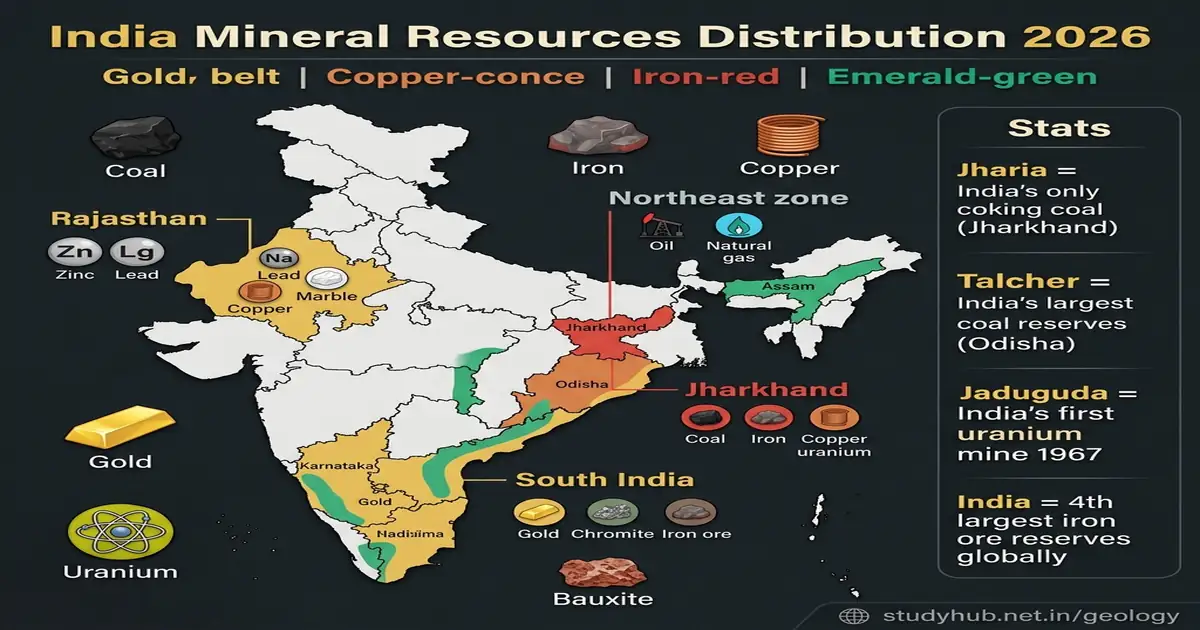
India’s Mineral Resources — Distribution, Mining Belts & Economic Significance 2026
1. Metallic Minerals — Iron, Aluminium, Copper, Gold & More
| Mineral | Reserves & Production | Major Mining Locations | Industrial Use & Significance |
|---|---|---|---|
| Iron Ore (Fe) | India’s total reserves: ~28.5 billion tonnes (BT) — 4th largest in world. Annual production: ~250 MT (2022-23 = historic record). Major ore types: Haematite (Fe₂O₃, most valuable, 58-65% Fe, high grade, Superb for steel). Magnetite (Fe₃O₄, 45-65% Fe, magnetic — best for direct reduction steel). India = net EXPORTER of iron ore (primarily to Japan, China, South Korea, EU). Steel production: India = 2nd largest steel producer globally (2022) — 124 MT crude steel. National Steel Policy 2017: target 300 MT steel/yr by 2030. Tata Steel, SAIL (Steel Authority of India), JSW, RINL (Rashtriya Ispat Nigam) are major producers | Odisha (largest): Keonjhar, Sundargarh (Kiriburu, Meghataburu, Bolani mines), Koraput, Bargarh. Total Odisha = ~35% India’s iron ore production. Chhattisgarh: Bailadila (district Dantewada = world-class high-grade haematite, 65% Fe, 14 deposit range = one of world’s highest quality iron ore mines, NMDC = National Mineral Development Corporation). Bailadila ore loaded on Vishnupur-Jagdalpur-Kirandul Railway (NMDC’s own rail). Goa: Codli, Bicholim (laterite-capped haematite) — controversial. Mining banned 2018 by SC, partially resumed. Karnataka: Bellary-Hospet-Sandur (Kudremukh magnetite = closed 2005 to protect national park). Jharkhand: Singhbhum (Gua, Chiria). AP/Telangana: Karimnagar, Kurnool | Steel = backbone of infrastructure, construction, defence, automobiles. Every 1 tonne of steel needs ~1.6T iron ore + 0.8T coking coal. India is now 2nd largest steel producer globally (after China). Bellary-Hospet (Karnataka): “Sponge iron capital” — DRI (Direct Reduced Iron) using local iron ore + coal. Goa mining: major exports (Mormugao Port). 2012-2018 illegal mining scandal + SC ban → Goa GDP fell sharply. Resumption allowing 20 MT/yr cap (controversial). NMDC (National Mineral Development Corporation): PSU, Hyderabad HQ, world’s 3rd largest iron ore mining company. Operates Bailadila (CG), Donimalai (Karnataka), Panna diamond (MP). EXPORTS: India exports ~60 MT/yr iron ore. Major destination: China (60%), Japan, South Korea. Iron export cess used to fund NMDC |
| Coal (Energy Mineral) | India’s coal reserves: ~319 billion tonnes (world’s 4th largest). Annual production: ~893 MT (2022-23 = India’s highest ever). Annual consumption: ~1,200 MT (imports 200+ MT for coking coal and high-grade thermal coal). India = world’s 2nd largest coal consumer (after China). Types: Bituminous (most India’s coal — Gondwana coalfields, used for thermal power). Anthracite (small amounts, J&K = Kalakote = India’s ONLY anthracite mine). Lignite/Brown coal: Neyveli (Tamil Nadu, NLCIL = Neyveli Lignite Corp). Peat: small amounts in NE India. Gondwana coalfields: Permian age (250–290 Ma), Sedimentary basins, Peninsular India. These are the dominant commercial coalfields — coking + thermal. Tertiary coalfields: NE India (Assam, Meghalaya, Arunachal) — younger, lower quality | GONDWANA COALFIELDS (major): Jharkhand: Jharia (BCCL = Bharat Coking Coal Ltd — India’s LARGEST and India’s ONLY coking coal field, Dhanbad district, fire burning underground since 1916, >40 km² on fire = ecological + human disaster). Bokaro (BCCL). Giridih (oldest Jharia coal, discovered 1774). Karanpura (CCL = Central Coalfields Ltd). WestBengal: Raniganj (ACL = oldest coalfield in India, discovered 1774 CE by East India Company, John Sumner). Eastern Coalfields Ltd (ECL). Ranigunj = anthracite-bituminous mix. MP: Singrauli (NCL = Northern Coalfields, Singrauli MP), Sohagpur, Umaria, Johilla. Chhattisgarh: Korba (SECL = South Eastern Coalfields), Hasdeo-Arand (controversial forest area clearance). Odisha: Talcher (MCL = Mahanadi Coalfields = India’s LARGEST coalfield by reserves, Angul district, thermal coal). WB-Jh-Or most important. Tertiary: Assam (Margherita, Makum, Jaintia Hills = Ledo coal), Meghalaya (Jaintia Hill “rat-hole mining” = now SC banned) | Coal = 75% of India’s electricity generation (thermal power plants). Coal India Ltd (CIL): world’s largest coal mining company. HQ Kolkata. Has 7 subsidiaries (BCCL, ECL, ECL, MCL, NCL, SECL, CCL, WCL). Target: 1 billion tonne production by 2025. Jharia fire: underground fires for 100+ years → land subsidence, toxic gas, 380,000 residents displaced. Coking coal (metallurgical): only Jharia in India. India imports ~60 MT coking coal from Australia (Queensland) for steel plants (SAIL, JSW, Tata Steel can’t function without coking coal imports). Talcher: India’s future coal hub (15 billion tonnes reserves = MCL = largest single coalfield). Coal + environment: Coal India is one of world’s largest single emitters. India’s target = phasedown (not phaseout) of coal per Paris Agreement commitment. Solar + renewables growing fast but coal still 75% power mix |
| Bauxite (Aluminium ore = Al₂O₃·nH₂O) | India’s bauxite reserves: ~3.9 billion tonnes (5th largest in world). Annual production: ~23 MT. Bauxite = thoroughly laterised (leached) soil/rock with >40% aluminium oxide. India’s bauxite = gibbsite-type (easily processable). Aluminium uses: Aircraft, packaging, electrical cables, construction, automobiles (lightweight). India has significant aluminium smelting capacity: NALCO (NALCO = National Aluminium Company, PSU, Bhubaneswar HQ), Vedanta (Bharat Aluminium = BALCO CG, Vedanta Aluminium Odisha Lanjigarh), Hindalco (Renukoot UP, Aditya Birla Group) | Odisha: Koraput (Panchpatmali bauxite plateau = India’s largest bauxite deposit = 1,200 MT reserves, Naptha Jhola, NALCO’s Damanjodi refinery). Also: Kalahandi (Karlapat), Rayagada (Chhattisgarh border). Jharkhand: Lohardaga district (Netarhat Plateau bauxite = high quality, HAL uses for aerospace). Lohardaga = India’s most important bauxite district by quality. Chhattisgarh: Ambikapur, Surguja, Jashpur. Gujarat: Bhavnagar, Jamnagar (lower-grade marine sedimentary bauxite). MP: minor. Goa: minor. Note: NALCO’s full chain: Panchpatmali Bauxite Mine (Koraput, Odisha) → Damanjodi Alumina Refinery (Koraput) → Angul Aluminium Smelter (Angul district, Odisha, powered by NALCO’s own thermal plant) — India’s most integrated aluminium chain. Vedanta Lanjigarh: controversial (Niyamgiri Hills, Kondh tribe, rejected mining, PESA + Forest Rights Act issues, SC ruled Kondh consent required) | Vedanta’s Lanjigarh (Niyamgiri): one of India’s most prominent mining-vs-tribal rights cases. Niyamgiri Hills sacred to Kondh Adivasi (worship “Niyam Raja” god = hills as divine). SC 2013: ruled that gram sabha (village assembly) CONSENT required before mining. All 12 gram sabhas voted NO → mining halted. Key precedent for FPIC (Free, Prior, Informed Consent) in India. Forest Rights Act 2006: guarantees tribal forest rights; PESA 1996: panchayat rights in scheduled areas. NALCO: state-of-art energy-efficient aluminium (0.5 MW/tonne vs global avg 1 MW/tonne). MMDR Amendment 2021: auctioning of mineral blocks (not allocations), increased District Mineral Foundation (DMF) levy for local area benefit. Critical mineral for: EV battery cases (aluminium body), solar panels (aluminium frames). India’s aluminium: 40 lakh tonne/yr capacity, 56% exported |
| Copper, Zinc & Lead | COPPER: India’s reserves: ~698 MT copper ore. Small domestic production (~1-3% global share). India IMPORTS ~80% of copper concentrate needs. Companies: Hindustan Copper Ltd (HCL, PSU, only fully integrated copper company). Annual production: Malanjkhand Mine (~5 MT ore/yr). Khetri Mine (Rajasthan). Singhbhum (operational but declining). ZINC-LEAD: India = world’s 5th largest zinc ore producer. Hindustan Zinc Ltd (HZL, Vedanta Group, majority privatised): operates Rampura Agucha (world’s largest zinc mine in Rajasthan). ~850,000 tonnes zinc metal/yr = 11% of world zinc output from single company. Zawar mines (oldest continuously operating mine, 2,500+ years history, AD 400 = world’s first zinc smelting = Zawar, Rajasthan) | COPPER MINES: Malanjkhand (Balaghat district, MP = India’s largest copper mine, underground + opencast, HCL, ore reserves 370 MT at 0.98% Cu). Khetri (Jhunjhunu district, Rajasthan = “Copper City”, HCL, underground mine, Rajasthan Copper Project). Singhbhum Copper Belt (East Singhbhum, Jharkhand: Rakha, Surda, Mosaboni mines — some closed, some active, HCL). Agnigundala (AP Guntur — small copper). Parbatpur (Bihar). ZINC-LEAD MINES: Rampura-Agucha (Bhilwara district, Rajasthan = world’s LARGEST zinc mine by ore production, ~6 MT/yr ore, 14% Zn grade). Rajpura-Dariba (Rajsamand, Rajasthan). Sindesar Khurd (Rajsamand). Zawar Complex (Udaipur district, Rajasthan — 4 mines: Zawar, Mochia, Balaria, Baroi — 2,500 year old zinc smelting tradition). LEAD: largely co-produced with zinc in Rajasthan | Copper = essential for: electrical wiring (66% of use), motors, EVs (4x copper than ICE car), plumbing. India’s copper deficit is STRATEGIC RISK for EV ambitions. India mining ~0.4 MT copper/yr, consuming 0.9 MT/yr → large deficit. Hindustan Copper Ltd working to expand Malanjkhand + explore new deposits. Zinc = galvanising steel (prevents rust), batteries, agriculture (zinc sulphate fertiliser). HZL (Hindustan Zinc) = private company (Vedanta group), Govt retains 29.5% stake. World’s largest zinc company outside China. Zawar zinc mines: archaeological evidence of distillation-based zinc smelting dating to AD 400 — the WORLD’S FIRST KNOWN ZINC SMELTING (centuries before Europe or elsewhere). UNESCO-worthy industrial archaeology. Now part of HZL modern mining. Rajasthan = India’s “Zinc State” + India’s “Copper State” + India’s “Marble State” = one of India’s most mineralised states |
| Gold, Chromite & Manganese | GOLD: India’s reserves: small (~650 tonnes gold ore reserve, globally minor). Only significant gold belt: Hutti (Raichur, Karnataka) = India’s ONLY operated primary gold mine + Uti (minor). KGF (Kolar Gold Field, Kolar, Karnataka) closed 2001. CHROMITE: India’s reserves: ~200 MT = 1st or 2nd globally. Production: 3rd globally (~4 MT/yr ore). Uses: stainless steel (70%), chemicals, refractories. MANGANESE: India’s reserves: ~480 MT. Production: 2-3 MT ore/yr. Uses: steel alloy (1 tonne steel needs ~7 kg Mn). Also batteries. | GOLD: Hutti Gold Mine (Raichur district, Karnataka) = India’s ONLY significant current gold mine (Hutti Gold Mines Company Ltd, Karnataka state PSU). Production ~2 tonnes/yr gold (falls far short of India’s 900 tonne/yr gold jewellery demand → India imports 850+ MT/yr = world’s largest gold importer!). KGF (Kolar Gold Field, Kolar): mined 1875–2001, 3.2km deep, total ~800 tonnes extracted in 126 years. Closed (uneconomic). Wainad (Kerala): minor alluvial gold (placer). Nilambur (Kerala): ancient alluvial gold. CHROMITE: Odisha = 92% India’s chromite (Sukinda Valley, Jajpur district = world’s largest chromite deposit, 93% of India’s chromite). Hutti and Nuggihalli (Karnataka) minor. Orissa Minerals Development Company (OMDC). Ferro Alloys Corporation (FACOR). Charge chrome exports. MANGANESE: Odisha (Keonjhar, Bonai, Koraput), Karnataka (Sandur mandate), MP (Balaghat = MOIL = Manganese Ore India Ltd, PSU), Maharashtra (Nagpur-Bhandara-Gondia), Gujarat (minor). MOIL (PSU): India’s largest Mn ore producer | GOLD: India imports 800-900 MT/yr gold (mostly UAE, Switzerland, Ghana) → India’s gold import = 2nd largest import item after crude oil → contributes to current account deficit. Gold is held primarily as jewellery (53% of world’s gold jewellery demand from India + China). Gold monetisation scheme (India): unused household gold (~25,000 tonnes) → deposit with banks → earn interest → banks lend for productive use. Gold Bond Scheme (SGB): Sovereign Gold Bonds by RBI. CHROMITE: Sukinda Valley = environmental crisis (hexavalent chromium leaching into groundwater → cancer → Sukinda = one of world’s 10 most polluted places per Blacksmith Institute). CSE (Centre for Science and Environment) reports document Sukinda chromium pollution. MANGANESE: essential for electric vehicle batteries (NMC lithium-ion batteries use Mn). India exploring seabed Mn nodules (Indian Ocean EEZ). MOIL: listed PSU, operates Balaghat (deepest mine, Madhya Pradesh), Dongri-Buzurg (Maharashtra) |
| Uranium, Thorium & Critical Minerals | URANIUM: India’s reserves: modest (~70,000–148,000 tonnes U₃O₈ — smaller than Kazakhstan/Australia/Canada). All uranium mining by Uranium Corporation of India Ltd (UCIL, Jaduguda, Jharkhand). THORIUM: India has world’s LARGEST thorium reserves (~30% of world total, mainly Kerala + Tamil Nadu monazite sand). India’s 3-stage nuclear power programme designed to exploit thorium as fuel (Stage 1: natural U reactors, Stage 2: Pu-239 fast breeders, Stage 3: Th-232 → U-233 → thorium reactors — long-term energy security). CRITICAL MINERALS (2023 India list): 30 critical minerals identified including Lithium, Cobalt, Nickel, REE, Graphite, Vanadium, Niobium, Tungsten, Silicon, Titanium, PGM (platinum group metals) | URANIUM: Jaduguda (East Singhbhum, Jharkhand) = India’s FIRST uranium mine (1967, UCIL). Also: Bhatin, Narwapahar, Turamdih, Bagjata (all East Singhbhum, Jharkhand). Lambapur-Peddagattu (Nalgonda district, Telangana — new mines). Domiasiat (Meghalaya — proposed, controversial, tribal resistance). Tummalapalle (Kadapa district, AP — India’s one of largest U deposits, ~80,000 tonnes U, being developed). THORIUM/MONAZITE: Kerala coast (Chavara, Kollam district = IREL India Ltd = Indian Rare Earths Ltd collects monazite from beach placer sands). Manavalakurichi (Kanyakumari, TN). These are defence/strategic minerals — fully state-controlled. LITHIUM: Reasi (Ramban-Reasi, J&K — 5.9 million tonne estimates, 2023 GSI discovery — India’s FIRST significant domestic lithium deposit). Chhattisgarh: minor exploration. Rajasthan: preliminary surveys. Critical Minerals Mission (2023): India allocated ₹16,300 crore for critical mineral exploration, strategy | Jaduguda radiation controversy: local health impacts debated. UCIL says within limits; activists cite higher cancer rates, birth defects (not conclusively proven). Mine tailings management = sensitive. India’s nuclear expansion: 22 operational nuclear reactors (7,480 MW). Target: 100 GW nuclear by 2047. But domestic U reserves insufficient → uranium imports from Kazakhstan, Russia, Canada. Thorium = India’s long-term energy salvation (if Stage 3 works). CRITICAL MINERALS CHALLENGE: India imports 100% of lithium (for EVs), 100% of cobalt (for batteries), nearly 100% of rare earths (from China = strategic risk). MMDR 2021 Amendment: Centre controls 6 atomic minerals, States control rest. Khanij Bidesh India Ltd (KABIL): India’s government company to acquire critical mineral assets overseas (Australia lithium deal, UK cobalt deal). India-Australia Critical Minerals Partnership. Australia = India’s key supplier for Li, Co, REE. 2023 India Critical Mineral List published by Ministry of Mines (30 minerals). India GSI (Geological Survey of India): conducting systematic surveys for REE, Li, graphite, titanite |
2. Non-Metallic Minerals & India’s Mineral Policy Framework
| Topic | Details | India Context & Exam Facts |
|---|---|---|
| Limestone, Mica & Industrial Minerals | LIMESTONE (CaCO₃): India’s most economically important non-metallic mineral. Needed for: cement (India = world’s 2nd largest cement producer, 380 MT/yr, 2022). Iron-smelting flux. Chemical industries. Paper, rubber fillers. Reserves: abundant (estimated 200+ BT) — no shortage. Distribution: everywhere there are Vindhyan, Cuddapah, Satpura, NW Himalayan, Deccan sedimentary formations. MICA: Used for: electrical insulation (capacitors, transistors), paint filler, cosmetics, thermal insulation. India was world’s 1st producer (Jharkhand = Koderma, Giridih, Hazaribag = “mica belt”). Now synthetic mica (muscovite) from labs → demand shifted. Child labour controversy in Jharkhand-Rajasthan mica mines → international attention → many brands switched suppliers | LIMESTONE major districts: Rajasthan (Jodhpur, Nagaur, Jaisalmer = Rajasthan’s limestone = major cement raw material. Ambuja Cement, JK Cement, Shree Cement all have Rajasthan quarries). Madhya Pradesh (Satna, Katni = “Cement City”, Rewa — India’s largest cement cluster). Andhra Pradesh (Kurnool, Guntur, YSR Kadapa). Karnataka (Gulbarga). Chhattisgarh (Nandini near Bhilai — feeds Bhilai Steel Plant’s needs + ACL cement). MICA: Jharkhand (Koderma, Giridih, Hazaribag, Nawada = India’s mica belt). Rajasthan (Bhilwara, Udaipur, Ajmer — sheet mica for high-value electronics, cosmetic mica for lipstick sparkle). Andhra Pradesh (Nellore = cosmetic grade mica). Mineral Concession Rules 2016 + MMDR Act: regulate concession (lease) duration, environmental clearances, auction process. IBM (Indian Bureau of Mines, Nagpur): regulates/monitors mineral production statistics quality control |
| Petroleum & Natural Gas | India’s oil reserves: ~600 MT (modest). Annual crude oil production: ~30 MT (2022-23). Annual consumption: ~215 MT → India = world’s 3rd largest oil consumer + major importer (imports ~85% of oil needs = ~170 MT/yr, costing ~₹12 lakh crore/yr = single largest import). Gas reserves: ~1.3 trillion cubic metres. Annual production: ~35 BCM (Billion Cubic Metres). Exploration: DGH (Directorate General of Hydrocarbons). ONGC (Oil and Natural Gas Corporation): largest state-owned E&P company. Oil India Ltd (OIL): NE India focus. Petronet LNG: imports LNG. Major basins: Bombay Offshore (Mumbai High), KG Basin, Rajasthan Basin, Assam-Arakan | MAJOR OIL FIELDS: Bombay High / Mumbai High (Offshore, ONGC, Maharashtra coast, Arabian Sea) = India’s largest producing field since 1975, well past peak. ~180,000 BOPD (barrels/day). Cairn India (Vedanta now) / Barmer / Mangala Field (Rajasthan): onshore, largest onshore oil discovery since Bombay High (2004 discovery). ~170,000 BOPD. KG Basin offshore (Reliance Industries, ONGC): RIL’s KG-D6 block (gas from D1-D3 Wells = India’s largest gas find ever, peak 60 BCMD in 2010, now ~18 BCMD due to geological reservoir performance issues). NATURAL GAS: KG Basin (AP offshore, Reliance-upstream). Assam (OIL = Oil India Limited = Digboi-area gas). Gujarat (Hazira LNG terminal, Shell). Rajasthan (associated gas with Cairn oil). REFINERY: India = 4th largest petroleum refiner. Major: Jamnagar (Reliance, Gujarat = world’s largest single-site oil refinery, 1.24 MB/D). Mundra (RIL SEZ). Panipat (IOCL, Haryana). Koyali (BPCL-GSPC, Gujarat). Barauni (IOCL, Bihar). Chennai Manali (CPCL). DIGBOI (Assam) = first oil well in Asia (1889 = India’s oldest refinery, still operating, 0.65 MT/yr). |
| National Mineral Policy 2019 & MMDR Reforms | National Mineral Policy (NMP) 2019 replaced NMP 2008. Key goals: (1) Auction-based transparent allocation (NOT discretionary grant). (2) Exploration-linked grants (EL = exploration licence → MC = mining concession). (3) Promote Private and FDI in exploration. (4) Sustainability: mandatory progressive restoration, District Mineral Foundation (DMF) contributions. (5) Reduce import dependence for critical minerals. MMDR Act 1957 (major amendments 2015, 2021): 2015: introduced auction of mineral leases (online bidding). DMF (District Mineral Foundation): 10-30% of royalty → fund local development in mining districts. PMKKKY (Pradhan Mantri Khanij Kshetra Kalyan Yojana): DMF money for mining-district welfare (health, education, roads). 2021 Amendment: extended lease periods, end-use restrictions removed, allows captive mines to sell 50% to market, government took control of 6 atomic minerals from states | DMF importance: mining districts (Keonjhar Odisha, Bastar CG, Jharia JH) are rich in minerals but POOR in human development indicators (classic “resource curse”). DMF is supposed to address this. PMKKKY: 576 districts with DMF. But: governance + utilisation of DMF funds often poor (CAG reports). Resource curse India: Jharkhand (richest state in minerals) but low HDI (Human Development Index). Odisha’s Keonjhar = richest iron ore district, high poverty. Extractive industry has NOT translated to local prosperity. Naxalism/Maoism: overlaps with mineral-rich tribal areas (Bastar CG, Keonjhar Odisha, Singhbhum Jharkhand) — “Resource Curse + Tribal Displacement” = insurgency root cause. PARIVESH Portal: single-window clearance for environment + forest + wildlife clearances (MoEFCC). Critical Minerals Mission (2023): ₹16,300 cr for exploration. KABIL (Khanij Bidesh India Ltd): overseas acquisition of critical minerals (lithium in Australia, cobalt in EU/DRC future). Geological Survey of India (GSI) 5-year plan: systematic mineral surveys of 4,000 identified blocks by 2026 |
Frequently Asked Questions
Why is Chhotanagpur Plateau India’s “mineral heartland” — and why are its mining districts still among India’s poorest?
The Chhotanagpur Plateau (primarily Jharkhand, with extensions into Odisha, WB, and Chhattisgarh) is India’s most extraordinary mineral concentration zone — yet it is paradoxically home to some of India’s poorest and most conflict-ridden districts. This apparent contradiction has a deep historical, geological, and political explanation that is essential for UPSC General Studies Paper I (Geography) and Paper II (Governance and Social Issues). Geological Reason for Mineral Richness: The Chhotanagpur Plateau is an ancient Precambrian craton (3,000–2,500 Ma old Archaean crystalline basement). Over 2.5 billion years, this craton has experienced multiple episodes of: (1) Hydrothermal fluid flow through fault zones → deposition of copper sulphides (chalcopyrite, bornite) in the Singhbhum Copper Belt. (2) Weathering of iron-rich greenstone belt BIF (Banded Iron Formation) → concentration of haematite and magnetite iron ore deposits (Kiriburu, Chiria, Gua mines, Singhbhum). (3) Continental rifting and crustal heating → intrusion of uranium-bearing pegmatites and granites into Singhbhum shear zone → Jaduguda uranium. (4) Lateritic weathering of Al-rich basement rocks (anorthosite, Al-rich pelites) → bauxite accumulation on plateau surfaces (Lohardaga = India’s best quality aluminium ore bauxite). (5) Gondwana rifting → Damodar-Koel-Son inter-montane basins → Permian Gondwana coal swamps → now Jharia (coking coal), Bokaro, Giridih, Karanpura, Ramgarh coalfields. All of this means the same small plateau contains: India’s only coking coal + among India’s richest iron ore + India’s best bauxite + India’s first uranium + significant copper + abundant mica + manganese. Essentially an entire industrial economy’s mineral raw material base is concentrated in ~70,000 km². Why Mining Districts Remain Poor: The “resource curse” on full display. Multiple reasons: (1) Colonial-era extraction: British India mined Jharia, Raniganj from 1770s (Raniganj discovered 1774 = same year as USA declared independence). All profits went to British and Calcutta-based industrialists. Local Santali-Munda-Oraon-Ho tribal communities received nothing — their forests were cleared, their land acquired without compensation. (2) Post-independence extraction: Coal India Ltd, SAIL, HCL, UCIL all PSUs — profits went to Delhi/Kolkata/Mumbai headquarters, NOT reinvested in Jharkhand/Odisha. Royalty rates: set very low historically → states barely benefited. (3) Displacement without rehabilitation: millions displaced by mining operations, dams (Damodar Valley Corporation = Panchet, Maithon, Tilaiya dams) → most are Adivasi (tribal) who received meagre or no compensation, no jobs. Jharkhand’s Adivasing saying: “Jal, Jungle, Zameen” (water, forest, land) = three pillars of tribal life → all three taken for mining. (4) Naxalism-Maoism: emerged partly in response to State and corporate extraction from tribal areas without benefit sharing. “Resource conflict” → insurgency (Bastar CG, East Singhbhum JH, Keonjhar Odisha heavily affected). CRPF deployment in mining areas. (5) Structural: Jharkhand’s royalty earnings from coal = ₹4,500 cr/yr; its GDP = ₹3.5 lakh cr. But royalty rate was kept at 14% of pit-head price for coal (revised up in 2012 to 14%, then to 20% for coal in 2021). Compared to resource-rich states in Australia and Canada which earn 30-40% of mine profits → India’s royalties systematically underestimate mineral value. The DMF Solution: The District Mineral Foundation (DMF, established under MMDR 2015 amendment) mandates that 10-30% of statutory payments → local area only. PMKKKY (2015): DMF money for health, education, sanitation, water, environment. However: by 2022, ₹80,000+ crore collected in DMF nationwide but utilisation rate was only 45% (CAG 2023). Money sitting unspent while Jharia’s residents live below poverty line. Governance deficit = as big a problem as extraction. The resource curse in India’s mineral belt is structural, historical, and political — not inevitable.
Important for Exams — Indian Minerals UPSC, SSC & State PCS
Iron ore: Haematite (Fe₂O₃, best grade) + magnetite (Fe₃O₄). Major states: Odisha (35%), Chhattisgarh (Bailadila = world-class haematite, NMDC), Goa (controversial), Karnataka (Bellary-Hospet, Kudremukh closed). Jharkhand-AP minor. India = 4th largest reserves, 4th largest producer, major exporter (ONGC). 2nd largest steel producer globally. Coal: Gondwana coalfields (Permian, 250-290 Ma, bituminous) = main. Territories: Jharia (India’s only coking coal, Dhanbad JH, fire underground since 1916), Raniganj (WB, India’s oldest coalfield 1774), Talcher (Odisha, India’s largest reserves, MCL), Singrauli (MP, NCL), Korba (CG, SECL). Coal India = world’s largest coal company. Tertiary coalfields (NE India, Assam-Meghalaya, younger, lower quality). Neyveli = lignite (TN, NLCIL). Bauxite: Odisha (Panchpatmali-Koraput = largest deposit), Jharkhand (Lohardaga = best quality). NALCO. Niyamgiri case = Kondh tribe consent. Copper: Malanjkhand (MP, largest mine, HCL), Khetri (Rajasthan, “Copper City”), Singhbhum (JH). India imports 80% copper. Zinc-Lead: Rajasthan dominant (Rampura-Agucha = world’s largest zinc mine, Zawar = world’s first zinc smelting 400 AD). Hindustan Zinc (Vedanta). Gold: Hutti (Karnataka = India’s only operating gold mine). KGF (Kolar, closed 2001, 3.2km deep). India imports 850 MT/yr gold = world’s largest importer. Chromite: Sukinda Valley (Jajpur, Odisha = 92% India). World’s largest chromite. But severely polluted (hexavalent Cr). Manganese: Odisha-Karnataka-MP. MOIL (PSU). Uranium: Jaduguda (JH, India’s first, 1967), Tummalapalle (AP largest deposit). UCIL. Thorium: India has WORLD’S LARGEST thorium reserves (Kerala-TN beach sands, monazite, IREL India Ltd). 3-stage India nuclear programme based on thorium. Petroleum: Mumbai High (largest, ONGC), Barmer-Mangala (Cairn/Vedanta, Rajasthan), KG Basin (Reliance gas, D-6). India imports 85% oil. Jamnagar (Reliance = world’s largest single-site refinery). Digboi (Assam, 1889 = first oil in Asia). Critical minerals: India Critical Mineral List 2023 (30 minerals). KABIL for overseas acquisition. Reasi J&K = India’s first lithium deposit (5.9 MT, 2023). Policy: MMDR Act 1957 + 2015+2021 amendments. DMF (District Mineral Foundation). National Mineral Policy 2019. IBM (Indian Bureau of Mines, Nagpur) = production statistics. GSI = geological survey. PMKKKY = DMF usage for local welfare.
What to Read Next
- India’s Physiographic Divisions — Chhotanagpur Plateau & the Peninsular Mineral Belt 2026
- Igneous Rocks — How Magmatic Processes Create India’s Metallic Mineral Deposits 2026
- Sedimentary Rocks — How India’s Coal & Oil Formed in Gondwana & Tertiary Basins 2026
- Metamorphic Rocks — Mineral Deposits in India’s Metamorphic Terranes 2026
- Geological Time Scale — Age of India’s Mineral Deposits (Archean to Gondwana) 2026
🎔 Exam Quick Reference — Indian Minerals: IRON ORE: Haematite+Magnetite. Odisha(35%), CG(Bailadila=NMDC), Goa, Karnataka(Bellary). India=4th largest reserves, 2nd largest steel producer. COAL: Gondwana (Permian) = main. JHARIA (JH, only coking coal, Dhanbad, underground fire since 1916). RANIGANJ (WB, oldest 1774). TALCHER (Odisha=largest reserves, MCL). SINGRAULI (MP, NCL). KORBA (CG, SECL). Coal India=world’s largest mining company. NEYVELI=lignite (TN). BAUXITE: Odisha (Panchpatmali=India’s largest deposit), Jharkhand (Lohardaga=best quality). NALCO. Niyamgiri conflict. COPPER: Malanjkhand (MP=largest mine), Khetri (Rajasthan), Singhbhum (JH). HCL (PSU). ImportS 80%. ZINC-LEAD: Rajasthan dominates. Rampura-Agucha (world’s largest zinc mine). Zawar (world’s FIRST zinc smelting, 400 AD). HZL (Vedanta). GOLD: Hutti (Karnataka, only active). KGF closed 2001 (3.2km deep, 800T gold total). India imports 850MT/yr=world’s largest importer. CHROMITE: Sukinda (Jajpur, Odisha=92% India, chronium pollution crisis). MANGANESE: Odisha-Karnataka-MP. MOIL. URANIUM: Jaduguda (JH=India’s first, 1967, UCIL). Tummalapalle (AP=largest deposit). THORIUM: India has WORLD’s LARGEST thorium reserves (Kerala-TN beach monazite sands). Stage 3 nuclear plan. PETROLEUM: Mumbai High (ONGC=largest). Barmer-Mangala (Rajasthan, Cairn). KG Basin D6 (Reliance=gas). Digboi 1889=first in Asia. Jamnagar=world’s largest single-site refinery. CRITICAL MINERALS: India Critical Minerals List 2023 (30). KABIL for overseas acquisition. Reasi J&K=India’s FIRST lithium deposit (5.9MT, 2023 GSI). POLICY: NMP 2019, MMDR 1957+2015+2021. DMF+PMKKKY. Resource Curse: JH richest in minerals, poor in HDI. Chhotanagpur = Iron/Coal/Copper/Bauxite/Uranium/Mica all concentrated here = “India’s Ruhr”.
🌍 India’s 4 Major Mineral Belts — Quick Reference 2026: (1) CHHOTANAGPUR MINERAL BELT (Jharkhand-Odisha-WB-CG): India’s richest. Coal (Jharia=coking, Bokaro, Giridih=1774 oldest, Karanpura), Iron ore (Singhbhum), Copper (Mosaboni, Surda, Rakha), Bauxite (Lohardaga=best quality), Uranium (Jaduguda=first, Narwapahar, Baharagora), Mica (Koderma=India’s mica belt). STATES: primarily Jharkhand + Odisha (Keonjhar iron ore + Sukinda chromite + Panchpatmali bauxite + Talcher coal) + WB (Raniganj coal). (2) RAJASTHAN MINERAL BELT: Zinc-Lead (Rampura-Agucha=world largest Zn, Zawar=first Zn smelting, Rajsamand), Copper (Khetri=Copper City), Marble (Makrana=world famous, Kishangarh), Rock phosphate (Jhamarkotra=India’s largest rock phosphate), Gypsum, Sand stone, Mica (Bhilwara). (3) SOUTH INDIA MINERAL BELT (Karnataka-AP-TN-Kerala): Gold (Hutti Karnataka, KGF closed), Iron ore (Bellary-Hospet Karnataka, Bailadila CG adjacent), Chromite (Sukinda Odisha, Nuggihalli Karnataka), Bauxite (Koraput Odisha + Visakhapatnam AP), Thorium-Monazite (Kerala + TN coast = IREL India Ltd). Manganese (Sandur Karnataka, Balaghat MP). (4) NORTHEAST (ASSAM-MEGHALAYA-ARUNACHAL): Oil+gas (Digboi=first oil in Asia 1889, Naharkatia, Moran, Sibasagar all Assam, OIL Ltd), Coal (Tertiary, Margherita, Ledo coal Assam, Jaintia Hills Meghalaya=rat-hole mining banned). Limestone (Shillong Plateau, Meghalaya). Uranium (Domiasiat, Meghalaya, proposed). KEY PSUs: Coal India Ltd (7 subsidiaries). NMDC (iron ore, Hyderabad). NALCO (bauxite+aluminium). HCL (copper). UCIL (uranium). MOIL (manganese). Oil India (NE oil+gas). ONGC (offshore+domestic oil). MECL (Mineral Exploration Corp Ltd). GSI (Geological Survey of India).
About This Guide: Written by the StudyHub Geology Editorial Team (studyhub.net.in/geology/) based on NCERT Class 11 Geography India Chapter 7 (Mineral and Energy Resources), Indian Bureau of Mines (IBM) Annual Report 2023, Geological Survey of India (GSI) District Resource Map series 2022, National Steel Policy 2017, National Mineral Policy 2019, and Ministry of Mines Annual Report 2022-23. Last updated: March 2026.