
Last Updated: March 2026 | Reading Time: 13 minutes | ~2,900 words | Category: Human Geography — Population of India
In April 2023, India made history — becoming the world’s most populous country, surpassing China for the first time in recorded history (UN Population Division estimate: India 1,428.6 million vs China 1,425.7 million as of April 2023). As of 2026, India’s population is approximately 1.44 billion, and India is projected to remain the world’s most populous country for the remainder of the 21st century (China is ageing and declining). This milestone is a source of both pride and concern — pride because India’s young, growing population represents one of the world’s most significant potential economic assets (the “Demographic Dividend”), and concern because this population must be fed, educated, employed, and healthy for the dividend to materialise. India’s last decennial Census was conducted in 2011 (Census 2021 was delayed by COVID-19 and has not yet been conducted as of March 2026 — making 2011 data the official reference). The 2011 Census reported: India’s population = 1,210.9 million; population density = 382 persons/km²; sex ratio = 943 females per 1,000 males (improved from 933 in 2001); literacy rate = 74.04% (male 82.14%, female 65.46%); decadal growth rate (2001-2011) = 17.7% (decline from 21.5% in 1991-2001 = positive trend). India’s Total Fertility Rate (TFR) has declined to approximately 2.0 (Sample Registration System 2020-21) — at or just below the replacement level of 2.1. Understanding India’s population geography — distribution patterns, reasons for density variations, growth phases, demographic transition theory, migration patterns, and the demographic dividend — is a mandatory topic for UPSC General Studies Paper I (Human Geography) and Paper II (Social Issues), and all competitive examinations including SSC, state PCS, NDA, and CDS.
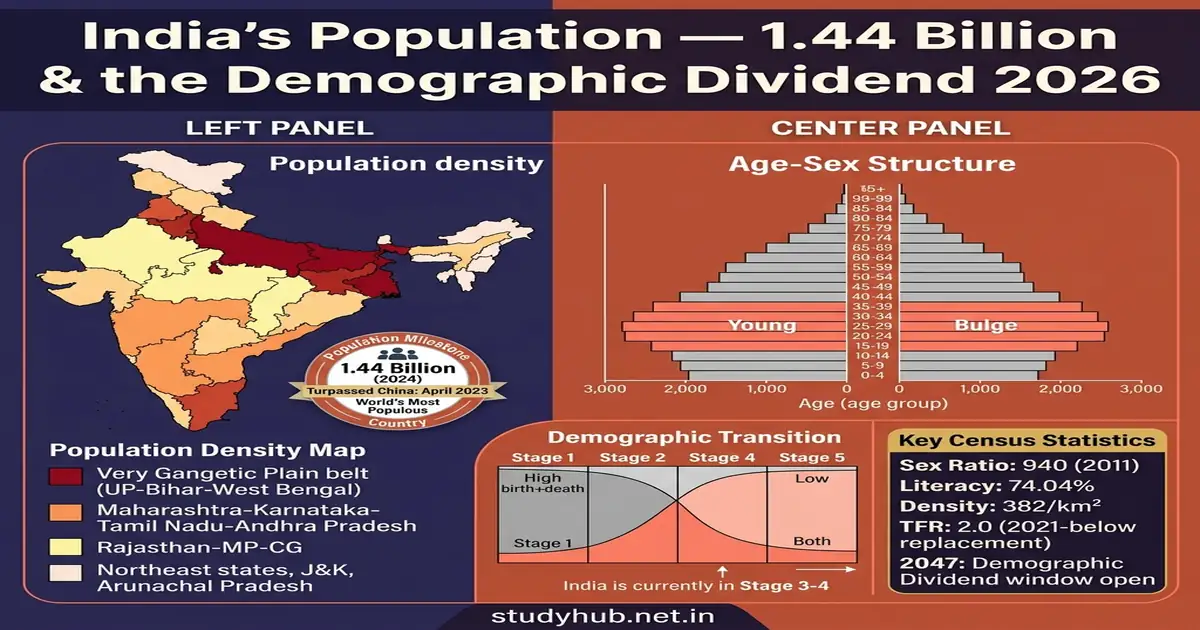
India’s Population — Distribution, Density, Growth & Demographic Dividend 2026
1. Population Distribution, Density & Growth Phases
| Topic | Details | India Data & Exam Facts |
|---|---|---|
| Population Distribution — Where India Lives | India’s population distribution is EXTREMELY UNEVEN. The Northern Plains (Indo-Gangetic Plain) — UP, Bihar, WB — and parts of Maharashtra, TN, AP form the high-density heartland. The sparsely populated zones include: Rajasthan’s Thar desert, Himalayas (J&K, HP, Uttarakhand, Sikkim, NE hill states), Andaman & Nicobar Islands, and the central tribal plateaus (CG, JH, Odisha interior). FACTORS governing distribution: (1) Relief and terrain: plains = easy agriculture, settlement. Mountains, deserts = sparse. (2) Climate: humid areas (WB, Kerala, coastal AP, TN) = dense. Arid areas (Rajasthan) = sparse. (3) Soil: alluvial IGP = fertile → dense. Laterite-rocky Deccan interior = less dense. (4) Mineral + Industrial base: Jharkhand, WB, Maharashtra = dense despite difficult terrain (mining + industry attracts population). (5) Historical: ancient civilisations (Ganga-Yamuna doab = Harappan + Gangetic civilisation) = continuously settled for 5,000+ years. Population clustering around temples/pilgrimage centres (Varanasi, Puri, Tirupati, Haridwar). (6) Irrigation: canal-irrigated Punjab-Haryana = dense despite semi-arid climate. Tube-well irrigated UP = densest state India. Administrative capital effect: Delhi = highest density urban area | MOST DENSELY POPULATED STATES (2011, persons/km²): 1. Bihar = 1,106 (India’s most densely populated state). 2. West Bengal = 1,028. 3. Kerala = 860. 4. Uttar Pradesh = 829 (but total population = highest = 199 million = UP alone > Brazil’s population!). 5. Haryana = 573. 6. Tamil Nadu = 555. 7. Punjab = 550. 8. Jharkhand = 414. Most densely populated Union Territory: NCT Delhi = 11,320 persons/km² (2011). LEAST DENSELY POPULATED: 1. Arunachal Pradesh = 17 persons/km² (India’s least dense state). 2. Mizoram = 52. 3. Sikkim = 86. 4. Jammu & Kashmir = 56. 5. Andaman & Nicobar = 46 (UT). Lakshadweep = 2,013 (UT, very small but dense islands). LARGEST POPULATION STATES (2011): 1. Uttar Pradesh (199.8 million = UP alone has more people than Brazil). 2. Maharashtra (112.4M). 3. Bihar (104.1M). 4. West Bengal (91.3M). 5. Andhra Pradesh (84.6M, undivided — Telangana separated 2014). 6. MP (72.6M). 7. Rajasthan (68.6M). 8. Karnataka (61.1M). 9. Gujarat (60.4M). 10. Odisha (41.9M). KEY EXAM FACT: Unlike area (where Rajasthan is LARGEST state), population concentration is in IGP (UP+Bihar) not in area-largest states. NORTH-SOUTH DIVIDE: Southern states (TN, Kerala, AP, Karnataka, Telangana) have LOWER fertility and SLOWER growth — having completed their demographic transition. Southern states prefer more resources per fewer children = “quality over quantity” demographic model. Northern states (UP, Bihar, Rajasthan, MP) still have higher TFR + faster growth. This creates political tension (delimitation of Lok Sabha constituencies based on population = northern states would gain seats, southern states lose = frozen until 2026 delimitation freeze lifted = election-year controversy) |
| Population Growth Phases & Demographic Transition | India’s population growth has passed through 4-5 distinct phases since 1901: PHASE 1 — STAGNANT/DECLINING (1901-1921): Population in 1901 = 238 million. 1921 = 251 million. Low growth due to: recurrent famines (1900, 1905, 1907, 1913, 1918), influenza pandemic 1918-19 (killed 12-17 million in India alone), plague, cholera epidemics. 1921 is called the “Year of Great Divide” = lowest point of growth, turning point for future growth. PHASE 2 — SLOW GROWTH (1921-1951): From 251M (1921) to 361M (1951). Post-famine recovery, colonial-era public health improvements (sanitation, smallpox vaccine), railways enabling food distribution in famines, slight reduction in mortality. No major fertility decline yet. PHASE 3 — EXPLOSION/RAPID GROWTH (1951-1981): 361M (1951) → 683M (1981). POPULATION EXPLOSION. Death rates fell sharply (penicillin, DDT, malaria eradication campaigns, improved food supply = Green Revolution). But birth rates REMAINED HIGH (social norms, child marriage, need for agricultural labour). Gap between death rate and birth rate = NATURAL INCREASE = rapid growth. India’s peak decadal growth = 24.8% (1961-71). PHASE 4 — HIGH GROWTH, DECLINING RATE (1981-2011): 683M (1981) → 1,210M (2011). Growth slowing: TFR declining from 4.0 (1985) to 2.5 (2005) to 2.0 (2020). Female education, urbanisation, family planning. But absolute numbers still large because the base is huge = “population momentum.” PHASE 5 — NEAR-STABILITY (2021+): TFR = 2.0 (2021) = at replacement level. Many southern states + Kerala, TN, AP, Karnataka, Delhi = TFR below replacement (1.5-1.8). UP, Bihar, Rajasthan, MP still above 2.5-3.0 TFR. DEMOGRAPHIC TRANSITION THEORY (Warren Thompson, 1929): Stage 1 (High BR, High DR = pre-industrial, stable). Stage 2 (High BR, Falling DR = early industrial = population explosion). Stage 3 (Falling BR, Low DR = developing = growth slowing). Stage 4 (Low BR, Low DR = developed = stable). India was in Stage 2 (1951-1981) → Stage 3 (1981-now). Southern India arguably in Stage 4. | 1921 = “Great Divide” in India’s population history. Why? Before 1921: population approximately stagnant due to famine + disease = high DR balanced high BR. After 1921: death rates began declining (first vaccines, transport = food distribution, British sanitation). But birth rates remained high → natural increase began. KEY NUMBERS FOR EXAM: 1901 = 238M. 1921 = 251M. 1951 = 361M. 1981 = 683M. 2001 = 1,028M (India crossed 1 BILLION on 11 May 2000). 2011 = 1,210M. 2023 = 1,429M (surpassed China). 2026 = ~1,440M. FERTILITY RATE DATA: National TFR (SRS 2020-21) = 2.0. South India: Kerala TFR = 1.5 (fertility below replacement, state growing mainly through in-migration from other states). TN TFR = 1.6. AP = 1.6. Karnataka = 1.7. UP TFR = 2.7. Bihar = 3.0 (India’s highest TFR state). Rajasthan = 2.6. MP = 2.7. LITERACY (Census 2011): National = 74.04%. Highest: Kerala = 94.0% (highest), Goa = 88.7%, Tripura = 87.7%, Mizoram = 91.3%, Himachal Pradesh = 82.8%. Lowest: Bihar = 63.8% (lowest schedule state), Arunachal Pradesh = 65.4%, Rajasthan = 66.1%, Jharkhand = 66.4%. SEX RATIO (Census 2011): National = 943 females per 1,000 males. Highest SR: Kerala = 1,084 (Kerala = only state where women outnumber men). Manipur, Chhattisgarh, Meghalaya = also >1,000. Lowest: Haryana = 879. Rajasthan = 928. Punjab = 895. J&K = 889. Child Sex Ratio (0-6 years, 2011): National = 919. Lowest: Haryana = 834 (severe female foeticide). Punjab = 846. Rajasthan = 888. HIGHEST: Mizoram = 971. Meghalaya = 970. |
| Urbanisation, Migration & Census Urban Classification | URBANISATION: India’s urban population: 377 million (2011 = 31.2% of total). Estimated 520-560 million urban (2026 = ~37%). Urban growth: urbanisation accelerating with economic migration. India has 53 cities with population >1 million (2011), called “Million Plus Cities” or “Class I cities.” 7 “Megacities” (>10 million): Mumbai (18.4M), Delhi (16.3M urban agglomeration), Kolkata (14.1M), Chennai (8.7M), Bengaluru (8.5M), Hyderabad (7.7M), Ahmedabad (6.4M). URBAN CLASSIFICATION (Census):: Statutory Towns: declared by law (municipalities, cantonment boards, notified area committees). Census Towns: settlements meeting 3 criteria: (1) Population ≥5,000. (2) Population density ≥400 persons/km². (3) >75% of male workers employed in non-agricultural activities. Urban Agglomeration (UA): a city + its urban outgrowths. Example: Delhi UA includes Delhi + satellite cities. MEGA-TRENDS: Census Towns grew from 1,362 (2001) to 3,894 (2011) = rapid informal urbanisation in peri-urban areas. MIGRATION PATTERNS: Internal migration: 45.36 crore (453.6 million) internal migrants in India (NSSO 2007-08 data; 2011 Census Migration data also available). Rural-to-urban migration = dominant pattern. Reasons: Economic (pull: jobs in cities; push: agricultural distress, small landholdings, debt). Social (child education, healthcare). Environmental (floods in Bihar, drought in Vidarbha, disaster-displaced). Major migration streams: UP →Delhi, Bihar→Delhi/Punjab/Haryana, AP-TN→Bengaluru/Chennai/Mumbai, Rajasthan→Gujarat/Surat, Odisha-CG→Gujarat manufacturing, NE hill states→Delhi/Bengaluru (service sector) | MIGRATION – UPSC RELEVANT ASPECTS: Seasonal migration: Bihar agricultural labourers to Punjab wheat harvest, Rajasthan brick kiln workers to Gujarat, Chhattisgarh tribal communities to Maharashtra/MP for construction. Causes of rural-urban migration under “Push-Pull” model (Ravenstein’s Laws): Push factors from rural: landlessness (81% of farmers have <2 ha), agricultural mechanisation (reduces labour demand), rural poverty, drought + flood, caste discrimination, indebtedness, lack of schools/hospitals. Pull factors to urban: higher wages, better education, healthcare, entertainment, economic aspiration. REMITTANCES from cities to villages = major rural income stream (Kerala model: high out-migration → high remittances → high HDI). INTERNATIONAL MIGRATION: Indian Diaspora = 32 million strong (world’s largest diaspora). Major destinations: UAE (3.5M), USA (4.4M), Saudi Arabia (2.5M), Kuwait (1.1M), UK (1.5M), Canada (1.3M), Australia (0.8M), Malaysia (2.9M old diaspora). Remittances to India = USD 111 billion (2022 = world’s largest recipient). UP receives most domestic remittances. Kerala + MH + TN = top remittance receiving states from international migration. “Brain Drain” concern: India’s top engineers, doctors, scientists choose USA/UK/Canada. Indian Americans = highest median household income among all US ethnic groups (USD 119,000 median, 2022). 40%+ of Silicon Valley startups founded by Indian-Americans. Brain Gain counter-argument: Indian diaspora investments (FDI), knowledge transfer, soft power, diaspora philanthropy. Brain Circulation: recent trend of return migration of NRIs (especially during COVID + US visa uncertainty). NITI Aayog on internal migration: improving migrant rights, portability of welfare schemes (PM-KISAN, PDS through One Nation One Ration Card). ANTYODAYA (poorest 20%): most likely internal migrants, most vulnerable |
2. Demographic Dividend, Population Policy & Human Development
| Topic | Details | India Context & Policy |
|---|---|---|
| Demographic Dividend — India’s Greatest Opportunity | DEMOGRAPHIC DIVIDEND: the economic growth potential that arises from a shift in a population’s age structure. Specifically: when the working-age population (15-64 years) is larger than the dependent population (0-14 and 65+), the country has a high “Dependency Ratio” advantage. Each working-age person has fewer dependents to support → more savings → more investment → faster growth. East Asia’s “miracle” (Taiwan, South Korea, Singapore, Japan: 1960-1990) = 35% of GDP growth came from demographic dividend (World Bank estimate). THE INDIA WINDOW: India’s demographic dividend window = approximately 2020-2050 (UNFPA / Economic Survey estimate). During this window, over 60% of India’s population is in the working-age group. India adds 12-13 million new workers to the labour force each year. But to realise the dividend, India MUST: (1) Educate and skill this workforce (not let it remain in low-productivity agriculture). (2) CREATE JOBS at scale (currently India struggling = “jobless growth” concern). (3) Keep this population healthy (healthcare infrastructure). (4) Financial inclusion (savings must be mobilised productively). NITI Aayog + Economic Survey = say demographic dividend is India’s biggest potential advantage for 2047 “Viksit Bharat” goal. CONTRAST: China’s demographic dividend is OVER (aging population, 1-child policy legacy). Japan, Germany, South Korea = NEGATIVE demographic disadvantage (shrinking workforce). | India’s YOUNG POPULATION: Median age: India = 28.4 years (2022) vs China = 38.4, USA = 38.5, Japan = 48.5. India has the world’s largest population of young people (15-24 years = ~254 million). 50% of India’s population under 30 years. “YOUTH BULGE” = both opportunity and risk. OPPORTUNITY: Large workforce for manufacturing, services, global care economy (India’s 2.3M doctors/nurses/technicians are in demand globally, UK-Canada-UAE-Australia importing Indian healthcare workers). RISK: If young people remain unemployed or in low-quality jobs → social unrest, crime, political radicalisation. Youth unemployment is India’s BIGGEST hidden crisis. CMIE (Centre for Monitoring Indian Economy) data: youth unemployment (15-24) = 22-24% in recent quarters = 1 in 4 young Indians unemployed or not in education/training. SKILLING: PM Kaushal Vikas Yojana (PMKVY, 2015): skill training for youth. Target: train 1 crore (10M) youth/year. Results: mixed (training completed but jobs not always found). National Education Policy (NEP 2020): restructuring school-university education for 21st century skills. IITs, IIMs, expansion. DEMOGRAPHIC DOOM SCENARIO: Without fast job creation, education quality improvement, and healthcare investment, India’s “dividend” becomes a “demographic disaster” — a massive cohort of angry, unemployed young men with limited prospects. This is the “demographic time bomb” concern raised by economists. India’s challenge: replicate East Asia’s transition from agriculture → manufacturing → services (leap-frogging at scale) |
| National Population Policy & Human Development | NATIONAL POPULATION POLICY 2000 (NPP 2000): India’s comprehensive policy on population. Goals: (1) Short-term: meet unmet contraceptive needs. (2) Medium-term: bring TFR to replacement level of 2.1 by 2010 (achieved 2020 = delayed but achieved). (3) Long-term: achieve stable population by 2045 at 1.7-1.9 billion (more recent estimates revise down to 1.6B peak by 2060). Key provisions: Voluntary family planning (no compulsory sterilisation), Universal primary education, Reduce infant mortality to <30/1,000 (achieved: IMR = 28 in 2020), Reduce maternal mortality to <100/1,00,000 (India MMR = 97 in 2020, target achieved!), Universal immunisation, Girls’ education as priority. Controversies: Forced sterilisation Emergency (1975-77, Sanjay Gandhi campaign of forced vasectomies, targeted poor + Muslim populations = major political controversy, contributed to Congress electoral defeat 1977). Modern approach: entirely voluntary, incentive-based. Two-child policy debates: several states (Assam, UP, Rajasthan) proposed incentives for 2-child families (e.g., disqualification from government jobs if >2 children). Such policies critiqued as targeting religious minorities disproportionately. INDIA’S HDI: Human Development Index (UNDP 2023): India ranked 134 out of 193 countries. HDI = 0.644. Category: Medium Human Development. Components: Life expectancy at birth = 67.7 years (improving). Expected years of schooling = 11.9 years. Mean years of schooling = 6.6 years. GNI per capita (PPP) = USD 8,475 (2023). HIGHEST HDI STATES: Kerala (HDI = 0.782, comparable to China/Brazil), Goa, Delhi, Himachal Pradesh, Punjab. LOWEST HDI STATES: Bihar (0.574), Jharkhand, Uttar Pradesh, MP, Rajasthan. | KEY HEALTH INDICATORS (2020-22): Infant Mortality Rate (IMR): 28 per 1,000 live births (National, 2020). Lowest: Kerala = 6, Goa = 6. Highest: MP = 43, Odisha = 38, UP = 38. Maternal Mortality Ratio (MMR): 97 per 1,00,000 live births (2018-20, SRS). Down from 254 (2004-06). Target: <70 by 2030 (SDG target = <70/1L). Life expectancy: 70.4 years overall (2019-23). Female = 72.2, Male = 69.0 (females live longer). Kerala = 77.3 years (highest). CG = 67.7 (lower). IMMUNISATION: India’s Universal Immunisation Programme (UIP): BCG, OPV, Hepatitis B, DPT, Measles-Rubella, PCV, Rotavirus. Mission Indradhanush (2014) = catch-up immunisation for missed children. India achieved Polio-free status in 2014 (WHO certified). COVID VACCINATION: 2.2 billion doses administered (world’s largest vaccination programme by absolute doses). Covishield (AstraZeneca-Oxford, manufactured by SII = Serum Institute of India, Pune), Covaxin (Bharat Biotech, Hyderabad = India’s first indigenous COVID vaccine). GENDER INDICATORS: GENDER INEQUALITY INDEX (GII, UNDP 2023): India = 0.437, rank = 108. Female Labour Force Participation Rate (FLFPR) = 23-25% (very low for India’s development level; China = 60%, Bangladesh = 36%). International Labour Organization: India’s FLFPR has been increasing slowly after 2017 (now 26.8% = 2023 estimate). Beti Bachao Beti Padhao (BBBP, 2015): scheme to save girl child + educate. Results: Child sex ratio (CSR) improved nationwide but unevenly. SUKANYA SAMRIDHI YOJANA: savings scheme for girl children. PAHAL/PM UJJWALA: LPG to rural women. PM MATRU VANDANA YOJANA: maternity benefit scheme. |
Frequently Asked Questions
India surpassed China in population in April 2023 — what does this mean for India’s future and why does it matter for the UPSC exam?
India becoming the world’s most populous country in April 2023 is one of the most significant demographic events of the 21st century, and it has profound implications for India’s economy, politics, environment, and geopolitics — all of which are directly relevant to UPSC Civil Services examination. The Population Crossover — What Actually Happened: The UN Population Division estimated that around April 2023, India’s population (approximately 1,428.6 million) overtook China’s (approximately 1,425.7 million). However, this should be understood carefully: the last official Chinese census (2020) showed 1,412 million, with China already showing negative growth rates. India’s last official census was 2011. Both numbers are estimates for 2023. The key difference: India’s population is STILL GROWING (slowly), while China’s population began DECLINING in 2022 (first absolute decline since the Great Leap Forward famine of 1959-61). China’s National Bureau of Statistics confirmed China’s population FELL by 850,000 in 2022 = first decline in 60 years. India is projected to reach PEAK POPULATION of approximately 1.65-1.7 billion around 2060-2065, then begin declining. Why It Matters for India’s Economy: The numbers game in global economics is about PRODUCTIVE POPULATION, not total headcount. India now has the world’s largest working-age population (15-64 years) — approximately 940 million people (vs China’s ~940 million too, but China’s is ageing faster). India adds 12-13 million NEW WORKERS per year = each year a new Australia enters India’s labour force. For global manufacturing companies looking to “China+1” diversification (companies wanting to reduce China dependence post-COVID, post US-China trade war), India’s massive + young + growing + English-speaking + tech-savvy population is hugely attractive. Apple, Samsung, Google, Foxconn, Pegatron, Vedanta — all moving or expanding in India. India’s domestic demand: 1.44 billion people increasingly moving to middle class = the world’s largest potential consumer market for everything (smartphones, two-wheelers, housing, insurance, healthcare, education, tourism). McKinsey: India will be the world’s 3rd largest consumer market by 2030. Why It Also Creates Risks: (1) Jobs: India needs 90-100 million new quality jobs over 2025-2035 = one of the hardest challenges in economic history. CMIE data shows India’s employment rate = 37% of working-age adults (vs 55% in China, 61% in USA). Millions of graduates are unemployed or underemployed. (2) Education quality: India has more university students than any country (38 million+), but quality is highly uneven. ASER report: 50%+ of Grade 5 students cannot read a Grade 2 text. (3) Healthcare: India’s hospital beds per 1,000 = 0.5 (vs China = 6.7, OECD = 4.3). Doctors per 1,000 = 0.9 (below WHO minimum = 1.0). (4) Environment: India’s 1.44 billion generate enormous resource pressure on water (groundwater depletion), food (import dependency growing), energy (India burns 900 MT coal/year), and urban infrastructure. Climate change → monsoon disruption → agricultural stress → population displacement. India’s 2047 Target — “Viksit Bharat” (Developed India by Independence Centenary): To achieve this, India must realise its demographic dividend within this window (2025-2047). Key actions needed: universal school quality improvement (NEP 2020 implementation), vocational training at scale (PMKVY), manufacturing job creation (PLI + DFC + industrial corridors), healthcare infrastructure investment (Ayushman Bharat), gender empowerment (FLFPR increase from 25% to 40%+ by 2030 = would add ~100 million workers), and urbanisation management (smart cities, affordable housing, metro systems). The window is open but not unlimited — the dividend peaks in the 2030s and begins closing around 2050 as India too starts ageing.
Important for Exams — India Population UPSC, SSC & State PCS
KEY DATES: 1921=”Great Divide”(lowest growth, turning point). 2000=India crossed 1 BILLION (11 May 2000). April 2023=India surpassed China=world’s most populous. CENSUS 2011 DATA: Population=1,210.9 million. Density=382/km². Sex ratio=943F/1000M. Child sex ratio=919. Literacy=74.04%. Decadal growth=17.7%(down from 21.5%). MOST POPULOUS STATE: Uttar Pradesh (199.8M = more than Brazil). 2nd Maharashtra(112.4M). 3rd Bihar(104.1M). HIGHEST DENSITY: Bihar(1,106/km²)=1st. WB(1,028)=2nd. Kerala(860)=3rd. Lowest density STATE: Arunachal Pradesh(17/km²). Highest density UT: Delhi(11,320). LITERACY: Highest state= Kerala(94%). Lowest state=Bihar(63.8%). SEX RATIO: Highest=Kerala(1,084=only state women>men). Lowest=Haryana(879). Child SR: Lowest=Haryana(834=female foeticide). Highest=Mizoram(971). FERTILITY: National TFR=2.0(SRS 2020-21=at replacement). Highest TFR state=Bihar(3.0). Lowest=Kerala(1.5). HEALTH: IMR=28(2020). Lowest IMR: Kerala=6. Highest IMR: MP=43. MMR=97(2018-20). Life expectancy=70.4yrs. Polio-free: 2014(WHO certified). HDI: India rank=134(UNDP 2023). HDI=0.644(Medium). Highest state=Kerala. Lowest=Bihar. MIGRATION: 453.6M internal migrants. Rural→Urban dominant. Indian Diaspora=32M(world’s LARGEST diaspora). Remittances=USD 111B(world’s LARGEST recipient). DEMOGRAPHIC DIVIDEND: Window=2020-2050. Median age=28.4 years(vs China=38.4). 50% population under 30. Youth unemployment=22-24%(CMIE). FLFPR=23-25%. POLICY: NPP 2000=voluntary family planning. Beti Bachao Beti Padhao(BBBP 2015). Sukanya Samridhi Yojana. PM Matru Vandana Yojana. Ayushman Bharat(health insurance Rs 5L/family). Mission Indradhanush(immunisation). URBAN: 31.2%(2011)=urban. 53 Million+ cities. Megacities=7. Census town criteria: pop≥5000, density≥400/km², 75%+ male workers in non-farm jobs. North-South divide: Southern states TFR below replacement, Northern states higher. Delimitation freeze lifted 2026=Northern states gain Lok Sabha seats politically sensitive.
What to Read Next
- Agriculture — Can India Feed 1.44 Billion People Sustainably? 2026
- Transport — How DFC & Urbanisation Shape India’s Population Distribution 2026
- Industries — Manufacturing Jobs for India’s 12 Million New Annual Workers 2026
- Indian Soils — Soil Carrying Capacity and India’s Population Pressure 2026
- Physiographic Divisions — Why the IGP Supports Half of India’s Population 2026
🎔 Exam Quick Reference — India Population: MILESTONE: April 2023=India surpassed China=World’s MOST POPULOUS(1,428M). India peak ~1.65-1.7B around 2060-65. CENSUS 2011: Pop=1,210.9M. Density=382/km². SR=943F/1000M. CSR=919. Literacy=74.04%. Decadal growth=17.7%. LARGEST STATE: UP(199.8M=more than Brazil). DENSEST STATE: Bihar(1,106/km²). LEAST DENSE: Arunachal Pradesh(17/km²). DENSEST UT: Delhi(11,320). LITERACY: Highest=Kerala(94%). Lowest=Bihar(63.8%). SEX RATIO: Highest=Kerala(1,084=women>men). Lowest state=Haryana(879). Child SR: Lowest=Haryana(834). Highest=Mizoram(971). TFR: National=2.0(SRS 2020-21). Bihar=3.0(highest). Kerala=1.5(lowest). IMR=28(2020). Lowest IMR: Kerala=6. Highest: MP=43. MMR=97. Life expectancy=70.4yrs. Polio-free 2014. HDI rank=134(UNDP 2023)=0.644. DEMOGRAPHIC DIVIDEND: Window 2020-2050. Median age=28.4 years. 50% pop under 30. India adds 12-13M new workers/yr. Youth unemployment=22-24%(CMIE). FLFPR=23-25%(very low). MIGRATION: 453.6M internal migrants. Indian Diaspora=32M=WORLD’S LARGEST. Remittances=USD 111B=WORLD’S LARGEST RECIPIENT. ONE NATION ONE RATION CARD=portability for migrants. URBANISATION: 31.2%(2011). 53 million-plus cities. 7 megacities(>10M). Census town: pop>5000+density>400+75% non-farm males. GREAT DIVIDE YEAR: 1921. FIRST INDIA BILLION: 11 May 2000. NORTH-SOUTH DIVIDE: Southern states TFR below replacement vs northern states higher. DELIMITATION controversy: northern states to gain Lok Sabha seats.
🌍 India’s Demographic Transition & Key State Comparisons 2026: DEMOGRAPHIC TRANSITION THEORY (Warren Thompson): Stage 1=High BR+High DR(pre-industrial, stable). Stage 2=High BR+Falling DR(early development=EXPLOSION). Stage 3=Falling BR+Low DR(transition=slowing growth). Stage 4=Low BR+Low DR(post-industrial=stable). INDIA: 1951-81=Stage 2. 1981-2020=Stage 3. Southern India=approaching Stage 4. STATE STAGE COMPARISONS: Kerala=Stage 4(TFR 1.5, IMR=6, SR=1,084, literacy=94%) = India’s most demographically advanced state. Bihar=Stage 2-3 transition(TFR=3.0, IMR=43, literacy=63.8%, density=1106/km²). UP=Stage 3(TFR=2.7, literacy=67.7%). Tamil Nadu=Stage 4(TFR=1.6, IMR=16, literacy=80.3%). POPULATION POLICY HISTORY: 1952=India FIRST country in world to adopt National Family Planning Programme. Emergency 1975-77=Sanjay Gandhi forced sterilisation = political disaster → NPP 2000 reverted to fully voluntary approach. NPP 2000: TFR target achieved(2.0 by 2020). BPNI(National Population Commission) 2000. National Health Policy 2017: universal health coverage + TB elimination by 2025. Ayushman Bharat(2018): Rs 5 lakh/year health insurance = 50 crore beneficiaries = world’s largest government health insurance scheme. AB-PM-JAY (ABY). AB-HealthNest and HWCs (1.5 lakh Health and Wellness Centres). PM Matru Vandana Yojana(PMMVY): maternity benefit Rs 5,000 for first child. Pradhan Mantri Jan Arogya Yojana(PM-JAY)=health insurance. Beti Bachao Beti Padhao(BBBP, 2015): targeted 100 districts with low CSR. PM POSHAN(formerly MDM = Mid-Day Meal): school nutrition programme = world’s largest school feeding programme(120M children daily). SAKSHAM Anganwadi(nutrition for under-5s and pregnant women). India’s SDG Progress: SDG 3 (Health), SDG 4 (Education), SDG 5 (Gender equality) = India behind schedule on most SDGs for 2030 target.
About This Guide: Written by the StudyHub Geology Editorial Team (studyhub.net.in/geology/) based on Census of India 2011 (Office of the Registrar General and Census Commissioner, India), Sample Registration System (SRS) Statistical Report 2020-21, UNDP Human Development Report 2023-24, UN World Population Prospects 2022, National Family Health Survey (NFHS-5, 2019-21), and NITI Aayog India Voluntary National Review 2023. Last updated: March 2026.