
The Indian Monsoon is the most important climate event in South Asia — it brings over 75–80% of India’s annual rainfall in just 4 months (June to September) and directly determines the agricultural output, water supply, and economic health of 1.4 billion people. Understanding how the monsoon forms, why it arrives when it does, what causes it to fail (El Niño), and what happens when it’s stronger than usual (La Niña) is among the most essential topics for UPSC, SSC, State PSC, and all competitive geography exams.
What is a Monsoon? — Definition
The word monsoon comes from the Arabic word mausim meaning “season”. A monsoon is a seasonal reversal of wind direction — winds that blow from the ocean toward the land in summer (bringing rain) and from land toward the ocean in winter (dry). India experiences the most powerful and most studied monsoon system in the world.
Causes of Indian Monsoon — Mechanism
Traditional Explanation — Differential Heating
- ☀️ Summer (April–May): The Indian subcontinent heats up rapidly (land heats faster than sea). A massive low-pressure area develops over the Thar Desert (Rajasthan/Pakistan) and the northwestern plains.
- 🌊 Indian Ocean: Stays cooler, maintains high pressure over the ocean.
- 💨 Wind direction: Winds blow from high pressure (Indian Ocean) to low pressure (Indian land) — bringing moisture-laden air from the sea onto the continent.
- 🌧️ Rainfall: As this moist air rises over land (orographic lifting over Western Ghats, Himalayas), it cools, condenses, and precipitates as monsoon rain.
Modern Explanation — Jet Stream & ITCZ
Modern climatology adds critical components to the traditional explanation:
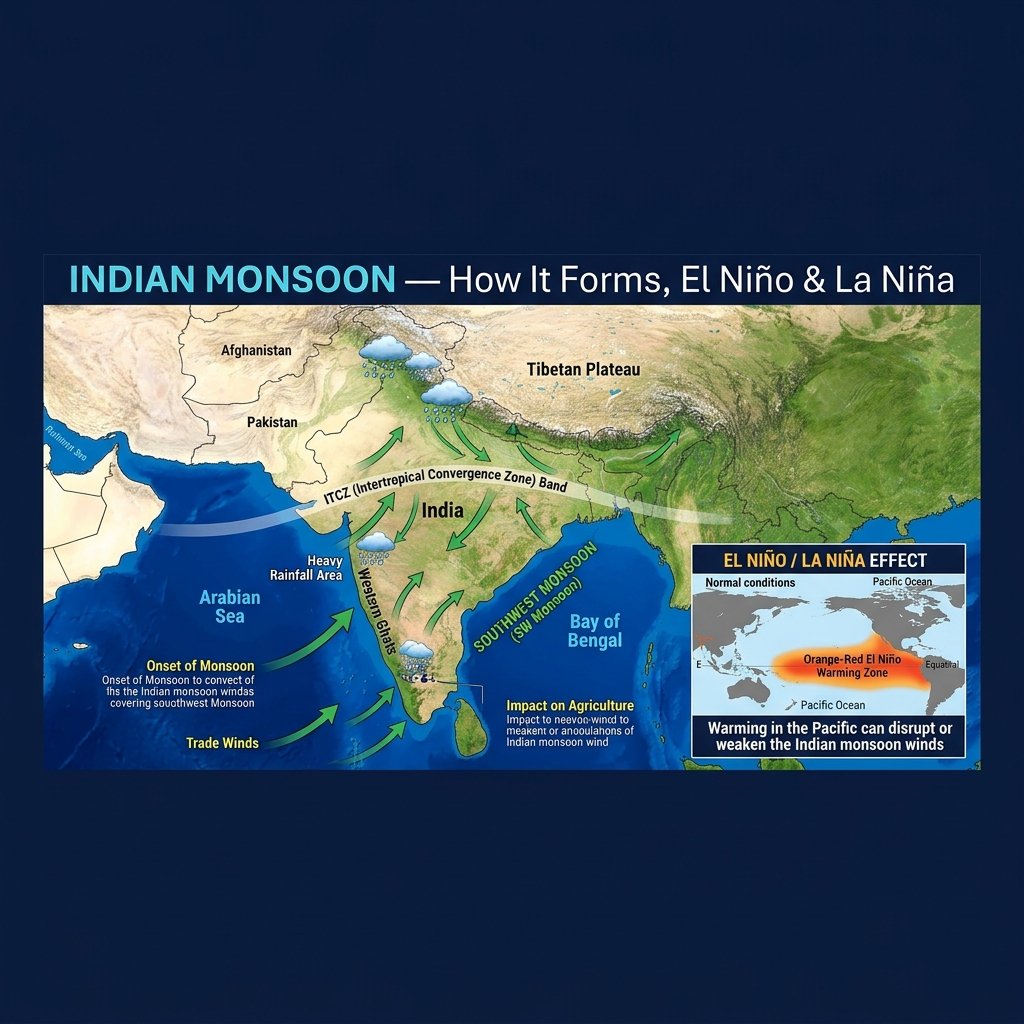
- 🌀 ITCZ (Inter-Tropical Convergence Zone): A belt of low pressure near the equator where trade winds from the north and south converge and rise. In summer, the ITCZ shifts northward to ~25°N over India — this “pulling” of the monsoon is crucial for its onset. The monsoon arrives over India as the ITCZ establishes itself over the subcontinent.
- ✈️ Subtropical Jet Stream: In winter, the Subtropical Westerly Jet Stream (STJ) flows south of the Himalayas — keeping the monsoon away. In late May/June, the STJ shifts north of the Himalayas — removing the barrier and allowing the monsoon to surge northward over India.
- 🌊 Somali Jet/Findlater Jet: A powerful low-level jet stream that forms over the Somali coast (East Africa), sucking warm humid air into the Arabian Sea branch of the monsoon.
- 🌡️ Mascarene High: A semi-permanent high-pressure cell over the southern Indian Ocean (near Mascarene Islands/Mauritius) that “pumps” moisture northward toward India.
The Southwest (SW) Monsoon — June to September
The Southwest Monsoon is the main Indian monsoon — it brings ~75% of India’s annual rainfall between June and September, arriving from the southwest direction (from the Indian Ocean).
Two Branches of the Southwest Monsoon
| Feature | Arabian Sea Branch | Bay of Bengal Branch |
|---|---|---|
| Origin | Arabian Sea (SW direction) | Bay of Bengal (SE→NE direction) |
| Arrives at | Kerala coast (1 June normally) | Myanmar/NE India (early June) |
| Deflected by | Western Ghats → heavy rain on windward side; rain shadow on leeward (Deccan) | Himalayas and NE hills → turns westward along Gangetic plains |
| Heaviest rain areas | Western Ghats (Cherrapunji/Mawsynram region via Bay branch too), Kerala, Konkan, Goa | NE India (Assam, Meghalaya), West Bengal, UP, Delhi, Punjab |
| Rainfall type | Orographic (relief) rain on Western Ghats; low rain in Deccan rain shadow | Cyclonic + convective rain across Gangetic plains |
Monsoon Onset — Normal Dates
- 🌴 1 June: Kerala (Thiruvananthapuram) — official onset date (±7 days variation)
- 🌿 10–15 June: Mumbai, Goa, Karnataka coast
- 📅 15–20 June: NE India (Assam), West Bengal, Odisha
- 🗓️ 1 July: Delhi, Rajasthan (eastern), UP, MP
- 📅 15 July: Entire India covered (Rajasthan, Punjab, Himalayan region)
Monsoon Retreat (Withdrawal)
- 📅 September: Begins withdrawing from Rajasthan and Northwest India (September 17 normally)
- 📅 October: Retreats from most of North and Central India
- 📅 November–December: Withdraws from Karnataka and Tamil Nadu coast
- ⚠️ During retreat from Bay of Bengal — winds reverse and bring the Northeast Monsoon
The Northeast (NE) Monsoon — October to December
The Northeast Monsoon (also called the Retreating/Winter Monsoon) blows from northeast to southwest — from land toward the Indian Ocean. It is a dry, cold wind that picks up moisture as it crosses the Bay of Bengal and brings significant rainfall to Tamil Nadu, Andhra Pradesh coast, and Sri Lanka.
- 📅 Season: October–December (Northeast Monsoon season)
- 📍 Main affected area: Tamil Nadu, coastal Andhra Pradesh, Puducherry, Sri Lanka
- 🌧️ Chennai receives 60–70% of its annual rainfall during the Northeast Monsoon — opposite to most of India which gets it from SW monsoon
- ⛈️ Bay of Bengal cyclones — NE monsoon season coincides with peak Bay of Bengal cyclone activity (October–December) — cyclones like those affecting Odisha, AP, Tamil Nadu coasts
Cherrapunji — World’s Most Rainfall Region
- 📍 Mawsynram, Meghalaya: Gets the highest annual rainfall in the world — ~11,872 mm/year (competing with Cherrapunji nearby)
- 📍 Cherrapunji (Sohra), Meghalaya: ~11,430 mm/year — used to hold the world record
- 🌧️ Cause: Bay of Bengal SW monsoon hits the southern slopes of the Meghalaya Plateau (Khasi Hills) — forced to rise rapidly over the escarpment → extreme orographic rainfall
- 🏜️ Paradox: Despite being the world’s wettest place, Cherrapunji faces water shortage in winter because the rainfall is intensely concentrated in June–September, the plateau is rocky without good groundwater storage, and deforestation has worsened runoff
El Niño — When the Monsoon Fails
El Niño (“The Child” in Spanish — referring to the Christ child, because it often begins around Christmas) is a periodic warming of the central and eastern tropical Pacific Ocean that disrupts global weather patterns, including the Indian Monsoon.
How El Niño Weakens the Indian Monsoon
- Normally, the Pacific Ocean is warm in the west (near Indonesia) and cool in the east (near Peru). The Walker Circulation (east-west atmospheric circulation over the equatorial Pacific) drives this.
- During El Niño, trade winds weaken → warm water spreads eastward → western Pacific cools → rising air (convection) shifts from Indian Ocean region to central Pacific.
- Reduced convection over the Indian Ocean → weakened moisture supply to India → weaker Somali Jet → Indian Monsoon weakens or fails → drought in India
- Major Indian droughts are strongly correlated with El Niño: 1877, 1899, 1918, 1965, 1972, 1982, 1987, 2002, 2009, 2015 droughts coincided with El Niño years
La Niña — When the Monsoon is Stronger
La Niña is the opposite of El Niño — the eastern Pacific cools below normal. This strengthens the Walker Circulation, enhances convection over the Indian Ocean, strengthens the Somali Jet, and typically results in:
- ✅ Above-normal Indian monsoon rainfall — good for agriculture
- ⚠️ But can also cause floods and extreme rainfall events in some years
- 🌊 Often follows an El Niño year (El Niño → La Niña cycle = ENSO cycle — El Niño Southern Oscillation)
- 📅 India’s 2010 floods and abundant 2020 monsoon both occurred during La Niña conditions
Indian Ocean Dipole (IOD) — India’s Home Advantage
- The IOD measures temperature difference between the western Indian Ocean (near Africa) and eastern Indian Ocean (near Sumatra)
- Positive IOD: Western Indian Ocean warmer → increased moisture supply to India → good monsoon (can partially counter El Niño’s negative effect). The 2019 monsoon recovered partly due to a strong positive IOD.
- Negative IOD: Eastern Indian Ocean warmer → reduced moisture to India → weakened monsoon (combined with El Niño = severe drought)
Monsoon Rainfall — Regional Distribution
| Region | Rainfall Type | Annual Rainfall | Notes |
|---|---|---|---|
| Western Ghats (windward) | Orographic — SW branch | 200–400+ cm | Heaviest rain on windward slopes (Kerala, Konkan) |
| Deccan Plateau (leeward) | Rain shadow | 50–80 cm | Pune, Nashik, interior Karnataka — in rain shadow of Western Ghats |
| NE India (Assam, Meghalaya) | Orographic — Bay branch | 200–1,200+ cm | Mawsynram/Cherrapunji = world’s highest rainfall |
| Gangetic Plains | Cyclonic + convective | 80–200 cm | Decreasing westward (Kolkata 160cm → Delhi 65cm → Jodhpur 35cm) |
| Rajasthan (Thar Desert) | Minimal (SW branch weakens) | 25–30 cm | Jaisalmer ~20cm — least rain in India |
| Tamil Nadu (NE Monsoon) | NE Monsoon — Bay of Bengal | 100–130 cm | Gets rain in Oct–Dec when rest of India is dry |
| Lakshadweep / Andaman | SW branch — marine | 150–300 cm | Islands receive prolonged monsoon |
Key Takeaways
| Topic | Key Fact |
|---|---|
| Monsoon word origin | Arabic: mausim = season |
| SW Monsoon: India’s rainfall | ~75–80% of annual rainfall in 4 months (June–September) |
| Monsoon onset date (Kerala) | 1 June (normal date ± 7 days); IMD declares official onset |
| ITCZ role | Shifts north over India in summer → triggers monsoon onset |
| SW Monsoon branches | Arabian Sea branch (Kerala) + Bay of Bengal branch (NE India) |
| NE Monsoon states | Tamil Nadu, Andhra coast, Puducherry (Oct–Dec) |
| World’s rainiest place | Mawsynram, Meghalaya (~11,872 mm/year) |
| El Niño effect | Warm eastern Pacific → weakens Indian monsoon → drought risk |
| La Niña effect | Cool eastern Pacific → strengthens Indian monsoon → flood risk |
| Positive IOD effect | Warm western Indian Ocean → boosts monsoon (can counter El Niño) |
| Least rainfall India | Jaisalmer, Rajasthan (~20 cm/year) |
| Monsoon’s economic role | ~60% Indian agriculture rain-fed; GDP, food prices, rural income all depend on monsoon |
Frequently Asked Questions (FAQs)
1. Why does the monsoon arrive in Kerala first?
Kerala is at the southwestern tip of India, directly facing the Arabian Sea. The Southwest Monsoon — driven by the Somali Jet and the southwesterly winds from the Mascarene High — crosses the Indian Ocean and makes first landfall on the Kerala coast, typically on 1 June. The Western Ghats (running parallel to the Kerala coast) act as a barrier that forces the moist air upward (orographic lifting), causing intense rainfall on the windward slopes. The Kerala onset is declared officially by IMD when rainfall conditions meet specific criteria at designated stations.
2. What is the “Break in Monsoon” and why does it happen?
The Indian monsoon doesn’t rain continuously — it has active phases (heavy rain) and break phases (little or no rain over central India, though Northeast India and Himalayan foothills remain rainy). During a “monsoon break,” the ITCZ shifts northward to the foothills of the Himalayas, and the low-pressure systems that drive rain over central India stop forming. These breaks typically last 5–15 days. During the break, Rajasthan and parts of peninsular India can experience heatwaves. Extended breaks increase drought risk. The 2002 monsoon had an unusually long break — contributing to the severe drought that year.
3. Why does Tamil Nadu get rain when the rest of India is dry?
This is one of India’s most important climatological quirks. When the SW Monsoon retreats from India in October–November, the winds reverse direction — now blowing from the northeast (from the landmass) toward the sea. These northeast winds pick up moisture as they cross the Bay of Bengal, and when they hit Tamil Nadu’s coast (especially the Coromandel Coast), they deposit rain. Tamil Nadu receives ~60–70% of its annual rainfall during this NE Monsoon (October–December) — including Chennai’s rainy season. This is why Tamil Nadu is often “dry” during India’s main monsoon season (June–September) and “wet” when the rest of India is dry.
4. Can the monsoon be predicted accurately in advance?
The IMD (India Meteorological Department) issues a Long Range Forecast (LRF) for the southwest monsoon in April (covering June–September). It uses multiple models including the coupled ocean-atmosphere general circulation models and ENSO indices. Accuracy has improved significantly — IMD predicted the below-normal 2015 monsoon (El Niño year) and above-normal 2020 monsoon (La Niña year) correctly. However, there is still significant uncertainty in spatial and temporal distribution within the monsoon season. Predicting individual monsoon events (cloud bursts, heavy rain episodes) beyond 5–10 days remains challenging.
⭐ Important for Exams — Quick Revision
- 🔑 Monsoon = Arabic mausim = season; seasonal reversal of wind direction
- 🔑 SW Monsoon = June–September; 75–80% India’s annual rain; two branches (Arabian Sea + Bay of Bengal)
- 🔑 Kerala onset = 1 June (normal); first landfall of SW Monsoon
- 🔑 Whole India covered = ~15 July (Rajasthan, Punjab last)
- 🔑 ITCZ shifts north over India in summer → monsoon onset trigger
- 🔑 Subtropical Jet Stream shifts north of Himalayas in June → allows monsoon surge
- 🔑 Somali Jet = feeds Arabian Sea branch of SW Monsoon
- 🔑 Mascarene High = southern Indian Ocean high pressure → pumps moisture northward
- 🔑 Rain shadow = leeward side of Western Ghats (Pune/Nashik/Deccan get less rain)
- 🔑 NE Monsoon = Oct–Dec; Tamil Nadu, AP coast get rain when rest of India dry
- 🔑 Mawsynram (Meghalaya) = world’s highest annual rainfall (~11,872 mm)
- 🔑 Jaisalmer = least rainfall in India (~20 cm/year)
- 🔑 El Niño = warm eastern Pacific = weakens Indian monsoon = drought risk
- 🔑 La Niña = cool eastern Pacific = strengthens Indian monsoon = flood risk
- 🔑 Positive IOD = warm western Indian Ocean = boosts monsoon (can counter El Niño)
- 🔑 Break monsoon = ITCZ shifts north, central India rain stops temporarily
Related Geology Articles on StudyHub
- ➡️ River Systems of India — How Monsoon Flows Determine Rivers
- ➡️ Soil Types of India — Monsoon’s Role in Soil Formation
- ➡️ Indian Ocean — Tsunamis, Cyclones & Monsoon Source
- ➡️ Coastal Geomorphology — Monsoon Impact on India’s Coast
- ➡️ Thar Desert — Why Rajasthan Gets So Little Monsoon Rain