
The Indian Monsoon is one of the most powerful and consequential weather systems on Earth — a seasonal reversal of winds that determines the fate of India’s agriculture, water supply, rivers, economy, and ultimately the food security of over 1.4 billion people. The word “monsoon” comes from the Arabic mausim (season), reflecting the ancient Arab sailors who navigated the Indian Ocean using the predictable seasonal wind shifts. India receives approximately 75–90% of its annual rainfall in just 4 months (June–September) from the Southwest Monsoon. A 10% deficit in monsoon rainfall can shrink India’s agricultural output by 15–20% and reduce GDP growth by 1–2%. A 10% surplus can cause catastrophic floods displacing tens of millions. Understanding the monsoon — its mechanism, onset, withdrawal, anomalies, and the ENSO-IOD connection — is absolutely critical for UPSC, SSC, Class 9–11 NCERT Geography, and all competitive examinations covering Indian Geography, Climate, and Agriculture.
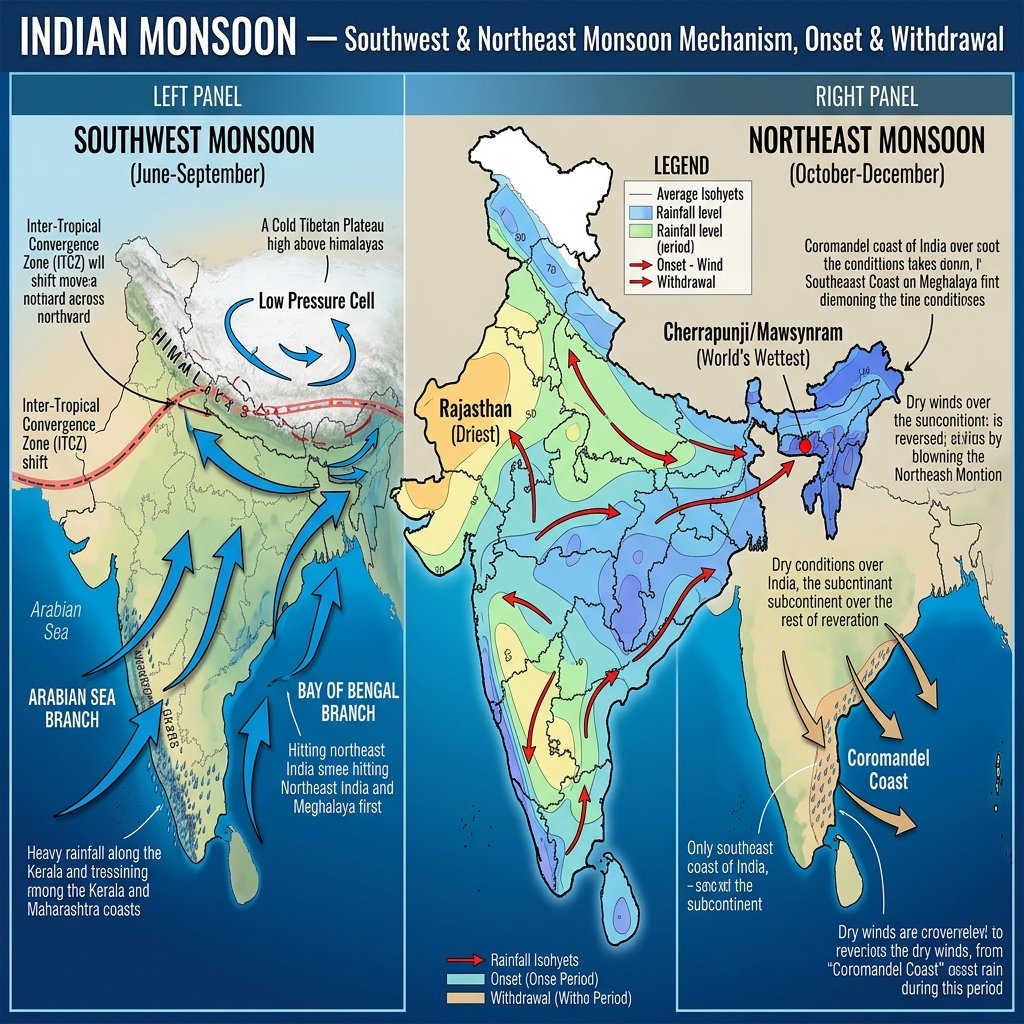
What Causes the Indian Monsoon? — The Core Mechanism
- 🌡️ Differential heating of land and sea: The fundamental driver of the monsoon. Land heats up much faster than the ocean. By May–June, the Indian subcontinent (especially the Thar Desert and Indo-Gangetic Plain) becomes extremely hot (45–50°C surface temperatures). This creates a powerful low-pressure system over the land. The Indian Ocean remains relatively cooler. Air flows from high pressure (cool ocean) to low pressure (hot land) → moisture-laden ocean winds blow toward India = monsoon
- 🌀 Shift of ITCZ (Inter-Tropical Convergence Zone): The ITCZ is the equatorial belt where northeast and southeast trade winds converge. In summer, solar heating shifts the ITCZ northward over the Indian subcontinent (up to 25°N) creating an extensive low-pressure zone → this draws in the Southeast Trade Winds which cross the equator and are deflected rightward by the Coriolis effect → they become the Southwest Monsoon winds
- 🏔️ Role of the Tibetan Plateau: The vast elevated Tibetan Plateau (average 4,500m altitude) acts as a giant heat engine in summer. Intense solar heating at this altitude creates a powerful anticyclone (high pressure) in the upper atmosphere above Tibet, which drives the Tibetan anticyclone — a major jet stream that helps pull Maritime air toward India and intensifies the monsoon circulation
- 💨 Role of Jet Streams: The Sub-tropical Westerly Jet Stream (STWJ) blows across northern India in winter, keeping cold dry conditions; in June, the Tibetan heating forces the STWJ to shift north of the Himalayas, removing the “cap” on Indian air and allowing moist oceanic air to move in. The Tropical Easterly Jet (TEJ) then forms over peninsular India at 150 hPa altitude, reinforcing the monsoon moisture transport
The Southwest Monsoon (June–September)
Two Branches
| Feature | Arabian Sea Branch | Bay of Bengal Branch |
|---|---|---|
| Origin direction | Southwest (Arabian Sea) | Southeast (Bay of Bengal + Bay of Bengal circulation) |
| First landfall | Kerala Coast (June 1st, normal date) | Andaman & Nicobar Islands (late May), then NE India/Myanmar (late May–early June) |
| Movement into India | Strikes Western Ghats → heavy orographic rainfall on windward (west) side; rain-shadow to east; then reaches southern peninsula interior; eventually Bay of Bengal branch circulation | Hits Meghalaya Hills (Cherrapunji/Mawsynram = world’s wettest); sweeps westward up Ganga plains (UP, Bihar, Rajasthan by July); reaches NW India by mid-July |
| Strongest rainfall zones | Western Ghats (Kerala, Karnataka, Maharashtra Konkan); Mumbai; Goa — 2,000–7,500mm annually | Meghalaya (Cherrapunji 11,871mm average), Assam, NE India; then Ganga plains |
| Moisture source | Arabian Sea (warm, saline; more moisture-laden) | Bay of Bengal (warmer SST; also from Indian Ocean) |
Monsoon Onset & Progress
| Location | Normal Onset Date | Significance |
|---|---|---|
| Andaman & Nicobar | ~May 20 | IMD’s traditional first onset marker |
| Kerala | June 1 (±7 days) | Official onset of SW Monsoon on Indian mainland; announced by IMD; major media event |
| Mumbai | ~June 10 | Mumbai monsoon = heavy; Konkan coast flooding |
| Delhi NCR | ~June 29 (historically); now May 2021-onwards IMD revised) | Arrival marks end of severe June heat; pre-monsoon thunderstorms precede |
| Rajasthan (West) | ~July 15 | Last area to receive monsoon; Jaisalmer may get only 100–200mm total |
| Northwest India (NW Rajasthan) | ~July 15–20 | Monsoon covers entire India by ~July 15 |
Monsoon Withdrawal
- 📅 Withdrawal is much slower than onset; begins with NW Rajasthan (~September 1) and progressively retreats southeastward
- 📅 Withdrawal from entire India: ~October 15–November 15 (southeast peninsular India last to lose SW monsoon)
- 🌀 As monsoon withdraws, Low Pressure Systems in the Bay of Bengal intensify → cyclone season begins (October–December)
The Northeast Monsoon (October–January)
- ❄️ After Southwest Monsoon withdraws, the pressure pattern reverses: land cools, pressure rises; ocean is now relatively warmer; winds blow from land (NE) to sea
- 💧 Dry for most of India — the NE monsoon winds originate over dry continental land (Central Asia), so they carry little moisture
- ☔ Exception — Tamil Nadu and SE Andhra Pradesh: The NE monsoon crosses the Bay of Bengal, picks up moisture, and strikes the Coromandel Coast (TN, southern AP) bringing significant rainfall (October–December); Chennai receives ~60% of its annual rainfall during NE monsoon! This is why TN’s main rice season (samba) is harvested in January-February unlike the rest of India
- 📊 States receiving NE monsoon rain: Tamil Nadu (~48% annual rain from NE monsoon), Puducherry, SE Andhra Pradesh, south Karnataka (partially), Sri Lanka (very heavy)
Rainfall Distribution in India
| Category | Annual Rainfall | Regions |
|---|---|---|
| Very Heavy (>200 cm) | 2,000+ mm | Western Ghats (Kerala, Karnataka, Goa, Maharashtra Konkan), NE India (Meghalaya, Assam, Arunachal Pradesh), Andaman & Nicobar Islands |
| Heavy (100–200 cm) | 1,000–2,000 mm | Orissa coast, WB, Bihar, parts of UP, Himachal Pradesh, Uttarakhand Himalayas, eastern Maharashtra |
| Moderate (50–100 cm) | 500–1,000 mm | Most of UP, MP, Chhattisgarh, Bihar plateau, Telangana, AP interior, TN interior, Gujarat (east) |
| Low (25–50 cm) | 250–500 mm | Punjab, Haryana, western UP, Rajasthan (east), Gujarat (west), Karnataka interior-Rayalaseema |
| Very Low (<25 cm) | <250 mm | Western Rajasthan (Jaisalmer, Barmer), Gujarat (Rann of Kutch), Ladakh (trans-Himalayan region = cold desert) |
- 🌧️ Wettest place on Earth: Mawsynram (Meghalaya) — average annual rainfall ~11,872 mm (about 11.9 metres = wet!); previously Cherrapunji (now 2nd); both in the Meghalaya Hills which form a bowl-shaped topography that funnels Bay of Bengal moisture upward; record: Cherrapunji received 26,461 mm in 1861 = single-year world record!
- ☀️ Driest areas: Jaisalmer, Rajasthan ~100mm; Ladakh ~50mm (but Ladakh is a cold desert, not hot); contrast of >10,000mm (Mawsynram) to 50mm (Ladakh) = 200:1 rainfall ratio within India!
Monsoon Variability — El Niño, La Niña & the IOD
- 🌊 El Niño (ENSO Warm Phase): Periodic warming of central and eastern Pacific Ocean (every 2–7 years); weakens Indian Ocean Trade Winds; shifts convection toward Pacific; reduces SW Monsoon rainfall over India by 10–20% on average; El Niño years = drought risk: 1972, 1982, 1987, 2002, 2009, 2015 were El Niño + drought years for India
- 💧 La Niña (ENSO Cool Phase): Opposite — cooling of Pacific; strengthens Indian monsoon; often brings excess rainfall and floods; LA Niña years = flood risk
- 🔵 Indian Ocean Dipole (IOD): Temperature gradient between western and eastern Indian Ocean; Positive IOD = warmer western Indian Ocean → enhances monsoon; Negative IOD = warmer eastern Indian Ocean → suppresses monsoon; IOD can modify El Niño impact (2019 = strong positive IOD cancelled El Niño effect → good monsoon despite El Niño!)
- 📊 IMD forecast: India Meteorological Department issues long-range monsoon forecasts in April and June each year; accuracy has improved significantly; uses statistical + dynamical models; GDP + agri futures markets move based on these forecasts
Important Monsoon Phenomena
- ⚡ Monsoon “Burst” at Kerala: The dramatic, sudden onset of heavy rains at Kerala around June 1 is called the “Burst” of the monsoon — the transition from dry pre-monsoon to heavy continuous rain is nearly instantaneous; related to the rapid establishment of the Somali Jet (low-level jet stream over western Arabian Sea)
- 💨 Break Monsoon: Between June and September, the SW monsoon is not continuous — it has active spells and break spells. During a break monsoon, the ITCZ retreats northward to the foothills of Himalayas; northwest India and most plains becomes dry while NE India gets heavy rain; if break is prolonged (2+ weeks), it can signal a drought year
- 🌩️ Pre-monsoon showers (Blossom Showers / Mango Showers): Local convective showers in April–May before monsoon onset; called Mango Showers in Kerala + Karnataka (helps mango ripening) and Blossom Showers (helps coffee blossom in Coorg/Kodagu); Nor’westers / Kalbaisakhi = violent, dusty thunderstorms in WB + NE India in May before monsoon (“destruction from the northwest”)
- ❄️ Western Disturbances: Extratropical cyclones originating in Mediterranean Sea / West Asia; travel eastward across Iran, Afghanistan, Pakistan, and enter North India (Punjab, Haryana, J&K, Uttarakhand) causing winter rainfall and snowfall (December–March); critical for Rabi crops (wheat) in Punjab, Haryana; Shimla / Gulmarg snowfall; NW India would be completely dry in winter without Western Disturbances
- 🌀 Loo: Hot, dry, dusty winds blowing from the west and northwest over Rajasthan and UP in May–June (pre-monsoon); temperatures 45–50°C; desiccating; dangerous for livestock and people without shelter
⭐ Important for Exams — Quick Revision
- 🔑 Monsoon driver: Differential land-sea heating → low pressure over India, high pressure over ocean → moisture-laden winds blow inland = monsoon
- 🔑 ITCZ shifts northward in summer over Indian subcontinent → draws Southeast Trade Winds → they cross equator, deflect right (Coriolis) → become SW Monsoon
- 🔑 Tibetan Plateau = giant summer heat engine; drives upper-atmosphere Tibetan Anticyclone; forces Sub-tropical Westerly Jet Stream north of Himalayas → allows monsoon onset
- 🔑 Two SW Monsoon branches: Arabian Sea branch (Kerala, Western Ghats, heavy orographic rain) + Bay of Bengal branch (NE India first, then westward along Ganga plains)
- 🔑 SW Monsoon onset: Kerala = June 1 (official mainland onset); covers all India by July 15; withdrawal starts NW Rajasthan ~September 1
- 🔑 NE Monsoon (Oct–Jan): Dry for most of India; moisture-bearing only for Tamil Nadu and SE Andhra (60% of Chennai’s rainfall); Coromandel Coast
- 🔑 Mawsynram (Meghalaya) = world’s wettest place (~11,872 mm); Cherrapunji = world record year 1861 (26,461 mm); Jaisalmer ~100mm; Ladakh ~50mm
- 🔑 El Niño = Pacific warming = weak Indian monsoon → drought; La Niña = Pacific cooling = strong monsoon → floods
- 🔑 IOD (Indian Ocean Dipole): Positive IOD = enhances monsoon; Negative IOD = suppresses; can counter El Niño effect (as in 2019)
- 🔑 Break Monsoon = ITCZ retreats to Himalayas; plains dry; NE India wet; prolonged break = drought year indicator
- 🔑 Mango Showers / Blossom Showers = pre-monsoon Kerala/Karnataka; Kalbaisakhi / Nor’westers = pre-monsoon WB/NE thunderstorms
- 🔑 Western Disturbances = Mediterranean cyclones traveling east; bring winter rain/snow to NW India (Punjab wheat, Shimla snow); J&K, HP, Uttarakhand affected
- 🔑 Loo = hot dry dusty wind; Rajasthan + UP; May–June pre-monsoon; temperatures 45–50°C
- 🔑 India’s 80% annual rainfall in just 4 months (June–September); monsoonal concentration = flood + drought cycle
- 🔑 Somali Jet (low-level jet stream over Arabian Sea) = triggers and intensifies monsoon onset at Kerala; formed by Somali coast upwelling
Frequently Asked Questions (FAQs)
1. Why does Cherrapunji (Mawsynram) receive the world’s highest rainfall, yet faces water scarcity in winter?
The paradox of Cherrapunji — world’s wettest place facing water scarcity — is one of the most compelling examples of how rainfall distribution matters as much as rainfall quantity. Cherrapunji (and nearby Mawsynram) in Meghalaya’s East Khasi Hills receives its extraordinary rainfall because of a perfect convergence of topographic factors: the Bay of Bengal branch of the SW Monsoon follows the Bengal coast northward, then encounters the abrupt southern escarpment of the Shillong Plateau. The plateau’s southern face rises from near sea level to 1,500–1,900m in just 50–80km horizontally, creating one of the world’s steepest orographic lifts. This forces moisture-laden air to rise rapidly, cool adiabatically, and deposit almost all its moisture — resulting in 11,872mm average annual rain (the 1861 record was 26,461mm in a single year! a figure still unmatched). Yet this rainfall is almost entirely confined to June–September. October through May — eight months — is largely dry. The Shillong Plateau is mostly composed of hard Archaean granites and gneisses with minimal soil depth and limited groundwater storage. The heavy monsoon rain that falls runs off rapidly down the steep slopes into deep gorges and eventually into the Sylhet plains of Bangladesh — it does not seep into rock crevices to create significant local aquifers. By January, streams are reduced to trickles. The forest cover that once slowed runoff and recharged shallow soils has been significantly degraded by limestone quarrying (Cherrapunji has major cement limestone deposits). Communities must rely on small ponds, rainwater harvesting tanks, and springs that barely maintain flow through the long dry winter. The living root bridges of Meghalaya (made by training the roots of rubber fig trees — Ficus elastica — across streams over decades) are direct evidence of how the local Khasi communities engineered across fast-flowing monsoon streams — the same streams that barely exist in winter.
2. How does the Western Disturbance bring winter rain to Northwest India — and why is it critical for wheat?
The Western Disturbance (WD) is an extratropical cyclonic system that originates over the Mediterranean Sea and the Caspian Sea region between November and March. It forms when mid-latitude westerly winds pick up moisture from the Mediterranean and travel eastward across Turkey, Iran, and Afghanistan before entering India from the northwest (this is why it’s called “western” disturbance — it comes from the west). As it travels, it interacts with the Western Himalayan ranges and the Sub-tropical Westerly Jet Stream (STWJ) that blows above it. The interaction causes the cyclone to deepen and produce precipitation: rain at lower elevations, snow at 2,000m+, and heavy snowfall at 3,000m+ (Kashmir Valley, Himachal Pradesh high ranges). The role in wheat cultivation is existential: Rabi crops (winter crop season; Oct–March) in Punjab, Haryana, Uttarakhand, Himachal Pradesh, and western UP depend almost entirely on Western Disturbance rainfall. These regions receive negligible monsoon rain in comparison to eastern India, and winter is completely dry without WDs. Wheat requires 400–600mm of water during its October-March growing cycle; the 3–5 Western Disturbances that typically pass through India each winter provide 100–200mm across the NW plains — equivalent to several critical irrigations. This is supplemented by groundwater pumping, but WD rainfall is particularly efficient because it arrives gently (not in destructive monsoon downpours), soaks into soil, and triggers exactly the right cool-temperature stress responses in wheat that improve grain filling. Years with fewer or weaker WDs (which can result from certain El Niño patterns or from Arctic warming reducing the north-south temperature gradient that drives the westerlies) lead to drought stress in Rabi crops and damage to India’s wheat harvest — a direct food security risk. The 2022 abnormal early heat in March-April (reduced WD frequency) damaged India’s wheat crop significantly, forcing India to ban wheat exports for the first time in years.
3. What is the difference between “Forecast Monsoon” and “Actual Monsoon” — why are IMD predictions important?
India’s India Meteorological Department (IMD) issues India’s Long Range Forecast (LRF) for the Southwest Monsoon season in two stages: the first forecast released in April (before monsoon onset), and a detailed update in June (as monsoon approaches Kerala). These forecasts state the total seasonal rainfall as a percentage of the Long Period Average (LPA) — the 50-year average of ~88cm over India. Normal = 96–104% of LPA; Below normal = 90–95%; Deficient = <90%; Excess = >110%. The economic significance of these forecasts is enormous: (1) Government policy preparation: If IMD forecasts a deficient monsoon, the government activates drought monitoring committees, identifies vulnerable districts, pre-positions food stocks, accelerates groundwater scheme releases, and sometimes pre-emptively adjusts crop insurance payouts. (2) Agricultural input planning: Fertiliser, seed, and pesticide companies calibrate production and inventory based on monsoon forecasts. Farmer credit systems (Kisan Credit Cards) adjust lending norms. (3) Financial markets: Indian stock market indices (especially FMCG, agriculture inputs, two-wheeler stocks which correlate with rural income) move significantly on IMD monsoon forecast announcements. Futures markets for agricultural commodities (sugar, cotton, pulses) price in monsoon expectations months in advance. (4) Power sector: Thermal power plants pre-position coal stocks knowing monsoon will affect coal logistics; hydropower generation outlook depends on reservoir filling. (5) FMCG sector: Rural consumption (soaps, biscuits, motorcycles) correlates strongly with monsoon performance — a good monsoon means higher farm income = higher spending. IMD’s forecasting accuracy has improved dramatically since 2003 when a private consortium (Skymet) began competing — the resulting improvements in dynamical models (seasonal forecasting using coupled ocean-atmosphere models like CFSv2) have brought seasonal forecast skill to useful levels, though predicting the spatial and temporal distribution within the season remains challenging.
Related Geology Articles on StudyHub
- ➡️ Natural Disasters — Monsoon Floods & Droughts
- ➡️ Water Resources India — Rivers Fed by Monsoon
- ➡️ Physiographic Divisions — How Topography Controls Rainfall
- ➡️ Climate Change — Monsoon Under Threat
- ➡️ Soil Types — Monsoon Controls Indian Soil Development