
Last Updated: March 2026 | Reading Time: 12 minutes | ~2,700 words | Category: Pedology & Soil Science
Soil is Earth’s most precious and irreplaceable natural resource — it is the thin, unconsolidated layer covering the land surface that supports plant growth and sustains terrestrial ecosystems, agriculture, and ultimately all terrestrial life. Pedology (Greek: pedon = ground) is the scientific study of soils in their natural setting — their formation, classification, morphology, and distribution across the landscape. Soil is not simply weathered rock; it is a complex mixture of four components: mineral matter (~45% by volume — sand, silt, clay derived from weathered rock), organic matter (~5% — humus, living organisms, plant roots), water (~25% in pore spaces), and air (~25% in pore spaces). The balance among these four components, shaped by five soil-forming factors (CLORPT: Climate, Living organisms, Original parent material, Relief/topography, Time), determines the fertility, texture, drainage, and agricultural potential of any soil. India is a land of extraordinary soil diversity: its wide latitudinal range (8°N to 37°N), extreme rainfall gradients (50 mm in Rajasthan to >11,000 mm in Mawsynram, Meghalaya), diverse geology (ancient Archean cratons to young Himalayan formations, Deccan Traps basalt), and varied topography (sea level to 8,000 m) have produced at least 8 major soil types recognised by the ICAR (Indian Council of Agricultural Research) and the NBSS&LUP (National Bureau of Soil Survey and Land Use Planning, Nagpur). Understanding India’s soils — their origin, properties, distribution, and agricultural significance — is mandatory for UPSC Civil Services Geography, SSC CGL, UPSC NDA, and all State PCS examinations.
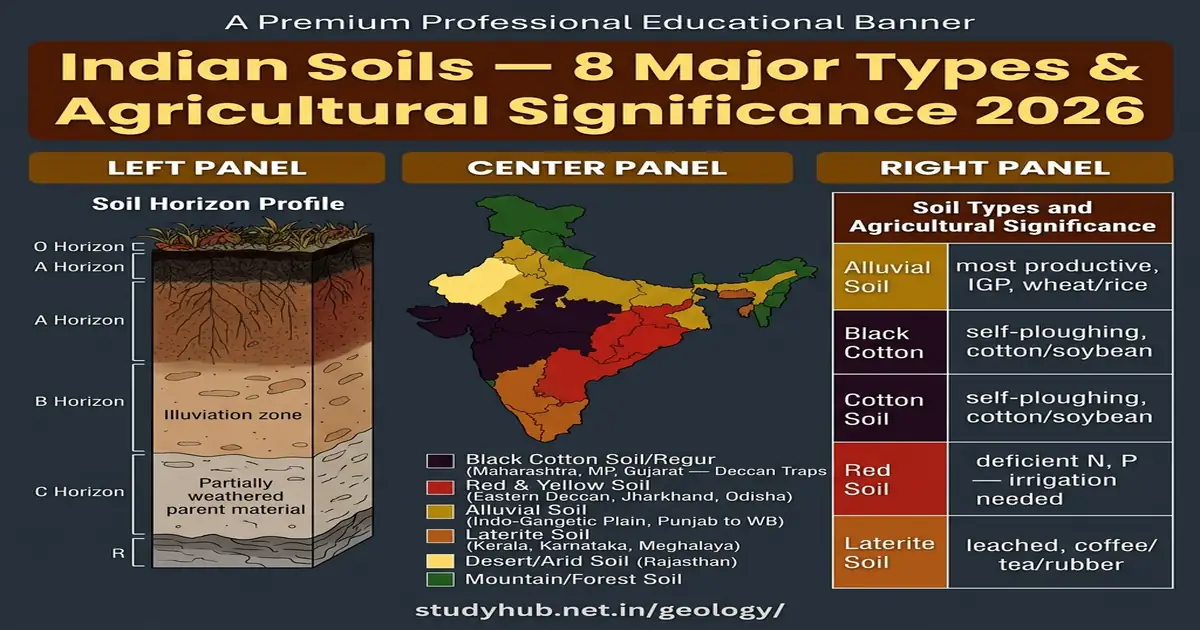
Indian Soils — 8 Major Types, Pedology & Agricultural Significance 2026
1. Soil Formation, Horizons & Key Concepts
| Concept | Details | India Context |
|---|---|---|
| Five Soil-Forming Factors (CLORPT) | Hans Jenny (1941) formalized: S = f(cl, o, r, p, t). Climate (cl): Most important factor. High temperature + high rainfall = intense chemical weathering + leaching → deep, red, lateritic soils (Kerala). Cold + dry = shallow, light-coloured soils. Rainfall determines leaching intensity. Living organisms (o): Bacteria decompose organic matter → humus. Earthworms mix and aerate soil. Plant roots penetrate and weather rock. Mycorrhizal fungi aid nutrient uptake. Fungi and bacteria = primary decomposers. Original parent material (p): Determines base mineral composition. Basalt weathers to montmorillonite clay (black cotton soil). Granite weathers to kaolinite clay (red soil). Limestone weathers to terra rossa (red limestone soil). Sandy parent = well-drained sandy soil. Relief / Topography (r): Steep slopes = thin soils (erosion > formation). Flat plains = thick soils (accumulation). Lower slopes = moister, darker soils. Valley floors = waterlogged soils (gleysols). Time (t): Older soils = more developed, deeper profiles. Young alluvial soils = azonal (immature, IGP). Ancient laterite = heavily leached, mature | India examples by CLORPT: Climate driver: Kerala (high rainfall = deep laterite, intense leaching). Rajasthan (low rainfall = shallow desert soil, minimal leaching). Living organisms: IGP alluvial soil + intensive rice-wheat cropping → soil organic matter depleted (Punjab soil health crisis). Parent material driver: Deccan basalt → black cotton soil (montmorillonite clay from Ca-Mg-Fe-rich basalt). Dharwar granite → red soil (kaolinite + iron oxide). Limestone → red limestone soils (AP). Relief: Himalayan steep slopes → shallow mountain soils. IGP flat plain → deep alluvial accumulation. Time: IGP = Quaternary (geologically young) → fertile Khadar. Eastern Ghats pediment → ancient, deeply weathered laterite. Rajasthan desert soil = azonal (minimal weathering due to aridity) |
| Soil Horizons (Profile) | A complete soil profile from surface to bedrock contains: O Horizon: Organic litter (undecomposed leaves, twigs, humus) at surface — absent in cropland (tilled away). A Horizon (Topsoil): Humus-rich, darkest (organic matter = dark brown/black), most biologically active, highest fertility. Eluviation (leaching of fine particles and solutes DOWN from A to B). B Horizon (Subsoil): Illuviation zone — clay, iron oxides, aluminium sesquioxides, organic colloids accumulate here (washed in from above). Lighter coloured than A. Clay-pan / Argillic horizon in some soils. C Horizon: Slightly weathered parent material (rock fragments, partially altered minerals). Weak soil development. R Horizon: Unweathered bedrock. Special horizons: E Horizon (Eluviated, bleached, between A and B in Spodosols/Podzols). Bg Horizon (waterlogged, blue-green from reduced iron). Solum = A + B horizons (the “true soil”). Pedon = smallest 3-D unit of soil described as a series | IGP alluvial soil: thick A horizon (dark, humus, fertile). Khadar = thin O, thick A, relatively young (recently deposited alluvium). Bhangar = older, with kankar (CaCO₃) nodules developing in B/C horizon. Laterite soil: thick B horizon (Fe-Al accumulation), thin or absent A (leached). Characteristic red/orange colour = iron sesquioxide accumulation in B horizons. Black cotton soil: deep A horizon (thick, dark, montmorillonite) — the famous “self-ploughing” soil (montmorillonite swells when wet, cracks when dry = slickensides in profile). Forest mountain soils: thin A, raw humus on top, rapid accumulation from leaf fall, but thin due to slope erosion. Desert soils: thin A, minimal organic matter, sometimes calcic horizon (CaCO₃ accumulation) in B zone |
| Soil Texture & Fertility | Textural classes based on particle size (USDA Triangle): Sand (2.0–0.05 mm): gritty, fast draining, low nutrient retention (small surface area). Silt (0.05–0.002 mm): smooth, good moisture retention, moderately fertile. Clay (<0.002 mm): sticky when wet, hard when dry, very high surface area, high nutrient/water retention, shrink-swell behavior (montmorillonite). Sandy loam, loam (mix of sand+silt+clay in ideal proportion) = best agricultural soil texture (LOAM = ideal balance of drainage + water retention + nutrient availability). Clay loam, silty clay loam. USDA Soil Taxonomy: 12 soil orders classified by degree of development, key features. Indian soils by USDA order: Alluvial=Entisols/Inceptisols. Black cotton=Vertisols. Red soil=Alfisols/Oxisols. Laterite=Ultisols/Oxisols. Desert=Aridisols. Mountain=Entisols/Inceptisols. Peaty/marshy=Histosols. Saline=Aridisols (sub-type) | Punjab-Haryana wheat belt: alluvial loam → moderate drainage + good fertility + Green Revolution inputs → world’s most productive wheat zone. However, excessive irrigation → falling water table + soil salinisation (Punjab groundwater crisis). Black cotton soil: clay-rich (montmorillonite = smectite) soil with very high shrink-swell capacity — excellent for cotton, soybean, wheat (Madhya Pradesh, Maharashtra). Red soil: loamy to sandy, low fertility, needs fertiliser (Odisha, Jharkhand, Karnataka — mainly rainfed dryland crops: millets, groundnuts). Laterite: high acidity, low P, high Al toxicity — suited for plantation crops (tea, coffee, rubber, spices) NOT staple crops. NBSS&LUP (Nagpur): India’s soil survey authority — soil maps at 1:250,000 scale cover whole of India |
2. India’s 8 Major Soil Types — Origin, Properties & Distribution
| Soil Type | Origin & Parent Material | Properties & Key Features | Distribution & Agricultural Significance |
|---|---|---|---|
| 1. Alluvial Soil (Most widespread — 43% of India’s land area) | Origin: Transported and deposited by rivers — Himalayan rivers (glacial + chemical weathering products from Himalayas) + Peninsular rivers (chemical weathering products of Deccan Plateau). Young, immature (azonal) — stratified alluvial deposits. Two types: Khadar (newer alluvium) = lower, low-lying, flood plains, renewed annually by monsoon floods, light-coloured, rich, loamy. Bhangar (older alluvium) = higher, older terraces, calcareous nodules/kankar, slightly less fertile, brownish | Properties: Sandy loam to clay loam texture. High fertility (fresh nutrient supply from river transport). Moderate to high organic matter. Well-drained (Khadar) to poorly drained (low-lying areas). pH neutral to slightly alkaline. Rich in potash, lime, phosphorous (sufficient). Deficient in nitrogen (needs fertiliser) and organic matter in intensively farmed areas. Khadar: most fertile (fresh nutrients), fine-grained, darker. Bhangar: slightly older, with CaCO₃ (kankar) — “usar” soils develop where drainage poor and salinity accumulates. “Self-healing” — receives fresh nutrients each flood | Distribution: Indo-Gangetic Plain (Punjab, Haryana, UP, Bihar, West Bengal). Coastal deltas (Ganga, Godavari, Krishna, Cauvery, Mahanadi). Rajasthan rivers (Chambal, Luni). Northeast India (Brahmaputra Valley = exceptionally fertile alluvial). Agricultural significance: India’s most productive agricultural zone. Wheat (Punjab/Haryana/UP), Rice (WB/Bihar/AP), Sugarcane (UP), Maize (UP/Bihar). IGP = India’s foodgrain surplus producing region. Punjab farmer = wheat belt. Khadar lands along river Ganga = best rice + jute growing. Assam alluvial = tea + rice. India’s Green Revolution was anchored in alluvial soil + irrigation (Punjab-Haryana-UP wheat belt). Critical issue: Punjab-Haryana groundwater depletion from over-irrigation; soil health declining from chemical inputs |
| 2. Black Cotton Soil (Regur — “self-ploughing soil”) | Origin: In-situ chemical weathering of Deccan Trap Basalt (mafic rock rich in Ca, Mg, Fe). The ferromagnesian minerals in basalt (olivine, pyroxene, Ca-plagioclase = top of Bowen’s series) weather rapidly under tropical conditions → produce montmorillonite (smectite) clay mineral. This 2:1 clay lattice mineral swells enormously when wet (absorbs water) and shrinks dramatically when dry → creating deep cracks (slickensides in profile). Black colour: from titaniferous magnetite (Ti-Fe oxide mineral) derived from basalt, and from humus accumulation (moisture retention supports high organic matter). Also called: Regur (Hindi term, used in revenue records), Vertisol (USDA taxonomy) | Properties: Very fine clay texture (montmorillonite = smectite, 70-80% clay content). Extremely plastic and sticky when wet. Very hard, cracked when dry — deep cracks allow surface soil to fall in → “self-ploughing” or “self-mulching” effect. High water-holding capacity (but poor drainage when solid → waterlogging in depressions). Rich in Ca, Mg, Fe, Al (from basalt parent). Deficient in N, P, organic matter. Neutral to alkaline pH (6.5–8.5). Very deep (1–2 m). Swells when wet = poor aeration. Slickensides (polished, striated surfaces from clay movement) | Distribution: Maharashtra (largest area), Madhya Pradesh, Gujarat, Andhra Pradesh/Telangana, Karnataka, Rajasthan, Tamil Nadu. Total ~5.5 million km² (Deccan Plateau lava area). Agricultural significance: Excellent for cotton → “black cotton soil” (holds moisture for long dry period after monsoon = suits long-season cotton). Also: Soybean (MP = India’s largest soybean producer), Jowar (sorghum), Wheat (drylands of MP/Maharashtra), Sugarcane (Maharashtra irrigated). Cotton (Maharashtra, Gujarat = Bt cotton now). Problem crops: paddy (waterlogging + crack = difficult for transplanting). Known as Deccan’s agricultural backbone. Wardha, Vidarbha = cotton + soybean heartland. Maharashtra farmer distress partly linked to cotton price + input cost on black soil farms |
| 3. Red & Yellow Soil | Origin: In-situ chemical weathering of ancient crystalline and metamorphic rocks (granite, gneiss, quartzite, schist) of Deccan Plateau and Peninsular India. Under lower rainfall than Deccan Traps area → less intense leaching than laterite. Iron oxide (hematite Fe₂O₃) gives red colour. When hydrated (in lower rainfall, poorly drained areas) → yellow goethite (FeOOH) = yellow soil. The “red” = ferruginous = iron-rich residual. Relatively thin compared to black cotton soil | Properties: Loamy to sandy loam texture (coarser than black cotton). Porous, well-drained. Low fertility (leached). Deficient in N, P, humus (poor nutrient retention). Acidic to neutral pH. Iron-rich (but non-plant-available form). Low clay content (kaolinite clay = less fertile than montmorillonite). Red colour diagnostic: iron sesquioxide coating on soil particles. Less water retention than black cotton → needs irrigation | Distribution: Odisha, Jharkhand, Chhattisgarh, Eastern Deccan (Andhra Pradesh, Telangana), Tamil Nadu (non-laterite parts), Karnataka, Bundelkhand (MP-UP), Rajasthan (eastern fringes). Total ~350,000 km². Agricultural significance: Relatively low productivity (needs fertiliser + irrigation). Crops: Groundnut, Millets (jowar, bajra = drought tolerant), Pulses (tur/arhar, cowpea), Oilseeds (Rajasthan, Maharashtra). Cotton (with irrigation). Not suited for water-intensive crops (paddy, sugarcane) without irrigation. Major issue: nutrient deficiency + low water retention → subsistence farming zone. Eastern India’s “poverty belt” partly coincides with red soil zone (Odisha, Jharkhand — tribal agricultural areas) |
| 4. Laterite Soil | Origin: Intense leaching in high-rainfall tropical/subtropical areas. The word “Laterite” = from Latin “later” = brick (Buchanan, 1807, first described in Kerala — it hardens on exposure to air and was used as building bricks). Chemical process: High rainfall + high temperature → intense leaching removes silica (SiO₂) and bases (Ca, Mg, Na, K) from soil. What remains = iron oxide (Fe₂O₃) and aluminium oxides (Al₂O₃ = gibbsite, boehmite) = sesquioxides. Extreme leaching = bauxite (almost pure Al₂O₃ → aluminium ore). Laterite = intermediate between normal soil and bauxite. Develops on flat-topped plateaus or peneplains with good drainage (leached from above, impermeable below) | Properties: High iron + aluminium sesquioxide content → red/brick-red colour. Acidic (pH 4.5–6.0 from acid leaching). Very low silica, bases, N, P, K. Hardens irreversibly on exposure to air (laterite = “ironite” hardening). Once hardened → poor agricultural land but excellent building material (traditional Kerala + Karnataka houses, temples use laterite blocks). Low organic matter (high temperature destroys organic matter rapidly). High Al toxicity (inhibits plant roots). NOT suited for most staple food crops | Distribution: Kerala (Malabar Coast, Western Ghats slopes), Karnataka (Western Ghats, Malnad), Tamil Nadu (Nilgiri foothills), West Bengal (Laterite plateau — Bankura, Purulia), Odisha (Eastern Ghats margins), Maharashtra (Konkan coastal plateau), Meghalaya (Shillong Plateau). Total ~1.26 million km². Agricultural significance: Plantation crops thrive due to acidity + drainage + humidity: Tea (Assam hills, West Bengal — Darjeeling tea on laterite slopes), Coffee (Coorg/Kodagu Karnataka, Wayanad Kerala — on laterite slopes of Western Ghats), Rubber (Kerala — largest in India), Spices (black pepper, cardamom = Kerala + Karnataka Western Ghats slopes). These are NOT staple food crops but high-value export crops. Building material: Kerala laterite blocks (traditional architecture). Mining: Bauxite from thoroughly leached laterite — Odisha (Nalco bauxite, Koraput + Kalahandi districts), Jharkhand (Lohardaga = India’s largest bauxite deposit), Maharashtra (Kolhapur, Ratnagiri) |
| 5. Desert / Arid Soil | Origin: Wind-blown sand deposits (aeolian) + minimal chemical weathering due to aridity (low rainfall = slow weathering). Also: mechanical weathering fragments from nearby rocky outcrops. Parent material: aeolian sand, alluvial fans. Time factor: very recent, immature, azonal soil (pedogenesis barely started). Minimal biological activity (sparse vegetation) | Properties: Sandy, loose, well-drained (excessively). Very low organic matter (sparse vegetation → minimal humus). Low moisture retention (water drains through quickly). Alkaline to strongly alkaline pH (8.0–9.5). Often saline at surface (no leaching to remove salts). CaCO₃ concentrations (calcic horizon, calcrete/kankar). Sometimes gypsum horizon. Pale grey or light brown colour (no iron oxidation = not red). Low fertility (N, P, organic matter all deficient). Low biological activity | Distribution: Rajasthan (Thar Desert — Jaisalmer, Barmer, Bikaner), Gujarat (Rann of Kutch), Haryana-Punjab semiarid margins. Total ~1.4 million km². Agricultural significance: Very limited without irrigation. IGNP (Indira Gandhi Nahar Project): transformed western Rajasthan from desert to agricultural land — now produces wheat, cotton, mustard, vegetables. Without irrigation: sparse khejri tree + desert grasses + bajra (pearl millet = most drought-tolerant crop). Overextraction of groundwater for IGNP-fed agriculture causing salinisation in some areas. Horticulture: dates (khajoor), cumin (jeera = Rajasthan’s major spice crop). Special issue: sand dune encroachment on farmland (desertification); Indira Gandhi Canal seepage → waterlogging in adjacent areas |
| 6. Mountain / Forest Soil | Origin: In-situ mechanical and chemical weathering of Himalayan rocks (limestone, schist, gneiss, sandstone) combined with abundant organic matter accumulation from dense forests. Young, skeletal soils on steep slopes (thin, rocky). Alpine soils at high altitude (cold, slow weathering, raw humus). Bottom of valleys: deeper, more developed soils. Varies enormously from subtropical forests (lower Himalayas) to alpine grasslands (above treeline) | Properties: Thin, skeletal, stony on slopes (slope erosion prevents deep accumulation). Rich in humus from forest litter (O and A horizons well-developed where undisturbed). Moderately acidic (coniferous forests = more acidic, deciduous = less). Variable fertility — good where humus-rich, poor where rocky. Waterlogged in valley bottoms. Peaty where drainage poor (Terai). Rocky, sandy in alpine zones. Podzolisation at high altitudes: E horizon bleached by leaching under conifers | Distribution: Himalayan belt (J&K, Ladakh, Himachal Pradesh, Uttarakhand, Sikkim, Arunachal Pradesh, Meghalaya hill areas, Nagaland-Manipur-Mizoram hills). Also Eastern Ghats and Western Ghats upper slopes. Total ~2.85 million km². Agricultural significance: Traditional terrace farming (Uttarakhand, Himachal Pradesh, Nagaland) — paddy, wheat, potato, vegetables. Apple orchards (Himachal Pradesh — Kullu, Shimla: thin, humus-rich mountain soil). Potato (Uttarakhand mountains). Cardamom (Sikkim — India’s largest cardamom producer on mountain forest soil). Horticulture (apricots, cherries, almonds, walnuts in J&K mountain soil). Plantation forestry: Teak, sal, pine. Limited flat agricultural land → erosion if trees removed (slope stability) |
| 7. Peaty & Marshy Soil | Origin: Waterlogged, poorly drained conditions → anaerobic decomposition → high organic matter accumulation (peat). Coastal backwaters, flood plains, mangrove areas. Also: Himalayan Terai (seasonally waterlogged zone at base of Himalayan foothills) | Properties: Very high organic matter (10–40% or more). Dark black / dark brown colour. Waterlogged in situ → anaerobic. Dense, spongy texture. Highly acidic (pH 3.5–5.5 in peatlands). Nutrient-poor (even though organic = nutrients locked in organic form). Low bulk density (peat is light). When drained for agriculture = releases CO₂ (major emission source) | Distribution: Kerala (Kuttanad — below-sea-level paddy fields in backwaters area), West Bengal coastal (Sundarbans mangrove area), Odisha coastal, Andaman-Nicobar mangrove areas, Bihar-UP-WB Terai belt, Manipur (Loktak Lake wetland periphery). Total relatively small. Agricultural significance: Kuttanad (Kerala): unique below-sea-level paddy cultivation using polders (enclosed bunded fields below sea level) — famous as “Below Sea Level Farming.” Biswanath Ghat (Assam): jute on peaty soil. Mangal (mangrove) soils in Sundarbans — not farm land (protected). Peat = potential fuel (like low-grade coal) but not commercially exploited in India. Kerala Kuttanad = UNESCO Globally Important Agricultural Heritage System (GIAHS) |
| 8. Saline & Alkaline Soil (Reh / Usar / Kallar / Thur) | Origin: (1) Waterlogging + high evaporation in low-lying areas → salts accumulate at surface (capillary rise brings dissolved salts up, water evaporates, salt stays). (2) Excessive irrigation without adequate drainage → same result. (3) Coastal ingress of seawater. (4) Geological saline groundwater brought up by irrigation. Main salts: NaCl, Na₂SO₄, Na₂CO₃, NaHCO₃ (sodic), CaCl₂, MgSO₄. Alkaline soil (Usar = sodic): Na₂CO₃ → very high pH (>8.5), sodium replaces Ca/Mg on clay surface → dispersed, cementing, black alkali soils | Properties: Pale brown to white salt efflorescence at surface. High electrical conductivity (high salt content). pH 8.5–10 (Usar/alkali soils). Poor soil structure (dispersed clay from Na). Very low permeability (dispersed clay seals pores). Lack of vegetation or sparse halophytic plants. Shallow water table. Saline soils (reh) = more soluble salts. Sodic soils (usar/alkali) = dominated by Na₂CO₃ | Distribution: Uttar Pradesh (Unnao, Hardoi, Lucknow, Kanpur districts — Usar land = notorious in UP), Rajasthan (arid zone, near canal commands), Punjab-Haryana (salt-affected from over-irrigation), Bihar (flood plains), Gujarat (coastal saline), AP coastal. Total ~6.73 million hectares salt-affected in India. Agricultural significance: Cannot grow most crops (salt toxicity + osmotic stress on roots + soil structure destruction = “white desert”). Reclamation methods: (1) Leaching (apply excess water + drain = flush salts). (2) Gypsum application (for sodic/usar: CaSO₄ replaces Na from clay surface, Na washed out). (3) Deep ploughing + green manuring. (4) Planting salt-tolerant trees: Prosopis juliflora (vilayati babool), Eucalyptus, Tamarix. (5) Biological reclamation: Karnal Bunt resistant wheat. CSSRI (Central Soil Salinity Research Institute, Karnal, Haryana): India’s premier institution for salt-affected soil research and reclamation |
Frequently Asked Questions
Why is Black Cotton Soil called “self-ploughing” — and what makes it simultaneously India’s best and most difficult soil to farm?
Black Cotton Soil (Regur) is one of the most geologically and agronomically fascinating soils on Earth, and its seemingly paradoxical nature — simultaneously excellent for water retention and terrible for drainage, simultaneously self-fertile and chronically nitrogen-deficient — comes directly from its unique clay mineralogy. The key is the clay mineral montmorillonite (also called smectite), which constitutes 60–80% of the clay fraction of black cotton soils. Montmorillonite is a 2:1 phyllosilicate clay: its crystal structure consists of one aluminium octahedral sheet sandwiched between TWO tetrahedral silica sheets. The layers are bonded weakly, and crucially — water molecules can enter between the layers (interlayer water), causing the entire clay particle to swell dramatically. When black cotton soil gets wet (monsoon rains): montmorillonite absorbs water → each clay particle swells to many times its dry volume → the whole soil mass swells → it becomes sticky, plastic, impermeable (waterlogged) — the swollen clay particles physically block all pore spaces and drainage pathways. At this stage: (1) The soil sticks to everything. Tractors bog down. Bullock ploughs struggle. Traditional farmers wait for perfect moisture window (“wetting front”). (2) The soil holds enormous water reserves deep in the clay structure — this is precious in the dry post-monsoon season when rain stops but clay slowly releases bound water for crops. Cotton’s long 180-day season can exploit this slow water release. When black cotton soil dries out (February-May): montmorillonite loses its interlayer water → clay particles shrink dramatically → deep polygonal desiccation cracks form (1–4 cm wide, 50–100 cm deep). These cracks are the “self-ploughing” mechanism: loose topsoil and organic matter falls into the cracks. Next monsoon rain → soil swells again → cracks close, incorporating the crack-infill material back into the soil profile. This vertical mixing effectively “turns” the soil without any ploughing — hence “self-ploughing” or “self-mulching” soil. Agronomic paradox: (1) Excellent water retention → good for crops with long growing season. COTTON (Gossypium hirsutum, Bt cotton) thrives because it needs sustained soil moisture during boll development (July-November). SOYBEAN (Madhya Pradesh) exploits the heavy July-August monsoon rainfall stored in black soil. (2) But TERRIBLE for short-season paddy rice → continuous waterlogging + crack formation damage transplanted seedlings. Poor drainage → root anaerobiosis. (3) High cation exchange capacity (montmorillonite) → excellent Ca, Mg retention. But: NO nitrogen fixation (no water retention of NO₃⁻ which leaches). → Chronically nitrogen-deficient despite seeming “fertile.” Farmers must add urea each season. (4) Tillage timing critical: too wet = soil sticks, compacts horribly → plough compacted ribbons. Too dry = hard as concrete, impossible to penetrate. Only a 1–2 week window of ideal moisture for ploughing (at “plastic limit”). Maharashtra’s Vidarbha cotton farmers face chronic economic distress partly from this difficult soil management + dependence on monsoon timing + cotton market price volatility.
Important for Exams — Indian Soils UPSC, SSC & State PCS
8 major Indian soil types (ICAR classification): 1. Alluvial (43% area, most widespread, IGP + coastal deltas, Khadar=newer, Bhangar=older, deficient N, wheat/rice/sugarcane). 2. Black Cotton/Regur (Deccan basalt weathering, montmorillonite clay, self-ploughing, Maharashtra/MP/Gujarat, cotton/soybean/jowar). 3. Red and Yellow (crystalline rock weathering, iron oxide, kaolinite, lower fertility, Odisha/Jharkhand/AP, millets/groundnut/pulses). 4. Laterite (intense leaching, Fe-Al sesquioxides, acidic, Kerala/Karnataka/WB, tea/coffee/rubber, bauxite ore). 5. Desert/Arid (Rajasthan, sandy, low organic matter, alkaline, bajra, IGNP irrigation = wheat). 6. Mountain/Forest (Himalayas, thin, skeletal, humus-rich under forest, apple orchards/potato/cardamom). 7. Peaty/Marshy (waterlogged, high organic, acidic, Kuttanad Kerala below sea level farming). 8. Saline/Alkaline/Reh/Usar (high salts, UP/Punjab/Rajasthan, gypsum reclamation, salt-affected 6.73 Mha India). Key institutions: NBSS&LUP (National Bureau of Soil Survey, Nagpur). CSSRI (Central Soil Salinity Research Institute, Karnal Haryana). ICAR (Indian Council of Agricultural Research). USDA Taxonomy: Alluvial=Entisol/Inceptisol. Black cotton=Vertisol. Red=Alfisol. Laterite=Ultisol/Oxisol. Desert=Aridisol. Peaty=Histosol. Key distinctions: Largest area=Alluvial. Most fertile=Alluvial (and Black Cotton for cotton). Self-ploughing=Black Cotton (montmorillonite). Laterite hardens=brick material. Usar reclamation=gypsum. Kuttanad=below sea level farming (Kerala)=peaty soil. Deccan=black cotton=Regur=Vertisol. Green Revolution crops grow on alluvial soil (Punjab/Haryana). Plantation crops on laterite (Western Ghats). Bauxite from laterite extreme (Odisha, Jharkhand). Soil degradation India: ISRO 2021: 97.85 Mha degraded land. Wind erosion (Rajasthan/Gujarat), Water erosion (hills, IGP), Waterlogging (Punjab/Bihar), Salinisation (irrigation areas), Landslides (Himalayas). Soil Conservation: contour bunding, terracing, check dams, windbreaks, agroforestry.
What to Read Next
- Weathering — Chemical Weathering Processes That Create India’s Soils 2026
- Igneous Rocks — How Deccan Basalt Weathers into Black Cotton Soil 2026
- Rivers — How Himalayan Rivers Build the Alluvial IGP Soils 2026
- Deserts — Thar Desert Soils & IGNP Irrigation Transformation 2026
- Geological Time Scale — Age of India’s Soil Parent Materials 2026
🎔 Exam Quick Reference — Indian Soils: 8 types by ICAR: (1) ALLUVIAL (largest 43%, IGP, Khadar=fertile newer, Bhangar=older+kankar, deficient N, wheat/rice/sugarcane, Punjab/Haryana/UP/Bihar/WB+deltas, USDA=Entisol/Inceptisol). (2) BLACK COTTON/Regur (Deccan basalt→montmorillonite clay, self-ploughing/self-mulching, Maharashtra/MP/Gujarat, cotton/soybean, deep crack when dry, waterlogged when wet, USDA=Vertisol). (3) RED & YELLOW (crystalline rocks→iron oxide kaolinite, low fertility, Odisha/Jharkhand/AP/TN/Karnataka, millets/groundnut/pulses, USDA=Alfisol). (4) LATERITE (intense leaching=iron+aluminium sesquioxides, acidic pH 4.5-6, hardens into brick, Kerala/Karnataka/WB/Odisha/Meghalaya, tea/coffee/rubber plantations, bauxite ore=Odisha Jharkhand, USDA=Ultisol/Oxisol). (5) DESERT/Arid (Rajasthan, sandy, alkaline, minimal organic, IGNP wheat, USDA=Aridisol). (6) MOUNTAIN/Forest (Himalayas, thin skeletal, humus-rich under forest, apple/potato/cardamom, USDA=Entisol/Inceptisol). (7) PEATY/Marshy (waterlogged, high organic, acid, Kuttanad Kerala below-sea-level farming, USDA=Histosol). (8) SALINE/Alkaline Reh/Usar (6.73 Mha India, UP worst, gypsum reclamation, CSSRI Karnal, USDA=Aridisol subtype). KEY FACTS: NBSS&LUP=soil survey authority (Nagpur). Soils forming factors=CLORPT (climate=most important). Loam=ideal texture. Latent=irreversible hardening on exposure. Montmorillonite=black cotton self-ploughing. Kaolinite=red soil. Laterite hardens=bricks (Kerala/Karnataka buildings). Bauxite=extensively leached laterite (Al₂O₃). Kuttanad=UNESCO GIAHS (below sea level farming). Green Revolution=alluvial soil+irrigation (Punjab). Plantation crops=laterite (coffee, tea, rubber, spices). Usar reclamation=gypsum+leaching.
🌍 Soil Degradation in India — Key Data & Facts 2026: Total degraded land: 97.85 million hectares (Mha) as of 2018-19 (ISRO National Remote Sensing Centre, 2021). Key degradation types: Water erosion: 59.2 Mha (largest — hill areas, IGP cropland, Himalayan slopes). Wind erosion: 9.5 Mha (Rajasthan, Gujarat). Waterlogging: 6.5 Mha (Punjab-Haryana-UP irrigation areas, Bihar flood plains). Salinisation: 6.73 Mha (Punjab-Haryana-Rajasthan-AP). Landslides: Significant in NE India, Himachal Pradesh, Uttarakhand. India’s degradation goal: Land Degradation Neutrality (LDN) — restore 26 Mha by 2030 under Bonn Challenge. SOIL CONSERVATION METHODS: Physical: Contour bunding (along contour lines to reduce runoff speed), Terracing (step terraces on hillslopes — Uttarakhand), Check dams (small masonry structures in gullies — Rajasthan Fanmer tanks, Gujarat check dam revolution), Strip cropping (alternating crops with different rooting depths + erosion resistance), Windbreaks/Shelterbelts (rows of trees perpendicular to prevailing wind — protect desert cropland). Agronomic: Green manuring (Dhaincha/Sesbania — summer crop ploughed in), Cover cropping (legumes fix N + protect soil), Contour ploughing (across slope NOT down slope). Biological: Agroforestry (trees + crops together), Grass establishment on gullied land. River Valley Projects: Soil Conservation in river catchments (CSWCRTI, Dehradun = Central Soil and Water Conservation Research and Training Institute).
About This Guide: Written by the StudyHub Geology Editorial Team (studyhub.net.in/geology/) based on NCERT Class 11 Geography India Chapter 6 (Soils), ICAR Soil Classification of India, NBSS&LUP Soil Maps 2021, ISRO National Land Degradation Assessment 2021, and Brady & Weil “The Nature and Properties of Soils” (15th ed., 2016). Last updated: March 2026.