
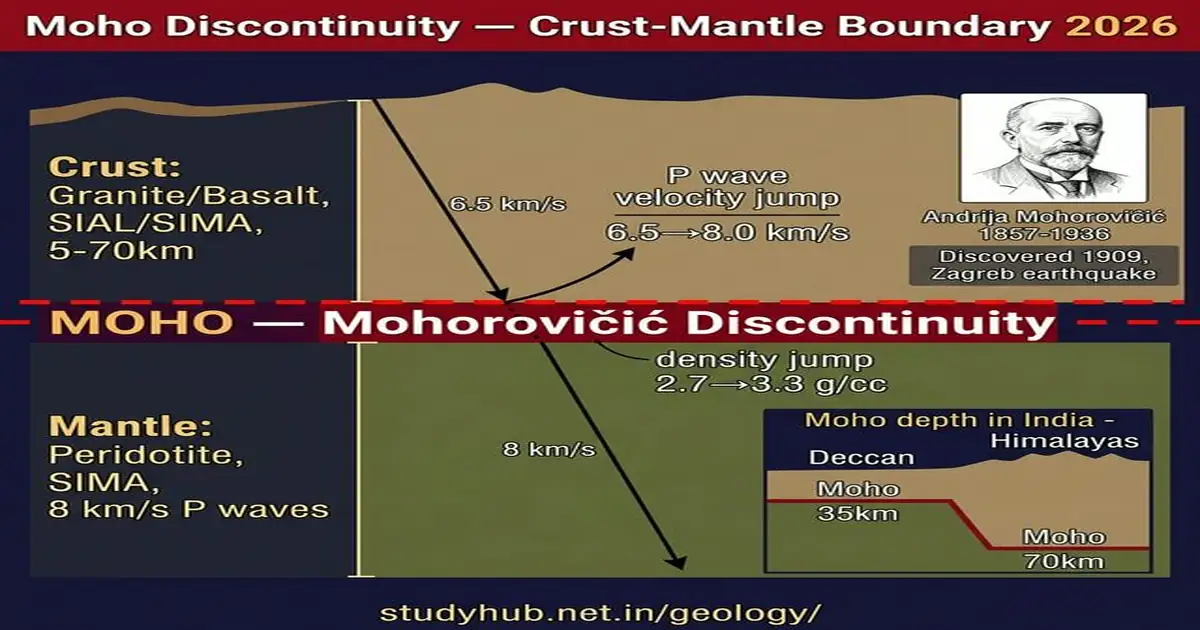
On 8 October 1909, a moderate earthquake struck the Kupa Valley in Croatia. While other seismologists treated it as routine, Andrija Mohorovičić (1857–1936) — a Croatian meteorologist-turned-seismologist at the Zagreb Meteorological Observatory — noticed something extraordinary in the seismograms: at distances greater than about 200 km from the epicentre, he could identify two distinct sets of P wave arrivals. By carefully analysing travel-time curves, he deduced that the faster set had refracted through a denser layer deeper in the Earth, explaining the later-arriving, slower waves as direct crustal P waves and the faster-arriving (at long distances) waves as refracted waves that had dipped into and travelled through a much faster underlying layer. The velocity jump he calculated — from approximately 6–7 km/s in the crust to ~8 km/s in the underlying rock — implied a sharply defined compositional boundary at approximately 54 km depth beneath Croatia. This boundary is now known universally as the Mohorovičić Discontinuity, universally shortened to the Moho — the globally recognised boundary between Earth’s crust and mantle, one of the most important interfaces on our planet. For UPSC, SSC, NDA, and all competitive geography exams, the Moho’s definition, the seismic velocity values at the boundary, its depth under different geological settings, and India-specific depth values are directly tested.
Mohorovičić Discontinuity (Moho) — Definition, Discovery & India Depths 2026
Moho — Key Facts Summary
| Parameter | Value / Details |
|---|---|
| Full Name | Mohorovičić Discontinuity (pronounced: mo-ho-ROH-vi-chich; informally “Moho”) |
| Discovered By | Andrija Mohorovičić (Croatian seismologist, 1857–1936), Zagreb Meteorological Observatory |
| Discovery Year & Earthquake | 1909 — analysing seismograms from the Kupa Valley earthquake (8 October 1909), Croatia |
| Definition | The compositional boundary (discontinuity) between Earth’s crust (above) and the upper mantle (below). Defined by an abrupt increase in seismic P wave velocity |
| P Wave Velocity — Above Moho (crust) | ~6.0–7.5 km/s (varies: 5.8–6.5 km/s in upper continental crust granite; 6.5–7.5 km/s in lower crust granulite; 6.5–7.5 km/s in oceanic basalt/gabbro) |
| P Wave Velocity — Below Moho (mantle) | ~7.8–8.5 km/s (typically stated as ~8 km/s). The jump of ~1–2 km/s is abrupt and globally consistent |
| S Wave Velocity Jump | S wave velocity: ~3.6–4.0 km/s (crust) → ~4.4–4.7 km/s (mantle). Both P and S waves accelerate at Moho due to denser, more rigid mantle peridotite |
| Density Jump | ~2.7–3.0 g/cm³ (crust: granite 2.7, basalt/gabbro 2.9–3.0) → ~3.3 g/cm³ (upper mantle peridotite). An increase of ~0.3–0.6 g/cm³ |
| Compositional Change | Crust (above): felsic-to-mafic silicates (granite, basalt, gabbro — high SiO₂, moderate Fe/Mg). Mantle (below): ultramafic peridotite (olivine + pyroxene — much lower SiO₂, very high Fe/Mg). This is a chemical discontinuity (unlike the asthenosphere boundary, which is mechanical) |
| Depth — Global Average Oceanic | ~5–10 km below sea floor. Thinnest at mid-ocean ridge crests (3–5 km). As shallow as 3 km at some ultra-slow spreading ridges |
| Depth — Global Average Continental | ~30–35 km below surface. Range: 20 km (extended continental margins, rifted crust) to 70+ km (high mountain belts) |
| Nature of Boundary | Generally sharp (transition over 1–3 km) but locally gradational. “Sharp Moho” (transition <0.5 km): common under stable cratons. “Laminated Moho” (gradational, transitional over 5–10 km): found under some rifted margins and collisional orogens (lower crust and uppermost mantle interlayered) |
Moho Depth Across India — Regional Variation
| Region | Moho Depth | Geological Setting | Exam Significance |
|---|---|---|---|
| Himalayan Mountains (Himachal/Uttarakhand/Nepal sector) | ~65–75 km (deepest in India; average ~70 km cited in standard texts) | Continental-continental collision (Indian + Eurasian plates). Indian lithosphere being underthrust beneath Tibet. Crustal doubling via stacked thrust sheets (MCT, MBT, MFT). Moho step = root of Himalayan mountain belt | Deepest Moho in India + world’s deepest under Tibetan Plateau (~75–80 km = world record for thickest continental crust). Airy isostasy: high mountains = deep crustal root. Active uplift: Himalayas still rising 5 mm/yr = Moho still deepening slowly |
| Tibetan Plateau (Eurasian Plate above Indian underthrust) | ~75–80 km (world’s deepest continental Moho) | Double-thick crust from India-Eurasia collision stacking. Not strictly Indian territory but result of Indian Plate underthrusting | Highest plateau (average 4,500 m elevation) + deepest Moho = isostatic balance. Seismic evidence: INDEPTH profiles (US-China collaborative seismic survey) confirmed 75–80 km Moho depth under Tibet in 1990s–2000s |
| Indo-Gangetic Plain | ~38–45 km (transitional — thicker than Deccan, thinner than Himalayas) | Foreland basin: Himalayan load is flexing the Indian crust downward. Moho deepens northward (towards Himalayas). Thick sedimentary cover (10–15 km) over crystalline basement | Northward increase in Moho depth reflects Himalayan crustal loading (isostatic flexure of foreband). Groundwater (Jal Jeevan Mission) in Indo-Gangetic alluvial aquifer above basement |
| Deccan Plateau / Peninsular India (stable craton) | ~35–42 km (standard text value: ~35 km for shield; locally 38–42 km under older metamorphic cores) | Ancient, stable continental crust (Dharwar, Bastar, Singhbhum cratons). Moho is relatively flat (reflecting crustal stability), sharp, and well-defined (sharp Moho under stable cratons) | Reference value for India’s standard continental Moho: ~35 km. Deccan Traps (basalt) sit above older crystalline basement — Moho unaffected by surface basalt cover. Seismic Zone II (lowest risk) |
| Western Ghats / Konkan Margin | ~33–36 km (thinning toward margin) | Passive continental margin (rifted from Africa/Madagascar ~70–88 Ma). Crust thinning toward Western Ghats escarpment and then steeply to oceanic crust beneath Arabian Sea | Rifted margin structure: Moho shallows westward from ~35 km (plateau) to ~10 km (oceanic). The dramatic escarpment = erosional response to rifting and uplift (~20–30 million years of denudation) |
| Andaman & Nicobar Sector | ~15–20 km (effectively oceanic/island arc crust) | Oceanic and island-arc crust above subducting Indian Plate. Thin arc crust (15–20 km) overlying mantle wedge. Totally different geological setting from mainland India | Shallowest Moho in Indian territory. Barren Island volcano, active seismicity (Zone V). Oceanic crust = basalt + gabbro directly overlying thin depleted mantle wedge peridotite |
| Lakshadweep Islands | ~15–25 km (oceanic plateau type) | Oceanic plateau (Lakshadweep-Chagos Ridge) formed by Réunion hotspot trail. Thickened oceanic crust (~20–25 km — much thicker than normal oceanic Moho of 7–10 km due to plume magmatic underplating) | Evidence for Réunion hotspot plume magmatic underplating. Chagos-Laccadive Ridge tracks Indian Plate motion over Réunion hotspot (65 Ma → present) |
Project Mohole — The Attempt to Drill Through the Moho
If seismology can detect the Moho at 5–70 km depth, could we drill down to sample the mantle directly? In 1961, Project Mohole — a US-led scientific drilling project — made the first serious attempt to drill through the oceanic crust and reach the Moho. The project chose the ocean floor rather than continental crust because oceanic Moho is only 5–7 km beneath the sea floor, compared to 30–35 km under continents — a much more achievable drilling target even accounting for 3,500 m of water above. In 1961, the CUSS I drilling vessel operated by AMSOC (American Miscellaneous Society) successfully drilled five holes in 3,500 m of water off the coast of Guadalupe, Mexico, in the Pacific — reaching 183 m into the basaltic oceanic crust and retrieving the first ever samples of oceanic basalt directly from the sea floor. However, the project was cancelled by the US Congress in 1966 due to cost overruns and political controversy before it reached the Moho. The legacy of Project Mohole lives on in the Ocean Drilling Program (ODP) / International Ocean Discovery Program (IODP) — a series of international scientific drilling expeditions that continue to drill into ocean floor to study the crust-mantle boundary. As of 2026, the deepest ocean floor drill hole (ODP Hole 1309D, mid-Atlantic Ridge) has reached ~1.4 km into the oceanic crust. The Japanese scientific vessel Chikyu (commissioned 2005) is specifically designed to drill through 7 km of oceanic crust to reach the Moho — a goal still not yet achieved. India context: the Kola Superdeep Borehole (Russia, Kola Peninsula), drilled between 1970–1989, reached 12.26 km depth — still the world’s deepest drill hole — but this was entirely within the Archean continental crust (total continental Moho at that location: ~35 km). The Kola drilling discovered that the assumed seismic boundary at ~7 km depth (which had been interpreted as Moho) was actually a metamorphic transition zone in the crust, not the true Moho. Temperature at 12 km depth: 180°C (much higher than expected) — meaning heat flow is higher, and drilling would need to overcome extreme temperatures to reach even the mid-crust, let alone the Moho.
Frequently Asked Questions
What exactly causes the Moho? Why do seismic velocities jump at this boundary?
The Mohorovičić Discontinuity represents one of Earth’s most fundamental compositional transitions — from crustal rock (granitic/basaltic silicates: primarily feldspar, quartz, pyroxene with SiO₂ content 45–75%) to upper mantle rock (peridotite: primarily olivine and pyroxene with SiO₂ content only 38–45%, rich in MgO and FeO). This compositional change causes three simultaneous physical changes that together produce the seismic velocity jump: (1) Density increase: Continental crust (granite): 2.7 g/cm³; lower continental crust (granulite): 2.9–3.0 g/cm³; upper mantle peridotite: 3.3 g/cm³. Denser rock transmits compressional (P) waves faster, because P wave velocity ∝ √(elastic modulus / density). The bulk modulus and shear modulus of peridotite are higher than those of granulite/gabbro, more than compensating for the density increase. (2) Loss of feldspar / gain of olivine: The crust’s dominant mineral is feldspar (a framework silicate with relatively low P wave velocity: ~5.5 km/s). Below the Moho, olivine ((Mg,Fe)₂SiO₄) dominates — a dense orthosilicate with intrinsically high seismic velocity (~8.5 km/s at Moho pressure and temperature conditions). The replacement of feldspar-based rocks with olivine-based peridotite is the primary cause of the velocity jump. (3) Phase transitions (in some settings): Under high-pressure conditions (30–35 km depth), basalt can transform to the denser mineral assemblage eclogite (garnet + omphacite pyroxene, density ~3.5 g/cm³) — significantly denser than gabbro. In some subduction zones and in the lower parts of thickened crust (Himalayas), eclogite transformation contributes to the Moho signal and to lower crustal delamination (dense eclogite sinking into mantle). For exam: Moho = feldspar-rich crust → olivine-rich mantle; P wave 6.5→8.0 km/s; density 2.7→3.3 g/cm³. Chemical (compositional) boundary, NOT mechanical (that’s the LAB/asthenosphere boundary).
Important for Exams — Moho Facts for UPSC, SSC & State PCS
Discovery: Andrija Mohorovičić, 1909, analysing Kupa Valley earthquake (Croatia) seismograms. First seismological discontinuity discovered.
Definition: Chemical boundary between crust (feldspar/silicate) and mantle (peridotite/olivine). P wave velocity: 6.0–7.5 km/s (crust) → 7.8–8.5 km/s (mantle). Density: 2.7–3.0 g/cm³ → 3.3 g/cm³.
Depth values (memorise): Oceanic: 5–10 km; Continental average: 30–35 km; India Deccan/Shield: ~35 km; Indo-Gangetic: 38–45 km; Himalayas: ~70 km; Tibetan Plateau: 75–80 km (world’s deepest); Andaman: 15–20 km (shallowest in India).
Moho vs LAB: Moho = chemical boundary (crust/mantle); LAB = mechanical boundary (rigid lithosphere / plastic asthenosphere) — LAB is DEEPER than Moho. Moho is within the lithosphere. Drilling: Project Mohole (1961) = first ocean floor scientific drilling, USA, off Mexico — cancelled 1966. Kola Superdeep Borehole (Russia) = world’s deepest drill hole 12.26 km, never reached Moho. IODP = ongoing ocean drilling programme. Chikyu (Japan) = purpose-built Moho drilling vessel.
India Moho data: GSI + NGRI have conducted seismic refraction surveys across India. INDEPTH programme (1990s–2000s) = US-China seismic survey confirming Tibet Moho at 75–80 km. Deep Seismic Sounding (DSS) profiles across India by NGRI documented Moho at 35–42 km across Deccan craton and 65–75 km across Himalayan zone.
What to Read Next
- Earth’s Structure — Crust, Mantle, Outer Core & Inner Core Explained 2026
- Continental vs Oceanic Crust — SIAL vs SIMA, Thickness, Age & Isostasy 2026
- Seismic Waves — How P Waves & S Waves Reveal Earth’s Hidden Interior 2026
- Asthenosphere — Plastic Layer Below the Lithosphere & Isostatic Rebound 2026
- Earth’s Mantle — Composition, Asthenosphere & Mantle Plumes 2026
🎔 Exam Quick Reference — Moho Discontinuity: Discovered: Andrija Mohorovičić, 1909 (Kupa Valley earthquake). P wave: 6.0-7.5 km/s (crust) → 7.8-8.5 km/s (mantle) — abrupt jump. Density: 2.7 g/cc → 3.3 g/cc. Cause: feldspar-rich crust → olivine-rich peridotite mantle. Depth: Oceanic 5-10km; Continental average 35km; Himalayas 70km; Tibet 75-80km (deepest). India: Deccan ~35km; IGP ~40km; Himalayas ~70km; Andaman ~15-20km. Moho = CHEMICAL boundary. LAB = MECHANICAL boundary (deeper). Drilling: Project Mohole (1961, incomplete); Kola Borehole (12.26km, world deepest, never reached Moho); Chikyu (Japan, ongoing).
🌍 India Moho Research: NGRI Hyderabad = Deep Seismic Sounding (DSS) profiles mapped Moho under all major Indian geological provinces. Results: Deccan craton ~35-42km; Dharwar Craton (South India) ~38km; Eastern Ghats ~38-42km; Aravalli-Delhi belt ~38-44km; Indo-Gangetic Plain ~40-45km increasing northward; Himalayan frontal zone (Seismogenic MCT zone) ~50-60km; Tibetan-facing Himalayan chain ~65-75km. INDEPTH (International Deep Profiling of Tibet and Himalayas) seismic survey confirmed 75-80km Moho under Tibet. National Geophysical Data Centre: all Indian DSS profiles archived at NGRI, Hyderabad.
About This Guide: Written by the StudyHub Geology Editorial Team (studyhub.net.in/geology/) based on NCERT Class 11 Physical Geography Chapter 3, Telford, Geldart & Sheriff “Applied Geophysics” (2nd Ed.), Mooney, Laske & Masters CRUST 5.1 global model (1998), and GSI-NGRI Deep Seismic Sounding reports on India. Last updated: March 2026.