
India is one of the world’s most biologically mega-diverse nations — home to over 47,000 plant species (about 12% of the world’s recorded flora) and 91,000 animal species, within just 2.4% of Earth’s land area. This extraordinary biodiversity is the direct result of India’s remarkable range of climates, soils, altitudes, and geological histories — from sea level tropical coasts to 8,000m+ Himalayan peaks, from hyper-arid deserts to the world’s wettest regions. India’s natural vegetation is classified into 5 major types broadly, with numerous sub-types based on rainfall, temperature, and altitude. These forests, grasslands, wetlands, and scrublands are not just ecologically critical — they are the foundation of India’s agriculture (pollinators, watershed catchments), climate regulation (carbon sinks), and the livelihoods of ~300 million forest-dependent people. Understanding India’s vegetation types, their distribution, characteristic species, and conservation status is essential for UPSC, SSC, Class 11 NCERT Geography, and all competitive examinations.
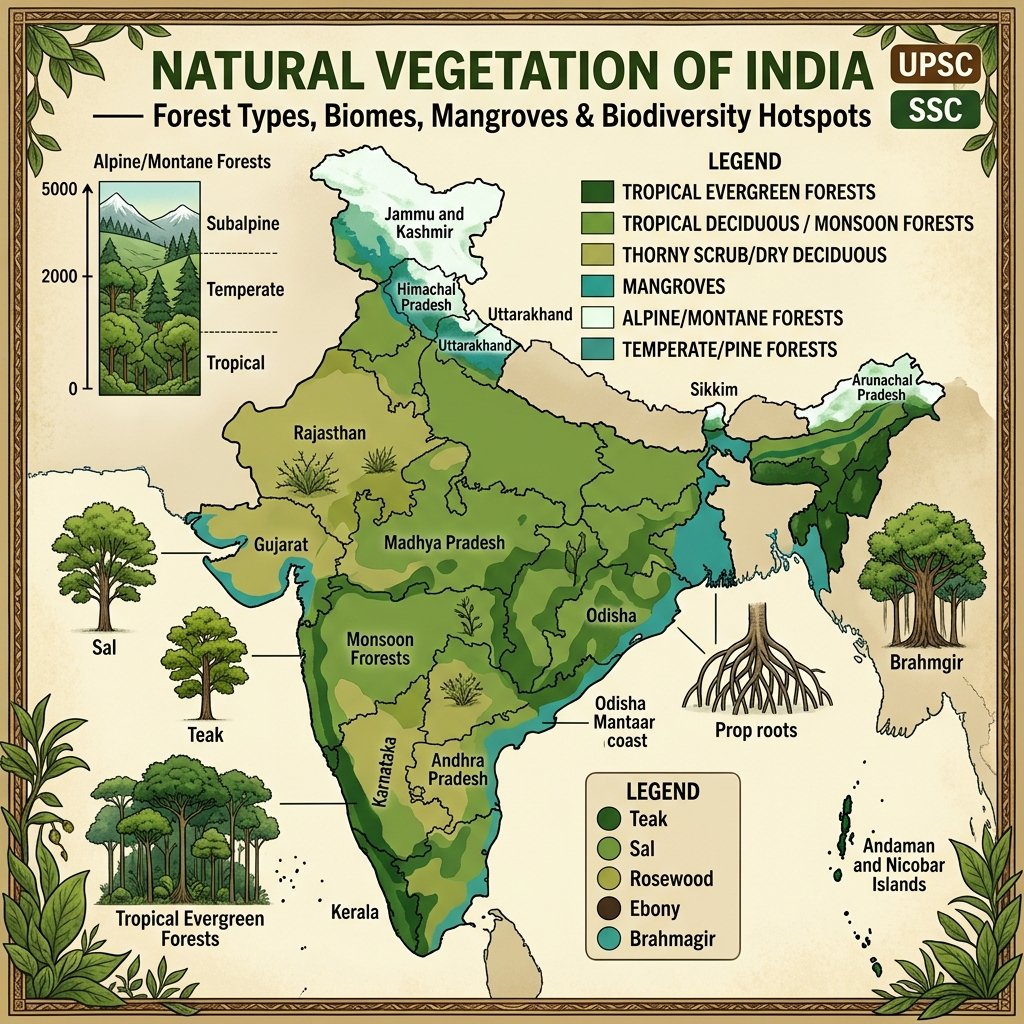
India’s Forest Cover — Overview
- 📊 Total forest + tree cover: 8,09,537 km² (India State of Forest Report 2023, FSI) = 24.62% of India’s geographical area; includes forests + trees outside forests
- 🌲 Forest cover only: 7,15,343 km² = 21.76% of India’s area (below the national target of 33% mentioned in National Forest Policy 1988)
- 🏆 States with highest forest cover (%): Mizoram (85%), Arunachal Pradesh (79%), Meghalaya (76%), Manipur (75%), Nagaland (75%) — NE India dominates
- 🌳 States with highest forest cover (area): Madhya Pradesh (77,073 km²), Arunachal Pradesh (66,431 km²), Chhattisgarh (55,611 km²), Odisha (52,888 km²)
- ⚠️ India’s deforestation rate: Despite overall statistics, significant forest degradation occurring; primary forests replaced by plantations; NE India, Western Ghats fragmentation; annual loss in primary forests continues
Factors Determining Vegetation Type
- 🌧️ Rainfall (most important): >200cm = evergreen; 100–200cm = moist deciduous; 70–100cm = dry deciduous; 50–70cm = thorny scrub; <50cm = desert vegetation
- 🌡️ Temperature: Controls altitude zones in Himalayas; determines whether tropical or temperate species
- 🪨 Soil type: Black cotton soil (poor drainage, waterlogged) → different species than laterite; alluvial vs rocky soil
- ⛰️ Altitude: Every 1,000m gain shifts vegetation zone (tropical → subtropical → temperate → subalpine → alpine tundra → nival)
- 💧 Drainage: Waterlogged areas → swamp forests, mangroves; well-drained → upland forests
1. Tropical Evergreen Forests
- 📍 Distribution: Areas receiving >200cm rainfall; Western Ghats (Kerala, Karnataka, Goa), northeast India (Assam, Meghalaya, Arunachal Pradesh, Manipur, Nagaland), Andaman & Nicobar Islands
- 🌡️ Climate: Hot and wet year-round; no real dry season; high humidity (80–90%+); temperature 22–32°C throughout
- 🌳 Characteristics: Multi-layered canopy (4–5 layers); trees do NOT shed leaves simultaneously — different species shed at different times so forest appears “evergreen”; very dense canopy — ground receives little sunlight; rich epiphytes (plants growing on other plants), lianas (woody vines), mosses
- 🌿 Key species: Rosewood (Dalbergia latifolia), Ebony (Diospyros ebenum), Mahogany, Iron Wood (Mesua ferrea = Nahar), Gurjan (Dipterocarpus turbinatus), Rubber tree, Bamboo; understory: aroids, ferns
- 🛠️ Economic importance: Rosewood and Ebony among world’s most valuable hardwoods; Karnataka/Kerala rosewood furniture; illegal logging major threat
- 📌 Silent Valley (Kerala): One of India’s last undisturbed primary tropical rainforest patches; protected as Silent Valley National Park after famous 1970s–80s campaign that stopped a hydroelectric dam; UNESCO Biosphere Reserve (Nilgiri); home to lion-tailed macaque
2. Tropical Deciduous Forests (Monsoon Forests)
The most widespread forest type in India — covering the largest area. Also called Monsoon Forests because their leaf-shedding cycle is perfectly synchronised with the monsoon: leaves shed in the dry season (October–June) to conserve water, then flush new leaves just before or at monsoon onset. Divided into Moist Deciduous and Dry Deciduous:
| Feature | Moist Deciduous | Dry Deciduous |
|---|---|---|
| Rainfall | 100–200 cm annually | 70–100 cm annually |
| Distribution | Eastern slopes of Western Ghats, NE India, Odisha, eastern MP, Chhattisgarh, Jharkhand, WB foothills, Himalayan foothills (Terai) | Most of peninsular India interior — UP, Bihar, MP, Rajasthan (east), AP, Karnataka (interior) |
| Key trees | Teak (Tectona grandis) — India’s most commercially important timber; Karnataka, MP, Maharashtra; Sal (Shorea robusta) — dominant in eastern India, Jharkhand, UP foothills; Bamboo (considered a grass but ecologically forest component), Shisham (Dalbergia sissoo) | Tendu (Diospyros melanoxylon) — leaves used for bidis (India’s poor man’s cigarette); Axle wood, Mahua (Madhuca indica) — flowers used for tribal alcohol; Palas/Flame of the Forest (Butea monosperma) |
| Understorey | Grasses and shrubs; bamboo thickets common | Sparser; more grassland patches between trees |
| Wildlife | Tiger, elephant, leopard, gaur (Indian bison), deer (sambar, chital); major tiger habitats in Satpura, Kanha, Pench | Sambar, chital, nilgai (blue bull = largest antelope India); Indian wolf; blackbuck in open areas |
- 🌳 Teak (Sagwan): King of Indian timber; naturally found only in Western Ghats, Satpura, and some parts of MP, Maharashtra, Karnataka; highly valued for its durability, resistance to termites and water, and beautiful grain; India was once world’s largest teak exporter; over-harvesting led to heavy regulation; plantation teak now grown widely in Kerala, TN, AP; Myanmar teak still the global standard but over-exploited
- 🌿 Sal: Dominant tree of eastern India’s forests (Jharkhand, Odisha, WB Terai, Uttarakhand foothills); very hard, heavy timber; used for railway sleepers, construction; highly important for Adivasi (tribal) communities — leaves for plates (Sala), seeds for vegetable oil; indicator species of eastern Himalayan foothills forests
3. Thornny Scrub & Dry Forests
- 📍 Distribution: Regions with 50–70cm rainfall; western Rajasthan margins, Gujarat, parts of MP, AP interior (Rayalaseema), Karnataka (Mysore Plateau eastern parts)
- 🌵 Characteristics: Trees small and scattered; thorny; deep root systems to access water; leaves small, waxy, or reduced to spines (all adaptations to conserve water); long dormancy in dry season
- 🌳 Key species: Khejri (Prosopis cineraria) = State tree of Rajasthan; sacred to Bishnoi community (the Chipko-equivalent event: 363 Bishnois died defending Khejri trees from Maharaja’s soldiers in 1730 CE — the original tree-protectors of India); Ber (Ziziphus mauritiana), Acacia, Babul, Palas, Cactus (naturalized)
- 🦅 Wildlife: Indian Gazelle (Chinkara), Great Indian Bustard (critically endangered — only ~150 remaining; most in Rajasthan; electricity transmission line collisions = primary cause of death), Blackbuck, Desert Fox, Sand Grouse
4. Mangrove Forests
- 📍 Distribution: Tidal coastal areas (inter-tidal zone — flooded at high tide, exposed at low tide); Sundarbans (WB + Bangladesh) = world’s largest mangrove forest; Odisha (Bhitarkanika = 2nd largest in India); Gujarat (Gulf of Kutch, Gulf of Khambhat); Andaman & Nicobar; Kerala backwaters; AP, TN coasts
- 📊 India’s total mangrove cover: 4,992 km² (FSI 2023); increased by 17 km² from 2021; India has ~3% of world’s mangroves
- 🌿 Adaptations: Pneumatophores (aerial breathing roots that stick up from anaerobic waterlogged mud — act like snorkels); Prop roots / stilt roots (above-ground arch roots for structural support in soft unstable mud); Viviparous germination (seeds germinate on the parent tree → propagules drop into water ready to root → rapid colonisation); waxy salt-excluding leaves; ability to tolerate high salinity (halophytes)
- 🛡️ Ecological services: Natural coastal buffer against cyclones and storm surge (Bhitarkanika mangroves significantly reduced Odisha cyclone impact; 2004 tsunami: coasts with intact mangroves saw dramatically lower deaths compared to cleared coasts); nursery ground for 80%+ of India’s commercially important marine fish; carbon storage (mangrove soil = among the highest carbon density ecosystems on Earth = “blue carbon”); water purification; prevents coastal erosion
- 🐯 Sundarbans: World’s largest mangrove delta; shared India (West Bengal) and Bangladesh; 10,000 km² total (India side ~4,200 km²); UNESCO World Heritage Site; home to the Bengal Tiger (the only tigers in India that swim regularly and live entirely in tidal environments); Royal Bengal Tiger = estimated 96 tigers (Indian side, 2020 census); also home to Irrawaddy Dolphin, saltwater crocodile, Olive Ridley sea turtle
- ⚠️ Threats: Aquaculture (shrimp farming) — primary destroyer of mangroves globally (cleared for ponds); coastal development; sea level rise inundating inner mangrove zones; cyclone damage; pollution
5. Montane / Himalayan Forests — Altitude Zones
| Zone | Altitude | Climate | Key Vegetation | Indian Regions |
|---|---|---|---|---|
| Tropical Foothill | 200–1,000m | Hot, very wet (terai) | Sal, Teak, Bamboo, Elephant grass (Saccharum spontaneum); dense undergrowth | Himalayan foothills: Uttarakhand, UP terai, Assam, Arunachal foothills |
| Subtropical Pine | 1,000–2,000m | Warm, moderate rainfall | Chir Pine (Pinus roxburghii); Blue Pine; Oak varieties; Rhododendron (lower) | HP (Shimla belt), Uttarakhand, J&K lower ranges; NE hill states |
| Temperate Broad-leaf | 1,500–3,000m | Cool, moderate | Oak (Quercus spp.), Maple, Rhododendron, Deodar (Cedrus deodara = State tree of J&K/Uttarakhand), Blue Pine, Silver Fir | Uttarakhand, HP, Kashmir Valley, Sikkim, Arunachal Pradesh |
| Sub-alpine / Fir-Spruce | 2,800–4,000m | Cold, heavy snowfall | Silver Fir, Spruce (Picea smithiana), Birch (Betula), Juniper; high-altitude Rhododendron (tree form) | Higher Uttarakhand (Kedarnath, Badrinath area), higher HP, Kashmir |
| Alpine Meadows (Bugyals) | 3,500–5,000m | Very cold; short growing season | Dwarf shrubs, sedges, mosses, Alpine flowers (Brahmakamal = Uttarakhand state flower; Edelweiss); Saussurea (Brahmakamal) | Uttarakhand bugyals (Valley of Flowers UNESCO), Kashmir Gulmarg meadows, Ladakh |
| Nival (Snow zone) | >5,000m | Permanent ice/snow; year-round frost | Virtually no vascular plants; lichens on exposed rocks; snowfield algae | High Himalayan peaks, glaciers, Siachen |
- 🌸 Valley of Flowers (Uttarakhand): UNESCO World Heritage Site (Natural); located in Chamoli district at 3,352–3,658m; extraordinary alpine meadow with 300+ species of wildflowers blooming July–September; also part of the Nanda Devi Biosphere Reserve; discovered by British mountaineer Frank Smythe in 1931
- 🌲 Deodar Cedar: Most prized Himalayan timber tree; state tree of Himachal Pradesh; used historically for temple construction, railway sleepers; sacred (“Deodar” = Sanskrit for “wood of the gods”); fragrant; resistant to rot; found 1,500–3,200m in Western Himalayas
India’s Biodiversity Hotspots
A Biodiversity Hotspot (concept by Norman Myers, 1988; adopted by Conservation International) is a region that: (1) contains at least 1,500 endemic vascular plant species (>0.5% of the world total), AND (2) has lost at least 70% of its original habitat. India has 4 Biodiversity Hotspots:
| Hotspot | Coverage | Key Features | Threats |
|---|---|---|---|
| Western Ghats | Along western coast of India (Kerala, Karnataka, Goa, Maharashtra, TN hills); ~160,000 km² | UNESCO World Heritage (39 sites); ~5,000 plant species (1,700 endemic); 139 freshwater fish species (over 50% endemic); 4 major river systems source here (Godavari, Krishna, Cauvery, Periyar); Lion-tailed macaque, Nilgiri Tahr, Malabar giant squirrel; Periyar Tiger Reserve | Encroachment for tea/coffee plantations; roads through forest (NH266 ghat sections); hydroelectric projects; invasive Lantana camara; sand mining in rivers; railway expansion |
| Eastern Himalayas | Extends from Nepal through Sikkim, Assam, Arunachal Pradesh, Meghalaya into Bhutan and Myanmar; ~524,000 km² | Extraordinary plant diversity (over 10,000 plant species); 163 globally threatened species; Red Panda (State animal of Sikkim), Snow Leopard, Clouded Leopard; orchid diversity (Arunachal Pradesh = most orchid species); Kaziranga (one-horned rhino) | Shifting cultivation (jhum) in NE; road building for strategic military access; hydroelectric dams (Arunachal has 168 dams planned); illegal trade (bear bile, pangolins, big cats) |
| Indo-Burma | Mostly Myanmar + Indo-China, but includes Manipur, Mizoram, Tripura, Nagaland, Meghalaya of India | ~13,500 plant species; freshwater turtle diversity; Brow-antlered deer (Sangai = State animal of Manipur; lives on floating islands in Loktak Lake!); Hoolock Gibbon (India’s only ape); Slow Loris | Extreme deforestation in Myanmar; shifting cultivation; hunting; political instability in border areas |
| Sundaland | Primarily Southeast Asia (Sumatra, Java, Borneo) but extends to Andaman & Nicobar Islands (India) | Andaman & Nicobar = 2,200+ plant species, many endemic; Andaman Horseshoe Crab; Edible Nest Swiftlet; Saltwater Crocodile; protected tribes (Jarawa, Sentinelese, Onge) | Tourism pressure on Andaman; infrastructure development (Port Blair expansion); illegal fishing; impact of 2004 tsunami on Nicobar ecosystems |
⭐ Important for Exams — Quick Revision
- 🔑 India’s forest cover: 21.76% of area; target = 33% (National Forest Policy 1988); MP has largest area; Mizoram highest % (85%)
- 🔑 Rainfall determines vegetation: >200cm = Evergreen; 100–200cm = Moist Deciduous; 70–100cm = Dry Deciduous; 50–70cm = Thorny Scrub; <50cm = Desert
- 🔑 Tropical Deciduous = most widespread forest type in India; shed leaves in dry season; synchronised with monsoon; also called Monsoon Forests
- 🔑 Teak = most commercially important Indian timber; Western Ghats, MP, Maharashtra, Karnataka; very hard, water/termite resistant; plantation now widespread Kerala, TN, AP
- 🔑 Sal = dominant eastern India forests (Jharkhand, Odisha, UP-Uttarakhand foothills); Adivasi communities depend on it; very hard timber for railway sleepers
- 🔑 Khejri = State tree of Rajasthan; sacred to Bishnoi community; 363 Bishnois died defending it in 1730 CE — original tree martyrs of India
- 🔑 Tendu = dry deciduous; leaves used for bidi (cigarette) making; major income source for tribal communities in MP, CG, Jharkhand
- 🔑 Mangroves: Sundarbans = world’s largest (India+Bangladesh); Bhitarkanika (Odisha) = 2nd in India; pneumatophores + prop roots + viviparous seeds = key adaptations; “blue carbon” ecosystem; coastal cyclone buffer
- 🔑 Sundarbans: UNESCO World Heritage; Bengal Tiger (only swimming tigers); India side ~96 tigers (2020); saltwater crocodile; Irrawaddy Dolphin
- 🔑 Silent Valley (Kerala) = last primary tropical rainforest; National Park; saved by campaign stopping hydroelectric dam; Nilgiri Biosphere Reserve; lion-tailed macaque
- 🔑 Valley of Flowers (Uttarakhand) = UNESCO World Heritage; Chamoli; 300+ alpine flowers; July–September bloom; Saussurea/Brahmakamal
- 🔑 India has 4 Biodiversity Hotspots: Western Ghats, Eastern Himalayas, Indo-Burma, Sundaland (Andaman & Nicobar)
- 🔑 Western Ghats = biodiversity hotspot; UNESCO; source of Godavari, Krishna, Cauvery; lion-tailed macaque, Nilgiri Tahr
- 🔑 Sangai deer (Manipur State animal) = lives on floating islands (Phumdis) in Loktak Lake = world’s only dancing/floating deer habitat; critically endangered
- 🔑 Deodar Cedar = State tree of HP and J&K; most prized Himalayan timber; “wood of the gods”; 1,500–3,200m altitude
Frequently Asked Questions (FAQs)
1. Why does the Sundarbans have swimming tigers — and what does their future look like under climate change?
The Sundarbans tigers are behaviourally unique among all tiger populations on Earth. While tigers are generally known to be good swimmers, tigers in most habitats use water to cool off or occasionally cross rivers. Sundarbans tigers live in tidal mangrove habitat where islands are separated by brackish tidal creeks; they have no option but to swim regularly — up to 10–15 km across tidal channels to move between islands for territory maintenance and hunting. Their diet consists heavily of mud skippers, crabs, fish, and monitor lizards in addition to chital deer and wild boar — a more aquatic diet than any other tiger population. They are also the only tigers that have been recorded attacking and eating humans with significant frequency (historically dozens of people per year in both India and Bangladesh). Multiple theories exist for the man-eating: (1) High salinity of brackish water may influence tiger behaviour through electrolyte imbalance and aggression; (2) Dense human activity in the mangroves (honey collectors, fishers, wood cutters) increases encounters; (3) tigers in Sundarbans live at much higher densities for this habitat type and human territories completely overlap with tiger habitat. Climate change threat: The Sundarbans face an existential crisis. IPCC models project 0.5–1.5m sea level rise by 2100. The mangroves can migrate landward as sea level rises — if there is land to migrate to. The problem: the Sundarbans are surrounded by densely populated agricultural land and the Bangladesh delta; there is virtually no landward space for the ecosystem to shift. Studies published in Science of the Total Environment (2020) project that a 28cm sea level rise would inundate ~96% of Sundarbans tiger habitat. The estimated tiger population on the Indian side (~96 tigers) could face catastrophic habitat loss well before 2100. The Sundarbans may be the first major tiger habitat rendered uninhabitable by climate change.
2. What is the Bishnoi community’s relationship with trees — and how did 363 people die protecting them?
The Bishnoi community of Rajasthan represents perhaps the world’s oldest and most deeply codified environmental protection movement — predating the modern conservation movement by nearly 300 years. The Bishnois follow 29 principles (bis = 20, noi = 9) established by Guru Jambheshwar (1451–1536 CE) in the Thar Desert region of what is now Rajasthan. These principles explicitly prohibit: cutting green trees, killing wild animals (including blackbuck, peacock, and other species that live on Bishnoi land), and harming any living being. The most remarkable event in this tradition occurred in 1730 CE in Khejarli village (near Jodhpur): when the ruler of Jodhpur, Maharaja Abhay Singh, sent soldiers to cut Khejri (Prosopis cineraria) trees to burn for lime to build a new palace, a woman named Amrita Devi embraced a tree and was beheaded by soldiers. Her three daughters also embraced trees and were killed. When news spread, people from 84 Bishnoi villages converged — and 363 people were killed by soldiers still trying to cut trees before the Maharaja stopped the massacre. The Maharaja issued a royal decree permanently banning tree-cutting and animal hunting in any Bishnoi village territory. This event — the Khejarli Massacre of 1730 — is directly credited as the inspiration for the Chipko Movement of the 1970s (Uttarakhand women hugging trees to stop logging) and the template for all subsequent tree-protection movements in India. Every year, the Indian Ministry of Environment awards the Amrita Devi Bishnoi Wildlife Protection Award (cash prize ₹1 lakh) in her memory. The Bishnoi community today continues to protect blackbuck, chinkaras, and trees with remarkable dedication — Bishnoi villages are de facto wildlife sanctuaries where blackbuck graze freely and trees are never cut.
3. What are India’s Biodiversity Hotspots and why is the Western Ghats so critical globally?
India’s Western Ghats is one of the world’s 36 recognized Biodiversity Hotspots — regions of exceptional species richness and endemism that have lost over 70% of their original habitat. The Western Ghats’ global significance is extraordinary for several reasons: (1) Plant diversity: The ~160,000 km² range supports over 5,000 species of flowering plants (compared to all of Europe’s ~13,000); of these, approximately 1,700 are endemic (found nowhere else on Earth). Many are of pharmaceutical significance — traditional Ayurvedic knowledge identifies hundreds of medicinal plant species found here including Rauvolfia serpentina (reserpine for hypertension = one of pharma’s first drugs sourced from tropics). (2) Freshwater fish endemism: Over 50% of the Western Ghats’ ~290 freshwater fish species are endemic — found only in these rivers; this is among the world’s highest freshwater fish endemism ratios for a non-island region. (3) Amphibian hotspot: Over 180 known amphibian species; new species being discovered regularly (12 new purple frog relatives discovered 2015–2021 in Western Ghats); Caecilians (legless worm-like amphibians) particularly diverse. (4) Water tower of South India: All major rivers of peninsular South India originate in the Western Ghats — Godavari (at Trimbakeshwar), Krishna (at Mahabaleshwar), Cauvery (at Talakaveri), Tungabhadra, Periyar, Bharathapuzha. The watershed catchment directly supports 245 million people’s drinking water and 5 million hectares of irrigated agriculture. Destroying Western Ghats forests is literally removing the water source for South Indian civilization. Yet the fragmentation continues — railway lines, roads, hydroelectric projects, and encroachment for tea and coffee plantations collectively cut the continuous forest into isolated patches. The Gadgil Committee Report (2011) recommended declaring 64% of Western Ghats as Ecologically Sensitive Zones (completely protected); this was significantly diluted in the Kasturirangan Committee Report (2013) to 37%, and actual implementation has been even more restricted due to strong political pressure from farming and development interests in Kerala, Karnataka, and Goa.
Related Geology Articles on StudyHub
- ➡️ Climate Types India — Climate Controls Vegetation
- ➡️ Soil Types India — Soils Support Different Vegetation
- ➡️ Water Resources — Rivers of the Western Ghats
- ➡️ Natural Disasters — Mangrove Role in Cyclone Protection
- ➡️ Climate Change — Threat to India’s Forests & Biodiversity