
Northeast India — the “Seven Sisters” (Assam, Meghalaya, Tripura, Manipur, Mizoram, Nagaland, Arunachal Pradesh) and Sikkim — is India’s most ethnically diverse, ecologically rich, and geopolitically strategic region. Covering approximately 2.6 lakh km² (7.9% of India’s land area) with just 3.8% of India’s population, the Northeast is home to over 200 distinct tribal communities, at least 220 languages (one-third of India’s total linguistic diversity), 4 of India’s biodiversity hotspots, and borders 5 countries (China, Bhutan, Bangladesh, Myanmar, and Nepal near Sikkim). The region contributes a disproportionate share of India’s freshwater resources (Brahmaputra system alone = 30% of India’s river water), hydropower potential (~60 GW untapped), petroleum (Assam = India’s oldest oilfield), and biodiversity. Yet it has historically been among India’s least developed regions — connected to the rest of India only through the Siliguri Corridor (Chicken’s Neck), a 22-km-wide land strip between Nepal and Bangladesh. India’s Act East Policy (2014) reframes the Northeast from a landlocked periphery into a strategic gateway to ASEAN — a pivot that drives current infrastructure and development investment. Understanding Northeast India’s geography, tribal diversity, conflicts, ecology, and strategic importance is essential for UPSC, SSC, and all competitive examinations.
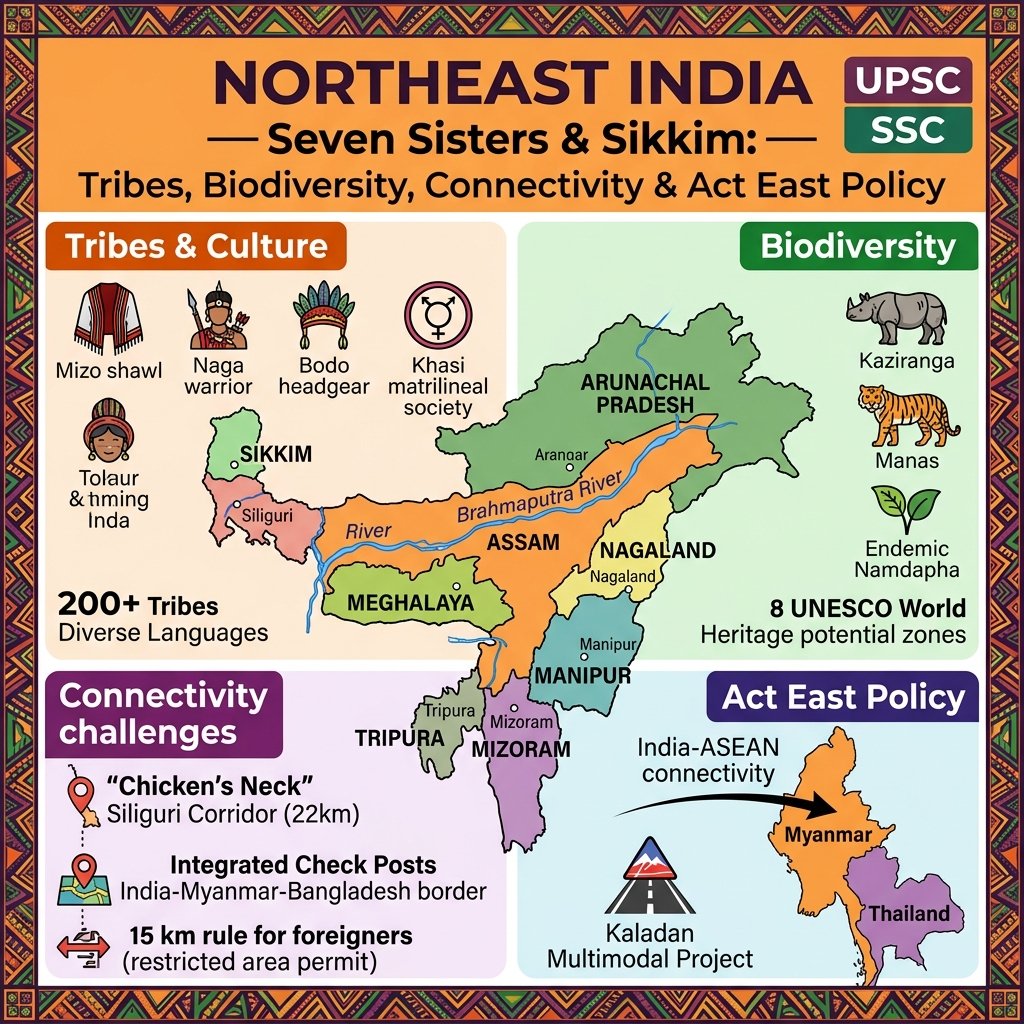
The Eight States — Profile
| State | Capital | Area (km²) | Key Facts | Major Tribes / Communities |
|---|---|---|---|---|
| Assam | Dispur (largest city = Guwahati) | 78,438 | Largest NE state by population (3.12 crore); Brahmaputra plains; India’s oldest oilfield (Digboi, 1889); Kaziranga NP (Greater One-Horned Rhino); tea capital of India (55% of India’s tea from Assam); NRC controversy (National Register of Citizens); Bodo conflict; floods annually | Bodo, Mising, Rabha, Sonowal Kachari, Dimasa, Bengali (significant minority); Assamese = majority but multi-ethnic |
| Meghalaya | Shillong | 22,429 | “Abode of Clouds”; Cherrapunji (Sohra) and Mawsynram = world’s wettest places (11,000–12,000 mm/year); Khasi Hills, Jaintia Hills, Garo Hills; sacred groves (Law Kynmaw); Living Root Bridges (Cherrapunji); matrilineal society (Khasi, Jaintia = matrilineal = property passes through female line) | Khasi (matrilineal), Jaintia (matrilineal), Garo (matrilineal) = all three major tribes are matrilineal; largest proportion of matrilineal communities globally |
| Tripura | Agartala | 10,486 | Smallest NE state by area; 84% surrounded by Bangladesh; Unakoti rock-cut sculptures (UNESCO TL); Neermahal Water Palace; rubber and pineapple cultivation; Hevea Brasiliensis = major crop; tribal vs non-tribal tension; LFT (Left Front government historically longest) | Tripuri, Reang (Bru), Chakma, Jamatia, Halam; Bengali settlers from Bangladesh = significant demographic |
| Manipur | Imphal | 22,327 | Valley (Imphal valley = 10% area; 90% of population) vs Hill tribal districts tension; Loktak Lake = largest freshwater lake NE India (phumdis = floating biomass islands; Sangai = brow-antlered deer = State Animal found only here); Polo horse = smallest horse breed; ethnic conflict Meitei vs Kukis (2023 crisis); AFSPA controversy | Meitei (valley, majority non-tribal), Naga tribes (hill), Kuki-Zo tribes (hill); sharp valley-hills divide; 2023 ethnic violence = 200+ deaths |
| Mizoram | Aizawl | 21,081 | Mizo Accord (1986) = template for conflict resolution through negotiation; highest literacy in NE India (91.6%); Champhai valley bamboo; Aizawl perched on ridge = challenging urban geography; Bamboo flowering (mautam, thingtam) = rat population explosion = famine cycle historically; LAP (inner line permit required) | Mizo (Lushai) = dominant; various Zo sub-groups; deeply Christian (Protestant Presbyterians); most homogeneous NE state culturally |
| Nagaland | Kohima | 16,579 | Battle of Kohima (1944) = “Stalingrad of the East” (Japan vs British; turning point in Burma Campaign WW2); Hornbill Festival (December); warrior culture; 16 major Naga tribes; Naga peace process = longest ongoing in India (NSCN-IM ceasefire 1997; Framework Agreement 2015 with Govt of India; final accord still pending 2026); inner line permit (ILP) required; 88%+ Christian | Angami, Ao, Sumi, Lotha, Chakhesang, Konyak, Phom etc. = 16 major tribes each with distinct language/costume/tradition |
| Arunachal Pradesh | Itanagar | 83,743 | Largest NE state by area; least populated per km²; India’s easternmost state; 90,000 km² disputed by China (“South Tibet”); McMahon Line = de facto boundary (not accepted by China); Tawang Monastery = largest Buddhist monastery in India (Tibetan Buddhism); Dibang, Siang, Lohit = major rivers; Namdapha NP (endemic species-richest in India) | 26 major tribes + 100 sub-tribes; Adi, Apatani, Nyishi, Garo, Monpa (Buddhist, Tawang), Wancho, Nocte; Protected Area Permit (PAP) required for foreigners; tribal customary law important |
| Sikkim | Gangtok | 7,096 | Smallest NE state (and 2nd smallest state of India); Himalayan state; India’s first organic state (2016 = 100% organic agriculture = Global Award); Kanchenjunga (3rd highest peak, 8,586m = sacred, local climbers refused to summit due to religious belief); hydropower (Teesta River dams = India’s major hydro project, 2023 dam breach tragedy killed 100+); merged with India 1975 (35th state) | Lepcha (indigenous), Bhutia (Tibetan origin), Nepali/Gorkhali (majority); Buddhist (Tibetan), Hindu mix; Sikkimese = culturally Himalayan |
Strategic Geography — The Chicken’s Neck & Borders
- 🗺️ Siliguri Corridor (Chicken’s Neck): 22-km-wide land strip in West Bengal connecting mainland India to the entire Northeast; flanked by Nepal (north) and Bangladesh (south); approximately 60 km long; through this narrow corridor passes the lone railway line, NH-31 (now NH-27), and pipelines connecting the Northeast to India; strategically India’s most vulnerable geographic point — any hostile force blocking this corridor could physically sever the Northeast from India; China’s military planners have explicitly discussed this vulnerability in strategic literature; Indian military has invested heavily in alternative road routes (BRO — Border Roads Organisation) and the Bogibeel Bridge (longest rail-road bridge in India, 4.94 km, Assam, 2018) reduces pressure on corridor logistics
- 🗺️ International borders: NE India shares 5,182 km of international boundary — with Bangladesh (4,156 km; fencing ongoing under Smart Fence project), China (1,395 km; LAC mostly in Arunachal and Sikkim), Myanmar (1,643 km; porous; insurgent movement, Chin refugee influx), Bhutan (699 km; friendly, jointly managed), Nepal (near Sikkim; friendly); India’s geopolitical sensitivity in the region is shaped by this multi-border character
- 🗺️ McMahon Line: Boundary between British India and Tibet drawn at the Simla Accord (1914); China considers it illegal (Tibet not empowered to sign international agreements separately); India recognises it as legal international boundary; 90,000 km² of Arunachal Pradesh claimed by China; Tawang is the highest-value disputed area (closest monastery site to China and symbolically important as birthplace of 6th Dalai Lama)
Tribal Communities & Culture
- 👘 Scale of diversity: The 8 NE states collectively contain approximately 220 listed languages/dialects; the region’s tribal diversity is unmatched in South Asia; most tribes are Tibeto-Burman linguistic group (distinct from Indo-Aryan majority India); tribal communities have distinct customary laws, land rights (Community Forest Rights), and governance systems (e.g., Traditional Naga Village Councils with elected Headmen)
- 👘 Matrilineal systems (Meghalaya): Khasi, Jaintia, and Garo tribes of Meghalaya practice matrilineal descent — property (including ancestral home), clan membership, and surname pass through the female line (mother to youngest daughter = “Ka Khadduh” = keeper of ancestral home); men marry into wife’s clan; women control property but NOT necessarily political power (a frequent misconception — Khasi women have economic power but traditional village councils historically male-dominated)
- 👘 Christianity in NE: Nagaland (88% Christian), Mizoram (87%), Meghalaya (75%), Manipur (41%) = heavily Christian states; Christianity introduced by British-era missionaries (American Baptist missionaries in Naga hills from 1840s; Presbyterian missionaries in Mizoram from 1890s); the church is the central social institution in Nagaland and Mizoram — more than government in some remote areas; Christmas = biggest festival; church welfare networks outperform government services in many locations
- 👘 Inner Line Permit (ILP): System under Bengal Eastern Frontier Regulation 1873; non-residents of Nagaland, Mizoram, Arunachal Pradesh, and Manipur (added 2019) must obtain ILP to visit; protects tribal land rights and demographics from outsider settlement; debated as simultaneously protective (prevents demographic change from mainland migration) and isolating (reduces investment, tourism, development)
- 👘 Scheduled Tribe status & 6th Schedule areas: Most NE tribes are Scheduled Tribes (Constitution’s Schedule); 6th Schedule of Constitution = Autonomous District Councils (ADCs) with legislative and judicial powers over customary law, land, social customs in designated tribal areas of Assam, Meghalaya, Mizoram, Tripura; a unique constitutional arrangement giving tribal communities partial self-governance
Biodiversity & Conservation
- 🦏 Kaziranga National Park (Assam): UNESCO World Heritage Site (1985); 430 km²; home to world’s largest population of Greater One-Horned Rhinoceros (~2,640 rhinos = approximately 70% of world population); also significant Tiger Reserve (118 tigers), Wild Water Buffalo, Eastern Swamp Deer; seasonal flooding by Brahmaputra = natural management tool that renews grasslands and drives animals to higher ground (filmed by BBC Planet Earth); poaching = primary threat; Anti-Poaching camps; one of India’s most effective conservation success stories
- 🐯 Manas National Park (Assam): UNESCO World Heritage Site + Biosphere Reserve + Tiger Reserve; at Bhutan border; Golden Langur (endemic to India-Bhutan border), Pygmy Hog (world’s smallest pig species, India endemic), Hispid Hare; declining due to BODO insurgency in 1980s–90s (fences broken, wildlife poached during conflict); has recovered significantly post-peace deal
- 🌳 Namdapha National Park (Arunachal Pradesh): One of India’s most biodiverse protected areas; spans from 200m to 4,500m altitude (tropical to alpine = 5 vegetation zones vertical!); hosts all 4 large cat species in India simultaneously (Tiger, Leopard, Snow Leopard, Clouded Leopard); Namdapha Flying Squirrel (rediscovered 2023 after 70-year gap — one of world’s rarest mammals); extreme remoteness provides natural protection
- 🌺 Sacred Groves (Meghalaya): Khasi term “Law Lyngdoh” or “Law Kynmaw” = sacred forests protected by religious/cultural prohibition on logging or hunting; ~100+ sacred groves in Meghalaya hills; function as informal biodiversity reserves independent of formal government protection; some contain primary forest fragments not disturbed for centuries; example of traditional ecological knowledge (TEK) as conservation tool
Act East Policy & Connectivity
- 🌏 From “Look East” to “Act East”: India’s Look East Policy (1991, PM Narasimha Rao) recognised ASEAN as a priority engagement area; renamed “Act East Policy” (2014, PM Modi) to signal more active implementation vs passive orientation; Northeast India is central to Act East because it is India’s geographic gateway to Southeast Asia — sharing a 1,643 km border with Myanmar
- 🌏 Kaladan Multimodal Transit Transport Project: India-funded project connecting Kolkata Port to Sittwe Port (Myanmar) by sea; then Sittwe to Paletwa by river (Kaladan River); then Paletwa to Zorinpui (Mizoram border) by road; creates an alternative trade/connectivity route to NE India bypassing the Siliguri Corridor; Sittwe Port operational (2023); road section Paletwa-Zorinpui delayed by Myanmar coup (2021) and Chin insurgency
- 🌏 India-Myanmar-Thailand Trilateral Highway: 1,360 km road project connecting Moreh (Manipur, India) through Myanmar to Mae Sot (Thailand); when complete, India-ASEAN road trade becomes physically possible; landmark connectivity project for NE India; target 2027; delayed by Myanmar political instability
- 🌏 BRO (Border Roads Organisation): India’s premier agency for road construction in strategic border areas; building roads in Arunachal Pradesh, Sikkim, Ladakh for strategic and development purposes; Sela Tunnel (2024, Arunachal = longest road tunnel in northeast, 980m; provides all-weather access to Tawang bypassing Sela Pass)
- 🌏 Infrastructure milestones: Bogibeel Bridge (4.94 km, Assam, 2018 = longest rail-road bridge India); Dhola-Sadiya Bridge (9.15 km, Assam, 2017 = longest river bridge India); New Bhupen Hazarika Bridge; Rani Gaidinliu highway project (Nagaland); Northeast as priority in PM Gati Shakti infrastructure programme
Key Conflicts & Peace Processes
| Conflict | State | Background | Current Status |
|---|---|---|---|
| Naga Insurgency | Nagaland (+ Manipur, Assam) | Naga National Council declared independence (1947, day before India’s Independence!); armed struggle since 1950s; NSCN (National Socialist Council of Nagaland) = main faction; NSCN-IM (Muivah-Isak) signed ceasefire 1997 | Framework Agreement signed Aug 3, 2015 (Modi government); details contested (NSCN-IM demands “Greater Nagalim” incorporating Naga-inhabited areas of Manipur/Assam); final settlement not reached as of 2026; longest ongoing peace process in India |
| Bodo Conflict | Assam (Bodoland Territorial Area Districts) | Bodo tribe demands separate state “Bodoland”; 1993 Bodoland Autonomous Council; NDFB (National Democratic Front of Bodoland) armed attacks; multiple factional splits and ceasefires; 2014 Kokrajhar violence killed 50+ | Bodo Peace Accord (January 2020) = most significant recent NE peace deal; NDFB factions surrendered 1,615 militants; Bodoland Territorial Council given more powers and funds; relative peace since 2020 |
| Manipur Ethnic Conflict | Manipur | Valley Meitei (majority Hindu/non-tribal) vs Hill Kuki-Zo tribes (Christian/ST); historical resource competition; 2023 violence triggered by Meitei demand for Scheduled Tribe status (Kuki-Zo groups resisted, fearing land competition) | May 2023 onwards: 200+ deaths, 50,000 displaced, 4,000+ houses burned; internet shutdowns; security forces deployed; no political resolution as of 2026; deep communal division remains |
| Assam-Mizoram Border | Assam + Mizoram | Disputed boundary in Inner Line Forest area; July 2021 = police clash between Assam and Mizoram police = 5 Assam police killed (rare inter-state security force clash) | Home Ministry mediation; boundary commission review; temporary de-escalation but underlying boundary dispute unresolved; Assam also has boundary disputes with Meghalaya (partially resolved 2022 — 6 of 12 disputed sectors resolved) |
⭐ Important for Exams — Quick Revision
- 🔑 Seven Sisters: Assam, Meghalaya, Tripura, Manipur, Mizoram, Nagaland, Arunachal Pradesh + Sikkim (8th state)
- 🔑 Coined by: “Seven Sisters” phrase coined by journalist Jyoti Prasad Saikia; Sikkim is newer addition (merged 1975)
- 🔑 Siliguri Corridor / Chicken’s Neck: 22-km wide; only land connection to NE India; connects Nepal (north) to Bangladesh (south); India’s most strategic geographic vulnerability
- 🔑 Longest NE bridge: Dhola-Sadiya (9.15 km, Lohit River, Assam, 2017); Longest rail-road bridge = Bogibeel (4.94 km, Assam, 2018)
- 🔑 Meghalaya = Matrilineal: Khasi, Jaintia, Garo = all 3 major tribes matrilineal; property + clan through female line; Cherrapunji + Mawsynram = world’s wettest places
- 🔑 Kaziranga NP: UNESCO WHS; 70% of world’s Greater One-Horned Rhinoceros (~2,640); Assam; annual flooding by Brahmaputra helps grassland ecology
- 🔑 Manas NP: UNESCO WHS; Assam-Bhutan border; Pygmy Hog (world’s smallest pig); Golden Langur (India-Bhutan endemic)
- 🔑 Namdapha NP: Arunachal; 5 vegetation zones (tropical to alpine); all 4 large Indian cats simultaneously; Namdapha Flying Squirrel rediscovered 2023
- 🔑 ILP (Inner Line Permit): Required in Nagaland, Mizoram, Arunachal, Manipur (2019); under Bengal Eastern Frontier Regulation 1873
- 🔑 6th Schedule of Constitution: Autonomous District Councils (ADCs) in Assam, Meghalaya, Mizoram, Tripura; tribal self-governance powers
- 🔑 McMahon Line: India-China boundary in Arunachal (1914 Simla Accord); China disputes it; 90,000 km² of AP claimed by China; Tawang = most sensitive
- 🔑 Naga Framework Agreement (2015): NSCN-IM + GoI; details disputed (Greater Nagalim demand); final accord pending as of 2026
- 🔑 Bodo Peace Accord (Jan 2020): Most recent major NE peace deal; 1,615 militants surrendered; Bodoland Territorial Council empowered
- 🔑 Manipur 2023 conflict: Meitei vs Kuki-Zo; 200+ deaths; 50,000 displaced; no resolution by 2026
- 🔑 Kaladan Multimodal: Kolkata-Sittwe(sea)-Paletwa(river)-Zorinpui(Mizoram) road; India-Myanmar connectivity; delays due to Myanmar coup 2021
- 🔑 Act East Policy (2014): Replaced Look East (1991); NE India = gateway to ASEAN; India-Myanmar-Thailand Highway target 2027
- 🔑 Sikkim = India’s first organic state (2016); 100% organic certification; UN FAO recognition; Kanchenjunga (8,586m = 3rd highest globally)
- 🔑 Assam: 55% of India’s tea; oldest oilfield Digboi (1889); NRC = National Register of Citizens controversy; AFSPA = Armed Forces Special Powers Act
Frequently Asked Questions (FAQs)
1. What is AFSPA and why is it so controversial in Northeast India?
The Armed Forces (Special Powers) Act, 1958 (AFSPA) is a parliamentary legislation that grants extraordinary powers to the armed forces operating in “disturbed areas” — territories declared so by state governments or the central government. AFSPA was originally enacted to deal with the Naga insurgency in 1958 and has since been applied at various times across most Northeast Indian states, as well as Jammu and Kashmir. The powers granted under AFSPA are far-reaching: any commissioned officer, warrant officer, non-commissioned officer, or even a junior soldier can (1) fire upon any person contravening an assembly order, even resulting in death if the officer believes it necessary for “maintenance of public order”; (2) arrest any person without a warrant if he has reason to believe that person has committed or is about to commit a cognisable offence; (3) enter and search any premises without a warrant to make an arrest or recover any person or weapons; and critically, (4) no prosecution or legal suit can be launched against any Armed Forces personnel without the prior sanction of the Central Government — effectively granting near-immunity from civil prosecution. Why AFSPA is justified by the government: The government’s position is that AFSPA is a necessary operational legal framework for the Armed Forces to function effectively in areas with active armed insurgencies, where normal judicial processes (warrant requirements, arrest procedures) imposed by civilian law would make military counter-insurgency operations practically impossible. Insurgent groups use civilian populations as cover, conduct hit-and-run attacks, and then blend into rural communities — requiring soldiers to make split-second threat assessments without the luxury of judicial oversight. The Army argues that without protection from vexatious litigation, junior soldiers would be paralysed by fear of legal consequences when confronting armed insurgents. Why AFSPA is controversial: Multiple documented incidents over decades have revealed the severe human rights consequences of this broad power: the Malom Massacre (2000) — 10 unarmed civilians killed at Malom bus stop, Manipur, by Assam Rifles; triggered the famous protest by Irom Sharmila who hunger-struck for 16 years (2000–2016) demanding AFSPA repeal. The Thangjam Manorama case (2004) — a young Meitei woman arrested and killed by Assam Rifles (allegedly raped and tortured); the case triggered the extraordinary protest where 12 elderly Manipuri women stripped naked outside the Assam Rifles HQ with a banner reading “Indian Army Rape Us.” The Nagaland Oting killings (December 2021) — 13 civilians killed by Army in a botched ambush in Nagaland’s Mon district, mistaken for insurgents; no prosecution followed (AFSPA immunity); generated renewed calls for repeal. The Supreme Court of India in a landmark ruling (July 2016, Nagaland case) held that the Army cannot claim impunity for disproportionate force even under AFSPA, and ordered registration of FIRs in 1,528 alleged extrajudicial killings in Manipur — a significant judicial pushback on AFSPA’s blanket immunity. Current status: In 2022, the government withdrew AFSPA from Assam (mostly), Tripura, Manipur (partially), Nagaland (partially) — citing improved security situation; it remains fully in force in Arunachal Pradesh’s Tirap, Changlang, and Longding districts, and parts of Nagaland and Manipur. Complete repeal remains a major demand of civil society groups and political parties in the Northeast.
2. Why does Meghalaya have a matrilineal society — and how does it work in practice?
Meghalaya’s three major tribal groups — the Khasi, Jaintia (Pnar), and Garo — practise one of the few functioning matrilineal kinship systems in the world, making Meghalaya’s Shillong a study destination for anthropologists globally. How matriliny works in Khasi society: The fundamental unit of Khasi social organisation is the clan (kur), which is traced exclusively through the mother’s line. Every Khasi child belongs to the mother’s clan, not the father’s. The youngest daughter (Ka Khadduh) has a special status: she inherits the family’s ancestral property (the iing — ancestral home) as a sacred trust — she does not own it personally but is its custodian and keeper, responsible for maintaining the ritual, ceremonial, and family functions of the clan in that home. When a couple marries in traditional Khasi custom, the husband moves to the wife’s house (uxorilocal residence) — the opposite of the patrilocal norm in most of India. Children take the mother’s surname (clan name). Property — land, house, family heirlooms — passes from mother to youngest daughter (not necessarily to the most capable daughter, but specifically the youngest — a traditional rule). Older siblings including brothers may receive some property, but the ancestral home and its custodianship belongs to Ka Khadduh. Practical implications: In Khasi society, women traditionally control household finances, manage domestic agricultural production, and conduct market trade — Shillong’s markets are overwhelmingly women-managed. Khasi women have historically had greater economic agency than women in patrilineal India. Divorce in Khasi society is relatively straightforward (neither partner loses their clan membership or property); children automatically stay with the mother. Brothers in Khasi society have a unique role: they manage their maternal clan’s property as trustees (the “maternal uncle” / kni is the legal guardian), even though they themselves belong to their mother’s clan and will pass their property to their own sister’s descendants, not their own children. A Khasi man’s greatest emotional bond is often to his sister’s children rather than his own (his children will be raised in his wife’s clan and he will have limited property authority over them). The “Meghalaya paradox”: Despite this economic matriliny, traditional political power in Khasi village councils (Dorbar Shnong) was historically male-dominated — the customary belief being that administrative/ritual-political functions belong to men. In recent years, some Khasi women have begun demanding full representation in Dorbar Shnong, which has created intra-community debate. Some Khasi men have also formed groups arguing that matriliny disadvantages men psychologically (feeling no connection to own children’s property) and demanding reform. This makes Meghalaya’s matrilineal system a living, contested, evolving institution — far more complex than it appears from the outside — not simply “female-dominant” but a sophisticated kinship system with its own internal tensions and adaptations.
3. Why is the Siliguri Corridor India’s most critical strategic vulnerability — and what is being done about it?
The Siliguri Corridor — popularly called the “Chicken’s Neck” — is the 22-km-wide strip of West Bengal territory that connects the Indian mainland to all eight Northeast states. It is bounded to the north by Nepal and to the south by Bangladesh; the narrowest point, near Siliguri city, is only about 22 km across. Through this sliver of land must pass all surface connectivity to the entire Northeast: the National Highway (NH-27, formerly NH-31), the Northeast Frontier Railway’s main line to Guwahati and beyond, petroleum pipelines, telecommunications infrastructure, and the daily flow of goods and people to and from 46 million people in eight states. Why it is strategically critical: War-game scenarios studied by Indian strategic analysts focus on the Chicken’s Neck as the most severe vulnerability in India’s strategic geography. Any adversary — whether China (from Tibet) or Pakistan-backed non-state actors through Nepal or Bangladesh — that can physically block this corridor would effectively isolate the entire Northeast from mainland India, cutting off supply lines, reinforcements, and civilian logistics simultaneously. China’s People’s Liberation Army in Tibet is physically closer to the Siliguri Corridor than Indian forces can easily reinforce in a surprise scenario. The PLA has built a significant road and rail network in Tibet (including the Lhasa-Shigatse railway, now being extended toward Arunachal) that improves Chinese ability to concentrate forces near the corridor. Bhutan’s Doklam plateau (site of the 2017 India-China standoff) is significant partly because it overlooks the Siliguri Corridor — Chinese presence on Doklam heights would potentially provide artillery firing positions that threaten corridor traffic. This is why India was exceptionally firm in the Doklam standoff (a 73-day military standoff where Indian Army physically blocked Chinese construction of a road on the Doklam plateau) — Doklam oversight of the Siliguri Corridor made this a red line. What India is doing: Multiple strategic responses to the Chicken’s Neck vulnerability are underway: (1) Improving road and rail connectivity within the Northeast as a secondary logistics network — Sela Tunnel (2024, 980m), Bogibeel bridge (2018), Trans-Arunachal Highway (under construction), so that even if the Siliguri Corridor were disrupted, movement within the Northeast could continue; (2) Developing Kaladan Multimodal route (Kolkata-Sittwe-Mizoram) as an alternative sea-river-road connection to the Northeast that bypasses the Siliguri Corridor entirely; (3) Maintaining Bhutan alliance — ensuring Bhutan’s Doklam area remains under Bhutanese sovereignty (jointly patrolled with India) rather than allowing Chinese annexation; (4) India-Bangladesh connectivity (Akhaura-Agartala rail link, 2023; Maitree Express Dhaka-Kolkata) to ensure that even Bangladesh is not hostile during any Siliguri blockade scenario; (5) Air connectivity expansion — 8 airports and heliports in the Northeast being expanded under UDAN scheme, providing alternative logistics in any surface blockade scenario. The Siliguri Corridor remains India’s most studied strategic vulnerability, and its protection explains much of India’s diplomacy toward Nepal, Bangladesh, Bhutan, and China.
Related Geology Articles on StudyHub
- ➡️ India Foreign Policy — Act East & China-India Relations
- ➡️ Natural Vegetation — NE India’s Extraordinary Forest Cover
- ➡️ Wildlife Conservation — Kaziranga, Manas & NE Protected Areas
- ➡️ Physiographic Divisions — Eastern Himalayas & NE Geography
- ➡️ Transport India — NE Connectivity Challenges & Bridges