
In April 2023, India surpassed China to become the world’s most populous nation — home to 1.44 billion people, representing approximately 18% of all humanity on a landmass that is 1/3rd the size of China. This milestone arrived not as a crisis but as a complex inflection point: India’s population growth rate has been falling steadily (from 2.5% in the 1960s to ~0.9% in 2023), its Total Fertility Rate (TFR) has dipped below replacement level (2.0 in 2021 vs replacement threshold of 2.1), and the country stands at the opening of a historic demographic dividend window — a period where the working-age population (15–64) is exceptionally large relative to dependents, potentially adding ~1% to GDP growth annually if harnessed through employment, education, and health. But India’s population story is not uniform — there are stark regional disparities between the high-fertility, young-population states of the “BIMARU” belt (Bihar, MP, Rajasthan, UP) and the below-replacement-fertility, ageing southern states (Kerala, TN, Andhra), creating a complex inter-state political economy of representation and resource allocation. Understanding India’s demographic profile, census data, urbanisation patterns, and migration dynamics is essential for UPSC, SSC, and all competitive examinations.
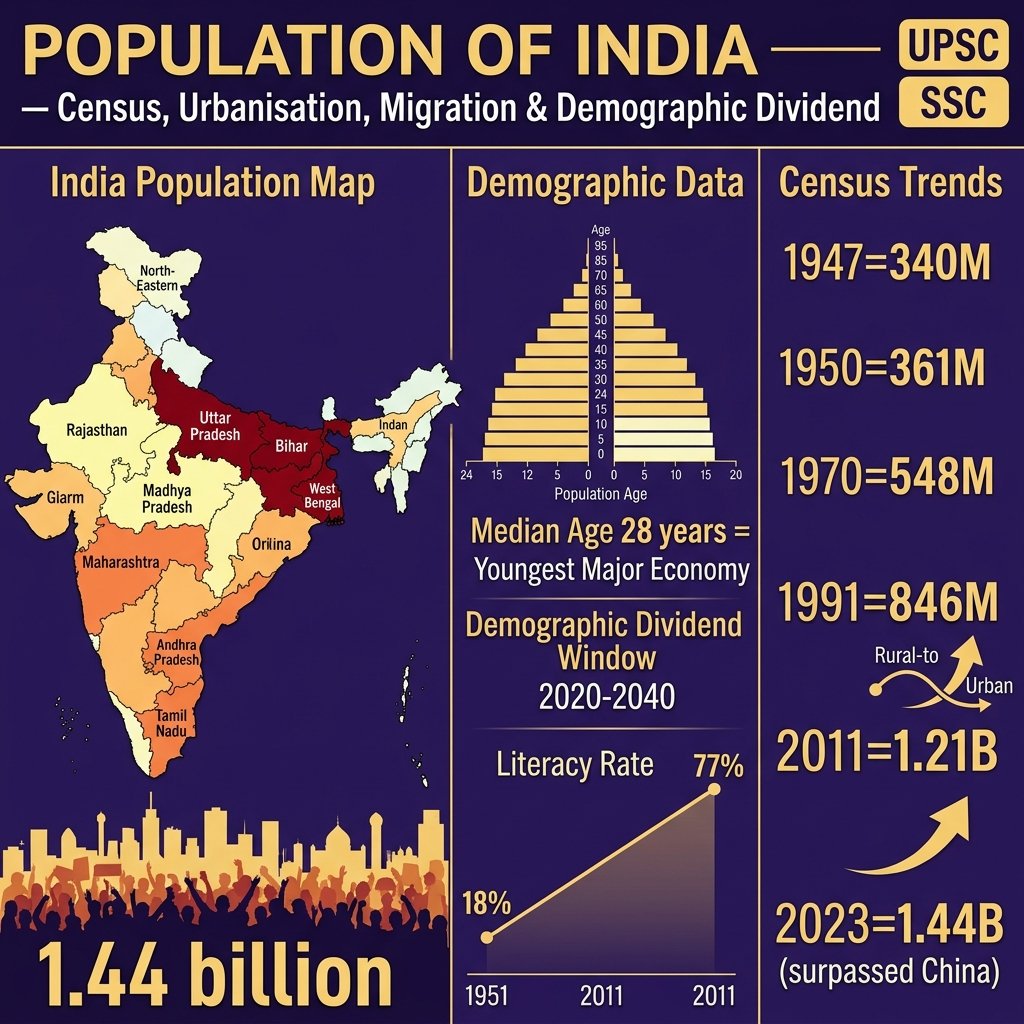
India’s Population — Key Census Data (2011)
Note: India’s Census 2021 was delayed due to COVID-19 and has not been published as of 2025–26. All official census data remains from Census 2011 (Registrar General of India). Demographic surveys (NFHS-5, 2019–21) provide more recent estimates.
| Parameter | 1951 (first post-independence census) | 2011 Census | 2023 Estimate |
|---|---|---|---|
| Total Population | 361 million | 1,210 million (1.21 billion) | ~1.44 billion |
| Decadal Growth Rate | 13.3% (1941–51) | 17.7% (2001–11) | ~9–10% (2011–21 est.) |
| Population Density | 117 persons/km² | 382 persons/km² | ~450 persons/km² |
| Sex Ratio (females per 1000 males) | 946 | 943 | ~952 (NFHS-5) |
| Child Sex Ratio (0–6 years) | — | 919 (alarming decline from 927 in 2001) | ~929 (NFHS-5, improving) |
| Literacy Rate | 18.3% | 74.0% (Male: 82.1%; Female: 65.5%) | ~77–78% (estimated) |
| Urban Population Share | 17.3% | 31.2% | ~36–37% (estimated) |
| Total Fertility Rate (TFR) | ~5.9 | ~2.4 | 2.0 (NFHS-5) = at replacement level |
| Infant Mortality Rate (IMR) | 146 per 1,000 live births | 44 per 1,000 | ~28 per 1,000 (SRS 2020) |
| Life Expectancy | ~37 years | ~67 years | ~70.8 years (2019–21) |
Population Distribution — States & Density
- 🏆 Most populous states (2011 Census): Uttar Pradesh (19.95 cr = 16.5% India), Maharashtra (11.24 cr), Bihar (10.4 cr), West Bengal (9.13 cr), AP (8.46 cr)
- 📍 Highest density states: Bihar (1,106 persons/km² = highest in India), West Bengal (1,028), Kerala (860), UP (829), Haryana (573)
- 📍 Lowest density states: Arunachal Pradesh (17 persons/km² = lowest), Mizoram (52), Sikkim (86), Ladakh (UT, ~3)
- 📊 Population share paradox: UP + Bihar + MP + Rajasthan = 4 states = ~37% of India’s population on ~25% of India’s area; these 4 states also have the highest fertility rates, lowest literacy, and highest poverty rates — creating a significant development gap with southern and western India
- 🗳️ Delimitation controversy: Parliamentary seats are allocated based on population (Lok Sabha constituencies based on population from 1971 census, frozen until 2026 by constitutional amendment, then re-delimited). Post-2026 delimitation based on Census 2021 data will significantly increase seats for high-growth northern states (UP, Bihar, MP, Rajasthan) and reduce relative representation for lower-growth southern states (Kerala, TN, AP, Telangana, Karnataka) — a major ongoing political controversy about rewarding good family planning vs penalising it
Demographic Indicators — Regional Disparities
| State / Group | TFR (NFHS-5) | IMR | Female Literacy | Population Growth | Profile |
|---|---|---|---|---|---|
| Kerala | 1.8 | 7 (lowest India) | 95.2% | Very slow | Most developed demographic profile; below replacement; ageing population; high emigration to Gulf |
| Tamil Nadu | 1.8 | 13 | 80% | Very slow | Early demographic transition; concerns about political representation dilution post-delimitation |
| Andhra / Telangana | 1.7 / 1.8 | 28 / 20 | 66% / 70% | Slow | Both states below replacement level; concerns about seats lost in delimitation |
| Bihar | 3.0 (highest India) | 50 (highest India) | 53.3% | Rapid | Highest TFR and IMR; highest density; slowest demographic transition; large youth bulge |
| UP | 2.4 | 38 | 59.3% | Rapid | Declining but still high; adds ~4 million people per year; larger than Brazil in population |
| Rajasthan | 2.0 | 31 | 57.6% | Moderate-rapid | Improving rapidly; “Rajasthan model” = community health workers (ASHAs) credited with decline |
| All India | 2.0 | ~28 | ~70% | Slowing | Reached replacement level TFR nationally (NFHS-5) |
Demographic Dividend — India’s Economic Opportunity
- 📈 What is Demographic Dividend? When a country’s proportion of working-age population (15–64) is high relative to dependents (children 0–14 + elderly 65+), economic output per capita rises (more producers relative to consumers). This requires investment in health, education, and employment to translate the demographic advantage into actual output.
- 📅 India’s dividend window: Approximately 2020 to 2050; during this period, India’s working-age population (~68% of total by 2030) is exceptional; India’s median age = 28 years (2023) — youngest major economy (China median age = 38, USA = 38, Japan = 49)
- 💰 Potential: If India successfully employs its working-age population, the demographic dividend could add ~1.2% annually to GDP growth (World Bank estimate) — the equivalent of $40–50 billion per year in additional output
- ⚠️ The risk — demographic burden instead of dividend: If the working-age population cannot find productive employment (due to skill gaps, insufficient job creation, or structural unemployment), the same demographic profile becomes a demographic burden — rising unemployment, social unrest, and economic strain. India is creating ~5–8 million new labour force entrants per year but formal job creation struggles to match this pace. India’s Labour Force Participation Rate (LFPR) for women is ~25% — among the lowest globally for India’s economic level. Bringing women into the formal workforce is the single largest untapped demographic dividend lever.
- 📊 India’s education challenge: The working-age youth entering India’s labour market increasingly has higher educational attainment (literacy, secondary schooling) but often lacks market-relevant skills; the mismatch between education output and industry requirements (especially for formal sector employment) is called the skill gap crisis; PM Kaushal Vikas Yojana (PMKVY) attempts to address this through certification-based skill training
Urbanisation in India
- 🏙️ Urban population: 31.2% (Census 2011) = 377 million urban residents; estimated 36–38% by 2025; India expected to reach 50% urban by ~2050 (World Bank); urban population to add 416 million by 2050 (UN)
- 🏙️ Largest Urban Agglomerations (Census 2011): Mumbai UA (18.4 million), Delhi UA (16.3 million), Kolkata UA (14.1 million), Chennai UA (8.7 million), Bengaluru UA (8.5 million), Hyderabad UA (7.7 million)
- 📊 Urban categories: Town: 5,000+ population + >75% male workforce in non-agriculture + density >400/km²; Census Town: meets above criteria but governed as rural Gram Panchayat (India’s fastest-growing urban category); Statutory Town: declared by state government with urban local body; Metropolitan Area: >10 lakh (1 million) population
- 🌆 Slums: 1 in 6 urban Indians lives in slums (65.5 million in slums per Census 2011); Mumbai has ~40–55% slum population (Dharavi alone = ~one million people in ~2.4 km²); Rajiv Awas Yojana (RAY) and PM Awas Yojana (Urban) are key housing schemes; Dharavi redevelopment project (Adani Group contract, ongoing, contentious)
- 🏙️ Smart Cities Mission (2015): 100 cities selected; ₹2.05 lakh crore investment; focus on area-based development (retrofitting, redevelopment, greenfield) + pan-city digital initiatives; mixed results — technology-heavy spending without addressing fundamentals (water, sanitation, housing) in many cities
Migration in India
- 🚶 Scale: Census 2011 counted ~450 million internal migrants (cumulative in-lifetime migration); NFHS and NSSO surveys indicate ~40 million short-term circular migrants per year (seasonal workers who move and return)
- 📍 Major migration streams:
- Rural-to-urban: Most dominant; rural labourers, agricultural workers, and small-town youth to large cities for manufacturing, construction, domestic service, and trade; Bhiwandi (textile), Surat (diamond, textile), Mumbai (construction, services) attract millions
- Inter-state labour migration: UP and Bihar = largest source states; migrants go to Delhi, Punjab (agriculture — UP/Bihar labour), Haryana, Gujarat, Maharashtra, Karnataka; Rajan Committee (Planning Commission) found ~13 million migrating from UP + Bihar to other states annually
- Rural-to-rural: For agricultural work; Bihar workers harvesting Punjab wheat; Rajasthan/MP workers harvesting Maharashtra’s cotton
- Urban-to-urban: Skilled professionals moving between metros for careers; IT workers Delhi-Bengaluru-Hyderabad circuit
- ⚠️ COVID Reverse Migration (2020): The national lockdown (March 2020) stranded an estimated 40–50 million migrant workers in cities with no income, no housing security, and no transport — triggering the largest internal human displacement post-Partition as workers walked hundreds of kilometres home. This crisis exposed the complete absence of portability of social benefits (ration cards, health benefits tied to home state, not work state) for migrant workers. The Govt of India subsequently launched the One Nation One Ration Card (ONORC) scheme allowing migrants to access PDS rations in any state — a significant social policy response
- 🌍 International migration: India’s diaspora = ~32 million (world’s largest diaspora by numbers); remittances = ~$125 billion (2022–23 = world’s largest remittance recipient); Gulf corridor = largest (Kerala, UP, Bihar, AP, Rajasthan sending workers); USA corridor = highest remittances per capita (Indian-American community)
⭐ Important for Exams — Quick Revision
- 🔑 India surpassed China (2023): became world’s most populous nation; ~1.44 billion people = 18% of world population
- 🔑 Census 2011: 1.21 billion; density 382/km²; sex ratio 943; child sex ratio 919; literacy 74%; urban 31.2%
- 🔑 Census 2021 = delayed (COVID); official data still Census 2011
- 🔑 TFR India (NFHS-5) = 2.0 = reached replacement level nationally; Kerala/TN = 1.8; Bihar = 3.0 (highest)
- 🔑 Highest density state = Bihar (1,106/km²); lowest = Arunachal Pradesh (17/km²)
- 🔑 Most populous state = UP (~20 crore = 16.5% India population); UP alone is larger than Brazil
- 🔑 Lowest IMR = Kerala (7); highest = Bihar (50); national average ~28 (SRS 2020)
- 🔑 Demographic Dividend window = ~2020–2050; median age India = 28 years; working-age population 68%; needs employment + education + health to convert
- 🔑 India’s LFPR for women ~25% = very low; largest untapped dividend lever
- 🔑 Urban population: 31.2% (2011); expected 50% by ~2050; Mumbai UA (18.4M) = largest agglomeration
- 🔑 Slums = 65.5 million (Census 2011); Dharavi = ~1 million in 2.4 km² = Asia’s largest slum
- 🔑 Smart Cities Mission (2015): 100 cities; ₹2.05 lakh crore; mixed results
- 🔑 Internal migration: 450 million cumulative (Census 2011); UP + Bihar = largest source states; COVID reverse migration = 40–50 million stranded = triggered ONORC (One Nation One Ration Card)
- 🔑 India’s diaspora = 32 million = world’s largest; remittances = $125 billion (world’s highest recipient, 2022–23)
- 🔑 Delimitation controversy: Post-2026 re-delimitation will shift seats from slow-growing south to fast-growing north — seen as penalising states that achieved family planning success
Frequently Asked Questions (FAQs)
1. India’s TFR has reached replacement level — so why is India’s population still growing rapidly?
This is one of the most commonly misunderstood demographic facts about India. The Total Fertility Rate (TFR) of 2.0 (NFHS-5, 2019–21) means that Indian women, on average, are now having just below 2.1 children — the replacement level at which a population theoretically stabilises in the long run. Yet India’s population is still growing by approximately 13–14 million people per year (2023–24). The explanation lies in population momentum — one of demography’s most important concepts. Population momentum works as follows: even after a country reaches replacement-level fertility, the population continues growing for several decades because of the large cohorts of young women who were born during the high-fertility era and are now entering their reproductive years. India had very high fertility (5–6 children per woman) from independence through the 1970s; those births created extremely large cohorts born in the 1970s–90s. These large cohorts, even producing only 2 children each (replacement level), generate more total births than the smaller cohorts of earlier generations produced with 4–5 children each. The analogy: imagine a train that has been accelerating for 70 years — even after the engine is cut (TFR drops to replacement), the train runs forward for decades due to built-up momentum before it stops. India’s population is expected to peak at approximately 1.6–1.7 billion around 2060–2070 and then begin declining — similar to China’s current trajectory (China’s population peaked in 2022 and is now officially declining). The states driving remaining growth are primarily UP and Bihar (still above replacement TFR), while southern states have been below replacement for 20+ years. India’s overall population growth rate has fallen from 2.5% per year (1960s) to ~0.9% (2023) — the deceleration is dramatic even if the absolute numbers still appear large.
2. What is India’s demographic dividend — and what must India do to capture it before the window closes?
The demographic dividend refers to the economic acceleration that occurs when the proportion of working-age population (15–64) is high relative to dependents (children + elderly). When a country transitions from high fertility (many children) to lower fertility (fewer children), there is a period of decades when the large birth cohorts of the high-fertility era are in working age but have fewer children to support — this creates a favourable dependency ratio (fewer dependents per worker). East Asia’s “economic miracle” of the 1960s–90s (Japan, South Korea, Taiwan, Singapore, then China) was substantially powered by demographic dividend — estimates suggest it contributed 25–40% of East Asian GDP growth in that period. India’s demographic dividend window is approximately 2020 to 2050. By 2030, India will have the world’s largest working-age population (~1 billion people aged 15–64). India’s median age (28 years) is dramatically younger than China (38), USA (38), Europe (44), or Japan (49). This means India’s potential productive workforce is uniquely large among major economies. What must India do to capture this dividend? The academic consensus (Bloom, Williamson, Mason, Lee) identifies three essential conditions: (1) Education and skills: The working-age youth must be educated and skilled for the types of jobs that generate high economic value. India’s current education system produces graduates (17.5 million/year from universities) but often with skills mismatched to industry needs — English literacy varies dramatically by region and socioeconomic group; STEM quality is deep at top-tier institutions (IITs, IISc, NITs) but shallow across the mass of engineering colleges (many producing unemployable graduates). Quality education reform — not just enrolment but learning outcomes — is critical. The National Education Policy 2020 (NEP 2020) attempts systemic reform. (2) Health: Healthy workers are more productive. India’s public health expenditure (~2.1% of GDP) remains far below the WHO recommendation of 5%. High anaemia rates (especially in women and children), malnutrition (32.1% children under 5 stunted — NFHS-5), and preventable disease burden reduce labour productivity. Anaemic women produce 10–20% less labour output. The dividend is literally biological — malnourished children become less productive adults. (3) Employment: The most critical condition. India must create 90 million formal sector jobs over the next decade to employ its youth dividend productively. Currently, ~90% of India’s workforce is in the informal sector (no job security, no social protection, low productivity). Formal job creation requires: vibrant manufacturing growth (Make in India, PLI), service sector expansion, infrastructure investment as job generator, and MSMEs (Micro, Small, Medium Enterprises = 63 million MSMEs generate 45% of exports and 30% of GDP but struggle with credit access and regulatory compliance). The closing window risk: India’s demographic dividend window typically lasts 30–40 years. After 2050, the large working-age cohorts will age into dependency (elderly), fertility will continue declining, and India will face the same ageing population challenges now confronting China, Japan, and Europe. Countries that failed to capture their dividend (several sub-Saharan African nations, parts of South Asia) found the demographic bulge became a demographic burden — youth unemployment, social unrest, and stunted development. India has approximately 25–30 years to make the transition — the urgency is real.
3. The COVID Reverse Migration of 2020 — what happened and what did it reveal about India’s invisible workforce?
On March 24, 2020, Prime Minister Narendra Modi announced India’s national lockdown with 4 hours notice — cities shut, public transport stopped, construction sites closed, factories went silent. For the ~40–60 million migrant workers living in cities — in dormitory quarters near construction sites, in textile mill chawls, in cramped rooms shared by 8–10 workers near industrial estates — this created an immediate existential crisis. They had no savings to survive weeks without income, no secure housing (most had no written rental agreements — landlords could and did demand they leave), and no transport to return home. Beginning March 26–27, scenes of extraordinary human suffering began appearing across India’s major highway arteries: hundreds of thousands of workers, many carrying small children and bundled belongings, walking along highways — some walking 500–1,500 km to reach UP, Bihar, Rajasthan, Odisha, MP. Workers drowned crossing rivers to reach their home states. A group of 16 workers sleeping on railway tracks in Maharashtra were killed by a goods train. Deaths from exhaustion, heat, and road accidents accumulated. The scenes went globally viral and forced a rethinking. What the crisis revealed about India’s invisible workforce: (1) The absence of portable social protection: A construction worker from Gorakhpur (UP) working in Bengaluru was entitled to a PDS ration card — but only in Gorakhpur. Their Bengaluru employer (usually a contractor) contributed nothing to their social security. The worker had no Provident Fund, no ESI health insurance, no legal protection — invisible to the formal system despite being essential to the urban economy that produced India’s GDP. (2) The contractor system’s informality: Most migrant workers are not employed directly by construction companies, factory owners, or restaurant chains — they are hired through labour contractors who take margins and provide no formal employment contracts. This means workers have no legal employer to approach for relief funds. (3) The essential nature of migrant labour: When migrants left cities, construction stopped across India (delayed housing projects, stalled infrastructure), restaurants could not open, domestic services ceased, small manufacturing units producing garments/auto parts/leather goods shut. The economy revealed its deep dependence on this invisible, unprotected workforce. Policy responses: The government launched One Nation One Ration Card (ONORC) — allowing migrant workers to access subsidised food at PDS shops in any state using their Aadhaar-linked ration card. By 2024, ONORC is operational in all states and has enabled over 100 crore transactions by migrants accessing food away from their home state. The e-Shram portal (2021) has registered over 28 crore unorganised workers. These are meaningful steps, but comprehensive portable social security, minimum wage enforcement for migrants, and licensing of labour contractors remain unfinished agendas.
Related Geology Articles on StudyHub
- ➡️ Agriculture — Population Pressure on Farmland
- ➡️ Transport — Migration Corridors & Urban Connectivity
- ➡️ Industries — Employment & Urban Growth
- ➡️ Natural Disasters — Population Vulnerability & Displacement
- ➡️ Climate Change — Population & Climate Vulnerability