
India is executing one of the world’s most ambitious energy transitions — from a coal-dominated system inherited at Independence to a diversified clean energy economy that the International Solar Alliance (ISA), founded by India, is helping replicate globally. In 2023–24, India’s total installed renewable energy capacity crossed 190 GW — making India the world’s 4th largest renewable energy market after China, USA, and Germany. Solar alone contributes ~85 GW (FY 2024); Wind ~44 GW; Hydro ~47 GW; Biomass + Small Hydro + Others ~13 GW. India has committed to achieving 500 GW of non-fossil fuel energy capacity by 2030 and net zero carbon emissions by 2070 — the most ambitious decarbonisation schedule of any major developing economy. Yet India also remains the world’s 3rd largest coal producer and consumer, with coal generating ~70% of electricity and 250 million households depending on coal directly or indirectly for livelihoods. Understanding India’s renewable energy landscape, policy architecture, green hydrogen strategy, and international solar diplomacy is essential for UPSC, SSC, and all competitive examinations.
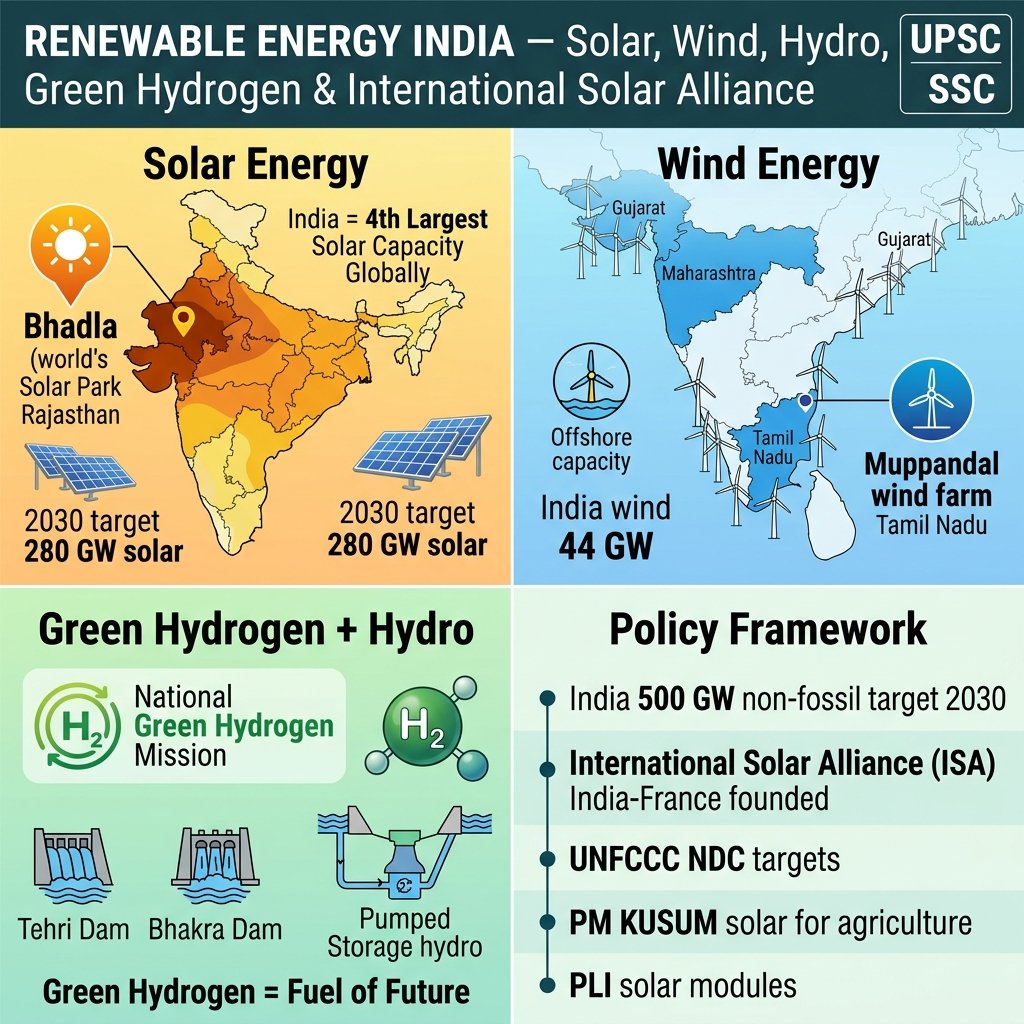
India’s Energy Mix — Current Status (FY 2024)
| Energy Source | Installed Capacity (GW) | % of Total Capacity | Key Facts |
|---|---|---|---|
| Coal (Thermal) | ~210 GW | ~48% | Still the backbone of India’s grid; 70% of electricity generated; NTPC = India’s largest power company; Coal India = world’s largest coal producer (800MT/year); energy security anchor but climate liability |
| Solar PV | ~85 GW (March 2024) | ~20% | 4th largest globally; Bhadla Solar Park (Rajasthan) = world’s largest (2,245 MW); costs fallen 90% since 2010 ($0.026/kWh tariff records in India); 280 GW target by 2030 |
| Wind | ~44 GW | ~10% | 4th largest globally; Tamil Nadu (14 GW) + Rajasthan (10 GW) + Gujarat (9 GW) = top states; offshore wind potential = 70 GW+ (Tamil Nadu, Gujarat coast); 140 GW target by 2030 |
| Large Hydro | ~47 GW | ~11% | Classified as non-renewable in India’s older policy framework (now reclassified); Tehri Dam (2,400 MW, Uttarakhand); Sardar Sarovar (1,450 MW, Gujarat); pumped storage potential = 96 GW |
| Nuclear | ~7.5 GW (22 reactors) | ~1.7% | NPCIL operates 22 reactors; 10 new reactors announced (2023–Budget); Jaitapur NPP (French EPR, Maharashtra) = planned largest nuclear park in world (9,900 MW); 3-stage nuclear programme (Bhabha); IAEA member |
| Small Hydro / Biomass / Others | ~13 GW | ~3% | Small hydro (up to 25 MW) = hilly NE states, Himachal, Uttarakhand; Biomass = agricultural residue power generation; waste-to-energy; biogas |
| Total Installed Capacity | ~440 GW | 100% | India is world’s 3rd largest electricity market by installed capacity; 500 GW non-fossil target by 2030 requires adding ~310 GW more renewable capacity |
Solar Energy — India’s Solar Revolution
- ☀️ Solar resource potential: India receives 300+ sunny days/year across most of country; solar insolation = 4–7 kWh/m²/day; highest in Rajasthan, Gujarat, Ladakh (9 kWh/m²/day); total technical potential = 748 GW (rooftop + utility-scale); NISE (National Institute of Solar Energy) estimates potential of 35,000 GW if all suitable land deployed
- ☀️ Key solar parks: Bhadla Solar Park, Jodhpur district, Rajasthan (2,245 MW = world’s largest single solar park); Pavagada Solar Park, Karnataka (2,050 MW = 3rd largest); Kurnool Ultra Mega Solar Park, AP (1,000 MW); Rewa Solar Project, MP (750 MW) — first to supply power to Delhi Metro at competitive rate (Rs 3.30/kWh, 2018)
- ☀️ Cost achievement: India’s solar tariff has fallen from Rs 18/kWh (2010) to Rs 2.00–2.15/kWh (2023 auction records) — a 90%+ decline; cheaper than coal-based electricity (Rs 3–4/kWh average for new coal plants); LCE (Levelised Cost of Electricity) for solar now below coal in most Indian states; this is the structural disruption that makes India’s solar expansion commercially self-sustaining
- ☀️ PM KUSUM (Pradhan Mantri Kisan Urja Suraksha evam Utthaan Mahabhiyan): Solar for agriculture scheme; 2 MW solarisation of agricultural feeders; rooftop solar on farmers’ homes; small solar pumps replacing diesel pumps (reducing diesel subsidy + improving irrigation reliability); Rs 34,422 crore budget; target: 30.8 GW by 2026
- ☀️ Rooftop Solar: 40 GW rooftop target by 2026 (achieved ~11 GW by March 2024); PM Surya Ghar Muft Bijli Yojana (2024) — 1 crore households get free rooftop solar with subsidy up to Rs 78,000; first 300 units/month free electricity to beneficiaries
Wind Energy
- 💨 Onshore wind: India = 4th largest wind power country; major wind states: Tamil Nadu (14+ GW, Muppandal = India’s oldest and largest wind farm), Rajasthan, Gujarat, Maharashtra, Karnataka, Andhra Pradesh; Wind Resource Atlas shows Class 3+ wind zones covering large portions of northwest and peninsular India
- 💨 Offshore wind: India has a coastline of 7,500+ km with strong marine wind resources, especially off Tamil Nadu and Gujarat coasts; MNRE estimates 127 GW offshore potential; first 1 GW offshore wind tender issued (off Tamil Nadu coast, 2024); India has offered viability gap funding (VGF) for first offshore projects as costs are still higher than onshore
- 💨 Wind + Solar hybrid: Combining wind and solar on same land/grid connection reduces intermittency (wind peaks at night/winter, solar peaks at day/summer); SECI (Solar Energy Corporation of India) tenders 7.5 GW Wind-Solar Hybrid capacity; Rajasthan and Gujarat ideal for hybrid parks
- 💨 Repowering: India’s early wind turbines (1990s) have small capacity (250 kW–500 kW) on excellent wind sites; replacing with modern 3–5 MW turbines on same sites = “repowering” = doubling India’s wind output without new land acquisition; National Repowering Policy 2016 in place but implementation slow
Green Hydrogen — India’s National Mission
- 🟢 What is Green Hydrogen: Hydrogen produced by electrolysis of water using renewable electricity (solar/wind); “green” because no carbon emissions in production (vs “grey” hydrogen from natural gas with CO2, or “blue” from natural gas with CCS); hydrogen burns cleanly (only water vapour as exhaust); can decarbonise hard-to-abate sectors: steel, fertilisers, shipping, aviation, heavy trucks
- 🟢 National Green Hydrogen Mission (NGHM): Launched January 2023; target: 5 million metric tonnes (MMT) Green Hydrogen production/year by 2030; 125 GW dedicated renewable energy capacity for electrolysis; ₹19,744 crore government outlay; SIGHT (Strategic Interventions for Green Hydrogen Transition) programme with incentives for electrolyser manufacturing and GH production
- 🟢 Why India is well-positioned: India’s strong solar + wind resources mean the “green electricity” input to electrolysis can be very cheap (some projections: $1/kg hydrogen production cost by 2030 = competitive with fossil fuels); India already the world’s 2nd largest fertiliser consumer (hydrogen needed for ammonia = fertiliser); decarbonising fertiliser production via green hydrogen is enormous domestic market; India’s steel industry (2nd largest in world) can use hydrogen in direct reduced iron (DRI) production
- 🟢 Pilot projects: NTPC Green Hydrogen plant at Simhadri (AP); IOC’s Mathura Refinery green hydrogen pilot; Reliance Industries’ 100 GW + green hydrogen ambition (Jamnagar); HPCL Baroda refinery green hydrogen; Green Hydrogen Valley concept (dedicated industrial zones with green hydrogen supply infrastructure)
- 🟢 Export vision: India aims to become a major green hydrogen exporter by 2030–2035, leveraging cheap solar energy to produce and export hydrogen (initially as ammonia, the easiest hydrogen carrier for shipping) to Japan, South Korea, Germany, and other energy-importing nations willing to pay premium for clean molecules
International Solar Alliance (ISA)
- 🌍 Founded: November 30, 2015 — announced jointly by PM Narendra Modi and French President Francois Hollande on sidelines of COP21 (Paris Climate Summit); formally launched January 2016; headquarters at Gurugram (Haryana), India (within TERI campus)
- 🌍 Membership: 124 member countries (as of 2024); predominantly countries between Tropics of Cancer and Capricorn (originally “Sunshine Countries” with high solar potential); now open to all UN members
- 🌍 Mandate: Mobilise $1 trillion of solar investment by 2030; reduce cost of solar finance for developing nations; deploy 1,000 GW of solar globally by 2030; standardise solar equipment to reduce costs through common procurement
- 🌍 Key achievements: ISA joint tender for procurement of solar pumps reduced unit costs by 27%; standardised solar specifications for agricultural pumping; OSOWOG (One Sun One World One Grid) proposal — India’s proposal for a global interconnected electricity grid starting with Middle East-South Asia-Southeast Asia connection enabling 24/7 solar power (sun always shining somewhere in the network); World Bank partnership ($5B solar financing); AfDB (African Development Bank) partnership for Africa solar deployment
- 🌍 India’s soft power: ISA is one of Modi government’s signature foreign policy initiatives; establishes India as a global clean energy leader rather than a laggard; counterbalances India’s coal-heavy domestic profile with international clean energy leadership; positions India as developing world champion on climate — arguing that rich nations must finance clean energy transition for poor nations who did not create the climate problem
Key Energy Policies & Institutions
| Policy / Institution | Year | Key Provisions |
|---|---|---|
| Electricity Act 2003 | 2003 | Separated generation, transmission, distribution; introduced competition; created CERC (Central Electricity Regulatory Commission) + SERCs; enabled independent power producers (IPPs); open access for large consumers; Renewable Purchase Obligations (RPOs) on discoms to buy minimum % renewable power |
| National Solar Mission (JNNSM) | 2010 (Phase I); expanded | Jawaharlal Nehru National Solar Mission; originally targeted 20 GW by 2022; revised to 100 GW by 2022 (achieved ~67 GW by March 2022); now part of 500 GW 2030 target; SECI (Solar Energy Corporation of India) = nodal agency for solar tenders |
| RPO (Renewable Purchase Obligation) | 2010 onward; progressively increased | All electricity distribution companies (discoms) must purchase minimum % of electricity from renewable sources; Solar RPO = 4.5% by FY 2023–24; rising to 29.91% total RPO by 2029–30; penalties for non-compliance; drives mandatory renewable procurement |
| PLI for Solar Modules | 2021 | Rs 4,500 crore PLI for high-efficiency solar PV module manufacturing; India imports ~85% of solar cells/modules (mostly from China); PLI targets 10 GW integrated solar manufacturing (polysilicon to module) within India; Adani, NTPC, Reliance, Waaree = major recipients; reduces import dependence + creates employment |
| PM KUSUM | 2019 | Solar for agriculture; 3 components: solar pumps for farmers (2.0 million pumps); solarisation of existing grid-connected agriculture pumps; solar power plants (up to 2 MW) by farmers on barren land; farmers sell surplus power to discoms at guaranteed rate; Rs 34,422 crore budget |
| MNRE (Ministry of New and Renewable Energy) | Established 1992 | Nodal ministry for all renewable energy; sets targets, issues tenders through SECI, sets standards (BIS for equipment), manages IREDA (Indian Renewable Energy Development Agency) which provides concessional loans for RE projects; announces RPO trajectories |
| India’s NDC (Paris Agreement Commitment) | Updated 2022 | 500 GW non-fossil electricity capacity by 2030; 50% of total electricity from non-fossil by 2030; reduce GDP emissions intensity by 45% from 2005 levels by 2030; net zero by 2070; LiFE (Lifestyle for Environment) campaign as demand-side complement |
⭐ Important for Exams — Quick Revision
- 🔑 India total installed capacity (FY2024): ~440 GW; Renewable = ~190 GW; Coal = ~210 GW; 70% of electricity from coal
- 🔑 India = 4th largest renewable energy market globally (after China, USA, Germany)
- 🔑 Solar 85 GW (FY2024); 280 GW target by 2030; Bhadla Solar Park = world’s largest (2,245 MW, Rajasthan)
- 🔑 Wind 44 GW; Tamil Nadu = largest wind state (14+ GW); offshore potential = 127 GW; 140 GW target 2030
- 🔑 Solar tariff: Rs 2.00–2.15/kWh (2023) vs Rs 18/kWh (2010) = 90% cost reduction; cheaper than new coal plants
- 🔑 India’s 2030 targets (NDC): 500 GW non-fossil; 50% electricity from non-fossil; 45% GDP emissions intensity reduction from 2005; net zero 2070
- 🔑 Green Hydrogen Mission (Jan 2023): 5 MMT production by 2030; 125 GW dedicated RE; Rs 19,744 crore; SIGHT programme
- 🔑 Green H2 = renewable electricity + electrolysis of water; decarbonises steel, fertilisers, shipping, aviation
- 🔑 ISA = International Solar Alliance: Founded Nov 30, 2015 at COP21 Paris by Modi + Hollande; HQ Gurugram; 124 members; $1 trillion solar investment by 2030
- 🔑 OSOWOG: One Sun One World One Grid — India’s proposal for global solar grid interconnection; enables 24/7 solar power globally
- 🔑 PM KUSUM (2019): Solar for farmers; 2 million pumps; solarisation of grid pumps; farmers sell power to discoms; Rs 34,422 crore
- 🔑 PM Surya Ghar (2024): 1 crore household rooftop solar; up to Rs 78,000 subsidy; 300 units free electricity/month
- 🔑 Electricity Act 2003: Separated generation/transmission/distribution; CERC + SERCs; RPO = Renewable Purchase Obligation mandatory for discoms
- 🔑 JNNSM (2010): Jawaharlal Nehru National Solar Mission; originally 20 GW by 2022; revised 100 GW by 2022; SECI = nodal agency
- 🔑 PLI solar modules (2021): Rs 4,500 crore; India imports 85% solar cells from China; PLI for domestic manufacturing; Adani, Waaree, Reliance, NTPC recipients
- 🔑 Nuclear power: 7.5 GW; 22 reactors; NPCIL; Jaitapur NPP (Maharashtra, 9,900 MW planned); 3-stage nuclear programme (Bhabha) — uses thorium in stage 3
- 🔑 Pumped storage hydro = 96 GW potential; key for storing intermittent solar/wind energy; approved 16 GW by 2024
- 🔑 Coal India = world’s largest coal producer (800 MT/year); India = 3rd largest coal consumer; just transition for coal workers = major social challenge
Frequently Asked Questions (FAQs)
1. Why is India both a global leader in renewable energy AND still building new coal plants — is this contradictory?
India’s simultaneous expansion of both renewable energy capacity and coal-fired power generation is frequently cited as hypocritical or contradictory — particularly by Western critics at climate negotiations. In fact, it reflects a rational response to India’s specific development constraints, and understanding this is essential for any informed discussion of India’s climate policy. The electricity demand problem: India’s per capita electricity consumption (~1,200 kWh/year) is roughly one-third of China’s and one-tenth of the USA’s. As India’s economy grows — as 300 million people enter the middle class, as industrial output increases, as EVs replace petrol vehicles, as air conditioning penetrates more households — electricity demand will increase dramatically. NITI Aayog and CEA (Central Electricity Authority) project India’s electricity demand growing from ~1,600 TWh (FY 2023–24) to ~5,000–6,000 TWh by 2047 (when India celebrates its centenary of Independence). To meet this demand purely from renewables would require building 2,000–2,500 GW of solar and wind capacity plus 500–700 GW of storage. India’s current renewable addition rate is ~15–20 GW/year; it needs to reach 50–70 GW/year to meet 2030 targets. The intermittency problem: Solar generates only during daylight hours; wind is variable. When solar peaks at noon, India has excess power; at 8 PM when cooking loads peak, solar produces nothing. Batteries at grid scale are enormously expensive in India today (approximately Rs 4–5 crore per MWh of storage). Coal and gas power plants are “dispatchable” — they generate on demand, 24 hours a day, 365 days a year. Until India builds sufficient storage (batteries, pumped hydro, green hydrogen to reconvert), maintaining coal capacity as backup is a genuine grid reliability necessity. The economic development argument: India’s government argues — with significant moral force — that rich countries industrialised and developed using abundant coal for 150 years and are only now asking developing nations to forgo the same path. India’s cumulative CO2 emissions since industrialisation are approximately 4% of global total; the USA’s are approximately 25%. For India to accept per capita emissions restrictions while wealthy nations refuse to provide adequate climate finance for India’s clean transition is perceived as profoundly unjust by Indian policymakers. PM Modi made this point explicitly at every COP from Glasgow (2021) through Dubai (2023): India needs $1 trillion of climate finance at concessional rates to decarbonise its electricity system; the $100 billion/year promise made at Copenhagen (2009) has never been fulfilled by wealthy nations. What is actually happening: India’s coal expansion is real — several new large coal plants are under construction (particularly ultra-supercritical units with higher efficiency = lower CO2 per unit electricity). But the pace of renewable addition is also real and accelerating. India’s coal share of electricity generation is projected to fall from 70% today to approximately 45% by 2030 (even with some coal plant additions) as the renewable capacity grows disproportionately faster. India’s carbon intensity of electricity (CO2 per kWh) has already declined measurably and will continue declining. The “contradiction” is really a transition — a managed phasedown of coal as alternatives are built at sufficient scale to maintain grid reliability.
2. What is OSOWOG — One Sun One World One Grid — and is it feasible?
OSOWOG (One Sun One World One Grid) is India’s proposal for an interconnected global electricity grid that would allow solar power generated in one part of the world to be transmitted to another part experiencing nighttime or low solar irradiance. The concept was launched by PM Modi at the First ISA Assembly in October 2018, developed collaboratively with the UK (who coined the phrase “Green Grids Initiative — One Sun One World One Grid” at COP26 Glasgow, 2021), and endorsed by over 80 countries at COP26. The conceptual logic is elegant: the sun is shining somewhere on Earth at every hour of every day. If a sufficiently interconnected grid existed, regions with daytime solar surplus could export electricity to regions experiencing night. The most logical starting point — proposed in the original MNRE concept paper — is a three-grid architecture: (1) Middle East + South Asia, (2) South Asia + Southeast Asia, and (3) Southeast Asia + Australia; eventually connecting all three. Phase 1 (near-term feasibility): India already has working cross-border power trade with Nepal (importing 500 MW hydropower), Bhutan (importing 1,400+ MW hydropower), Bangladesh (exporting ~600 MW) and pilot connections to Myanmar. The SAARC Energy Ring concept (connecting all South Asian electricity grids) has been discussed since 2012; India-Sri Lanka undersea cable (400 MW) is at feasibility stage. Cross-border electricity trade in South Asia could expand significantly without new technology — only political agreements, investment in interconnection infrastructure, and payment mechanisms. Phase 2 (medium-term — connecting to Middle East): The India-Middle East Electricity Grid would require high-voltage direct current (HVDC) submarine cables from Gujarat/Rajasthan to Oman/UAE — high capital cost but technically feasible; HVDC cables of 1,000 km+ are operational elsewhere (UK-Belgium, Morocco-Spain). The Middle East’s vast solar potential (some of the world’s highest irradiance) and India’s timing complementarity (when India’s peak demand occurs, Middle East’s solar is still producing) makes this technically attractive. Technical and political challenges: Each country in the interconnected grid must cede some energy sovereignty — accepting that their grid frequency, voltage standards, and dispatch operations are influenced by adjacent grids. Countries with authoritarian political systems or unresolved territorial disputes (India-Pakistan, India-China) make grid interconnection politically extremely complex. Cross-border power trade requires trusted payment mechanisms (India proposes using its unified payments system as a model). Submarine cables are expensive (approximately $1–2 million per km) and have limited precedent in the Indian Ocean context. Long-term vision: By 2040–2050, if India’s grid architecture evolves as planned, the country’s robust renewable base could anchor an inter-regional grid connecting Central Asia, South Asia, and Southeast Asia. This would reduce the need for storage at each national level (the grid itself acts as storage by geographically distributing supply) and reduce the average cost of electricity across the member region. OSOWOG is simultaneously a vision statement, a soft power tool, and a serious technical proposal that deserves longitudinal investment in feasibility studies and pilot interconnection projects.
3. What is India’s 3-stage nuclear programme — and why is it important for India’s long-term energy security?
India’s 3-Stage Nuclear Programme was conceived by Dr. Homi Jehangir Bhabha (founder of India’s nuclear programme and first chairman of the Atomic Energy Commission) in the 1950s, designed to address a specific resource constraint that India faces: India has very limited uranium reserves (insufficient to fuel a large conventional nuclear fleet) but the world’s largest thorium reserves — estimated at 6,00,000 tonnes, approximately 30% of global thorium reserves, concentrated in Kerala’s monazite sands (Chavara, Kollam district), Rajasthan, Jharkhand, and Odisha. The 3-stage programme was designed to ultimately use thorium as India’s primary nuclear fuel, with uranium playing only an intermediate role. Stage 1 — PHWR (Pressurised Heavy Water Reactors): India operates natural uranium-fuelled heavy water reactors (PHWRs) — the 22 operating reactors in India (generating 7.5 GW) are mostly PHWRs of Indian design (the CANDU-derived 220 MW and 540 MW models). PHWRs consume natural uranium and produce plutonium-239 (Pu-239) as a byproduct of fission in their spent fuel. This plutonium is recovered via reprocessing. Stage 2 — FBR (Fast Breeder Reactors): The recovered Pu-239 from Stage 1 is used as fuel in Fast Breeder Reactors (FBRs). FBRs operate on fast neutrons (unlike conventional thermal reactors); crucially, they can use thorium-232 (Th-232) as a “blanket” material surrounding the fuel core. Fast neutrons convert Th-232 into U-233 (a fissile isotope of uranium) — thereby “breeding” more fuel than consumed. This is why they are called “breeders.” India’s Prototype FBR (PFBR) at Kalpakkam, Tamil Nadu (500 MW) has been “almost ready” since 2015; it achieved criticality (first sustained nuclear reaction) in July 2024 — a very significant milestone. Stage 2 creates the U-233 fuel needed for Stage 3. Stage 3 — Advanced Heavy Water Reactors (AHWRs) — Thorium Cycle: In Stage 3, India’s AHWRs would run on a Th-232/U-233 fuel cycle — using abundant domestic thorium as the primary fuel. This is the ultimate goal: a self-sufficient nuclear fuel cycle using India’s own thorium to generate electricity without significant uranium imports. The thorium in Kerala’s beaches could theoretically fuel India’s energy needs for centuries. Why this matters: Uranium is geopolitically sensitive — India cannot import uranium freely (due to historical weapons programme; only after 2008 US-India Civil Nuclear Agreement did India gain access to international uranium market). Thorium is abundant, domestic, and the ultimate answer to India’s long-term energy security independent of geopolitical uranium supply chains. The 3-stage programme is India’s long-game in energy security — a 50–100 year vision that, if successfully executed, could make India energy-independent on nuclear power using entirely domestic resources.
Related Geology Articles on StudyHub
- ➡️ Energy Resources India — Conventional Energy Systems
- ➡️ Climate Change — India’s Paris Agreement Commitments
- ➡️ Air Pollution — Coal Power Plants & Pollution Policy
- ➡️ Foreign Policy — ISA as India’s Climate Diplomacy
- ➡️ Industries — Green Hydrogen for Steel Decarbonisation