
The Rock Cycle is one of geology’s most fundamental concepts — a continuous, dynamic system showing how rocks of all three types (igneous, sedimentary, metamorphic) are interconnected and constantly transforming into one another over geological timescales. Driven by Earth’s internal heat (from plate tectonics and radioactive decay) and external energy (from the Sun, powering weathering, erosion, and deposition), the rock cycle has no beginning and no end. Every rock on Earth is a temporary arrangement of minerals in an ongoing journey of transformation that has been running for over 4 billion years. Understanding the rock cycle — its processes, pathways, driving forces, and timescales — is essential for UPSC, SSC, Class 9–11 NCERT, and all geology and geography examinations.
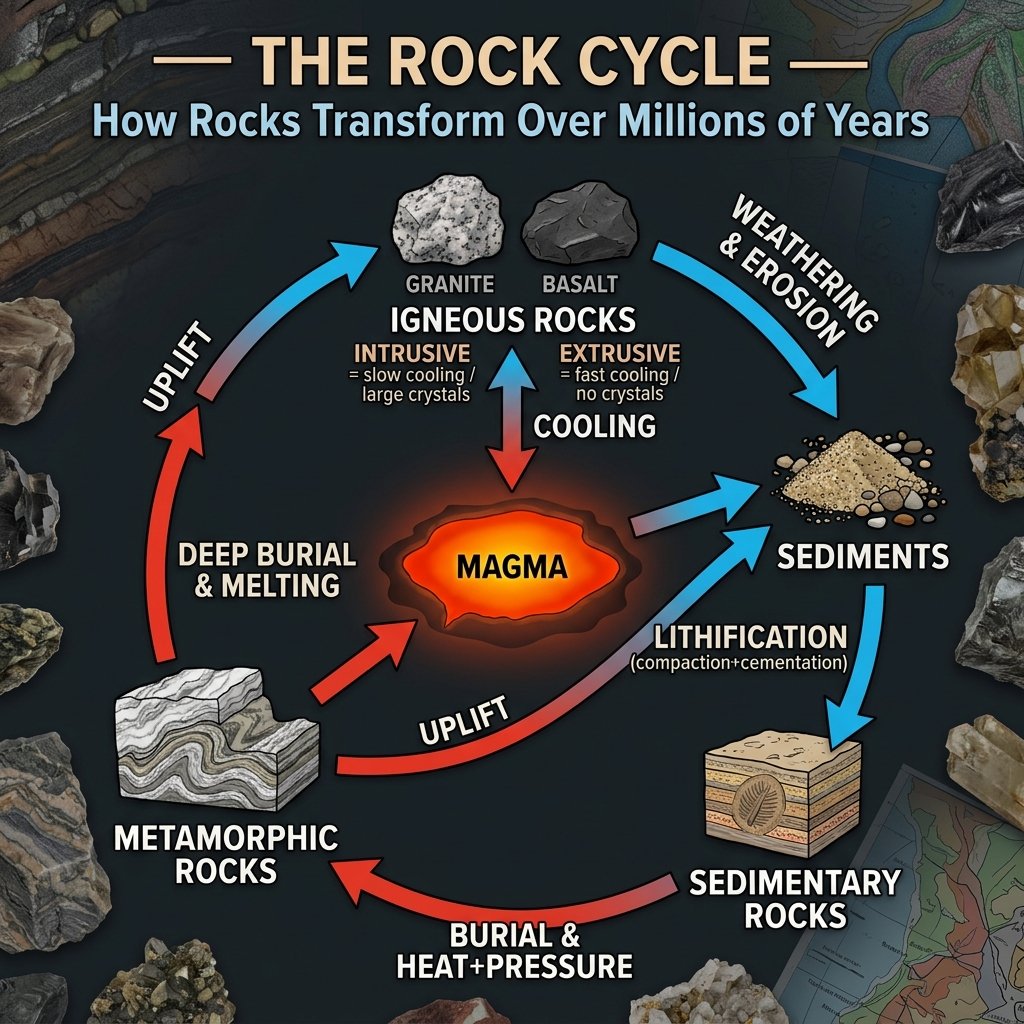
What is the Rock Cycle? — Key Facts
- 🔄 The rock cycle = the continuous process by which rocks are created, destroyed, and recycled through Earth’s systems
- ⏱️ Complete cycles take tens to hundreds of millions of years
- 🌋 Driven by two energy sources: (1) Earth’s internal heat (geothermal energy + radioactive decay = powers melting, metamorphism, plate tectonics) and (2) Solar energy (powers weathering, erosion, transport, deposition at surface)
- ♻️ No rock type is permanent — any rock can become any other rock given the right conditions
- 🌍 First proposed conceptually by James Hutton (1788) — the “Father of Modern Geology” — who observed that rocks are continuously recycled through geological processes
The Complete Rock Cycle — Pathways & Processes
| Starting Rock | Process(es) | Resulting Rock/Material | Where It Happens |
|---|---|---|---|
| Magma | Cooling + crystallisation (slow, underground) | Intrusive Igneous Rock (granite, gabbro) | Deep crust — batholiths, plutons |
| Magma/Lava | Rapid cooling at surface | Extrusive Igneous Rock (basalt, obsidian, pumice) | Volcanoes, ocean floor, lava flows |
| Any Rock at surface | Weathering (mechanical + chemical) | Sediments (loose fragments, dissolved ions) | At Earth’s surface — rivers, coasts, deserts |
| Sediments | Transport (wind, water, ice, gravity) | Moved sediments | Rivers, glaciers, wind, ocean currents |
| Sediments | Deposition + Compaction + Cementation = Lithification | Sedimentary Rock (sandstone, limestone, shale) | River deltas, ocean floors, lake beds, deserts |
| Any Rock (buried) | Heat + Pressure (without melting) | Metamorphic Rock (marble, slate, schist, gneiss) | Deep crust — subduction zones, mountain roots |
| Any Rock (deeply buried) | Extreme heating — partial or complete melting | Magma | Deep mantle/lower crust — subduction zones |
| Metamorphic/Igneous (uplifted) | Tectonic uplift + erosion | Exposed rock at surface, then weathers | Mountain belts, continental interiors |
Stage 1 — Weathering: Breaking Rocks Down
Weathering is the in-place breakdown of rocks into smaller fragments without transporting them. It is the first essential step in the rock cycle — it converts solid rock into the loose material (sediment) that feeds the sedimentary rock pathway.
Mechanical (Physical) Weathering
- 🌡️ Freeze-Thaw (Frost Action) — water enters rock cracks, freezes (expands 9%), shatters rock; dominant in Himalayan high altitudes, Arctic; produces angular fragments (scree slopes)
- ☀️ Thermal Expansion/Contraction — repeated heating and cooling of rock surfaces (day/night temperature swings) causes surface layers to expand and contract at different rates than interior, eventually peeling off (exfoliation/onion-skin weathering); dominant in deserts (Rajasthan Thar, Sahara)
- 🌱 Root Wedging — plant roots penetrate rock cracks and grow, expanding cracks; powerful long-term mechanical force
- 💧 Hydraulic Action — water pressure in cracks forces rock apart (especially coastal cliffs hit by waves)
- 🔵 Abrasion — rocks scraping against each other during transport; sandpaper effect
Chemical Weathering
- 💧 Solution/Dissolution — rock minerals dissolve directly in water (halite, gypsum); limestone dissolves in weak carbonic acid (CO₂ + H₂O = H₂CO₃) forming karst caves; India’s Meghalaya limestone caves formed this way
- 🔴 Oxidation — minerals react with oxygen; iron minerals oxidise to iron oxides (rust) giving red/orange colour to laterite soils and lateritic rocks; Deccan Plateau red soils
- 💦 Hydrolysis — water reacts with mineral structure; most important chemical process — feldspar (most abundant crust mineral) hydrolyses to clay minerals (kaolinite); this is how granite weathers to produce the clay that makes shale
- 🌿 Carbonation — CO₂ dissolves in rainwater, making carbonic acid (pH 5.6 normally; acid rain pH 4-5); slowly dissolves limestone and other carbonate rocks
- 🌡️ Hydration — minerals absorb water and expand; anhydrite (CaSO₄) hydrates to gypsum (CaSO₄·2H₂O) — volume increases 30-50%, causing rock disintegration
💡 Key rule: Chemical weathering is faster in hot, humid climates (tropical India — Kerala, Northeast) and slower in cold or dry climates (Himalayan peaks, deserts). Mechanical weathering dominates in cold/dry conditions (Ladakh, Thar Desert).
Stage 2 — Erosion & Transport
Erosion is the detachment and removal of weathered material from its source. Transport moves that material to its eventual deposition site. Together, erosion and transport are the rock cycle’s conveyor belt — moving sediment from mountains to sea.
| Agent | What It Transports | Indian Examples |
|---|---|---|
| Flowing Water (Rivers) | Sand, gravel, silt, clay, dissolved minerals; dominant agent globally | Ganga, Brahmaputra carry enormous sediment loads from Himalayas to Bay of Bengal; Ganga-Brahmaputra delta = world’s largest river delta (Sundarbans) |
| Glaciers | All sizes — from boulder to fine clay (glacial flour); most powerful erosion agent per unit area | Himalayan glaciers (Gangotri, Siachen) carry massive sediment; glacial erratics dropped on plains during ice ages |
| Wind (Aeolian) | Sand and fine dust; sand dunes; dust can travel globally | Thar Desert dunes (Rajasthan); Loess deposits; dust storms (aandhi) carry fine particles; Indian Ocean receives dust from Arabia |
| Waves & Ocean Currents | Sand, gravel along coasts; fine sediment in deep ocean | India’s 7,516 km coastline; beaches eroded by waves; fine sediment carried by Indian Ocean currents to abyssal plains |
| Mass Movement (Gravity) | Rock falls, landslides, debris flows move material quickly downslope | Himalayan landslides (especially during monsoon); Kedarnath 2013 debris flow; Western Ghats landslides (Idukki, Wayanad) |
Stage 3 — Deposition & Lithification (Making Sedimentary Rock)
When the energy of transport decreases (river slows, wind drops, glacier melts), sediments are deposited in layers. Over time, burial under more sediment leads to lithification — the conversion of sediment into sedimentary rock.
- 📏 Sorting by particle size: Grains are deposited by size — largest first as energy drops (gravel and cobbles drop first in fast rivers; sand in slower water; silt and clay in deltas and deep ocean)
- 📄 Layering (stratification/bedding): Each depositional event creates a layer; seasonal floods, storms, or annual cycles create distinct beds visible in cliff faces and quarries
- 🏗️ Compaction: Weight of overlying sediment squeezes lower layers, reducing pore space; water is expelled
- 🧪 Cementation: Minerals (calcite, silica, iron oxides) precipitate from groundwater and fill remaining pore spaces, “gluing” grains together; creates a solid rock from loose sediment
- ⏰ Lithification timescale: Can range from thousands of years (rapid burial) to many millions of years; deeply buried sedimentary rocks may take tens of millions of years to fully lithify
Stage 4 — Metamorphism (Transformation Under Heat & Pressure)
When rocks are buried deep enough (>10–15 km) or come into contact with magma, temperatures and pressures become so extreme that minerals recrystallise and rock texture changes — without the rock melting. This is metamorphism.
Metamorphic Grade
| Grade | Temperature | Pressure | Typical Rocks Formed |
|---|---|---|---|
| Low-grade | 200–400°C | Low | Slate (from shale), Phyllite (shale, slightly higher grade), Greenschist |
| Medium-grade | 400–600°C | Medium | Schist (from shale), Marble (from limestone), Quartzite (from sandstone) |
| High-grade | 600–800°C | High | Gneiss (from granite, shale), Migmatite (partial melting begins) |
| Ultra-high-grade | >800°C | Extreme | Granulite; begins to partially melt = migmatite; approaches magma formation |
Stage 5 — Melting (Back to Magma)
- 🌋 If metamorphic (or any) rock is buried even deeper or enters a subduction zone, temperatures can exceed the rock’s melting point
- 💧 Flux melting — water released from subducting oceanic crust lowers the melting point of mantle rock above, causing melting even without temperature increase — key mechanism in volcanic arcs
- 🔴 Decompression melting — when rock rises rapidly (at divergent boundaries, hot spots), pressure decreases faster than temperature, causing melting; creates mid-ocean ridge basalt and hot spot volcanoes
- 🌡️ Heat melting — direct heat from mantle plumes or radiogenic heat generation causes crustal rocks to melt, forming granitic magmas
Stage 6 — Uplift: Bringing Deep Rocks to the Surface
Tectonic uplift is the mechanism that brings metamorphic and igneous rocks formed deep in Earth’s crust back to the surface, where weathering can begin again — completing the cycle.
- 🏔️ Mountain building (orogeny): Continental collision thrust-stacks rocks, lifting deep metamorphic and igneous rocks to high elevations; Himalayan collision exposed deep metamorphic rocks (schists, gneisses) at the surface — visible along the Main Central Thrust
- ⬆️ Isostatic rebound: When overlying rock/ice is eroded away, the lighter crust “floats” higher on the mantle (like a ship made lighter); exposed deeper rocks can then be weathered
- 🌋 Volcanic eruption: Directly brings deep mantle/crustal material to the surface as lava; bypasses the slow uplift process
Rock Cycle Timescales — How Long Does Each Step Take?
| Process | Typical Timescale | Notes |
|---|---|---|
| Lava cooling to solid basalt | Hours to months | Surface lava flows cool in days; thick flows take months; intrusive rock = millions of years |
| Weathering of granite surface | Thousands to millions of years | Depends on climate; tropical = fast; desert = slow |
| River transport to ocean | Weeks to thousands of years | Dust storm transport = days; glacier transport = thousands of years |
| Lithification of sediment to rock | Thousands to millions of years | Rapid burial = faster lithification |
| Low-grade metamorphism | 1–100 million years | Requires burial to 10+ km depth |
| High-grade metamorphism | 10–500 million years | Requires very deep burial at convergent margins |
| Tectonic uplift of mountain range | 1–50 million years | Himalayas: still rising ~5mm/year |
| Complete rock cycle | 50–500 million years | Some rock material has cycled multiple times in 4.5 billion years of Earth history |
Rock Cycle & India — Key Connections
- 🏔️ Himalayas: Classic example of the full rock cycle — ancient ocean floor sediments (now limestone and sandstone) were buried, metamorphosed (marble, schist, gneiss visible along trekking routes), and thrust to heights of 8,000m+ by India-Eurasia collision; now being eroded at ~1mm/year by glaciers and rivers
- 🌋 Deccan Plateau: Vast extrusive igneous province (basalt lava flows) — formed 66 million years ago; now weathering to produce the fertile Black Cotton/Regur soil of Maharashtra and Madhya Pradesh; eventually this basalt will become sediment, then sedimentary rock
- 🪨 Peninsular India: Ancient Precambrian gneisses and granites (2–3.5 billion years old) form the stable craton; these rocks have survived multiple rock cycle passes without being destroyed — testimony to the old, stable nature of the Gondwana landmass
- 💎 Ganga Plains: Alluvial sediments deposited by rivers from Himalayan erosion — currently in the “sediment” stage; over millions of years, these will be buried and lithified into new sedimentary rocks
- 🔵 Gondwana coal beds: Ancient plant material (300–250 million years ago) buried and compacted — organic sedimentary rock (coal) cycle; currently being mined in Jharkhand, Odisha, Chhattisgarh
⭐ Important for Exams — Quick Revision
- 🔑 Rock cycle = continuous transformation of all rock types; driven by internal heat (geothermal/radioactive) + solar energy (weathering/erosion)
- 🔑 James Hutton (1788) = “Father of Geology” = first described rock cycle; principle of Uniformitarianism = “Present is the key to the past”
- 🔑 Weathering types: Mechanical (freeze-thaw, thermal expansion, root wedging) vs Chemical (dissolution, oxidation, hydrolysis, carbonation, hydration)
- 🔑 Chemical weathering = faster in hot, humid tropics; Mechanical weathering = dominant in cold/dry (Himalayas, Thar Desert)
- 🔑 Feldspar + water (hydrolysis) = clay minerals (kaolinite) = most important weathering reaction; granite weathering to produce clay
- 🔑 Lithification = sediment to sedimentary rock = compaction + cementation; agents = calcite, silica, iron oxide
- 🔑 Transport agents: Water (rivers = dominant), glaciers (most powerful), wind (aeolian), waves, gravity (mass movement)
- 🔑 Metamorphic grade = low (slate) → medium (schist, marble) → high (gneiss) → ultra-high (granulite, migmatite)
- 🔑 Flux melting = water from subducting plate lowers mantle melting point = creates arc volcanoes = Andaman Islands formation mechanism
- 🔑 Decompression melting = rapid pressure decrease causes melting = mid-ocean ridges + hot spots = Hawaii
- 🔑 Himalayan rock cycle: Ocean sediments buried → metamorphosed → uplifted by India-Eurasia collision → now eroding → sediment to Ganga-Brahmaputra delta
- 🔑 Deccan Traps: Basalt (igneous) → weathering → Regur/Black Cotton Soil = classic igneous-to-sediment step of rock cycle in India
- 🔑 Complete rock cycle timescale: 50–500 million years
- 🔑 Oldest minerals on Earth: Zircon crystals from Jack Hills, Australia = 4.4 billion years old; some rock material has survived multiple rock cycle passes
Frequently Asked Questions (FAQs)
1. Can the rock cycle run “backwards” — from sedimentary to igneous without going through metamorphic?
Yes — the rock cycle has many “shortcut” pathways that don’t follow the full sequence. A sedimentary rock can be directly melted by magma (contact melting) without going through metamorphism first, producing magma that then cools as igneous rock. An igneous rock at the surface can be directly weathered and transported to become sediment, skipping any metamorphism. Metamorphic rocks can be uplifted and weathered directly to sediment without re-melting. The “standard” textbook depiction (igneous → weathering → sedimentary → burial → metamorphic → melting → igneous) is a simplified teaching model — in reality, rocks can take any pathway depending on their position in Earth’s crust and the geological processes acting on them. The key principle is that all pathways are possible; what determines the actual path is temperature, pressure, burial depth, and position relative to tectonic boundaries.
2. How does the rock cycle connect to soil formation in India?
Soil is essentially the surface product of the rock cycle’s weathering stage. In India, different rock types in different climatic zones produce profoundly different soils: (1) Deccan Plateau Basalt + weathering in humid Maharashtra → Black/Regur/Cotton Soil (Vertisols) — rich in clay minerals formed from basalt weathering; self-ploughing (shrinks in dry season, swells in wet); excellent for cotton, soybean, sugarcane. (2) Himalayan river sediments (igneous + metamorphic + sedimentary clasts weathered and transported by Ganga, Yamuna, Brahmaputra) → Alluvial Soils — India’s most fertile and extensive soils; cover the Indo-Gangetic Plain; support wheat, rice, sugarcane cultivation. (3) Peninsular gneisses and granites + intense tropical weathering → Red/Yellow Soils — iron-rich (oxidised iron colours soil red); covers parts of Odisha, Madhya Pradesh, Jharkhand, Tamil Nadu, Andhra Pradesh. (4) High rainfall + intense chemical weathering on older rocks → Laterite Soils — iron-aluminium hydroxide-rich; in Kerala, Western Ghats, Karnataka, Northeast; low fertility but used for tea, rubber, cashew. The rock cycle is therefore fundamental to agriculture — the soil beneath India’s crops took millions of years to form from India’s diverse geological heritage.
3. Why do some regions of India have ancient rocks while others are geologically young?
India’s geological diversity directly reflects where different rocks are in their rock cycle journey at this moment in time. Peninsular India (the Deccan Plateau and surrounding areas) consists of ancient Precambrian shield rocks — gneisses, granites, and schists that are 2–4 billion years old. These form part of the stable Gondwana craton — a geologically quiet zone that has experienced very little tectonic activity for hundreds of millions of years. The rocks here have survived multiple rock cycle passes without being completely recycled. Northwest India and the Indo-Gangetic Plain have young alluvial sediments (recent — Quaternary period, last 2.6 million years) brought down from the Himalayas by rivers; these are at the “sediment/young sedimentary rock” stage of the cycle. The Himalayas are geologically young (collision started 50 million years ago) and still actively rising — rocks here are in the “metamorphism and uplift” stage of the cycle, with fresh metamorphic rocks being exposed by erosion daily. The Deccan Traps are 66 million years old igneous rocks now in the early “weathering” stage. Northeast India (Assam, Meghalaya) has a mix — ancient Shillong Plateau (Precambrian gneisses) next to young Brahmaputra valley alluvium. This geological diversity is why India has such varied landscapes, soils, mineral resources, and ecological zones — all products of different rocks at different stages of an ancient, slow, continuous cycle.
Related Geology Articles on StudyHub
- ➡️ What is a Rock? — Introducing the Three Rock Types
- ➡️ What is a Mineral? — Building Blocks of All Rocks
- ➡️ Igneous Rocks — The Starting Point of the Rock Cycle
- ➡️ Plate Tectonics — The Engine Driving the Rock Cycle
- ➡️ Deccan Traps — India’s Igneous Rock Province Now Weathering