
Last Updated: March 2026 | Reading Time: 11 minutes | ~2,400 words | Category: Petrology & Rock Cycle
Rocks are the fundamental building blocks of Earth’s solid exterior — the crust, the lithosphere, and the deeper mantle and core. Every landscape, every mountain range, every ocean floor, every soil horizon ultimately traces its origins to rocks and their interactions with heat, pressure, water, and biological activity over geological time. Geologists classify rocks into three great families based on their origin: Igneous rocks (formed by cooling and crystallisation of magma or lava), Sedimentary rocks (formed by compaction and cementation of sediments derived from weathering of pre-existing rocks, or by chemical/biological precipitation from water), and Metamorphic rocks (formed when pre-existing rocks are transformed by heat, pressure, or chemically active fluids without melting). These families are not separate, isolated categories — they are connected in an endless cycle of transformation called the Rock Cycle (or geological cycle), first conceived by James Hutton (1726–1797), the “Father of Modern Geology,” in his 1788 masterwork “Theory of the Earth.” The rock cycle is geology’s most fundamental unifying concept — it describes how matter is continuously recycled through Earth’s interior, surface, and atmosphere over millions of years. India’s geological record presents extraordinary examples of all three rock types, including some of the world’s oldest Archaean gneisses (Dharwar Craton, Karnataka), spectacular Proterozoic sedimentary formations (Vindhyan Supergroup, Bundelkhand), and some of the world’s best-studied metamorphic belts (Eastern Ghats Granulite Belt, Western Ghats khondalites). For UPSC, SSC, CDS, and NDA exams, rock types, their classification, economic importance, and Indian examples are standard, frequently tested topics in the Physical Geography / Geology section.
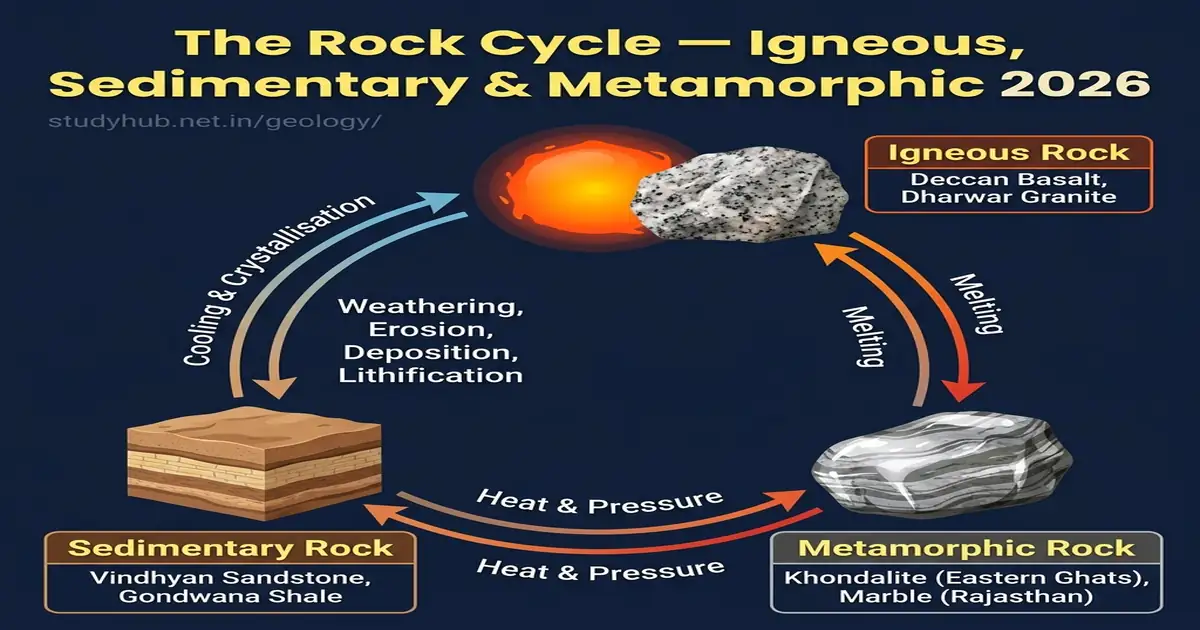
The Rock Cycle — Igneous, Sedimentary & Metamorphic Rocks Explained 2026
1. Igneous Rocks — formed from Magma or Lava
| Sub-Type | Formation | Texture | Composition | India Examples | Economic Use |
|---|---|---|---|---|---|
| Intrusive (Plutonic) — Coarse-grained | Magma cools SLOWLY deep inside Earth (km below surface) → large crystals form because atoms have time to migrate into crystal lattices as temperature drops slowly over thousands to millions of years. Classic depth: 5–30 km | Coarse-grained (phaneritic): individual crystals visible to naked eye (>1 mm). Interlocking texture — crystals fill all available space. No glass. No vesicles | Granite (high SiO₂ ~70%, quartz, K-feldspar, plagioclase, biotite/muscovite mica): most common felsic intrusive. Gabbro (low SiO₂ ~50%, pyroxene, Ca-plagioclase): mafic intrusive. Diorite (intermediate). Peridotite (ultramafic — <45% SiO₂, olivine+pyroxene — makes up Earth’s mantle) | Dharwar Craton granite-gneisses (Karnataka, 2.5–3.4 Ga — some of India’s oldest rocks). Bundelkhand Granite (Madhya Pradesh/UP, ~2.5 Ga). Closepet Granite (Karnataka, 2.5 Ga). Malani Igneous Suite (Rajasthan, ~750 Ma — large felsic intrusive complex). Ladakh Batholith (granite-diorite, 60–45 Ma — arc pluton above Tethys subduction) | Granites widely used as building/ornamental stone (India = world’s largest granite exporter). Granite polish tiles, kitchen countertops, monuments (India’s famous “Black Galaxy” granite from Andhra Pradesh). Gabbro = road aggregate. Minerals in pegmatitic granites: feldspar (ceramics), quartz (glass/electronics), mica (insulation, electronics), beryl (emeralds — Rajasthan), tourmaline, corundum (ruby-sapphire) |
| Extrusive (Volcanic) — Fine-grained | Magma erupts onto Earth’s surface as lava → rapid cooling (hours to days/weeks) → very small crystals (too little time for crystal growth). Pyroclastic rocks (tuff, ignimbrite) form from airborne ash/fragments | Fine-grained (aphanitic): crystals too small to see without microscope. Glassy texture if quenched instantly (obsidian = volcanic glass, no crystals at all). Vesicular texture if gas bubbles trapped. Amygdaloidal if vesicles later filled with minerals (zeolite, agate) | Basalt (fine-grained equivalent of gabbro, mafic): most abundant surface rock on Earth — covers all ocean floors and many continental flood basalt provinces. Rhyolite (fine equivalent of granite, felsic): rare, explosive. Andesite (intermediate). Obsidian = volcanic glass. Pumice = frothy volcanic glass (extremely vesicular, can float on water) | Deccan Traps basalt (65.5 Ma, Maharashtra/MP/Gujarat/AP — 500,000 km², 3,000 m thick). Rajmahal Traps basalt (117 Ma, Jharkhand, Kerguelen plume). Sylhet Traps (117 Ma, Meghalaya). St. Mary’s Islands columnar basalt (88 Ma, Karnataka, India-Madagascar rift). Barren Island andesitic lava flows (ongoing, Andaman Islands). Amygdaloidal Deccan basalt: contains agate, zeolites (Ratnapuri, Maharashtra; Gujarat) | Deccan basalt: road aggregate, construction stone, black cotton soil (weathered basalt → regur vertisol critical for cotton, soybean agriculture in Maharashtra/MP). Amygdaloidal basalt: agate semi-precious stones (largest agate deposit in India = Gujarat). Pumice: abrasive for polishing. Obsidian: prehistoric tool-making (Archaean-era obsidian tools found in India). Basalt fibre = modern composite material |
| Hypabyssal (Dyke / Sill) — Medium-grained | Magma intruded into cracks in pre-existing rocks near the surface (not as deep as plutons, not at surface) → intermediate cooling rate → medium crystal size | Medium-grained (porphyritic texture common): larger phenocrysts in finer groundmass, showing two stages of cooling — slow deep (phenocrysts) then faster shallower (groundmass) | Dolerite/Diabase (medium-grained equivalent of basalt/gabbro): most common dyke rock. Intrudes as sheet-like dykes (crosscut other rocks) or sills (parallel to layering of host rock) | Cuddapah Basin dolerite dykes (Andhra Pradesh). Deccan province dyke swarms (radial and regional dyke swarms fed by Réunion plume). Eastern Ghats dyke swarms (Precambrian, multiple generations). Rajmahal dyke swarms (Jharkhand, Kerguelen plume feeder system) | Dolerite = important road aggregate, ballast for railways (very hard, resistant to crushing). Dolerite sills sometimes form spectacular cliffs (e.g., Palisades Sill, New Jersey, USA). In India: road metal, construction aggregate in many Deccan/Gondwana states |
2. Sedimentary Rocks — formed from Sediments
| Sub-Type | Formation Process | Examples | India Examples | Economic Importance |
|---|---|---|---|---|
| Clastic (Detrital) Sedimentary | Formed from fragments (clasts) of pre-existing rocks transported by water/wind/ice, deposited, compacted (lithostatic pressure), and cemented (silica, calcite, iron oxide cement precipitates from pore water). Grain size classification: Boulder/Cobble/Pebble → Conglomerate (coarse, rounded gravel). Sand → Sandstone (medium, 0.0625–2 mm). Silt → Siltstone. Clay → Shale/Mudstone (finest, <0.004 mm). | Conglomerate (gravel+coarse sand), Breccia (angular fragments), Sandstone (sand), Arkose (feldspar-rich sandstone), Siltstone, Shale (most abundant sedimentary rock — ~70% of all sedimentary rocks), Mudstone, Tillite (glacial till lithified — Talchir Tillite) | Vindhyan Supergroup (Bundelkhand, MP/Rajasthan/Bihar/UP, 1,600–900 Ma): extensive sandstone-limestone-shale sequence; includes Kaimur Sandstone (red quartz arenite, reservoir rock). Gondwana Supergroup (Damodar Valley + Peninsular coalfields, Permian-Cretaceous): shale, sandstone, coal. Talchir Formation (Odisha/Jharkhand/MP, ~290 Ma): glacial tillite = India’s record of Gondwana glaciation. Siwalik Group (Miocene-Pliocene, Himalayan foreland): sandstone, conglomerate, clay. Indo-Gangetic Alluvium (Khadar/Bhangar): unconsolidated modern sediment, not yet lithified | Coal (in Gondwana Supergroup shales/carbonaceous sequences): India’s primary domestic energy source (Jharkhand, Chhattisgarh, Odisha, MP, West Bengal). Sandstone: building stone (Red Fort, Agra Fort, Fatehpur Sikri — all Vindhyan/Bundelkhand red sandstone). Shale: source of oil + natural gas (shale gas wells). Conglomerate: aggregate for construction. Kaimur Sandstone: important aquifer. Talchir Tillite: historical proof of Gondwana connectivity |
| Chemical Sedimentary | Formed by chemical precipitation from water (usually saline/mineral-rich lake or shallow sea water evaporates or changes chemistry). No transportation of clasts — minerals crystallise directly from solution in situ | Limestone (CaCO₃ from inorganic precipitation, or accumulation of calcareous skeletal organisms); Dolostone/Dolomite (CaMg(CO₃)₂ — secondary dolomitisation of limestone); Rock Salt/Halite (NaCl — evaporation of seawater); Gypsum (CaSO₄·2H₂O — evaporite); Chert/Flint (microcrystalline SiO₂ — from radiolarian/diatom ooze or chemical precipitation); Travertine (cave limestone from CaCO₃-saturated groundwater); Ironstone/BIF (Banded Iron Formation — Archaean-Proterozoic, alternating SiO₂ and Fe-rich layers) | Vindhyan limestone (MP/Rajasthan: Rohtas limestone, 1,400 Ma — used in cement). Cuddapah limestone (Andhra Pradesh, Proterozoic). Nummulitic limestone (Himalayan Tethyan sequence: Eocene limestone from nummulite foraminifera = shallow Tethys sea — used in cement in Himachal). Dhanjori BIF (Jharkhand, Archaean): iron ore. Rajasthan gypsum (Barmer, Bikaner deposits). Sambhar + Pachpadra + Didwana lakes — evaporite salt production (Rajasthan) | Limestone: cement industry (India = world’s 2nd largest cement producer; major limestone belts in Rajasthan, MP, Andhra Pradesh, Karnataka); building lime; road aggregate. Dolomite: steel industry flux (refractory lining). Rock salt: domestic + industrial sodium. Gypsum: plaster of Paris, fertiliser (soil amendment), cement retarder. Chert: prehistoric tools. BIF: iron ore baseline for steel industry (Jharkhand-Odisha iron belt) |
| Organic / Biochemical Sedimentary | Formed from accumulation and diagenesis of organic material (plant/animal remains, shells, skeletal carbonates). Organisms extract dissolved minerals from water to build shells, skeletons → these accumulate as sediment → lithify | Coal (from compressed plant organic matter — peat → lignite → bituminous coal → anthracite with increasing burial, temperature, pressure); Chalk (from coccolithophore calcareous ooze — finest marine limestone: UK Cretaceous chalk, Indian Cretaceous phosphorites); Fossiliferous limestone (coral/shell accumulations); Diatomite (from siliceous diatom shells = lightweight, used in filtration) | Gondwana Supergroup coal (Damodar Valley coalfields: Jharia, Raniganj, Dhanbad; Jharkhand; Bokaro = coking coal for steel; Talcher, Ib River = thermal coal for power; Singrauli = one of India’s largest thermal coal fields). Rajmahal-Gondwana coal (Rajmahal Hills, Jharkhand). Tertiary coal (Meghalaya, Assam, Nagaland = soft lignite-sub-bituminous coal from Eocene-Oligocene tropical forests). Nummulitic limestone (Himalayan Tethyan carbonate platforms) | Coal: India’s 2nd largest coal producer globally (after China); ~55% of India’s electricity from coal. Gondwana coking coal (Jharia) = critical for steel industry (SAIL, TATA Steel). India’s coal reserves estimated at 320 billion tonnes (BEE, MoC). Petroleum and natural gas from organic-rich marine shales (Mumbai High — offshore India, Bombay Basin; Krishna-Godavari basin; Assam-Arakan Basin = India’s oldest producing oilfields since 1889, Digboi) |
3. Metamorphic Rocks — formed by Heat, Pressure & Fluids
| Sub-Type | Agents & Conditions | Key Rock Types | India Examples | Economic Importance |
|---|---|---|---|---|
| Regional (Barrovian) Metamorphism | Large-scale high pressure + high temperature over wide areas (100s–1000s km²). Associated with continental collisions and deep burial in mountain belts. Temperature: 300–900°C. Pressure: 3–15 kbar. Time: millions of years. Produces progressive metamorphic zones (Barrow zones): chlorite → biotite → garnet → staurolite → kyanite → sillimanite (with increasing grade). Produces foliated (layered) textures due to directed pressure | Slate (lowest grade — fine-grained, perfect cleavage; from shale). Phyllite (slightly higher — lustrous, wrinkled). Schist (medium grade — well-developed foliation, mica-rich; garnet/staurolite porphyroblasts). Gneiss (high grade — alternating light/dark bands; quartz+feldspar bands alternate with dark mica/hornblende bands = “gneissose banding”). Granulite (highest grade — >700°C, >8 kbar, dry conditions — coarse-grained, no mica, pyroxene+garnet+feldspar) | Dharwar Craton schist belts (Karnataka: Kolar Gold Fields in Archaean greenstone-schist belts). Eastern Ghats Granulite Belt (Odisha-Andhra Pradesh: khondalite = garnet-sillimanite gneiss; charnockite = hypersthene-bearing granulite = hallmark of Indian high-grade metamorphics). Himalayan metamorphic belt (Greater Himalaya: sillimanite gneiss, kyanite schist — MCT footwall). Rajasthan marble (Makrana — metamorphosed limestone = calcite marble, used in Taj Mahal, Victoria Memorial) | Makrana marble (Rajasthan) = one of world’s finest marbles; used for Taj Mahal (Mughal era) and Victoria Memorial (Kolkata). India’s marble industry (Rajasthan dominant) worth ₹5,000+ crore. Schist belts = host rocks for India’s major gold deposits (Kolar Gold Field, Hutti mines). Eastern Ghats: graphite (crystalline flake graphite in granulites = critical mineral for EV batteries): India has one of world’s largest graphite resources in Odisha. Slate roofing tiles (Himachal Pradesh, Uttarakhand). Quartzite (road aggregate) |
| Contact (Thermal) Metamorphism | Heat from igneous intrusion without significant directed pressure. High temperature (300–800°C), LOW pressure (1–3 kbar). Affects rocks immediately surrounding an intrusion in an “aureole” (halo). Width of aureole: cm to km depending on intrusion size and duration. No foliation (since no directed pressure) — produces massive, fine-to-medium grained hornfels | Hornfels (hard, dark, massive — from shale or mudstone baked by intrusion). Marble (from limestone heated by granitic intrusion). Quartzite (from sandstone). Skarn (calc-silicate reaction at contact between granite and carbonate rock — produces wollastonite, garnet, epidote, diopside — important ore hosts) | Makrana marble (Rajasthan): both contact and regional metamorphism involved. Skarn deposits around Deccan dyke intrusions (minor). Rajmahal intrusives contact aureoles (Jharkhand). Himalayan leucogranite contact aureoles (local contact metamorphism around Manaslu granite, for example) | Skarns = important hosts for iron ores, copper, tungsten, tin, molybdenum (India: Khammam skarn copper deposit, Andhra Pradesh). Marble: ornamental stone. Quartzite: silica sand/glass industry raw material |
| Dynamic (Cataclastic) Metamorphism | Intense mechanical deformation along fault zones — crushing, grinding, shearing of rocks without significant heat increase. High differential stress, low temperature. Occurs along major fault planes and shear zones | Mylonite (ultrafine-grained rock from intense ductile shear — “smeared” texture). Cataclasite (brittle crushing). Fault gouge (clay-rich, mechanically crushed along active faults). Pseudotachylite (friction-induced melt along fault in large earthquakes) | MCT shear zone (Main Central Thrust) mylonites (Greater-Lesser Himalaya boundary). MBT, MFT shear zones (Himalayan thrust system — extensive mylonite development). Dharwar greenstone belt shear zones (Karnataka, Archaean) | Pseudotachylite along Himalayan faults = evidence for past great earthquakes (paleoseismology). Mylonite zones = fluid conduits in hydrothermal ore systems |
The Rock Cycle — Summary of Transformations
| Starting Material | Process | Product | Key Conditions |
|---|---|---|---|
| Magma (molten rock) | Cooling & crystallisation (slow, deep) | Intrusive igneous rock (granite, gabbro) | Slow cooling 100s–1000s of years, km depth |
| Lava (erupted magma) | Rapid cooling at surface | Extrusive igneous rock (basalt, rhyolite) | Hours to weeks, surface/shallow |
| Any rock at surface | Weathering → erosion → transport → deposition → compaction → cementation (diagenesis) | Sedimentary rock (sandstone, limestone, shale) | Low T, low P, millions of years, surface processes |
| Any rock deeply buried | Heat + pressure (no melting) + chemically active fluids | Metamorphic rock (schist, gneiss, marble) | 300–900°C, 3–12 kbar, 1–100 Ma duration |
| Any rock further heated/deeper | Melting (partial or complete) | Magma (restarts the cycle) | >650–1200°C depending on composition, flux melting, decompression |
| Metamorphic or igneous lifted to surface | Uplift + erosion (isostasy, tectonic) | Sediment → new sedimentary rock | Millions of years of denudation |
Frequently Asked Questions
What makes granite India’s most important rock economically — and why is India the world’s largest granite exporter?
India is the world’s largest exporter of dimension stone granite (processed granite slabs, tiles, and blocks for construction and decoration) — exporting approximately USD 1.3–1.5 billion worth of granite annually, primarily to China, USA, Italy, UAE, and Australia. The geological reasons for this dominance are direct: India’s Precambrian cratons expose enormous volumes of ancient, high-quality granites and granite-gneisses that have been exhumed by billions of years of erosion and are now readily quarried at the surface. Why Indian granites are exceptional: (1) Variety: India’s granites span an extraordinary compositional and age range — from 3.4 Ga Archaean grey gneisses of the Dharwar Craton (Karnataka) to 1.5 Ga Proterozoic pink granites (Rajasthan) to 750 Ma Malani granites (Rajasthan) and 60 Ma Ladakh granites. This diversity produces unmatched colour variety: “Absolute Black” (Cuddapah, AP — one of the world’s darkest granites), “Tan Brown” and “Indian Blue Pearl” (AP), “Tiger Skin” (Rajasthan), “Alaska White” (Rajasthan), “Royal Red” (Rajasthan), “Galaxy Black” or “Black Galaxy” (Khammam, Andhra Pradesh — a gabbro with spectacular golden oligoclase/labradorite phenocrysts, technically a gabbro but marketed as granite). (2) Scale: The Archaean and Proterozoic granitic terrains of India extend for hundreds of thousands of km² in Karnataka, Andhra Pradesh, Tamil Nadu, and Rajasthan — vast reserves of consistent-quality stone. (3) Hardness and durability: Granite (Mohs 6–7 overall; individual quartz grains 7, feldspar 6) resists weathering, polishes beautifully, and maintains polish for decades. (4) Labour-competitive quarrying: India’s large skilled quarrying workforce makes extraction cost-competitive. Major granite quarrying states: Andhra Pradesh (largest exporter), Karnataka, Rajasthan, Tamil Nadu. Important granite quarry regions: Ongole area (AP), Cuddapah (AP), Karimnagar (Telangana), Chikmagalur (Karnataka, “Shivakashi Black”), Kishangarh (Rajasthan). For exam: India = world’s largest granite exporter. Granite = intrusive igneous rock (quartz+feldspar+mica). Major states: AP, Karnataka, Rajasthan, TN. Taj Mahal = Makrana marble (metamorphic) NOT granite (a very common confusion).
Important for Exams — Rock Cycle Facts for UPSC, SSC & State PCS
Three rock types: Igneous (from magma/lava), Sedimentary (from sediments), Metamorphic (from heat+pressure). Igneous subtypes: Intrusive/plutonic (slow cooling, coarse-grained: granite, gabbro). Extrusive/volcanic (rapid cooling, fine-grained: basalt, rhyolite). Hypabyssal/dyke (intermediate: dolerite). Key India igneous rocks: Deccan Traps basalt (65.5 Ma, Maharashtra). Dharwar granite-gneiss (3.4 Ga, Karnataka). Ladakh Batholith (60 Ma, J&K). Sedimentary subtypes: Clastic (conglomerate, sandstone, shale). Chemical (limestone, dolomite, rock salt, gypsum). Organic/biochemical (coal, chalk). Key India sedimentary rocks: Vindhyan Supergroup sandstone (MP/Rajasthan, 1.6-0.9 Ga, Red Fort/Agra Fort). Gondwana Supergroup coal shale-sandstone (Damodar Valley, largest coal reserves). Gondwana coal fields: Jharia (coking coal, Jharkhand), Raniganj (West Bengal), Talcher (Odisha), Singrauli (MP). Siwalik Group (Miocene-Pliocene, Himalayan foreland — Sivapithecus fossils). Metamorphic subtypes: Regional (widespread: schist, gneiss, granulite). Contact (local aureole: hornfels, marble). Dynamic (fault zone: mylonite). Key India metamorphic rocks: Makrana marble (Rajasthan, Taj Mahal). Khondalite (Eastern Ghats, Odisha-AP). Charnockite (Eastern Ghats, Tamil Nadu coast). Schist belts (Karnataka, Kolar gold), Himalayan kyanite-sillimanite schists. Rock cycle process: Hutton 1788, “Theory of the Earth.” Magma → cooling → igneous. Igneous → weathering → erosion → deposition → lithification → sedimentary. Any rock → burial, heat, pressure → metamorphic. Any rock → deeper burial, melting → magma (cycle restarts). Important confusions to avoid: Taj Mahal = Makrana MARBLE (metamorphic, NOT granite). Red Fort = Agra Fort = Lal Qila = Vindhyan RED SANDSTONE (sedimentary, NOT granite). Lonar Crater = METEORITE (not volcanic). Gondwana coal = Permian-age (NOT Carboniferous like European coal). India = world’s largest granite exporter (AP, Karnataka, Rajasthan, TN). India = world’s 2nd largest coal producer (behind China).
What to Read Next
- Igneous Rocks — Classification, Bowen’s Reaction Series & India’s Granites 2026
- Sedimentary Rocks — Classification, Gondwana Coal & Vindhyan Sandstone 2026
- Metamorphic Rocks — Eastern Ghats Granulites, Makrana Marble & Kolar Gold 2026
- Deccan Traps — India’s Largest Igneous Province 2026
- Geological Time Scale — Eons, Eras, Periods & India’s Precambrian Record 2026
🎔 Exam Quick Reference — Rock Cycle: Igneous: Intrusive (slow, coarse — granite, gabbro), Extrusive (fast, fine — basalt, rhyolite), Hypabyssal (intermediate — dolerite). Sedimentary: Clastic (sandstone, shale, conglomerate), Chemical (limestone, gypsum, rock salt), Organic (coal, chalk). Metamorphic: Regional (schist, gneiss, granulite — heat+pressure+wide area), Contact (hornfels, marble — heat only, near intrusion), Dynamic (mylonite — shear zone). India: Deccan Traps=basalt (igneous extrusive). Dharwar=granite-gneiss (igneous/metamorphic). Vindhyan Sandstone=Red Fort/Agra Fort (sedimentary clastic). Gondwana coal=Jharia/Raniganj/Talcher (sedimentary organic). Makrana marble=Taj Mahal (metamorphic contact). Eastern Ghats khondalite/charnockite (metamorphic regional, granulite grade). Rock cycle concept: James Hutton 1788. India=world’s largest granite exporter (AP, Karnataka, Rajasthan). India=2nd largest coal producer. Taj Mahal=MARBLE not granite (exam trap!).
🌍 India’s Critical Minerals from Rocks 2026: Graphite (Eastern Ghats granulites, Odisha — critical for EV battery anodes, India = major global reserve). Mica (Bihar/Jharkhand/Rajasthan — pegmatitic granite —1960s: world’s largest mica producer). Kyanite/Sillimanite (Orissa/Andhra — metamorphic Khondalite belts — refractories, ceramics). Corundum/Ruby-Sapphire (Rajasthan/Karnataka — granite/marble contacts). Garnet (Rajasthan/Tamil Nadu — metamorphic schists — industrial abrasives, India = world’s largest garnet exporter). Wollastonite (Rajasthan, Skarn contact — ceramics, paint). Feldspar (Rajasthan granite — ceramics, glass; India = major exporter). Quartz/Silica sand (Rajasthan sandstone — glass, silicon; Rajasthan=India’s largest glass-grade silica source). Lithium (Reasi, J&K discovery 2023 in mica-bearing pegmatitic granite — estimated 5.9 million tonne reserve = significant for EV batteries). All these minerals occur in rocks — understanding rock types is essential to understanding mineral wealth.
About This Guide: Written by the StudyHub Geology Editorial Team (studyhub.net.in/geology/) based on NCERT Class 11 Physical Geography Chapter 5 (Minerals and Rocks), GSI (Geological Survey of India) Annual Report on India’s Mineral Resources, Wadia (1975) “Geology of India” (classic reference), and Ministry of Mines India (2023) Annual Report on Indian mineral resources. Last updated: March 2026.