
In 1960, a Princeton University geologist named Harry Hammond Hess (1906–1969) — who had spent World War II commanding a Navy assault transport ship while secretly using its echo-sounder to map the Pacific Ocean floor — published a paper that would transform geology: “History of Ocean Basins.” In it, he proposed sea floor spreading: the idea that new oceanic crust is continuously created at mid-ocean ridges as hot mantle material wells up, melts, and solidifies, then spreads outward symmetrically on both sides. Old ocean floor, meanwhile, is recycled downward into the mantle at subduction zones (ocean trenches). This elegant mechanism provided exactly what Alfred Wegener’s continental drift theory had lacked: a plausible way for continents to move without ploughing through solid ocean floor. Instead, the ocean floor itself moves — carrying the continents as passive passengers atop lithospheric plates riding the asthenosphere. Three years later, in 1963, Frederick Vine and Drummond Matthews (Cambridge, UK) — independently and simultaneously with Lawrence Morley (Canada) — published the definitive proof of sea floor spreading: the symmetric pattern of magnetic anomaly stripes on ocean floors on either side of mid-ocean ridges. This discovery, now known as the Vine-Matthews-Morley hypothesis, was the “smoking gun” that won over the geological community. For UPSC, SSC, NDA, and state PCS exams, sea floor spreading is tested directly — including Hess, magnetic anomalies, age of ocean floors, and the mid-ocean ridge system.
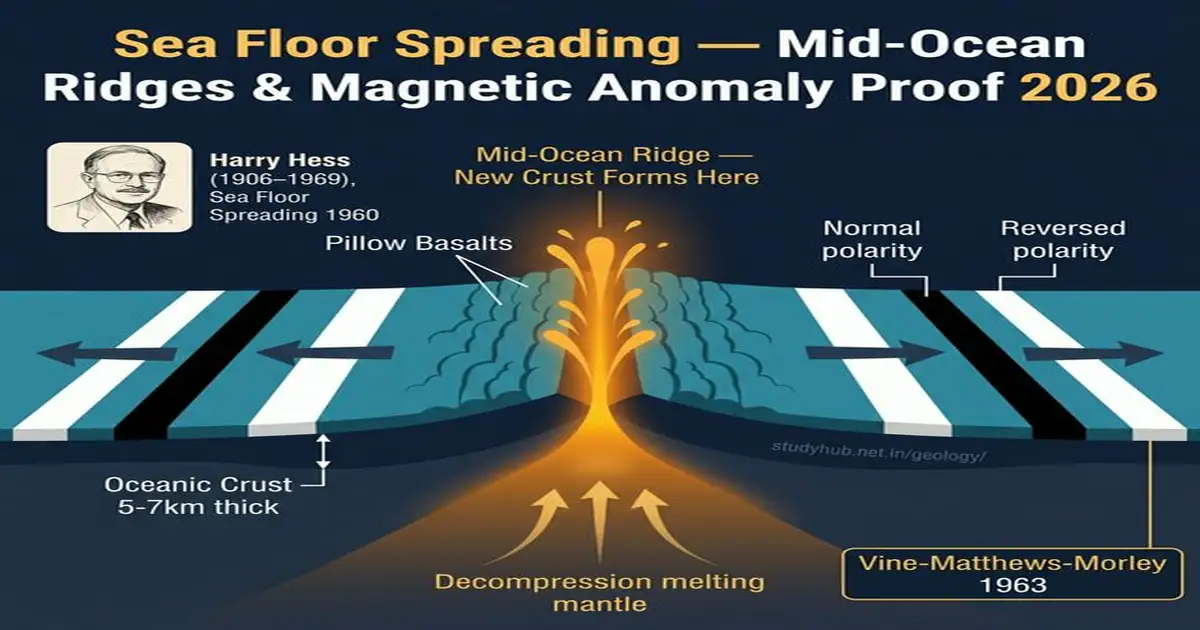
Sea Floor Spreading — Harry Hess, Magnetic Anomaly Proof & Indian Ocean Ridges 2026
Sea Floor Spreading — Key Facts Table
| Aspect | Details |
|---|---|
| Proposed By | Harry Hammond Hess (Princeton University, Princeton, NJ, USA) |
| Year | 1960 (circulated as a preprint/research report); formally published 1962 in “Petrologic Studies: A Volume in Honor of A.F. Buddington” |
| Core Idea | New oceanic crust is created continuously at mid-ocean ridge crests (divergent plate boundaries) via decompression melting of the asthenosphere. This new basaltic crust spreads symmetrically outward from the ridge on both sides. Old oceanic crust is destroyed at subduction zones (ocean trenches). Thus the ocean floor is like a giant conveyor belt — constantly renewed at ridges, destroyed at trenches. Total ocean floor area remains approximately constant |
| Hess’s Evidence | WWII-era echo-sounding surveys of the Pacific Ocean floor (Hess had quietly mapped ocean floor while commanding USS Cape Johnson). Discovered: (1) global system of mid-ocean ridges; (2) deep ocean trenches at continental margins; (3) guyots (flat-topped seamounts = ancient eroded volcanic islands that subsided as oceanic crust aged and cooled); (4) no ocean sediments older than ~180 Ma (young ocean floor everywhere); (5) heat flow highest at ridge crests, lowest away from ridges |
| Decompression Melting at Ridges | As plates diverge, asthenospheric peridotite wells up to fill the gap. Decreasing pressure (from ~3 GPa to <1 GPa) causes the rock to cross its solidus temperature (begin melting) WITHOUT additional heat input. This “decompression melting” generates basaltic melt → rises through crust → erupts as pillow lavas on ocean floor → solidifies → new oceanic crust (5–7 km thick: top 0.5 km pillow basalt, 1–2 km sheeted dykes, 4–5 km gabbro) |
| Spreading Rate | Slow: 1–2 cm/yr per side (Mid-Atlantic Ridge, Southwest Indian Ridge). Fast: 6–9 cm/yr per side (East Pacific Rise). Ultraslow: <1 cm/yr (Gakkel Ridge, Arctic). Total spreading rate = sum of both sides. Fast-spreading ridges are broad and low; slow-spreading ridges are narrow with deep central rift valleys (e.g., Mid-Atlantic Ridge has a deep axial valley; East Pacific Rise has no axial valley) |
| Proof — Magnetic Anomaly Stripes (Vine-Matthews-Morley, 1963) | Frederick Vine & Drummond Matthews (Cambridge, 1963) + Lawrence Morley (Geological Survey of Canada, 1963, independently). Key insight: basaltic ocean crust, when it crystallises from magma at the ridge crest, records Earth’s magnetic polarity at that moment in its magnetite (Fe₃O₄) grains. Since Earth’s polarity reverses periodically (last reversal: 780,000 years ago = Brunhes-Matuyama reversal), the seafloor preserves a “bar code” of alternating normally-magnetised (darker) and reversely-magnetised (lighter) rock stripes — symmetric on both sides of the ridge, growing older outward. Vine & Matthews measured these stripes on ocean floor surveys near the Juan de Fuca Ridge (NE Pacific) and confirmed the symmetry |
| Age of Ocean Floor | Ocean floor age increases with distance from mid-ocean ridges — confirmed by ocean drilling (DSDP 1968 onwards). Oldest surviving oceanic crust: ~180–200 Ma (W. Pacific, off Japan — Jurassic age). No oceanic crust older than ~200 Ma exists anywhere — all older crust has been subducted. Confirms ocean floor is constantly recycled. Continental crust by contrast: up to 4.0 Ga (Acasta Gneiss, Canada) |
| Heat Flow Pattern | Heat flow is maximum at ridge crests (new hot rock, thin lithosphere) and decreases away from ridges as oceanic lithosphere cools, thickens, and subsides. Confirms ridge crest as site of active mantle upwelling. Ocean floor depth also increases away from ridges following the “thermal subsidence” square-root relationship (depth ∝ √age) |
World’s Major Mid-Ocean Ridges — Including Indian Ocean Ridges
| Ridge Name | Ocean | Spreading Rate (total) | Length | India / Exam Relevance |
|---|---|---|---|---|
| Mid-Atlantic Ridge (MAR) | Atlantic Ocean | ~2.5 cm/yr (slow) | ~16,000 km (longest continuous ridge in world) | Wegener’s jigsaw fit — separation of S.America from Africa; Iceland (astride MAR) = volcanic island built on ridge crest; deep axial rift valley = slow-spreading type |
| East Pacific Rise (EPR) | Pacific Ocean (eastern sector) | ~13–18 cm/yr (fastest-spreading ridge) | ~10,000 km | No deep rift valley (broad, smooth = fast-spreading type); fastest ocean floor production on Earth; connected to Juan de Fuca Ridge (NE Pacific, where Vine-Matthews measured magnetic stripes) |
| Carlsberg Ridge | NW Indian Ocean (Arabian Sea–Gulf of Aden) | ~2.5 cm/yr (slow) | ~2,400 km | Directly relevant to India: separates the Indian Plate from the African Plate and Somali Plate. Responsible for opening the Arabian Sea and Gulf of Aden. Connects to the Red Sea Rift (where Arabia is separating from Africa — still in early rifting stage). Carlsberg Ridge is the northern arm of the Indian Ocean spreading system |
| Southwest Indian Ridge (SWIR) | SW Indian Ocean (between Africa and Antarctica) | ~1.4–1.6 cm/yr (ultraslow to slow) | ~8,000 km | Separates Indian Plate from Antarctic Plate. One of Earth’s slowest-spreading ridges. Deep axial rift. Connects to the Carlsberg Ridge (via Rodriguez Triple Junction) — a triple junction where Indian, African, and Antarctic plates meet. Part of India’s southern oceanic boundary |
| Southeast Indian Ridge (SEIR) | SE Indian Ocean (south of Australia) | ~7–8 cm/yr (intermediate to fast) | ~8,000 km | Separates Indian-Australian Plate from Antarctic Plate. Faster-spreading than SWIR. Connects to the same Rodriguez Triple Junction. Australia is separating from Antarctica via this ridge — the last piece of Gondwana to fully separate (~35–40 Ma, Australia-Antarctica split) |
| Gakkel Ridge | Arctic Ocean | ~0.3–1.5 cm/yr (Earth’s slowest) | ~1,800 km | World’s slowest-spreading ridge. Deep, magma-starved; thin crust. Separates North American and Eurasian Plates under the Arctic Ocean |
How Magnetic Anomaly Stripes Prove Sea Floor Spreading — Step by Step
The Vine-Matthews-Morley discovery is one of geology’s most elegant confirmations of a theory — a direct “recording” of Earth’s geological history preserved in ocean floor rock. Here is how the mechanism works: Step 1 — Magma erupts at ridge crest. At the mid-ocean ridge, asthenospheric peridotite decompresses and melts. Basaltic magma rises and erupts on the sea floor as pillow lavas and passes through sheeted dykes. At the ridge, the magma is a high-temperature liquid (above 700°C, the Curie temperature of magnetite). Step 2 — Rock cools and records magnetic field. As fresh basalt crystallises and cools below the Curie temperature (~580°C for magnetite, ~680°C for hematite), magnetite grains (Fe₃O₄) align their magnetic moments (tiny domains) parallel to Earth’s ambient magnetic field at that moment — “locking in” the polarity. If Earth’s field is in its current normal polarity state (north pole at geographic north), the rock records normal polarity. If Earth is in a reversed state (north pole at geographic south — as it was, for example, during the Matuyama Chron 780,000–2.58 Ma ago), the rock records reversed polarity. Step 3 — Ocean floor spreads outward. New magma continuously erupts at the ridge centre — the newly formed rock splits and spreads symmetrically outward on both sides. Each new batch of rock records whatever polarity Earth has at the time it cools. As Earth’s polarity reverses (randomly, on average every few hundred thousand years), the spreading creates alternating bands of normal and reversed magnetic polarity — symmetric on both sides of the ridge because the same sequence of reversals is recorded equally on both flanks. Step 4 — Magnetic anomaly measurement. Research ships tow magnetometers across the ocean floor and measure the total magnetic field. Where ocean floor crust is normally magnetised, the measured field is slightly higher than expected (the crustal rock adds to Earth’s ambient field). Where reversed, the field is slightly lower (crustal rock partially cancels Earth’s field). This produces a regular pattern of high and low anomalies — the “stripes.” Step 5 — Age calibration. The sequence of polarity reversals is independently known from dating volcanic rocks on land (using radiometric dating of lava flows of known polarity — the Geomagnetic Polarity Time Scale, GPTS). Matching the stripe pattern to the GPTS gives the age of each stripe — and therefore the age-spreading-rate history of the ridge. This is ocean floor “tape recording” — a complete, independently dateable history of ocean floor production.
Frequently Asked Questions
What are guyots and how do they support sea floor spreading?
Guyots (also called tablemounts) are flat-topped seamounts — underwater volcanic mountains with a distinctive flat upper surface — discovered by Harry Hess during his WWII Pacific surveys (he named them after Swiss-American geographer Arnold Guyot, 1807–1884, who founded the modern geography department at Princeton). The flat top of a guyot is a wave-erosion platform — formed when the volcanic island was at sea level and waves cut it flat. The guyot is now thousands of metres below sea level — it has subsided. This subsidence is explained directly by sea floor spreading: (1) A volcanic island forms above a mid-ocean ridge or hotspot, initially at sea level. (2) As the oceanic plate moves away from the ridge, it cools, contracts, and sinks — thermal subsidence following the √(age) relationship. (3) The island subsides below sea level over millions of years, losing its volcanic source. (4) Waves erode the submerged seamount flat (or the island was eroded flat before subsidence). The result: a flat-topped seamount at depth, with coral reef fossils and shallow-water sediments preserved on top — evidence that the flat-top was once at sea level in a warm tropical ocean. For Hess, guyots were direct evidence: (1) the ocean floor must be moving (they are transported away from where they formed); (2) the ocean floor is old and dynamic (guyots of different ages at different depths track the subsidence path); (3) the flat top was formed near an active ridge in warm shallow water, not at depth. Hess found dozens of guyots in the western Pacific — their flat tops at depths of 1,500–2,000 m below sea level, confirming that the Pacific ocean floor had subsided by that amount since the guyots formed. This was entirely consistent with thermal subsidence from sea floor spreading.
Important for Exams — Sea Floor Spreading Facts for UPSC, SSC & State PCS
Harry Hess (1906–1969): Princeton University. Published sea floor spreading concept 1960/1962. Called his paper “History of Ocean Basins.” Background: WWII Navy commander who mapped Pacific floor secretly. Proposed: new crust at mid-ocean ridges → spreads outward → consumed at ocean trenches. Evidence used: guyots, ridge system, no old ocean floor (>200 Ma), heat flow pattern.
Vine-Matthews-Morley (1963): Magnetic anomaly stripes on ocean floor = symmetric bands of normal/reversed polarity either side of mid-ocean ridges. Proof of spreading. Named after Fred Vine (postgrad student, Cambridge), Drummond Matthews (Cambridge supervisor), Lawrence Morley (Canadian, simultaneous independent discovery, whose paper was infamously rejected by Nature and JGR before Vine-Matthews published).
Key features of mid-ocean ridges: Slow (MAR, Carlsberg, SWIR): deep rift valley, rough terrain. Fast (EPR): broad dome, no rift valley, smooth. Ocean floor: oldest = 180–200 Ma (W. Pacific). Youngest = ridge crests. Depth increases with age (thermal subsidence). Heat flow highest at ridges. Ocean sediment thickest away from ridges. Indian Ocean ridges: Carlsberg Ridge (NW Indian Ocean) = separates Indian from African plate, 2.5 cm/yr. SWIR = separates Indian from Antarctic plate, 1.4 cm/yr. SEIR = separates Australian from Antarctic plate, ~7 cm/yr. Rodriguez Triple Junction = where Indian, African, Antarctic plates meet.
Guyots: Flat-topped seamounts. Evidence of ocean floor subsidence. Discovered/named by Hess from WWII surveys.
Ocean drilling: DSDP (1968) and ODP confirmed age-distance relationship from ridges.
What to Read Next
- Plate Tectonics — Full History & Evidence from Wegener to GPS 2026
- Continental Drift — Alfred Wegener, Pangaea & India’s Gondwana Journey 2026
- Types of Plate Boundaries — Mid-Ocean Ridges, Trenches & Transform Faults 2026
- Lithosphere — Tectonic Plates, Indian Plate & Carlsberg Ridge 2026
- Asthenosphere — Decompression Melting & Mid-Ocean Ridge Basalt (MORB) 2026
🎔 Exam Quick Reference — Sea Floor Spreading: Harry Hess (Princeton), 1960/62. New crust at mid-ocean ridges → spreads → consumed at trenches. Evidence: guyots (flat-topped seamounts, named by Hess), heat flow pattern, no ocean crust >200 Ma. Vine-Matthews-Morley (1963): magnetic anomaly stripes = symmetric normal/reversed polarity bands either side of ridge = proof. Oldest ocean floor: 180-200 Ma (W. Pacific). Carlsberg Ridge (NW Indian Ocean): 2.5 cm/yr, Indian-African plate separation. SWIR: 1.4 cm/yr, Indian-Antarctic. East Pacific Rise: 13-18 cm/yr (fastest). Slow ridges: deep rift valley. Fast ridges: no rift valley. DSDP (1968): ocean drilling confirmed age-distance. Morley’s paper rejected by Nature and JGR before Vine-Matthews published.
🌍 Indian Ocean Spreading System: Three ridges meeting at Rodriguez Triple Junction (21°S, 70°E, central Indian Ocean): (1) Carlsberg Ridge (NW, separates India from Africa/Somalia, 2.5 cm/yr); (2) Southwest Indian Ridge (SWIR, separates India from Antarctica, 1.4 cm/yr — one of Earth’s slowest); (3) Southeast Indian Ridge (SEIR, separates Australia from Antarctica, ~7 cm/yr). The Indian Ocean is entirely Cretaceous-Recent age (0-130 Ma) — entirely created by sea floor spreading after Gondwana breakup. Lakshadweep-Chagos Ridge = hotspot trail from Réunion plume = thickened oceanic plateau (magmatic underplating). Arabian Sea floor: 0-80 Ma (young, still spreading from Carlsberg Ridge). Bay of Bengal: up to 130 Ma oceanic crust under thick Bengal Fan sediments. No pre-Cretaceous Indian Ocean floor exists — confirms Gondwana assembly.
About This Guide: Written by the StudyHub Geology Editorial Team (studyhub.net.in/geology/) based on NCERT Class 11 Physical Geography Chapter 4, Hess (1962) “History of Ocean Basins” original paper, Vine & Matthews (1963) original Nature paper, DeMets et al. NUVEL-1A plate kinematic model, and IODP/DSDP site reports for the Indian Ocean. Last updated: March 2026.