
Transport infrastructure is the circulatory system of any economy — it determines where industries locate, how goods reach markets, how workers access jobs, and how nations integrate their territories. India’s transport system is one of the world’s largest and most complex: the 4th largest railway network on Earth (68,000 km of route), the 2nd largest road network (~63 lakh km including all categories), 12 major ports handling over 800 million tonnes of cargo annually, and a rapidly expanding civil aviation network connecting 149 airports. Yet India’s transport infrastructure has historically been its greatest economic bottleneck — logistics costs as a percentage of GDP (~13–14%) are nearly double those of China (~8%) and USA (~8%), adding costs throughout the supply chain. The transformational investments of the 2010s–2020s — PM Gati Shakti, Bharatmala, Sagarmala, Dedicated Freight Corridors, and the first high-speed rail project — are attempting to fundamentally restructure India’s transport economy. Understanding India’s transport system, key routes, major projects, and policy frameworks is essential for UPSC, SSC, State PSC, and all competitive examinations.
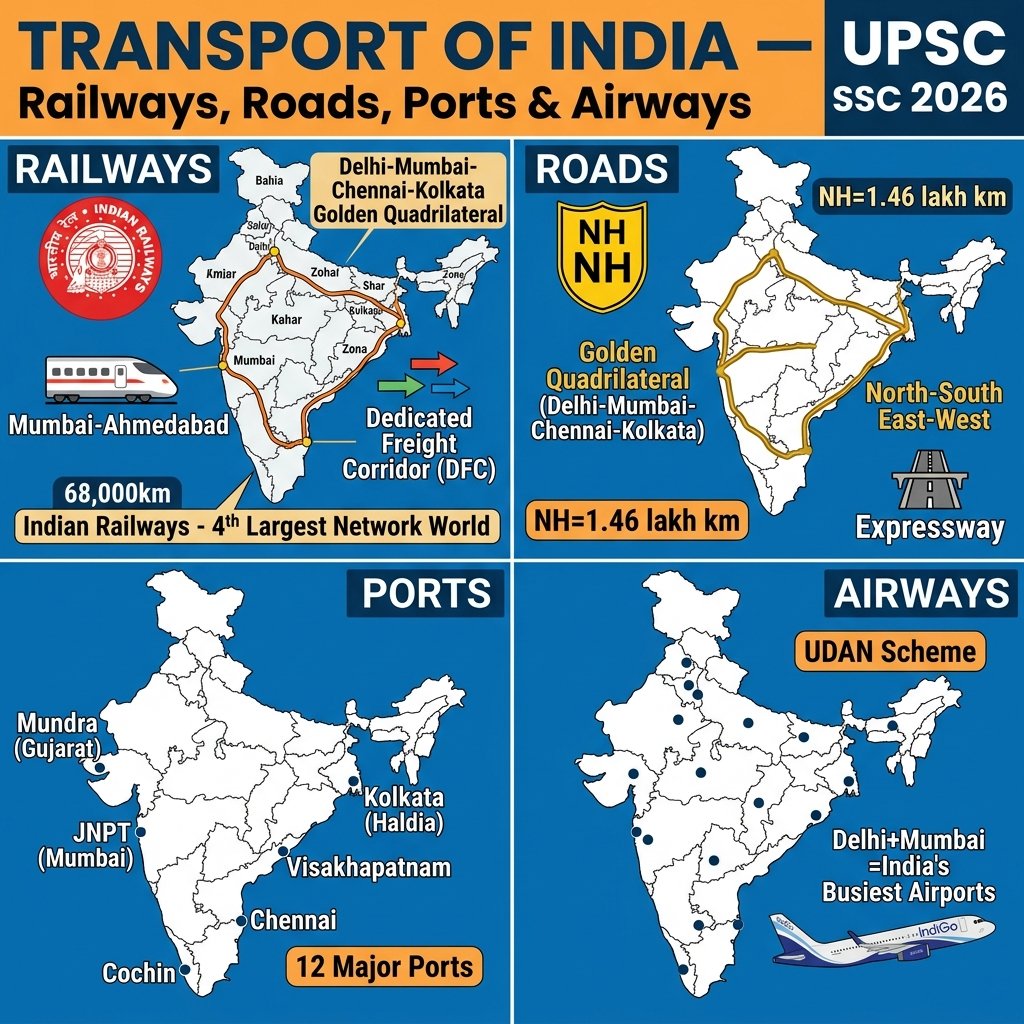
1. Indian Railways
- 🚂 Scale: 68,084 km of route length (4th largest in world after USA, Russia, China); 7,325 stations; runs 13,000+ trains daily; carries 23 million passengers/day; 3,000 MT freight/year
- 🏛️ Ownership: Indian Railways = a Ministry of the Government of India (not a corporatised entity); one of the world’s largest employers (~1.2 million employees, down from 1.6 million peak)
- 📊 Gauges: Broad Gauge (1,676mm — 93% of network; standard for all main lines); Metre Gauge (1,000mm — declining, being converted to BG); Narrow Gauge (762mm/610mm — hill railways like Matheran, Darjeeling, Nilgiri)
Key Railway Projects
| Project | Details | Status / Significance |
|---|---|---|
| Dedicated Freight Corridors (DFC) | Two corridors: Western DFC (Delhi-Mumbai, 1,504 km) + Eastern DFC (Ludhiana-Dankuni/Kolkata, 1,856 km); total 3,360 km; electrified, double-stack container trains at 100 kmph freight speed | Largely operational (2024); frees up existing tracks for passenger trains; reduces Delhi-Mumbai freight time from 14 days to <24 hours; transformational for logistics competitiveness; DMIC runs alongside Western DFC |
| Mumbai-Ahmedabad High Speed Rail (MAHSR / Bullet Train) | 508 km; designed for 320 kmph (operational 350 kmph max); Japan’s Shinkansen E5 technology; 12 stations; Japan JICA funding (88% of ₹1.08 lakh crore cost) | Under construction; initially targeted 2026 but delayed; Surat-Bilimora section possibly first operational phase; largest single transport infrastructure project in India; 21 km undersea tunnel through Thane Creek = India’s first undersea rail tunnel |
| Vande Bharat Express | Made-in-India semi-high-speed train (160 kmph); manufactured at ICF Chennai; 16-coach trainset; chair-car configuration; KAVACH automatic protection system | 75+ Vande Bharat trains operational (2024); connects major cities; target 400 trains by 2025; first home-grown premium passenger train; significantly cuts journey times (Delhi-Varanasi: 3.4 hrs vs 12+ hrs express) |
| PM Gati Shakti National Master Plan | GIS-based digital platform integrating 16 ministries’ infrastructure plans; identifies corridor conflicts, bottlenecks, land availability; enables multimodal connectivity planning | Launched 2021; foundational policy change — moving from siloed ministry planning to integrated infrastructure development; World Bank cited as global best practice for infrastructure planning coordination |
| Konkan Railway | 760 km, Roha (Maharashtra) to Mangaluru (Karnataka); cuts Mumbai-Mangaluru time from 24 hrs to 10 hrs; 2,000 bridges + 91 tunnels; traverses Western Ghats; most difficult railway construction in post-independence India | Fully operational since 1998; connects Goa to national railways; scenic — runs through coastal mountains and bridges; critical for Goa tourism economy |
UNESCO World Heritage Hill Railways of India
- 🏔️ Darjeeling Himalayan Railway (DHR): “Toy Train”; 78 km; Narrow Gauge (610mm); 1881; connects Siliguri (NJP) to Darjeeling; UNESCO WH 1999; steam locos still operated for heritage tourism; “Batasia Loop” = famous spiral to gain altitude in minimal horizontal distance
- 🏔️ Nilgiri Mountain Railway (NMR): 46 km; Metre Gauge; rack and pinion system (unique in India — cogs grip a toothed rail on steep sections up to 8.33% gradient); Mettupalayam to Ooty (Udhagamandalam); 1908; UNESCO WH 2005 (extension of Darjeeling WH)
- 🏔️ Kalka-Shimla Railway (KSR): 96 km; Narrow Gauge (762mm); 1903; 102 tunnels, 800+ bridges; UNESCO WH 2008 (extension); connects Kalka (Haryana) to Shimla; average gradient 1:33
- 🏔️ Matheran Hill Railway: 21 km; Narrow Gauge; 1907; connects Neral (Maharashtra near Mumbai) to Matheran hill station; toy train; not UNESCO but protected; no motor vehicles in Matheran = this railway the only mechanised access
2. Roads and National Highways
- 🛣️ Total road length: ~63 lakh km (6.3 million km) = 2nd largest road network in world (after USA ~6.58 million km); includes National Highways, State Highways, district roads, village roads
- 🛣️ National Highways: 1.46 lakh km (146,000 km); only 2% of total road length but carry 40% of total road traffic; maintained by NHAI (National Highways Authority of India)
- 🛣️ Expressways: ~4,000 km completed (2024); Yamuna Expressway (165 km, Agra-Delhi), Mumbai-Pune Expressway (94 km), Delhi-Meerut Expressway, Purvanchal Expressway (340 km), Eastern Peripheral Expressway
| Road Project | Route / Length | Significance |
|---|---|---|
| Golden Quadrilateral (GQ) | Delhi-Mumbai-Chennai-Kolkata; 5,846 km; 4/6-lane NH | India’s most important highway project; completed 2012; connects 4 metros; passes through all major industrial and agricultural states; carries ~40% of road freight and 40% of road passengers despite being only 2% of NH length; built by NHAI under Atal Bihari Vajpayee’s NDA government (late 1990s) |
| North-South & East-West (NS-EW) Corridor | N-S: Srinagar to Kanyakumari (3,745 km); E-W: Porbandar (Gujarat) to Silchar (Assam) (3,640 km); total ~7,142 km | Extensions of GQ project; connect extremities of India; run along NH44 (India’s longest NH, 3,745 km; Srinagar to Kanyakumari) and NH27 (E-W corridor, 3,652 km); NH44 passes through 11 states |
| Bharatmala Phase I | 34,800 km of new/upgraded NHs; ₹5.35 lakh crore; 550 districts to be connected | Ambitious national programme to build economic corridors, inter-corridors, ring roads, and expressways; overlaps with GQ and NS-EW; under implementation 2017 onwards; significant delays; 2024 completion unlikely for many sections |
| NH44 (Srinagar-Kanyakumari) | 3,745 km; India’s longest NH; replaces old NH1+NH7+NH44 | Passes through J&K, HP, Punjab, Haryana, Delhi, UP, MP, Maharashtra, Telangana, AP, Karnataka, TN; single NH connecting Himalayan north to tip of peninsula; strategic (J&K military supply) + economic (peninsular trade) |
| Atal Tunnel (Rohtang Tunnel) | 8.8 km; world’s longest highway tunnel above 10,000 feet (3,000m); Manali-Leh highway (HP); single tube, 2-lane | Opened 2020; provides all-weather connectivity to Lahaul-Spiti and Leh from Manali; previously road blocked by snow 6 months per year; strategic for military supply to Ladakh; critical border infrastructure |
| Zoji La Tunnel | 14.2 km; Zoji La pass, J&K; NH1 (Srinagar-Leh highway) | Under construction; will provide all-weather Srinagar-Leh connectivity; currently Zoji La pass closes in winter cutting off Ladakh by road; strategic priority post-Galwan standoff (2020); expected completion 2026 |
3. Ports & Waterways
- ⚓ India’s coastline: 7,517 km; 12 Major Ports (controlled by central government under Major Port Authorities Act 2021) + 200+ Minor/Intermediate Ports (state government controlled); total cargo handled: ~800 MT/year (2022–23)
| Major Port | State | Specialisation / Key Facts |
|---|---|---|
| JNPT (Jawaharlal Nehru Port) | Maharashtra (Navi Mumbai) | India’s largest container port (handles ~55% of India’s container trade); connected to DFC Western corridor; 5 container terminals; capacity ~9 million TEUs; busiest for EXIM trade |
| Mundra Port (Gujarat) | Gujarat (Kutch coast) | India’s largest port by cargo volume (total cargo); private port (Adani Ports — APSEZ); ~200 MT cargo handled; handles coal, crude, containers; growing fastest in India; connected to DFC Western |
| Kandla / Deendayal Port | Gujarat (Gulf of Kutch) | Largest Major Port by cargo (government); handles petroleum products, fertilisers, salt; hinterland = Rajasthan, Punjab, Haryana; renamed Deendayal Port 2017 from Kandla Port |
| Mumbai Port | Maharashtra | Natural harbour; oldest modern port in India; handling declining as JNPT grew; primarily handles petroleum products (Bharat Petroleum refinery Mahul uses it); major passenger cruise terminal |
| Visakhapatnam Port | Andhra Pradesh | India’s deepest natural harbour; major bulk cargo hub (coal, iron ore, steel products from Vizag Steel nearby); Eastern India’s main cargo port; naval base (Eastern Naval Command) |
| Chennai Port | Tamil Nadu | India’s 2nd largest container port; handles automobiles (Chennai = Detroit of India); connects to manufacturing hubs in Tamil Nadu; constructed harbour (artificial) on open coast |
| Kolkata Port + Haldia Dock | West Bengal | India’s only riverine major port (on Hooghly River, 203 km from sea); handles coal, foodgrains, jute; shallow and silting problem; Haldia Dock Complex = deep-water satellite dock 56 km downstream; handles petroleum products for eastern India |
| Cochin (Kochi) Port | Kerala | Natural harbour (backwater lagoon); handles spices, coir, fish; cruise terminal; Cochin Shipyard (India’s largest); International Container Transhipment Terminal (ICTT) at Vallarpadam — India’s first transhipment hub for deep-sea vessels |
- 🚢 Sagarmala Programme: ₹6 lakh crore port-led development programme; 574 projects; port modernisation, port connectivity enhancement (road/rail last mile connections), port-led industrialisation (coastal economic zones), and coastal community development; aims to reduce logistics costs through coastal shipping and waterways
- 🚢 Inland Waterways: India has 14,500 km of navigable rivers and canals; National Waterways Authority of India (IWAI); 111 National Waterways declared (NWA 2016); NW-1 (Ganga: Allahabad-Haldia, 1,620 km) = most important; MV Ganga Vilas cruise ship (Varanasi to Dibrugarh, 3,200 km) = world’s longest river cruise
4. Civil Aviation
- ✈️ India’s aviation scale: 3rd largest domestic aviation market globally (after USA and China); 149 operational airports (2024); 220 million domestic passengers/year; IndiGo = India’s largest airline (60%+ domestic market share = one of India’s biggest single-airline market dominance in the world); Air India (now Tata Group after re-acquisition from government in 2022)
- 🛫 Major airports: Indira Gandhi International Airport (Delhi) = India’s busiest (~72 million passengers/year, pre-COVID); Chhatrapati Shivaji Maharaj International Airport (Mumbai) = most slot-constrained (2 runways + residential areas limit expansion); Kempegowda International Airport (Bengaluru); Rajiv Gandhi International Airport (Hyderabad / Shamshabad); CSIA New Airport (Navi Mumbai) = under construction
- 🌐 UDAN Scheme (2016): Ude Desh ka Aam Naagrik (Let the Air of the Country Fly the Common Man); regional connectivity scheme; subsidises airlines to operate on unserved/underserved routes; 533 new routes added; connected 68 previously unserved airports; airfare capped at ₹2,500 for 1-hour journey; mixed results — many routes commercially unviable and discontinued after subsidy period
- ✈️ New Greenfield Airports: Navi Mumbai (under construction, Maharashtra); Jewar (Noida International Airport, UP — under construction, will be Delhi’s 2nd airport and one of Asia’s largest); Bhogapuram (AP); Hollongi (Itanagar, Arunachal Pradesh — newest; opened 2024 = AP’s first airport)
5. Pipeline Transport
- 🛢️ India’s pipeline network: ~25,000 km of petroleum product pipelines; operated by IOCL, HPCL, BPCL, GAIL, OIL; most efficient mode for crude oil, petroleum products, and natural gas
- 🛢️ Key pipelines: Salaya-Viramgam-Mathura (crude oil, Gujarat to UP); Kandla-Bhatinda (petroleum products); HBJ Pipeline (Hazira-Vijaypur-Jagdishpur, 1,750 km — India’s longest gas pipeline, GAIL; carries natural gas from Hazira, Gujarat to UP regions); GAIL’s natural gas grid expanding rapidly under PM Urja Ganga pipeline and City Gas Distribution network
- 🛢️ Why pipelines matter: No intermediate handling losses; significantly cheaper per tonne-km than road (1/3rd cost); lower pollution; continuous throughput. Critical for rapidly growing petroleum product demand and LPG distribution (India = world’s 2nd largest LPG importer)
⭐ Important for Exams — Quick Revision
- 🔑 Indian Railways: 4th largest network (68,084 km); 7,325 stations; 23 million passengers/day; 1.2 million employees; Broad Gauge 93% of network
- 🔑 Dedicated Freight Corridors: Western DFC (Delhi-Mumbai, 1,504 km) + Eastern DFC (Ludhiana-Kolkata, 1,856 km); DMIC runs alongside Western DFC; Delhi-Mumbai freight: 14 days to <24 hours
- 🔑 Bullet Train (MAHSR): Mumbai-Ahmedabad, 508 km; Shinkansen-E5; JICA-funded (88%); 21 km undersea tunnel; under construction
- 🔑 Vande Bharat: Made-in-India semi-high-speed (160 kmph); ICF Chennai manufactured; 75+ operational; KAVACH collision prevention
- 🔑 UNESCO Hill Railways: Darjeeling (1881, UNESCO 1999), Nilgiri (1908, UNESCO 2005), Kalka-Shimla (1903, UNESCO 2008), Matheran (1907, not UNESCO)
- 🔑 Roads: 63 lakh km total (2nd world); NH = 1.46 lakh km; Golden Quadrilateral (5,846 km, Delhi-Mumbai-Chennai-Kolkata, completed 2012)
- 🔑 NH44 = India’s longest NH = 3,745 km (Srinagar to Kanyakumari); passes 11 states
- 🔑 Atal Tunnel: 8.8 km; world’s longest highway tunnel above 10,000 ft; Rohtang Pass bypass; opened 2020; all-weather Manali-Leh
- 🔑 Zoji La Tunnel: 14.2 km; under construction; will provide all-weather Srinagar-Leh connectivity; strategic post-Galwan
- 🔑 JNPT (Mumbai): Largest container port (55% India container trade); Mundra (Adani, Gujarat) = largest by total cargo volume
- 🔑 Visakhapatnam: India’s deepest natural harbour; major bulk cargo; Eastern Naval Command
- 🔑 Kolkata: India’s only riverine major port (Hooghly river); shallow + silting; Haldia = satellite deep-water dock
- 🔑 Cochin ICTT (Vallarpadam): India’s first international container transhipment terminal
- 🔑 Sagarmala: ₹6 lakh crore port-led development; 574 projects; coastal shipping promotion
- 🔑 UDAN scheme (2016): Regional connectivity; subsidised routes; 533 new routes; ₹2,500 fare cap for 1 hour
- 🔑 IndiGo: 60%+ domestic market share; India’s largest airline; Air India returned to Tata Group (2022)
- 🔑 HBJ Pipeline: 1,750 km; India’s longest gas pipeline (Hazira-Vijaypur-Jagdishpur; GAIL)
- 🔑 India’s logistics cost = 13–14% of GDP (vs China/USA 8%); reducing to 9% is the target of PM Gati Shakti
Frequently Asked Questions (FAQs)
1. Why are India’s logistics costs so high — and how is PM Gati Shakti trying to fix it?
India’s logistics costs — the cost of moving goods from production to consumption — consume approximately 13–14% of GDP, compared to 8% in China and the USA, and 6–8% in developed economies. This 5–6% excess cost acts as a hidden tax on every Indian-manufactured product, making them uncompetitive in global export markets and inflating domestic prices. The causes are structural: (1) Modal imbalance: Only ~27% of India’s freight moves by rail (natural steel wheel efficiency = cheapest per tonne-km); ~58% moves by road (most expensive mode for long-distance freight). The reverse is true in efficient economies (China: 47% rail, 39% road). Why does India load its most expensive mode? Because Indian Railways historically prioritised passenger trains over freight trains on the same tracks — freight trains averaged just 22–25 kmph speed (slower than a bicycle race) due to congestion and mandatory passing loops for passenger trains. Freight customers switched to road because despite higher per-km cost, road was faster and more predictable. (2) Fragmented warehousing: Before GST (2017), each state had its own taxes and checkpoints, forcing companies to maintain mini-warehouses in every state to avoid Inter-State tax cascades; trucks waited 1–3 days at state border checkpoints (octroi, state VAT checkpoints). GST eliminated most of this but the physical infrastructure fragmentation remains. (3) Last-mile connectivity gaps: Industrial clusters, ports, and railheads are rarely well-connected; goods often loaded, unloaded, and reloaded 4–5 times in a supply chain (each handling = cost + damage + delay). (4) Port dwell time: In 2018, average dwell time at Indian ports was 3–4 days (Singapore: 8 hours); improved to ~45 hours (2023) — still 5x worse than global benchmarks. PM Gati Shakti: Launched October 2021, this is a GIS-based national master plan platform integrating data from 16 ministries and 36 departments onto a single digital layer. Before Gati Shakti, a road project might not know a planned railway station was 2 km away; a port might not align its approach road with the planned expressway. Gati Shakti identifies: multimodal logistics parks (where road, rail, and warehouse integrate), first-and-last-mile connectivity gaps, corridor bottlenecks, and optimises land use planning across modes simultaneously. It is conceptually borrowed from Singapore’s Total Plan framework. Whether it delivers depends on political will to maintain coordination across ministries (historically India’s biggest governance challenge) and on actually completing the DFCs, which are the foundational shift needed to move freight from roads to railways.
2. What is the Dedicated Freight Corridor — and why is it the most important infrastructure project India has built since Independence?
The Dedicated Freight Corridor (DFC) is arguably India’s most consequential infrastructure investment since the original railway network construction of the British era, precisely because it addresses the single biggest structural inefficiency in India’s economy: the inability to move goods cheaply and reliably at scale. Here is why it matters so profoundly: The problem it solves: Indian Railways by the 2000s had the paradox of running the world’s 4th largest railway network but being unable to meaningfully compete with road freight because freight trains averaged 22–25 kmph (passenger trains get priority; freight waits in sidings). The Golden Quadrilateral highways built in the 2000s actually made this worse — road became faster and more reliable, pulling more freight to road, further degrading Indian Railways’ finances. What DFC does differently: The DFC is built entirely as freight-only infrastructure — no passenger trains ever. This means: (a) No station platforms needed (freight passes without stopping); (b) Track optimised for heavy-load slow trains (25-tonne axle load vs Indian Railways’ standard 22.5 tonnes); (c) Double-stack container trains — two layers of shipping containers on flatbed wagons (impossible on existing network with lower overhead clearance); (d) No speed conflicts with passenger trains; (e) 32-coach long trains (vs 22 standard), carrying 3–4x cargo per train. The result: Delhi-Mumbai freight transit time falls from ~14 days to under 24 hours. The Western DFC (1,504 km, Delhi-Mumbai) directly enables the Delhi-Mumbai Industrial Corridor (DMIC) — 11 industrial cities planned along its length are the “New China” manufacturing zones strategy. The Eastern DFC (1,856 km, Ludhiana-Dankuni) connects Punjab’s agriculture and UP’s industrial belt to Kolkata’s port. Economics at scale: Moving freight by rail is approximately 3–7x cheaper per tonne-km than road; if even 20% of road freight shifts to rail, India’s logistics cost drops dramatically. The DFCCIL (Dedicated Freight Corridor Corporation of India Ltd) estimates that full DFC utilisation would generate ₹10,000 crore+ per year in logistics cost savings to the Indian economy. The World Bank (which co-funded Eastern DFC), JBIC (Japan, which funded Western DFC), and ADB have all cited the DFCs as their highest-impact infrastructure investment in India. The only question is how quickly industrial clients build the siding connections needed to actually load goods directly onto DFC-connected wagons — a “last kilometer” challenge that determines whether the DFC’s theoretical benefits actually materialize at scale.
3. Will the Mumbai-Ahmedabad Bullet Train actually transform India’s transport — or is it a vanity project?
The Mumbai-Ahmedabad High Speed Rail (MAHSR) — India’s first bullet train project — has become a lightning rod for debates about infrastructure prioritisation and development philosophy. Let us assess both perspectives rigorously. The case FOR the bullet train: (1) Traffic corridor argument: The Mumbai-Ahmedabad-Surat corridor is one of the world’s most densely travelled origin-destination pairs — this 500 km stretch connects India’s financial capital (Mumbai), its textile+diamond capital (Surat), and Gujarat’s commercial capital (Ahmedabad), with ~2 crore people living in the direct catchment. The current Shatabdi Express takes ~7 hours; bullet train reduces this to under 2 hours, effectively merging three cities into one metropolitan commuting zone. (2) Technology transfer: Japan’s JICA specifically structured the deal to mandate technology transfer — Indian engineers trained in Japan, Indian companies licensed to manufacture components, with eventual goal of India building its own high-speed rail. (3) Precedent: China made exactly this criticism of its first high-speed rail (Beijing-Tianjin, 2008) — “is it cost-effective?” and “could the money be better spent?” — but the technology once mastered was then scaled to 40,000 km of HSR in 15 years, fundamentally changing China’s economic geography. (4) Undersea tunnel innovation: The 21 km undersea tunnel through Thane Creek (India’s first submarine tunnel for railways) and the engineering complexity of the project will develop Indian construction capabilities for future projects. The case AGAINST (or for scepticism): (1) Cost-benefit: At ₹1.08 lakh crore for 508 km, MAHSR costs ~₹212 crore per km. For the same budget, India could build 3,000–4,000 km of Vande Bharat-upgradeable track OR construct multiple DFC extensions. (2) Ticket price accessibility: HSR ticket prices will realistically be in the ₹3,000–5,000 range for the full journey — affordable for business travellers but not for the student or agricultural worker who cannot afford the current ₹800 Shatabdi. (3) Land acquisition pain: The Maharashtra portion (particularly from Thane/Boisar to Mumbai BKC) has faced serious land acquisition resistance from farmers in Palghar district; court cases, delays, and political complications have pushed the original 2023 deadline to 2026 and counting. The verdict: The bullet train is neither a pure vanity project nor an unambiguous development priority. It is a long-term technological bet — the real payoff comes when India extends the network (Karnataka, Hyderabad corridor; Varanasi corridor; Delhi-Amritsar), not from the first 508 km alone. The question of whether it should be the highest infrastructure PRIORITY at this moment — given the DFCs, urban metro networks, and rural road connectivity needs — is legitimately debatable, and reasonable people disagree depending on their values around elite connectivity versus mass access.
Related Geology Articles on StudyHub
- ➡️ Industries India — Transport as Location Factor
- ➡️ Agriculture India — Transport & Market Access
- ➡️ Physiographic Divisions — Terrain & Transport Challenges
- ➡️ Natural Disasters — Road & Rail Infrastructure Damage
- ➡️ Water Resources — Rivers as Transport Waterways