
Geology is the scientific study of the Earth — its materials, structures, processes, and history. The word comes from the Greek gē (Earth) + logos (study). Everything you stand on, every mountain you see, every mineral in your phone, every drop of oil that powers civilisation — all of it is the domain of geology. Geology tells us how our planet formed 4.54 billion years ago from a swirling cloud of gas and dust, why the Himalayas are still rising today at 5mm per year, where to find the coal and iron ore that drive India’s economy, and when the next great earthquake is likely to shake a Himalayan city. For students preparing for UPSC, SSC, NEET, JEE, and state-level geography papers, geology is not merely academic — India’s seismic zones, its mineral wealth (coal, iron, bauxite, mica, diamonds), its river systems, its monsoon mechanics, and its vulnerability to natural disasters (earthquakes, landslides, floods) all have geological explanations. Understanding geology is understanding India’s past, present, and future — encoded in rock.
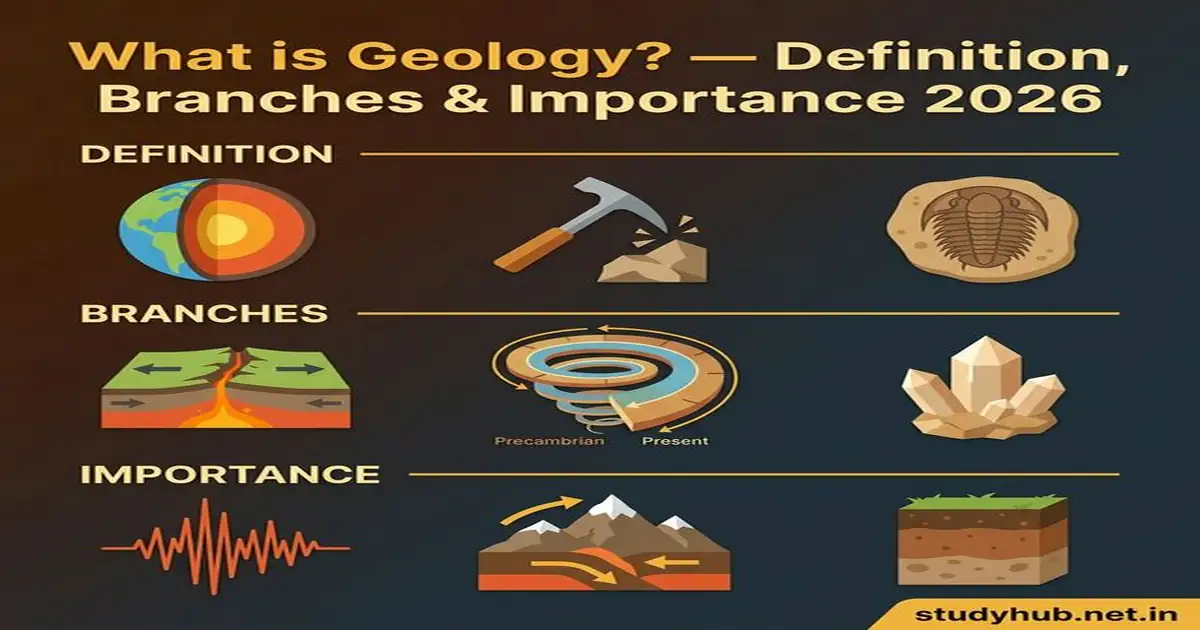
What is Geology? — Definition, Branches & Importance for Exams 2026
The Major Branches of Geology
| Branch | What It Studies | Exam Relevance / India Connection |
|---|---|---|
| Physical Geology | Earth’s materials (minerals, rocks) and the processes that shape its surface and interior — volcanism, erosion, earthquakes, glaciation, river action, wind action, coastal processes. The foundational branch — what most people mean by “geology.” | UPSC Geography: rock types, landform formation (NCERT Class 11 Physical Geography); SSC CGL/CHSL: basic Earth science; NEET/JEE: not primary, but Earth chapter in Class 11 Physics (seismic waves, Earth interior) |
| Historical Geology | The history of Earth and life — using rock records, fossils, and radiometric dating to reconstruct 4.54 billion years of planetary evolution; geological time scale (Precambrian, Palaeozoic, Mesozoic, Cenozoic); mass extinctions; evolution of continents | UPSC Mains Geography Paper 1: geological time scale; NCERT Class 11 Fundamentals of Physical Geography Ch. 2; state PCS geography papers; IFS (Indian Forest Service) geology paper |
| Structural Geology | How rocks are deformed — folds, faults, joints, unconformities; the geometry and mechanics of rock deformation under stress; essential for understanding mountain building, earthquake mechanics, and mining engineering | IFS Geology Paper; GATE Geology; mining engineering competitive exams; understanding Himalayan structure (thrust faults, nappe formation); India continental collision tectonics |
| Mineralogy | The study of minerals — their chemistry, crystal structure, physical properties (hardness, cleavage, colour, lustre), classification, and formation; Mohs scale; silicate vs non-silicate minerals; precious and industrial minerals | UPSC prelims: mineral distribution map of India; SSC geography: minerals of India (iron, coal, bauxite, mica); NCERT Class 10 and 11 minerals chapter; IFS Geology Paper II |
| Petrology | The study of rocks — their origin, composition, texture, and classification; the three rock families (igneous, sedimentary, metamorphic) and the rock cycle; petrology connects mineralogy to geological processes | NCERT Class 11 Physical Geography Chapter 5 (Minerals and Rocks); UPSC Geography optional; IFS Paper 1 petrology section; engineering geology for construction projects |
| Geomorphology | The study of landforms — how rivers, glaciers, wind, waves, and tectonic forces create and modify Earth’s surface features; V-shaped and U-shaped valleys, deltas, coastal platforms, desert dunes, karst topography; classification of landforms by agent | Extremely important UPSC topic — Geomorphology is 20–30% of Geography Paper 1 (Mains); state PCS exams; SSC CGL geography section; NCERT Class 11 Chapters 6–8 (landforms); India-specific: Himalayan landforms, Deccan Plateau, Indo-Gangetic Plain |
| Economic Geology | Earth’s mineral and energy resources — where they form, how to find them, how to extract them; petroleum geology (oil and gas traps), coal geology, ore deposit geology, hydrothermal vein deposits, placer deposits; essential for resource exploration | UPSC: mineral distribution + economic importance; Planning Commission India’s mineral policy; Coal India, ONGC, NMDC (iron ore), HZL (zinc-lead); IFS Geology; GATE Geology |
| Environmental Geology | The interaction between geological processes and human society; natural hazards (earthquakes, volcanoes, landslides, floods, tsunamis); land degradation, soil erosion, groundwater contamination, mining impacts; geological role in climate change | UPSC current affairs: earthquakes (Uttarakhand, Gujarat, Manipur), landslides (Himachal, Kerala), floods (Brahmaputra, Chennai); National Disaster Management Act 2005; India’s seismic hazard zonation; GSI natural hazard mapping |
| Hydrogeology | Groundwater — aquifers, water table, springs, wells; recharge and discharge of aquifers; groundwater contamination (arsenic, fluoride, nitrate); water table depletion (India’s crisis states — Punjab, Haryana, Rajasthan) | UPSC Geography: groundwater depletion in India; Central Ground Water Board (CGWB) India; Jal Jeevan Mission; Atal Bhujal Yojana; arsenic contamination (Bengal, Bihar, Jharkhand); fluorosis (Rajasthan, AP) |
| Seismology | Earthquakes — seismic waves, seismographs, magnitude measurement (Richter/Moment Magnitude scale); earthquake prediction; Earth’s interior revealed by seismic wave behaviour; major fault systems; India’s seismic zones | Critical for India: 59% of India’s landmass under moderate-to-severe seismic threat; 2001 Bhuj, 2015 Nepal (felt across India); Himalayan seismic zone; National Seismological Network (IMD + NDMA); BIS IS-1893 earthquake-resistant building code |
| Volcanology | Volcanoes — magma generation, eruption mechanisms, lava types, pyroclastic materials, volcanic hazards; monitoring and prediction; global distribution (Ring of Fire, hotspots, mid-ocean ridges); extinct Indian volcanoes (Deccan Traps) | UPSC: Deccan Traps; Barren Island (India’s only active volcano — Andaman); volcanic soil fertility (Maharashtra’s Deccan basalt soils → cotton growing — “regur” black cotton soil); global Ring of Fire geography |
| Glaciology | Glaciers — formation, movement, erosional and depositional landforms; ice ages; glacial retreat and sea level rise; Himalayan glaciers (Siachen, Gangotri, Zemu) and their water security implications; permafrost | India urgent: 9,575 glaciers in Himalayas (GSI count) — Gangotri retreating 22m/year; Himalayan glaciers water tower for 800 million people; climate change + glacier melt + flood risk; IPCC reports; Uttarakhand disaster 2021 |
| Planetary Geology (Astrogeology) | Geology of other planetary bodies — Moon, Mars, Venus, Mercury, asteroids; impact cratering; planetary formation; ISRO’s Chandrayaan missions (water ice on Moon’s south pole); Mars geology (Olympus Mons, Valles Marineris) | ISRO current affairs: Chandrayaan-3 landed on lunar south pole (August 2023) → confirmed water ice presence (Pragyan rover S-alpha X-ray spectrometer data); Gaganyaan prep; Aditya-L1; planetary geology increasingly in UPSC current affairs |
Why Geology Matters — Real-World Importance
1. Natural Resource Discovery
Every mineral resource that drives modern civilisation — iron ore for steel, coal for electricity, petroleum for fuel, lithium for batteries, uranium for nuclear power — was found by geologists. In India, the Geological Survey of India (GSI), founded in 1851 (the 4th oldest geological survey in the world), has mapped the subcontinent’s mineral wealth over 175 years: India holds 7% of the world’s iron ore reserves (Odisha, Jharkhand, Chhattisgarh); world’s largest mica deposits (Jharkhand — historically); 8th largest coal reserves globally (Jharia, Raniganj, Singrauli, Korba basins — all Gondwana Coalfields); significant bauxite (Odisha), manganese (Odisha, Maharashtra), and copper (Rajasthan — Khetri). Geology guides where to drill, mine, and explore.
2. Natural Disaster Prediction and Mitigation
59% of India’s land area is under moderate to severe seismic hazard (Zones III, IV, V — BIS IS-1893). The 2001 Bhuj earthquake (Mw 7.7 — 20,000 deaths — entire city of Bhuj destroyed) occurred on the Kutch rift zone — a geological feature known to seismologists but whose rupture potential was underestimated. Geology-based seismic zonation, earthquake-resistant design codes, and fault mapping directly reduce mortality. Similarly, landslide hazard mapping by GSI in the Himalayan states (Uttarakhand, Himachal Pradesh, Manipur) identifies high-risk areas, guiding NDMA evacuation and construction restrictions. Volcanology monitors Barren Island (Andaman) — India’s only active volcano. Hydrogeology guides groundwater depletion policy (Central Ground Water Board).
3. Civil Engineering and Infrastructure
Every dam, tunnel, railway track, bridge foundation, and building rests on geological conditions that an engineering geologist must assess: rock type determines bearing capacity; fault proximity determines earthquake risk; groundwater depth determines drainage needs; soil type determines liquefaction risk. India’s Himalayan infrastructure (UDAN mountain airports, NH tunnels — Atal Tunnel, Banihal tunnel), hydropower projects (Tehri Dam on the Bhagirathi — a geological risk zone — Garhwal Synclinorium), and metro rail systems (Mumbai, Delhi, Chennai — all through different geological terrains) required intensive geological investigation before and during construction.
4. Agriculture and Soil Science
The parent rock from which a soil forms determines its mineral composition, drainage, and fertility. India’s agricultural diversity is partly geological: Deccan basalt (regur/black cotton soil) — weathered from Deccan Trap volcanic basalt — is self-ploughing (shrinks and cracks when dry, swells when wet), inherently fertile (high iron, calcium, magnesium), and ideal for cotton and soya (Maharashtra, Gujarat, MP); alluvial soils of the Indo-Gangetic Plain derive from Himalayan river sediments — khader (newer, near river) vs bhangar (older, terrace) — fertile for wheat, rice, sugarcane; laterite soils (heavily leached tropical soils from ancient crystalline rocks) of Kerala and Tamil Nadu coastal areas — poor in nutrients, good for rubber and cashew; red soils of Deccan Plateau margins (Tamil Nadu, Andhra, Karnataka) from weathered crystalline basement — iron-rich → red colour → suited to groundnut, millets.
Geological Survey of India (GSI) — India’s Geological Authority
The Geological Survey of India (GSI) — headquartered in Kolkata — was established in 1851 under the British Raj primarily to find coal for the railways (the 1851 Indian Railway expansion required massive coal quantities → GSI’s first mission was coal mapping of Bengal and Bihar). It is one of the oldest geological surveys in the world (after the British BGS 1835, the French BRGM, and US USGS 1879). GSI’s current mandate covers: systematic geological mapping of the Indian subcontinent; mineral exploration (discovery of new ore deposits); seismic hazard assessment; glaciological monitoring (Himalayan glaciers — ongoing retreat measurement); natural hazard assessment (landslide, flood hazard mapping); geo-environmental studies; marine geology (seabed mapping of Exclusive Economic Zone); and planetary geoscience (in collaboration with ISRO). GSI publishes the Geological Map of India (1:50,000 and 1:250,000 scales), the Memoirs of the Geological Survey of India (detailed regional studies), and the Records of GSI (scientific papers — ongoing since 1868).
Timeline: Key Events in the History of Geology
| Year | Event | Significance |
|---|---|---|
| 1785 | James Hutton publishes Theory of the Earth | Establishes Uniformitarianism: “The present is the key to the past” — geological processes operating today operated in the past → Earth is very old (not 6,000 years); overthrows Biblical chronology for the scientific community |
| 1830–33 | Charles Lyell publishes Principles of Geology (3 volumes) | Codifies uniformitarianism; influenced Darwin; establishes geology as a rigorous science; geological time scale concept developed |
| 1851 | Geological Survey of India (GSI) founded, Calcutta | First systematic geological mapping of Indian subcontinent; coal mapping for railways → industrial revolution in India; T.H. Oldham (first Superintendent) |
| 1912 | Alfred Wegener proposes Continental Drift | The Origin of Continents and Oceans: Pangaea supercontinent; jigsaw fit of continents; dismissed by most geologists (no mechanism proposed) — validated 50 years later by plate tectonics |
| 1935 | Charles Richter develops Richter Magnitude Scale | First quantitative earthquake measurement scale; allowed standardised comparison of earthquake sizes globally |
| 1953 | Marie Tharp maps Atlantic Ocean floor | Creates first accurate map of mid-Atlantic ridge → provides key evidence for seafloor spreading → validates continental drift → leads to plate tectonics revolution |
| 1960 | Harry Hess proposes Sea Floor Spreading | The mechanism missing from Wegener’s continental drift — mantle convection currents push oceanic crust apart at mid-ocean ridges → moves continents; confirmed by magnetic striping of ocean floor |
| 1968 | Plate Tectonics Theory formally synthesised | Unifying theory of geology — integrates continental drift, seafloor spreading, earthquake distribution, volcanic distribution into single framework; “the Darwinian revolution of geology” |
| 1980 | Alvarez et al. propose asteroid impact killed dinosaurs | Iridium layer at KT boundary (65.5 Ma) → extraterrestrial impact → Chicxulub crater Mexico → validates asteroid extinction hypothesis; “impact geology” as a field |
| 2023 | Chandrayaan-3 lands on Moon’s south pole | India becomes first nation to land on Moon’s south pole; Pragyan rover confirms water ice and sulphur presence by X-ray spectroscopy → planetary geology milestone; international scientific significance |
Frequently Asked Questions
What is the difference between geology and geography?
This is one of the most common questions students ask — and the answer is nuanced because the two subjects significantly overlap: Geology focuses on the Earth’s physical composition, structure, and history — the rocks, minerals, fossils, internal processes (plate tectonics, volcanism, seismicity), and the evolution of Earth’s physical form over geological time (billions of years). Geology is essentially a physical science — it uses chemistry (geochemistry), physics (geophysics), biology (palaeontology), and mathematics (geostatistics). Geography is the study of the Earth’s surface and the patterns of human and physical features on it — it includes physical geography (landforms, climate, soils, vegetation, rivers, glaciers) AND human geography (population, settlements, agriculture, economies, urbanisation, geopolitics). Physical geography is closely related to geology — geomorphology (the study of landforms) sits in the overlap zone between the two disciplines. Key distinctions for exams: Geology is primarily concerned with the deep past (billions of years) and the deep interior (crust, mantle, core); geography is more concerned with present-day patterns on Earth’s surface. Geology = WHY the Himalayas have granite and metamorphic rocks + how they were thrust upward by India-Eurasia collision; Geography = WHERE the Himalayas are + how they affect India’s climate + what rivers flow from them. For UPSC: Geography Paper 1 contains significant physical geography (geomorphology, climatology, oceanography) which requires understanding of geology; Geography optional candidates benefit enormously from studying geology separately.
What are the most important geology topics for UPSC and competitive exams?
For UPSC Prelims and Mains Geography Paper 1, the following geology-related topics appear consistently and carry the highest marks: Tier 1 — High priority (direct questions every year): (1) Rocks and minerals — types of rocks (igneous/sedimentary/metamorphic), rock cycle, major minerals of India (coal, iron ore, bauxite, mica, copper, gold, diamonds), distribution by state; (2) Geomorphology — landform formation by rivers (V-valley, gorge, waterfall, meander, delta, alluvial fan), glaciers (cirque, arête, moraine, U-valley, fjord), wind (barchan dunes, yardang), and waves (cliff, platform, beach, lagoon); (3) India’s mineral map — must know by heart: iron ore (Odisha, Jharkhand, Chhattisgarh, Karnataka), coal (Jharkhand, Chhattisgarh, Odisha, WB), bauxite (Odisha, Gujarat), mica (Jharkhand, Andhra), petroleum (Rajasthan, Gujarat, Mumbai offshore, Krishna-Godavari basin); (4) Earthquakes — seismic zones of India (I to V), causes, Richter scale, difference from moment magnitude scale, 2001 Bhuj, 2015 Nepal; (5) Volcanoes — Deccan Traps, Barren Island, Ring of Fire, types of eruptions; (6) Plate tectonics — Himalayan formation (India-Eurasia collision), Deccan Trap volcanism (linked to Réunion hotspot), seismic zone connection. Tier 2 — Periodic questions: Geological time scale (Precambrian, Palaeozoic, Mesozoic, Cenozoic with major events — Cambrian explosion, Permian extinction, KT extinction); soil types and geological origin (regur/basalt, alluvial/Himalayan sediments, laterite/tropical leaching); Glaciers of India — Gangotri, Siachen, Zemu — retreat rates, water security implications; Continental drift and Wegener; GSI history and role. Study tip: Buy NCERT Class 11 Physical Geography (Fundamentals of Physical Geography) — Chapters 1–8 cover Earth interior, rocks, geomorphology, atmosphere, oceans. For deeper understanding, supplement with NCERT Class 12 India: Physical Environment (Chapters 1–3 on geology/landforms of India). For IFS or Geography optional: Oxford Atlas + Strahler’s Physical Geography + any introductory geology textbook (Tarbuck & Lutgens — Essentials of Geology is excellent).
How old is the Earth — and how do geologists know?
The Earth is 4.54 billion years old (± 50 million years) — a figure established through radiometric dating of the oldest rocks and meteorites. Here is how geologists determined this: Radiometric dating — the fundamental tool: Radioactive isotopes decay at predictable rates (half-lives). By measuring the ratio of parent isotope to daughter isotope in a rock sample, geologists can calculate when the rock crystallised. Key methods: Uranium-Lead (U-Pb): U-235 decays to Pb-207 (half-life: 704 million years); U-238 decays to Pb-206 (half-life: 4.5 billion years) — ideal for old rocks; the oldest minerals dated by U-Pb: Hadean zircon crystals from Jack Hills, Australia → 4.404 billion years old (rock itself is this old; older than the oldest rock formations); Potassium-Argon (K-Ar): K-40 decays to Ar-40 (half-life: 1.25 billion years) — used for volcanic rocks; excellent for Deccan Trap dating (65.5 Ma — confirming the Deccan volcanism coincided with Cretaceous-Palaeogene boundary); Rubidium-Strontium (Rb-Sr): used for ancient crystalline basement rocks (Archean cratons); Carbon-14 (radiocarbon): ONLY for organic materials <50,000 years old (too short-lived for geological time); NOT used for Earth age. How Earth’s age was determined: Earth’s oldest rock (Acasta Gneiss, Canada): 4.031 billion years; Earth’s oldest mineral (Jack Hills zircon, Australia): 4.404 billion years; oldest moon rocks (Apollo missions): 4.5 billion years; meteorites (undifferentiated chondrites from the primordial solar nebula): 4.54 billion years consistently across multiple methods — this is the age of the solar system AND Earth. The agreement across different isotopic systems and sample types gives geologists extremely high confidence in the 4.54 Ga age. India’s oldest rocks: Eastern Ghats Mobile Belt and Dharwar Craton (Karnataka): Archean basement rocks 2.5–3.4 billion years old; some Bundelkhand Granite (UP/MP) samples: up to 3.5 billion years; Singhbhum Craton (Jharkhand/Odisha): up to 3.3 billion years — some of the world’s oldest preserved continental crust.
What is the Geological Survey of India and what does it do?
The Geological Survey of India (GSI), headquartered in Kolkata (with six regional offices — Northern: Lucknow; Southern: Hyderabad; Eastern: Kolkata; Western: Jaipur; North-Western: Jaipur; North-Eastern: Shillong), is India’s premier geological organisation under the Ministry of Mines. Its current functions: (1) National Geological Mapping Programme: Systematic mapping of the entire Indian subcontinent at 1:50,000 scale (completed ~85% — ongoing updates); mapping identifies rock types, structural features, fault lines, mineral occurrences; the data feeds into planning for infrastructure, mining, and disaster management. (2) Mineral Exploration: GSI discovers and delineates mineral deposits for eventual transfer to mining companies (NMDC, Coal India, NALCO, HCL, etc.) for development; recent GSI discoveries: potash deposits in Rajasthan (reducing fertiliser import dependency); REE (rare earth elements) deposits in Andhra Pradesh (critical for defence electronics); lithium deposits in J&K Reasi district (2023 — potentially one of world’s largest at 5.9 million tonnes). (3) Natural Hazard Assessment: Seismic hazard zonation (input to BIS IS-1893 earthquake zone maps), landslide hazard mapping (Himalayan states — 40+ districts mapped with GIS-based susceptibility zones), flood hazard mapping, coastal erosion mapping. (4) Himalayan Glacier Monitoring: GSI’s dedicated Snow and Glacier Studies Division monitors 75 benchmark glaciers including Gangotri (retreating at 22m/year — a 2.3km total retreat from 1780 snout to 2023), Siachen, Zemu (Sikkim), Milam, and Pindari glaciers; data informs climate change reports, hydropower planning, and military logistics. (5) Marine Geology: Mapping of India’s continental shelf and Exclusive Economic Zone (EEZ) seafloor — sediments, mineral deposits (polymetallic nodules in Central Indian Ocean Basin — India has pioneered zone 75,000 sq km allocated by UN-ISA for manganese nodule exploration), petroleum prospects. (6) Chandrayaan Scientific Support: GSI geoscientists contributed to sample analysis protocols and geological mapping frameworks for ISRO’s Chandrayaan missions, particularly in lunar geomorphology and mineral spectroscopy.
Important for Exams — Key Geology Facts to Remember
The following facts appear consistently across UPSC Prelims, state PCS exams, SSC, and geography competitive tests: Earth facts: Age: 4.54 billion years; Crust types: continental (avg density 2.7 g/cc, granite composition) and oceanic (2.9 g/cc, basalt); Thinnest crust: under mid-ocean ridges (5–8 km); thickest: under Himalayas (75 km); Moho discontinuity: separates crust from mantle; Gutenberg discontinuity: mantle-outer core boundary (2,900 km depth); Lehmann discontinuity: inner-outer core boundary (5,100 km); Plate tectonics: Indian Plate moving NE at 5cm/year; Himalayas still rising 5mm/year; Deccan Traps: 65.5 Ma; related to Réunion hotspot; India-Eurasia collision began 50 Ma; Geological Survey of India: Founded 1851; HQ Kolkata; under Ministry of Mines; India’s oldest scientific organisation (pre-independence); lithium discovery J&K 2023 (5.9 million tonnes); Rocks and minerals India: Gondwana Coalfields: Damodar Valley (WB/JH), Mahanadi Valley (Odisha), Son-Mahanada (MP), Pranhita-Godavari (AP) — these are the major coalfields; Dharwar system: major iron ore source; Vindhyan system: limestone (cement), sandstone (building stone); regur soil = Deccan basalt weathering product = cotton soil; Barren Island: India’s only active volcano — Andaman & Nicobar; last major eruption 2017; India’s seismic zones: Zone V (highest risk): J&K, Himachal, Uttarakhand, NE India, parts of Gujarat (Kutch), parts of Bihar; Zone IV: remaining Himalayan states, Delhi; Zone III: most peninsular margin states; Zone II (lowest): stable Deccan Plateau interior (Madhya Pradesh, Maharashtra Vidarbha, Karnataka interior).
What to Read Next
- Earth’s Structure — Crust, Mantle, Outer Core & Inner Core Explained (with Seismic Evidence)
- What is Plate Tectonics? — Theory, Evidence & How It Works 2026
- Rocks & Minerals — Types, Rock Cycle, Mohs Scale & India Distribution 2026
- Geological Survey of India — History, Lithium Discovery 2023 & Current Role
- Earthquakes India — Seismic Zones I–V, Bhuj 2001, Himalayan Fault & Safety Guide 2026
📚 Exam Tip — UPSC/SSC/State PCS: Geology is the foundation of Physical Geography. Memorise: (1) India’s 5 seismic zones + high-risk states; (2) Mineral map of India — iron/coal/bauxite/mica/petroleum by state; (3) Gondwana Coalfields locations; (4) Regur = Deccan basalt soil = cotton; (5) GSI founded 1851, Kolkata, Ministry of Mines; (6) India-Eurasia plate collision → Himalayas (50 Ma ago); (7) Barren Island = only active volcano India; (8) Deccan Traps = 65.5 Ma flood basalt. These 8 facts alone cover 15+ marks across competitive exams.
🔬 Chandrayaan-3 Update (2023): India made planetary geology history on 23 August 2023 when Vikram lander touched down near the Moon’s south pole — the first nation to achieve this. Pragyan rover’s APXS and LIBS instruments confirmed: sulphur, aluminium, calcium, iron, chromium, titanium, manganese, silicon, and OXYGEN; S-alpha X-ray Spectrometer confirmed water ice presence. A major scientific and geological milestone. Expect UPSC questions on Chandrayaan-3’s geological findings for the next 3–5 years.
About This Guide: Written by the StudyHub Geology Editorial Team (studyhub.net.in) based on NCERT Class 11 Physical Geography, GSI Annual Reports, USGS Geological Science primers, Tarbuck & Lutgens “Essentials of Geology” (13th Ed.), UPSC Geography Syllabus 2024, and Ministry of Mines India publications. Last updated: March 2026.