
The word lithosphere comes from Greek lithos (stone) + sphaira (sphere) — literally “the rocky sphere.” It refers to Earth’s outermost rigid shell: the combination of the crust (continental or oceanic) and the uppermost rigid portion of the mantle directly beneath the crust, together forming a coherent mechanical unit typically 70–100 km thick (thicker under continents, thinner under young oceanic crust). The lithosphere is fundamentally different from the layers defined purely by chemical composition (crust/mantle/core) — it is defined by mechanical behaviour: it is rigid, behaving as an elastic solid on all timescales from seconds (seismic waves) to millions of years (geological deformation), in contrast to the weak, ductile asthenosphere beneath it. The lithosphere is broken into approximately 7 major tectonic plates and several minor plates that move slowly over the flowing asthenosphere — and it is the interactions between these plates at their boundaries (collision, divergence, sliding) that generate virtually all of Earth’s earthquakes, volcanoes, mountain ranges, and ocean trenches. For UPSC, SSC, and all competitive geography exams, the lithosphere’s definition, its contrast with the asthenosphere, and the plate tectonic context are foundational topics appearing every examination cycle.
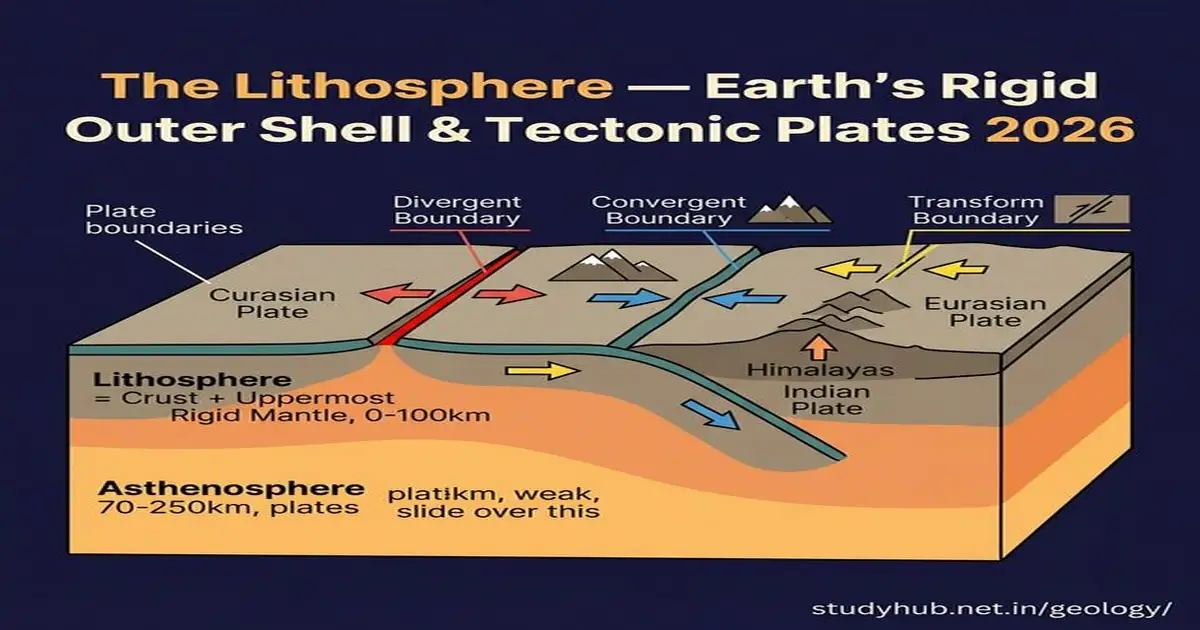
What is the Lithosphere? — Definition, Thickness & Plate Tectonics 2026
Lithosphere vs Asthenosphere vs Crust — Key Distinctions
| Term | Definition Basis | Depth Range | Physical Behaviour | Composition | Exam Key Point |
|---|---|---|---|---|---|
| Crust | Chemical / Compositional boundary (Moho = base) | 0–5 km (oceanic) to 0–70 km (continental mountains) | Rigid solid (part of lithosphere) | SIAL (continental granite) or SIMA (oceanic basalt) | Defined by Moho — compositional change from silicate crust to ultramafic mantle. Thinnest layer but most familiar |
| Lithosphere | Mechanical boundary — rigid vs plastic behaviour. Defined by temperature isotherm (~600–800°C solidus isotherm) | 0–70 km (young oceanic) to 0–200 km (old thick continental cratons). Averages ~100 km | Rigid elastic solid — does not flow on any geological timescale. Breaks (faults/earthquakes) rather than flows when stressed too much | = Crust + uppermost rigid mantle (peridotite, same composition as asthenosphere but cooler and stronger) | Lithosphere includes both crust AND the cool, rigid topmost mantle. The tectonic plates ARE lithospheric slabs. NOT the same as crust alone |
| Asthenosphere | Mechanical boundary — weak zone below rigid lithosphere | ~70–250 km (varies: shallower under ridges/hotspots, deeper under cratons) | Weak, ductile, plastic — flows slowly (solid-state creep, viscosity 10¹⁸–10²¹ Pa·s). Low seismic velocity zone (S waves slow here ~4.1 km/s vs 4.5 km/s in lithosphere) | Peridotite (same as lithospheric mantle) — but close to melting point (1,280–1,400°C), with 1–3% partial melt in some zones beneath mid-ocean ridges | The lubrication layer. Plates SLIDE over the asthenosphere. Without the asthenosphere, plate tectonics would not work. DIFFERENT from lithosphere only in temperature and mechanical strength — same composition |
| Mesosphere (Lower Mantle) | Lower mantle below asthenosphere — more rigid again due to increased pressure | 660–2,900 km | Stronger than asthenosphere (higher pressure increases viscosity) — convects very slowly | Bridgmanite (MgSiO₃ perovskite) + ferropericlase | Sometimes called “mesosphere” in older texts. Not to be confused with the atmospheric mesosphere (50–85 km altitude) |
The Major and Minor Tectonic Plates
| Plate | Type | Area (approx.) | Motion / Rate | India Connection |
|---|---|---|---|---|
| Pacific Plate | Oceanic (largest plate) | ~103 million km² | NW at 7–10 cm/yr (fastest major plate); subducting under North America (Cascadia), Japan, Philippines | 2004 Sumatra earthquake (9.1 Mw) caused by Indian Plate subducting under Burma Plate — analogy to Pacific subduction zones |
| North American Plate | Continental + oceanic | ~76 million km² | WSW at 2.3 cm/yr. San Andreas Fault = transform boundary with Pacific Plate | North American craton (Canadian Shield) = world’s largest exposed Precambrian shield — analogy to Peninsular India (Deccan craton) |
| Eurasian Plate | Continental (mainly) | ~68 million km² | Slowly eastward. Colliding with African Plate (Alps), Arabian Plate (Zagros Mts.), Indian Plate (Himalayas) | Indian Plate collided with Eurasian Plate ~50 Ma → Himalayas still rising 5 mm/yr. India still pushing into Eurasia at 5 cm/yr today |
| African Plate | Continental + oceanic | ~61 million km² | NNE at 2.15 cm/yr. East African Rift = active continent splitting | Africa + India were once joined in Gondwana ~130 Ma; separation created the Indian Ocean. The Carlsberg Ridge separates India and Africa today |
| Antarctic Plate | Continental + oceanic | ~60 million km² | Expanding — surrounded by spreading ridges. East Antarctica = ancient Gondwana craton | India + Antarctica separated ~120–130 Ma. India’s Antarctic stations (Maitri, Bharati) study Antarctic geology |
| Indo-Australian Plate | Continental + oceanic (composite) | ~58 million km² | NE at ~5–6 cm/yr (Indian sector); now believed to be two separate plates — Indian Plate + Australian Plate — dividing along a diffuse boundary in the central Indian Ocean. Initially one plate but gradually deforming and separating | The Indian Plate — birthplace of Gondwana fragment, source of Himalayas, Deccan Traps. Indian Ocean floor is Indian Plate + Australian Plate oceanic crust |
| South American Plate | Continental + oceanic | ~43 million km² | W at 1.5 cm/yr. Nazca Plate subducts under → Andes Mountains + Pacific Ring of Fire | South America + India + Africa + Antarctica + Australia = Gondwana; SA’s east coast “fits” Africa’s west coast (Wegener’s jigsaw evidence). Glossopteris fossils in Gondwana coalfields connect India and S. America |
Types of Plate Boundaries
| Boundary Type | Motion | Features Formed | Examples | India Examples |
|---|---|---|---|---|
| Divergent (Constructive) | Plates move APART — new lithosphere created as magma fills the gap | Mid-ocean ridges (oceanic divergence); Rift valleys (continental divergence — proto-ocean stage); normal faults; basaltic volcanism; shallow earthquakes | Mid-Atlantic Ridge (N. America + Eurasia separating); East African Rift (continent splitting) | Carlsberg Ridge (NW Indian Ocean) = Indian Plate + African Plate diverging at 2.5 cm/yr; Southwest Indian Ridge = separating Indian + Antarctic plates; Andaman Sea back-arc spreading (minor) |
| Convergent (Destructive) | Plates move TOGETHER — one subducts (oceanic) or both crumple (continental-continental) | Oceanic-continental: ocean trench + volcanic arc (Andes type); Oceanic-oceanic: island arc + trench (Japan type); Continental-continental: mountain belt (no subduction, both too buoyant — Himalayan type) | Mariana Trench (Pacific subducting under Philippine); Japan (Pacific under Eurasia); Himalayas (India under Eurasia — no trench, both continental) | Himalayas = Indian continental plate colliding with Eurasian continental plate (50 Ma–present); Andaman Trench = Indian oceanic plate subducting under Burma Plate (Sunda Arc) → Barren Island volcano; 2004 earthquake (9.1 Mw) at rupture on this zone |
| Transform (Conservative) | Plates SLIDE past each other horizontally — no creation or destruction of lithosphere | Strike-slip faults; shallow, frequent large earthquakes (but no volcanoes); offset mid-ocean ridges (fracture zones) | San Andreas Fault (Pacific + North American plates, California); North Anatolian Fault (Turkey). Mid-ocean ridge transform faults (offset segments) | No major transform boundary within Indian territory on land. Owen Fracture Zone (Arabian Sea) = right-lateral transform fault separating Indian and Arabian plates offshore (west of Pakistan/Oman coast) — seismically active |
Lithospheric Thickness — Why It Varies
The lithosphere is not a uniform-thickness shell — it ranges from as thin as 5–10 km at mid-ocean ridge crests (newly formed hot rock, thin lithosphere) to over 200 km beneath the ancient Archean cratons (stable, cold, thick lithospheric “keels”). The key controlling factor is temperature: the lithosphere-asthenosphere boundary (LAB) is approximately the isotherm where mantle rock reaches its solidus temperature (~1,280°C) — below this temperature, mantle rock is rigid (lithosphere); above it, rock is weak (asthenosphere). Since oceanic lithosphere cools as it ages and moves away from mid-ocean ridges, older oceanic lithosphere is both thicker and denser — ultimately becoming dense enough to sink at subduction zones. The depth-age relationship for oceanic lithosphere follows a square root law: depth below sea level ∝ √(age in million years). Young ocean floor near ridges sits at ~2,000 m depth; 100 Ma ocean floor sits at ~5,000 m. Continental lithosphere, being insulated by thick continental crust (poor thermal conductor), retains heat longer and can be thick without being as dense as oceanic lithosphere. The lithospheric keel (root) beneath the Dharwar Craton (South India) extends to ~200 km depth — it has been stable for 3 billion years, acting as a rigid “anchor” that makes Peninsular India geologically quiet compared to the Himalayas.
Frequently Asked Questions
What is the difference between the lithosphere and the crust?
This is one of the most commonly confused pairs of terms in geology — and a question that distinguishes well-prepared UPSC/SSC candidates from those who have only surface knowledge. The confusion arises because the crust and the lithosphere are sometimes used interchangeably in casual speech, but they are fundamentally different concepts defined on different bases. The crust is defined chemically (compositionally): it is the outermost chemical layer of Earth, bounded below by the Mohorovičić Discontinuity (Moho) where rock composition changes from crustal silicates (granite/basalt) to mantle peridotite. Continental crust extends to ~35 km average depth (70 km under Himalayas); oceanic crust to ~7 km average depth. The lithosphere is defined mechanically (rheologically — based on how rock deforms): it is the outermost rigid mechanical layer, defined by the contrast with the weak asthenosphere below. The lithosphere includes the entire crust PLUS the uppermost rigid portion of the mantle (the lithospheric mantle) — typically adding another 30–100 km of rigid mantle below the Moho. Total lithosphere thickness: 70–200 km. So: Lithosphere = Crust + Rigid Uppermost Mantle. The Moho (crust-mantle chemical boundary) lies WITHIN the lithosphere — the boundary between lithosphere and asthenosphere (the LAB — Lithosphere-Asthenosphere Boundary) is BELOW the Moho, deeper in the mantle. Two different boundaries, two different definitions. For exam: Crust = compositional layer (Moho boundary); Lithosphere = mechanical/rheological layer (LAB boundary at ~100 km depth). Crust is inside the lithosphere. The tectonic plates are made of lithosphere (not just crust).
How does the Indian Plate fit into the global lithosphere system?
The Indian Plate (technically part of the larger Indo-Australian Plate, but increasingly treated as a separate entity due to diffuse deformation in the central Indian Ocean) is one of geology’s most dramatic examples of lithospheric plate motion. The Indian Plate consists of: (1) The ancient continental core — Peninsular India (Deccan Plateau, Dharwar Craton, Aravallis, Eastern Ghats) — Precambrian continental lithosphere 600 Ma–3.4 Ga old, with lithospheric keel extending 150–200 km deep; (2) The surrounding oceanic lithosphere — the Indian Ocean floor (Indian Ocean Basin), consisting of Cretaceous–Recent oceanic crust (0–130 Ma), much thinner (7–10 km crust, 50–80 km total lithosphere). The Indian Plate is on a remarkable geological journey: after breaking away from Gondwana (~130 Ma) off eastern Africa, it drifted northward across the former Tethys Ocean at extraordinarily fast speeds — up to 20 cm/yr during 60–50 Ma (the fastest documented plate motion in geological history, possibly driven by the Réunion plume thinning the lithosphere). The Indian oceanic lithosphere of the Tethys Ocean was gradually subducting under Eurasia as India charged northward. When the continental portion of India reached Eurasia (~50 Ma), subduction stopped (continental crust too buoyant) and the Himalayan collision orogeny began. Today, the Indian Plate still moves NNE at ~5 cm/yr — the collision continues, the Himalayas still rise, and the Indian continental lithosphere is being underthrust beneath the Tibetan Plateau (subduction of continental lithosphere — rare), thickening the crust to 70 km under Himalayas and depressing the Moho to record depths. The southern (oceanic) part of the Indian Plate is simultaneously being subducted under the Burma Plate at the Andaman Trench (slab pull), creating the volcanic Andaman Arc (Barren Island active volcano).
Important for Exams — Lithosphere Facts for UPSC, SSC & State PCS
Definition (must know): Lithosphere = Crust + Uppermost Rigid Mantle (defined mechanically, NOT chemically). Lithosphere thickness: 70 km (young oceanic) to 200 km (old cratons). Asthenosphere: below lithosphere, 70–250 km, weak/plastic, plates slide over it. LAB = Lithosphere-Asthenosphere Boundary (≠ Moho).
7 major plates: Pacific (largest, oceanic), North American, Eurasian, African, Antarctic, Indo-Australian (Indian + Australian), South American + minor plates (Arabian, Caribbean, Cocos, Nazca, Philippine, Scotia, Burma).
Plate boundary types and features: Divergent = mid-ocean ridge + rift valley (Carlsberg Ridge, East African Rift); Convergent = trench + volcanic arc OR mountain belt (Himalaya = continental-continental; Andaman = oceanic-continental); Transform = strike-slip fault (San Andreas, Owen Fracture Zone).
India plate facts: Indian Plate velocity: 5 cm/yr NNE. Himalayan collision: 50 Ma. Himalayas still rising: 5 mm/yr. Deccan Plateau = ancient stable craton = lithospheric keel 150–200 km. Andaman Trench = Indian oceanic slab subducting under Burma Plate. Carlsberg Ridge = Indian-African divergence = 2.5 cm/yr.
World’s fastest plate: Pacific plate at 7–10 cm/yr. Historical fastest: Indian Plate at ~20 cm/yr during 60–50 Ma.
What to Read Next
- Earth’s Mantle — Asthenosphere, Convection Currents & Mantle Plumes 2026
- Continental vs Oceanic Crust — SIAL vs SIMA, Thickness, Density & Age 2026
- Asthenosphere — The Weak Layer Below the Lithosphere That Drives Plate Tectonics 2026
- What is Plate Tectonics? — Continental Drift, Evidence & Himalayan Formation 2026
- Types of Plate Boundaries — Divergent, Convergent & Transform Explained 2026
🎔 Exam Quick Reference — Lithosphere: Lithosphere = Crust + Rigid Uppermost Mantle (mechanical definition, NOT chemical). 70-200km thick. Asthenosphere (70-250km) = weak zone plates slide over. 7 major plates: Pacific (largest), North American, Eurasian, African, Antarctic, Indo-Australian, South American. Boundary types: Divergent (ridge/rift), Convergent (trench/arc/mountain), Transform (fault). Indian Plate: 5 cm/yr NNE, Himalayan collision 50 Ma. Carlsberg Ridge (Indian-African, 2.5 cm/yr). Andaman Trench = Indian oceanic slab subducting under Burma Plate. Barren Island = active volcano above subducting slab.
🌍 India Lithosphere Connection: Peninsular India = ancient stable lithosphere (Dharwar Craton keel: 150-200km deep, 3.4 Ga). Himalayan zone = active collision = thickest continental lithosphere on Earth (Moho at 70km). Indo-Gangetic Plain = subsiding foreland basin under Himalayan load. Andaman-Nicobar = convergent boundary (oceanic Indian Plate + Burma Plate) = most seismically active region of India (Zone V). Owen Fracture Zone (Arabian Sea) = transform boundary = right-lateral strike-slip. Carlsberg Ridge (NW Indian Ocean) = active seafloor spreading = new oceanic lithosphere creating = Indian and African plates diverging 2.5 cm/yr.
About This Guide: Written by the StudyHub Geology Editorial Team (studyhub.net.in/geology/) based on NCERT Class 11 Physical Geography Chapter 4 (Distribution of Oceans and Continents), Tarbuck & Lutgens “Essentials of Geology” (13th Ed.), DeMets et al. NUVEL-1A plate motion model, and GSI reports on Indian Plate tectonics. Last updated: March 2026.