
India is the only country on Earth that is home to both the lion and the tiger, and one of the few nations where populations of the world’s largest land animals — elephants and rhinoceroses — have actually increased over the past decades despite massive human population pressure. With over 1.4 billion people sharing space with extraordinary megafauna, India’s wildlife conservation story is one of humanity’s most remarkable ecological achievements — and its most urgent ongoing challenges. India has 106 National Parks, 566 Wildlife Sanctuaries, 97 Conservation Reserves, 4 Community Reserves, and 18 Biosphere Reserves, covering approximately 5.03% of India’s geographical area within the formal protected area network. The flagship conservation programmes — Project Tiger (1973) and Project Elephant (1992) — have become global models for large mammal conservation. Yet critical species like the Great Indian Bustard, Ganges River Dolphin, and Indian Vulture face extinction-level crises demanding emergency intervention. This complete guide covers India’s protected area network, flagship conservation projects, major national parks, and critically endangered species — essential for UPSC, SSC, and all competitive examinations.
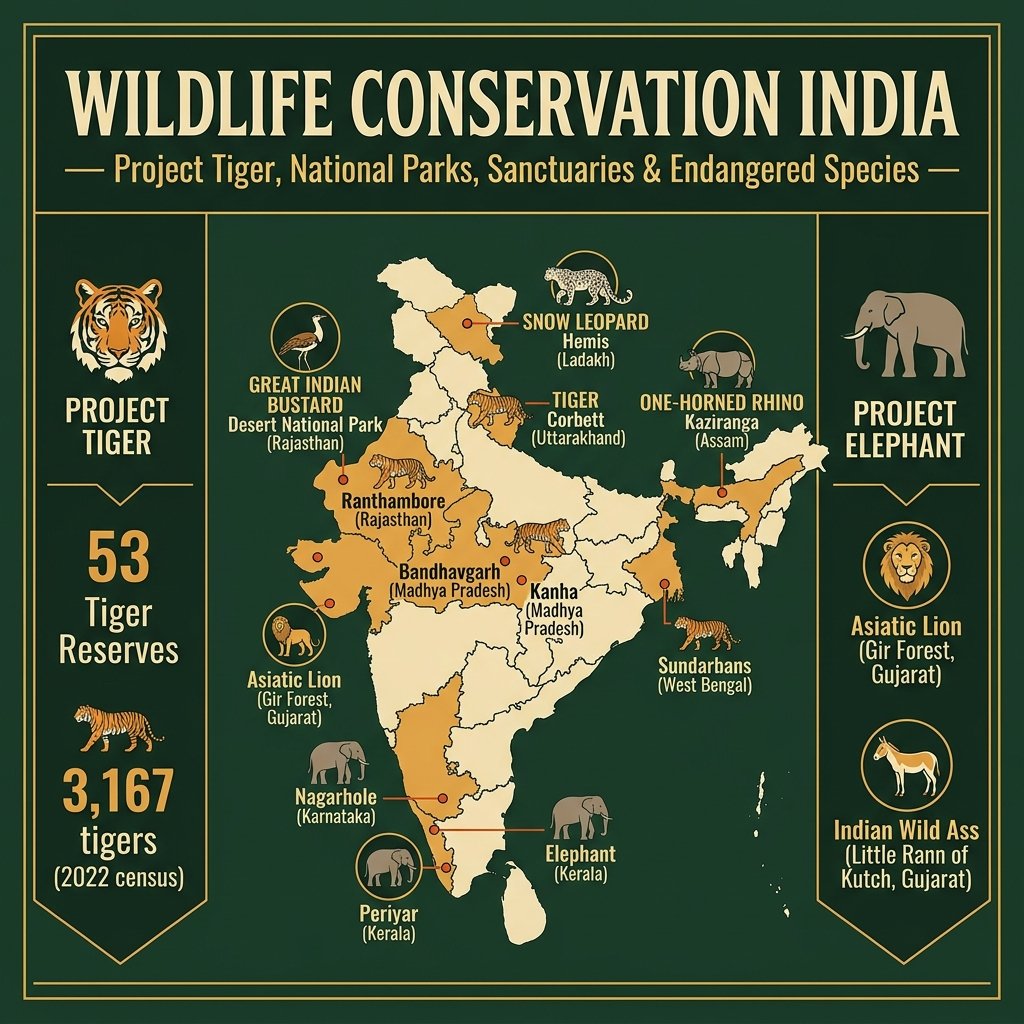
India’s Protected Area Network
| Category | Number | Legal Basis | Key Difference |
|---|---|---|---|
| National Parks | 106 | Wildlife Protection Act 1972 (WPA), Section 35 | Highest protection; no human habitation; no grazing; no forestry; no private land inside; even entry requires permit; boundaries fixed by legislation |
| Wildlife Sanctuaries | 566 | WPA 1972, Section 26A | High protection for wildlife; but some human activities permitted (forestry outside core, grazing, settlement rights may exist); private land can be inside; boundaries by government order |
| Tiger Reserves | 53 | WPA 1972, Section 38V; designated under Project Tiger | Two-zone: Core (National Park level protection) + Buffer (sustainable use); managed by National Tiger Conservation Authority (NTCA); most stringent tiger-specific management |
| Biosphere Reserves | 18 (India); UNESCO recognises 12 | UNESCO Man and Biosphere (MAB) Programme + MoEFCC designation | Three zones: Core (strictly protected) + Buffer (research, eco-tourism) + Transition (human settlement, agriculture); focus on conservation AND sustainable development |
| Conservation Reserves | 97 | WPA 1972, Section 36A (amendment 2002) | Community-managed; on government land; local communities have key role in management; newer, more flexible category |
| Ramsar Wetlands | 82 (2024) | Ramsar Convention on Wetlands (1971); India signatory since 1982 | International designation for globally important wetlands; India has most Ramsar sites in Asia; includes Chilika, Keoladeo (Bharatpur), Wular Lake, Loktak, Sambhar |
Project Tiger — India’s Greatest Conservation Success
- 🐯 Launch: April 1, 1973, by Prime Minister Indira Gandhi; initiated under the chairmanship of Kailash Sankhala (“Tiger Man of India”); launched from Jim Corbett National Park, Uttarakhand — India’s first national park (est. 1936)
- 📉 Background crisis: Tiger population crashed from ~40,000 (early 20th century) to just 1,827 tigers (1972 census) — 95% decline in 70 years; causes: hunting by colonial rulers and royalty (maharajas), habitat loss (forest clearance for agriculture), prey depletion, poaching for bones and skin (traditional Chinese medicine)
- 🔧 Key measures: 9 initial tiger reserves designated (now 53); ban on tiger hunting; anti-poaching measures; habitat restoration; village relocation from core zones (controversial); camera trap monitoring
- 📈 Results: Perhaps the world’s greatest large mammal conservation recovery:
- 1973: 1,827 tigers
- 2006: 1,411 tigers (census improved — radio-collar + camera trap methodology)
- 2010: 1,706 tigers
- 2014: 2,226 tigers
- 2018: 2,967 tigers
- 2022: 3,167 tigers = 75% of world’s wild tigers in India
- 🏛️ National Tiger Conservation Authority (NTCA): Statutory body under WPA 1972; regulates and monitors all 53 tiger reserves; coordinates with state governments; approves core-buffer zone plans; receives Project Tiger funds from central government
Major Tiger Reserves of India
| Tiger Reserve | State | Area (km²) | Notable Features |
|---|---|---|---|
| Jim Corbett | Uttarakhand | 1,318 | India’s oldest national park (1936); first Project Tiger reserve (1973); sal forests + Ramganga river; excellent tiger + elephant sightings; named after Jim Corbett (hunter-turned-conservationist who killed many man-eaters) |
| Ranthambore | Rajasthan | 1,334 | Tigers in ruined Mughal forts + semi-arid landscape; most photographed tigers in India; Machli (famous tiger, lived 20 years, featured in BBC/NatGeo); UNESCO World Heritage (core zone) |
| Kanha | Madhya Pradesh | 2,052 | Inspired Kipling’s Jungle Book; moist deciduous sal + bamboo; highest density of barasingha (swamp deer) = Kanha’s symbol; significant tiger + leopard + wild dog (dhole) population |
| Bandhavgarh | Madhya Pradesh | 1,537 | Historically highest tiger density in India; White Tigers origin (extinct in wild now; last wild white tiger caught here 1951 = Mohan, became ancestor of all captive white tigers); 105+ tigers |
| Sundarbans | West Bengal | 2,585 | World’s only mangrove tiger habitat; swimming tigers; UNESCO WHS; 96 tigers (2020); saltwater crocodile, Irrawaddy dolphin; man-eating tiger incidents |
| Kaziranga | Assam | 1,030 (core) | UNESCO WHS; world’s highest density of one-horned rhinos (2,613 rhinos, 2022); also highest density of tigers in India per area; annual flood adaptation by wildlife |
| Periyar | Kerala | 925 | Periyar Lake (artificial reservoir) at centre; boat safaris; elephants, tigers, gaur (Indian bison); Western Ghats biodiversity; earliest ECO-DEVELOPMENT initiative in India |
| Nagarhole / Rajiv Gandhi NP | Karnataka | 848 | Part of Nilgiri Biosphere Reserve; contiguous with Bandipur, Mudumalai, Wayanad; large elephant and tiger populations; Kabini reservoir safari |
| Sariska | Rajasthan | 1,213 | Infamous for total tiger loss (all 26 tigers killed by poachers by 2004 — major crisis exposing NTCA failure); restocked by translocation from Ranthambore (2008–2012); now recovering |
Project Elephant & Other Conservation Programmes
- 🐘 Project Elephant (1992): Launched to protect elephant corridors, mitigate human-elephant conflict, and improve captive elephant welfare; India has ~29,964 wild elephants (2023) = ~60% of Asian elephant population; 33 Elephant Reserves across 16 states; major challenge: HEC (Human-Elephant Conflict) kills ~400 people and ~100 elephants annually in Assam, WB, Odisha, Jharkhand, and Kerala
- 🦁 Asiatic Lion Conservation: Last Asiatic lions in world exist ONLY in Gir Forest National Park & Wildlife Sanctuary (Saurashtra, Gujarat); population: 674 lions (2020 census) = up from just 177 (1968) = remarkable recovery; entirely confined to 1,412 km² area = risk of epidemic; debate over second home (Kuno National Park, MP) for safety; Kuno prepared for lions but Supreme Court order partially implemented
- 🦏 Indian One-Horned Rhinoceros: Kaziranga NP (Assam) = primary stronghold (2,613 of India’s ~3,700 rhinos); Pobitora WS (Assam) = world’s highest rhino density; Manas NP (Assam), Dudhwa NP (UP), Jaldapara NP (WB); poaching for horn (worth more than gold on black market — used in traditional Vietnamese + Chinese medicine); India + Nepal = 80% of world’s remaining one-horned rhinos; IUCN Vulnerable
- 🐊 Crocodile Conservation Project (1975): Three species: Mugger (Crocodylus palustris) — freshwater rivers; Saltwater Crocodile (Crocodylus porosus) — Sundarbans, Bhitarkanika, Andaman (world’s largest reptile); Gharial (Gavialis gangeticus) — Critically Endangered; Chambal River (MP-UP-Rajasthan) = primary remaining habitat; Gharial’s long snout specialized for fish; down to ~650 individuals; captive breeding at Kukrail Gharial Centre (Lucknow)
- 🐬 Ganges River Dolphin (Susu): India’s National Aquatic Animal; found only in Ganga-Brahmaputra-Meghna-Karnaphuli river systems; IUCN Endangered; functionally blind (uses echolocation); indicator species of river health; population ~4,000; threats: sand mining, fishing net entanglement, river pollution, dam construction, low water flows
Critically Endangered Species in India
| Species | Population | Primary Habitat | Main Threats | Conservation Status |
|---|---|---|---|---|
| Great Indian Bustard (GIB) | ~150 | Grasslands of Rajasthan (Desert NP), Gujarat, Maharashtra (Solapur), AP | Power line collisions (primary!); habitat loss to solar/wind farms; agriculture; free-ranging dogs and cats; predation by foxes | IUCN Critically Endangered; Supreme Court ordered power lines underground (2021 order — being contested by power companies); captive breeding started (Jaisalmer centre) |
| Indian Vultures (3 species) | Down >97% since 1990s | Across India; primarily South Asian rivers and pasturelands | Diclofenac (anti-inflammatory drug given to cattle; vultures eat dead cattle; kidney failure within days); Meloxicam (safe alternative) now legally mandated but diclofenac still used illegally | All 3 species (White-rumped, Slender-billed, Long-billed) IUCN Critically Endangered; Vulture Restaurants (safe feeding stations) and Vulture Safe Zones established; South Asia Vulture Recovery Plan |
| Snow Leopard | ~450–700 India | High Himalaya: Ladakh, HP, Uttarakhand, Sikkim, Arunachal | Prey depletion (blue sheep, ibex); retaliatory killing (attacks livestock); climate change (alpine habitat shrinking); poaching for fur + bones for TCM | IUCN Vulnerable; India’s Snow Leopard Population Assessment (2022, first systematic survey): estimated 718 in India; Project Snow Leopard (2009); Hemis NP (Ladakh) = world’s largest protected snow leopard habitat |
| Gangetic Gharial | ~650 | Chambal River (MP-UP-Rajasthan); Girwa River | Sand mining destroys nesting sites; fishing net entanglement; low water levels from dams; historical hide + fat use; river development | IUCN Critically Endangered; Chambal Gharial Sanctuary; captive breeding programme; National Chambal Sanctuary = only remaining stronghold |
| Sangai Deer (Brow-antlered Deer) | ~260 | Floating vegetation mats (Phumdis) in Loktak Lake, Manipur | Phumdi destruction; Ithai Barrage (changed water levels); hunting; Keibul Lamjao NP (world’s only floating national park) = sole habitat | IUCN Endangered; Manipur State Animal; Keibul Lamjao NP established 1977; population stabilized but remains critically vulnerable to any water level change |
Key Conservation Legislation
| Legislation / Policy | Year | Key Provisions |
|---|---|---|
| Wildlife Protection Act (WPA) | 1972 (amended 2006, 2022) | Schedules I–VI listing species by protection level; establishes National Parks, Sanctuaries, Tiger Reserves; bans hunting of Schedule I species; NTCA; Wildlife Crime Control Bureau (WCCB) |
| Forest Conservation Act | 1980 (amended 2023) | Central approval required for diverting forest land to non-forest use; controversially amended in 2023 to exclude land within 100km of international borders from its purview (strategic reason but ecological concern) |
| Environment Protection Act | 1986 | Umbrella legislation post-Bhopal gas tragedy; establishes MoEFCC powers; basis for Eco-Sensitive Zones, Coastal Regulation Zone, EIA notifications |
| Biological Diversity Act | 2002 | Implements India’s obligations under CBD (Convention on Biological Diversity); National Biodiversity Authority (NBA); State Biodiversity Boards; People’s Biodiversity Registers (PBR) at Gram Panchayat level; Access and Benefit Sharing (ABS) from bio-resources |
| Forest Rights Act (FRA) | 2006 | Recognises and vests forest rights in Scheduled Tribes and Other Traditional Forest Dwellers; community forest rights; key tension with conservation: WPA vs FRA has led to legal conflicts over tiger reserve land |
| National Wildlife Action Plan | 2017–2031 | Current policy framework; focus: wildlife corridors, human-wildlife conflict mitigation, wetland conservation, marine biodiversity, climate change adaptation |
⭐ Important for Exams — Quick Revision
- 🔑 Project Tiger (1973): Launched by Indira Gandhi; 9 reserves initially; now 53; from 1,827 tigers (1972) to 3,167 (2022) = 75% of world’s wild tigers in India
- 🔑 Jim Corbett NP: India’s oldest NP (1936); first Project Tiger reserve (1973); Uttarakhand
- 🔑 Bandhavgarh: Historical highest tiger density; origin of White Tiger (Mohan, 1951); MP
- 🔑 Ranthambore: Tigers in Mughal forts; most photographed; Machli (20-year tiger); Rajasthan
- 🔑 Sariska scandal (2004–05): All 26 tigers poached; exposed monitoring failure; restocked from Ranthambore from 2008
- 🔑 Kaziranga: UNESCO WHS; 2,613 rhinos (2022) = world’s largest one-horned rhino population; Assam; also highest tiger density per area
- 🔑 Asiatic Lion: ONLY in Gir Forest, Gujarat; 674 lions (2020); second home proposed at Kuno NP (MP); SC order to shift some lions partially implemented
- 🔑 Project Elephant (1992): 29,964 wild elephants; 33 Elephant Reserves; 16 states; HEC kills ~400 people + ~100 elephants annually
- 🔑 Ganges River Dolphin = National Aquatic Animal; functionally blind; IUCN Endangered; Ganga-Brahmaputra system
- 🔑 Gharial = Critically Endangered; long thin snout (fish-eater); Chambal River = last stronghold; ~650 remaining
- 🔑 Great Indian Bustard: ~150 remaining; power line collisions = primary threat; Desert NP Rajasthan; IUCN Critically Endangered; SC 2021 order to underground power lines
- 🔑 Vulture crisis: Diclofenac (cattle drug) kills vultures through kidney failure; Critically Endangered; Vulture Safe Zones; Meloxicam = safe alternative
- 🔑 Sangai Deer: Lives on floating Phumdi mats in Loktak Lake (Manipur); world’s only floating National Park (Keibul Lamjao); ~260 remaining; Manipur State Animal
- 🔑 Snow Leopard: ~718 in India (2022 first systematic survey); Hemis NP (Ladakh) = world’s largest protected habitat; IUCN Vulnerable; Project Snow Leopard (2009)
- 🔑 India’s Ramsar Sites = 82 (2024) = most in Asia; includes Chilika Lake (Odisha = largest coastal lagoon), Keoladeo (Rajasthan = winter home for Siberian Crane), Loktak (Manipur)
- 🔑 Wildlife Protection Act 1972: Core legislation; Schedule I = highest protection (tiger, lion, elephant, rhino); amended 2006 (NTCA established), 2022 (CITIES compliance)
- 🔑 Forest Rights Act 2006: Protects Adivasi land rights inside forests; major tension with WPA for tiger reserves
Frequently Asked Questions (FAQs)
1. How did diclofenac almost erase India’s entire vulture population — and why does it matter?
The Indian Vulture Crisis is one of conservation biology’s most dramatic and instructive stories — the near-total collapse of a bird population across an entire subcontinent in under a decade, caused by a single pharmaceutical drug. In the 1980s, India had an estimated 40–80 million vultures across three Gyps species (White-rumped Vulture Gyps bengalensis, Slender-billed Vulture G. tenuirostris, Long-billed Vulture G. indicus). By 2007, populations had crashed by 97–99.9% — the fastest decline of any bird species in recorded history. Scientists spent years searching for the cause — initially suspecting a disease. The answer, finally identified in 2004 by ornithologist Lindsay Oaks and colleagues, was devastating in its simplicity: Diclofenac — a common NSAID (anti-inflammatory painkiller) given to cattle — was the culprit. Vultures feeding on carcasses of recently treated cattle ingested residual diclofenac and developed acute visceral gout (uric acid crystal deposits in kidneys) causing kidney failure within 24–48 hours. Even a tiny amount (1/500th of a therapeutic cattle dose) was lethal to vultures. The ecological consequences were severe: vultures are nature’s most efficient carcass disposal system; they strip a large animal carcass in under an hour (faster and more completely than any other scavenger), and their extremely acidic stomach destroys anthrax, rabies, cholera, and other dangerous pathogens that would otherwise persist in rotting meat. With vultures gone: (1) feral dog populations exploded (dogs ate carcasses instead); India now has ~30 million feral dogs — the world’s highest — carrying rabies (India accounts for 36% of global rabies deaths); (2) golden jackals and rats (also disease vectors) increased; (3) rotting carcasses contaminated water sources. The estimated cost of the vulture collapse to India’s health system (through increased rabies deaths and disease treatment) between 2000–2012 was calculated at $34 billion by researchers. Diclofenac for veterinary use was banned in India in 2006, and Meloxicam — equally effective for cattle but safe for vultures — designated as the alternative. Yet illegal veterinary diclofenac use persists, and populations remain critically low. Recovery will take decades, given vultures’ very slow reproduction (one egg per year; sexual maturity at 5 years).
2. Why are there no tigers anywhere outside India — and how did India save 75% of the world’s last wild tigers?
This question requires understanding both the collapse of tigers globally and India’s specific conservation architecture. At the start of the 20th century, approximately 100,000 tigers roamed across Asia — from Turkey’s Caspian coast to China, from the Russian Far East to Bali. Today, fewer than 4,500 tigers remain globally across only 13 countries. Three subspecies went extinct in the 20th century (Caspian Tiger, Javan Tiger, Bali Tiger). Tigers disappeared from Turkey, Iran, Afghanistan, most of China, Vietnam, Laos, Cambodia — countries that had significant populations just 50–80 years ago. The drivers: habitat destruction (deforestation for agriculture and timber), prey depletion (deer and boar hunted for food), and poaching for traditional Chinese medicine (tiger bone wine, tiger-bone glue, tiger skin). A single tiger skeleton can fetch $50,000–70,000 on black markets; a tiger skin $10,000–20,000. Why India succeeded while other countries failed involves several factors: (1) Political will at the highest level: Indira Gandhi personally championed Project Tiger (1973) and the Wildlife Protection Act (1972); she was an avid naturalist who understood ecological relationships. This top-level political commitment funded the initial reserve creation and enforcement infrastructure. (2) Network of inviolate core areas: India’s 53 tiger reserves have legally protected core zones where no human activity is permitted — critical because tigers as apex predators require very large undisturbed territories (male: 50–100 km² or more); most other Asian countries could not clear human populations from large enough areas. (3) Prey recovery: Protecting forests meant recovering prey populations — chital, sambar, wild boar; Indian reserves now have thriving prey bases supporting high tiger densities (Bandhavgarh: ~15 tigers per 100 km²; global average for tiger habitat: ~1–3 per 100 km²). (4) Anti-poaching infrastructure: NTCA-trained Special Tiger Protection Force, camera trap networks (India has the world’s most extensive wildlife camera trap network), DNA databases, M-STrIPES app for patrolling. (5) International support: WWF, WCS, and other INGOs consistently channelled resources to India’s tiger reserves — Global Tiger Forum (India chairs). The result: India’s 2022 tiger census (3,167) made India home to more than 75% of all wild tigers on Earth.
3. What is the human-wildlife conflict crisis in India — and can coexistence be sustained?
Human-wildlife conflict (HWC) is India’s most urgent and politically sensitive conservation challenge. As tiger, elephant, leopard, and wild boar populations recover due to conservation success, and as human agricultural and settlement boundaries push deeper into forest margins, direct conflicts are becoming more frequent and more deadly. Key conflict types: (1) Human-Elephant Conflict (HEC): Deadliest large mammal conflict in India. Approximately 400 people killed by elephants per year (more than by any other wildlife); ~100 elephants killed per year in retaliation or road/railway accidents. Elephant corridors — traditional migration routes used for centuries — are now bisected by roads, railway lines, and settlements in Assam, WB, Odisha, Jharkhand, and Kerala. When corridors are blocked, elephants raid crops (rice, sugarcane, maize) and sometimes enter villages. A herd of 30 elephants raiding a small farmer’s annual crop in one night can erase that family’s entire year of income. Frustrated communities retaliate with electric fences (illegal but common), poison, and firecrackers. Railways kill ~100 elephants per year (Assam + WB = worst). Solutions attempted: elephant-proof trenches, chili fences (elephants dislike capsaicin), beehive fences, early warning SMS systems, and ex-gratia compensation (inadequate). (2) Human-Tiger/Leopard Conflict: While tiger kill only ~50–100 people annually in India (predominantly in Sundarbans), leopards account for many more — leopards are highly adaptable to human landscapes, live in agricultural areas, and occasionally take children. Conflict peaks when natural prey declines. (3) Wild Boar/Crop Destruction: Wild boar are Schedule III species (not fully protected) and numbers have risen significantly; major crop raider in UP, Bihar, Jharkhand, Uttarakhand; farmers demand hunting rights. Can coexistence be sustained? Evidence suggests yes — but requires systemic investment: adequate and timely compensation for livestock and crop losses (current NSS-based compensation is slow and inadequate); GPS-based real-time elephant tracking for community SMS alerts; forest corridor maintenance through land-use zoning; depredation insurance products for farmers; revenue from eco-tourism directed to frontier communities to create financial incentives for tolerating wildlife. The fundamental challenge is that the costs of sharing space with wildlife (crop loss, injury, death) fall disproportionately on India’s poorest rural communities while the benefits (biodiversity, ecosystem services, tourism revenue) flow to urban society and international stakeholders. Sustainable coexistence requires redistributing those benefits.
Related Geology Articles on StudyHub
- ➡️ Natural Vegetation — Habitats of India’s Wildlife
- ➡️ Natural Disasters — Floods Affecting Wildlife Corridors
- ➡️ Water Resources — Rivers as Wildlife Corridors
- ➡️ Climate Change — Threat to India’s Wildlife Habitats
- ➡️ Physiographic Divisions — Chota Nagpur & Forest Ecosystems